Archives for category: Charter Schools

The Washington Post reports from a town in the Louisiana Delta.

VACHERIE, La. — At the new public charter school in this Mississippi River town, nearly all the students are African American. Parents seem unconcerned about that. They just hope their children will get a better education.

“I wanted my girls to soar higher,” said Alfreda Cooper, who is black and has two daughters at Greater Grace Charter Academy.

Three hours up the road, students at Delta Charter School in Concordia Parish are overwhelmingly white, even though the surrounding community is far more mixed.

As the charter school movement accelerates across the country, a critical question remains unanswered: whether the creation of charters is accelerating school segregation. Federal judges who oversee desegregation plans in Louisiana are wrestling with that issue at a time when President Trump wants to spend billions of dollars on charter schools, vouchers and other “school choice” initiatives.

In February, a judge found that Delta Charter had violated the terms of the parish’s court-ordered desegregation plan and asked the parties to submit proposals for how to move forward. The local school board in Concordia not only is seeking reimbursement of millions of dollars, but also wants the judge to require the charter school to cancel its enrollment and start over with the aim of creating a more diverse student body. That would include offering transportation to the school — something that could make it possible for more black students to attend.

The nation’s schools have become more segregated by race and class over the past two decades, according to federal data, and some research indicates that charter schools are more likely to be segregated than traditional public schools. Some charter advocates say they are more interested in creating good schools for marginalized children as quickly as possible — no matter the consequences for the racial makeup of enrollment.

Choice gives Southern whites the opportunity to restore racial segregation without saying so openly.

The great retreat from the goal of desegregation is underway, rolling back advances wherever they occurred, and charter operators are more than willing to lure students who are all black or all white. Charters are the new segregation academies.

As an aside, the article cites Urban Prep Academy as a charter in Chicago where 100% of students graduate and enroll in college. This is a myth that was exploded by Gary Rubinstein years ago. Urban Prep has high attrition and its students have lower test scores than students in Chicago’s public schools.

I wrote this article for The New Republic.

https://newrepublic.com/article/142364/dont-like-betsy-devos-blame-democrats

It explains how Democrats set the stage for DeVos’ anything-goes approach to school choice by their advocacy of charter schools. Charters are the gateway to vouchers. We have seen many groups like Democrats for Education Reform try to draw a sharp distinction between charters and vouchers. It doesn’t work. Once you begin defaming public schools and demanding choice, you abandon the central argument for public schools: they belong to the public.

The political side to this issue is that the Democratic Party sold out a significant part of its base–teachers, teachers unions, and minorities–by joining the same side as ALEC, the Walton family, and rightwing conservatives who never approved of public schools.

Their pursuit of Wall Street money in exchange for supporting charters helped to disintegrate their base. To build a viable coalition for the future, the Party must walk away from its flirtation with privatization and support the strengthening and improvement of our public schools.

Please share this article widely.

One of the most heartening developments in recent years is the awakening of major newspapers in Ohio to the massive scandals surrounding their state’s charter industry. These scandals have come about because of the money nexus that connects charter operators and politicians. Charters in Ohio have a dismal academic record, and also a dismal financial record. This happens because the laws were written by charter lobbyists and protect the operators from full financial disclosure.

The Columbus Dispatch has had enough. In this editorial, it calls for legislation to compel charters to open their books for public inspection. Where public money goes, public accountability must follow.

No function of state government is more important than its constitutional obligation to “secure a thorough and efficient system of common schools throughout the state.” Education is the bedrock of democracy. That is why the Ohio Constitution, since 1851, has obligated the state to provide an education to each of its citizens.

How thoroughly and how efficiently the state fulfills this mandate should concern every Ohioan, every year, every generation.

But Ohioans’ ability to judge the state’s performance is threatened by state lawmakers’ willingness to hide from public view how the charter-school industry spends a sizable portion of taxpayer dollars.

In an era of privatization of much of primary and secondary education, taxpayers should insist that state lawmakers provide complete transparency of the expenditure of public funds for education.

State Rep. David J. Leland, D-Columbus, has introduced legislation to accomplish this goal. In fewer than 100 words, the bill declares “funds that the department of education pays to a community (charter) school or nonpublic school . . . are public funds and shall be subject to the same requirements related to permissible expenditures and audit by the auditor of state as public funds allocated to school districts.

“If a community school uses public funds to pay for services of an entity to manage the daily operations of that school or to provide programmatic oversight and support of that school, those funds maintain their status as public funds upon transfer.”

In recent years, Ohio earned an unwelcome reputation for having the nation’s worst oversight of the charter-school industry. No surprise, then, that Ohio has had some of the nation’s worst-performing charter schools.

The editorial goes on to detail the changes that are needed.

What this represents is a welcome recognition by the major media that charter schools cannot continue to operate as private schools with public money. A recent court decision in Ohio ruled, in accordance with the charter-friendly law, that anything purchased by the charter with public funds belongs to the charter operator, not the public. If the law is rewritten, that giveaway of public money must be ended.

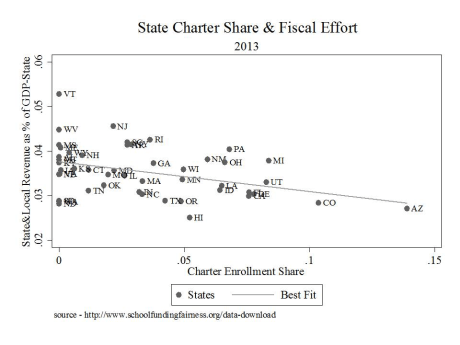
Bruce Baker at Rutgers University created a valuable graph that shows the relationship between every states’ number of charter schools and its fiscal effort.

Some states appear to think that opening charters relieves them of their responsibility to fund public schools. They choose to “reform” by handing schools off to private entrepreneurs, thus relieving the state of the duty to provide adequate and equitable funding.

Image-1

Politico’s Morning Edition posted this description of 50CAN, the pro-privatization organization that was started by hedge fund managers and big pharma in Connecticut:

FIRST IN MORNING EDUCATION: 50CAN’S GROWTH PLAN: The national education reform advocacy group, 50CAN, hopes to hire 1,000 new advocates by the year 2023. That’s a key part of the organization’s new growth plan, the first of its kind since 50CAN launched in 2011. The organization hopes those advocates will lead at least 250 policy campaigns across every single state to push on goals like more charter schools and holding schools and teachers accountable. At least two thirds of those policy pushes “will be at the neighborhood or regional level,” the plan says. 50CAN now cites 64 policy “wins” across 13 states, including a push for an A-F school grading system in Tennessee and a “more equitable public charter school funding in New Jersey.” To ensure future policy victories, 50CAN says that by 2023, its entire network of advocates “will be connected together through a best-in-class technology platform where they can plan campaigns, execute strategies and tactics, track and analyze campaign data in real time and gain key insights into how to increase their odds of success.”

50CAN will be pushing the DeVos-Jeb Bush agenda in every state. Charters and A-F ratings, which set up public schools for takeover to charter chains.

Education Week is a paradox. On one hand, it has many excellent reporters who check facts and write lucidly without partisanship. On the other, the corporate entity has become a selling platform for technology and charter schools.

I used to blog regularly at EdWeek, in a column called “Bridging Differences,” with Deborah Meier. No one ever changed what I wrote. I know that editorial independence is central to a journal’s integrity.

But since I departed (and even before), Education Week needed advertising from the industry on which it was reporting, and it began to turn into a platform for the industry. EdWeek also receives funding from the Gates Foundation and the Walton Foundation, each of which has its own agenda.

And so I regularly open my email box to find advertisements from EdWeek for tech products, webinars, seminars, panels, events, etc.

The latest was a solicitation for a webinar about “Mastering the Charter School Market.” Part of the pitch was that charters would capture 20-40% of the “market” by 2035.

Where did they get that figure? I thought about it. Then I discovered the source: The projection was made by Bellwether Partners, a consulting firm founded by reformer Andrew Rotherham, a leader in the charter school movement who represents charter corporations and advocates. This 2015 report (slide 60) says that the charter schools will have 22-38% of the “market” by 2035. That assumes that the numerous scandals associated with deregulation and the resistance of parents and educators to privatization have not slowed the movement long before then.

I am posting this after the event, because this is not an advertisement but rather a post expressing my concern about Edweek’s descent into marketing for the edBiz, whether it is technology or charters.

The registration form can be found here.

Screen Shot 2017-05-16 at 7.14.34 AMScreen Shot 2017-05-16 at 7.14.54 AM

Carol Burris, executive director of the Network for Public Education, has written a brilliant critique of the rankings of America’s high schools. She looks specifically at Jay Mathews’ list of “America’s Most Challenging High Schools,” but her critique applies equally to U.S. News & World Report’s ranking of “America’s Best High Schools.”

As she points out, charter advocates jumped for joy when they learned that the lists were dominated by charter schools, and they urged the nation to learn from the success of these schools.

Burris points out that the highest ranking school on Jay Mathews list is BASIS Phoenix (the U.S. News & World Report had BASIS charters as numbers 1, 2, and 3 on its lists, albeit not the one in Phoenix). And consider what the lessons might be:

The BASIS Phoenix graduating class of 2016 had 24 students — fewer than the average New York City kindergarten class. It began four years earlier with 43 ninth-graders. The drop from 43 to 24 represents an attrition rate of 44 percent. Jay’s list says that the school’s enrollment is 757 students, but that is deceiving because BASIS Phoenix is both a middle and high school. The entire high school population (which is what the list is about) in 2016 was only 199[3].

BASIS Phoenix does not have a free or reduced-price lunch program, and it does not provide transportation. It asks its parents for a $1,500 donation per child each year, along with hefty fees to participate in sports and extracurricular activities. In 2016, the school had so few students with disabilities, the state could not list the number without violating privacy — not even to give a total for the entire school. Thirty-three percent of its students were Asian American and 57 percent were white. In Maricopa County, Arizona, where the school is located, 3 percent of the students are Asian American, and 41 percent are white. The majority of Maricopa County students are Latino, and 47 percent receive free or reduced-priced lunch.

Burris points out that Jay Mathews uses the senior class as the denominator, not those who started in the high school, and this rewards high attrition rates:

Because Jay’s formula uses the senior class enrollment as the denominator to create the Challenge Index, schools with high attrition rates that give AP exams to underclassmen are rewarded. This results in BASIS Phoenix’s absurdly high Challenge Index of 26.250. If you used the original number of students who entered the high school as the denominator, the Index would drop to 14.65. Losing kids who can’t keep up has it rewards.

The number 2 school on Jay’s list had 11 graduates, out of 17 that started. One of the best high schools in America?

Jay gives credit to schools where students take AP classes, whether or not they pass them. Some of the schools on the list offer incredible numbers of AP classes. His list has encouraged this practice.

Burris writes:

What, then, are the lessons public schools should learn from the “top schools?”

Should our neighborhood schools follow the lead of the top charters and cater to the strivers and the gifted so those who cannot complete 11 AP courses, or pass an AP course, are forced to move out?

Should ranking lists call high schools “the best” when their program keeps teenagers with Down syndrome and serious learning disabilities out, or when they shed 10 percent or more of their students who cannot keep pace? Should we then have “default” public high schools where the students who can’t keep up are segregated from more academically able peers? If we continue down the path of unfettered choice with vouchers and boutique charters, that will surely be the outcome.

If, however, we believe that the good school equitably serves all children, there must be a balance between reasonable challenge and inclusivity. Asking all students, with the exception of students with the most challenging disabilities, to take an IB or AP course or two before graduation is an idea I support.

However, when we establish schools that create exclusivity by design, or by their unreasonably difficult graduation requirements, we are not furthering equity. And that results in lists more appropriate for Ripley’s Believe it or Not, than “best schools” lists.

In the current atmosphere, the one created by NCLB and Race to the Top, schools are congratulated when their scores and graduation rates are high even though their attrition rates are also high. Is the best high school the ones that set standards so high that a large number of students are pushed out? Is the best high school the one that is most selective? Or is the best high school the one that aims to educate all kinds of students and does a good job of preparing all of them for citizenship, for life, and for whatever path they choose after high school?

The day after the election that handed control of the Los Angeles school board to charter promoters, the head of a now-closed Los Angeles charter school was charged with embezzling $200,000.

Kendra Okonkwo, 51, was charged with misappropriation of public funds, grand theft by embezzlement, money laundering and keeping a false account, according to a news release issued by the Los Angeles County district attorney’s office. Her son, 29-year-old Jason Okonkwo, is accused of approving fake invoices to further the plot and faces the same charges, prosecutors said.

Kendra Okonkwo founded the Wisdom Academy for Young Scientists near the Watts neighborhood in 2006, but the school quickly became a target of regulators and lost its charter in 2016. She and her son were arrested in Los Angeles on Thursday morning and remain jailed in lieu of $145,000 bail, according to Deputy Dist. Atty. Dana Aratani, who is prosecuting the case.

From January 2012 to March 2014, approximately $201,000 was transferred from the school to an unnamed business run by Okonkwo, according to the district attorney’s office. The money was then transferred to her personal bank account, prosecutors said.

That’s the downside of opening schools that receive public funds without transparency or accountability.

Here is a new charter school trick. The Florida legislature, which has an unseemly number of members who are directly connected to the charter industry, passed legislation that will benefit charters and harm public schools. Parents of public school students have been writing Governor Rick Scott and urging him to veto the bill. The public school parents are acting on their own. It would be unethical for their schools to encourage political activity. The two charter schools involved are part of the politically powerful for-profit Academica chain.

Some charter schools are offering parents an incentive to write the governor and urge him to sign the bill. At least two charter schools in Hialeah, Florida, are urging parents and students to contact the governor in support of the bill, which will help them and hurt public schools.

Some school choice advocates in South Florida are going so far as to offer incentives to parents in order to amplify the perception of public support for a controversial K-12 public schools bill that many are urging Gov. Rick Scott to veto.

At least two privately managed charter schools in Hialeah — Mater Academy Lakes High School and City of Hialeah Educational Academy — publicly advertised this week that they would give parents five hours’ credit toward their “encouraged” volunteer hours at the school, so long as they wrote a letter or otherwise urged Gov. Rick Scott to sign HB 7069.

“It is IMPERATIVE that the Governor, and the rest of the State of Florida, see what a POSITIVE DEMAND there is for this education bill,” read an alert on the homepage of Mater Academy Lakes’ website Thursday evening. “This is the strongest legislation supporting the charter school movement since charters were first established in Florida 20 years ago.”

“We need all of our Bear Family to show their support for HB 7069 and encourage your friends, family and children to get involved as well,” the message continued…

The two Hialeah charter schools’ advocacy and other promotional efforts by influential school choice organizations come in the wake of a groundswell of opposition from traditional public school supporters since lawmakers passed HB 7069 on May 8.

The nearly 10,000 phone calls, emails, letters and individual petition signatures received by Gov. Rick Scott were 3-to-1 against the bill, as of information provided Thursday evening. In contrast to the charters, there is no evidence that traditional public school advocates have offered incentives to boost support for their veto campaign.

Read more here: http://www.miamiherald.com/news/politics-government/state-politics/article151507657.html#storylink=cpy

Public school advocates are pinning their hopes for a veto on a Republican governor who looks to Jeb Bush for guidance. Will he listen to public school parents? We will watch.

Rita Moore, a pro-public education advocate, won a hotly contested seat on the Portland, Oregon, school board. Her son attended Portland public schools, and she has long been involved in support of public education. She holds a Ph.D. in political science.

She ran against a candidate who was principal of a KIPP school in Houston and worked also for TFA. See here.

In her response to a survey of candidates, she expressed her views about the importance of public education.

What is your stance on the movement to privatize education?

I am fundamentally opposed to efforts to privatize education. Free public education is America’s gift to the world. It has been the foundation of our society, the bedrock of our democracy, and the engine of economic growth, producing the American dream and making the US the capital of innovation.

Privatizing education is not good for students or this city. I am completely opposed to it, as is the vast majority of voters and residents of Portland. Public education is a door that all kids have the right to walk through and which we as a society have the obligation to fully fund.

Congratulations, Rita Moore!