Archives for category: Charter Schools

Lynn Davenport is a parent activist in Texas. She wrote the following post to alert her fellow Texans about the invasion of Kitamba Consultants, who bring with them the so-called “portfolio model” of privatization.


She writes:

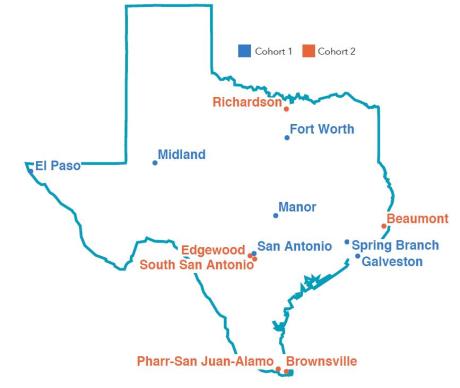
The LA teacher strike thwarted a concealed plot to use Kitamba consultants to reinvent LAUSD with a portfolio model of privatization. Kitamba has a contract with TEA right now for these districts, including RISD:

tea1

I just got a 228 page public information request from the Texas Education Agency and Region 13 service center in Austin for their MOU with Kitamba.

Texas is spending big bucks on the same Kitamba consultants exposed in the LAUSD strikes against philanthropist/private equity reformer and Supt Austin Beutner:

https://www.chalkbeat.org/posts/us/2019/04/09/los-angeles-consultants-recommendations-reimagine-kitamba-consultants/
“Created by the consulting firm Kitamba, the documents lay out an aggressive timeline for assigning schools to 32 support networks, giving principals more power, and cutting the central office by fall 2019.

The January strike appears to have derailed the plans. A spokesperson for Los Angeles Unified declined to comment.

During the January strike, United Teachers of Los Angeles criticized what it described as the district’s portfolio plan and its partnership with Kitamba. (A spokesperson at the time said Los Angeles Unified is not pursuing a portfolio approach.) Kitamba won a $765,000 contract for its work, paid by a slate of outside donors, including the Eli and Edythe Broad Foundation.

Details of Kitamba’s contract and scope of work were reported in February by the Los Angeles Times after school board member Scott Schmerelson criticized Beutner for not disclosing contracts with consultants, including Kitamba, or the work they had done for the district.”

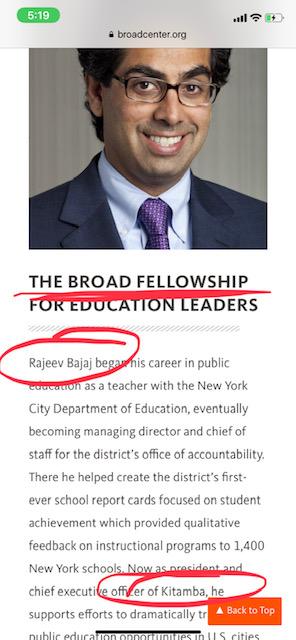
Rajeev Bajaj is a Broadie:

tea2

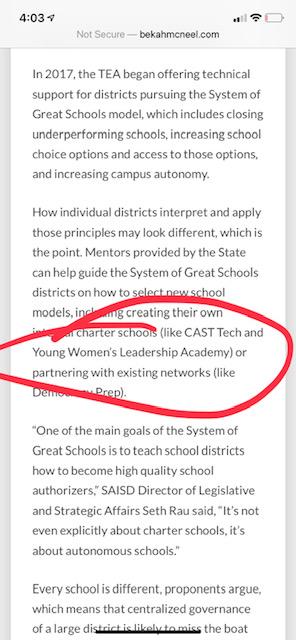
I researched all of this during my System of Great Schools LinkedIn article in December, I just didn’t see the magnitude of the Kitamba contract at the time:

tea3

Please read my SGS Takeover article again:
https://www.linkedin.com/pulse/privatization-system-great-schools-takeover-lynn-davenport

tea4

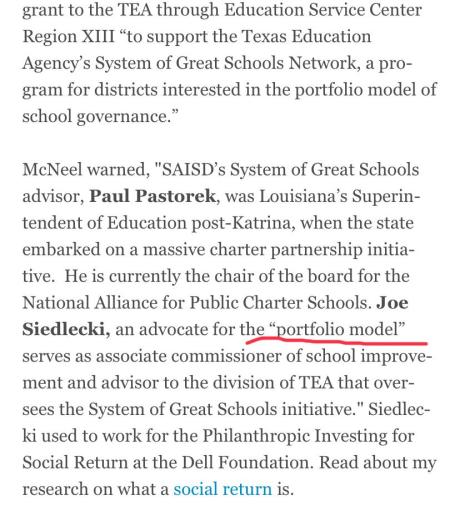
Blogger Bekah McNeel found that, “In 2017 the Laura and John Arnold Foundation gave a two-year $85,000 grant to the TEA through Education Service Center Region XIII “to support the Texas Education Agency’s System of Great Schools Network, a program for districts interested in the portfolio model of school governance.”
http://bekahmcneel.com/in-becoming-a-system-of-great-schools-saisd-is-fighting-for-its-life/

Interesting that Dallas mayoral candidate Lynn McBee’s org was mentioned:

tea5


We need to stop this with the help of Texas AFT, parents, and trustees who see the harm of the portfolio model. We also need to loop in the California union to get their advice. I would like to hire Brett Shipp Media to help expose this. If we don’t stop it, our neighborhood schools, teachers, and elected boards will be eliminated in favor of a charter-like model of “autonomy”.


A judge in Berks County, Pennsylvania, ruled that a charter school’s property was not tax-exempt, prompted by some unusual financial arrangements. 

Judge Madelyn S. Fudeman upheld a ruling by the Berks County Board of Assessment Appeals denying I-LEAD Inc. an exemption from property taxes.

The building at 401 Penn St., which houses the I-LEAD Charter School, is assessed at $9.7 million, according to Berks County property records.

The property was placed on Berks County’s September upset tax sale for four years of unpaid property taxes totaling $2.8 million; the unpaid years spanned 2014-17.

The property’s owner, I-LEAD Inc., Philadelphia, was ordered to pay a bond of $500,000 to be removed from the tax sale list, which it did in December…

In her ruling, Fudeman takes I-LEAD Inc. to task, saying it appears to be more of a for-profit operation.

She said the testimony of [CEO David ] Castro and Angel Figueroa, the charter school’s CEO and chief operating officer, “fell far short of establishing” the charter school operates at a loss.

In her ruling, Fudeman noted a revenue-sharing agreement between I-LEAD Charter School and Harcum College.

Harcum is a two-year college offering associate degree that operates from the same building as the charter school.

For every student that I-LEAD referred to Harcum College, I-LEAD would receive 40 percent of tuition and fees received by Harcum, the ruling states.

I-LEAD received more that $8.6 million from Harcum from July 2014 to June 2017…

Castro was paid over $195,000 for the most recent year and Figueroa was paid over $240,000 for the most recent year, court documents showed.

“The salaries paid to Mr. Castro and Mr. Figueroa appears more in line with a profit making institution than a truly charitable organization,” Fudeman said in the ruling.


Peter Greene writes here about an exceptionally silly “study” that Betsy DeVos is using to drum up fading public support for charter schools.

The study, by choice advocates Patrick  Wolf and Corey DeAngelis, attempts to measure “success” by return on investment, converting taxpayer dollars into NAEP scores.

Sounds crazy, no?

Greene writes:

This particular paper comes out of something called the School Choice Demonstration Project, which studies the effects of school choice.

A Good Investment: The Updated Productivity of Public Charter Schools in Eight U.S. Cities pretends to measure school productivity, focusing on eight cities- Houston, San Antonio, New York City, Washington DC, Atlanta, Indianapolis, Boston, and Denver. In fact, the paper actually uses the corporate term ROI– return on investment.

We could dig down to the details here, look at details of methodology, break down the eight cities, examine the grade levels represented, consider their use of Investopedia for a definition of ROI. But that’s not really necessary, because they use two methods for computing ROI– one is rather ridiculous, and the other is exceptionally ridiculous.

The one thing you can say for this method of computing ROI is that it’s simple. Here’s the formula, plucked directly from their paper so that you won’t think I’m making up crazy shit:

Cost Effectiveness=Achievement Scores divided by Per-Pupil Revenue.

The achievement scores here are the results from the NAEP reading and math, and I suppose we could say that’s better than the PARCC or state-bought Big Standardized Test, but it really doesn’t matter because the whole idea is nuts.

It assumes that the only return we should look for on an investment in schools is an NAEP score. Is that a good assumption? When someone says, “I want my education tax dollars to be well spent,” do we understand them to mean that they want to see high standardized test scores– and nothing else?? Bot even a measure of students improving on that test. The paper literally breaks this down into NAEP points per $1,000. Is that the whole point of a school?

It gets worse, and Greene explains why.

I am reminded of a fad in the 1920s to compute the dollar value of different subjects. The curriculum experts of the day calculated that teaching Latin was a total waste of time because it was expensive and produced no return on investment.

The whole thing called “education” got left out of the calculus.


As I reported earlier, I had a long conversation about education policy with top staff in the Bernie Sanders campaign. Among other things, I explained that charters are a first step on the privatization path that leads to vouchers and that charters cause deep cuts to public schools. I emphasized that charter schools are privately managed and areNOT public schools.

I could not have been clearer in warning that charters that get high scores “succeed” by screening out the kids they don’t want.

So Bernie’s campaign issued a statement on public schools this morning. The big message: Reinvest in public schools.

But this is point one:

  • We must make sure that charter schools are truly serving the needs of disadvantaged children.

This ignores the fact that charter schools are not public schools. They are privately managed. They are free to choose their students and free to expel those they don’t want.

This ignores the fact that the NAACP called for a charter moratorium. The ACLU of Southern California criticized charters for discriminating against and excluding students with disabilities and ELLS.  The Southern Poverty Law Center filed suit against charters in Mississippi for seeking to divert public funds from public schools, contrary to the state constitution.

How can the federal government “make sure” that charters are meeting the needs of disadvantaged students when they are free to exclude them and when charter lobbyists write the state laws?

Can Bernie learn?


A teacher at a BASIS charter school shamed a black student by teaching a lesson about the civil rights movement by inviting the class to isolate him.

BASIS is known for its high test scores and its exclusionary practices.

“A Phoenix mother says her 9-year-old son was forced to walk through his class as his teacher and fellow students yelled at, humiliated and berated him during a lesson on school segregation.

“Claudia Rodriguez posted on Facebook that a third-grade teacher at BASIS Phoenix Central singled out her son, who is black, as the class was learning about the civil-rights movement.

“The Head of School had the nerve to tell me that there was some educational value in this incident because it started conversations in the homes of the other kids,” Rodriguez wrote. “I felt the need to speak up so that no other child ever has to feel what my son felt.””


Bob Braun is one of the keenest investigative reporters in the nation, who worked for New Jersey’s leading newspaper—the Star-Ledger—for half a century. Now, retired, he keeps watch over the corporate privatization of New Jersey’s public schools, especially those in Newark. That city, it’s schools, and it’s children have been in a Reformer Petri dish for decades.

The schools were taken over by the states in the 1990s. At last, the state has restored an elected board, but the politicians are maneuvering to gain control of the board.

Sadly, Mayor Ras Baraka is leading the effort for a takeover by the charter industry, after running as the anti-charter candidate for mayor.

There is a school board election in Newark on Tuesday.

Read the latest story here. 

I wish that the New York Times were not behind a paywall. I wish you could read this article in full. It is an interview with Melinda Gates.

You would get a sense of a very rich and very privileged woman who doesn’t realize how out of touch she is with the lives of ordinary people.

The interviewer wants to know how she feels about her privilege, given the rise of tide of anger against elites and the super-rich.

Here are a few snippets:

One of the recurring criticisms of large-scale philanthropists is that they aren’t interested in any redress of the economic systems that create inequality. But in order to rectify inequalities, doesn’t a radical rethinking need to happen? Bill and I are both on the record saying that we believe in more progressive taxes. We believe in an estate tax. We don’t believe in enormous inherited wealth.  

There are certain places where Bill and I sit where that is not a popular idea. Bill will be the first person to tell you, and Warren Buffett will be the second, that they could not have done what they did without having grown up in the United States, benefiting from the United States education system, benefiting from the infrastructure that exists here to build a business. If they had grown up in — pick your favorite place — Senegal, they couldn’t have started their businesses. There’s no way. So they have benefited. But we do need to think about how we right some of these inequities. How do we open our networks of power for women and people of color? We have to think about our privilege. I have to think about my privilege every day.

Yet, they choose to live in the lowest-taxed state in the nation, where there is no income tax and no corporate tax. With all of Gates’ power and influence, he has not lobbied the Washington State legislature to pass a progressive income tax. The schools of Washington State have been underfunded for years, and it took a long-running court case to get the legislature to allocate more money to them. Meanwhile, Bill used his influence to fight for a charter school law, enabling about 3,500 students to attend charter schools in a state with a student enrollment of one million.  Warren Buffett and Bill Gates had very different experiences in “the United States education system.” Bill went to private school in Seattle, with small classes, lavish facilities, and experienced teachers; his own children attended the same elite private school. Warren Buffett went to public school in Omaha, sent his own children to public school in Omaha, and they sent their children to public school.

What’s a recent epiphany you’ve had about your privilege? That it’s not enough to read about it. You have to be in the community with people who don’t look like you. When I read about a shooting, maybe in the south side of Seattle, I’m not living the experience. Whereas if I have a friend who’s a person of color, they most likely are living that experience or know somebody who was part of that community. And so my youngest daughter and I — she has a lot of friends whom I’m meeting, and they’re of very mixed races, I love that — have this motto that we go by: Every single person who walks through our door should feel comfortable in our house, despite how large it is and that it has nice art. And, believe me, there are people who show up at my front door who are not that comfortable. So sometimes that means sitting down inside the front door with our dog — and I’m in my yoga pants, no makeup on — and petting the dog until they’re comfortable being there. And only if we’ve made them comfortable can we be in real community. I have to do more to break down those barriers. It is very hard for almost anybody to show up at my front door….

To get back to philanthropy: What about the notion that the foundation’s work on an issue like public education is inherently antidemocratic? You’ve spent money in that area in a way that maybe seems like it’s crowding out people’s actual wants in that area. What’s your counter to that criticism? Bill and I always go back to “What is philanthropy’s role?” It is to be catalytic. It’s to try and put new ideas forward and test them and see if they work. If you can convince government to scale up, that is how you have success. But philanthropic dollars are a tiny slice of the United States education budget. Even if we put a billion dollars in the State of California, that’s not going to do that much. So we experiment with things. (Including funding small-population schools, bonuses for high-performing teachers and supporting the development and implementation of the Common Core educational standards.)

 If we had been successful, David, you’d see a lot more charter schools. I’d love to see 20 percent charter schools in every state. But we haven’t been successful. I’d love to say we had outsize influence. We don’t.

Certainly you have more influence than, say, a group of parents. Not necessarily. I went and met with a group of three dozen parents in Memphis. We thought we had a good idea for them. They were having none of it. So we didn’t move forward. A group of parents, a group of teachers, they can have a very large influence.

Well, Melinda is wrong about the influence of the foundation and the Gates’. After all, they singlehandedly (or four-handedly) funded the Common Core standards and paid out millions to every organization they could think of advocate for them. More than anyone else, the Gates Foundation imposed the Common Core standards on the nation, and they flopped by any measure one could think of. All of their “experiments” on the American educational system have failed. But she is right that the charter movement has stalled. In some states where the Gates’ have been most active, only 3-5% of the students are in charter schools. Now that scandals appear daily in the charter industry, this investment is blowing up too. And as she said, “a group of parents, a group of teachers, they can have a very large influence.” Yup. Parents and teachers can beat big money. They can beat the Gates’ money and protect their public schools from being one of Bill & Melinda’s “experiments.”


Ann O’Leary is Chief of Staff to California Governor Gavin Newsom. Previously she was education advisor to Presidential candidate Hillary Clinton. She is a lawyer and a very accomplished person, with a long history in Democratic politics. She was leading the Clinton transition team right before the election of 2016. For several years, she was a senior fellow at the Center for American Progress, which strongly defends charter schools and Obama’s failed Race to the Top program.

During the 2016 campaign, when it was clear Hillary would be the nominee, Carol Burris of the Network for Public Education and I went to see O’Leary at the Clinton headquarters in Brooklyn. We tried to persuade her that Hillary should oppose charters. After all, school choice is a Republican priority. It is supported by the Waltons, the Koch brothers, ALEC, the DeVos family, and every Red State Governor. Democrats should support public schools, we argued, not privatization. We failed. We went back again, after the convention. O’Leary was unmovable. The best we could get from her was a promise that Hillary would oppose for-profit charters.

We knew that was a meaningless offer, because large numbers of nonprofit charters hire for-profit management companies.

We were thrilled when Gavin Newsom and Tony Thurmond were elected, because the charter industry placed its bets on Antonio Villaraigosa for Governor, who ran third, and on Marshall Tuck for Secretary of Education. Tuck’s campaign spent twice as much as Thurmond’s and vilified him with false advertising. Thurmond barely beat Tuck, the charter industry’s favorite and former leader of a charter chain.

Newsom promised to create a task force to advise on reforming the state’s notoriously weak charter law, which has enabled fraud, embezzlement, and grifters to cash in. Thurmond would chair the task force.

But then the task force was named, and it was clear that the charter industry was running the show. Of the 11 members, seven are connected to the charter industry. Two appointees are directly employed by the charter lobby.

Here are the members:

The task force members are:

  • Cristina de Jesus, president and chief executive officer, Green Dot Public Schools California (charter chain);
  • Dolores Duran, California School Employees Association;
  • Margaret Fortune, California Charter Schools Association board chair; Fortune School of Education, president & CEO (charter lobby);
  • Lester Garcia, political director, SEIU Local 99 (Local 99 took $100,000 from Eli Broad to oppose Jackie Goldberg, a critic of charters, and its former national president, Andy Stern, is CEO of the Eli Broad Center);
  • Alia Griffing, political director, American Federation of State, County and Municipal Employees (AFSCME) Council 57;
  • Beth Hunkapiller, educator and administrator, Aspire Public Schools (charter chain);
  • Erika Jones, board of directors, California Teachers Association;
  • Ed Manansala, superintendent, El Dorado County; the El Dorado County Office set up a Special Education Local Plan Area (SELPA) specifically to service students with disabilities in charter schools and wooed charter students away from their local districts, even students who live hundreds of miles away; 
  • Cindy Marten,  superintendent, San Diego Unified School District;
  • Gina Plate, vice president of special education, California Charter Schools Association (charter lobby);
  • Edgar Zazueta, senior director, policy & governmental relations, Association of California School Administrators (ACSA endorsed Marshall Tuck against Tony Thurmond). 

Only four members of the task force are not connected, politically or financially, to the charter industry: Cindy Marten; Dolores Duran; Alia Griffing; and Erika Jones.

Who selected this skewed task force?

A tip came from someone with a direct line to the Governor’s Office.

Ann O’Leary.

Ann, I hope you read this because I want you to know that you are protecting an industry that tolerates corruption and malfeasance.

Please read this report, “Charters and Consequences,” written by Carol Burris, which begins with a description of charter operators in California who hire family members, run multiple charters with appallingly low graduation rates and continues to describe a state law that is sorely in need of real reform.

Why does California have a law that ignores graft and corruption? The California Charter Schools Association fought any reform. Yet you put the chair of the board of this lobby on the task force to reform the charter law! And to make it worse, you added another employee of CCSA! This is the lobby that fought any reform of the law, that fought previous efforts to ban nepotism and conflicts of interest, that fought accountability and transparency.

And now the Network for Public Education has documented how charter operators in California have wasted millions of federal dollars. 

Nationally, about one-third of federally-funded charter schools either never opened or closed soon after getting the money. In California alone, the state with the most charter schools, the failure rate for federally funded charters is 39%.

California charters won almost $326 million from the federal Charter School Program between 2006-2014. To be exact: $325,812,827. Of that amount, $108,518,463 went to 306 charter schools that either never opened or soon shut down. Of that 306, 75 never opened at all. But the charter operator kept the money.

In addition, the ACLU of Southern California in its 2016 report, ”Unequal Access,” identified 253 charters in the state that engage in discriminatory—often illegal—practices. That number, they said, was the tip of the iceberg, because these were the charters that put their discriminatory policies on their website! Thirty-four California charter schools that received federal CSP grants appear on the ACLU of Southern California’s updated list of charters that discriminate—in some cases illegally—in admissions.

One can only imagine how much the waste has grown since 2014, with the Obama and Trump administrations adding even more millions to expand charters that divert resources from public schools.

So, this is on you, Ann.

Will the task force protect the charter industry? Will it come up with meaningless “reforms” that do nothing to rein in waste, fraud, and abuse?

Will it protect the power of districts to authorize charters in other districts, far away, without the permission of the receiving district, so the authorizers gets a fee and the charter has no oversight?

Will it continue to allow charters to open with no consideration of the fiscal impact on the district where it chooses to open?

Will it continue to allow endless appeals when the host district rejects a new charter?

Will it continue to allow corporate chains to Walmartize what were once public schools? Will it continue to allow non-educators to open and operate charter schools?

Will it ignore the expansion of Gulen schools, schools run by a Turkish imam who lives in seclusion in Pennsylvania, schools which import Turkish teachers and relies on Turkish boards?

Is it possible for a task force to regulate an industry when industry insiders are a majority of the task force?

I know you are very busy, but I hope you will take the time to think about these questions and respond.


Michael Bonds, former president of the Milwaukee Public Schools’ Board, was charged in federal court for taking kickbacks from a charter chain. 

“Bonds is accused of conspiracy and violations of the Travel Act for allegedly accepting kickbacks from executives of the Philadelphia-based Universal Companies in return for votes beneficial to the company between 2014 and 2016. Two unnamed executives of the Philadelphia-based company were implicated in the scheme but not charged.

“According to the charging document, the executives used fake invoices to make payments totaling $6,000 to African-American Books and Gifts, a company purportedly created by Bonds. Efforts to locate a Wisconsin company by that name were not immediately successful.

“The document says Bonds also received “things of value” but did not elaborate. It is seeking $18,000 in forfeitures from Bonds.

“The document identifies the executives only as Universal’s president and chief executive officer, and its chief financial officer. The Philadelphia Inquirer used tax records to identify those individuals as former CEO Rahim Islam and current CFO Shahied Dawan.

“The charges come five months after the FBI raided Universal’s offices and Islam’s home.

“Universal was chartered by MPS to operate the Universal Academy for the College Bound in three Milwaukee school buildings from 2013 until it abruptly left the district in 2017, leaving hundreds of children stranded in the middle of the school year.

“The school received at least $11 million in taxpayer funds in its first two years, according to the court document, yet it struggled academically and financially from the beginning.”


That is an easy question. Betsy DeVos believes that parents can choose really dreadful ”schools,” where their children won’t learn anything about the modern world and it’s okay.

But Betsy’s not a pundit on FOX News. She is Secretary of Education. People listen to her incoherent babbling and try to make sense of it.

As the AP reports, Betsy has decided to ignore evidence that her own Department—during the Obama Administration, wasted nearly $1 billion on failed charter schools. She can’t defend this outrage. Where are the other charter cheerleaders?

Why is it okay to fund charters that never open or close within a year?