Archives for category: Charter Schools

Jersey Jazzman notes that charters in his state are on the horns of a dilemma: on one hand, public school advocates are suing to block charter expansion, because they drain away public school funding: on the other hand, charters want to join a lawsuit that would allow them to share in a settlement intended to provide equity for public schools in impoverished districts. JJ is a very smart guy but he doesn’t seem to understand that what matters most is not consistency but being in the right place when the money spigot is turned on. Charters are public when that’s where the money is; charters are not public when it suits them to avoid mandates.

He writes:

This was a long time coming: the Christie administration happily encouraged the expansion of charter schools without seriously thinking about appropriate oversight, regulation, and funding of the sector. Now the state has to contend with a system that imposes fiscal burdens on school districts that host charter schools, even as those districts have no meaningful say on charter school proliferation.

The fact – which I have validated empirically – is that charter school expansion is not a revenue-neutral policy. As school districts lose students to charters, they are unable to adjust immediately to enrollment declines, because districts have fixed costs like buildings and personnel that can’t be quickly scaled back. 


But charter operators appear to be unconcerned with this reality; repeatedly, they have demanded they get everything they think they are owed, even when school districts are facing serious financial pressures. During Christie’s time, this meant charter budgets weren’t touched
, even as host districts’ were slashed…

As Bruce Baker and Gary Miron pointed out years ago, charter school regulations like New Jersey’s lead to an absurd situation: the public pays for school buildings that many times used to be owned by a school district – in other words, the public – but wind up in private hands. Sometimes those hands are nonprofits aligned with the charter school; sometimes they are for-profit companies, paying off their mortgages with funds the charters receive in per pupil payments from hosting school districts.

In either case, the public is paying for a building that the public will never own. And in most cases, these are buildings that are paid for, at least in part, with local funds, even though the state is the entity that gets to decide whether charters will be granted or renewed.

This lunacy is at the heart of the serious conflicts of interest, lack of transparency, and just generally bad policymaking that surrounds New Jersey’s charter school facilities…

The legal status of charter schools has always been open to debate, but it’s clear at this point that they are not government actors. As such, they can claim immunity from oversight regulations that other governmental entities, such as school boards, must abide by. Why, then, should the taxpayers simply turn over revenues for charter facilities when they won’t even know who, if anyone, is profiting off of this system?

There are a lot of aspects of charter school policy we can debate, but this one if clear: If the public pays for a school building — including a charter school building — the public should own the building. If New Jersey’s charter schools want more funding for their facilities, the price to be paid is that those facilities stay in public hands, with public oversight and complete transparency.

If you think I’m wrong, I’d love to hear your argument. But it seems clear to me that New Jersey’s charter schools can’t have it both ways: if you want public funding, you can’t have privately owned buildings.
Charter advocates have reacted with astonishment and outrage at the Trump-DeVos decision to fold the federal Charter Schools Program into a block grant to the states, along with 29 other programs. The Trump administration’s goal is to shift federal funding to states and let them decide how to spend the money.

Matt Barnum of Chalkbeat writes the story here, detailing the administration’s rationale and charter advocates’ reaction. 

Jim Blew, formerly of the Walton Family Foundation, which claims to have launched one of every four charters in the nation, brushed off the charter lobbyists: 

“The federal lobbyists for charter schools sound a lot like the lobbyists for all of the other competitive grant programs,” Assistant Secretary Jim Blew told Chalkbeat in a statement. “In their desperate communications, they have exaggerated the importance of CSP — just like other lobbyists,” he added, referring to the Charter Schools Program.

It’s not clear that the program is in real jeopardy, since Congress has previously disregarded the Trump administration’s proposed budgets. But the budget proposal and combative rhetoric suggest that charter advocates do not have as staunch an ally in the administration as they previously believed.

“We are saddened and puzzled by the Department of Education’s comments,” said Nina Rees, president of the National Alliance for Public Charter Schools, which has receivedfederal charter dollars. “We advocate for the federal Charter Schools Program because we believe it is a lifeline for students.”

Rees formerly was education advisor to Vice President Dick Cheney and to entrepreneur MIchael Milken, who engaged in education philanthropy after serving a term in prison for financial crimes.

Strangely, Barnum refers to Democrats for Education Reform (DFER) as “left of center,” which is laughable since they were founded by and funded by hedge fund managers, some of whom are billionaires and may not even be Democrats. DFER’s funding has gone to supporters of school choice, and their beneficiaries show no interest in funding, class size, teachers’ salaries, integration or other issues that matter to progressive Democrats.

It is ironic that the Republican-dominated charter industry will now have to count on Democrats in the House to save the federal Charter Schools Program, which DeVos has used to fatten avaricious corporate charter chains.

The federal CSP has funded a large proportion of the nation’s charter schools, acting like “the Small Business Administration” for charters entrepreneurs, as NPE executive director Carol Burris said recently on Twitter.

Barnum wrote:

A recent presentation from the Department showed the figure was slightly higher: as of 2016, more than 3,100 existing charter had received such a grant, with the program helping to fund close to 45% of all operating charters. (Morabito, the spokesperson, acknowledged the error when asked about it by Chalkbeat.)

For charters that opened between 2006 and 2016, the share was even higher — 60% had received a federal grant.

Studies of the federal Charter Schools Program by the Network for Public Education found that it was riddled with waste, fraud, and abuse. More than 1/3 of the federally funded charters either never opened or closed soon after opening. This is a program that should be eliminated.

What will the Democrats do?


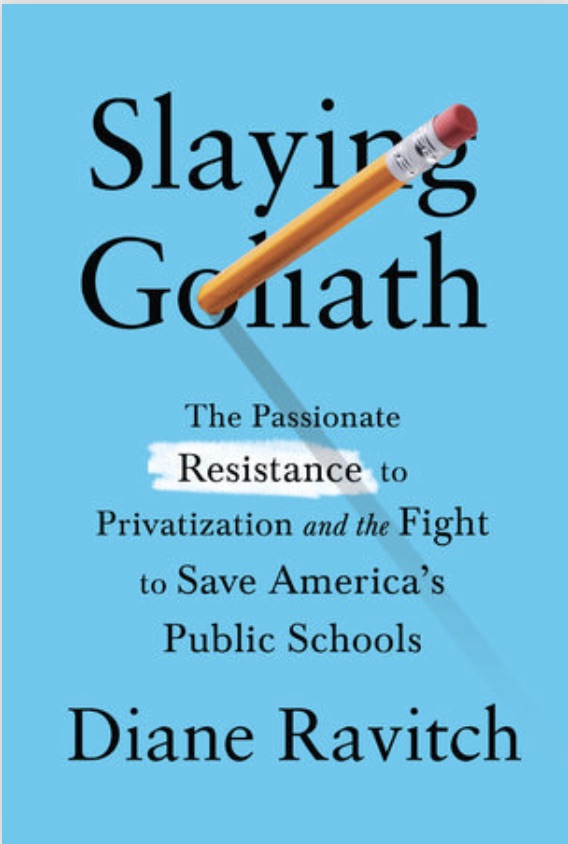
John Thompson, historian and retired teacher in Oklahoma, reviews SLAYING GOLIATH. This is the second part of his review.

This is an excerpt of a long and thoughtful review.

This second post will focus on Ravitch’s analysis of the research which predicted the defeat of accountability-driven, charter-driven policies. Perhaps the most striking pattern documented in Slaying Goliath is how they failed in the way that scholars and practitioners anticipated.

Decades of Disruption-driven reform began with the false claim “that American education was failing and the only way to fix it was with standards, tests, competition, and accountability.” As Arne Duncan’s public relations officer and Walton-funded reformer Peter Cunningham said, “We measure what we treasure.”

Ravitch’s response was, “I was taken aback because I could not imagine how to measure what I treasure: my family, my friends, my pets, my colleagues, my work, the art and books I have collected.” And that foreshadows the victory of the Resistance over Goliath. Most educators, patrons, and students agree that children are more than a test score.

No Child Left Behind and the Race to the Top set impossible test score targets. They were based in large part on the weird idea that “no-excuses” behaviorist pedagogies could be quickly “scaled up,” providing poor children of color a ladder to economic equality. Drawing on the tradition of Edward Thorndike and B.F. Skinner, reformers “rigidly prescribed conditioning via punishments and rewards.” Previewing their fatal flaw, Ravitch observes, “Behaviorists, and the Disrupters who mimic them today, lack appreciation for the value of divergent thinking, and the creative potential of variety. And they emphatically discount mere ‘feelings.’”

When educators resisted, corporate reformers became livid and doubled down on the punitive. Perhaps their worst debacle was using value-added teacher evaluations to hold each individual educator accountable for test score growth. It combined inappropriate test outputs with an unreliable and invalid algorithm, the VAM, as a club to enforce compliance. In the short run, it forced educators, who had previously tried to keep their heads down and “monkey wrench” testing mandates to join patrons and students in the Resistance. By 2018, however, pent up anger exploded as teacher strikes spread across the nation.

Today, many or most of Goliath’s coalition have become disenchanted with standardized testing, but their Disruption model can’t function without it. Few have gone as far as Paymon Rouhanifard, the former Camden superintendent who abolished report cards after listening to complaints, and denounced standardized testing as he left the job.

The more common path is to spin their punitive tests as “personalized” learning, and their incentives and disincentives as the “portfolio model.” As Ravitch explains, “A portfolio district is one where the local board (or some entity operating in its stead) acts like a stockbrokerage, holding onto winners (schools with high test scores) and getting rid of losers (schools with low test scores).”

As was also predicted by Campbell’s Law, test-driven accountability (made more intimidating by the dual threat of test-driven competition with charters) led to corruption. The cheating was far greater than just the scandals where adults erased and changed bubble-in answers. Graduation rates were easy to manipulate. For instance, NPR reported a “heartwarming story” in 2017 about a school with 100% graduation rate. A subsequent FBI investigation and a district audit found 1/3rd of the school’s graduates lacked credits and only 42% were on track to graduation.

And that leads to the corruption associated with school choice. Today’s Disrupters seem to be doubling down on charters to drive transformative change. As explained in a previous post, in 1988 Al Shanker saw charters as a path towards innovation. Within two years, however, the promise of win-win experimentation started to be undermined when conservative reformers Terry Moe and John Chubb claimed “choice is a panacea.”

In this case, it was choice-advocate Paul Peterson who predicted the political future. Charters didn’t take off because of the balanced approach of Shanker, but because reformers “radicalized” the concept. And, of course, there was plenty of big bucks available for pushing their radical but false narrative.

Within a decade, a shocking number of non-educators had been convinced by Goliath’s spinsters that the KIPP’s behaviorist model could be scaled up. As Slaying Goliath explains, “The biggest innovation in the charter sector was the invention of ‘no-excuses’ schools.” It took nearly another decade for policy makers to accept the fact that charters get average results except for those with high attrition.” And it took nearly as long to reveal the much greater down sides of charters…

Regardless of whether we’re discussing high-stakes testing, charter expansion, or the other pet theories, we should all heed Ravitch’s most important lesson of the past few decades is that “Reform doesn’t mean reform. It means mass demoralization, chaos, and turmoil. Disruption does not produce better education.”

Slaying Goliath celebrates a great victory for public education and democracy. However, Ravitch reminds us that the Disrupters are still threatening. She compares today’s danger to that which faced a man who decapitated a rattlesnake but who nearly died after being bitten by the detached head.

So, we can’t lower our guard until the principles that inspired the Resistance are safe in our schools.


Peter Greene nails it here, in discussing how Trump and DeVos folded the federal Charter Schools Program into a big, fat block grant that states can spend however they wish. 

For decades, Republicans have been wanting to eliminate social programs by turning them into block grants to the states. Now, as Valerie Strauss reported, charter school advocates are outraged. Brought to the dance and abandoned.

Open the link and see the great image Greene posts to make the point.

I have known for many years that right-wingers went for charters only because they lay the groundwork for vouchers.

I learned that when I worked in rightwing think tanks like the Thomas B. Fordham Institute and the Koret Education Program at the Hoover Institution.

The true right-wingers don’t give a hoot about charter schools except as a way to condition the American public to give up on public schools and place their faith in consumerism.

Charters pave the way for vouchers. They turn citizens, invested in public institutions, into consumers, looking out only for their own child.

Now that the Trump administration has a chance to show what it really cares about, it is vouchers (aka “Education Freedom Scholarships” or some other deceptive name).

DeVos wants every American child in a religious school or some other private school.

Not the kind that costs $25,000-50,000 a year.

The kind that costs $4,800 a year.

The kind that scoffs at the common good.

The kind that employs high-school dropouts as teachers (as in Florida), the kind that decides which children are acceptable and which are not allowed. The kind that kicks out students, staff and families who are gay, knowing that Trump’s rightwing Supreme Court will back them up.

The kind that accepts only “our kind.”

The Trump-DeVos show and the return of racism, sexism, xenophobia, and homophobia as acceptable public policy.

The Education Law Center is suing to block former Governor Chris Christie’s 2016 decision to expand charters in Newark:


February 11, 2020
NJ SUPREME COURT TO REVIEW STATE COMMISSIONER’S DECISION TO DRAMATICALLY EXPAND CHARTER SCHOOLS IN NEWARK
The New Jersey Supreme Court has granted a petition filed by Education Law Center (ELC) to review the State Commissioner of Education’s 2016 decision approving an enrollment increase of 8500 students in KIPP, Uncommon and other charter operators’ schools in the Newark Public School (NPS) district.
In accepting In Re Team Academy Charter School, the Supreme Court will now decide several consequential issues raised by the State’s push to rapidly grow charter school enrollments in NPS over the last decade. Under former Governor Chris Christie, Newark charter enrollments grew 320% from 4,559 in 2009, to 19,152 in 2020. NPS payments to charter schools increased from $63 million in 2009, or 7% of the NPS operating budget, to $265 million in 2020, or 26% of the budget.
The legal issues before the NJ Supreme Court in Team Academy implicate the Commissioner’s failure to comply with the Court’s 2000 Palisades Charter ruling imposing an affirmative obligation under the New Jersey Constitution to carefully evaluate the impact of charter school applications in two interrelated areas:
  • The education resources available to NPS students from the loss of funding that will occur from increasing charter school enrollments;
  • The segregation of NPS students by disability, English language proficiency and race.
The Team Academy appeal addresses the obligation of charter authorizers to protect the constitutional rights of public school students when faced with overwhelming and unrefuted evidence that expanding charters will deprive district students of essential education resources and intensify persistent patterns of student segregation in the resident district.
In 2016, ELC, on behalf of NPS students, submitted detailed evidence to the Commissioner opposing the charter school expansion. ELC’s evidence showed that, if the expansion was approved, NPS would continue to lose funding from its budget, causing further cuts to essential teachers, support staff and programs, including for English language learners (ELL) and students with disabilities. ELC also documented that the expansion would increase the concentration of more costly to educate students with disabilities and ELLs in Newark district schools and worsen the entrenched isolation of Black and Latino students in the already intensely segregated district.
After the Commissioner ignored this evidence and approved the applications, ELC appealed. The Appellate Division upheld the decision, relying on the failure of the NPS superintendent, hired by the State, to object to the expansion. At the time the charter applications were decided by the State, NPS was under State control.
Because NPS students are in the class of plaintiff school children in the landmark Abbott v. Burke school funding litigation, the Supreme Court will also decide whether the Commissioner bears a heightened burden when reviewing charter applications in those districts. Abbott district students remain the subject of continuing Abbott orders to remedy the State’s longstanding violation of their right to a constitutional thorough and efficient education.
Michael Stein of the Pashman Stein Walder Hayden law firm is serving as pro bono co-counsel on this appeal, along with ELC Executive Director David Sciarra, lead counsel for the Abbott v. Burke school children.
Argument before the NJ Supreme Court is expected in the fall.
Press Contact:
Sharon Krengel
Policy and Outreach Director
Education Law Center

Tim Slekar, one of the pioneers of the Resistance invited me to talk with him on his podcast Busted Pencils. 

We talked about SLAYING GOLIATH.

To the shock and consternation of charter school advocates, the Trump budget proposal abandons the controversial federal Charter Schools Program, turning it into a state bloc program that turns the money over to the states. 

The National Alliance for Public Charter Schools issued a scathing denunciation of the axing of the federal charter school programs, which has enriched the big corporate charter chains.

The Network for Public Education issued two reports on waste, fraud, and abuse in this program, showing that nearly 40% of the federal money was spent on charters that either never opened or closed soon after opening, with waste of nearly $1 billion. See the reports here and here.

Trump and DeVos are backing their chief priority: vouchers, which they prefer to call “education freedom scholarships,” at a proposed cost of $5 billion. They want America’s children to be “rescued” from public schools that hat have been burdened by harmful federal policies like high-stakes testing, and punishments attached to testing. They want them to attend religious schools that are low-cost and have no standards or accountability, and are free to discriminate against students, families, and staff they don’t like.

The erstwhile Center for American Progress lamented the proposal to cut federal spending on charter schools, even though Democratic support for them has substantially declined. Apparently, CAP is the last to know that school choice is a Republican Policy.

Chalkbeat reports:

The Trump administration wants to create a new stream of funding for disadvantaged students that would consolidate current spending on Title I — which gives money to schools serving low-income students — and 28 other programs.

This school year, the department spent $16.3 billion on Title I grants to states and districts and $7.8 billion on the other programs. Under the proposed budget, it would all become a $19.4 billion pot that would be distributed through the Title I formulas — a $4.7 billion cut, if the budget were enacted.

The individual programs on the chopping block include:

  • 21st Century Learning Centers, which supports after-school programs in places like Detroit and New York City ($1.25 billion)
  • Arts in Education ($30 million)
  • English Language Acquisition ($787 million)
  • Homeless Education ($102 million)
  • Neglected and Delinquent, which offers grants to states to educate incarcerated students ($48 million)
  • Magnet Schools, which offers grants some districts use for desegregation ($107 million)
  • Migrant Education ($375 million)
  • Rural Education ($186 million)
  • Supporting Effective Instruction State Grants, which is also known as Title II, Part A, which districts can use for teacher training and to reduce class sizes ($2.1 billion)

This move, the budget documents say, would reduce the federal government’s role in education and pave the way for less spending on department staff.

But the proposed elimination of these streams of funding raised alarms among civil rights advocates, who said this would enable states to spend less money on vulnerable groups like students who are English learners, homeless students, students involved in the juvenile justice system, or migrant students.

“History has shown us that … unless the federal government says you must serve migrant children, and here are funds to help you do that, migrant children are lost and forgotten,” said Liz King, the education equity program director at The Leadership Conference on Civil and Human Rights. “The purpose of the dedicated pots of money … is to make sure that the most powerless people in our country are not lost.”

Advocates for other programs expressed concern, too. During a question and answer session with education department officials, a member of the National Association for Gifted Children asked why the administration had proposed eliminating a $13 million program that supports gifted education.

Jim Blew, one of DeVos’s assistant secretaries, and a former official at the Walton Family Foundation, said that advocates for these programs should lobby the states to fund their favorite programs.

One of the regular commenters on the blog signs in as NYC Public School Parent.

She wrote the following:

The ed reformers have set up a game with rules in which they always win.

If 100% of students in public schools are meeting standards, then the standards are too low.

If 50% of students in public schools are meeting standards, then the schools are terrible.

If a charter comes in and cherry picks from the 50% of students who meet standards, then the charter is performing miracles because 100% of their students meet standards.

If a public magnet comes in and cherry picks from the 50% of students who meet standards, then the public school is wrongly cherry picking students and look, the 50% who are left are still not meeting standards.

If a charter has 100 students in 9th grade and 4 years later only 60 of them make it to 12th grade, the charter has a 100% graduation rate because all 60 seniors graduate.

If a public school has 100 students in 9th grade and 4 years later has 90 students and “only” 70 of them graduate, the public school is a failure.

The ed reformers could not get away with this if the education reporters at major newspapers did not demonstrate their incompetence every single day when they accept every press release and study put out by ed reformers as the gospel truth. Too many overprivileged education reporters are so terrified of numbers that they cannot even envision that a charter that starts with 100 students in 9th grade and graduates 60 is not performing the miracles in which 100% of their students are high performing scholars. It is beyond their very limited ability to take a deep dive into numbers. These reporters write as if they were simply acting as stenographers for the PR groups. Their stories are as ridiculous as if a medical/science reporter kept reporting: “This brand name cough medicine cures 100% of the children with serious coughs, as proven by this never peer reviewed study which started with 100 children taking this brand name cough medicine in which 50 children disappeared from the study. We know that the number of kids who disappeared from this brand name cough medicine study is irrelevant because the people at the brand name cough medicine company explained to us that all those children who disappeared had parents who – once they saw that their child would be miracle-cured – decided that they would rather see their children suffer.”

Would science reporters simply report that the cough medicine had 100% cure rates because they accepted as gospel that there were large numbers of parents who had enrolled their kids in that study and then decided they’d prefer their child suffer and stop taking this miracle medicine? Would science reporters say “it doesn’t matter if 25% of the kids disappeared, if 50% of the kids disappeared, or if 80% of the kids disappeared from this study because the people running it told me these missing kids’ parents wanted them to suffer with coughs once their kid started experience the miracle of our cure.”

Would science reporters ignore all the parents publicly explaining how their kids were pushed out of these studies? Would science reporters say “we already know from the cough medicine maker that you just wanted your child to suffer from the cough so we are still going to report that this medicine miraculous cures 100% of the kids who take it.” Or would they listen to parents and say “hey, it’s clear something very fishy and corrupt is going on”.

Would a science reporter make that judgement based on the race and class of the children who leave the study, and if their parents are white and middle class, then reporters are skeptical of the cough medicine company’s claims that they want their children to suffer more instead of being cured. But if those parents are African-American, do those science reporters simply accept as gospel what the cough medicine company tells them is true, that those parents prefer to see their children suffer than be cured and that’s the only reason their kids disappeared from the study?

It seems like education reporters don’t feel the need to ask any questions when the kids who disappear are African-American and Latinx with few other resources. They accept as gospel that their parents prefer to see them suffer, and it never occurs to those white education reporters that perhaps their parents are pulling them BECAUSE the charters are making their kids suffer. I have no doubt that those white education reporters would ask a whole lot more questions if all the missing students were white.

Five years ago, Kevin Welner and Gary Miron explained why you should not believe claims about charter “wait lists.”

At the same time that they released this caution (2014), the National Alliance for Public Charter Schools [sic] put out a press release claiming that more than one million students were wait-listed to get into charter schools.

Five years later, the New York Times cited this press release by NAPCS to substantiate a statement that “hundreds of thousands” of students were on charter wait lists. On the other hand, Los Angeles school board member Scott Schmerelson posted on his Facebook page that more than 80% of the charter schools in LA had vacancies.

Welner and Miron gave nine reasons not to believe unverified claims about hundreds of thousands of students waiting to get into charter schools.

They posted this caution after the NAPCS [sic] claimed in 2013 that precisely 902,007 students were on wait lists for charter schools.

Here are nine reasons to be skeptical of the numbers offered by the National Alliance for Public Charter Schools.

Reason #1: Students Apply to Multiple Charter Schools

The NAPCS estimate is complicated by the fact (acknowledged by NAPCS in its 2013 announcement) that “families often apply to multiple charter schools….” Because of this practice, NAPCS downsizes its own topline number by over 400,000 students. That is, instead of the 920,007 waitlist students given as the 2013 topline number, NAPCS later adds: “at a minimum, more than 520,000 total individual students – many of whom are on multiple charter school waitlists … are on waitlists across the country.” In practice, many families may apply to one or more charter schools along with district-run schools or programs. Such students receive offers at a variety of schools (multiple charter and/or district options) but may choose a district school option. In short, a given charter school application may not reflect a student’s first choice.

Reason #2: The Waitlist Numbers Cannot Be Confirmed

Even the NAPCS 520,000 estimate is problematic. For most jurisdictions,2 it is derived from unaudited and unauditable numbers reported to NAPCS through a survey it administers annually. The survey apparently asks for the number of applications received, as well as the number of available seats. The waiting list numbers are then calculated as applications minus seats.

There is no state or federal indicator that is called “waitlist.” Instead, this is a statistic developed by NAPCS and others who hope to advance the argument that, “With such demand, it is up to our elected officials to remove the facilities and funding barriers that exist to ensure that every child has the option to attend a high-quality public charter school” (Nina Rees, NAPCS president and CEO).3

Open the link to read the other seven reasons.


Tonight (before the Oscars) I spoke at the Mark Taper Auditorium in the Los Angeles Central Library. It was a magnificent event, led by Alex Caputo-Pearl of the United Teachers of Los Angeles.

The library is an elegant building that has been renovated. The auditorium is gorgeous. The audience was wonderful.  The event was videotaped so I hope to post it here. I noticed that many big contributors to the privatization movement (Richard Riordan, Bill Gates) also contributed to the Public Library. Do you think they see a contradiction between supporting a great public library, free and accessible to all, while undermining public schools?

It was thrilling to be sponsored by UTLA. This is a union that is fully woke and fighting to save public education and make it far, far better.

First comes the March 3 election, where four seats on the LAUSD board are up for grabs. UTLA is vigorously supporting Jackie Goldberg, George McKenna, Scott Schmerelson and Patty Castellanos.

Then comes a major funding referendum next November where UTLA and other educators are asking voters of California to tax major corporations whose tax rates have not changed since 1978. The tax for the Communities and Schools defending would raise $12 Billion a year, half for social services for children, and half for schools.

UTLA boldly went on strike in January 2019. They have now purchased highway billboards to shame the corporate Privatizers. They are a brave and militant union.

I was thrilled to see so many LA friends and meet new ones, especially the East Side Hispanic parents who have created a neighborhood organization to fight privatization. I also enjoyed seeing our own commenter Left Coast Teacher, who is tall and very handsome. And it was great to see blogger Sara Roos (Red Queen in LA) and many more LA allies.

I love this union! They are truly leaders of the Resistance!