Archives for category: Budget Cuts

I am late posting about the school closings in Sacramento, but better late than never.

In Sacramento, the Hmong Innovating Politics (HIP) and the Sacramento Coalition to Save Public Education are working together to protest the closing of seven elementary schools. The closing of these schools will have a disparate impact on children of color and English-language learners. The “savings” to the district will be miniscule.

The HIP press release against the closings follows here:

For Immediate Release Contact
March 7, 2013 Jonathan Tran
626.607.1897
Press Release
School Closures Disproportionately Impact Sacramento’s Most
Disadvantaged, Budget Woes to Continue
SACRAMENTO, CA – On Thursday, Superintendent Jonathan Raymond and four members of
the Sacramento City Unified School Board of Education finalized the last of their “wrong-sizing”
plan. While Hmong Innovating Politics (HIP) is extremely happy for the students and parents of
Mark Twain and Tahoe Elementary; we also recognize that the District’s poorly devised
proposal, arbitrary saving projections and disregard for community input will have devastating
impacts on the Sacramento’s most vulnerable communities. In total, the Board voted to close
seven neighborhood schools—ALL in low-income and socioeconomically disadvantaged
communities.
With poorly developed transition plans and only a month of public discourse, it is clear that the
Superintendent and Board Member’s irresponsible decision will hurt Sacramento’s most
vulnerable populations. According to the California Department of Education, two of every five
displaced student will be Limited English Proficient (LEP). Moreover, while students of color
account for 80.9-percent of the total SCUSD Elementary school population, they account for
more than 93.4-percent of the displaced student population. Finally, students enduring
‘socioeconomic disadvantages’ make up 97.8-percent of the total displaced student population,
compared to only 72-percent of the total Elementary school population.
Overall, the detrimental impacts of these school closures outweigh any fiscal gains. Originally
anticipated to be a savings of $2.3 million, the District’s projected savings has dwindled to $1
million or less than 0.8% of the total budget. These projections do not reflect the drop in
Average Daily Attendance (ADA) that historically follows school closures nor does it include the
unexpected expenses of transition impacted students. In addition, Thursday evening’s board
meeting highlighted the possibilities of on going budget deficits. HIP has maintained that rather
than closing schools, the District must seek out innovative solutions that attract more students—
not disenfranchise parents. Ultimately, the Superintendent and Board Member’s actions will
exacerbate issues of under-enrollment, undermine student achievement and jeopardize student
safety.


We are not alone.

We are not the only great nation doing truly absurd things to our education system to advance the interests of private enterprise, under the guise of “reform.”

Great Britain’s Minister of Education Michael Gove has invited Bain & Company of the U.S. to advise him on how to make cuts to the national education budget and encouraged them to apply for contracts in the newly reconstituted Department for Education.

Bain is the company created by our own Mitt Romney.

Now if Minister Gove brings in Boston Consulting (the company that birthed Bain & Company), Stand for Children, and Andy Smarick of Bellwether Partners, he can get a report recommending full privatization of the British education system and finish the job.

A teacher writes about the pluses and minuses of the Common Core:

There are a lot of good reasons to adopt the Common Core Standards. They really do provide an excellent framework for what would would love to see our students doing: thinking, writing, finding evidence in text, justifying arguments, and persevering in problem solving.

That being said, it is clear that there are some crazy problems that will require a lot more thoughtful implementation. There is no technology to prepare for the tests. There are no curricular materials to support teachers.

There are serious problems with expectations for students in middle and high school (less so at the elementary level). There is incredible confusion over the extent to which informational text is to be integrated (do science teachers incorporate more text or do English teacher incorporate more content? Again, not as big of an issue at the elementary level.)

The biggest problem is that we are doing this in an environment of hostility between states and teachers, totally ignoring the effects of poverty on background knowledge and performance, and it is all WAY TOO FAST!

I truly view the Common Core as an overall positive development in a sea of horrific rhee-forms. It is correct to say that it is an experiment. We are still not sure if students will be able to rise to the challenge. If they do not, we fear that teachers will take the blame yet again.

Standards by themselves are great but introducing them in a toxic environment with no money to back them up is not going to work.

When I heard about Strongsville, I thought I was reading a children’s storybook about a wonderful, all-American city, a city where all the families are happy and have nice houses, and the children play in well-equipped playgrounds, and go to wonderful schools.

Think of it: Strongsville. It evokes Wheaties and Jack Armstrong, the all-American boy, the town where everything is just fine.

But then I got this letter from a teacher:

My name is Christina Potter and I have taught in the Strongsville City Schools in Strongsville, Ohio for the last eight years.

When I was hired in Strongsville, a great community with excellent schools, many other teachers said I was lucky, and they were jealous of my new job, and during the first two years, they were right; things were great with all sides working together,and we earned Ohio’s highest ranking, Excellent with Distinction.

As time went on a division started to occur between the administration and the teachers. During our 2010 contract negotiations the school stated that times were difficult and they needed the teachers to make concessions. In good faith, and promise of a levy, we agreed to an additional two year pay freeze on top of the three years we had already taken. We also increased our medical expenses, took on an additional duty period, and agreed to work two days unpaid. Times were tough, but everyone was striving to make Strongsville great.

Then, everything went haywire. With the ink still drying on our contract, the Board tried to take the levy off the ballot but failed, so instead, they informed the community to vote the levy down. Then we learned that while the district cried broke in 2010, it spent $500,000 to hire an attorney who publicizes himself as a union breaker. Every school district in this area that has hired him has either gone on strike or threatened to. Needless to say, the teachers, who negotiated in good faith, were outraged.

When our contract ended in June 2012, the district asked for extra time before negotiating to get its finances in order, so on July 19th, the first negotiation session took place. Upon walking in, their attorney put a contract down on the table and told us it was a take it or leave it offer and refused to negotiate one item at a time. After months of failing to negotiate a contract, our Education Association declared an impasse, and a Federal Mediator came in to oversee negotiations. Here is the timeline of recent events:

1. On February 15th, 2013 the teachers of the Strongsville Education Association (SEA) overwhelmingly passed a strike authorization.

2. On February 22nd, SEA submitted a 10-day notice of our intent to strike.

3. On March 1st, I had to hand in my I.D. badge and keys and have all of my personal belongings out of the building by 3:15 p.m. After 3:15, the doors would be locked, and anyone still on school property would be arrested even though we had not taken a final strike vote; we also had another negotiation session scheduled for Saturday morning. For all intense purposes we were not on strike yet but we were being locked out of the buildings, our email accounts and our grade books.

4. On March 2nd, both negotiating teams and the School Board members met with the federal negotiator. At that time the school gave its final offer which was only slightly different than their original.

And that takes us to where we are today, on strike. Many of my fellow teachers are also Strongsville residents, who have children in the system. They fear we are destroying our great public schools by trashing the teaching profession within them, instead of working toward a settlement. They feel the Board has chosen to waste tax payer money and painted teachers as greedy; meanwhile, it has forked over another $500,000, for a total of $1 million, to an attorney instead of using the money for books and technology.

Why are we striking in the cold, wind, and snow from 5:30 a.m. to 4 p.m. We, the Strongsville teachers, feel we are not just standing for the SEA, but for all of our fellow public school teachers in the Ohio and across the nation during this statewide/national epidemic of privatizing our public schools. If this contract goes through other school districts may soon go after their teachers, and we cannot in good conscience allow that to happen. As a teacher and a parent of two, I believe in public education and its hard working teachers, who too often are the brunt of undeserved bashing.

The teachers of Strongsville will hold a rally this afternoon at 4 pm in the center of Strongsville, at the gazebo, at the corners of Pearl Rd. and Rt 82.

Just minutes ago, I posted a strong letter from Superintendent Jeff Ramey, calling on parents and educators to support their schools and protest the budget cuts and tax caps that undermine them.

Carol Burris, an outstanding high school principal in Long Island, New York, responds here:

Superintendent Rabey,

I assure you, there are outraged New Yorkers all over our state.

Over 12,000 New Yorkers have signed the petition against high stakes testing http://roundtheinkwell.com/2012/12/29/petition-to-the-nys-board-of-regents-against-high-stakes-testing/ in two months. The Alliance for Quality Education has an Albany rally this month regarding funding. Over one third of all New York Principals signed a letter in opposition to APPR for the reasons that you mention. http://www.newyorkprincipals.org . The Niagara Regional PTA is proposing a resolution at the State PTA conference against high stakes testing. Schools Boards in Bedford and in New Paltz have passed their own resolutions.

The problem is that there is no state-wide coordinated effort and frankly a lack of courage to go beyond grumbling and resolutions into passive resistance and even active resistance. If you take your three key points–lack of funding, over testing, and state controlled teacher evaluations with test scores–and link them together, you have a powerful combination that many would support. Think about how much more funding there would be if all of the dollars going to testing and test prep and APPR went into classrooms in the schools that can no longer adequately serve their students?

I will hop on that bus anytime and I will bring others with me. In fact, you will have overwhelming support from principals and from rank and file teachers, though not necessarily from NYSUT, at least not on APPR.

Will you, however, get your colleagues to stop whispering their disgust at the Albany agenda and be willing to stand up against it?

Several years ago, death by lethal injection was brought to a halt in California, because anesthesiologists refused to participate. Courage, not compliance, is what is needed now.

Carol Burris

Here is a superintendent who is willing to raise his voice to demand that the Governor and Legislature fund New York state’s public schools. These days, there is so much fear in education, so many educators intimidated by get-tough, know-nothing politicians, that it is refreshing to encounter a superintendent who is willing to speak truth to power.

Superintendent Jeff Rabey wonders why citizens are willing to demonstrate for gun rights but not for their children’s schools. He writes:

Is it just me or do we have our priorities mixed up?

In response to the NY SAFE Act, “Angry demonstrators, at least 1,000 of them traveling from Erie County on 14 packed buses, showed their frustrations in colorful signs such as ‘Cuomo has to go’..” (Buffalo News 03/01/13)

Gun advocates rage against the trampling of their Second Amendment rights. Why don’t we rage at the profound trampling of our children’s Constitutional rights?

NYS’s Constitution guarantees children a fair and equitable education. Yet, for five years NYS has underfunded schools by $765 million. In 2009, when the courts ordered more equitable school funding, Foundation Aid was created to provide at least a 3% aid increase each year. Just one year later, Foundation Aid was frozen and the five-year “take back” of aid began. That “take back,” known as the “Gap Elimination” is decimating our public schools. Where are these 14 packed buses on their way to Albany?

Pounding another nail in the coffin, Albany passed the Tax Levy Cap, which further defunded schools and swept away school board control over local revenue. Heralded as a help to taxpayers facing soaring local property taxes, Albany looked heroic. Albany neglected to mention that local property taxes were soaring because local taxpayers picked up the tab for funding Albany took away … and for mandated expenses Albany won’t address.

The “Gap Elimination” take-back and tax levy cap have fast tracked schools to financial and educational ruin. Schools are cutting programs left and right to save costs. Our children’s transcripts will be too thin for entrance to our own NYS four-year schools. Where are these 14 packed buses on their way to Albany?

Finally, in an effort to grab $700 million in federal Race to the Top funds, Albany committed to transforming our educational system into one that promotes high stakes testing and linked those high stakes, unreliable assessments to teacher performance.

Albany swept away school board control over evaluation of their own teachers. Instead, that authority was given to a time-consuming, unproven system that dramatically escalates expenses for schools, pushing costs far beyond the initial Race to the Top funding. This at a time when Albany took away funding that was Constitutionally-guaranteed. Where are these 14 packed buses on their way to Albany?

Where is the outrage? The colorful signs? The microphones and cameras?

We need to take a lesson from the gun advocates and raise our voices in united outrage. Recently, in a letter sent to the Governor, which was initiated by Senator Gallivan and signed by 17 of his Upstate fellow Senators; the inequitable funding of schools was addressed. The letter urges the Governor to restore funding to low-wealth school districts that have been disproportionately impacted.

This is a start, but where are these 14 packed buses from Western New York on their way to Albany?

Jeffrey R. Rabey
Superintendent of Schools
Depew Union Free School District

Just when you think the corporate reformers have run out of ways to hurt children and kneecap educators, they pull another trick out of their bag.

In New Jersey, the state board of education proposes to cut staff trained to identify and manage the cases of special education students and turn the job over to classroom teachers.

Jersey Jazzman delineates what is happening:

“The New Jersey state Board of Education wants to give districts the option to fire Child Study Team members and have teachers take over the management of special education cases.

“I understand that we are all looking for ways to save money, but this is perhaps the most egregious cost-cutting scheme imaginable: the NJBOE wants school districts to balance their budgets on the backs of our most vulnerable and needy students.

“Case managers spend hours testing, coordinating services, working with parents, and – most importantly, perhaps – holding districts accountable for providing the services that special needs children must, by law, receive. It is outrageous that the NJBOE wants to move this critical function over to “any staff member with appropriate knowledge.” What is “appropriate”? Why won’t the NJBOE clearly delineate this?

“If this regulation is adopted, it will be nothing more than an excuse to fire CST members at-will. Without question, it will gravely affect districts with greater numbers of at-risk kids, but it will also severely impact every district in the state. All of you parents with special needs children know what a big deal this is: imagine if the person you’ve been working with all throughout your child’s school career was suddenly fired and replaced by a teacher who already has a full workload.

“And if you don’t have a special needs child, think about how your child’s classroom teacher will be affected when the responsibilities for overseeing IEPs are dumped into her lap. Do you think she will have time to actually teach when she has to test and fill out paperwork and counsel parents and coordinate services?”

This is an assault on the state’s neediest children.

This is not reform.

Bring in the lawyers.

Philadelphia columnist Will Bunch couldn’t believe the onerous, mean-spirited proposal made by school officials to the city’s teachers. They are asked to accept a cut in pay and benefits, larger classes, a longer work day, and, adding insult to injury, no copying machines or supplies, no water fountains or parking facilities, not even desks.

Students will be in larger classes, in schools with no libraries, no librarians, no guidance counselors, and a corps of beaten-down teachers.

Way to go, School Reform Commission! I am reminded that the best corporations in the United States pamper their employees and make sure they have excellent working conditions. They want their employees to have high morale. In Philadelphia, they want to crush their teachers’ morale. The school officials are not employing a business model, unless they have in mind the 19th century idea of treating workers like scum.

If ever there were conditions for a strike against witless, cruel management, this is it.

Bear in mind that Philadelphia has not had an elected school board in over a decade. The School Reform Commission is appointed by the governor and mayor.

Will they care if there is a mass exodus of teachers? Will they happily employ scabs? Do they care about the quality of education? Or is driving down the cost of teachers more important than anything else?

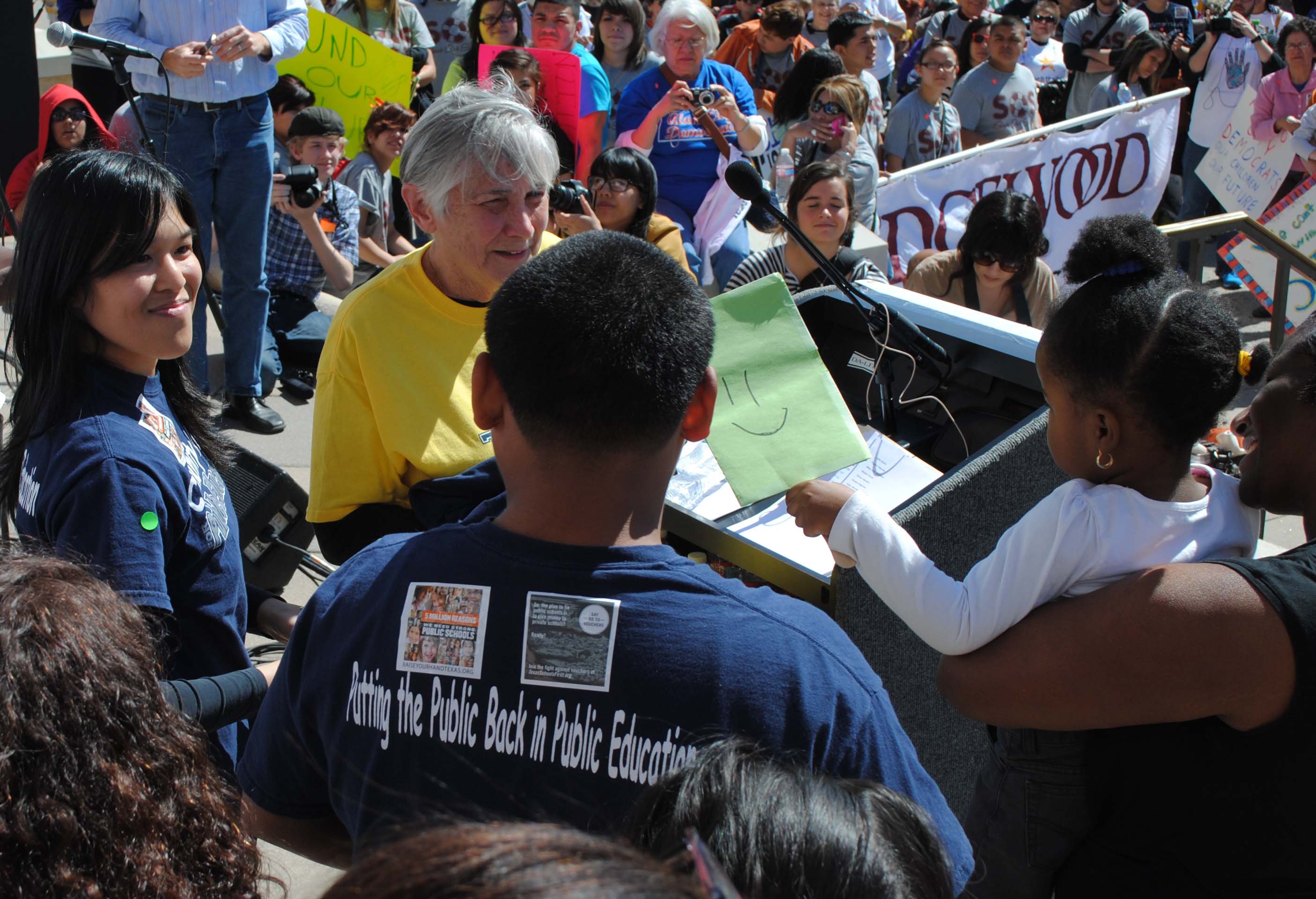
these photos were taken by retired Texas teacher Steve Coyle.

download5

download6

download7

download8

Governor John Kasich has made clear that he wants to privatize the schools of Ohio as much as possible with vouchers, charters, and online schools. His new budget reflects his attitude toward public education.

This report came from Jan Resseger in Cleveland. Jan works tirelessly on behalf of equity and social justice.

It is likely you have been getting mixed messages about Ohio’s proposed school funding plan. The political rhetoric is designed to confuse you. How to sort out the facts and how to consider the moral implications of the plan that will allocate opportunity among Ohio’s children?

First, forwarded below is an alert from the Ohio Coalition for Equity and Adequacy of School Funding. You’ll remember them as the DeRolph plaintiff group. The point being made here is clear and simple. Of course poor districts will get more from the state than the wealthiest districts, even though the proposed formula for this biennium rewards rich districts more than poor districts. All of Ohio’s school funding plans going back over a century deliver more money to poor districts. That is a primary function of a state funding formula… to make up at least to a tiny degree for disparate property taxing capacity across local school districts. Back in the 1990s, the Supreme Court of Ohio found four times that Ohio’s formula did not do a good enough job of equalizing access to opportunity.

The problem with this year’s budget proposal is that it doesn’t deliver anywhere what is needed to make up for vast disparities in local property taxing capacity. This means that school districts in wealthy communities will continue to have plenty while the poorest rural and urban districts won’t have nearly enough. This means, for example, that despite passage of a 15 mill levy last November, Cleveland probably still won’t be able to afford to reduce class size enough or hire back all the social workers who were laid off two years ago.

It is appropriate here to remember the words of political philosopher Benjamin Barber: “Equality is not achieved by restricting the fastest, but by assuring the less advantaged a comparable opportunity. Comparable in this matter does not mean identical. The disadvantaged usually require more assistance to compete. Adequate schooling allows those born disadvantaged to compete with those advantaged.”

Here also is a link to an analysis of the proposed state budget by an alternative newspaper in Cincinnati. It is a fair and balanced analysis.

In a constitutional, thorough and efficient system of public common schools, all students and all districts should be winners when a state budget bill is crafted. The state has the constitutional responsibility to secure a thorough and efficient system of public common schools for the benefit of all of Ohio’s school children. So why should there be any losers?

State administration officials, in regard to their state budget, had said such things as:

Students in every zip code deserve a quality education
If you are poor you will get more, if you are rich you will get less
The district-by-district spreadsheet revealed that poor districts typically will not receive more state aid than the current amount. The administration officials then said:

We were not looking for a specific per pupil funding number-there is no magical number
We are not attempting to arrive at a cost amount per pupil
Poor school districts receive more total state money per pupil
A historical perspective is warranted. Poor districts have received more state money per pupil than rich districts since at least 1906. SB 103, enacted April 2, 1906, provided state funds to poor districts on top of the state subsidy of $1.85 per pupil for all districts. In May 1908, HB 1302 appropriated $45,000 “to assist with the maintenance of weak school districts.” A $50,000 appropriation, via HB 561, was enacted in May 1910-again, to put more state money in poor school districts.

The state’s first foundation program (Ohio Foundation Program) was enacted in 1935. The Foundation Program Act provided additional funding to poor districts in addition to the state “flat rate” per pupil amount to all districts. The legislature revised the foundation law in 1947 but the result remained the same-more state aid to poor districts.

In August 1975 the legislature enacted SB 170 which included the equal yield formula. The premise was to yield more state funds to poor districts. Equal yield was repealed in the early 1980s in favor of a return to the foundation program. The equal yield formula failed because it was grossly underfunded.

The idea of more funds for low wealth districts is obviously not new. However, even with more state funding per pupil provided to low wealth districts, the total per pupil revenue available to low wealth districts is much less than high wealth districts. Since, in general, low wealth districts will receive no increase with the proposed state budget, the equity gap will widen.

The proposed budget for FY 14 & FY 15 is a loser for all districts. In general, most school districts will be receiving less state and federal money than they received in FY 11. K-12 public education will not benefit from an improved Ohio economy under the state budget proposal and thus a greater burden will be shifted to local revenue sources.FY 2014 and FY 2015 STATE BUDGET PROPOSAL:

Rich districts, poor districts, which are the winners?

Ms. Jan Resseger
Minister for Public Education and Witness
Justice and Witness Ministries
700 Prospect, Cleveland, Ohio 44115
216-736-3711
http://www.ucc.org/justice/public-education
“That all citizens will be given an equal start through a sound education is one of the most basic, promised rights of our democracy. Our chronic refusal as a nation to guarantee that right for all children…. is rooted in a kind of moral blindness, or at least a failure of moral imagination…. It is a failure which threatens our future as a nation of citizens called to a common purpose… tied to one another by a common bond.” —Senator Paul Wellstone, March 31, 2000