Archives for category: Billionaires

Fred Smith worked as an assessment specialist at the New York City Board of Education for many years. Recently he has advised opt-out groups. In this comments, he describes the remarkable power of Merryl Tisch, whose family are billionaires and influential in New York civic life. Note: Before King was named New York State Commissioner of Education, he founded and Leda charter school in Massachusetts that had the highest suspension rate in the state (59%).

Smith writes:

Coming soon to a campus near you: The Return of the Tisch Flunky.

Fill in the blanks– Sheldon Silver, Democratic leader of the New York Assembly, which selects members of the Zboard of Regents…. Merryl Tisch appointed to Board of Regents (1996) and elevated to Regents Chancellor by Silver (2009)…. Tisch and John King are classmates at Teachers College (small-group accelerated doctoral program)…. Tisch pushes King to become NYS Education Commissioner…. Andrew Cuomo advocates implementation of Common Core with Tisch’s willing compliance…. Opt Out Movement strongly opposes CC…. King leaves SED for USDE (2014)…. Silver found guilty of corruption charges (2015), convicted and expelled from NYS Assembly…. Tisch steps down as Regents chancellor after 20 years…. Cuomo appoints Tisch to SUNY Board of Trustees (2017) and elevates her to SUNY chairman…. Cuomo uses Tisch to abandon “national search” for new SUNY chancellor in order to give his closest adviser, James Malatras the job…. Cuomo stench starts catching up to Malatras, and Kathy Hochul tells Tisch to dump him…. Tisch praises Malatras and gives him a golden parachute. King announced as the next SUNY chancellor with words of praise a huge salary and perqs from Tisch.

Yes, there was a national search to find him.

Ryan Cooper writes at The American Prospect that Elon Musk is a walking, talking demonstration of the problem that affects billionaires and oligarchs. His extreme wealth, which at one point, was $300 billion, was about the same as the GDP of Finland. His bid for Twitter far exceeded its actual stock value, which is why he tried to back out of his offer.

He writes:

Elon Musk’s purchase of Twitter does not seem to be going well. Just three weeks after buying the company, Musk has fired the entire executive suite and half the staff, fired dozens more for insufficiently slavish devotion, and most recently has apparently driven off something like 40 percent of those who remain with an abrupt demand to submit to a “hardcore” new contract without most of the relevant details.

Though Twitter is still functioning at time of writing, in my experience it has become notably more glitchy and is swarming with bots. Informed observers are predicting that absent a major change of course, serious technical instability, major security breaches, or even total collapse are just a matter of time. “I know of six critical systems (like ‘serving tweets’ levels of critical) which no longer have any engineers,” one former employee told The Washington Post. “There is no longer even a skeleton crew manning the system.”

We can conclude one thing from this mess for sure: The oligarch class has entirely too much money.

One of Musk’s bad ideas was to change the verification system. Previously, if you established your identity, you got a blue check mark next to your name. Musk decided that anyone could buy the blue check mark for $8 a month, and a large number of fake accounts were created and used to insult or mock others. Someone opened a Pepsi account and advised people to drink Coca-Cola.

Musk promptly obliterated the company’s business model. He drove out the head of ad sales, alarming the companies that account for nine-tenths of Twitter revenue. He implemented a new verification system where anyone can pay for a blue check, which (of course) led thousands of people to impersonate celebrities, politicians, and huge companies. Eli Lilly and Lockheed Martin lost billions of dollars in market capitalization because two jokers spent $8. Advertisers, logically fearing Twitter would turn into a cesspit of abuse, racist slurs, and child porn, and turned off by Musk’s erratic behavior, started shunning the company….

Strictly speaking, an individual’s net worth is not the same as national GDP; one is a stock and the other is a flow. But it gets at the important point, which is that Elon Musk and his fellow ultra-oligarchs command resources comparable to those produced by a small wealthy nation over an entire year. Economists assume wacky stuff like “hugely overpaying for a company and immediately driving into a ditch” won’t happen, because all the monetary incentives are against it. But while Musk has lost nearly half his net worth since its peak, and probably will lose a lot more once all this is finished, he will almost certainly still be a multibillionaire at the end. Guys like him can lose more money than any single person has ever lost in history, in less than a month, and still have enough to live 10,000 lifetimes in resplendent luxury.

The odds of such a thing happening increase when one considers the social effects of extreme wealth. Being that rich tends to both convince people that they are heroic geniuses far beyond the capabilities of ordinary mortals, and isolate them from any normal social interaction or criticism. It is exceptionally easy to attract a coterie of yes-men and toadies who will indulge your every whim and bad habit. Substance abuse problems and delusions of grandeur are frequent. Sound familiar?

Non-rich people can be erratic weirdos too, and ordinary businesses without megalomaniac oligarch CEOs have destroyed themselves in the past. But allowing wealth to concentrate to such a degree greatly increases the chance of the kind of completely pointless disaster that has befallen Twitter.

During the New Deal, the oligarch class was cut down to size with confiscatory income taxes on the very rich, which topped out at 94 percent for the top bracket. We could go one better by adding a wealth tax to the largest fortunes, as economists Thomas Piketty and Gabriel Zucman suggest, perhaps even plowing the proceeds into an Alaska-style social wealth fund for the benefit of all.

The solutions are readily available. The larger point is this: The existence of major companies shouldn’t hinge on the behavior of loopy, Reddit-poisoned crackpots.

Mackenzie Scott, ex-wife of Jeff Bezos and richest woman in the world, has released her list of very lucky grant recipients. No one knows who advises her. No one applies for grants. Decisions about her largesse are secret.

Among the lucky recipients are Girl Scouts, Junior Achievement, Urban League chapters, Big Brothers Big Sisters Clubs, and many more.

A dozen public school districts were on her list, including Detroit and Chicago. She gave the Chicago Public Schools $25 million, but the Noble Network of Charter Schools in Chicago got $16 million, and LEARN Charter School Network in Chicago will receive $7 million. The two charter chains will get almost as much as the much larger school district. The Noble Network has 12,700 students. The LEARN charters enroll 4,000 students, pre-K through grade 8. The Chicago Public Schools enroll 320,000 students. So, 16,700 students get almost the same as 320,000 students.

Teach for America, which has hundreds of millions in its bank account, was gifted with $25 million.

Four KIPP charter schools received millions, although KIPP is amply funded.

Need does not seem to be a criterion in her giving.

I’m sorry to post so much about Elon Musk,, but it’s fascinating in a horrifying way to see the nation’s richest person, a man celebrated for his business acumen and technological genius, take over a social media platform with 400 million followers and proceed to disrupt it, frighten advertisers away, and create chaos. After I wrote this post, I read this morning that Musk warned employees that bankruptcy was a real possibility. And more of his top leadership team left.

NBC News reported:

Twitter’s chief information security officer and chief compliance officer resigned late Wednesday night as the company started implementing changes that would allow users to more easily impersonate major brands and government officials.

The departures came just hours before the company’s new CEO, Elon Musk, sent his first email to Twitter employees, titled “difficult times ahead,” and implementing a mandatory return-to-work policy.

Lea Kissner, the chief information security officer, confirmed they had left in a Twitter post Thursday morning. Chief Compliance Officer Marianne Fogarty has also left the company, according to a person familiar with the situation who asked to remain nameless because they were not authorized to speak publicly.https://www3.nbcnews.com/news/embedded-newsletter/rcna56597#amp=1

“I don’t watch Game of Thrones. I certainly don’t want to play it at work,” Fogarty tweeted Monday.

A spokesperson for the Federal Trade Commission said in an emailed statement that it is keeping watch on the situation.

“We are tracking recent developments at Twitter with deep concern,” the spokesperson wrote. “No CEO or company is above the law, and companies must follow our consent decrees. Our revised consent order gives us new tools to ensure compliance, and we are prepared to use them.”

On Wednesday, Twitter rolled out the new Twitter Blue, which allows any user to purchase a verification badge for $7.99 per month as long as they joined Twitter before Nov. 9. As feared by cybersecurity professionals, users immediately used the pay-to-play feature to impersonate public figures and brands. One user impersonating LeBron James demanded a trade from the Los Angeles Lakers.null

The resignations add to what has already been a chaotic two weeks with Musk at the helm of Twitter, where he recently said the company “will do lots of dumb things in coming months.”

Evelyn Douek, a professor at Stanford Law School, writes in The Atlantic about the international appetite to regulate social media, a fact that Elon Musk seemed not to anticipate.

She writes:

In the coming weeks, Musk is in for some surprising meetings and phone calls, it seems (if anyone’s left in the Twitter legal department to set up those meetings or calls). Canada’s C-11 bill, also known as the Online Streaming Act, would greatly increase governmental control over online content, and it is part of a wave of new internet-speech laws now being debated or implemented in countries around the world….

Since then, Musk has made numerous statements about his plans to change how the platform moderates content—that is, how it treats the material that its users post on its site. Most of these plans seem to involve taking a lot less content down. The mercurial Musk might not actually follow through on these thought bubbles; making good on his vow to “defeat the spam bots,” for example, would require Twitter to shut down more accounts, not fewer. But the overall tenor of his comments reflects a certain nostalgia for the more libertarian early days of social media. Musk seems to believe that “the tweets must flow,” as one of Twitter’s co-founders famously declared in 2011.

But the halcyon days of social-media platforms’ youth are over, and the regulatory landscape that these platforms grew up in is gone forever. In fact, contrary to common understanding, social media has never been unregulated. As the Georgetown professor Anupam Chander has argued, “Law made Silicon Valley,” by intentionally giving platforms a wide berth in how they treated content on their website. The centerpiece of this approach is the now-famous Section 230, which immunizes platforms from liability for most of their content-moderation choices. No other country has been as hands-off as the United States, but platforms have enjoyed substantial regulatory leeway in much of the rest of the world too. Now, amid a widespread belief that the tech giants are changing society for the worse, many jurisdictions are looking for ways to rein them in. And in many places, they are succeeding.

In the U.S., members of Congress have introduced a pile of bills to amend Section 230, but even if none becomes law, the legal framework in which internet platforms operate appears to be on shaky ground. In October, the Supreme Court agreed to hear two cases that may dramatically narrow Section 230’s scope and expose platforms to much more regulatory risk. In the first, Gonzalez v. Google, the relatives of an American student killed in a 2015 terrorist attack in Paris are suingYouTube’s parent company over Islamic State propaganda on the site. The Court will decide whether social-media platforms become liable for users’ content if they algorithmically recommend it to other users. If the justices say yes, then Twitter could suddenly be on the hook for recommending defamatory speech or harassment or speech that supports terrorism. The impact of such a ruling on Musk’s platform could be enormous, because basically everything in most users’ Twitter feed is “recommended” in one form or another.

In the second case, Twitter v. Taamneh, the Court will decide whether platforms can be found to have aided and abetted terrorism if terrorist propaganda appears on their sites, notwithstanding the fact that platforms already remove a lot of such material. If both of these cases come out against the platforms, Musk’s apparent disdain for taking content down might quickly evaporate….

More regulation is coming across the Atlantic too. After Musk tweeted “the bird is freed” on Thursday, European Union Commissioner for Internal Market Thierry Breton responded with a friendly reminder: “👋 @elonmusk In Europe, the bird will fly by our 🇪🇺 rules. #DSA.” The hashtag referred to the EU’s new Digital Services Act, which was passed this year and will take effect over the next few years. The complicated and sweeping law imposes a wide variety of risk-assessment, auditing, transparency, and procedural obligations on large platforms and exposes them to massive fines if they don’t comply. Unlike with the Canadian bill, Musk at least has heard of this one. In May, a few weeks after Musk announced he was buying Twitter with much bravado, Breton released something that vaguely resembled a hostage video, shot just after he had explained the DSA in a discussion with Musk. In it, the two men shook hands, and an uncharacteristically obliging Musk told Breton, “I agree with everything you said, really.”

In short, Musk wants fewer limits on Twitter content, but the regulatory environment is changing in ways that he won’t like. Not only in the U.S., but internationally. Racists, haters, anti-vaxxers, anti-maskers, and conspiracy theorists might not find a congenial home on Twitter.

In addition tto regulators and courts, Musk will have to persuade the big advertisers whose revenue he needs that Twitter has not turned into a swamp of lies, hate, and propaganda.

Steve Hinnefeld, Indiana blogger, writes about the political donations of billionaires who claim to be “liberal Democrats.” First and worst is Reed Hastings, who is CEO of Netflix. Hastings claims to be a supporter of women’s reproductive rights, but he has funded Republicans in Indiana who passed one of the most restrictive abortion bans in the nation. Why? Because these same conservative Republicans support charter schools. Hastings has said that he looks forward to the day when there are no more school boards, and every school is a charter. So, his passion for charter schools is stronger than his commitment to women’s reproductive rights. His allies in Indiana also loosened restrictions on guns. Michael Bloomberg, who favors abortion rights and gun control, also bankrolled the same Republicans.

Hinnefeld writes:

Indiana Republicans are spending several million dollars to protect and extend their supermajority status in the state House and Senate in Tuesday’s election. If they succeed, they may want to thank a California billionaire. One who’s usually described as a liberal Democrat.

Reed Hastings is a CEO of Netflix. Politically, he’s known for donating to Democratic politicians, nationally and in California. Netflix supports liberal causes, like abortion rights. But in Indiana, his campaign contributions go almost entirely to Republicans, who trample on his supposed principles.

It’s possible Hastings has given more money to the Indiana House and Senate GOP campaigns than any other individual in the past couple of years. Not directly. The money is funneled through a political action committee called Hoosiers for Great Public Schools. The PAC, headed by former Democratic Indianapolis Mayor Bart Peterson, was founded in 2020 to promote charter schools.

Almost all its direct support for candidates goes to Republicans.

Hastings has given the group $1.4 million, half of it in 2020 and half this year. It also got $200,000 from John Arnold, a Texas billionaire. That’s all the money it has raised.

Hoosiers for Great Public Schools has made campaign contributions totaling $926,000. Some $400,000 went to RISE Indy, a PAC that has supported charter-friendly candidates for the Indianapolis Public Schools board. Another $100,000 went to Hoosiers for Quality Education, which promotes school choice, including vouchers and education savings accounts, and gives exclusively to Republicans.

Of the remaining $426,000 that Hoosiers for Great Public Schools contributed, nearly all went to GOP candidates and groups. It has given $190,000 to the House Republican Campaign Committee, $45,000 to the Senate Majority Campaign Committee, and $75,000 to House Speaker Todd Huston, along with four- and five-figure donations to individual Republicans.

That’s who Reed Hastings is helping elect in Indiana.

A similar story can be told about Michael Bloomberg, the billionaire former mayor of New York City. He’s known for supporting liberal causes, including gun control and abortion rights. In recent years, Bloomberg has given $550,000 to Stand for Children Indiana, which supports charter schools. All of Stand for Children’s state-level contributions this year have gone to Republicans.

There’s a cynical argument for such behavior: If you have money and you want to influence Indiana politics, you give to Republicans, because they have the power.

Peterson, CEO of Christel House International, which operates charter schools in Indianapolis, told me in 2020 that the purpose of Hoosiers for Great Public Schools was to support charter schools. But Indiana Republicans are no longer in love with charter schools. In 2021, they gave charters a modest funding increase. In 2022, they did nothing. They have moved on to favoring a more radical form of school choice in which state money “follows the child,” including to private and religious schools.

What did Hastings get with his support of the Indiana GOP? For one thing, a new law that says Hoosiers don’t need a permit to carry a handgun in public. For another, a discriminatory anti-trans law that bars transgender students from school sports teams. Republicans also tried to restrict what schools could teach about “divisive topics” – i.e., racism and slavery – but fell short.

Shame on Reed Hastings!

Shame on Michael Bloomberg!

Shame on John Arnold!

Hypocrites!
The 1% understand very well that the Republican Party is dedicated, first and foremost, to cutting the taxes of the rich. How else to explain the billionaires who don’t like Trump but spent millions on candidates who repeated The Former Guy’s Big Lie?

Of course, they want low taxes. But they have another goal: School choice. Somehow these billionaires became convinced that charters and vouchers are superior to public schools, and they want to make sure that those in public office agree with them, regardless of ample evidence that school choice has proven to be a failure over the past three decades.

Maggie Severns reports at GRID:

Some of the biggest Republican megadonors don’t support former president Donald Trump — but have wound up supporting his candidates.

Ken Griffin, the founder of hedge fund Citadel and currently the third-biggest donor to the 2022 midterms, is a business leader and repeat critic of Trump. Earlier this year, he publicly called on Republicans to abandon the idea that the election was stolen, saying, “It’s really important that we end the rhetoric in America that elections can be rigged.” He maintains the Republican Party should “move on” from Trump in 2024.

When it came time for this year’s midterms, Griffin went big, becoming a top contributor to super PACs helping Republicans win back the House and Senate. But those super PACs are supporting the very politics that Griffin has shunned: He gave $10 million to a PAC that has aired ads for Blake Masters, the Republican Senate candidate in Arizona, a Peter Thiel acolyte who has falsely claimed Democrats are trying to “import” immigrants to help them win elections; Mehmet Oz, the Republican Senate nominee in Pennsylvania who recently said “lots more information” is needed to determine if Trump won the 2020 election; and Adam Laxalt, the Republican nominee in the Nevanda senate race, a former state attorney general who held press conferences and filed lawsuits alleging widespread voter fraud in 2020….

Jeffrey Yass, the richest man in Pennsylvania and the fourth-largest donor of the midterms, didn’t give money to Trump’s campaign during the 2020 election, but he has poured $47 million into federal politics this cycle, much of it to the conservative Club for Growth and an affiliated PAC, which have supported candidates who espouse conspiracy theories and challenged the 2020 election results. Yass is also focused on education policy, working to advance charter schools and school choice with his political money. Republican financier Paul Singer, another major super PAC donor who did little support to Trump, has spent $20 million this cycle.

Many Twitter users are fearful for the future of the popular social media site since it was purchased by Elon Musk. He is taking the company private and will be the sole proprietor. He has said he is an absolutist on free speech, which raises questions about whether he will tolerate hate speech, lies, propaganda, anti-vaxxers, disinformation, even Donald Trump, who was permanently banned from Twitter for inciting violence.

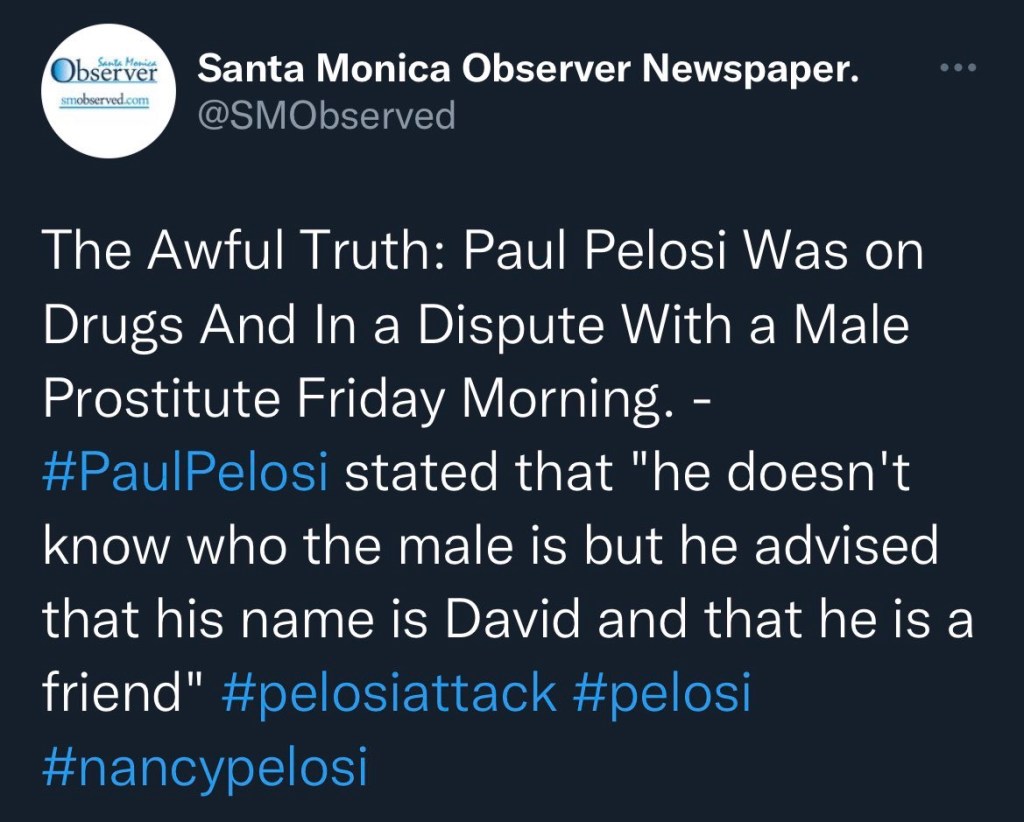
Now, the concern about Musk was stoked when he retweeted gossip from a free weekly (the Santa Monica Observer) that Paul Pelosi was drunk, high on drugs, and got into a fight with a man he picked up at a gay bar.

Musk posted that there was a “tiny possibility” that this was true. As readers began to react with incredulity that the new owner would spread unsubstantiated gossip, Musk deleted his tweet. Musk has 112 million followers on Twitter.

The San Francisco Chronicle wrote:

Musk responded Sunday at 5:15 a.m. Pacific time with a tweet that said, “There is a tiny possibility there might be more to this story than meets the eye,” and posted a link to a baseless, anti-LGBTQ article in the Santa Monica Observer. By 10:30 a.m. Sunday, the message and link had been retweeted more than 30,000 times and liked more than 110,000 times, before being deleted less than an hour later.

Last year, the Los Angeles Times reported that the Santa Monica Observer was “notorious for publishing false news,” and once claimed “that Hillary Clinton had died and that a body double had been sent to debate Donald Trump.”

Axios posted that the Santa Monica Observer is not a trustworthy site.

Why it matters: Musk linked to an article from the Santa Monica Observer, a website known for years for publishing false stories.

  • The site “is anything but trustworthy,” according to an executive at NewsGuard, a company that uses trained journalists to rate news and information sites.
  • The site has a trust score of 44.5 out of 100 points on NewsGuard’s rating scale for trustworthiness, due to repeatedly publishing numerous conspiracy theories and false claims about politics, the pandemic and more.
  • The site gets a red-rating and a warning for readers that says: “Proceed with caution: This website fails to adhere to several basic journalistic standards.”

Responsible people in the media fact-check. Musk didn’t think it was necessary. This does not bode well for the future of Twitter.

We have had our fill of conspiracy theories in the past six years.

It’s awful to think that the sole owner of Twitter will be a dupe for conspiracy theories and gossip and spread them to his millions of readers.

Just for laughs, read this article in The Intercept, which predicts that Elon Musk will regret his purchase of Twitter.

It begins:

ELON MUSK (and his consortium of much smaller investors) now owns Twitter. We need to take seriously the possibility that this will end up being one of the funniest things that’s ever happened.

That’s because as of this moment, it looks like Musk dug a big hole in the forest, carefully filled it with punji sticks and crocodiles, and then jumped in.

Elon Musk, the nation’s richest man, is heavily subsidized by taxpayers, according to an article in the Los Angeles Times. Musk’s net worth is somewhere about $210 billion. Yet he goes where the government money is.

Los Angeles entrepreneur Elon Musk has built a multibillion-dollar fortune running companies that make electric cars, sell solar panels and launch rockets into space.

And he’s built those companies with the help of billions in government subsidies.

Tesla Motors Inc., SolarCity Corp. and Space Exploration Technologies Corp., known as SpaceX, together have benefited from an estimated $4.9 billion in government support, according to data compiled by The Times. The figure underscores a common theme running through his emerging empire: a public-private financing model underpinning long-shot start-ups.

“He definitely goes where there is government money,” said Dan Dolev, an analyst at Jefferies Equity Research. “That’s a great strategy, but the government will cut you off one day.”

The figure compiled by The Times comprises a variety of government incentives, including grants, tax breaks, factory construction, discounted loans and environmental credits that Tesla can sell. It also includes tax credits and rebates to buyers of solar panels and electric cars.

A looming question is whether the companies are moving toward self-sufficiency — as Dolev believes — and whether they can slash development costs before the public largesse ends.

Tesla and SolarCity continue to report net losses after a decade in business, but the stocks of both companies have soared on their potential; Musk’s stake in the firms alone is worth about $10 billion. (SpaceX, a private company, does not publicly report financial performance.)

Musk and his companies’ investors enjoy most of the financial upside of the government support, while taxpayers shoulder the cost.

The payoff for the public would come in the form of major pollution reductions, but only if solar panels and electric cars break through as viable mass-market products. For now, both remain niche products for mostly well-heeled customers.

Musk declined repeated requests for an interview through Tesla spokespeople, and officials at all three companies declined to comment.

Thanks to our reader Joel for directing me to this story.

Maurice Cunningham is the nation’s leading expert on “Dark Money” in education. This is money given to organizations and candidates by anonymous donors. When the donors are occasionally revealed, they are typically billionaires who want to destroy public schools and teachers’ unions.

He recently wrote this post, which I excerpt here, about the “management chaos” at the so-called National Parents Union. As he points out, the two leaders of NPU are a married couple.

He writes:

That must have been some “convening” National Parents Union held in September because by October two of NPU’s five board members had disappeared, as had four of the nine individuals on their September 17 “Our Leadership” page and all—ALL—of NPU’s “delegates.” NPU disappears more people than the entire run of The Sopranos. NPU,—not national, not about parents, not a union—is routinely mismanaged, but it seems to be in more chaos than usual.

Board of Directors

Let’s start with the board of directors, a spin-the-bottle operation if there ever was one. Here are the board members identified on the NPU website on September 17 and October 12, 2022:Sept 17, 2022 Board of DirectorsOct 12, 2022 boardPeter CunninghamPeter CunninghamArthur SorianoVincent SlaughterVincent SlaughterMaria Del Carmen Parro CanoDr. Paul BloombergDr. Paul BloombergAnashay Wright

It’s worse than it looks. Ms. Wright was added as a board member on July 28, 2022 along with Shirley Irizarry, On October 3, after two months on the board, Ms. Irizarry was apparently dropped from the board and hired for a staff position as National Organizing Director West Region (according to a Twitter post; she is not on the October 12 website). Mr. Soriano, Mr. Slaughter, Ms. Del Carmen Parro Cano, Dr. Paul Bloomberg, and Vivett Dukes were all added to the board on July 28, 2021. Now Mr. Soriano, Ms. Del Carmen Parro Cano, and Vivett Dukes are all gone. That’s peculiar since Mr. Soriano is supposed to act as president until 2026.

There were three original board members. Mr. Cunningham, Bibb Hubbard (connected to the Gates Foundation), Gerard Robinson (a possible proxy for Charles Koch), and Dan Weisberg. Except for Mr. Cunningham they’re all gone, most within a year of NPU’s launch.

Then there’s the fact that NPU has two boards of directors, the one on the website for public consumption and the one on file with the Massachusetts Secretary of State’s Corporations Division, where NPU is incorporated. Currently NPU lists a board with the Secretary that consists of Mr. Cunningham, Mr. Soriano, Mr. Slaughter, Ms. Del Carmen Parro Cano, Dr. Paul Bloomberg—and Keri Rodrigues and Tim Langan, also identified with the Secretary as president and treasurer, respectively. So far as is known neither Ms. Rodrigues nor Mr. Langan have ever appeared on the website as directors. On the original corporate filings the board was listed as Ms. Rodrigues, Mr. Langan, and Alma Marquez. Ms. Marquez was also on the website as a co-founder and elected treasurer but NPU listed Jennifer Rego as treasurer with the commonwealth of Massachusetts. Ms. Rego disappeared. Ms. Marquez disappeared and Mr. Langan is treasurer. Mr. Langan and Ms. Rodrigues are married. Their compensation from NPU when combined with another Walton family operation named Massachusetts Parents United was $626,777 in 2020 which appears to be wildly out of line with industry standards. But when you’ve replaced the treasurer with . . .