Archives for category: Bill de Blasio

After hearing from a parent in Brooklyn that decisions at the New York City Department of Education were being made by Broadies and TFA, Leonie Haimson did some digging. The parent was right. The same people appointed by Joel Klein more than a decade ago are still closing schools, imposing the portfolio model, and opening charters. De Blasio appointed Carmen Farina to run the DOE. Farina was Deputy Chancellor to Klein and left in a a dispute. But apparently she saw no reason to clean house.

Leonie shows that it is not only Broadies and TFA, but the nefarious Education Pioneers, another billionaire-funded outfit the is running the show in New York City.

Wake up, Bill de Blasio! You inherited the status quo! When if ever will you clean house?

Arthur Goldstein is pretty damned angry at Mayor DeBlasio. The city just loaded billions of dollars of tax breaks onto Amazon and multibillionaire Jeff Bezos, even giving Amazon one of the Department of Education’s buildings in Queens. But Goldstein’s students are crammed into crowded classrooms.

Where are the city’s priorities?

I’m shocked that the city has space to turn over to Amazon but can barely find any for schools. I suppose it’s an extraordinary privilege to be able to provide Jeff Bezos a new helipad, while rolling out the red carpet for thousands of high-paid workers, who may or may not even live here. From my perspective, teaching 34 students in half a classroom, I’m not particularly concerned about where the world’s richest man parks his business, let alone his helicopter.

I’ve been working at Francis Lewis High School in central Queens since 1993, and I can’t recall a time when we’ve been so pressed for space. While I bemoan my half room, some of my colleagues are teaching in windowless converted book storage rooms. After years of complaints, admin found a way to air-condition them. Despite this, the air quality is still sub-standard, according to recent tests conducted by UFT….

It’s all about priorities, and the city that so long claimed to place children first is failing spectacularly to do so. In three or four years our school will have an annex, but who’s to say the DOE won’t just dump another thousand kids on us so we’re as overcrowded as ever?
There might be a time to lavish billions in subsidies on Jeff Bezos, but that time is most certainly not now. Our schools and our kids are more important, by far, than bragging rights for Amazon.

Is this fair?

As Leonie Haimson explains in this post, the New York Times published a front-page article on the failure of Mayor Bill deBlasio’s $773 Million Renewal Schools Program. The Mayor touted it as the antidote to former Mayor Bloomberg’s preference for closing schools. Ironically, many of the Klein-Bloomberg people were left in place to run the new program.

But, says Haimson, that’s not why Renewal Schools failed. The program failed because its leaders resolutely ignored the one reform that has proven to get the best results: reducing class size.

The few Renewal Schools that did reduce class size actually succeeded.

Those that didn’t struggled and failed.

Leonie Haimson writes about it here.

Back in the days of Mayor Bloomberg and Joel Klein, the policy of the city was to close big high schools that had varied programs (e.g., music, the arts, advanced classes in math and science) and replace them with small schools. Almost every large high school in the city was closed. One of them was DeWitt Clinton, which had become a dumping ground for the small schools that did not want students with low test scores, English learners, and students with disabilities. In effect, the school–once known for its excellence–was turned into a graveyard.

Klein and his acolytes touted the New York City Miracle, built on testing, testing, testing, and small schools.

A piece of the architecture fell apart recently at DeWitt Clinton, when teachers leaked that students who never attended class were getting good grades and graduating, based on credit recovery by computer (at home).

This high school is a hooky player’s dream.

At DeWitt Clinton HS in the Bronx, kids who have cut class all semester can still snag a 65 passing grade — and course credit — if they complete a quickie “mastery packet.”

Insisting that students can pass “regardless of absence,” Principal Pierre Orbe has ordered English, science, social studies and math teachers to give “make up” work to hundreds of kids who didn’t show up or failed the courses, whistleblowers said.

“This is crazy!” a teacher told The Post. “A student can pass without going to class!”

The 1,200-student Clinton HS is one of 78 struggling schools in Mayor deBlasio’s “Renewal” program. Last year, 50 percent of seniors graduated, but only 28 percent of the grads had test scores high enough to enroll at CUNY without remedial help.

The DOE’s academic-policy guide says students “may not be denied credit based on lack of seat time alone.” Passing must be based “primarily on how well students master the subject matter.”

Orbe has taken the policy to a absurd extreme, teachers charge.

Leonie Haimson of Class Size Matters says that DeWitt Clinton, which is part of Mayor de Blasio’s “Renewal Schools” initiative, has very large classes, some as large as 39. That’s one remedy that the mayor ignored.

By the way, if you want to meet Leonie (and me), we will be at the annual dinner of Class Size Matters tomorrow night in New York City. It is not too late to get a ticket.

Can you answer the questions on the test that eighth graders take to compete for admission to New York City’s Top High Schools?

Chalkbeat posted sample questions.

Very few African-American or Hispanic students gain admission, which is based entirely on passing the test. They ar3 70% of students in the city’s schools but only 10% of those in the specialized high schools.

Asian parents object to any effort to replace the current test-based system.

“While just 16 percent of public school students are Asian, they make up 62 percent of students at the specialized schools. White students also make up a disproportionate share of the students, though by a much smaller margin. They are 15 percent of the system overall and 24 percent of students at specialized schools.”

Mayor de Blasio ultimately hopes to eliminate the test and use other criteria for admission. The Mayor prefers to judge applicants by such metrics as class rank at their middle school and scores on state tests. However, to make these changes would require approval by the State Legislature. Alumni of the selective schools in the Legislature have prevented change in the past. In addition, de Blasio has enemies in Albany. The odds of a victory in Albany are slim. It may seem strange that the Mayor needs to get the Legislature’s okay to change admission requirements to selective high schools, but defenders of the school put this into law many years ago.

New York City public schools include eight high schools that admit students on the basis of a single score, a rigorous test that all applicants musty take. That requirement is set in state law.

Mayor de Blasio wants to increase diversity by scrapping the single test.

The de Blasio administration wants to increase diversity at the schools, which are dominated by white and Asian students, and small numbers of Black and Hispanic students.

“The city’s specialized high schools — considered some of the crown jewels of New York City’s education system — accept students based on a single test score. Over the last decade, they have come under fire for offering admissions to few students of color: While two-thirds of city students are black or Hispanic, only about 10 percent of admissions offers to those schools go to black or Hispanic students…

“Right now, we are living with monumental injustice. The prestigious high schools make 5,000 admissions offers to incoming ninth-graders. Yet, this year just 172 black students and 298 Latino students received offers. This happened in a city where two out of every three eighth-graders in our public schools are Latino or black.

“There’s also a geographic problem. There are almost 600 middle schools citywide. Yet, half the students admitted to the specialized high schools last year came from just 21 of those schools. For a perfect illustration of disparity: Just 14 percent of students at Bronx Science come from the Bronx.”

In the past, efforts to change the admissions requirements of these specialized high schools have been blocked by the Legislature, which includes a number of graduates of the specialized schools.

Chalkbeat summarized the specifics of the mayor’s plan:

“De Blasio’s solution, laid out in an op-ed in Chalkbeat, would set aside 20 percent of the seats at the eight schools for students from low-income families starting next school year. Students who just missed the test score cut-off would be able to earn one of those set-aside seats through the longstanding “Discovery” program. Just 4 percent of seats were offered through that program in 2017.

“The mayor also said he plans to push state lawmakers to change a law that requires admission at three of the schools to be decided by a single test score. That’s something de Blasio campaigned for during his run for mayor in 2014 but hasn’t made a priority since.

“Most significantly, de Blasio says for the first time that he backs a system of replacing the admissions test with a system that picks students based on their middle school class rank and state test scores. The middle-school rank component is especially notable, as an NYU Steinhardt report found that the only way to really change the makeup of the elite high schools would be to guarantee admission to the top 10 percent of students at every middle school.

“If all of these changes were implemented, de Blasio says that 45 percent of the student bodies at the eight high schools would be black or Latino.”

In 2013, when Bill de Blasio ran for Mayor of New York City for the first time, he was an outspoken supporter of public schools and an equally outspoken critic of charter schools. Taking him at his word, he won over many public school parents and advocates by his willingness to break with the Bloomberg policy of favoring charters over public schools. At the time, he met with me, sought my endorsement, and won it based on his firm commitment to stop privatization. I feel betrayed after reading the story that follows.

His first schools chancellor, Carmen Farina, a high-level veteran of the Bloomberg administration, walked a fine line, trying not to antagonize either side. The public schools enroll over 1.1 million children and the charters enroll 114,000 students. The charters are the darlings of the financial world and Wall Street and the big donors.

The new chancellor, Richard Carranza, visited three charter schools yesterday and embraced them as “public schools,” not “publicly funded private schools,” which is what most people see with their own eyes since they are operated by private boards and make their own rules about admissions and discipline and other matters.

Leonie Haimson, in a note to her listserve, asks these questions:

If they are public schools, why do they refuse to follow state law when it comes to suspension and expulsion policies? Why do they refuse audits from the state comptroller, and refuse performance audits from the city comptroller?

Why do their Charter Management Companies refuse to comply with FOILs or Open Meetings Law?

Why do they have the right to access space at the city’s expense, while more than half a million public school students are crammed into overcrowded buildings with no hope of relief?

The reality is that charter schools are private corporations that use public funding, and use their backing from billionaires to demand special privileges from elected officials, while refusing to follow the same rules or submit to the same oversight as public schools that are governed by public bodies.

There is an emerging body of law which is challenging the notion that charter schools are public schools. See The Legal Status of Charter Schools in State Statutory Law by Preston Green and Bruce Baker. The reality is that charter schools claim to be public schools when that advantages them in terms of funding or PR, and claim that they are private entities when that advantages them in terms of being able to ignore laws pertaining to student discipline, building code regulations, fair labor practices, fiscal and performance transparency, and a host of other issues.

I have some questions: If charters are public schools, why are they allowed to close school and send their students, teachers, and parents to political rallies in Albany and at City Hall? Will Chancellor Carranza authorize all public schools to do the same or will he forbid the charter schools from using their students as political fodder to get more money for the charters? If charters are allowed to control their admissions and discipline policies, should other public schools get the same approval to do so? If deregulation is important for those “public schools,” why aren’t all public schools similarly deregulated? If charters are public schools, shouldn’t they be subject to the same legal requirements as other public schools? Or are they private contractors who are not state actors, as charters have repeatedly said in their defense in federal courts and before the NLRB?

Sharon Otterman of the New York Times wrote:

New York City’s schools chancellor signaled on Wednesday that he wanted to usher in a new era of détente between the Department of Education and the city’s charter school sector, which have often been at odds under the administration of Mayor Bill de Blasio over issues like finances and the pressures of sharing public school space.

“Charter Schools are public schools,” Richard Carranza, the chancellor, said in the cafeteria of the Bronx Charter School for Excellence, as he wrapped up a day of visits to three charter schools in Brooklyn and the Bronx, to which he had invited reporters along. Even that simple statement was likely to make waves among charter school opponents, who prefer to describe charters as privately run, publicly funded schools.

“The question about charters versus traditional public schools,” Mr. Carranza added, addressing reporters around a cafeteria table, “is a red herring.”

“I would say that the more dialogue we have around building a portfolio of good choices for all students in the city, and the less we emphasize a dialogue about ‘us versus them,’ the better it is for all the children in New York City,” he said.

Crossing what was once a white-hot line for the de Blasio administration, Mr. Carranza said he would visit a Success Academy charter school “in the next few weeks.” Mayor de Blasio was elected in 2013 vowing to take action against the aggressive expansion of charter networks like Success Academy, which is led by his former political rival, Eva S. Moskowitz, and which now runs 46 of the 227 charter schools in the city.

“Time for Eva Moskowitz to stop having the run of the place,” Mr. de Blasio said while campaigning in 2013. “She has to stop being tolerated, enabled, supported.”

In February 2014, Mr. de Blasio reversed a decision by former Mayor Michael R. Bloomberg to provide space in city public school buildings to three charter schools, all part of the Success network.

In the political fallout, state legislators, with urging from the governor, passed a law requiring the city to pay much of the rent for new charter schools if it denied them free space, effectively curtailing Mr. de Blasio from removing more schools.

Chancellor Carranza “said he was happy to hear all three of the charters he visited hired only certified teachers, but he steered clear of the divisive political issue at play: that most charter schools in New York City are not unionized.”


Leonie Haimson describes Mayor Bill de Blasio’s very bad, horrible week, in which he slandered teachers by saying they complain too much and closed a high school for struggling students over the protests of students. 

A reporter asked why so few complaints of sexual harassments by teachers had been resolved, and the mayor said that teachers like to complain.

Leonie responds:

“Really?  Only 471 complaints over the last four years itself seems quite low given the fact that there are more than 135,000 DOE employees — the largest by far of any city agency.  Instead, the more likely explanation for the low number of allegations and the even smaller number of substantiated complaints is the well-documented chronic dysfunction and corruption at the DOE internal investigative office, the OSI, staffed by agents who drag their feet, whitewash, or retaliate against teacher whistleblowers when they attempt to expose misdeeds of their superiors.”

She then went on to the meeting of the Board of Education, which the mayor controls:

”Then last evening the Panel for Educational Policy met at Murry Bergtraum HS, the first with the new Chancellor Carranza.  It started with typical DOE dysfunction, with hundreds of students, teachers, and parents standing in an incredibly slow line to sign up to speak, with two pairs of DOE employees assigned to take each of their names.   Each speaker was asked to spell out his or her name, while one DOE staffer then recited the name to another staffer, who slowly entered the names into laptops.

“When the meeting started at about 6:15 PM, Chancellor Carranza repeated the news that the increase in Fair Student Funding to 90% – though not the Mayor’s controversial comments about the “culture of complaint” at DOE.  The proceedings went on till past midnight, with one student after another begging the DOE to keep their schools open or being saved from being merged and squeezed into less space….

”The two most controversial proposals involved the closure of Crotona Academy High School, a Bronx transfer school enrolling high-risk, overage and under-credited students, many of whom had already attended two or more high schools previously, and the merger of two transfer schools in Brooklyn, Bedford Stuyvesant Preparatory High School and Brooklyn Academy High School.

“There were many Crotona Academy High School students at the meeting, all of them opposed to the closure. Students spoke about their experiences at their other high schools, where large class sizes and overcrowding led to them being unable to form meaningful connections with their teachers. For hours, students pleaded with the Chancellor and  PEP members to keep the school open, including giving a musical performance. One parent said she was a DOE teacher, but she couldn’t help her two children who had dropped out of their previous schools — but Crotona did. The teachers explained that the data the DOE used to justify the closing of the school was out-of-date; later the Superintendent admitted to PEP members that he didn’t have access to the latest data but he insisted the school should be closed anyway.

“Crotona Academy has been a school in “good standing” by the New York State Education Department for the last five years. Closing a school is always disruptive for students, but it is particularly damaging for transfer students, whose self-confidence is exceedingly fragile. One student warned of an increase in street violence if the school closed. Yet the PEP approved the school’s closure by a vote of 7-5, with every mayoral appointee voting for closure and the five borough president appointees voting to keep the school open. Advocates say they will sue the DOE for violating federal law.

“The merger of Bedford-Stuyvesant HS and Brooklyn Academy HS also drew intense and passionate opposition. The merger is part of a plan to bring Uncommon Brooklyn East Middle school Charter , into the building, and give most of the building’s floors to Uncommon, which already operates a high school there. Uncommon has among thehighest reported suspension rates of any of the charter schools in the city, but for some reason it is a favorite of former Chancellor Farina anyway who granted it special privileges even when this undermined the education of public school students.

“Uncommon had to move from its current location, co-located in the building of PS 9, which is hugely overcrowded,at 117%, with enrollment having grown 28% since 2012-2013 school year. Yet the the DOE acknowledged that the intrusion of Uncommon into the new building would also result in overcrowding; by the 2021-2022 school year, the building is projected to have a utilization rate of 96%-104%.

“As a result, the merged transfer schools will lose an entire floor of the building to Uncommon . In addition, PS K373, a co-located District 75 school, will be assigned a classroom with only 240 square feet for its  12:1:1 program. This violates state guidelines, which call for at least 770 square feet for 12:1:1 classes.

“Neither Bedford-Stuyvesant HS nor Brooklyn Academy HS is poorly performing. Their graduation rates are at the 93rd and 88th percentiles for transfer schools, making them among the top transfer schools in the city. Merging the two schools will cause them to lose intervention rooms, counseling rooms, and classrooms, lead to teachers and counselors being excessed, and undermine the amazing progress made by their students, which should be celebrated and supported rather than undermined.”

So the Mayor closed needed public schools to make space for another no-excuses charter school.

I still remember his campaign promise in 2013 to reverse the Bloomberg policy of closing public schools and opening charter schools. I thought he supported public schools. Guess not.


Normally I wouldn’t write about the fate of a single school. But this is a special case.

I recall that when Bill DeBlasio ran for Mayor in 2013, he said emphatically that he would not follow the Bloomberg script of closing schools. I moderated a debate back in that first election where he pledged to take a different path. He has recently hinted that he has national ambitions, so his reversion to the previous Mayor’s plan of closing schools as a matter of course, over the protests of the school community, is very disturbing.

Here is a statement by the PTA president of a school that is slated for closure. It is a “transfer school,” that is, a high school for kids who have persistently struggled and are trying to earn a diploma. In other words, it is a “last chance” school for kids who have not been able to make it in the general education program.

Read this and see what you think. Should this school die?

“For Immediate Release

Contact: Shaunte Williams, PTA President
(718)-877-3821

“Crotona Academy, a transfer high school in the South Bronx, is actively rallying its community of students, alumni, parents, and staff to challenge a New York City Department of Education proposal to lock its doors to more than 150 at-risk students.

“Superintendent Paul Rotondo informed the school’s community in early February that the DOE had put the alternative high school on a fast track toward closure by August 2018. “This proposal threatens a major disruption in the education of teenagers who are at Crotona precisely because they have already suffered a disruption in their education,” said Shaunte Williams, president of Crotona Academy’s parents association and the parent of a current student at Crotona Academy.

“Unlike other identified NYCDOE schools proposed for closure, the decision to close the transfer high school Crotona Academy was left totally at the discretion of the Superintendent of transfer schools, Paul Rotondo. Superintendent Rotondo has been granted the authority to select which of his transfer high schools he elects to merge, co-locate, replace the school leader, or close completely. On February 9, 2018, Superintendent Paul Rotondo shocked the Crotona Academy community of students, parents and staff by stating that the school was proposed for closure effective September 2018.

“For thirteen years, Crotona Academy High School, the “Little Transfer School That Could” has dedicated itself to educating and supporting at risk, over aged, under credited students in their determination to earn a traditional high school diploma. Crotona Academy High School is a small transfer high school located in the poorest congressional district in America in the heart of the South Bronx. Since its inception, Crotona Academy High School has worked in conjunction with community-based organizations to offer in depth-individualized support, job readiness and career exploration to students who for a litany of reasons could not succeed in a general education high school. A large proportion of the Crotona students and their families are struggling with poverty-induced obstacles such as homelessness, unemployment, substance abuse, and mental health issues. Nearly half of Crotona Academy’s total enrollment compromised of special education and English language learners. In September 2016, the Crotona Academy school community was grateful to move into a new school building location after eleven years of being relegated to receiving instruction situated in series of TCU trailer units.

“Superintendent Rotondo’s decision to close Crotona Academy High School leaves many questions to bear in mind…

“Crotona Academy High has been identified by NYSED as a school “In Good Standing” for over five consecutive years. There are currently nine underperforming Transfer High Schools identified by the NYSED ESSA as “Focus” or “Priority” schools. Four of these underperforming Transfer High Schools identified by NYSED as Focus or Priority transfer high schools are located in the Bronx. Superintendent Rotondo however has elected to select only Crotona Academy High School, a school in GOOD STANDING for closure. Crotona Academy High School is actually the only transfer high school Superintendent Rotondo has selected for closure.

“Crotona Academy has made significant educational gains within the last three years in student attendance and has experienced a steady increase in student enrollment, graduation rates of English Language Learners and Special Education students and the inclusion of a variety of multi-cultural and college/career ready programs.

“Unfortunately, Superintendent Rotondo in the published Impact Statement has strategically concealed much of this data in order to support his rationale to close Crotona Academy High School.

“In spite of the educational gains Crotona Academy has made, the school’s five year identified status as a school “In Good Standing” by NYSED ESSA, and the fact that Crotona Academy students were just moved into their new school building less than two years ago, Superintendent Rotondo has still chosen Crotona Academy High School for closure. To add insult to injury, the proposed plan for the school building is to move the Crotona Academy students out and designate the school building to another school currently located in TCU trailer units.

“What message does this send to the Crotona Academy students? Those Crotona Academy students are less worthy than other students to be educated within a nice school building. That although NYSED has identified Crotona Academy as a school in good standing for the past five years, that this information is irrelevant, that the gains made at Crotona Academy in attendance, enrollment, graduation rates and post-secondary enrollment rates, is deemed by Paul Rotondo as inconsequential. What is the rational for Superintendent Rotondo to TARGET Crotona Academy High School for closure rather than those underperforming transfer schools identified by NYSED? What was the rationale for Superintendent Rotondo directing Crotona Academy High School to seize enrollment in August 2018 and preventing admissions although there was a demand from the community and no indication that the school was being proposed for closure that announcement was made later in February 2018.

“Clearly, many unanswered questions deserve to be answered before a decision is made to close Crotona Academy High School. It would be a travesty to punish at risk students by forcing them to relocate to other schools due to the questionable and possibly bias decision making practices of Superintendent Rotondo.

“A public hearing on the DOE proposal will be held on Thursday, April 12, 2018 at 5:00 P.M. at Crotona Academy High School located at 1211 Southern Boulevard, Bronx, NY, 10459. The panel for Educational Policy will vote on the proposal at a meeting on Wednesday, April 25, 2018 at 5 pm Murray Bergtraum High School, located at 411 Pearl Street, New York, NY, 10007. The Crotona Academy community encourages supporters to attend and voice their opposition to the proposal at both hearings.

“To voice your opposition to the closure ahead of the above-mentioned hearing dates, contact the DOE (anonymously) calling 212-374-5159 or email D12proposals@schools.nyc.gov”

I invited Leonie Haimson, executive director of ClassSizeMatters, to write about the unfortunate decision by the New York City Department of Education to close P.S. 25 in Bedford-Stuyvesant, Brooklyn. It is one of the most successful schools in the city. It is under enrolled, but the authorities could easily change that by advertising its success or placing additional programs in the building. If and when the school closes, the empty building would then be available for Eva Moskowitz’s charter chain, and the children in the area would no longer have a zoned public school. Did Mayor DeBlasio forget that he campaigned on the promise to support public schools against the voracious expansion of charter schools?


Leonie writes:

On Tuesday, a lawsuit was filed to block the closing of PS 25 Eubie Blake, a small school in the Bed Stuy section of Brooklyn, which by all accounts is a school that is excelling and exceeding expectations, especially given the high-needs students it serves.

Last month, the Panel for Educational Policy voted to approve the closure of ten city schools, most of them struggling schools on the Renewal list.  Lost in the media shuffle was the fact that one of these schools, PS 25, wasn’t a low-performing school; far from it.

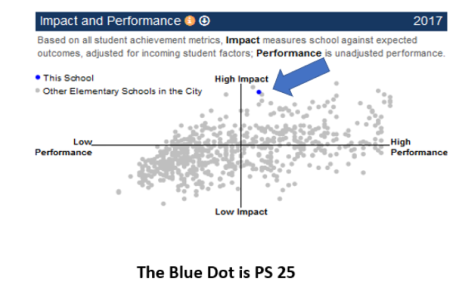
According to the DOE’s School Performance Dashboard, (according to Chancellor Farina, the “the most advanced tool of its kind,” PS 25 has the fourth highest positive impact of any public elementary school in the city and the second best in the entire borough of Brooklyn, when the need level of its incoming students is taken into account.
Picture1

According to this metric, the positive impact of PS 25 also exceeds that of any charter school in the city, except for Success Academy Bronx 2, given the fact that most of its students are economically disadvantaged, have disabilities and/or are homeless.

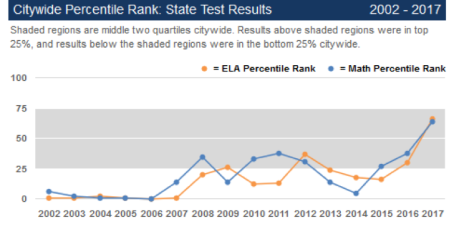
The test scores from PS 25 on the state exams show a sharp upward trajectory, with its students now exceeding the city average in both ELA and math.
Picture2

In fact, controlling for background and need, the students at PS 25 now outperform similar students by 21 percentage points in both subjects.

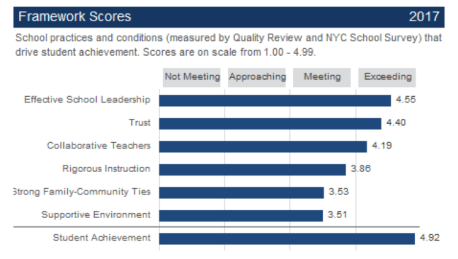
Now for those who say test scores aren’t everything, the school also excels according to all other methods the DOE uses to evaluate schools.  It exceeds or meets standards in “Effective School Leadership”, “Trust”, “Collaborative Teachers”, “Rigorous Instruction”, “Strong Family-Community Ties” and “Supportive Environment,” according to the school’s Quality Review as well as parent and teacher surveys.
Picture3

The fact that the DOE is closing a school which is delivering such great results for its students should not have been ignored.

Also unreported by any media outlet were two other salient facts: if PS 25 is closed, the entire city-owned building will be left to a charter school – Success Academy Bed Stuy 3, the first time this has happened in NYC, to my knowledge.

Also ignored was that the Community Education Council District 16 never voted to close this zoned school. State law requires that before this can occur, the CEC must authorize this, as any changes in zoning lines can only happen with their approval. The is one of the main responsibilities of CECs and some would argue their sole veto power over the unilateral and often arbitrary decision-making of the Mayor and the Chancellor.

So why does the Chancellor say PS 25 should be closed?  Chancellor Farina argues that the school is under-enrolled.  Yet at least five other schools have smaller enrollments than PS 25 and are not being closed.  Moreover, DOE has never publicized the fact that this school outperforms nearly every other school in the city.  If they had celebrated this school’s accomplishments, surely more parents would apply.  The sad reality is that many public schools in D16 have lost enrollment because of the supersaturation of charter schools in the district –  a drain on space, funding and resources which will only worsen if this school is closed.

According to the DOE’s controversial school capacity formula, PS 25’s “underenrollment” also means there is sufficient space in the building for its small class sizes of 10 to 18 – which provide ideal learning environments and are likely a major reason for its students’ success.  The DOE could also place another preK or a 3K class in the building if they wanted its enrollment to grow.

Currently, PS 25 parents are being shown a list of other schools to apply to, most outside the district and a few schools within — but none will have the same small classes and positive impact on learning, and none of them will their children have the right to attend.

Given how difficult many of these families’ lives are already, with nearly one quarter of the students homeless, this will be yet another terrible disruption, though in this case, wholly preventable. One can only hope the DOE changes course and withdraws the proposal to close PS 25 immediately.

Below is the press release about the lawsuit, which describes a 2009 legal precedent when then-Chancellor Joel Klein withdrew a proposal to close three zoned schools in Harlem and Brooklyn after being sued.  He then signed an agreement that the DOE would never do this again without a vote of the CECs.  The legal complaint to block PS 25’s closure with more data about the school and facts about the law is posted here.


For Immediate Release: Tuesday, March 27, 2018

Contact: Leonie Haimson, 917-435-9329; leoniehaimson@gmail.com


Lawsuit filed to stop the closure of PS 25, the 4th best public elementary school in NYC according to the DOE


Today a lawsuit was filed in the Brooklyn State Supreme Court against the proposed closure of P.S. 25 Eubie Blake in District 16, Brooklyn, a zoned neighborhood school, which Chancellor Carmen Farina and the Board of Education are attempting to close without the prior approval of the Community Education Council.

Last month, on February 28, the Panel on Educational Policy voted to close the school which will require students to seek enrollment in other schools, with no assurance of admission.  Not only is it a violation of NY State Education law 2590-e to close the only zoned school in the neighborhood without the district CEC’s prior approval, but P.S. 25 is also the fourth best public elementary school in NYC in the estimation of the Department of Education, and the second best in the borough of Brooklyn, when the need level of its students is taken into account.

According to the DOE’s School Performance Dashboard, which according to Chancellor Fariña is ““the most advanced tool of its kind,” the positive impact of P.S. 25 is greater than all but three of the city’s 661 public elementary schools, and its closure would leave the entire city-owned building to Success Academy Bed Stuy 3, a charter school. [1]

Achievement levels of P.S. 25 students have steadily climbed over the last three years, and the school now exceeds the city average in state test scores, despite the fact that a large percentage of students are homeless, economically disadvantaged, and/or have disabilities. According to DOE’s figures, the school’s students outperform similar students by 21 percentage points in ELA and math.  The achievement of the more than thirty percent of students with disabilities is also exceptionally high.

The school also meets or exceeds standards in all the following areas:  Effective School Leadership, Trust, Collaborative Teachers, Rigorous Instruction, Strong Family-Community Ties, and Supportive Environment.

Plaintiff Crystal Williams, a parent of two children at P.S. 25, said: “The school has seen a big improvement in recent years.  The teachers are excellent.  They give students close support, and my kids are learning.  The teachers take their time in part because they have small classes, and I don’t believe my children would be provided with the same quality of education at whatever other schools they are forced to attend.”

“PS 25 should be honored and replicated, not closed,” said Mark Cannizzaro, President of the Council for School Supervisors and Administrators, the principals’ union. “The school has been on a clear, upward trajectory: Dedicated school leaders and teachers have helped boost English and math test scores ever higher compared to the district and the city as a whole. All the while, PS 25 has made great strides in addressing students’ social and emotional needs, and has offered them a vibrant curriculum with art, music, library skills, coding and STEM classes. We continue to oppose this decision. The students, families and educators of PS 25 deserve better.”

Said Shakema Armstead, a plaintiff who has a third grader at PS 25, “My son, who has an I.E.P, loves the school.  It gives him and other students with a sense of community and stability that allow them to thrive.  There is no reason for them to be thrown into another school where they would have to re-adjust to an entirely new environment, especially as P.S. 25 is doing so well.”

There is a precedent for this lawsuit. In 2009, a lawsuit was filed against Chancellor Joel Klein on behalf of parents at three neighborhood zoned schools, in Harlem and Ocean Hill-Brownsville area, to prevent the closure of these schools without a vote of the relevant CECs.  The lawsuit was joined by Randi Weingarten, then President of the UFT, and NYC Public Advocate Betsy Gotbaum. Within weeks, Chancellor Klein withdrew the closure proposals.[2]  He subsequently signed the following settlement agreement:

The [plaintiffs and the DOE] agree with regard to the three schools identified in the Complaint and any other traditional public school that, for those grades that are within the province of school attendance zones, [the DOE] will not close, phase-out, remove, alter or engage in conduct designed to effect the closure of any such school in a way that deprives residents of the right to send a qualifying child to his or her zoned traditional school, without either (1) obtaining, pursuant to 2590-e(11) of the Education Law, the approval of the relevant Community Education Council as to such change or (2) timely replacing such school with another zoned school within the same attendance zone.

In this case, DOE has no plans to create another zoned school for these children, and yet no vote of Community Education Council 16 has occurred.  The DOE claims that the school is being closed because it is under-enrolled, but this ignores several important factors:  Parents have not been told of the exceedingly high quality of the school according to the DOE’s own metrics, and if they had been informed of this, more of them would likely enroll their children in the school.  The DOE could also install another preK or a 3K program in the school.   The availability of space has also allowed for very small classes, which in turn have provided PS 25 students with an exceptional opportunity to learn.

Said Leonie Haimson, Executive Director of Class Size Matters, “It would be tragic if the second best elementary school in Brooklyn were closed.  PS 25 has very small classes of 10 to 18 students, which are ideal for such high-poverty students.  Given how the DOE refuses to align the school capacity formula with smaller classes, that alone makes the school appear underutilized.  It would be extremely disruptive if this closure occurs, especially for the large number of homeless children at PS 25, because the school is a sanctuary of stability in their lives. Instead of closing PS 25, the DOE should celebrate, emulate and expand it—and give more NYC children the same chance to succeed.”

A copy of the lawsuit is posted here: https://tinyurl.com/y6wjocsu

###

[1] https://tools.nycenet.edu/dashboard/#dbn=16K025&report_type=EMS&view=City

[2] https://www.nyclu.org/en/press-releases/response-nycluuft-lawsuit-doe-announces-it-will-keep-schools-open