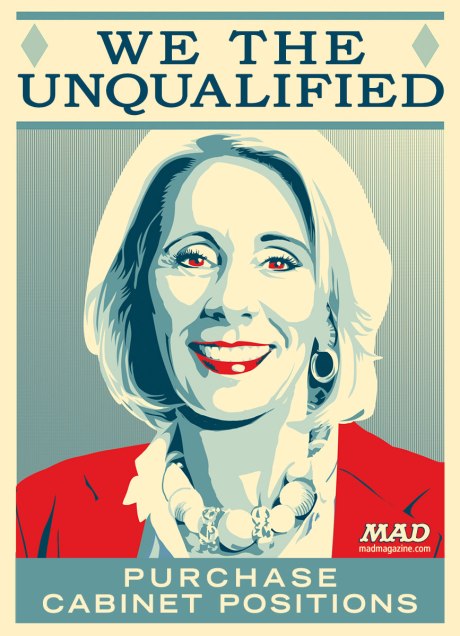
In case you want to print out your very own Betsy poster, here is the link.
Archives for category: Betsy DeVos
A reader sent me the link to this poster, which appears in the current issue of MAD Magazine. I don’t customarily engage in ridicule, but what DeVos is doing to the public schools of America, what she is doing to civil rights enforcement, and what she is doing to college students struggling to pay for their education is beyond ridiculous.
Andy Borowitz, who writes humorous pieces for the New Yorker, says only one person can stop North Korea.
That will cripple its nuclear program.
The NEA posted a handy explanation of the differences among current voucher programs.
Learn to understand Betsy DeVos’s euphemisms.
School vouchers are actually unpopular, which is why their advocates call them by another term.
“Voucher devotees like DeVos know this, which is why the term “school voucher” has been ditched in favor of more appealing terms.
“Take for example this line from DeVos’ speech to the AFC. Praising Indiana’s large-scale voucher program, she promised to “empower states and give leaders like Eric Holcomb the flexibility and opportunity to enhance choices Indiana provides its students.”
“In that one sentence alone, DeVos offers up four favorite euphemisms used to rebrand voucher legislation: “empower,” “flexibility,” “opportunity” and, of course, “choice.”
Confused about the difference between a “tax credit” voucher program and an “education savings account”? Read about it in this brief post.
The Los Angeles Times editorial board published an editorial today chastising the California Teachers Association for resisting privatization of public education via charters.
I assume that this editorial was in no way influenced by Eli Broad, who subsidizes the Times’ education coverage, which is a blatant conflict of interest.
The editorial board can’t see any critics of charters other than teachers’ unions, who presumably are protecting their jobs by fighting off the agenda that Donald Trump and Betsy DeVos are promoting.
It can’t see why parents and graduates of public schools (like me) think that turning public money over to private and unaccountable boards is a terrible idea.
One would think that the LA Times might express concern about the millions of dollars pumped into the school board race by billionaires like Eli Broad, Reed Hastings, Richard Riordan, and the Waltons. How did it happen that the California Charter Schools Association become the most influential lobby in Sacramento? Isn’t the Times just a little bit curious about the deployment of big money? Have they noticed that the same money has bought the school boards in Denver, Indianapolis, and other cities? Are they aware that Reed Hastings longs for the day when democratically elected school boards are obsolete. Meanwhile, he is willing to spend whatever it takes to buy them.
One would think that a major metropolitan newspaper would worry about the power of big money to buy local school board elections. When did any of these billionaires ever have a child or grandchild in the LAUSD public schools? Why doesn’t the editorial question why they want so badly to buy the school board? What do they want?
One would think that the LA Times might have noticed the numerous scandals associated with charter schools in Los Angeles and throughout California. Is that not a reason to fight for public schools and public accountability for public money?
Does the Los Angeles Times recognize that charter schools skim the students they want and dump the ones they don’t want? Is this not a dire threat to public education, which must take the students the charters don’t want?
This editorial must be a source of joy to Betsy DeVos. The game plan in California looks like the DeVos plan in Michigan: charters, charters, charters, while defunding public schools. Did it help struggling students? No. Did it improve the academic performance of the students of Michigan? No. Michigan’s NAEP scores have plummeted since DeVos launched her charter agenda in the state.
The people of California must stand up for public education, under democratic control and with full accountability and transparency.
Shame on the editorial board of the Los Angeles Times.
Jennifer Berkshire features an essay by a teacher who realizes that she was responsible for the appointment of Betsy DeVos. Why? She didn’t pay attention.
Read her story.
This is what she learned after a career of setbacks:
“Neoliberalism is an attractive ideology precisely because it meshes so nicely with our existing cultural norms and myths. We all want to be successful, and neoliberalism’s emphasis on quantification, organization, control, and discipline as a means of maximizing *performance* seems normal and reasonable rather than sinister. That’s why even students and teachers who are disenfranchised by a worldview that says competition is the defining characteristic of any relationship, scarcity the fundamental state of reality, and ownership and entrepreneurship the highest level of citizenship, still participate in it.
“A few weeks ago I accepted temporary employment as an on-site test proctor for state assessments for a virtual charter school, despite not agreeing in principle with charter schools, exam-based summative assessments, or online education. The position pays more than I usually earn as a substitute teacher and is much easier too. I’m also a participant in what researchers call *shadow education,* the supplementary instruction parents and adult students use to address the failings of the formal education system. I earn money as a tutor and academic success coach for high school, college, and graduate students. Shadow education is both a response to and result of the transfer of risk from society to individuals. It’s difficult to live within a system without adopting the culture of that system.
“But I am also working to be less complicit in the full-on assault upon public education. I try to remind myself and others that education is not a product. That understanding and expertise are knowable and observable conditions, but they don’t readily lend themselves to systematized mass production. That students, or rather, children, are not capital or resources for exploitation; neither are teachers, administrators or other school employees. That people have value because of their humanity, not just because of their predicted contribution to or detraction from economic growth. That learning has value apart from and above, say, achieving tests scores or getting a job. You should remind yourself of those truths, too, because the appointment of a philanthropist and political rainmaker to oversee public education will only heighten the consumerism and competition of the present policy-setting.
“I want public education to embody all the positive traits denoted by the words *public* and *education.* My first step to achieving that end was to examine myself. What do you want for public education? What are you going to do about it?”
Kathleen Oropeza of the parent group Fund Education Now has prepared an analysis of the destructive law passed by the Florida legislature and signed by Governor Rick Scott. To read the links, go to the post here.
HB 7069: Florida’s K-12 nightmare foreshadows the nation’s future
The Florida legislature set a dangerous precedent this year. One that will no doubt be repeated in GOP-controlled states across the nation.
Speaker Richard Corcoran and Senate President Joe Negron under scrutiny from Gov. Scott negotiated every major public education policy into HB 7069 and designed the K-12 budget under a transactional cloak of darkness – locking out everyone but themselves. Each man had his own rigid demands heavily supported by outside influence. Senators and Representatives were rendered so insignificant they should have stayed home.
Secret deals
Scott wanted funding restored to Visit Florida ($86M) and Enterprise Florida ($75M), a corporate incentive slush fund. Negron wanted funding and changes to higher Education and a reservoir near Lake Okeechobee. Corcoran wanted to enact a sweeping assault on public schools setting up Florida to be the poster child for the privatizing “choice expansion” soon to be rolled out by U.S. ED Secretary DeVos. To coerce passage, they included mandated recess and the Gardiner ESE voucher expansion, both bills that would have passed on their own. Politicians have used Florida’s public school children either as collateral or an “acceptable loss” for far too long.
As a result, HB 7069 emerged eligible only for a single up/down vote. No debate.
Derivative of 55 other bills, the only supporters of HB 7069 were the Koch Bros, Jeb’s Foundations and the charter industry lobby. Without exception, legitimate parent groups, who sent over 150,000 letters, joined stakeholders ranging from teachers to districts and superintendents in opposition of this bill.
Florida has been in the throes of a devastating public K-12 “reform” policy experiment for twenty years. Jeb Bush weaponized the Florida “A-F Accountability System” with high stakes tests, mandatory retention, school grades that mostly reflect zip codes and a profound disrespect for professional educators.
Thanks to HB 7069, even highly effective teachers are no longer sure of a job the following year. Florida politicians consistently talk about placing the best teachers in Title 1 schools where they may no longer be ranked “highly effective.” The Best & Brightest Bonus expansion in HB 7069 effectively punishes these teachers. As a result, politics are stifling the ability of teachers to serve at risk students by denying even the smallest gesture of job security.
Universally opposed by advocates
Every public education advocate in the nation should be concerned about what Florida is doing. The state’s longstanding 3:1 ratio of GOP to Democrats makes political balance impossible. This session, Speaker Corocran made no attempt to hide his contempt for public education. He began by calling teachers “downright evil, crazy, disgusting and repugnant.” HB 7069 disrespects the authority of duly elected school boards by forcing them to share their only capital outlay money with corporate charter chains. In addition, the state gives charters up to $100M per year from Public Education Capital Outlay funding derived from a telecommunications tax. Districts never see a dime!
Of course, Corcoran accuses them of whining, “It’s their bloat, inefficiency and gross over-spending. Their problem is their mismanagement…They just want to build Taj Mahals.” This deception ignores the fact that the Florida legislature has refused to invest any additional funds in K-12 education since 2008. Gov. Scott is proud that the 2017 budget includes a paltry $100 extra per student for just one year. Thanks to HB 7069 that money is already spent on new students, making up for lost capital funding and attempting to rescue programs that will be cut due to the shift in Title 1 expenditures.
Hostile to public education
Perhaps the worst policy found in HB 7069 is the $140 million dollar “Schools of Hope” which forces districts to either immediately close “D” and “F” schools or permanently hand them over to for-profit charter chains with zero history of successfully mitigating the impact of generational poverty. There’s no guarantee that these struggling students will actually attend a “school of hope.” This program is designed to escalate the takeover of district schools by a corporate charter chain.
Further, legislators purposely ignore proven public school successes such as the Evans Community School in Orlando.
People are angry about HB 7069. All indications are that it will be an issue in the 2018 mid-term elections. Sen. Gary Farmer is mulling over a lawsuit concerning the legality of using legislation to strip constitutionally granted authority from school boards.
Voucher mission creep
Gov. Scott chose to sign HB 7069 at an ESE Catholic School knowing that DeVos intends to kill the separation of church and state and pursue publicly funded vouchers for religious schools. Knowing that intent might not be well received, Scott used the expansion of the Gardiner ESE voucher as a beard to avoid praising the divisive contents of the bill. The Gardiner ESE voucher is another corporate tax credit that forces recipients to leave the state K-12 school system, giving parents the ability to choose an education for their child devoid of standards or any accountability. Make no mistake this program encourages mission creep toward Jeb and Betsy’s dream of universal vouchers. And some form of ESE voucher will be coming to your state, if it hasn’t already.
Jeb, along with the Milton Friedman Foundation and a formidable slew of “Return on Investment” billionaire philanthropists ranging from Bill Gates to Betsy DeVos share a singular view. Instead of truly wanting every child to get an excellent education, they are obsessed with liquidating our greatest public asset for the sake of profit and “choice” ideology.
Profit over people
Florida’s history of unmitigated charter growth is a tale of wasted tax dollars, scandal, closed schools and abandoned students The latest charter school fraud involves Newpoint Charters, racketeering charges and $57 million up in smoke.
Study the contents of HB 7069 carefully. This bill was born of secrecy, power-hoarding and deceit. It’s a blatant strategy to pass hostile pieces of legislation that could never be voted up alone. It’s a clear-eyed warning that the profiteers coming to dismantle Florida public schools will not be contained to a single state.
What’s in Florida’s HB 7069?
Title 1 Funds
• Redirects and dilutes Title I funds currently used by districts to provide a variety of district-wide programs that benefit some of the most vulnerable students.
• Eliminates district-wide programs currently funded with a portion of Title I money such as, AVID, mentorship programs, and some services offered by school transformation offices.
School Districts must give Charters a portion of locally levied capital outlay funding
• Requires school districts to share locally derived capital outlay funds with charters leaving a huge deficit in the sole funding source used by school boards to build, maintain and improve schools. Ex: Palm Beach County district expects to lose at least $230 million over 10 years; Broward County will lose at least $300 million over 10 years.
• Districts must prove need, charters do not.
• Once this capital outlay funding is shared, private corporations are free to keep the money to invest in buildings and improve property that the public will never own.
• No language to prevent taxpayer funds for capital projects from enriching for-profit corporate charters
Schools of Hope/High Impact Corporate Charter welfare (line 184)
• Creates the “Schools of Hope” program, funded with $140 million by the legislature for out of state charters to take over the education of the most vulnerable students in Florida with zero proof that there is any record of success in turning around schools
• Redirects further funding from traditional public schools and provides a corporate welfare program for charters.
• Does not require the charters to service the students in the schools that they are taking over.
• Increases the number of schools subject to charter take over because it requires school districts to prepare emergency plans if any school in the district earns a “D” or “F”
• Language from HB 7101, including the mandate that school districts use a standard contract and any amendments to the contract are deemed to violate charter schools flexibility per statute
• Allows charters to use district facilities at a deeply discounted rate that my not reflect the fair market value of properties.
• Allows just 25 schools from districts to compete for Schools of Hope funding – If Florida invested in struggling schools, Schools of Hope would be redundant
Charters get to grade District public schools
• Permits charter schools to “grade” school districts on their performance
• Does not allow for school districts to do the same to charters
Charter School Land Use
• Allows charter schools to bypass any land use or zoning requirements of local jurisdictions
• Preempts the authority of local jurisdictions and doesn’t permit local community participation on land use or zoning decisions that potentially affect their property uses and values
• Doesn’t allow for local governments or local citizens to evaluate the impacts on their communities caused by charter schools on issues such as traffic capacity and consistency with approved uses already in place
• School districts are not given the same flexibility as corporate charter chains.
Charter access to public facilities
• Allows charters to use district facilities at a deeply discounted rate that my not reflect the fair market value of properties.
• Requires districts to report to DOE if any facility or portion of a facility is vacant, underused, or surplus.
• Expands the current requirement of reporting surplus properties.
• Could result in a charter school operating simultaneously as an operating public school, affecting the ability of a district to properly plan for future growth.
• Grants charter schools sovereign immunity equal to what public entities currently have under state law.
Charters can hire non-certified teachers
• Allows “Schools of Hope” to hire non-certified teachers and administrators.
• These teachers and administrators are servicing some of the most vulnerable students in Florida.
• Why would the standards for these teachers and administrators be lowered?
Exempts corporate charter chains from paying for District services
• Caps the administration fees a school district may charge a charter for educational services.
• Exempts Charters from paying for additional services outside the agreed administrative fee, causing Districts to subsidize the cost of these extra services
• Impedes a district’s ability to provide adequate educational services for students enrolled in its district.
Charters Usurp Superintendent Authority/Schools of Excellence
• Mandates that a school of excellence be a part of the principal autonomy program which attempts to usurp superintendent powers under the constitution.
• Caps the administration fees a school district may charge a charter for educational services.
• If a district provides additional services to a charter outside what is contemplated with the administrative fee, it would result in school districts having to subsidize charter school programs and potentially affect a district’s ability to provide adequate educational services for students enrolled in its district.
Charters Usurp locally elected school boards
• Grants charter school systems governing board a designation as an local educational agency
• Allows charters to bypass local control and allowing them to remain largely unaccountable to the public despite receiving a significant amount of taxpayer funding.
School Grade Manipulation
• Requires the educational data from a student that transfers to a private school or comes from a private school to be factored into a school’s grade, despite the fact that the school is not providing educational services to the student.
Teachers
• Removes teacher bonus caps for IB, AP, and CAPE without funding.
• Teacher Contracts: Contains a provision limiting the employment contracts that school districts may award to teachers to one year.
• Makes VAM teacher evaluation system optional for districts
Best & Brightest Teacher Bonus
• Reduces bonus for teenage SAT/ACT scores and highly effective rank from $10K to $6K for the next three years
• Adds a principal bonus of $4K, uses qualifications that have no proven correlation to teacher or principal performance.
• $1,200/year before taxes to “highly effective” teachers
• Up to $800/year before taxes to “effective” teachers
• Does not provide much-needed permanent teacher raises
Gardiner ESE Voucher
• Adds an additional $30 million to the existing program which offers $10K vouchers to parents of ESE students
• In exchange, parents give up child’s right to a free and appropriate public education (FAPE).
• Funding is generated by allowing corporations to divert what would be Florida general revenue taxes to Step up for Students, the designated “Scholarship Funding Organization” who earns a management fee off of the gross
Recess
• Mandates 100 minutes of recess per week for all K-5 students in District public schools
• Exempts charter schools from this mandate – granting a carve-out from any expenses incurred by the recess mandate
Kathleen Oropeza is co –founder of FundEducationNow.org, a non-partisan public education advocacy group working to bring voters into a thoughtful discussion about school reforms and the threat of privatization. She also writes The EdVocate Blog and is the mother of two public school children. Reach Kathleen at: Kathleen@fundeducationnow.org
Scott Sargrad is in charge of K-12 education policy at the Center for American Policy. CAP has been one of the leading advocates for privately managed charters. This article explains in lucid prose why vouchers are a terrible strategy and how they actually harm most children who use them. He could have written the same article about charters, which suck money and top students away from public schools and weaken the very schools we should be helping.
He writes that no matter how many anecdotes you hear about vouchers, the bottom line is they they are a bad bet:
“But if our goal as a country is to provide an excellent education for every child, private school voucher schemes that send taxpayer dollars away from public schools and into private schools are too risky a gamble…
“It’s worth pausing for a moment to examine just how stunning the results of these studies are. In Indiana and the District of Columbia, students receiving vouchers actually moved backward in math, and made no progress in reading. In both Ohio and Louisiana, the students did significantly worse in both reading and math compared to their peers who remained in public schools – with students in Louisiana moving from the 50th percentile to the 34th percentile in math after just one year.
“And despite frequent claims that parents are happier after using a voucher, the evaluation of the District of Columbia program found no impact on parent or student satisfaction or parent involvement. (To be fair, the study found that parents perceived their private schools as safer – although the students did not.)
“It might be tempting to consider allowing for small, limited voucher programs that are carefully targeted to the neediest students and include important civil rights, antidiscrimination and transparency protections. Unfortunately, history shows clearly that this is never the case. Some of the biggest supporters of vouchers – including Secretary of Education Betsy DeVos – are explicitly against these kinds of protections, casting them as over-regulation that limits choice.
“In fact, voucher programs often start small – such as targeting students with disabilities or families with lower incomes. Then proponents slowly but surely expand eligibility to all students and raise or eliminate income caps. Eventually, students using vouchers are those who have never enrolled in a public school, and increased spending on voucher programs leads to budget crunches that could harm public schools.
“Of course, public schools are not perfect – not even close. That’s why instead of directing taxpayer dollars to private school voucher schemes, states and the federal government should be investing public money in improving public schools.”
He goes on to encourage choice within public schools, including charters, but surely he knows that charters are as discriminatory as voucher schools and just as likely to be corrupt because of the typical absence of oversight or accountability. The “effective” charters are those that cherrypick their students, avoid those with disabilities, and push out students who can’t get high scores.
Charter Schools, by definition, are privately managed. They are not public schools. No matter what their allies call them, no matter what they call themselves, they are private schools that are bankrolled by public money.
Sorry, CAP, you can’t reject half of the Betsy DeVos agenda and embrace the other half.
The charter industry does not collaborate with public schools. It seeks to weaken them, not help them.
CAP, either support public schools or school choice. There is no middle ground. One is public, the other is not. Which side are you on?
Gail Collins used to be the editorial page editor of the New York Times. Now she writes a regular column for the Times, which is usually hilarious.
Today, she names Betsy DeVos the winner of her informal reader poll as the Worst Member of Trump’s Cabinet.
This was no easy contest. Remember, she was up against Jeff Sessions, who has total amnesia, and Scott Pruitt, the director of the Environmental Protection Agency who fights to protect pollution.
DeVos really hates public schools — something you don’t find often in a secretary of education. Her goal seems to be replacing them with charter schools, none of which will need much oversight because, you know, the choice thing.
Many readers noted that our secretary of education does not seem to be … all that bright. (“DeVos is a solid choice based on irony alone.”)
Peter Greene is kind of busy, what with having two-week-old twins in the House, with crying, diapers, and all that entails. But not too busy to read that Checker Finn describes parts of Jeanne Allen’s pro-choice book as “idiocy.”
See, Jeanne agrees with Betsy DeVos that the government should hand out taxpayer dollars to families to use however they want. Checker recognizes that this is a dumb idea. He has noticed the frauds and thieves who want that money.
It is not even a free market approach, when the government subsidizes choices.
Peter quotes Checker:
“This is idiocy. It’s also entirely unrealistic in the ESSA era. It arises from the view—long since dismissed by every respectable economist—that education is a private good and the public has no interest in an educated citizenry. Once you conclude that education is also a public good—one whose results bear powerfully on our prosperity, our safety, our culture, our governance, and our civic life—you have to recognize that voters and taxpayers have a compelling interest in whether kids are learning what they should, at least in schools that call themselves “public.”
Peter agrees.

 Diane Ravitch's blog