Archives for category: Accountability

Gabriel Schoenfeld of The Bulwark cautions us about accommodating or compromising with totally unqualified people nominated by Trump to take prominent roles in crucial federal agencies. He writes specifically about the nomination of Robert Kennedy Jr. to direct the Department of Health and human Services, as well as Dr. Oz. Apparently, Trump offered him this role in return for his endorsement but it’s important to oppose this nomination, not accept it, because RFK is not only totally unqualified but dangerous due to his ignorance and his embrace of discredited ideas.

Schoenfeld reminds us of one of the especially sordid chapters in the history of Stalin’s USSR, when crackpot science became state policy and killed millions of people.

He writes:

RATHER THAN OPPOSE DONALD TRUMP’S dangerous nominee for secretary of health and human services, some liberal commentators have suggested that the critics of Robert F. Kennedy Jr. should find ways to accommodate him.

Writing in the New York Times in November, physician Rachael Bedard argued for finding “common ground” with the anti-vaccine ideologue. “We can’t spend four years simply fighting his agenda,” she wrote. Instead, RFK Jr.’s critics should try to “turn his most valid criticisms of the American health care system into constructive reforms.” In a follow-up interview this week, Bedard insists she isn’t “sane-washing” RFK Jr., she just wants to be realistic about recognizing “that he has a growing movement of people behind him, who aren’t just going to go away because we yell at them.”

Meanwhile, Adam Jentleson, a former Democratic congressional staffer—he held prominent jobs under Sens. John Fetterman and Harry Reid—has called for an effort to get RFK Jr. to “bless the next wave of vaccines.” How Jentleson thinks the notorious antivaxxer might be persuaded to perform an about-face is left unstated. Jentleson just wants to “build bridges.”

At a moment when we should be thinking of this nomination in terms of the potential risk to human lives, all this muddled analysis about science and politics calls to mind a grim episode from the last century that is a cautionary tale for today: the career of the Soviet biologist Trofim Lysenko.

Born in 1898, Lysenko had accomplishments of great consequence to his name. Most of these occurred in the field of agronomy, where he advanced a revolutionary set of ideas—now known as Lysenkoism. His main contentions were that genes did not exist, that acquired traits could be inherited, and that heredity itself could be altered by “educating” plants.

One such form of education was called “vernalization”—the notion that crop yields would dramatically increase if seeds that usually died in harsh frosts were exposed to lower temperatures before sowing. “Insights” like that, derived ultimately from Marxist ideology instead of legitimate empirical research, were put into practice on a large scale, first in the USSR and then in Communist China. Widespread crop failures followed, and then famines in which millions perished.

Lysenko—a crackpot with the power of the Soviet state behind him—was the recipient of numerous awards, including, on eight occasions, the Order of Lenin, and on three occasions, the Stalin Prize. Lysenko died of natural causes in 1976.

This history of massive state-sponsored scientific fraud is pertinent to Trump’s attempt to install Kennedy to the highest-ranking healthcare position in the U.S. government. The secretary of health and human services has oversight of everything from food safety to medical research to private health insurance to epidemiology to Medicare and Medicaid and much, much more.

Like Lysenko, RFK Jr. has departed from science even as he claims its mantle. He is a proponent of consuming raw milk despite the proven safety benefits of pasteurization (just last month raw milk in California was found to contain bird flu). He opposes the fluoridation of water despite the proven benefits to dental health. But it is for his opposition to vaccines—and his lies about them—that he is most notorious and most dangerous.

Kennedy’s position atop HHS would put him in charge of the Vaccines for Children program. It has saved millions of lives by immunizing children against diseases like polio and measles that, thanks to the vaccines, are now rare. He would also oversee the Centers for Disease Control and Prevention, which has as one of its most important roles deciding which vaccines health insurers are required to cover.

To be sure, in lobbying for his confirmation Kennedy has said that “We’re not going to take vaccines away from anybody.” He also says he aims to improve the science of vaccine safety and wants nothing more than to provide “good information” so people “can make informed choices.”

But in light of some of his other pronouncements, this is all disingenuous. One piece of his “good information”—repeated in a 2023 interview with Fox News—is that vaccines cause autism. This theory was first popularized by the British doctor Andrew Wakefield in the Lancet in 1998. But Wakefield was discredited and his Lancet paper was retracted because it was fraudulent. Despite numerous studies that have since found no link between vaccines and autism, Kennedy has persisted in trumpeting his view, and gone even further to claim that “no vaccine is safe and effective.” Notably, the lawyer Kennedy selectedto screen candidates for positions at HHS has filed a petition to the Food and Drug Administration to revoke approval of the polio vaccine. On social media, Kennedy has called COVID shots “a crime against humanity.” Estimates are that COVID vaccines have prevented 3.2 million deaths in the United States alone through 2022.

A person with no medical or scientific training, RFK Jr. is evidently unaware that vaccines are one of humanity’s greatest accomplishments. Smallpox, the deadliest disease in human history, has been wiped from the face of the earth. Polio, a scourge that terrified generations of Americans and struck down an American president, has been largely consigned to the dustbin of history, at least in the developed world. Rabies, an invariably fatal disease, is preventable by vaccination (does RFK Jr. want to stop vaccinating Fido as well?). New vaccines can even prevent cancer. This is “good information.”

Even if, unexpectedly, RFK Jr. did absolutely nothing to hinder the development and distribution of vaccines, the mere elevation of someone with such views to a position of national authority would undermine public confidence in vaccines and increase vaccine hesitancy, with severely deleterious consequences for public health. If vaccination rates decline sufficiently, diphtheria, measles, yellow fever, shingles, and many other infectious diseases now relatively dormant may roar back into prominence.


UNFORTUNATELY, RFK JR. IS NOT THE ONLY Lysenko-like figure nominated to serve in the incoming administration. Trump has also tapped MAGA loyalist Dr. Mehmet Oz to lead the Centers for Medicare and Medicaid Services (CMS). Oz has a long record as a grifter pushing pseudoscience for bucks. Among his claims lacking any scientific backing are that selenium supplements are “the holy grail of cancer prevention”; that raspberry ketones are “the No. 1 miracle in a bottle to burn your fat”; that umckaloabo root extract is “incredibly effective at relieving cold symptoms,” and that hydroxychloroquine is an effective treatment for COVID-19. All of this is quackery.

The analogy to Lysenko and Soviet science is not exact, of course. The differences between the totalitarian USSR under Joseph Stalin and the (for now) liberal democratic United States under Donald Trump are too obvious to enumerate. For one thing, a democracy such as ours has self-corrective mechanisms that can set things right. Crackpots like Kennedy and grifters like Oz have to be confirmed by the U.S. Senate—and it is not inconceivable that, even with a Republican majority, their nominations will be shot down. But given how cowed Republican senators are by Donald Trump, it would not be surprising if both are confirmed.

For another thing, Lysenko’s critics were either executed outright or sent to the gulag to die of starvation and overwork. Critics of RFK Jr. and Oz are not likely to suffer a remotely similar fate . . . unless, of course, their name is Dr. Anthony Fauci, who is now being threatened with imprisonment by leading figures in MAGA world, including by RFK Jr. himself. “You should be prosecuted for crimes against humanity. You belong in prison, Dr. Fauci,” says Rep. Marjorie Taylor Greene. On his X platform, president-elect sidekick Elon Musk has been particularly insistent, tweeting the same message multiple times: “My pronouns are Prosecute/Fauci.” The threats are serious enough that President Joe Biden is reportedly considering offering Fauci a preemptive pardon.

Trump has said he has appointed Kennedy to “go wild” on U.S. health. The phrase is well chosen. When it comes to medical care and medical science in the unfolding second Trump administration, we’re entering a wild time and a dark age. Among other things, Trump intends to withdraw the United States from the World Health Organization on his first day in office. The WHO is a flawed international body that badly needs reform—but withdrawal will have potentially catastrophic effects on the battle to contain the next future global epidemic. In the United States and around the world, as happened with COVID, millions could die. We are less than a month away from opening a new chapter of Lysenkoism, American style.
In a recent issue of The New Yorker, physician Dhruv Khullar writes about what happened to the practice of medicine when private equity began buying up hospitals and group practices. The result of privatization of healthcare was not surprising: the desire for profit became more important that the drive to improve patients’ health. Private equity was very successful in squeezing handsome profits out of community hospitals, but all too often those hospitals went bankrupt, leaving the communities without a hospital. Dr. Khullar says we are now in “the Gilded Age” of medicine, where wealth and corporate power are in charge.

Dr. Khullar is a physician and associate professor of health policy and economics at Weill Cornell Medical College.

Dr. Khullar wrote:

In 2010, a private-equity firm called Cerberus Capital Management, which is named for the three-headed dog that is said to guard the underworld, bought six Catholic hospitals in Massachusetts and christened the chain Steward Health Care. The state’s attorney general blessed the deal on multiple conditions, including that, during a five-year review period, the hospitals stayed open and their workers stayed employed. A few months after the period ended, however, Steward started selling the land on which the hospitals stood. A $1.25-billion-dollar deal, in 2016, helped to finance more acquisitions. Many facilities, asked to pay rent on land they’d previously owned, struggled.

According to a recent report published by Massachusetts Senator Ed Markey’s office, which covers the period between 2017 and 2024, some Steward facilities had to forgo key investments in staffing, surgical equipment, elevator repairs, and even clean linens. Patients increasingly languished in emergency rooms; many left without receiving care; and mortality rates for common conditions climbed sharply. (Steward has argued that its death rates were better than expected, given the underlying health status of the patients it cared for.) A hospital in Florida developed a bat infestation, and another, in Texas, was cited for placing potentially suicidal patients in rooms with materials with which they could hang themselves. Employees at Steward’s Carney Hospital, in Massachusetts, began calling their workplace “Carnage” hospital. (Cerberus’s ownership ended in 2020, and the firm claims that the quality issues at Steward are “overwhelmingly related to the post-Cerberus ownership period.”)

In May, Steward filed for bankruptcy. It has closed two hospitals and plans to sell thirty-one others. Steward’s C.E.O., Ralph de la Torre, who in 2011 purchased a forty-million-dollar superyacht, was subpoenaed by a Senate committee but failed to show up; he was held in contempt of Congress and resigned from his position. (De la Torre, in turn, sued the committee for violating his right against self-incrimination.) Nonetheless, Cerberus realized a profit of seven hundred and ninety million dollars from its investment in Steward. Meanwhile, in some places in the U.S., private-equity firms now own more than half of all medical practices within certain specialties. “We are being picked clean by private equity,” a New Jersey-based radiologist said at a recent meeting of the American Medical Association. “There are people who don’t know where their next paycheck is even going to come from because their groups have been flipped so often.”

2024 was arguably the year that the mortal dangers of corporate medicine finally became undeniable and inescapable. A study published in JAMA found that, after hospitals were acquired by private-equity firms, Medicare patients were more likely to suffer falls and contract bloodstream infections; another study found that if private equity acquired a nursing home its residents became eleven per cent more likely to die. Although private-equity firms often argue that they infuse hospitals with capital, a recent analysis found that hospital assets tend to decrease after acquisition. Yet P.E. now oversees nearly a third of staffing in U.S. emergency departments and owns more than four hundred and fifty hospitals. In some of them, patients were “forced to sleep in hallways, and doctors who spoke out were threatened with termination,” according to Jonathan Jones, a former president of the American Academy of Emergency Medicine.

Erin Fuse Brown, a professor at the Brown University School of Public Health, told me that private-equity firms have learned that they “don’t have to make things better or make them more efficient. You can just change one small thing and make a ton more money.” They are hardly the only corporations to learn this lesson. Increasingly, health insurers, private hospitals, and even nonprofits are behaving as though they aim first to extract revenue, and only second to care for people. Patients often are viewed less as humans in need of care than consumers who generate profit.

In 1873, Mark Twain co-wrote the novel “The Gilded Age: A Tale of Today,” which satirized an era that was marked by inequality, greed, and moral decay but was painted in a veneer of abundance and progress. Industrialists made fortunes in oil, steel, and shipping even as millions suffered poverty and exploitation. Today, health care is where the money is. New technologies and treatments sustain the impression that patients have never been healthier, but corporations and conglomerates wield immense power at the expense of the people they’re meant to serve. Welcome to the Gilded Age of medicine.

In recent years, health-care corporations have embraced an approach that can only be described as gamification. In the U.S., all seniors over sixty-five are entitled to health insurance through Medicare, and, for several decades, private companies have offered plans through programs such as Medicare Advantage. The government pays insurance companies a fixed sum based partly on how sick those patients are. The sicker the patients, the bigger the potential payments. But who’s to say, really, how sick a patient is? Let the games begin.

This year, the health-news site STAT revealed that UnitedHealth, the country’s largest private insurer, had set up dashboards for practices to compete on how many conditions they could diagnose in patients. Doctors who completed the most appointments with seniors in Medicare Advantage were eligible for ten-thousand-dollar bonuses, and patients were offered seventy-five-dollar gift cards for getting checkups at which their medical histories could be recorded. At the height of the covid-19 pandemic, an e-mail sent to one practice told clinicians that documenting chronic illnesses was the “#1 priority.”

Insurance companies have even started to scour medical records for possible diagnoses, and to send nurses to patients’ homes to perform “health-risk assessments.” These strategies rack up so many additional diagnoses that, in 2023 alone, the federal government made $7.5 billion in “overpayments” to insurers, according to the U.S. Office of the Inspector General. Insurers are “pouring tremendous resources into developing the capacity to code patients in a way that nets more money from Medicare,” Donald Berwick, a former head of the Center for Medicare & Medicaid Services, told me. “That’s taxpayer money being siphoned away from people who need it.”

Berwick said that his own physician’s practice had recently been acquired by UnitedHealth. One day, he asked his doctor, “Anything different now?”

“Two things,” the doctor replied. “I have to see more patients each day. And my patients have new diagnoses that I didn’t put there.” Many patients with atrial fibrillation, for example, were now coded as having another condition known as “hypercoagulable state”—which was technically accurate, but didn’t change patients’ care in any way. It did, however, generate higher payments from Medicare. Ask not what your insurer can do for you—ask how much revenue you can generate for your insurer.

The insurance companies in Medicare Advantage tend to argue that they’re simply recording diagnoses, not making them up; that they offer vision and dental benefits that traditional Medicare doesn’t offer; and that they rein in unnecessary care, such as by requiring prior authorization for certain tests and procedures. But according to the Medicare Payment Advisory Commission, a nonpartisan agency that counsels Congress, private Medicare Advantage plans will cost the federal government eighty billion dollars more per year than if those patients had been in the traditional Medicare program. “You might as well flush most of that eighty billion dollars down the toilet,” Berwick told me.

On December 4th, after I drafted this piece, Brian Thompson, the C.E.O. of UnitedHealthcare, was fatally shot in midtown Manhattan. In the days that followed, the public response was not just one of shock but also of frustration and even rage against the health-insurance industry. Someone posted in a subreddit for nurses, “Honestly, I’m not wishing anyone harm, but when you’ve spent so much time and made so much money by increasing the suffering of the humanity around you, it’s hard for me to summon empathy that you died.” The comedian Bill Burr compared C.E.O.s like Thompson to gangsters. “It’s a dirty game,” he said. “Health care—dirty game.” I was saddened by the callousness of these comments. Thompson had become a symbol of a broken system; people who devalued his life, it seemed to me, were engaging in a version of the dehumanizing behavior that they found objectionable within the health-care industry.

Please open the link to finish reading the article.

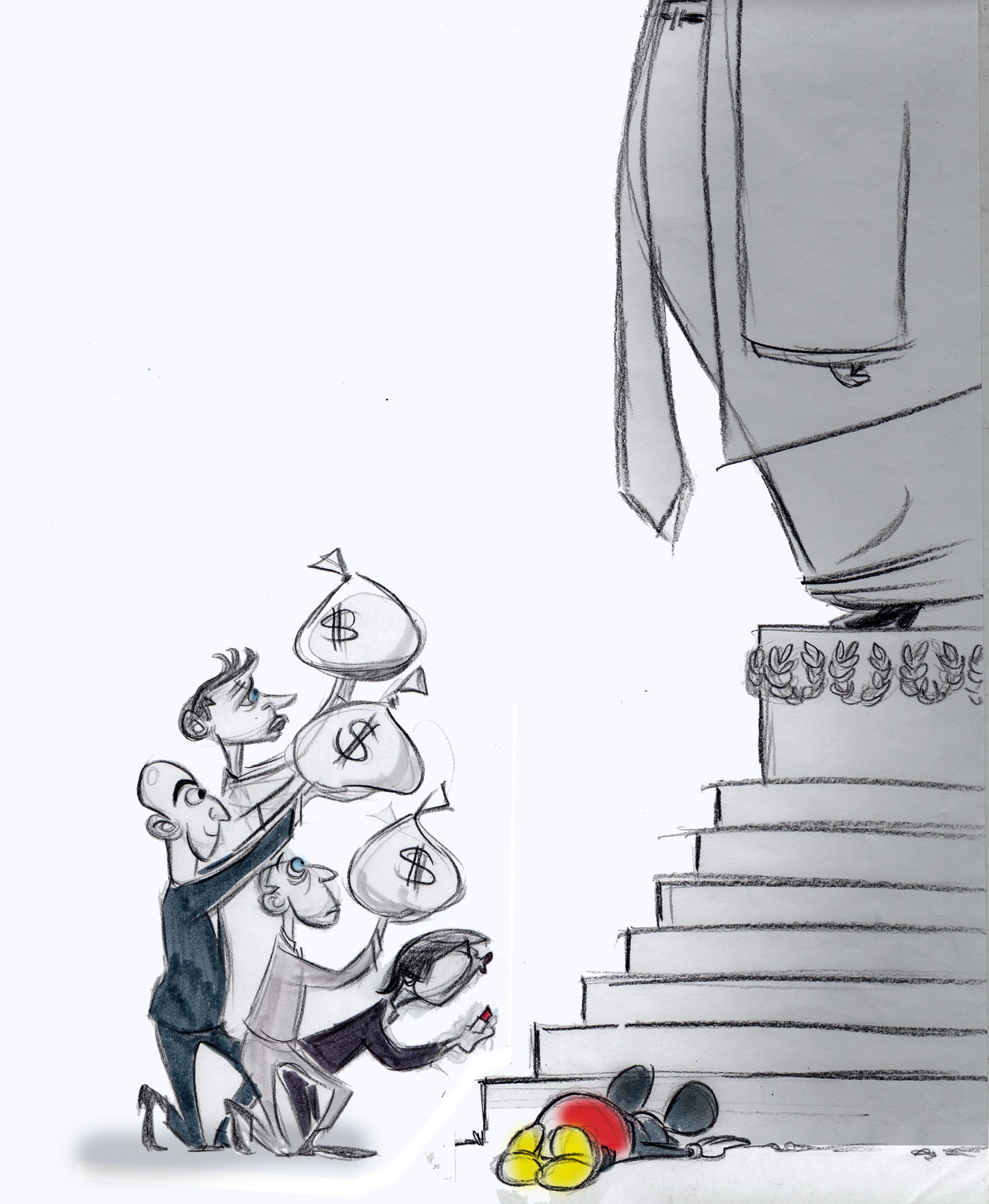
Ann Telnaes, editorial cartoonist for the Washington Post since 2008, quit her job after one of her cartoons was censored by higher-ups. The cartoon at issue depicted tech and media billionaires paying obeisance and money to Donald Trump. The cartoon included portrayals of Mark Zuckerberg (META), Sam Altman (AI), Patrick Soon-Shiong (Los Angeles Times), and Jeff Bezos, owner of the Washington Post. And, of course, Disney, which settled with Trump for $15 million rather than defend George Stephanopoulos in court. Each has given Trump $1 million or more to underwrite his inauguration. If Telnaes had waited a day, she would have added Tim Cook, CEO of Apple, to her list of suck-ups and sycophants.

The motto of the Washington Post is: “Democracy dies in darkness.” Conservative (but anti-Trump) lawyer George Conway wrote on BlueSky:

I guess the new slogan for the Washington Post ought to be:

“Newspapers die in cowardice.”

Ann Telnaes’ resignation is an act of courage that should inspire all of us to stand by our principles.

Telnaes wrote about her decision to resign on her Substack blog:

I’ve worked for the Washington Post since 2008 as an editorial cartoonist. I have had editorial feedback and productive conversations—and some differences—about cartoons I have submitted for publication, but in all that time I’ve never had a cartoon killed because of who or what I chose to aim my pen at. Until now.

The cartoon that was killed criticizes the billionaire tech and media chief executives who have been doing their best to curry favor with incoming President-elect Trump. There have been multiple articles recently about these men with lucrative government contracts and an interest in eliminating regulations making their way to Mar-a-lago. The group in the cartoon included Mark Zuckerberg/Facebook & Meta founder and CEO, Sam Altman/AI CEO, Patrick Soon-Shiong/LA Times publisher, the Walt Disney Company/ABC News, and Jeff Bezos/Washington Post owner. 

While it isn’t uncommon for editorial page editors to object to visual metaphors within a cartoon if it strikes that editor as unclear or isn’t correctly conveying the message intended by the cartoonist, such editorial criticism was not the case regarding this cartoon. To be clear, there have been instances where sketches have been rejected or revisions requested, but never because of the point of view inherent in the cartoon’s commentary. That’s a game changer…and dangerous for a free press.

(rough of cartoon killed)

Over the years I have watched my overseas colleagues risk their livelihoods and sometimes even their lives to expose injustices and hold their countries’ leaders accountable. As a member of the Advisory board for the Geneva based Freedom Cartoonists Foundation and a former board member of Cartoonists Rights, I believe that editorial cartoonists are vital for civic debate and have an essential role in journalism. 

There will be people who say, “Hey, you work for a company and that company has the right to expect employees to adhere to what’s good for the company”. That’s true except we’re talking about news organizations that have public obligations and who are obliged to nurture a free press in a democracy. Owners of such press organizations are responsible for safeguarding that free press— and trying to get in the good graces of an autocrat-in-waiting will only result in undermining that free press.

As an editorial cartoonist, my job is to hold powerful people and institutions accountable. For the first time, my editor prevented me from doing that critical job. So I have decided to leave the Post. I doubt my decision will cause much of a stir and that it will be dismissed because I’m just a cartoonist. But I will not stop holding truth to power through my cartooning, because as they say, “Democracy dies in darkness”.

Thank you for reading this.

Blogger “That’s Another Fine Mess” predicts trouble ahead for Team Trump. They are already squabbling because Trump insisted he would stop immigration but quickly backed down when Musk and Vivek said they needed highly skilled foreigners because no American was qualified. This is an excerpt. Open the link to read it all.

He writes:

The first year of Felon34 2.0 will be more shambolic than the first year of Felon 1.0, regardless of how many of the Felon’s idiots claim the benefit of four years of experience. Felon34 and his loyalists will take power better prepared to implement a number of malicious ideas, but will make less progress and create more chaos than they did in 2017 for two simple reasons:

First, because their added experience of preparedness will be swamped by their much greater arrogance, leading them to shed guardrails, fall into obvious traps, and overreach. We’ve seen it already on every major issue that has come up over this past month.

Second, because they’ll be inheriting the country at a somewhat less-stable equilibrium than they did last time: highly prosperous, but with less room to maneuver without generating inflation or triggering a recession. The market went through its longest period of decline since 1978 two weeks ago. With the uncertainty about whether Felon34 will be able to mount his mass deportation – and the effect that will have on the economy if he pulls off even a portion of it – added to his insane threats against Panama, Canada and Greenland; his plan to slap tariffs on the rest of the world; and his general insanity – the market will respond. The market does not like uncertainty. Felon34 sees his main job as keeping the market up – to support his billionaire owners and to flim-flam the flimflammables – and he is going to quickly run into the problem that he cannot please the droolers and the market simultaneously. He knows if he fucks the market he’s screwed, and if he doesn’t deliver the promises he made at his hatealongs he’s also screwed.

My prediction: Fire and fury. By this time next year it will be “a tale told by an idiot, signifying nothing.” Felon34 is the most determined moron in US political history. And then in January 2026, the mid-term campaign begins.

The MAGA Civil War will continue in 2025. Former George W. Bush Campaign Manager Stuart Stevens, who is now a Democrat, says that people should not ignore the fact Steve Bannon turned on Elmo: “Bannon is a guy who has defined himself as a thug, and thugs must do thuggish things. I think Musk has no idea what he’s getting into when he gets in a fight with Bannon over this.” Stevens then explained that if Bannon is ever able to turn Trump against Musk as he’s trying to do, that could be a big problem for Elmo: “There’s been reporting that Musk was not a student when he got a visa, and when he made his application for naturalization he put false information on that document. That is grounds for revoking citizenship. It happens all the time. One reason why Musk is so obsessed with immigration is because he knows this. I wouldn’t bet against Steve Bannon.”

Former Trump Press Secretary Sean Spicer posted a poll on X which asked if Republicans agreed with Musk on the H-1B visas or if they agreed with Steve Bannon on it. He got over 92,000 votes, with 67% siding with Bannon over Musk.

Elmo continued his purge and punishments of right-wing accounts who disagreed with him on this. White nationalist talk show host Stew Peters (758,000 followers): “Elon Musk is STEALING money from my subscribers and LYING to them. This morning I woke up to find that he removed my blue check mark and canceled my ability to have subscribers. My subscribers were told that I canceled my subscription service and they would not be refunded for the next two weeks in which they’ve already paid X for, but which won’t allow me to provide them content. This is intentional deceit and theft.”

White nationalist Nick Fuentes: “Today X appears to have un-verified 5 more prominent critics of the H-1B program. Their checkmarks were taken, subs were refunded, and character limit reduced. This is now overt political censorship. This comes after the Project Groyper brand account and all of its affiliates were suspended last week.” 

My prediction: I agree with Stuart Stevens that one should not bet against Bannon. He knows how to fight like this and Elmo doesn’t. If Bannon’s side ever gets the goods on Elmo’s immigration and naturalization, expect Elmo to be in deep shit and Felon34 will abandon him.

In closing, this is the gang – as Jeff Tiedrich described them – who could screw up a fuck in a brothel. As I like to say, they’re the people who flunked the IQ test low enough to qualify for membership in MAGA. They’re the Broken Toys who never learned to work and play well with others. Over the past three weeks – before they’re even in office – they have screwed the pooch and munched the lunch. They couldn’t pass the bill they had to pass without Democrats, and Democrats aren’t going to pull their chestnuts out of the fire next time. They have till the middle of the month to fix the debt ceiling and they can’t elect a speaker. There’s going to be nobody there next Monday to accept the vote count of the electoral college. The odds are good the stupid sonofabitch can’t get sworn into office, in which case, the position goes to the Speaker – of which there is none. Assuming they find a way through this mess, they have twelve months to do all the things they have to put through Congress – with a one-vote margin. Their leader is Donald Trump – who bankrupted a casino!

They’re going to be throwing their best friend through a window, and they’ll be tripping when they try to pull their pants on and falling against the dresser and knocking themselves out.

We’re the side who won the Civil War and beat the Nazis and smashed the Japanese.

Act. Like. It.

This article was written by Dr. Cassandra Ulrich, who served as president of the Michigan State Board of Education, and now is a member of the board of the Network for Public Education.

Dr. Casandra Ulbrich is a former Michigan State Board of Education president (2014 – 2023). She is a member of the Network for Public Education Board of Directors Ulbrich has spent most of her career in higher education administration, currently serving as the Vice Chancellor for Institutional Advancement at the University of Michigan-Dearborn. Ulbrich began her career as a press secretary to the former U.S. House Democratic Whip David Bonior, acting as the official spokesperson for the Congressman. She has been recognized as one of Michigan’s 40 under 40 by Crain’s Detroit Business.

At the end of the 2023-2024 session, the House and Senate of Michigan took up bills to increase charter school transparency in a state where 70% of the schools are run by for-profits. Ultimately, the bills did not pass, but the problems persist. Below is the testimony given by Dr. Casandra Ulbrich, the former President of the Michigan Board of Education.

As the former President of the State Board of Education, I would like to commend the State Senate for taking the issue of financial transparency seriously. The bills before you today level the playing field by requiring charter schools, education management companies, and authorizers to demonstrate that they are responsible stewards of public dollars, just as traditional public schools are currently required to do.

Financial transparency is an essential element of accountability for all publicly funded institutions and a necessary component for an engaged citizenry. Absent timely and accurate financial data in a manner that is easily accessible and understood by the public, citizens lack the resources necessary to make informed decisions. Missing or misleading financial information removes a citizen’s ability to adequately determine the value of their public investments. Similarly, a charter school board that is denied this information cannot fulfill its oversight duty and its commitment to the citizens it serves.

This is particularly true for the K-12 public schools that educate approximately 1.3 million students in the State of Michigan, nearly 10 percent of whom attend a charter school. In 2022 – that year will be relevant during my testimony – Michigan Charter schools received roughly $1.4 billion in taxpayer funding. How this money is spent is often hidden from taxpayer view behind a wall of secrecy. One reason is that Michigan law allows charter school boards to contract out all the school’s services to a for-profit education management company that also assumes control of the school’s budget. This arrangement is known as a ‘sweeps’ contract in the charter school sector. Its name comes from the fact that nearly all of the school’s public dollars – anywhere from 95 percent to 100 percent – is ‘swept’ into a charter management company. Once that happens, that money is no longer reportable to the taxpayers who funded those dollars.

While the schools themselves must adhere to Freedom of Information Act(FOIA) laws, private, for-profit management companies themselves are not subject to FOIA. Therefore, when a management company assumes the vast majority, if not all, of the school’s budget, how that money is spent is legally hidden from public view.

For years, the charter lobby has argued that charter schools adhere to all applicable transparency laws. In most cases, they are correct. But, those laws fall far short of allowing taxpayers adequate oversight over the schools for which they fund.

In 2022, the State Board of Education used the Freedom of Information Act to identify and disclose the similarities and differences in financial reporting between traditional and charter school districts.

We sent FOIA requests to all school districts, both traditional and charter, in five Michigan counties. Of those districts, 112 were traditional school districts, representing over 551,000 full-time equivalent (FTE) student counts, and 166 were charter school districts, representing nearly 80,000 FTE student counts. For the charter districts, 117 (71%) used for-profit management companies, 19% used non-profit management companies, and 11% were self-managed. Individual district student counts ranged from a low of 71 to a high of more than 55,000 FTEs.

On January 5, 2022, each district received a FOIA from me as the President of the SBE. A second letter was sent to those who did not respond, and in some cases, a third letter was also sent. The FOIA request included five items:

  • Contracts for rental or lease of facilities.
  • Contracts for food service management or vended meals.
  • Contracts with custodial service vendors.
  • Contracts with lawn and grounds service vendors.
  • Contracts with educational service providers or education management
    companies.

The results demonstrated what we had assumed all along.

Following the third letter, 100% of traditional school districts responded to the FOIA request, while only 93% of charter districts responded. Seven percent of charter school districts didn’t even bother to respond to three Freedom of Information Requests from the State Board of Education.

When it came to facility contracts, Charter school districts were more likelyto submit facility rental or lease contracts. Sixty-eight percent, or 105, of charter districts submitted these contracts. Many charter districts lease their buildings from entities related to the management companies overseeing the schools.

A management company that also subleases its own facilities to the schools they manage raises obvious questions about conflicts of interest. It also allows the management company/facility owner to set lease terms that may be excessive. The State Board of Education FOIA did not address the market rates of each lease, but other states have identified this as an issue. For example, in 2012, the New York State Comptroller issued a report detailing how a Brooklyn charter school managed by National Heritage Academies approved a lease from a “related business” at a rate nearly $800,000 above market value, or $3.96 million more over the term of the five-year lease. The report also indicated that NHA refused to divulge financial records supporting expenses that it charged to the charter school. A 2019 Ohio Auditor report found similar examples in that state.

Another issue is that many charter management contracts also include a provision that allows the management company to own all property in the school, even though that property was most likely funded by taxpayers.

Food Service, Custodial, and Lawn Contracts

Charter school districts, particularly those managed by for-profit companies, were far less likely to share food, custodial or lawn contracts. In fact, these charter districts indicated they were not responsible for these contracts. This reflects the fact that many charter districts engage in “sweeps contracts.” Therefore, a common response among for-profit managed companies was to deny the State Board’s FOIA request related to these three contracts. The FOIA coordinator responded, “Your request for information contained in bullets 2 through 4 is denied because the Academy does not (i) contract for food service management or vended meals, (ii) contract with custodial service vendors, or (iii) contract with lawn and grounds service vendors. Instead, the Academy contracts for the above services through a third-party management company by way of an educational management agreement and, thus, the Academy is not a party to the service contracts.” (S. Wilson, personal communication, January 14, 2022).

Financial Disclosures

One thing that became evident through the FOIA process was the vast differences in detailed financial disclosures. All districts, regardless of charter or traditional, are required by statute to submit annual comprehensive financial data (MCL 388.1618(5) and a financial audit report (MCL 388.1618(4). While the reports tend to be detailed for traditional school districts, this is not the case for charter districts. Most PSAs report most of their current operating expenditures as“purchased services” through their management company. The management companies, themselves, are not required to report detailed information. As a private vendor, there is no statutory requirement for management companies to submit financial reports to the state.

It’s important to note that, with limited exceptions, traditional school districts are not permitted by law to contract for instructional services. On the other hand, many charter school districts contract with a management company for all or most of these services. According to a state board of education resolution, in FY21, 90.4% of charter schools reported that more than 50% of the school’s current operating expenditures were spent on purchased services (totaling $1.3 billion in purchased services), resulting in those expenditures not being reported and audited with the same level of detail provided for expenditures of traditional school districts, and not subject to public disclosure under FOIA” (MI State Board of Education, 2022).

Financial Reporting

Michigan school districts provide financial information to the state via the Financial Information Database (FID). Data submitted to the FID includes financial reports, revenues, and expenditures. However, what is reported looks very different depending on the type of district and their management contracts, leading to greater disparity between traditional and charter school districts. Under current reporting requirements, the costs for services provided to charter districts under a management agreement are often aggregated under “purchased services” and therefore lack any detailed information.

As a result of this method of reporting, it is nearly impossible to make any kind of accurate comparisons of financial spending. And, since management companies are not subject to the same financial reporting and audit requirements as districts, taxpayers have no way of knowing if their investments are being spent appropriately or if those dollars are being spent in an illegal or
inappropriate manner. In my role on the State Board of Education, I have heard many anecdotal examples of this happening, but absent real transparency laws, there is no way of holding bad actors accountable for their actions. Not only is this inappropriate for a public entity, but it also serves as a stain on all charter schools, including those that are acting in good faith and are truly interested in
providing quality education for children.

The bills before you today alleviate many of the concerns that the State Board of Education has been raising over the last twenty years. Specifically, financial information will be available to the Boards that are charged with overseeing these schools, allowing them to do their jobs effectively. Financial
information will also be not only FOIA-able for the public but in many cases available on the school’s website. It will bring to light related party transactions and taxpayer overspending.

If we are truly interested in parents making choices for their children, they should have access to this information, as should taxpayers who are funding these schools.

For these reasons, the Charter School lobby should be the first in line tosupport these financial transparency laws that could demonstrate what they have been saying…that the vast majority of charter school operators are conducting themselves appropriately and to send a message to those who may not be.

Absent that, I would ask yourself, what do they have to hide?


Dr. Casandra Ulbrich is a former Michigan State Board of Education president (2014 – 2023). She is a member of the Network for Public Education Board of Directors Ulbrich has spent most of her career in higher education administration, currently serving as the Vice Chancellor for Institutional Advancement at the University of Michigan-Dearborn. Ulbrich began her career as a press secretary to the former U.S. House Democratic Whip David Bonior, acting as the official spokesperson for the Congressman. She has been recognized as one of Michigan’s 40 under 40 by Crain’s Detroit Business.

Donald Trump was quick to release a statement about the deadly terrorist attack in New Orleans. He said that the attacker was an immigrant, proving that his anti-immigrant warnings were right. He rushed to judgment.

“When I said that the criminals coming in are far worse than the criminals we have in our country, that statement was constantly refuted by Democrats and the Fake News Media, but it turned out to be true,” Trump posted on Truth Social Wednesday morning. “The crime rate in our country is at a level that nobody has ever seen before.”

But he was wrong. The perpetrator of the attack was born in Beaumont, Texas, and lived in Houston. Apparently he is also a military veteran.

Something went horribly wrong to turn this man into a mass murderer, but he was not an immigrant.

The Houston Chronicle reported:

Records show Jabbar was born in Texas. Misinformation circulated on social media that Jabbar was an immigrant or had crossed the U.S. Mexico border, including from President-elect Donald Trump on his Truth Social account.

“Sham,” as his classmates knew him, graduated from Beaumont’s Central High School in 2001. He was born and raised in Beaumont.

Grant Savoy, who was photographed with Jabbar in the 2001 high school yearbook, said the two took a couple classes together. He didn’t know him very well, as the high school had about 300 students that graduation year, but Savoy described Jabbar as “quiet.”

“He … didn’t seem like this guy I’m hearing about,” Savoy said. “But that was over 20 years ago, so I don’t know what life (has) done to him.”

Jabbar graduated from Georgia State University with a degree in computer information systems, the college confirmed. 

Not an immigrant.

Former federal prosecutor Joyce Vance explains in plain English the latest court case that Trump lost.

His lawyers appealed a decision awarding E. Jean Carroll $5 million, claiming that the trial judge erred by allowing admission of evidence about previous accusations of sexual assault by other women, as well as the infamous “Access Hollywood” tape.

The U.S. Court of Appeals for the Second Circuit rejected Trump’s appeal.

After I read the post below, I asked a friend who is a lawyer whether Trump could evade accountability by pardoning himself, and she replied, “No, the President can pardon only criminal convictions, and this is a civil conviction.”

Joyce Vance explains:

After an inexplicable delay, the Second Circuit Court of Appeals issued its opinion, affirming the jury verdict in the first of E. Jean Carroll’s two defamation cases to go to trial against Donald Trump (for those of you who followed closely, you’ll recall this was actually “Carroll II,” the second of the cases Carroll filed, but it made it to trial first for reasons discussed here.)

Trump Unleashes on E. Jean Carroll While Attending Defamation Trial

At the start of it’s 79 page opinion, the court recites that “after a nine-day trial, a jury found that plaintiff-appellee E. Jean Carroll was sexually abused by defendant-appellant Donald J. Trump at the Bergdorf Goodman department store in Manhattan in 1996. The jury also found that Mr. Trump defamed her in statements he made in 2022. The jury awarded Ms. Carroll a total of $5 million in compensatory and punitive damages.” 

The Second Circuit’s decision today does not involve the other case, where Carroll was awarded $83.3 million by a second jury. That happened in large part because Trump, after losing the first go-round, was simply incapable of letting it drop and continued to defame Carroll, including in a CNN town hall the day after the $5 million verdict.

The most important part first: The court ruled in Carroll’s favor, finding that Trump failed to show that the trial court committed errors that entitled him to a new trial. This is the final word in the Second Circuit’s view. Trump can ask the full court to rehear the case en banc, which it is unlikely to do. Or, he can petition the Supreme Court for certiorari review. But the Supreme Court doesn’t have to take the case and, in fact, it would be surprising if it did. 

If that topline from the case is enough for you, stop here. But if you want more, I’ve read the entire opinion, and I have some hot takes for you. Yes, it’s a lot of legalese, but I think you’ll find it worth your time. (And if you’re done here, do skip down five paragraphs and read the two starting with “In it’s recitation of the case,” because whether it’s intentional or not, the court has something to say about why E. Jean Carroll didn’t come forward for years.)

Keep in mind that as the court is careful to say, in an appeal like this, it’s required to view the evidence in the light most favorable to the plaintiff—that’s E. Jean Carroll—so the legal assumption the court proceeds with is that her version of the facts is accurate. This is the legal device used in an appeal of this nature: the Court of Appeals is evaluating the verdict and whether it can stand, assuming Carroll’s version of events, which the jury accepted, is true. Even with that in mind, the court’s recitation and evaluation of the evidence is a timely reminder of who the next president of the United States that is worth reviewing, even if you’re already thoroughly disgusted.

This appeal is primarily about whether the trial court erred when it admitted certain types of evidence at trial (see below), and in our legal system, those decisions are committed to the sound discretion of the trial judge and are only reversed if there is an abuse of that discretion. The Court of Appeals put it this way, “We accord ‘great deference’ to a district court, however, in ruling ‘as to the relevancy and unfair prejudice of proffered evidence, mindful that it sees the witnesses, the parties, the jurors, and the attorneys, and is thus in a superior position to evaluate the likely impact of the evidence.’” It is the trial court’s unique opportunity to eyeball the evidence and the witnesses during trial that puts it in the best position to make these calls.

Trump complained that Judge Kaplan improperly admitted certain types of evidence at trial. The Court of Appeals found there was no abuse of discretion and affirmed the verdict and award of damages to E. Jean Carroll.

There is nothing unique or novel in this case beyond the identity of the defendant. There is nothing to take it beyond the realm of the thousands of cases where decisions made by the courts of appeals across the country stand as a final decision every year. This decision should be the end of this case. If the Supreme does decide to take it, that, even in this era, would be a shocking abuse and indication of special treatment for Trump. 

It takes four Justices votes for the Court to agree to hear a case. Of the 7,000-8,000 cert petitions filed each term, the Court typically hears about 80 of them. Fact based questions about whether a trial judge abused their discretion in admitting evidence that demonstrates intent, motive, pattern of behavior, and so forth—evidence that is frequently used in cases—typically doesn’t rise to that level.

In its recitation of the facts of the case, the court seems to grasp something that Donald Trump never did, and that society at large often misses. Trump claimed Carroll made the whole thing up, that she wouldn’t have waited so long to tell the story if it was true. Of course, Carroll did tell two of her closest friends at the time, but she never went to the police. One of her friends had cautioned her: Trump was too powerful; it would end her career. It’s an all too familiar story for women.

Here is the court’s take: “While conducting interviews for a book that she was writing in 2017, the accounts of assaults perpetrated by Harvey Weinstein came to light and received nationwide attention. As a consequence of the many women who came forward to report their experiences of sexual assault, Ms. Carroll finally decided to share more broadly what Mr. Trump had done to her in 1996.” Me too was a watershed moment for so many women. It was for E. Jean Carroll too. In an era where women have faced taunts of “your body, my choice” in the wake of the election, we might want to stay focused on what women have gained—and lost—in recent American history.

In discussing the trial judge’s decision to permit Carroll’s lawyer to put on evidence of other alleged sexual assaults committed by Trump, the Court of Appeals writes, “Rules 413 and 415 permit a jury to consider evidence of a different sexual assault ‘precisely to show that a defendant has a pattern or propensity for committing sexual assault.’” They continue, “Congress ‘considered knowledge that the defendant has committed [sexual assault] on other occasions to be critical in assessing the relative plausibility of sexual assault claims and accurately deciding cases that would otherwise become unresolvable swearing matches.’ … ‘[T]he practical effect of Rule 413 [and Rules 414 and 415] is to create a presumption that evidence of prior sexual assaults is relevant and probative’ in cases based on sexual assault.”

A trial judge has the ability to prevent a jury from hearing evidence of prior sexual assaults if the value of the evidence in proving the plaintiff’s case is outweighed by undue prejudice to the defendant. That doesn’t mean that any prejudice is enough to keep the evidence out—all good evidence offered at trial is prejudicial, in the sense that it helps prove that one of the parties did or said something that they are being sued for. The question is whether there is unfair prejudice.

The court relates the evidence Carroll’s lawyers used at trial and concludes that all of it was properly admitted:

  • Jessica Leeds was assaulted on an airplane by Trump in 1978 or 1979 after he had a flight attendant invite her to come sit with him in first class. Leeds testified, “he was trying to kiss me, he was trying to pull me towards him. He was grabbing my breasts, he was — it’s like he had 40 zillion hands, and it was a tussling match between the two of us. And it was when he started putting his hand up my skirt that that kind of gave me a jolt of strength, and I managed to wiggle out of the seat and I went storming back to my seat in the coach.” Leeds acknowledged the groping and patting women frequently endured in that era, but testified, “when somebody starts to put their hand up your skirt, you know they’re serious and this is not good.”
  • Natasha Stoynoff testified that, in December 2005, she was areporter for People magazine on assignment at Mar-a-Lago to do a story about Trump and Melania’s one-year anniversary and the birth of Barron Trump. Donald Trump took Stoynoff to a room where he said he wanted to show her a painting. She testified, “I hear the door shut behind me. And by the time I turn around, he has his hands on my shoulders and he pushes me against the wall and starts kissing me, holding me against the wall.” Trump was interrupted when his Butler walked in, but he told Stoynoff afterward that they were going to have “an affair” and told her to remember what his second wife, Marla Maples, had said about him, “best sex she has ever had.” 
  • The infamous Access Hollywood tape was played twice for the jury. In the recording, Mr. Trump states that he “moved on” a woman named Nancy “like a bitch” and “did try and fuck her.” The first block below is what Trump says in the tape, as related by the court. The second one is Trump’s deposition testimony about it (the same deposition where he misidentified a photo of Carroll at the time as one of his second wife, Maples):

Here’s what the court has to say about this evidence adding up to show a pattern of sexual assault by Trump: “In each of the three encounters [Leeds, Stoynoff, and Carroll], Mr. Trump engaged in an ordinary conversation with a woman he barely knew, then abruptly lunged at her in a semi-public place and proceeded to kiss and forcefully touch her without her consent. The acts are sufficiently similar to show a pattern or ‘recurring modus operandi.’ … Moreover, the [Access Hollywood] tape was ‘directly corroborative’ of the testimony of Ms. Carroll, Ms. Leeds, and Ms. Stoynoff as to the pattern of behavior each allegedly experienced, and ‘the matter corroborated’ was one of the most ‘significant’ in the case — whether the assault of Ms. Carroll actually occurred.” On the question of undue prejudice, the court concludes, “we also find that the other act evidence was not unfairly prejudicial, as the incidents in question were ‘no more sensational or disturbing’ than the acts that Ms. Carroll alleged Mr. Trump to have committed against her.” The jury was entitled to hear all of this evidence against Trump.

Trump also objects to areas the trial judge didn’t permit his lawyers to go into in front of the jury, including why she never DNA tested her decades-old dress and why she didn’t file a police report. Using the same standard, the Court of Appeals concluded the trial judge did not abuse his discretion when he excluded this evidence.

So there you have it. The next president of the United States of America. A timely reminder.

As I’m writing this, the opinion is still only available on Pacer, the U.S. Court’s ridiculously expensive documents system. Unfortunately, that means I can’t link to it now, but I’ll update as soon as it’s available publicly. Taxpayers fund the courts, and they are well-funded. There is no reason the document system shouldn’t be available free of charge to everyone—open courts, and all that.

We’re in this together,

Joyce

Trump created an advisory group called the “Department of Government Efficiency,” led by Elon Musk and Vivek Ramaswamy. It is an advisory commission, not a “department.” It has no official mandate. Musk claims it will cut the federal budget by $2 trillion, though he hasn’t said whether that’s a cut in by the annual budget or a cut over years.

Musk has billions in federal contracts, so his participation in this exercise raises questions about his conflicts of interest and whether he will injure his competitors.

Three ethics experts wrote an article for MSNBC about the conflicted role that Musk has. They are: Virginia Canter, chief anticorruption counsel, State Democracy Defenders Fund, Richard W. Painter, MSNBC Columnist and Gabe Lezra, policy director for State Democracy Defenders Fund.

The so-called “Department of Government Efficiency” is officially a mere advisory commission. But DOGE is nevertheless poised to help restructure the federal government and perhaps upend decades of regulation of everything from vehicle safety to space exploration. Co-chair Elon Musk is one of the most politically powerful private citizens in the country, as evidenced by his role in the recent budget crisis in Washington. Through his wealth and his ownership of X, he has enormous influence over President-elect Donald Trump, lawmakers in Congress and the national narrative.

Musk’s clout and his role as DOGE co-chair are even more significant given the billions of dollars in federal contracts held by his various companies and the array of federal agencies that regulate those companies. Americans are entitled to know about his communications and activities with the federal government before he and Trump go about overhauling it. That’s why our organization, the State Democracy Defenders Fund, has begun our inquiry into DOGE by filing Freedom of Information Act requests across the federal government.

As leaders of a federal advisory committee, Musk and his co-chair, Vivek Ramaswamy, plan to serve as “outside volunteers, not federal officials or employees. As such, they will not be bound by conflict-of-interest law binding federal employees. But the Federal Advisory Committee Act of 1972 says that such groups must operate with transparency and allow public participation. Our inquiry about Musk’s interests before the federal government is part of the transparency that is required for DOGE to instill public confidence rather than sow distrust.

In announcing the creation of DOGE, Trump wrote that the commission would pave the way for his administration to “dismantle Government Bureaucracy, slash excess regulations, cut wasteful expenditures, and restructure Federal Agencies.” Musk’s companies receive billions of dollars in government contracts. DOGE’s broad mandatecould give Musk vast sway over the very same agencies that administer those contracts, as well as agencies investigating his companies.

The scope of the potential problem we are facing is immense. Musk’s companies have been the subject of more than a dozen federal investigationsor reviews with various agencies, including the Federal Aviation Administration, the U.S. Fish and Wildlife Service and the National Park Service, the National Labor Relations Boardthe Securities and Exchange Commission, the National Highway and Traffic Safety Administration, the Federal Communications Commission and the Federal Trade Commissionamong others.

Most recently, Musk reportedly failed to secure from the Air Force “high-level security access” due to “potential security risks,” and he and SpaceX reportedly “triggered” at least three federal reviews for noncompliance with federal reporting protocols in place to ensure the protection of state secrets. Accordingly, we’ve sent our requests for records to all of these agencies — and the agencies with which he or his companies appear to have (or have had) contracts, including NASA, the U.S. Space Force, the Department of Defense, the Air Force and the National Oceanic and Atmospheric Administration.

The possible conflicts of interest are too many to enumerate. The “de facto monopoly” that Musk’s aerospace company SpaceX has on rocket launches should raise flags at the Federal Trade Commission — an agency that is already in Musk’s crosshairs. Even minor changes in an agency’s enforcement priorities or procurement policies could cost — or make — Musk tens or even hundreds of millions of dollars. And given the sheer array of Musk-owned companies, decisions affecting competitors are almost inevitable. Earlier this month, Ramaswamy said that DOGE is already looking at a Department of Energy loan to one of Tesla’s rivals, Rivian Automotive.

The mere appearance of conflict in government can quickly undermine the public’s confidence in its government.

series of press reports indicate that Musk and Ramaswamy have already begun work on DOGE: They’ve been meeting with government officials, developing DOGE’s priorities and targets, and recruiting other technology executives to join the department. They’ve even launched a podcast. Musk has solicited applications on X (formerly Twitter) to join DOGE, with applicants expected to put in 80-hour weeks doing “tedious work…& compensation is zero.”

That is why we are beginning our investigation now, a month before the beginning of the new Trump administration. Presidential transitions have extensive contacts with the agencies the new administration will be taking over. If Musk, Ramaswamy or their agents are beginning to work on projects that could benefit them, the public must know.

The mere appearance of conflict in government can quickly undermine the public’s confidence in its government. Absent strong ethics controls and adequate oversight mechanisms, Musk’s participation in regulatory and other executive policy decisions could lead Americans to question whether his recommendations are truly in their interest — or in his financial interest.

If DOGE’s work has indeed begun, transparency must begin as well. Its leaders’ and agents’ communications with federal agencies are obviously in the public interest. They offer the first glimpse into how Musk and Ramaswamy may use DOGE to attempt to restructure the government — and the extent to which those plans may benefit DOGE’s leaders. Without these records, the public will remain in the dark as Musk and Ramaswamy begin this project, and will therefore not be able to assess whether DOGE will serve the nation — or the interests of a privileged few.

Allison Gill is a Navy veteran, a comedian, a podcaster, and a blogger. Her blog “Mueller, She Wrote,” was launched at the beginning of that long-ago investigation of Trump’s connections to Russia. This post appeared on her blog:

I’m not a lawyer, but usually, when the Supreme Court hears a case, they are supposed to rule on that specific case. Yet somehow, in two crucial cases about holding Donald Trump accountable for insurrection, the corrupt court went out of its way to decide on questions not before it, and create “a rule for the ages,” as Neil Gorsuch put it during oral arguments this past spring.

The first bomb they dropped to destroy accountability for Trump was their ruling overturning the Colorado Supreme Court on Section 3 of the 14th Amendment. The justices decided 9-0 that Colorado could not keep a federal candidate off the state ballot – but a 5-4 majority took it a step further by deciding that Section 3 of the 14th amendment is not self-executing; meaning Congress has to first pass legislation disqualifying Trump. An idea so wrong that even Amy Coney Barrett joined the liberal justices and objected to that part of the ruling in her concurrence.

The second bomb they dropped was the immunity ruling. Not only did they grant Trump presumptive immunity in the case before them, but they granted all presidents presumptive immunity, and took it a step further by disqualifying official acts from being used as evidence to prosecute unofficial acts.

But that’s not all! Rather than deciding which acts in the Trump case were subject to immunity, they kicked it back down to the lower court, teeing up a second interlocutory appeal on whatever the lower court ruled. That effectively added another year to the delay. Additionally, it would give the corrupt court another swing at the DoJ case on the second appeal, where I imagine they’d rip it apart once and for all. When all was said and done, they decided that they themselves would be the ultimate arbiter of rulings on official acts for criminal presidents while adding ridiculously long pre-trial appeals to the process.

That’s nothing compared to the official acts evidence part of the ruling. Again – so bad and so wrong that Amy Coney Barrett joined the liberal justices to disagree. The gist is this: let’s say you want to prosecute a president after he leaves office for accepting a million dollar bribe in exchange for an ambassadorship. And let’s say you have emails between the president and the potential ambassador explicitly stating “I will give you this ambassadorship in exchange for a million dollars.” This Supreme Court ruling says you can’t mention the appointment of the ambassador (the quo) while trying to prosecute the bribe (the quid). Absolutely bonkers.

These two rulings are the reason we can’t have nice things. That and Mitch McConnell failing to convict Trump of Insurrection after his impeachment. These decisions are the reasons Trump has not been held accountable. All because a bought-and-paid-for supreme court, funded by dark money with corporate interests before the court, needed to protect Trump from prosecution and accountability.

Were it not for the immunity ruling, Donald would have faced trial for his role in the insurrection in March of 2024. Would a conviction have made a difference in the election given he was already a 34-count convicted felon? I don’t know, but we would have had a trial were it not for the Supreme Court. The immunity ruling also contained a permission slip from Clarence Thomas in his concurrence for Aileen Cannon to dismiss the documents case, opining apropos of NOTHING that Jack Smith was probably appointed and funded improperly.

POOF. Both DoJ trials were scrapped from the pre-election calendar. But even if Trump had lost the election, there’d be a second interlocutory appeal of Judge Chutkan’s immunity determinations that would have gone all the way back up to the Supreme Court – adding at least a year to the trial calendar. Would the corrupt court have left Judge Chutkan’s ruling in place, allowing the case to go to trial? If you believe that, I have a luxury motor coach to sell you.

People have been trying to convince me that if Trump were indicted sooner, he would have gone to trial before the election and wouldn’t have been re-elected. For that to be true, you’d have to convince me that the dark money funded oligarchs on the Supreme Court would have been cool one time and allowed the trial to happen. You’d also have to convince me that people are fine electing a man convicted of 34 felonies, but not a man convicted of 38 felonies. I have my doubts.

Regardless, I will forever blame the billionaire-funded Supreme Court. They are part of the oligarchy, and were installed to dismantle democracy. 

~AG

Trump has repeatedly selected someone to run major government agencies who opposes the core mission of the agency.

Robert Kennedy Jr., for example, is opposed to routine public health measures.

Trump did it again. He chose a far-right critic of any government assistance to the poor to run the Department of Housing and Urban Decelopment.

ProPublica reported:

As Donald Trump’s nominee to run the U.S. Department of Housing and Urban Development, Scott Turner may soon oversee the nation’s efforts to build affordable apartments, protect poor tenants and aid the homeless. As a lawmaker in the Texas House of Representatives, Turner voted against those very initiatives.

Turner supported a bill ensuring landlords could refuse apartments to applicants because they received federal housing assistance. He opposed a bill to expand affordable rental housing. He voted against funding public-private partnerships to support the homeless and against two bills that called merely to study homelessness among young people and veterans.

Behind those votes lay a deep-seated skepticism about the value of government efforts to alleviate poverty, a skepticism that Turner has voiced again and again. He has called welfare “dangerous, harmful” and “one of the most destructive things for the family.” When one interviewer said receiving government assistance was keeping recipients in “bondage” of “a worse form to find oneself in than slavery,” Turner agreed.

Such views would seemingly place Turner at odds with the core work of HUD, a sprawling federal agency that serves as a backstop against homelessness for millions of the nation’s poor, elderly and disabled. With an annual discretionary budget of $72 billion, the department provides rental assistance to 2 million families, oversees the country’s 800,000 public housing units, fights housing discrimination and segregation and provides support to the nation’s 650,000 homeless. If Turner’s record indicates how he will direct the agency’s agenda, it is those clinging to the bottom of the housing market who have the most to lose, researchers and advocates said.