The biggest lie about American school kids is that most are “below grade level.” This lie is repeated so often by prominent figures that it is widely believed. But it’s not true. Those who believe it are wrong. Those who repeat it, knowing it’s not true, are liars.
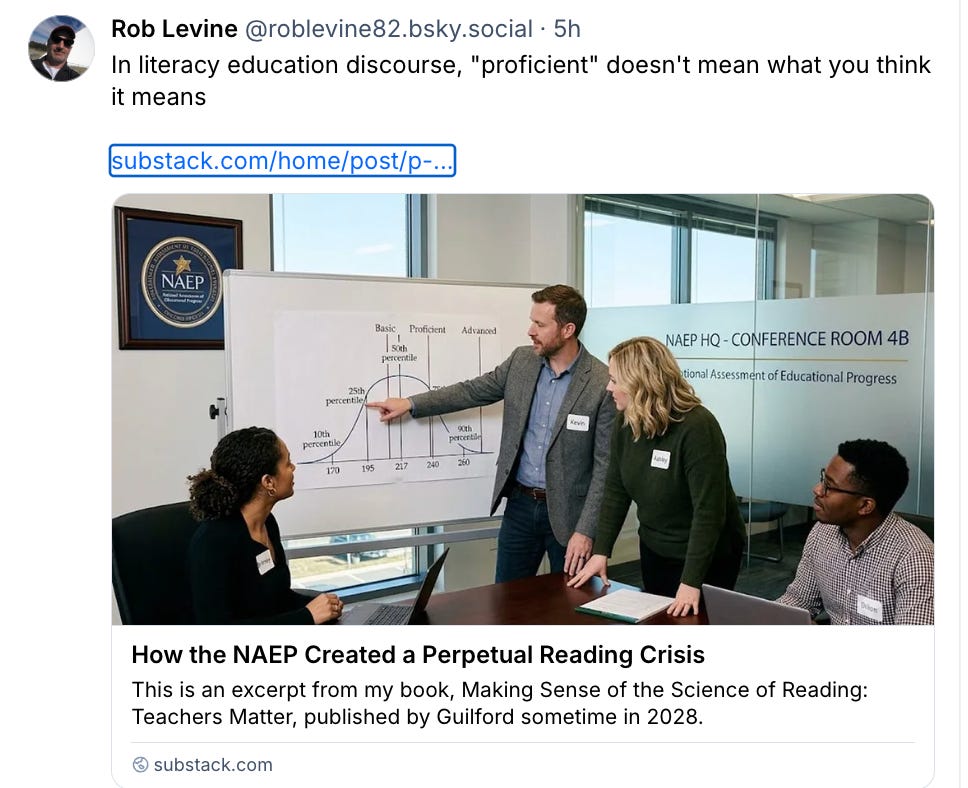
The source of the lie and the confusion is clear: the achievement levels in which NAEP scores are reported. The levels are “advanced,” “proficient,” “basic,” and “below basic.” When the media write about the latest release of NAEP scores, they frequently treat “proficient” as “grade level.”
But “proficient” is NOT “grade level.” It represents solid achievement, a rigorous aspirational goal. “Proficient” is equivalent to a solid A.
Every NAEP report on test scores says clearly in a footnote that “proficiency” is not the same as grade level. For example: “NAEP Proficient does not signify meeting grade-level expectations.” Yet the media and prominent commentators who should know better repeat the lie that most students are below grade level. The fact is that most students will never reach the high bar of “proficient.”
In 2023, as Bruce Lesley points out, Biden’s Secretary of Education–Miguel Cardona–testified to a Congressional committee that only one-third of American students were reading “at grade level.” I was flabbergasted. I couldn’t believe he said something so outrageous. I called Dr. Peggy Carr, who at that time was the Commissioner of Education Statistics. She was as surprised as I was that Secretary Cardona repeated the erroneous statistic. I asked Dr. Carr whether she had ever briefed him on understanding NAEP results; she had not.
I gave her an idea. Propose a change in name for “proficiency.” Change the name to “mastery.” No one would claim that “mastery” was the same as “grade level.” She liked the idea and promised to take it to the board. Whether she did, I don’t know. But nothing changed.
Bruce Lesley wrote this open letter to the National Assessment Governing Board, which oversees NAEP testing. Lesley is president of First Focus on Children and its partner organization First Focus Campaign for Children, bipartisan advocacy organizations dedicated to making children a priority in federal, state, and international policy. He has led both organizations since 2006 and 2009, respectively, building them into recognized national voices on child health, education, early childhood, economic security, budget and tax policy, immigration, children’s rights, and more recently, international child policy.
He wrote:
To the National Assessment Governing Board, the National Center for Education Statistics, and the leadership of the National Assessment of Educational Progress:
Every institution whose work affects children should begin with one question: “Is this good for children?”
By that standard, the National Assessment of Educational Progress (NAEP) has some important issues that deserve to be resolved. First and foremost, your achievement-level labels — “Basic,” “Proficient,” and “Advanced” — are being weaponized against the very children NAEP exists to serve, and you know it, because your own staff has been saying so for twenty-five years.
To be clear, this open letter is not a claim that NAEP’s underlying data is necessarily wrong, and it is not an argument against NAEP. The argument and request is narrower: you have a real and critically important ethical responsibility to correct the public misuse of your own data. NAEP should defend its credibility against those currently diminishing it.
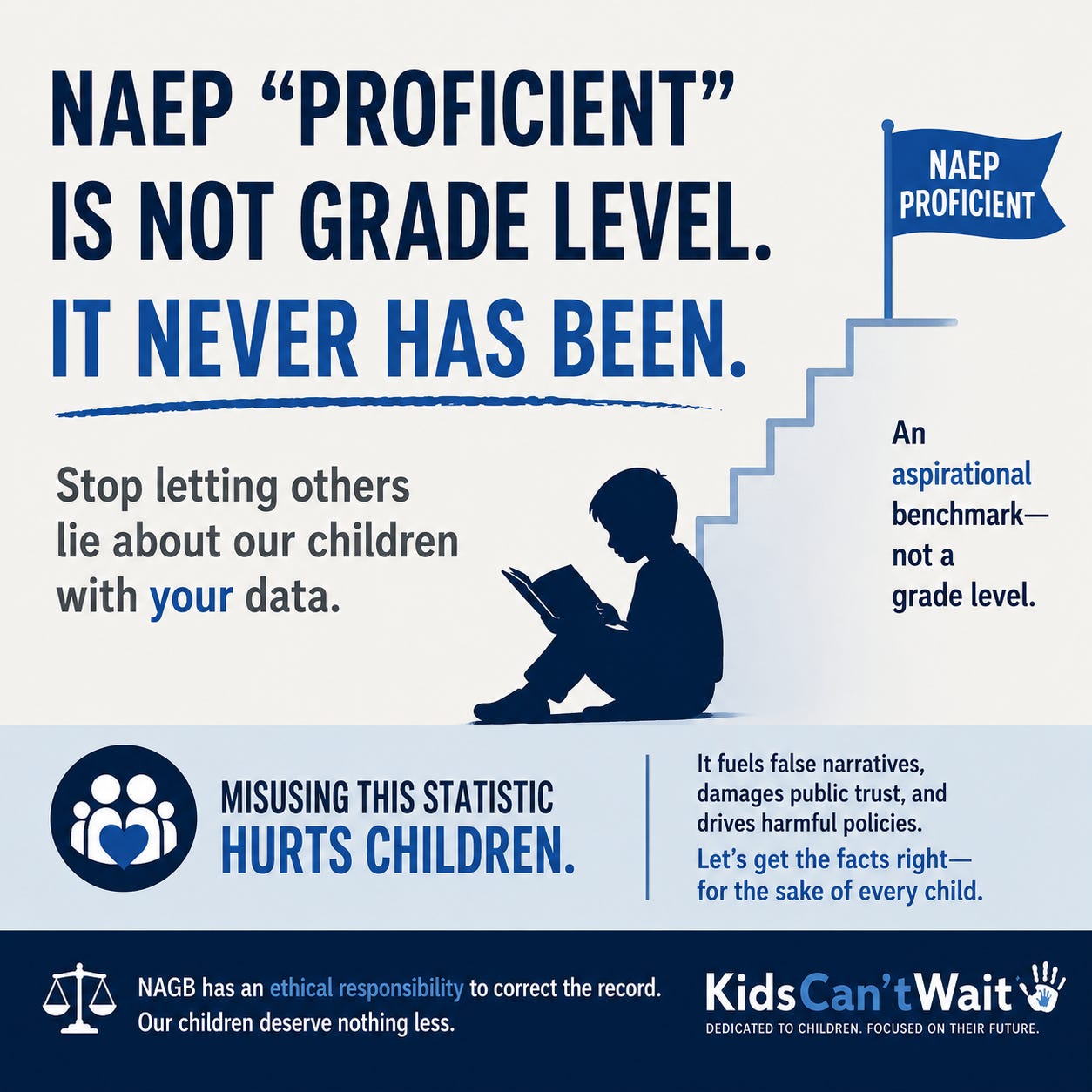
This Week’s House Mark-Up Provides Another Example
On July 15, 2026, the House Education and Workforce Committee marked up a ten-bill package to facilitate the dismantling of the U.S. Department of Education.
In his opening statement, Chairman Tim Walberg (R-MI) argued that “too many children can’t read or do math at grade level,” and used that claim as a central justification for several of the bills. That claim is false.
Chairman Walberg was drawing on NAEP data — the statistic that roughly two-thirds of American fourth-graders do not score “Proficient” in reading, which is wrongly cited as evidence of failing to meet grade-level reading levels. For some, this is done out of confusion and, for others, to promote a political agenda to undermine public schools. In reality, NAEP proficient is aspirational and reflects a standard that is well above grade level.
Unfortunately, during the markup, multiple members of Congress repeated the same error. But again, NAEP Proficient is not grade level. It has never been grade level.
When the public, the press, the administration, and Congress repeatedly miscite this fact, the National Assessment Governing Board (NAGB) must do much more to clarify and correct misstatements about what it means.
Education expert Peter Greene explains:
The problem is two fold. One part of the problem is that “proficient” is used on many state and local assessments to mean “at grade level,” or what once upon a time would have been called a gentleman’s C; this leads to some honest confusion for some folks. The other part of the problem is folks who are invested in the narrative that public schools are failing and who benefit from the confusion surrounding the term.
Greene adds:
And every time NAEP scores are released, education journalists write piece after piece explaining “proficient” all over again, usually in the wake of some prominent person decrying the large number of students not “at grade level.”
That confusion is NAGB’s responsibility to address, and it has deserved attention for years, but all the more NOW.
This Is Not a Partisan Problem
Chairman Walberg and his colleagues’ misstatements are only the most recent officials to make this mistake (whether unintentionally out of confusion or internationally), and the pattern runs through both political parties.
Secretary Betsy DeVos, in the first Trump Administration, told the public that two-thirds of American students could not read at grade level— the same inaccurate conflation Chairman Walberg and his colleagues made yesterday.
Secretary Miguel Cardona, testifying before Congress in April 2023 under the Biden Administration, told lawmakers directly that only one-third of students were reading “on Grade level,” treating a NAEP proficiency figure as if it were a grade-level statistic, in nearly identical language.
Potential Democratic Party presidential candidate Rahm Emanuel is doing it as part of his tour of early primary states.
And Secretary Linda McMahon, in the current Trump Administration, has used more careful wording — noting that nearly 70% of eighth graders are “not proficient” in reading — but has paired that technically accurate phrase with language implying total system failure. A Snopes piece by Rae Deng described this claim as lacking its own level of reading comprehension because, again, it completely mischaracterizes what NAEP’s “proficient” standard means.
Outside advocacy groups have been considerably less careful than any of them.
Moms for Liberty has publicly proclaimed that 68% of children cannot read at grade level, a direct misstatement of NAEP data. Here is just one of many examples.
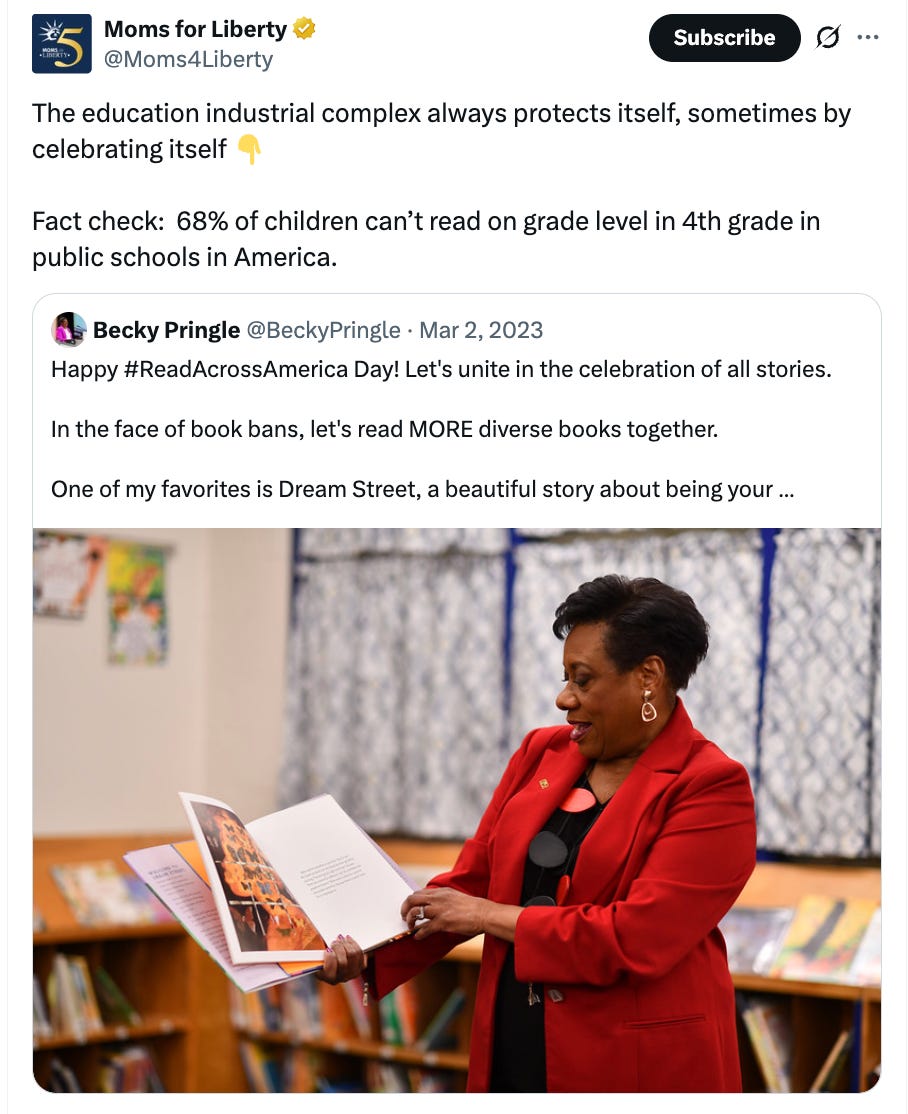
Furthermore, one of the organization’s co-founders has separately misread a state’s NAEP proficiency rate as that state’s overall literacy rate. Wrong again.
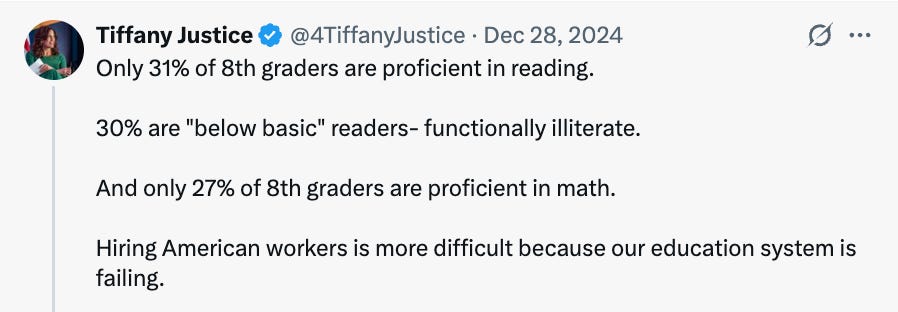
Corey DeAngelis, a leading advocate for school privatization, vouchers, and against public education, has cited NAEP proficiency figures directly, without qualification, as evidence that public schools are a system-wide “disgrace.”
Greene captures these types of political misuse of NAEP data in this Substack post.
This confusion is intentional by people arguing for both the dismantling of public education and federal investments in children.
Unfortunately, NAGB’s silence has allowed that rhetorical usefulness to go unchecked under Republican and Democratic administrations alike, and it is being used right now, this week, on Capitol Hill to justify eliminating the very agency that funds and safeguards the data NAGB produces.
NAGB’s Own Experts Have Been Saying This for Years
In 2001, Mary Lynne Bourque and Susan Loomis — a staff member and a board member of the National Assessment Governing Board itself — wrote plainly that the Proficient achievement level “does not refer to ‘at grade’ performance,” and that performance at Proficient is not the same as being “proficient” in a subject as any ordinary person would use that word.
Chester “Checker” Finn, Jr., who chaired the panel that adopted the achievement levels in 1992, has been candid that the levels were designed to be aspirational — a description of where students should ideally arrive, not a diagnosis of where most currently stand.
NCES itself has attached a caution to NAEP score reports for years: the Proficient level “does not represent grade level proficiency as determined by other assessment standards.”
If NAEP’s own architects and NAGB’s own website already say this, it is past time to be diligent in correcting the record when people misuse and misstate what it means. It is also on NAGB to stop publishing results in a format that predictably, foreseeably, and repeatedly gets misread as a verdict on grade-level performance, especially when you can see exactly how that misreading gets used again and again.
The clearest confirmation of all of this comes from NCES’s own data. Researchers Gina Cervetti and Kathleen Hinchman mapped every state’s definition of fourth-grade “grade-level” reading proficiency directly onto the NAEP scale and found that, as of the most recent analysis, nearly every state’s own standard for grade-level reading lines up with NAEP’s Basic level, not NAEP’s Proficient level. That means the honest translation of the data runs the opposite direction from how Chairman Walberg and others use it: by the states’ own definitions of grade level, roughly two-thirds of American fourth graders are reading at or above grade level, not below it.
Cervetti and Hinchman are also blunt about what actually is a crisis in the data: not a reading crisis, but an equity crisis. In 2022, only 48% of students eligible for free or reduced-price lunch scored at or above NAEP Basic, compared with 76% of students who were not eligible — a 28-point gap that has persisted, largely unchanged, for decades.
That is a story about generational wealth and unequal access to housing, healthcare, and school resources, not a story about failing classrooms, and NAEP’s own framing continues to let people tell the wrong story with your numbers.
What Education Writers and Researchers Have Been Saying
Diane Ravitch, who served seven years on the National Assessment Governing Board under President Clinton, has called out the confusion between NAEP Proficient and grade level as one of the most damaging and persistent falsehoods in American education discourse, noting that NAEP itself explicitly warns against the equivalence you continue to permit others to make.
Greene has argued that cut scores like “Proficient” function as scaled, curved judgments dressed up as fixed standards — noting that if every child scored above a cut, the establishment reaction would be to declare the cut too easy, not to celebrate the achievement. That is not how a genuine, fixed criterion is supposed to behave, and it is worth NAGB’s honest reckoning.
Mark Weber, a New Jersey teacher and education researcher, has done careful public work mapping state proficiency standards onto the NAEP scale, and his conclusion undercuts a favorite talking point of your critics-turned-allies in this fight: there is no empirical evidence that closing the so-called “honesty gap” between state and NAEP proficiency rates does anything to improve student achievement. If setting state cut scores to match yours were actually the lever for better outcomes, we would expect to see it in the data. We do not. That matters because it means the standard is being imported into state accountability systems on faith, not evidence — exactly the kind of unsupported claim NAGB should be correcting rather than allowing to spread.
The Brookings Institution’s Brown Center on Education Policy has been making this same case for nearly two decades. Tom Loveless, the Brown Center’s longtime director, authored a 2007 report concluding bluntly that NAEP’s cut scores were set too high.
His 2016 Brookings piece, “The NAEP Proficiency Myth,” went further, noting that the achievement levels came under critical review from the U.S. Government Accountability Office, the National Academy of Sciences, and the National Academy of Education shortly after they were adopted — with the National Academy of Sciences review concluding the achievement levels were fundamentally flawed.
Loveless adds:
Advocates of the NAEP proficient standard want it to be for all students. That is ridiculous. Another way to think about it: proficient for today’s eighth graders reflects approximately what the average twelfth grader knew in mathematics in 1990. Someday the average eighth grader may be able to do that level of mathematics. But it won’t be soon, and it won’t be every student.
That is not a stray outside critique. That is respectable experts in the field, writing for decades, about the very categories NASB is still using today without correction.
One Point Should Not Separate “Failing” from “Successful”
NAGB also owes the public an honest accounting of what a cut score actually is. A cut score is a single point on a continuous scale, chosen somewhat arbitrarily by a panel, above which a child is declared “Proficient” and below which the same child, one point lower, is declared “Basic,” which is actually grade level.
Two children who are functionally indistinguishable in what they know and can do are sorted into entirely different public categories — one used as evidence that a school, a state, or a federal agency is failing, the other treated as evidence of success — because of a single point set by a committee, not because of any meaningful difference in the children themselves.
That is not a rounding error. It is the mechanism by which your data gets converted into political ammunition.
If NAGB cannot explain, in terms parents can understand, why the child who scores one point below the line is a different kind of learner than the child one point above it, then the line is doing rhetorical work the data was never built to support.
As the psychiatrist and educator William Glasser warned schools decades ago, chasing a point or two of movement on a test score is precisely the wrong institutional goal — and yet that is the goal NAEP’s cut scores hand every state, district, and school in the country by default.
Researcher Andrew Ho makes a similar point. He has identified proficiency cut scores as arbitrary markers, set through what he calls an “overwrought, judgmental, and ultimately political process,” not derived from any fixed line in human learning.
Ho has also documented a specific illusion that follows from that arbitrariness: because a large cluster of students always sits near the middle of the score distribution, a cut score placed close to that cluster will make small, ordinary shifts in performance look like dramatic gains or losses, purely as an artifact of how many students happen to sit right at the line — not because anything real changed in how much they learned. A researcher with no stake in the politics of this issue is describing the identical mechanism that turns your data into a rhetorical weapon: the closer the line sits to where children actually cluster, the more your data will appear to swing wildly for reasons that have nothing to do with children’s learning.
Criterion-Referenced in Name, Arbitrary in Practice
NAEP describes itself as a criterion-referenced assessment, distinct from norm-referenced tests like the SAT that simply rank students against one another. That distinction matters, and I want to represent it accurately rather than overstate it — NAEP does not “grade on a curve” in the way the SAT’s percentile scoring does.
However, the practical effect on families is not so different as the label suggests. NAEP’s cut scores were set by hand-picked panels making judgment calls about what students “should” know, not derived from an external, agreed-upon standard of competence, and independent evaluators — including a National Academies review in 2017 — have called for stronger evidence connecting NAEP performance levels to any real-world outcome at all.
A test that is criterion-referenced in name but whose criteria were set arbitrarily, and whose results still track family income and race as tightly as any norm-referenced test on the market, produces the same practical harm as the norming bias critics have long raised: it tells us more about a child’s zip code than about a fixed, meaningful standard of what that child knows.
Notably, NAGB has conceded the point this year. The 2026 NAEP reading framework — administered to students for the first time this spring — now explicitly disaggregates racial and ethnic subgroup results by socioeconomic status, on the premise, well documented for decades, that apparent racial differences in test scores largely track socioeconomic differences. That is a welcome and overdue acknowledgment.
But it is also, in effect, NAGB admitting in 2026 what critics have argued for years: that the results have been measuring wealth and family circumstance as much as they measure “proficiency,” all along. If that acknowledgment is real, it should extend backward, to how NAGB talks about every score ever published, not just forward, to a single new breakdown in the data tables.
The Test Itself Is Not Neutral
Even setting the cut scores aside, the content of the test carries its own bias, and NAEP’s own commissioned reviewers have said so. The NAEP Validity Studies Panel — a technical review body NCES itself created and funds — published an analysis by Gerunda Hughes in 2023 documenting that the statistical methods used to build NAEP-style test items can systematically disadvantage the very students the test is supposed to serve fairly.
When an item is answered correctly by nearly every student, it gets treated as a poor “discriminator” between high and low performers and is typically cut from the test in favor of harder items, even though that easy item may represent exactly the content that should be mastered.
This is not a hypothetical risk. Education researcher Wayne Au, in Unequal by Design: High Stakes Testing and the Standardization of Inequality, documents exactly how this mechanism has played out on the SAT, a test built using the same basic pretesting logic NAEP relies on.
In his book, Au cites researchers Kidder and Rosner, who examined more than 300,000 SAT test-takers and the pool of trial questions used to build future exams and found that some trial questions were answered correctly by Black students, or by Latino students, more often than by White students. Those questions were then discarded — not because they were poor measures of the content, but because they failed to reproduce the racial score gap the rest of the test already produced. A question only “counted” as valid if high-scoring test-takers, who are disproportionately White, tended to get it right in pretesting.
My mother has verified the same process when she was asked to be on a panel to evaluate whether the item questions were “fair”. The publishers of the Texas State assessment at the time ran through the questions and kept throwing out questions as biased toward Black or Hispanic children if they scored the same or close to the scores of White children.
In contrast, questions in which there was a substantial gap in favor of White students were not flagged – thus, “norming” the disparity in test score outcomes into subsequent tests. Although my mother repeatedly objected, she was overruled throughout the day and, not surprisingly, never asked back to be a reviewer.
The result, as Au describes it, is a self-reinforcing loop: item selection is calibrated to match existing racial score gaps, which locks those same gaps into every future version of the test, all without anyone ever explicitly considering race in the selection criteria.
NAEP is a different test administered by a different organization, and I am not asserting that NAEP’s item-selection process has been documented to work in the same way. But NAEP uses the same category of item statistics that made this outcome possible on the SAT, and NAGB’s own validity panel has already flagged the risk. Given what is now documented on a test as consequential as the SAT, NAGB owes the public a direct, public answer to a direct question: has anyone checked whether NAEP’s item-selection process does the same thing?
There is also cultural and geographic bias. As the son of an English teacher and a math teacher, it should be no surprise that I did fairly well on standardized tests throughout my life. But I vividly recall a reading passage from the PSAT that focused on nautical issues and the definition of a “flotilla.”
Having grown up in El Paso, Texas, a city located hundreds of miles from any coastline, the passage and vocabulary word were unfamiliar to any of us taking the test in the desert borderlands. On the other hand, we would crush a passage referring to “tortillas.” NAEP’s own reviewers have a name for this: cultural validity, the idea that a test cannot cleanly separate what a child knows from what a child has been exposed to.
Research that NAEP’s own validity panel cites has found that when students are allowed to choose among reading passages on different topics, rather than being assigned a single passage that may be unfamiliar or uninteresting to them, some groups of students — including Black eighth graders and Hispanic twelfth graders in the panel’s own cited study — score much higher. That is evidence that some of what NAEP currently measures is exposure and familiarity, not just reading ability, and it argues for reform in how passages and vocabulary are chosen, not just in how results are labeled.
Again, the validity panel’s report contains proof that this is a design choice, not a fact of nature. In 1972, the psychologist Robert Williams built a test called the Black Intelligence Test of Cultural Hegemony, using vocabulary and content drawn from Black American culture instead of the dominant culture’s frame of reference. When Black and White teenagers took it, Black students substantially outscored White students by substantial margins.
Nothing about the underlying children changed between that test and the SAT. What changed was whose knowledge and cultural fluency the test happened to be built around.
That single fact should end, permanently, any claim that a test’s outcomes reveal some fixed truth about which children “can” or “cannot” read, think, or reason. What these tests reliably measure is often which cultural and economic frame of reference a child was raised in, and how well that frame matches the one test-makers chose to build around — which is another way of describing accumulated wealth, school funding, and generational inequity, not a verdict on a child’s mind.
That is real, and policies that address school finance inequity, child poverty, childhood hunger, and adverse childhood experiences (ACEs) deserve real policy attention. These issues would undoubtedly do more to improve educational outcomes in this country rather than privatization of public schools or the elimination of the Department of Education.
Claims that two-thirds of American children cannot read at grade level are simply false, and their interpretation by policymakers and advocates is harming children. There is an old warning that was popularized by author Mark Twain but attributable to British Prime Minister Benjamin Disraeli about three kinds of falsehood — “lies, damned lies, and statistics.”
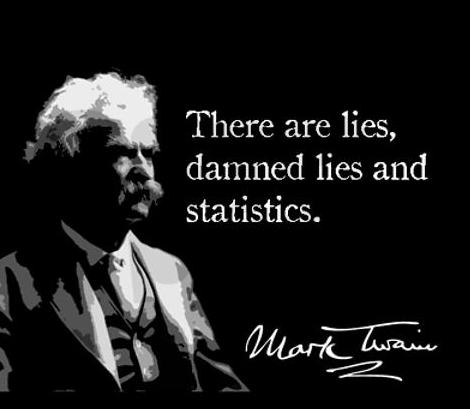
In this case, even a true number, presented without its context, can mislead more effectively than an outright fabrication. NAEP’s “proficiency” level is an aspirational one, but the grade-level story built on top of it is doing real harm. NAGB is a position to explain the difference, and the public is not, until you tell them.
The Damage Is Not Abstract: What Gets Tested Is What Gets Taught
This is not a technical quibble.
Every time “below Proficient” gets reported to the public as “can’t read” or “can’t do math,” it becomes ammunition for defunding public schools and for portraying millions of children — disproportionately low-income children and children of color — as failures because of a label your board itself has said should not be read that way.
It also reshapes what happens inside the classroom. When reading and math scores on tests built around NAEP cut points become the metric by which schools, teachers, and even state superintendents are judged, instructional time follows the incentive:
- Short, decontextualized passages crowd out real books — my children were taught how to write a brief constructive response (BCR) before they were even taught what a paragraph was.
- Science, government, history, the arts, and physical education are pushed to the margins of the elementary school day because they are not tested and therefore not rewarded.
Children end up narrower, not better educated, in the very subjects that make them informed citizens — and NAEP’s own cut-score architecture is a direct contributor to that narrowing, whether or not that was your intent.
NAGB tried a partial fix in 2018, adding the word “NAEP” before each level — “NAEP Proficient” rather than “Proficient” — so people would stop equating your terms with generic ones.
James Harvey, executive director of the National Superintendents Roundtable, was right to call that gesture insufficient at the time. Harvey said:
…the American people should understand that the misleading term “proficient” sets a performance benchmark beyond the reach of most students in the world.
Harvey argued “proficient” should be changed to something like “high” to avoid being “fooled.”
His point has been proven many times, including this week when a sitting congressional committee chairman, citing NAEP-adjacent data to justify eliminating a federal agency, still used the word “grade level” as if it meant what NAEP’s Proficient level does not mean.
The Perverse Incentive NAEP Has Inspired: Grade Retention As Score Manipulation
The clearest evidence that NAEP’s cut scores create perverse incentives and “manufactured” crises, rather than honest information, is what states have started doing in response to them: holding back third-graders who miss an early-literacy cut score, in order to produce a fourth-grade NAEP cohort that looks better on paper.
Education professor and researcher Paul Thomas has documented this closely in states such as Mississippi, where fourth-grade reading gains celebrated as a “Mississippi miracle” tracked closely with a mandatory third-grade retention policy.
A child who is nine years old competing against classmates who are eight will predictably score higher on a test built around the same content; that is a fact about test administration, not about literacy. Furthermore, those same “gains” have been shown to fade by eighth grade, once the retained cohort catches up in age to its peers without having genuinely caught up in learning.
This is worth NAGB’s own honest reckoning, not because the research on retention is unanimous — reasonable analysts, including some closely tied to NAEP’s own governing board, dispute how much of Mississippi’s gain is genuine instructional improvement versus retention’s effect on cohort composition — but because NAEP’s achievement levels are the mechanism creating the incentive either way.
States are not retaining eight-year-olds because it is good for those children. They are retaining them because a single cut score on a single test has been elevated to a measure of whether a state’s education policy is working. The cost of that incentive falls on children: retained students who show a short-term score bump can, over time, experience the opposite of what was intended — greater disengagement, higher rates of dropping out before graduation, and the well-documented psychological toll of being told, at eight or nine years old, that they failed.
William Glasser spent much of his career, in Schools Without Failure, and later in The Quality School, explaining exactly why this backfires. He argued that standardized testing reduces learning to disconnected, memorized facts at the expense of critical thinking and real application — and that the “right answer, wrong answer” format of a multiple-choice test teaches children that education is a hunt for a single predetermined answer rather than a process of genuine understanding.
In the schools Glasser held up as models, closed-book tests were replaced with open-book, collaborative assessments that actually resembled the problems students would face outside school. His deeper claim, grounded in what he called Choice Theory, is that people — including children — are driven by needs for freedom, power, and simple enjoyment in their work, and that using test scores to rank, shame, or coerce students destroys the very motivation that produces quality work in the first place.
Labels matter. When children repeatedly hear that two-thirds of them “cannot read at grade level,” many internalize failure that is not supported by the evidence. Parents lose confidence in neighborhood schools. Teachers become demoralized. Policymakers propose increasingly radical structural changes to fix a crisis that has been inaccurately described.
Glasser also warned explicitly against making small, arbitrary numerical gains — his example was raising a test score by a point or two — the primary institutional goal of a school, insisting instead on building a genuine culture of quality. That is precisely the trap a single-point NAEP cut score sets for states, and it is the trap third-grade retention policies walk students directly into.
That is the opposite of what an assessment meant to serve children should produce, and it deserves your acknowledgment, not your silence.
What We Are Asking You To Do, Now
- Issue a direct, public correction each time a federal official misstates NAEP Proficient as “grade level,” the way you would correct any other material misuse of your data. Silence is not neutrality; it is acquiescence in the misuse.
- Publish, prominently and alongside every score release, the state-by-state mapping showing that “grade level” as states themselves define it corresponds to NAEP Basic, not NAEP Proficient — the analysis your own data already supports and that outside researchers have had to do on your behalf.
- Publish a plain-language document — “What NAEP Proficient Does, and Does Not, Mean” — and require it alongside every score release, every webpage, every press briefing, and every congressional testimony that cites NAEP data. Most of this letter’s argument could be prevented by a single page NAGB.
- Stop using “Basic,” “Proficient,” and “Advanced” as headline labels without their NAEP qualifier in every release, chart, and public statement — not as a footnote, but as a mandatory part of the label itself, displayed with the same prominence as the number.
- Retire “Basic,” “Proficient,” and “Advanced” altogether in favor of terms that do not already carry a plain-English meaning your data does not support. If the words themselves are the problem, changing a modifier in front of them has not been enough.
- Extend the honesty of the 2026 reading framework’s socioeconomic disaggregation backward, not just forward. If you now accept that racial gaps in your data are substantially explained by family socioeconomic status, say so plainly every time a racial achievement gap is reported, and stop letting that gap be cited as evidence of school failure without that context.
- Commission and publish the external validity evidence the National Academies asked for in 2017 — a transparent accounting of what your cut scores do and do not predict, so the public can evaluate the standard rather than take your word for its meaning.
- Publicly acknowledge the perverse incentive your cut scores have created for third-grade retention policies, and commission independent, longitudinal research — tracking students well past eighth grade, through high school graduation — before any state is permitted to point to NAEP gains as proof that retaining eight-year-olds is good policy.
- Act on your own validity panel’s 2023 findings, and answer the question the SAT evidence now raises. Publicly disclose whether NAEP’s item-selection process has ever been audited for the same self-reinforcing bias documented on the SAT — where trial questions that marginalized students answered correctly were discarded for failing to reproduce the existing score gap — and commit to an independent audit if it has not. Explain how tests are “normed” from one year to the next and made comparable in a manner that is understandable to the public.
Kids can’t wait for another year of this same correction being offered and ignored, or for another cohort of eight-year-olds to be held back so a state’s chart can look better. NAGB has the power to end the confusion your own board identified more than two decades ago. Please do so. Kids deserve it.


When an obvious lie gets repeated often enough we can conclude that it’s not ignorance but instead purposeful. In this case it is both to undermine public education and to boost sales. I’ve also long thought that the penchant for phonics is derivative of a rule following mindset.
Arthur H. Camins Science Educator, Education Consultant, Writer e: arthurcamins@gmail.com url: http://www.arthurcamins.com/ twitter: @arthurcamins https://twitter.com/arthurcamins
LikeLike
Purposeful indeed. When you cannot make things and get rich, your schemes become thinking of ways to scrub a bit of money off general movements of money in the economy.
LikeLike
While I agree that misinterpretation of NAEP scores is a huge problem that is being exploited by reformers seeking to profit from the misinterpretation, this is by far not the worst problem associated with testing.
Society, especially in a large and diverse entity like the United States, is governed by complex policies based on narratives about who we are. Test scores become a part of this narrative, and may be twisted to expect too much or too little from some part of the body politic. As a southerner with a distinct accent, I have often been subjected to the assumption that I am generally uneducated. Other parts of the body politic suffer the same prejudice, usually far more pernicious that the prejudice I have felt.
In a country like ours, the distance between the ability of individuals in our population to take part in certain tasks is far more variable than test of narrow academic skills would suggest. Testing steers us away from the real question of the great society: how can we provide stability and a personal feeling of belonging for all our people?
We know from the recent DOGE fiasco that having peculiar abilities does not naturally lead to positive results for all of us. The kids Musk turned loose on government computers were obviously smart, but counterproductive at best. Perhaps criminal at worst.
Testing narrow academic abilities leads us to place value on things that are questionable at best. At least we should view these testing results with a suspicious eye. Perhaps we should not create these self-fulfilling prophecies at all.
LikeLike
Roy,
You are one wise man. Whenever I see young people do amazing things, on the playing field or the stage, I reflexively think “But what about their test scores?” Their performances and achievements imply the irrelevance of the tests.
LikeLike
We spend an inordinate amount of money on testing which could be more useful elsewhere. We are too preoccupied with ranking and sorting our young people.
LikeLike
Thank you, Diane, for sticking with your campaign to correct this egregious error!!! I hope that this message eventually gets through to our journalists!
LikeLike