Brian Brady is the grandson of Marion Brady, a progressive educator who has been critical of typical school subject-based curricula for many decades. Benjamin asks questions that his grandfather Marion has asked and puts them into the context of the 21st century, where information is easily accessible but hard to put into context as “knowledge.”
Brian has done his grandfather proud, as folks used to say.
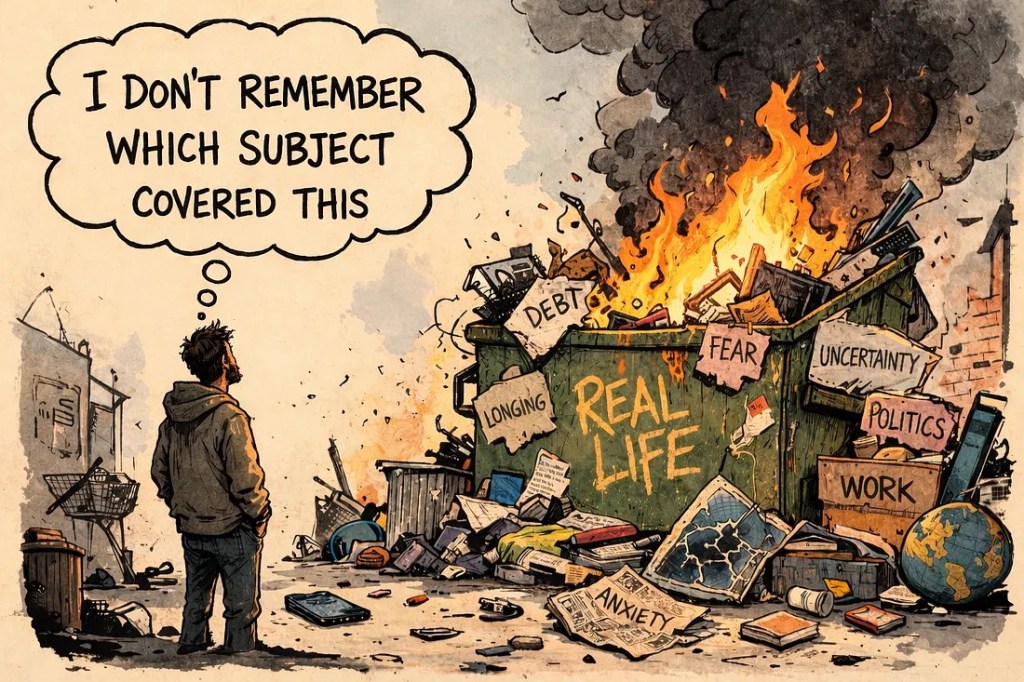
The crisis is no longer information. It is orientation.
My grandfather Marion Brady is 99 years old. For most of his life he has been asking a single question that feels larger now than when he first asked it:
What is worth learning?
Not what is easiest to test.
Not what breaks neatly into standards and benchmarks.
Not what helps institutions sort children into rows, percentiles, and predictions.
What is actually worth learning?
It sounds like a school question. It is not. It is a civilizational question.
If you take it seriously, it does not just expose the limits of school. It exposes the limits of the world school was built to serve.
Modern education was designed for an industrial age. Its task was not wisdom, but coordination, standardization, and legibility. It divided knowledge into subjects, time into periods, children into age groups, achievement into grades, and called that order an education.
For the world that built it, this made sense. Industrial society needed people who could move through prearranged sequences, follow instructions, tolerate fragmentation, and mistake compliance for progress. School served that machine well.
The problem is that the structure remained after its justification expired.
And still we teach as if reality itself were divided into compartments. Math at nine. History at ten. Science after lunch. Literature here. Economics there. A little civics. A little technology. Each subject kept in its lane as though the world itself respected those borders.
It does not.
Life does not arrive in subjects.
A financial crisis is not economics. It is psychology, history, incentives, propaganda, institutional failure, and fear operating at once. Illness is not biology. It is money, labor, family, bureaucracy, grief, and mortality arriving together. Loneliness is not merely a private feeling. It is architecture, technology, work, romance, status, community, and meaning breaking down in a recognizable pattern.
Reality is not modular. It is entangled.
That is part of why so many people leave school with a disappointment they cannot quite name. They did what they were told. Learned the material. Passed the tests. Moved through the sequence. Then they entered adult life and discovered that reality does not present itself as a worksheet.
It presents itself as consequence.
That is the betrayal inside modern schooling. Not that it teaches facts, but that it too often mistakes fragmentation for understanding. Students are given pieces without pattern, procedures without orientation, answers without structure. They are trained to perform knowledge before they are taught how to organize reality.
For a long time, institutions could hide this weakness by controlling access to information. That was the old bargain. Sit still. Absorb the fragments. Repeat them back. We will certify that you know something.
That bargain is collapsing.
Information is everywhere. Explanation is instant. Summary is on demand. Generation is cheap. If education is merely the transfer of information, then large parts of the inherited model are about to be exposed by machines with humiliating ease.
This does not make my grandfather’s question obsolete. It makes it unavoidable.
What is worth learning when information is cheap?
The crisis is no longer information. It is orientation.
The central problem is no longer whether a person can retrieve facts, generate prose, summarize an argument, produce an image, or assemble code. The machine can assist with all of that. The deeper problem is whether a person can judge what is worth knowing, what is worth building, what is worth preserving, what is worth resisting, and what kind of intelligence a civilization should trust itself to become.
The machine is a tool. A powerful one. A dangerous one. Not because it thinks for us in some dramatic science-fiction sense, but because it amplifies whatever confusion already exists upstream.
The machine can generate almost anything. It cannot tell us what is worth becoming.
A culture that cannot answer questions of value will use powerful tools to accelerate its own disorientation. It will confuse fluency with understanding, output with insight, scale with wisdom, optimization with purpose. It will become more capable and less clear about why any of that capability should exist.
That is why my grandfather’s question now reaches far beyond school.
What is worth learning?
A person should learn how systems behave. How incentives bend institutions. How language hides power. How metrics deform the things they claim to measure. How technology reshapes attention, memory, and desire. How emotion alters perception. How to distinguish causes from symptoms. How to think across domains, across timescales, and across consequences. How to remain inwardly free inside environments built to colonize thought.
These are not luxuries. They are survival skills.
And they are difficult to teach inside the model we inherited because they do not belong neatly to any single subject. They live between subjects, across domains, inside relationships and consequences. They require synthesis, context, pattern recognition, and judgment.
That is the real educational question now.
Not how to cram more content into the pipeline.
Not how to optimize test performance.
Not how to produce students who can generate the approved answer in the approved format.
How do we cultivate minds that can actually perceive reality?
That was always the deeper force inside my grandfather’s work.
What is worth learning?
In an age of infinite information and machine generation, it may be the most important question we have.

 Diane Ravitch's blog
when I was in college, I lucked into the honors department, a forward-thinking place in our university where teachers felt the need to tie the humanities together in special classes. These interdisciplinary classes became the meat and potatoes of my education. When I became a teacher in the system that divided up departments, students were sort of amazed that I found time to mention ties to history and literature. They thought they had “got me off the subject.”
In fact, I always saw myself as the Dutchman, jamming my fist into the hole in the dike. We now are reaping the punishment of a political climate in which techno-geeks think they can look into a future without knowing anything about the past. The dike feels like it ruptured around me.
LikeLike
In the ’90s many school districts and teachers were moving toward project based learning across the curriculum with hands-on learning, group projects and portfolio assessment, particularly in elementary schools. Then NCLB dropped a bomb on progressive efforts to change the system with its punitive elements that upended any efforts to deliver content and nurture original thinking. Unfortunately, the test score cultivators are at it again by trying to create a media campaign to reinstall more test and punish policies.
Thanks for this post which asks important questions that we should all be asking ourselves. Learning and thinking are more important than data collection.
LikeLike
true. There was an interest in cross department learning that lost to NCLB
LikeLike
Excellent article. And for at least a partial answer, I would again encourage people to make Teacher Tom’s Blog a regular stop. His answer is that play is learning what the children want to learn – asking and answering their own questions. What’s important to learn is whatever you want to know. Play is also an answer to another question I think needs to be asked in education – how do we know what we know? In play, children “know” the answer because they have experienced it directly. And in a play-based preschool where they are surrounded by other kids, they “know” because they’ve argued and learned from the other kids – if you assert something around kids, you generally get challenged to “prove it” and told “that’s not true” when you’re wrong.
Granted, there is certainly an argument to be made that somewhere along the line play has to become more direct instruction. I doubt many children spontaneously decide to ask and answer questions about prepositional phrases or the quadratic equation or the Teapot Dome Scandal through playing. But I think all children need a social, play-based early education and whenever the transition to more direct instruction is made, play in some form should always be an adjunct.
LikeLike
Perfect.
LikeLike
Here’s a way to approach this question. Ask, what have I learned that has truly made a difference in my quality of life?
A musical instrument and how to read music
Dance
Personal finance
Website , web video, blogging, and podcast development
Creative writing
Interpersonal skills
Childrearing and parenting
Basic automobile and bicycle maintenance
Theatre
Reading
Basic science and world history
Philosophy
Cooking
Poetry
Survival skills in natural settings
Physical training (cycling, weightlifting, swimming, hiking)
LikeLike
My list is in moderation. Add this to it: How to grow things
LikeLike