Archives for the month of: September, 2024

Soldiers of the Israeli Defense Force discovered the bodies of six young hostages while searching the vast tunnel infrastructure under Gaza. All six had been captured on October 7, 2023 They were young people, and each had been shot in the head within 24-48 hours of being found. This event provoked massive protests in Israel, with hundreds of thousands of people in the streets, demanding both a ceasefire and a release of all the hostages. The national labor federation called a general strike in support of these demands. Sadly, while the public wants an end to the war, the leaders on both sides do not.

The following article by Amir Tibon appeared yesterday in Ha’aretz, a liberal Israeli news site.

It seems like a lifetime ago, but just two weeks ago, U.S. Secretary of State Antony Blinken was in Israel, and ended his visit to the country with a surprising statement. The Israeli government led by Prime Minister Benjamin Netanyahu, he said, had accepted the latest bridging proposal put forward by the United States and the other mediators in the talks for a hostage release and cease-fire deal.

Blinken’s intention was good: He wanted to increase the pressure on Hamas leader Yahya Sinwar, who has been stalling and refusing to compromise for months now, sticking to maximalist positions and doing everything he can to avoid negotiating in good faith. Almost 11 months into the war that Sinwar initiated with the October 7 massacre, Gaza is in ruins, tens of thousands are dead, but the man who brought this calamity on his people is hiding in a tunnel and haggling for time.

The problem with Blinken’s statement is that on the other side of the negotiating table is a cynical and ruthless politician who feels even less urgency to reach a deal than Sinwar. Netanyahu pulled on Blinken the same trick he has been pulling on American diplomats for his entire career: Doublespeak. One message in English, the opposite in Hebrew.

And so, after a lengthy conversation in which Netanyahu promised the secretary that he will accept the bridging documentput forward by the mediators, Blinken gave his statement – and the Israeli prime minister, having “pocketed” the achievement, moved on to his next move.

In the two weeks that have passed since the visit, Netanyahu has done everything humanly possible to turn Blinken’s statement into a total joke. He imposed new conditions for any future agreement, stated that Israel will “never” evacuate its forces from the Philadelphi corridor along the Gaza-Egypt border, and pushed Israel’s security cabinet to pass a decision that prohibits any withdrawal from there. His own defense minister warned the cabinet members during a heated discussion on Friday morning that Netanyahu’s desired decision is a de facto death sentence for the dozens of living hostages still held in Gaza. Netanyahu ignored him.

It’s too late to save the six hostages who were murdered last week by Hamas, after surviving 11 months in the tunnels of Gaza. The time to save them was in June and July, when a deal was in hand, and Netanyahu again added new, last-minute obstacles.

At the end of the day, the Biden administration – which seems much more eager than the Israeli government and Hamas to reach a deal – is facing an impossible situation. Sinwar is an ultrareligious fanatic with a murderous zeal and a messianic world view. Netanyahu is an egotistic, selfish man who values the survival of his own coalition over the survival of the hostages. It’s not clear if the administration can truly get a deal under these circumstances. But if it can’t, it owes one thing to the families of the hostages, especially the American ones: to tell the truth, and stop allowing either side to use political tricks and manipulations.

Today is an ironic holiday. The nation recognizes the day and most offices are closed to honor the dignity of labor. But it was not created in the late nineteenth century to honor labor in general but to honor labor unions.

Why ironic? Because right wingers have always hated labor unions. Today, unions represent about 10-11% of workers. Most unionized workers belong to public sector unions. In the 1950s, about one-third of private-sector workers belonged to a union; now only 6% do. Most people think that the decline in union membership has been bad for the country. They are right.

Why does it matter? Because unions were crucial in building the middle class. Because they have always been a stepping stone from low-wage jobs to better-paying jobs with benefits, including healthcare and pension. Because they promote better working conditions and higher salaries. Because unions are the answer to closing the vast gap between rich and poor. Without unions, there will be more super-billionaires and more living in poverty.

We need more unionized workers and workplaces.

The Department of Labor has a page about the day’s history.

The first Labor Day holiday was celebrated on Tuesday, September 5, 1882, in New York City, in accordance with the plans of the Central Labor Union. The Central Labor Union held its second Labor Day holiday just a year later, on September 5, 1883.

By 1894, 23 more states had adopted the holiday, and on June 28, 1894, President Grover Cleveland signed a law making the first Monday in September of each year a national holiday.

A Nationwide Holiday

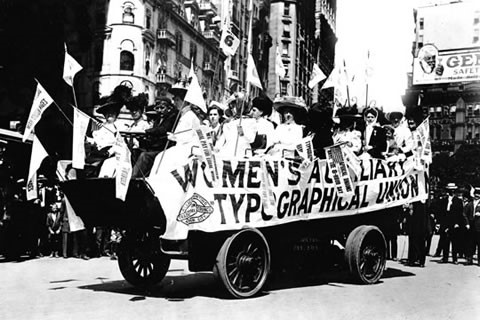
Women's Auxiliary Typographical Union

Many Americans celebrate Labor Day with parades and parties – festivities very similar to those outlined by the first proposal for a holiday, which suggested that the day should be observed with – a street parade to exhibit “the strength and esprit de corps of the trade and labor organizations” of the community, followed by a festival for the recreation and amusement of the workers and their families. This became the pattern for the celebrations of Labor Day.

Speeches by prominent men and women were introduced later, as more emphasis was placed upon the economic and civic significance of the holiday. Still later, by a resolution of the American Federation of Labor convention of 1909, the Sunday preceding Labor Day was adopted as Labor Sunday and dedicated to the spiritual and educational aspects of the labor movement.

American labor has raised the nation’s standard of living and contributed to the greatest production the world has ever known and the labor movement has brought us closer to the realization of our traditional ideals of economic and political democracy. It is appropriate, therefore, that the nation pays tribute on Labor Day to the creator of so much of the nation’s strength, freedom, and leadership – the American worker.

Every once in a while, you read a story about a person winning the lottery twice or three times, and it seems amazing that anyone could be so lucky. But when the same person wins the lottery thousands of times, something is wrong. The two biggest lottery scams in recent years happened in Massachusetts and Texas. The trick was different in each case but very effective. The perpetrators of the winning plan were jailed in Massachusetts, but not in Texas, where almost anything is legal except abortion.

In Massachusetts, the story appeared in the Boston Globe magazine about a family—a father and two sons—who collected $20 million from the lottery in less than a decade, with more than 14,000 winning tickets.

Dan O’Neil, the director of compliance and security for the Massachusetts State Lottery Commission, doesn’t typically get alerted when someone shows up to claim a $1,000 prize from a scratch-off ticket. Such transactions are usually quiet, pleasant, unremarkable. The lucky winner produces the ticket and the agent, sitting at a counter behind a pane of glass in Dorchester, doles out the money.

The call came from a customer service agent in the lobby at lottery headquarters and the message was short. The Jaafars are here again, the agent said. Yousef Jaafar, this time….

An information technology expert at the lottery had run the math to show just how unlikely it was. An instant-win game called “$10,000,000 Big Money” had a 1 in 1,106.72 chance of producing a jackpot of $1,000 or more, he reported. Yet somehow, over a recent span of six months, the Jaafars had managed to claim nearly $2 million in winnings, the bulk of it from instant tickets like “$10,000,000 Big Money.” To win at that rate, the Jaafars would’ve had to purchase 22,859 such tickets every day, 952 tickets every hour, 16 tickets every minute. “Every minute of every day,” the official said. “Twenty-four hours a day.”

In lottery terminology, there was a name for this. The Jaafars were “high-frequency winners.” They were also breaking the law and the rules of the lottery itself by working with dozens of convenience store operators in an underground network where everyone was trying to avoid paying taxes on lottery prizes. In this network, everyone got cash under the table while the Jaafars got the winning tickets to claim as their own. A lot of them. In 2019 alone, the Jaafars claimed more than $3.2 million in winnings. Yousef was the sixth-highest ticket casher in the entire state that year, Mohamed was third, and their father topped the list…

The Jaafars’ scheme was built on a premise that’s been known to gamblers for decades: Some people prefer not to publicly claim their winnings, particularly if they want to hide money from the Internal Revenue Service.

At American racetracks since at least the 1960s, these reluctant winners have turned to “ten percenters” for help. In the shadows beneath the grandstands, ten percenters would pay cash for someone’s winning ticket, minus a 10 percent cut off the top and often even more — 15 or 25 percent. The real winner would walk away with cash in hand, off the books, tax-free, while the ten percenter would claim the full prize at the racetrack window and often avoid taxes by claiming large gambling losses at the end of the year or by submitting fake identification at the track.

It usually amounted to tax evasion and could have devastating ramifications: the government sometimes lost as much as $1 million a week in tax revenue at a single track. It was only a matter of time before a similar practice of ten percenting infected state-run lotteries. For any jackpot over $600, winners have to produce a valid ID and Social Security number, and pay taxes. Those who owe back taxes or child support have one more obstacle to clear: Massachusetts authorities will take that money before paying out any winnings.

In this world, someone holding a scratch-off ticket worth $1,000 can sell their prize to a convenience store operator for $750 or $850. The winner leaves with cash under the table. The convenience store clerk picks up the phone and calls a runner. This person shows up and buys the ticket for the discount price, minus a cut for the clerk — maybe $50. The runner then pretends to be the real winner and claims the ticket at a lottery office for its full value, scoring a profit of $100 or $200.

Quite a racket. But they didn’t get away with it. The father was sentenced to five years in prison, the older son got 50 months, and the younger son got a plea deal.

In Texas, a slick operation based in New Jersey managed to score a $95 million jackpot by buying every numerical combination.

By April 22, seven months had passed without a winner of the jackpot, and the top prize had grown to $95 million.

That night’s draw — 3, 5, 18, 29, 30, 52 — matched a single ticket purchased in a small store in Colleyville, outside of Fort Worth. 

Winners have six months to claim their prize, either in payments over 30 years or a lump-sum, typically worth about half. On June 27, the state of Texas issued a check for $57.8 million to a New Jersey-based limited partnership apparently formed to collect the jackpot, called Rook TX.

The Texas Lottery Commission, whose proceeds mainly fund public education, celebrated the big win — “generating much needed revenue for Texas Schools,” then-Executive Director Gary Grief wrote. “What the Texas lottery is all about.”

But a statistical analysis of the April 22 Lotto Texas drawing strongly suggests that night’s draw wasn’t what a lottery is about at all. Rather, the numbers indicate Rook TX beat the system.

Unbeknownst to the millions of players who’d invested their hopes and dreams into the game and its life-changing jackpot, the winner had already been decided.

Rook TX appears to have engineered a nearly risk-free — and completely legal — multimillion-dollar payday.

And the state of Texas helped.

Warning: Numbers ahead

While lottery players have occasionally exploited a hidden mathematical advantage to guarantee a lottery profit, there is one sure way to win a jackpot. Stefan Mandel did it 14 times, and it had little to do with luck. He simply bought up every numeric combination.

Yet Mandel, a Romanian economist and mathematician, had to master both probability and logistics. The jackpots needed to be both big enough to cover his costs, as well as favor his chances of being the only winner; splitting a payout could be ruinous. Because buying so many lottery tickets required going to dozens, if not hundreds of separate stores, he required a team of accomplices. 

The recent introduction in Texas of digital lottery apps has lowered the logistical obstacles. The Lotto Texas drawing of April 22, meanwhile, presented a perfect-storm of high reward and low risk that practically guaranteed that an opportunistic player with a sizable bankroll could walk away with tens of millions of dollars.

The evidence is in the numbers.

The first thing someone wanting to buy a lottery drawing would need to know: How many tickets would you need to buy to cover every numeric combination in a game like Lotto Texas? The answer, said Tim Chartier, a Davidson College math professor who studies sports and lottery analytics: 25.8 million.

Lotto Texas draws typically generate 1 million to 2 million ticket sales. Records from the Texas Lottery Commission show that in the days leading up to the Saturday night draw, just over 28 million Lotto Texas tickets were purchased.

That doesn’t prove Rook TX accumulated the nearly 26 million tickets necessary to guarantee a win. But an examination of the second prizes awarded indicates it almost certainly did.

In addition to the jackpot for matching all six numbers, Lotto Texas pays lesser prizes to players who guess five-of-six, four-of-six and three-of-six of the draw. The total possible combinations for each, according to Nicholas Kapoor, a Fairfield University statistics professor who studies lottery probability: 288 five-of-six combos, 16,920 four-of-six combos and 345,920 three-of-six winners.

Lower-value prizes can be cashed in at any retailer that sells tickets, and the state doesn’t track them. But Texas requires any prize over $599 to be redeemed at an official Texas Lottery Commission center, which records the winners. The April 22 drawing paid $2,015 to its five-of-six winners.

Records from the Texas Lottery Commission show Rook TX cashed in 289 winning tickets in the five-of-six game — the same number as all possible combinations plus one for the grand prize ticket. The odds a single entity managed to win the grand prize and every possible five-of-six prize — but somehow didn’t buy up every combination — are vanishingly small, said Chartier…

There is compelling evidence that Lotto Texas’ ballooning jackpot was being probed by sophisticated players in the weeks leading up to Rook TX’s big win.

With the jackpot climbing to $60 million, the April 1, 2023, draw saw a sudden sales spike. Three million tickets were purchased, more than double the previous game.

No one matched all six numbers, but the draw produced a large number of five-of-six winners. More unusual: 17 of the 40 winning five-of-six tickets were held by the same person — a rate that is extremely unlikely to have occurred randomly.

Records show the claimant, Thomas Ashcroft, purchased all his winners through two stores — the Colleyville outlet and Luck Zone, an app-affiliated store in Round Rock. Although Ashcroft gave a Connecticut address, the Chronicle could not locate anyone with that name in the region.

Another burst of sales preceded the April 15 drawing — 7.4 million tickets. While no one claimed the jackpot, the number of five-of-six winners was again high. This time, more than three-quarters of the 71 winners were claimed by a single entity — Rook TX. State records show it purchased all 55 winning tickets from the same two stores. 

For one entity to randomly win that many of the five-of-six prizes, Chartier calculated a person would have to play a lottery game every day for 327 years. 

The Texas Lottery Commission said there was nothing suspicious about the games, which it said were attracting more players because of the big prize and relatively good odds of winning: “This is not indicative of unusual activity in the lottery industry, but rather a strategic decision made by players or groups that are in pursuit of high jackpots.” 

A week later Rook TX won the $95 million jackpot and 289 five-of-six winners. The April 15 and 22 draws are the only times its name appears in the state’s registry of lottery winners.

The Texas Lottery Commission allows winners of $1 million and more to remain personally anonymous, so identifying Rook TX’s members is practically impossible. Delaware corporation records show it was formed two weeks before claiming the top prize. The limited partnership’s registered agent, Glenn Gelband, a lawyer in Scotch Plains, N.J., did not respond to a request for comment.

Texas lottery officials said there was nothing illegal about buying up all the numbers.

Massachusetts put the guys who played the system into prison. Texas can’t find them and apparently doesn’t care. The only way to beat the guys who beat the system is to hope that two or three other combines copy their tactics; they would all lose money by splitting the prize.
Jennifer Rubin was a solid conservative journalist and lawyer who was hired by the Washington Post to express the conservative view on politics in a column called “Right Turn.” After Trump’s election, she became increasingly critical of him and eventually reversed her ideology. She is today one of the most incisive critics of the MAGA movement. In this column, she chastises Prominent Republicans for remaining silent in this election.

She writes:

One of the most uplifting parts of last week’s Democratic convention was the presence of so many Republicans, such as former Illinois congressman Adam Kinzinger and former Georgia lieutenant governor Geoff Duncan. Both decided to put country over party and self.

“I know Kamala Harris shares my allegiance to the rule of law, the Constitution and democracy, and she is dedicated to upholding all three in service to our country,” Kinzinger said. “Whatever policies we disagree on pale in comparison with those fundamental matters of principle, of decency and of fidelity to this nation.” Likewise, Duncan said, “Let me be clear to my Republican friends at home watching: If you vote for Kamala Harris in 2024, you’re not a Democrat. You’re a patriot.”

The day after the convention, a dozen former lawyers from the three Republican administrations before Donald Trump’s published a letter endorsing Vice President Kamala Harris. They wrote, “Trump’s attempt to prevent the peaceful transfer of power after losing the election proved beyond any reasonable doubt his willingness to place his personal interests above the law and values of our constitutional democracy.” They argued that returning Trump to office “would threaten American democracy and undermine the rule of law in our country.” Then, a four-star general who served under President George W. Bush and hundreds of former Republican staffers endorsed Harris.

So, the question remains: Where are the rest of the Republicans who understand Trump is an existential threat to democracy? Most of the big names still refuse to follow Kinzinger and Duncan’s lead.

Former president George W. Bush must be in a witness protection program; he has virtually disappeared. Former Wyoming congresswoman Liz Cheney courageously stood up to Trump when he tried to stage a coup. But, sorry — if you pledge to do everything possible to prevent Trump’s return to power, you have an obligation to endorse Harris, the only person who can beat him.

Former New Jersey governor Chris Christie, who shredded Trump in the primaries, previously objected to endorsing President Joe Biden because of Biden’s age. (“President Biden, in my view, is past the sell-by date.”) What is his excuse now for refusing to endorse the new, 59-year-old Democratic nominee?

Paul Ryan, a Fox board member and former speaker of the House, was quoted in May as saying, “Character is too important for me. … [The presidency] is a job that requires the kind of character [Trump] doesn’t have.” But Ryan too lacks the nerve to support the only viable alternative. When he rationalizes his refusal to endorse a Democrat on the grounds that he differs on “policy,” he is telling us that preserving democracy is not a high policy priority for him.

The list goes on: H.R. McMaster (actually commending Trump’s foreign policy in the Atlantic!), Jim Mattis, Condoleezza Rice. Moral cowardice, or craving for access in future Republican administrations, seems to have silenced even those most vocal on America’s defense of Ukraine and other allies. History will not treat them kindly.

Certainly, getting some Republicans to refrain from voting for Trump is helpful. But if they are as devoted to democracy and as committed to the international world order as they say, there is no moral argument for refraining from going the rest of the way to endorse Harris, especially after such a robust affirmation of her foreign policy views.

Biden gave up the presidency for the sake of our democracy. Can’t these Republicans give Harris their votes?

In anticipation of a renewal of student protests against the war in Gaza, Cornell recently announced that it has adopted an official policy of institutional neutrality, meaning that it won’t take sides. Harvard had adopted the same policy last spring.

I agree with this policy. Universities are places for learning, debate, study, and free expression of ideas. They lose their role as guardian of free thinking and open exchange of ideas when they take a stand on controversial issues. Conflicting groups of students and faculty want the University to “take a stand,” but that’s not the role of a university. That’s their responsibility.

Laurell Duggan of Unherd wrote:

Cornell University announced on Monday that its president and provost will refrain from making statements on issues that do not directly impact the school. This makes it the second Ivy League university to adopt such a policy in pursuit of institutional neutrality, after Harvard.

The school pledged that its response to expected protests in the coming months will be content-neutral, and said it will need to balance free speech rights with the legal obligation to protect students from harassment and discrimination. “Thus it is our responsibility and our obligation to enforce our policies ensuring that speech or actions by some members of our community does not violate the rights of others,” the announcement read.

This spring, Cornell was subject to widespread media coverage of its campus protests over the war in Gaza, with one piece in Tablet describing a campus culture which was hostile to “normal” students — including the one-third of the student body who belong to Greek life — and permissive of rule-breaking protests and encampments. The university also received pushback from pro-Israel donors and alumni, who expressed concerns about campus antisemitism. Going forward, Cornell will ensure that protests, particularly encampments, do not block other students from accessing campus spaces.

Institutional neutrality, most famously articulated in the 1968 Chicago Statement, is a policy under which universities remain neutral on hot-button issues in order to protect academic freedom for staff and students. In past years, most notably during the racial reckoning of 2020, American universities took stances through official statements in violation of this principle. After years of taking public stands, universities were slow to publish statements in the wake of the 7 October attacks and the ensuing war in Gaza, angering those on both sides of the debate and leading to a donor revolt by pro-Israel alumni as well as months-long anti-Israel campus protests that derailed the academic year at many Ivy League universities.

The debacle of the past year has prompted a change of heart among university leaders. Earlier this month, Johns Hopkins University announced that its president, provost and deans would no longer make public statements on current events unless they were directly related to the functioning of the university, instead adopting a “policy of restraint”. There has been a growth in demands for the university to make official statements in recent years according to the announcement, which explained that such statements “can be at odds with the university’s function as a place for open discourse and the free exchange of ideas”.

“The very idea of an ‘official’ position of the university on a social, scientific, or political issue runs counter to our foundational ethos […] to be a place where competing views are welcomed, challenged, and tested through dialogue and rigorous marshalling,” university leaders wrote.

As with other universities’ policies, this update at Johns Hopkins is not intended to prevent staff from engaging in politics. “In fact,” the announcement read, “one intent of the commitment is to extend the broadest possible scope to the views and expressions of faculty, bolstering faculty in the exercise of their freedom to share insights and perspectives without being concerned about running counter to an ‘institutional’ stance.”

Harvard implemented a similar policy in the spring, indicating that university staff wanted to move away from official statements and instead adopt institutional neutrality.

“We value free and open inquiry and expression – tenets that underlie academic freedom – even of ideas some may consider wrong or offensive,” Cornell’s core values state. “Inherent in this commitment is the corollary freedom to engage in reasoned opposition to messages to which one objects.”