To: U.S. Secretary of Education and state education policymakers From: [Your Name]
We call on the U.S. Department of Education to waive provisions of the Every Student Succeeds Act that require states to administer standardized exams to students in the 2020-2021 academic year. We also call on the states to cancel their own additional testing mandates and to waive any consequences attached to their results, at least for the current school year.
Simply reducing testing stakes is not enough. It is critically important to suspend all government-mandated standardized exams so that educators, who know their students firsthand, may focus on teaching and learning, address students’ social and emotional well-being, and connect with families.
The use of standardized tests in public education has long raised concerns. Too often, these tests have supplanted teacher assessments of student performance; forced schools to focus on a narrow set of skills and subjects; limited opportunities for low-income students, students of color, English language learners, and students with disabilities; and penalized schools for test results without providing them with the support they need to succeed. Instead of being a good measure of teaching and learning, test scores have always correlated closely with students’ socioeconomic status.
In light of the disruptions caused by COVID-19, waiving standardized testing requirements is especially important right now. The time and resources required to test students this year would be better spent educating and supporting them.
● The results won’t be valid, reliable, or useful. Teaching, learning, and testing conditions vary widely and continue to be in a state of flux. Since students will not have covered all the material the tests are supposed to measure, the results will not be comparable to results from other years or jurisdictions. We don’t need test scores to know that low-income children in poorly resourced schools have fallen even farther behind in a pandemic. In addition, more parents than usual are likely to opt their children out of taking the tests, further skewing the results.
● There are better ways to know how students from different backgrounds and learning needs fared during the pandemic. In addition to classroom-based assessments, sampling exams can provide data on trends in learning without distorting the curriculum or subjecting all students to standardized tests this year. Instead of more testing, we should be focusing on solutions that address poverty, racial inequities, and school funding disparities.
● Most parents oppose testing this spring. According to the Understanding America Study done by the University of Southern California, support for canceling the tests rose from 43 percent in mid-April to 64 percent in mid-October. The opposition is strong across all demographic groups but is especially high among Black parents, 72 percent of whom favor cancellation.
In a time of scarcity, funding must be used to support underserved and at-risk students, not enrich commercial test makers. It’s time to waive federal testing requirements and eliminate high stakes for state and local assessments.
Let’s seize this opportunity to provide better options for our students. Our children, their families, and their teachers deserve it.
Those who seek to apply business thinking to education make a huge error. SomeDAM Poet, a regular commenter, cites the work of the brilliant education scholar Yong Zhao, who has consistently argued that progress and creativity rely on diversity, not standardization. This is, for example, a fundamental flaw of the Common Core, which claims without evidence that the imposition of national standards for teaching, testing, teacher education, and curriculum will lead to vast improvements. Predictably, over a decade, it has failed to produce what was promised.
Bill Gates saw the Common Core standards, which he funded in their entirety, as necessary and beneficial standardization that would transform education. In 2014, he told a conference of the National Board for Professional Teaching Standards that teachers should defend the Common Core.
He said:
“If you have 50 different plug types, appliances wouldn’t be available and would be very expensive,” he said. But once an electric outlet becomes standardized, many companies can design appliances and competition ensues, creating variety and better prices for consumers, he said.
If students and teachers were toasters, he would be right.
SomeDAM Poet explained why standardization is wrong in these comments on the blog:
The error that the “education as a business” proponents make is in assuming that “standardizing” the process necessarily leads to higher quality output.
For a manufacturing process, that is actually true: the greater the standardization and control over the process, the lower the defect rate.
But, of course, the error is in assuming that an idea developed for manufacturing applies to education, where the goal is entirely different.
In manufacturing, the goal is to eliminate as much variation as possible and the best way of doing that is to carefully control the process.
With education, the goal should certainly not be elimination of variation, since that is the source of all creative thinking, which is more important today than it ever had been.
Yong Zhao has pointed this out many times, but of course, the billionaires, politicians and other widget manufacturers never listen to people who actually know what they are talking about.
Even in business, it is the “outliers” (Elon Musk, Steve Jobs and others) who drive change with new ideas.
It is only after the fact — after a new idea for a product like a smartphone or electric car has been proposed — that the mindless manufacturing focus on reducing defects goes into effect .
Evolution works this way as well. Random mutations sometimes produce characteristics that make an organism better adapted to its environment and it is only after the initiall change that the process settles down into a new stable state.
If all variation were rejected without regard for whether it makes an organism better adapted, there would be no evolution and hence no development of higher life forms.
The reason that standardization works well for manufacturing is that manufactured parts do only one thing and often have to fit together with other parts. For such a case , it is advantageous to eliminate as much variation as possible.
But what should be obvious is that humans don’t just do one thing, so the idea that one should apply a manufacturing model to education is just ridiculous.
First, Betsy DeVos extended the moratorium on student loan repayments from Dec 31 to January 31. This is a big breat for the many millions of students struggling to make ends meet. Thank you, Secretary DeVos, for giving extra time to the students. The Biden administration is likely to extend the moratorium as it figures out what to do next with hundreds of billions of debts.
Second, a federal judge reinstated DACA, relieving hundreds of thousands of young people who were brought to this country as children of their fear of deportation. The Trump official who gave the order was never confirmed by Congress and this his order was illegal.
Journalist Florina Rodov taught for several years in a New York City public schools, but she was turned off by the testing craze and the paperwork. Then she heard about these remarkable new schools called “charter schools.” She heard they were academically superior, safe, free of the bureaucracy of public schools, and she applied to work in a charter school in Los Angeles. The principal told her that the school was like a family. It sounded wonderful.
But then her eyes were opened.
I soon realized there was a gulf between charter school hype and reality. Every day brought shocking and disturbing revelations: high attrition rates of students and teachers, dangerous working conditions, widespread suspensions, harassment of teachers, violations against students with disabilities, nepotism, and fraud. By the end of the school year, I vowed never to step foot in a charter school again, and to fight for the protection of public schools like never before.
On August 15, my first day of work, I dashed into the school’s newest home, a crumbling building on the campus of a public middle school in South Los Angeles. Greeting my colleagues, who were coughing due to the dust in the air, I realized most of us were new. It wasn’t just several people who had quit over the summer, but more than half the faculty — 8 out of 15 teachers. Among the highly qualified new hires were a seasoned calculus teacher; an experienced sixth grade humanities teacher; a physics instructor who’d previously taught college; an actor turned biology teacher; and a young and exuberant special education teacher.
When the old-timers trickled in, they told us there’d been attrition among the students, too: 202 of 270 hadn’t returned, and not all their seats had been filled. Because funding was tied to enrollment, the school was struggling financially.
Her first-person tell-all pulls the curtain away from the charter myth. On Twitter, Rodov describes herself as a “fierce advocate for public schools.” Read this article and you will understand why.
Noted education scholar Andy Hargreaves questions the alternatives that are likely to follow the end of the pandemic: Will government impose deep cuts and austerity, or will they recognize the importance of funding better education for all students?
He poses the choice in this abstract of his paper:
One looming possibility is an onrush of austerity, deep cuts to public education, financial hardship for the working and middle classes, and a range of private sector, including online answers to public problems in education, leading to more inequity, and an even wider digital divide. The pandemic, it is argued, is already being used as a strategy to bring about educational privatization by stealth by mismanaging return-to-school strategies and by overselling the effectiveness of online and private school alternatives. The alternative is public education investment to pursue prosperity and better quality of life for everyone. This will reduce inequality instead of increasing it, close the digital divide that COVID-19 has exposed, and encourage balanced technology use to enhance good teaching rather than hybrid or blended technology delivery that may increasingly replace such teaching.
Ken Rice was an elected member of the Oakland Unified School District from 1997-2000. That was before the billionaire disrupters decided to take control of Oakland and turn it into their own petri dish for “reform” (i.e., privatization). Rice wrote the following description of the recent school board election, in which grassroots organizations stood together and beat the candidates of the out-of-district/out-of-state billionaires. He is a member of Educators for Democratic Schools (EDS), an Oakland-based organization composed primarily of retired public school teachers, administrators and school board members. When Ken Rice ran for school board, his race cost $12,000. Due to the intrusion of big money, grassroots groups are always outspent and usually overwhelmed. But Rice explains here how Oakland parents and educators fought back and won.
He writes:
Apparently Money Isn’t Always Everything–$300,000 Beats $900,000 In The Oakland School Board Elections!
“In nearly 20 years of privatization push into Oakland, this is the first time since 2003 that Oakland schools will be returned to local control by a school board that values and embraces authentic public education. Remaining hopeful for the future, and look forward to strengthening and improving Oakland’s schools.” ~ Diane Ravitch
The Oakland Unified School District (OUSD), the petri dish for school privatization for the past two decades, might have an answer. I ran and was elected to the Oakland school board and served one term (1997-2000). I raised $12,000. My opponent raised about the same amount. In those days the school board elections were neighborhood races funded by local supporters. There was no out of state money or PACs involved.
That began to change about ten years ago: huge donations from individuals and foundations began to pour into Oakland school board races. The money was funneled through the California Charter School Association and GO (Great Oakland Public Schools), a pro-charter organization. The money also came from Michael Bloomberg, the Walton Foundation, Eli Broad, Laurene Jobs (Steve Jobs’ widow), and several more. The goal was to elect a pro-charter, Board of Education. Unsurprisingly, the pro-charter organizations were successful.
The Oakland school board has approved about 65 charter school applications over the last twenty years–many of them in the last 12 years. Of those charters, about twenty have closed their doors—in some cases during the academic year, causing great dislocation to families who had to find another school for their children mid-year. OUSD now has 30% of its 50,000 students in charter schools—the highest percentage of students in charters of any school district in California.
What is surprising is what happened in the 2020 election. For the first time in memory no incumbents were running for any of the four of the seven school board seats up for election. Thus, there was a possibility of greatly changing the make-up of the school board, whose majority has opted for policies of charter school approval, school closures and lack of responsiveness to the greater Oakland educational community. This was an opportunity to flip the board . . . and flip it did!
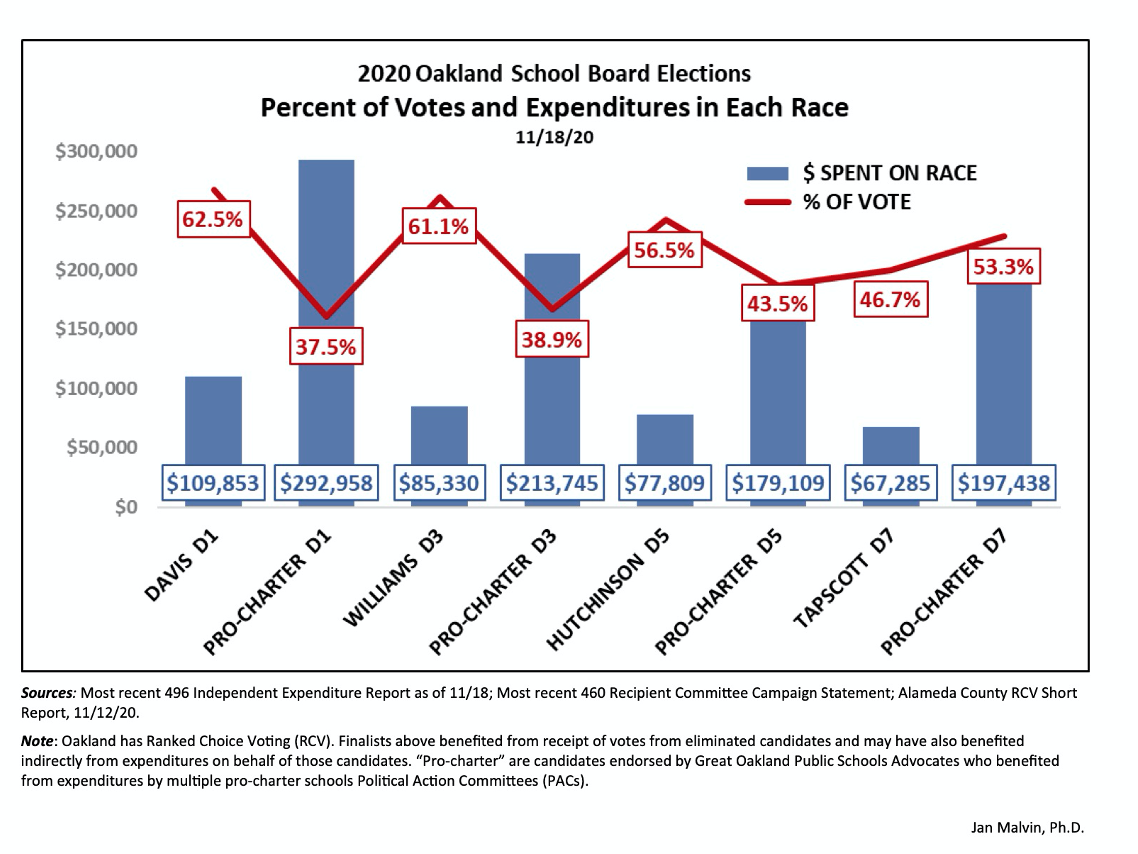
The charter community recognized this opportunity, and poured almost $900,000 into electing their candidates for the four open seats! Yet when the votes were counted, three of their four candidates lost.
Trying to understand how and why this happened can provide an insight into the educational landscape of not only Oakland, but urban cities nationally. While it might be early to know for certain why the charter candidates were defeated, we can make some educated guesses.
Strong Local Candidates
Two of the three candidates who won had deep Oakland roots. Two had been teachers (one in Oakland, one in San Francisco) and the other had worked in Oakland’s after school programs. Two had been community activists around school issues for years.
Oakland elections are calculated by ranked choice voting (RCV). When the RCV was tabulated, Sam Davis, the candidate in District 1 received 62% of the vote. Sam built a stellar campaign focused around school communities. He held zoom meetings with each school community in his district hosted by a combination of parents and teachers who worked in those schools. VanCedric Williams, in District 3, got 61%. VanCedric, a public school teacher for almost twenty years, had strong support from the teacher’s union as well as other unions. Mike Hutchinson in District 5 got 56%. Mike had run for the Board previously, networked with other education activists nationwide, and had built a reputation of challenging Board policies by going to Board meetings for years and reaching out on social media.
Backing of the Teacher’s Union
Last year, teachers in Oakland led a successful strike. The union’s ability to drum up enthusiasm with their members was one contributor to that success. Teachers recognized that if their future demands were to be met, they needed to have a responsive Board. Specifically, the current Board was considering a plan that would close up to 24 schools in Oakland, mostly in Brown and Black communities. At the same time, none of the 44 charter schools in Oakland were under threat of closure. Teachers made the connection between a charter friendly board and school closures of the public schools and were determined to change the direction of the district’s “blueprint”.
Teachers phone banked, texted, walked to drop off literature, and held zoom meetings in support of the three candidates who won. As Sam Davis noted, many voters tend to rely on their friends and neighbors who know something about the schools. The friends and neighbors were telling each other to vote for the candidates they trusted.
Backing of Other Groups: Building a Coalition
The three candidates were endorsed by the Democratic Party. This wasn’t an accident. Educational activists pushed the local democratic clubs to endorse candidates who would not be friendly to charters and wouldn’t owe their election to big money. These clubs, in turn, pushed the local Democratic party. In California the state Democratic party has taken a critical stance towards charter schools, and this was replicated locally. Organizers noticed that as people walked to the polls on election day, many of them carried the Democratic Party door hanger with them. Some of these candidates were also endorsed by :
The Alameda Central Labor Council
SEIU 1021
State Assemblyperson Rob Bonta
State Superintendent of Schools Tony Thurmond
Network for Public Education
Also, other community organizations like Educators for Democratic Schools, Democratic Socialists of America, and Wellstone Democratic Renewal Club helped to call, text, and walk precincts.
The Word is Out
You can fool some of the people all of the time but you can’t fool all of the people all of the time, or so Lincoln believed. Over time, the general public has begun to understand that there is an attempt to buy their votes. As I dropped off a flier at one home, a parent came to the door and asked, with hostility, “This isn’t the candidate who is getting all that money from Bloomberg, is it?” Several media sources reported on money from Bloomberg ($500,000 from Bloomberg alone!) and others pouring into Oakland.
After recovering from the astonishment that anyone would spend that kind of money for a school board election, voters became leery of candidates receiving those huge amounts of money. In District 1 where I live–and the charter candidate received nearly $300,000!–I found glossy fliers in my mailboxes more times than I could keep track of.
It is profoundly disturbing and a huge threat to our democracy that this big money trend has filtered down to local school board races. The Oakland community fought back against the billionaires’ spending advantage, and when the new board is seated in January, it will have a clear pro-public school majority. With appealing candidates and strong ground games, Oakland voters have shown that big money can be defeated. While Oakland will never go back to the days when a local neighborhood candidate spent only $12,000 to be elected, this recent victory over out of state billionaire bucks and their agenda sends a clear signal that our community will not be bought.
(Ken Rice is former OUSD board member, a member of Educators for Democratic Schools and currently has a daughter attending an OUSD school.)
Jeff Bryant writes that while we were all celebrating the pending departure of Betsy DeVos, the usual suspects were buying control of local school board elections. We are all aware of her efforts to direct federal funding to private schools and charter schools. But, he warns, we should pay attention to the “threat to democratically governed schools that preceded DeVos and will continue when she is long gone.”
In midsized metropolitan areas like Indianapolis and Stockton, California, parents, teachers, and public school advocates warn of huge sums of money coming from outside their communities to influence local politics and bankroll school board candidates who support school privatization. In phone conversations, emails, and texts, they point to a national agenda, backed by deep-pocketed organizations and individuals who intend to disrupt local school governance in order to impose forms of schools that operate like private contractors rather than public agencies—an agenda not dissimilar from that of DeVos.
In the 2020 school board election in Indianapolis, local teachers and grassroots groups the Indiana Coalition for Public Education and the IPS Community Coalition backed four candidates against a slate of opponents whom locals accuse of representing outside interests. At stake, according to WFYI, was “an ideological tilt” over whether the district would continue to “collaborate with outside groups and charter organizations” or “return to more traditional methods of improving struggling schools.”
Both sides raise the banner of “improving struggling schools,” but locals say what’s really at stake is whether voters retain democratic control of their public schools or see them turned over to private, unelected boards and their corporate supporters and funders.
Similarly, in Stockton, the clash between opposing slates of candidates in the 2020 school board election included controversies over charter school expansion and the influence of outside money in the district.
The controversy broke into public view in July 2020 when 209 Times reportedthat “[p]aid operatives” connected to Stockton’s outgoing mayor Michael Tubbs and three school board members were engaged in “a coordinated campaign of undue influence from outside of the city whose aim is… charter school expansion” into the district.
In both elections, candidates backed by outside organizations and individuals massively outspent candidates supported by local teachers and public school advocates.
In Indianapolis, WFYI reported that political action committees supporting the candidates aligned with charter school interests had contributed more than $200,000 into the election by October 9, while the “[f]our candidates backed by the IPS Community Coalition… [had by then] raised less than $20,000 in total.”
In Stockton, 209 Politics reported independent expenditure committees supporting candidates favoring charter school expansion outspent their opponents 25 to 1.
While the language used by these outside organizations and their benefactors is different from the rhetoric DeVos wields—substituting a message of rescuing struggling schools for DeVos’s calls for libertarian autonomy—the result is much the same: local citizens see democratic governance of their schools being swept aside as private actors get more control to do what they want.
This effort to squelch local democracy is funded by the usual billionaires: the Bill and Melinda Gates Foundation; the Walton Family Foundation, of Walmart fame; Arnold Ventures, the private foundation of former hedge fund manager and Enron trader John Arnold; and the City Fund, a nationwide organization providing financial support for city-level charter school expansions.
The City Fund is a relatively new organization of experienced charter school promoters that started on day one with $200 million from billionaires John Arnold and Reed Hastings. Its mission: to use the money to undermine democratic control of local school boards and to see that charter-friendly candidates are elected.
The other organization used by the billionaires to funnel money into the Indianapolis school board election was the notorious Stand for Children, which has played the same role in other districts. “Stand” worked closely with the Mind Trust, a local cheerleader for privatization, also funded by billionaires who don’t like local control or democracy.
Bryant reports that another PAC, aligned with Stand for Children, entered the race on behalf of the Alice Walton and Michael Bloomberg, neither of whom lives in Indianapolis or in Indiana.
Bryant relies on the careful research of Thomas Ultican, who has been documenting the billionaires’ determination to take control of urban districts. Their strategy is to promote the “portfolio model” of schools. This is basically a rightwing business agenda that aligns with a corporate model of governance. Outsource management and control. Close low-performing schools, open new schools; repeat.
In the Indianapolis contest, the billionaire-backed candidates outspent the teacher union-backed candidates by a margin of 11-1. All four of the charter-friendly candidates won.
In Stockton, the teacher- and community-backed candidates won.
Please read the article. There is much to learn from it as a cautionary tale.
Here’s the question that lingers: Charter schools are no longer an innovation. The first charter school opened in 1992, almost three decades ago. There is no evidence that charters as such have produced miraculous improvement. Some get high test scores, but typically because they can choose their students and kick out the ones they don’t want. Some are far worse than the public schools they replaced. Some close mid-year, either for financial or academic reasons or low enrollment.
Why are these billionaires so devoted to imposing their ideas on local communities without regard to results? Is it because they disdain democracy?
Trump slammed the door on immigrants, not just those without papers, but those who were vetted and approved. Sonali Kolhatkar is a journalist, talk show host, and activist in California. She expected to bring her parents from India, but Trump blocked their entry. Now she hopes that Biden will open the door to legal immigration.
She writes:
In April 2020, just as I was putting together the final stages of an arduous sponsorship application for my parents to obtain legal residency, President Trump signed an executive order upending our lives. Under cover of the COVID-19 pandemic, he enacted a 60-day suspension of most immigrant visas including those that enable citizens to sponsor their non-citizen parents. Two months later, Trump added more visa categories to the ban and extended it until the end of the year.
Trump’s cruel anti-immigrant agenda separated untold numbers of families, including mine. Will the new administration fix the mess?
Although the authority to change immigration laws lies with Congress, Trump managed to push through many aspects of an anti-immigrant wish list he has been touting for years. Americans like me suddenly have no access to the same rule that first lady Melania Trump used to sponsor her parents from Slovenia.
While the horrifying cases of family separation at the U.S.-Mexico border have justifiably drawn public indignation, the spectrum of separation is broader than most Americans realize. According to the advocacy group Value Our Families, Trump’s green card ban affects people like my parents who are being sponsored by their adult U.S. citizen children, as well as the spouses and children of green card holders, and the children and siblings of U.S. citizens. An estimated 358,000 people attempting to immigrate through available legal processes are affected...
As we wait for Biden to take the reins of government and do the right thing, my family will remain separated. Meanwhile, each day I can see from my backyard the newly built home, financed through the savings of my foreign-born parents, that sits empty and waiting for them.
Caroline Rose Guiliani offers thoughtful tips about self-care for those who acknowledge that TrumpWorld will no longer inhabit the White House. She clearly has her father Rudy and his client Donald Trump in mind in this article in Vanity Fair.
It is very funny.
Here are two of her excellent suggestions:
Adopt a stray. Please, just treat it better than Trump has treated his lapdogs: William Barr, Ted Cruz, and Lindsey Graham.
Engage with your surroundings. It’s time for a redesign! Demolish remaining Confederate statues and consider replacing them with busts of Dolly Parton and John Lewis. For outdoor architectural projects, I recommend Four Seasons Total Landscaping. (Get a jump on your holiday shopping at the literary establishment next door.) Sexual self-care is critical if you don’t want to end up in the crematorium across the street. This is not a sponsored ad. But it could be! Call me, Fantasy Island.
Tim Schwab has written several articles about the Gates Foundation and its negative effect on freedom of the press, education, and every other arena where it exercises an outsize influence because of its disproportionate power. When Melinda and Bill Gates make mistakes, they seldom apologize or make amends. They usually blame someone else or simply double down. In education, we have certainly seen this as Gates doubled down on using test scores to judge teacher quality, invested in charter schools, and funded the single biggest effort to standardize education: the Common Core.
In Schwab’s latest report on Gates’ follies, he reports that Gates has distorted knowledge about the pandemic by pouring hundreds of millions of dollars into one data-gathering project.
Schwab begins:
A perennial feature of the Covid-19 pandemic has been the guessing game of whether things are getting better or worse—and how policy approaches (masks, shutdowns) and changes in the weather will affect the coronavirus. Dozens of research institutes have published educated guesses about what’s coming next, but none have had the impact or reach of the University of Washington’s Institute for Health Metrics and Evaluation.
In the early days of the pandemic, the IHME projected a far less severe outbreak than other models, which drew the attention of Donald Trump, who was eager to downplay the danger. At a March 31 press briefing, the White House’s coronavirus response coordinator, Debbie Birx, with the president at her side, used IHME charts to show that the pandemic was rapidly winding down.
The IHME brushed aside the widespread criticism that emerged—“Many people do not understand how modeling works,” its director, Chris Murray, explained in a Los Angeles Times op-ed—and continued to push headline-grabbing projections that drew alarm from its peers. For example, while many researchers limit their projections to a few weeks into the future, Murray used his regular appearances on CNN to chart the course of the pandemic many months in advance, putting the IHME’s highly contested estimates in a position to guide policy-making ahead of other models.
“It seems to be a version of the playbook Trump follows,” says Sam Clark, a demographer at Ohio State University. “Absolutely nothing negative sticks, and the more exposure you get, the better, no matter what. It’s really stunning, and I don’t know any other scientific personality or organization that is able to pull it off quite like IHME.”
The institute’s uncanny resilience, unconventional methods, and media savvy have long made it controversial in the global health community, where scholars have watched its meteoric rise over the past decade with a mix of awe and concern. Years before Covid, the IHME gained outsize influence by tracking hundreds of diseases across the planet and producing some of the most cited studies in all of science.
But it has also spawned a legion of detractors who call the IHME a monopoly and a juggernaut and charge the group has surrounded itself with a constellation of high-profile allies that have made it too big to peer review, the traditional method of self-regulation in science. Fueled by more than $600 million in funding from the Bill & Melinda Gates Foundation—a virtually unheard-of sum for an academic research institute—the IHME has outgrown and overwhelmed its peers, most notably the World Health Organization (WHO), which previously acted as the global authority for health estimates.
With Gates’ funding, IHME has become the go-to source for public health data. Schwab explains the unfortunate consequences of this global hegemony.

 Diane Ravitch's blog