But attorneys representing the election officials being sued convinced the judge to reject the request after arguing the public “has a right to know how flimsy Plaintiffs’ evidence actually is.”
The Trump campaign filed the lawsuit on Saturday alongside the Republican National Committee and the Arizona Republican Party, claiming Maricopa County poll workers had disregarded procedures designed to give voters a chance to correct ballot mistakes on Election Day.
A Trump administration appointee is refusing to sign a letter allowing President-elect Joe Biden’s transition team to formally begin its work this week, in another sign the incumbent president has not acknowledged Biden’s victory and could disrupt the transfer of power.Follow the latest on Election 2020
The administrator of the General Services Administration, the low-profile agency in charge of federal buildings, has a little-known role when a new president is elected: to sign paperwork officially turning over millions of dollars, as well as give access to government officials, office space in agencies and equipment authorized for the taxpayer-funded transition teams of the winner.
It amounts to a formal declaration by the federal government, outside of the media, of the winner of the presidential race.
But by Sunday evening, almost 36 hours after media outlets projected Biden as the winner, GSA Administrator Emily Murphy had written no such letter. And the Trump administration, in keeping with the president’s failure to concede the election, has no immediate plans to sign one. This could lead to the first transition delay in modern history, except in 2000, when the Supreme Court decided a recount dispute between Al Gore and George W. Bush in December.
“An ascertainment has not yet been made,” Pamela Pennington, a spokeswoman for GSA, said in an email, “and its Administrator will continue to abide by, and fulfill, all requirements under the law.”
The GSA statement left experts on federal transitions to wonder when the White House expects the handoff from one administration to the next to begin — when the president has exhausted his legal avenues to fight the results, or the formal vote of the electoral college on Dec. 14? There are 74 days, as of Sunday, until the Biden inauguration on Jan. 20.
“No agency head is going to get out in front of the president on transition issues right now,” said one senior administration official, who spoke on the condition of anonymity because he was not authorized to speak publicly. The official predicted that agency heads will be told not to talk to the Biden team.
The decision has turned attention to Murphy, whose four-year tenure has been marked by several controversies involving the president, an unusually high profile for an agency little known outside of Washington.ADhttps://1172e0dead972cb9362ac3bba9372937.safeframe.googlesyndication.com/safeframe/1-0-37/html/container.html
“Her action now has to be condemned,” said Rep. Gerald E. Connolly (D-Va.), who leads a House oversight panel on federal operations. “It’s behavior that is consistent with her subservience to wishes of the president himself, and it is clearly harmful to the orderly transition of power.”
The delay has implications both practical and symbolic.
By declaring the “apparent winner” of a presidential election, the GSA administrator releases computer systems and money for salaries and administrative support for the mammoth undertaking of setting up a new government — $9.9 million this year.
Transition officials get government email addresses. They get office space at every federal agency. They can begin to work with the Office of Government Ethics to process financial disclosure and conflict-of-interest forms for their nominees.
Join us at our next virtual event as we discuss these issues with our excellent panelists.
Speakers: (list to date; parent panelist will be announced) Kevin Bryant — Principal at NYC DOE High Schools and current candidate for a PhD in Education at Harvard Leonie Haimson — Executive Director of Class Size Matters Jonathan Halabi –High School Teacher, DOE, & Chapter Leader, UFT Tracey Willacey –Teacher for the NYC DOE for over 25 years
Co-Moderators: Gloria Brandman, Retired Teacher, activist with Move the Money/NYC; Natasha Santos, Program Coordinator, Brooklyn For Peace
Big real estate interests managed to defeat Prop 15, intended to raise taxes on commercial real estate to produce billions for public schools.
The Los Angeles Times reports:
SACRAMENTO —
California voters have rejected Proposition 15, a ballot measure that sought to force large businesses to pay higher property taxes but likely fell victim to concerns about its economic impact on employers and consumers amid the pandemic-sparked recession.
The defeat, projected by the Associated Press on Tuesday, came with unofficial results showing almost 52% of votes were cast against the measure — a level of opposition that remained consistent through the early counting of ballots on Nov. 3 and the week that followed. While returns won’t be certified until early next month, the AP analysis concluded that there are unlikely to be enough ballots remaining to change the outcome.
“California voters understood the very real threat Proposition 15 presented to small businesses, farmers and consumers,” Allan Zaremberg, president of the California Chamber of Commerce, said in a written statement. “Voters in California smartly recognized that enacting the largest tax hike in California history would have been devastating to jobs, our economy and California’s future competitiveness.”
Since its inception, Proposition 15 was a fight about a different ballot measure — Proposition 13, the 1978 landmark initiative that created a tight cap on property values and tax rates. The new proposal’s supporters spent years crafting their plan to strip high-value business properties from the protections provided by Proposition 13, arguing that it had allowed powerful corporations to avoid paying property taxes they could easily afford. The November ballot measure could have generated as much as $11.5 billion a year for public schools and local government services once fully implemented.
Where Proposition 13 sets the value of a property by its purchase price and caps the annual tax at 1% of the value, Proposition 15 would have generated new tax revenue by allowing more frequent valuations of commercial and industrial property holdings worth $3 million or more. Some lower-valued properties would have also been swept into the system because their owners have large portfolios of property across California.
Proposition 15 was explicit in its protection of residential property tax rules, though some of its opponents ominously warned that it was the first step toward a complete overhaul, or outright repeal, of Proposition 13...
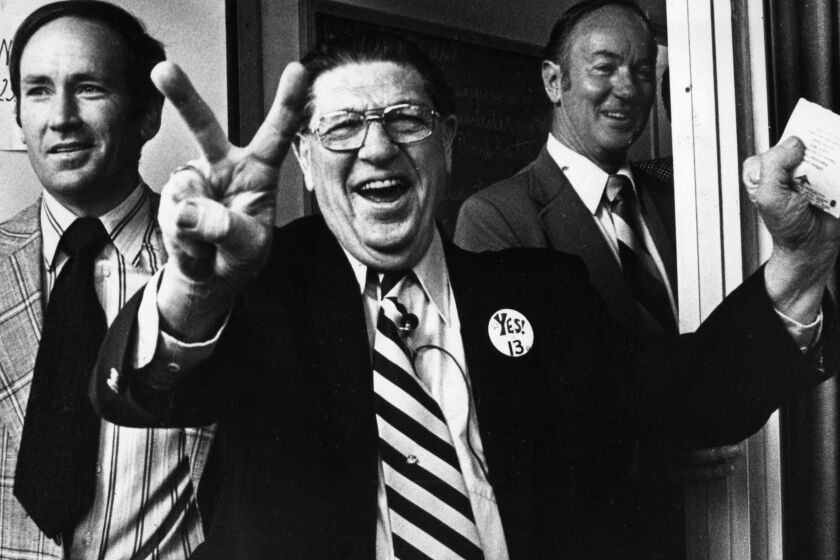
[Howard Jarvis, sponsor of Prop 13, which starved California’s schools]
While the homeowner tax protections of Proposition 13 have remained strongly popular over the last four decades, liberal interest groups and labor unions believed few voters realized that the low-tax rules also applied to multimillion-dollar corporations. Numerous studies revealed that many of these companies, many headquartered in Southern California and the Bay Area, operate in facilities where land values have changed very little since the 1970s — even as new businesses and homeowners alike pay taxes on property assessed more closely to market value.
Business groups that funded the opposition effort — contributing to a campaign with combined donations of more than $125 million — sought to divert attention away from large corporations and focus on Proposition 15’s potential impact on small businesses. Their advertising campaign hammered away at the fact that business owners who lease their location are often required to pay some, or all, of the building owner’s property taxes.
John Young is a journalist transplanted from Texas to Colorado. He wrote this brilliant column which lucidly explains why so many people were dancing in the streets on Saturday after Biden’s victory was announced.
It begins like this. Open the link to read the dazzling ending.
This is not fake news.
Donald Trump does not run the country.
You say he never did. You say the Constitution does. Ah, but he was prepared to show you differently.
When he was impeached, Republicans in the U.S. Senate told him he could. All but one of them barely flexed an eyebrow over his illegal act of extorting a struggling nation to help him torpedo a campaign rival — that rival who just became president-elect.
After those proceedings, Trump knew he could get away with anything.
Oh, yes, Barack Obama was right: The fate of democracy itself was at stake in this election. Democracy won.
This just in: Vladimir Putin has no more sway over U.S. foreign policy.
Today, like Trump, Vlad paces his quarters, steaming at what our voters have done. Vlad would never let this happen in his election.
Russia invested so much in destabilizing this nation. The good works of the 1,000-plus-employee Internet Research Agency paid off in 2016. Now? Nyet.
So much invested in making Americans disbelieve in their system.
Freedom. Many a Trump supporter has sent that word ringing through hills and valleys. But what does that word represent to them? For too many, it represents the freedom to stomp around in camo, an AK slung over the shoulder.
Freedom from fear? Don’t change the subject. The camo crowd couldn’t care less if you are a fearful person of color, or an immigrant, or if you are gay, or lesbian or transgender and fear for your rights.
GOP support wasn’t necessarily about freedom anyway. Look at the Republican Party platform. Basically it says, “What Trump says.”
Now he’s bound for civilian life and the life of a criminal defendant. What does his party do now?
Back to the Russians’ designs to mess with American voters’ minds, particularly people of color. Trump gloated over the lower-than-expected Black turnout in 2016, rightly pointing out that a no-vote by them was a vote for him.
As his presidency seeped away it was mostly Black votes that provided the drip, drip, drip that took him down, in Detroit, in Milwaukee, in Philly, in Pittsburgh, in Atlanta, in Savannah.
If ever an American election had a fitting coda, it was provided there in those communities.
Trump had trashed voting by mail. We in Colorado who have been doing this for years knew he spewed bilge. Now voters in many more states fully appreciate the process.
In the end it was mail-in votes — drip, drip, drip — that caused the waters to swell around and snuff a Trump dictatorship.
This interesting comment was posted on the blog a few days ago by a reader who identify as “Montana Teacher.”
To my dear online friends whom I have never met, the faithful readers of Diane Ravitch’s blog. Like you, I felt sick all last night and much of today. I am hoping Biden will win, of course. But I am sickened that even ONE person would vote for Trump, after all that he has done.
What I am writing about to you today is this: I am sitting in the middle of a bunch of RED STATES right now. In fact, Montana went completely red after years of a Democratic governorship and other Democratic officials. It is a sad, sad day for us. Our beautiful public lands will be desecrated and potentially sold off. We don’t have charter schools yet, but we will. A sad, sad day.
But here is the deal: Not all Republicans are racist. And by calling them that, we stop all conversation with them. To understand why they vote the way they do, we must listen. To win in the elections, as Democrats, we must understand our opponents who, actually, are our neighbors.
Many Republicans certainly are racist. But if you analyze the U.S. voting map, the main difference between blue and red states is the URBAN/ RURAL difference. So when people say Republicans are racist, they are indirectly saying that RURAL people are racist. That is a generalization.
We need to understand why there is such a major difference between urban and rural voters. Here are my theories:
Have you ever visited Jordan, Montana? It’s in the middle of nowhere. It feels like you’re on a different planet. It’s just sky and grass and cows. To live there, you have to be fiercely independent, and you need a gun, for food (hunting) and for protection (you might be the only one around for miles). There are no black people, there are no Latinos, there are no people from India or Korea or China, but there are Native Americans on the adjacent reservation.
You go to church on Sunday. Your kids are in 4-H. You say the Pledge of Allegiance. You have traditional values. This doesn’t mean you are racist. These people rely on themselves and on each other, and they don’t like to be told what to do, like “don’t shoot prairie dogs in order to save black-footed ferrets.” I don’t agree with that; it’s just we need to understand them more.
Many rural people feel THREATENED that their way of life is being taken away from them. They like their traditional values. Now, in my opinion, Trump does not support those values (church, family, community, agriculture, independence, freedom). But somehow, he has convinced them that he supports them. He has reached out to them in ways that the Democratic Party has not.
These folks LOVE their post offices! They love their local, public schools with locally elected school boards! They love their community hospitals and nursing homes! They want their Medicare and Social Security. They want their agriculture trade deals with foreign countries. Democrats need to show them who actually supports them. But, of course, guns, flags, and abortion get in the way. And they are worried about their towns drying up and blowing away, so the economy is a big deal for them.
Anyway, my point is this. We need to listen, observe, understand, think about, analyze, and reach out to these citizens if we’re ever going to win over the rural states of America. I think this is possible. For example, climate change will ruin their livelihoods. How can we help them understand this?
I’m writing a lot today because I’m desperate to figure out how we save Montana and other rural states and the country. But think about it–cowboys in Texas, Mormons in Utah and Idaho, pioneer stock in North and South Dakota, farmers in Iowa, etc. Somehow, these people think that Trump represents their values more than Biden. I don’t think that’s true. But how do we talk to them?
Perhaps as consequential as President Trump firing Defense Secretary Mark Esper via tweet on Monday, which has been widely expected for months, was the hiring of Michael Ellis to be the National Security Agency’s general counsel.
As one of the most controversial staffers in the White House over the past four years, Ellis has shown himself to be as much a staunch Trump loyalist as anyone else in the administration. But his new job means that he will no longer be a political appointee. Instead, as a civilian member of the senior executive service, he gets protections that will make it quite difficult for President-elect Joe Biden to fire him.
Burrowing down into what Trump derides as “the deep state” will give Ellis, a former Republican campaign operative, a powerful platform from which he could seek to complicate or undermine the incoming Democratic administration’s agenda. This is a preview of the sort of behavior from Trump that many on Biden’s transition team expect, and fear, during the lame-duck president’s final 71 days in power, even as he refuses to concede defeat.
Christopher Miller arrives at the Pentagon on Monday to take control just moments after Trump tweeted that he had “terminated” Mark Esper and installed Miller as acting secretary of defense. (Adrees Ali/Reuters)
Ellis worked for Rep. Devin Nunes (R-Calif.) before joining the National Security Council when Trump took office. In March 2017, Ellis was reportedly one of the people involved in giving Nunes access to classified files related to the investigation into Russian interference in the 2016 campaign. Nunes reviewed the records at the White House in the middle of the night. The notorious episode came to be known as “the midnight run.”
In July 2019, Ellis was allegedly the first person who proposed moving the transcript of Trump’s call with Ukraine’s president to a special server where fewer people would be able to see that the president had pushed his counterpart in Kyiv to announce an investigation into Biden and his son Hunter when the topic of Javelin antitank missiles came up.
Then-Army Lt. Col. Alexander Vindman testified under oath before Congress that Ellis was behind moving the transcript. But Ellis defied a subpoena to answer questions about his role in the donnybrook and what knowledge he might have had of the freeze on vital military assistance that Congress had approved for Ukraine. Ellis is named in the second article of impeachment that passed the House as a party to Trump’s obstruction of Congress.
After the GOP-controlled Senate voted not to convict the president, Trump ordered the removal of Vindman from the White House and promoted Ellis to be senior director for intelligence on the NSC.
Being general counsel for the NSA is one of the most immensely complicated and critical legal jobs in all of government, but it is somewhat insulated from politics. Ellis will report to the deputy general counsel for intelligence at the Defense Department, a civilian job. That person reports to the DOD general counsel, who is a political appointee. Once Biden’s eventual nominee for that job is confirmed by the Senate, he or she could choose to reassign Ellis to a different civil service position inside the military’s legal architecture.
“The appointment was made under pressure from the White House,” Ellen Nakashima reports. “NSA Director Paul Nakasone was not in favor of Ellis’s selection, according to three people familiar with the matter. However, the selection was not up to him, they said. … Ellis was selected over two other finalists: acting NSA general counsel Teisha Anthony and Bradley Brooker, acting general counsel at the Office of the Director of National Intelligence. Both are career civil servants.” The Pentagon and White House did not respond to a request for a comment.
Ironically, this is happening as Trump moves aggressively to roll back civil service protections for members of the bureaucracy. But it’s not surprising. Trump trying to burrow people inside the government shows just how much this president sees personnel as policy.
In related news, the top political appointee at the U.S. Agency for International Development told staff during a Monday phone call that three Trump loyalists are being elevated to top positions inside the agency in the waning days of the administration. John Barsa, who holds the title of acting deputy administrator, was formerly USAID’s acting administrator. He was supposed to step down from his position at the helm of the agency last week under the Vacancies Act but got to remain in charge after the White House fired Bonnie Glick, who had been serving as the deputy administrator.
“Glick was not given any reason for her firing but had supported the steps already taken in the transition process required by law,” Yeganeh Torbati and John Hudson report. “USAID officials also learned Monday that Max Primorac, who held previous roles focusing on religious rights in the agency, would be Barsa’s deputy … His title will be ‘senior official performing the duties of the deputy administrator.’ Primorac’s behavior while at USAID over the past two years has raised eyebrows among his colleagues. In 2019, Primorac expressed confidence during a government forum that Trump would win reelection. … And in 2018, just before he joined USAID, Primorac promoted a client’s business interests to a U.N. agency funded by USAID, ProPublica reported. … USAID, which provides billions of dollars of humanitarian assistance to foreign countries ever year, declined to comment.
Trump has also removed the official in charge of the federal program that produces the U.S. government’s definitive reports on climate change. “Michael Kuperberg, a climate scientist who had been executive director of the U.S. Global Change Research Program (USGCRP) since July 2015, was told Friday evening to return to his previous position as a scientist at the Energy Department. He had been expected to stay on through the production of the fifth edition of the congressionally mandated National Climate Assessment,” Jason Samenow, Andrew Freedman and Juliet Eilperin report. “The USGCRP is a program Congress created to help coordinate the climate science programs of 13 federal agencies. … Kuperberg directed that office through the release of the fourth edition of the climate assessment, which detailed the potentially dire consequences for Americans should the country take little action to cut emissions.” That report angered the White House because Trump has consistently downplayed the seriousness of the climate threat.
“Removing Kuperberg could allow the White House to insert someone whose climate science views more closely align with Trump’s,” per Samenow, Freedman and Eilperin. “That may be exactly what’s about to happen, according to Myron Ebell, a climate change contrarian at the Competitive Enterprise Institute who is close to the administration. Ebell said in an interview that the job will most likely go to David Legates, a meteorologist from the University of Delaware who was recently appointed to be the deputy assistant secretary of Commerce for environmental observation and prediction at the National Oceanic and Atmospheric Administration (NOAA).
“While that is a senior position at NOAA reporting directly to the acting administrator, Legates does not have a role in the climate assessment process while serving in that capacity. … Even if he were to hold the climate research job for just the remaining few months of Trump’s term, Ebell said he could help select the authors of the next assessment and influence its final content that way. Once the assessment’s authors are selected, it can be difficult to change them as the process moves along, Ebell said, regardless of the administration in office at the time.”
Slate is posting a series of farewell to the odious cast of characters in the Trump administration. Dan Kois wrote this goodbye to Betsy DeVos.
He writes:
So long, Secretary of Education Betsy DeVos! It wasn’t just that you were unqualified to lead America’s educational system, as someone who never worked at a public school, attended a public school, or took out a school loan. It was that you were the opposite of qualified, an early example of the Trump administration’s elitist disregard for the very role of government agencies themselves. You sailed into the Department of Education as if sailing into port on one of your yachts, buoyed by your belief that public schools are a “dead end,” your declaration that government “sucks,” and your family’s hundreds of millions of dollars donated to Republican causes.
And yeah, you made the most of the opportunity. You promoted charter and religious schools while ignoring public schools. You reduced protections for victims of sexual assault, for minority students, for gay and trans students. You gleefully ignored a court order and continued to collect loan payments from students at a defunct, fraudulent for-profit university—16,000 times, including wage garnishments and tax seizures.
But it was in 2020, as American schools faced arguably their biggest crisis since the civil rights era, that you really made your contempt for teachers and children plain. As schools across the country sought aid and advice to reopen safely in the fall, you holed up in your Michigan compound, protected by around-the-clock U.S. Marshals that have cost taxpayers as much as $25 million over four years. (You’re the first Cabinet secretary ever to insist on such protection.) From your mansion, you joined Donald Trump’s demands that schools reopen NOW—but offered no support or assistance. The end result: politicizing school reopening as an issue, making it more difficult for schools to open safely. You’ve overseen a slow-motion education disaster that will have lasting effects on an entire generation of children.
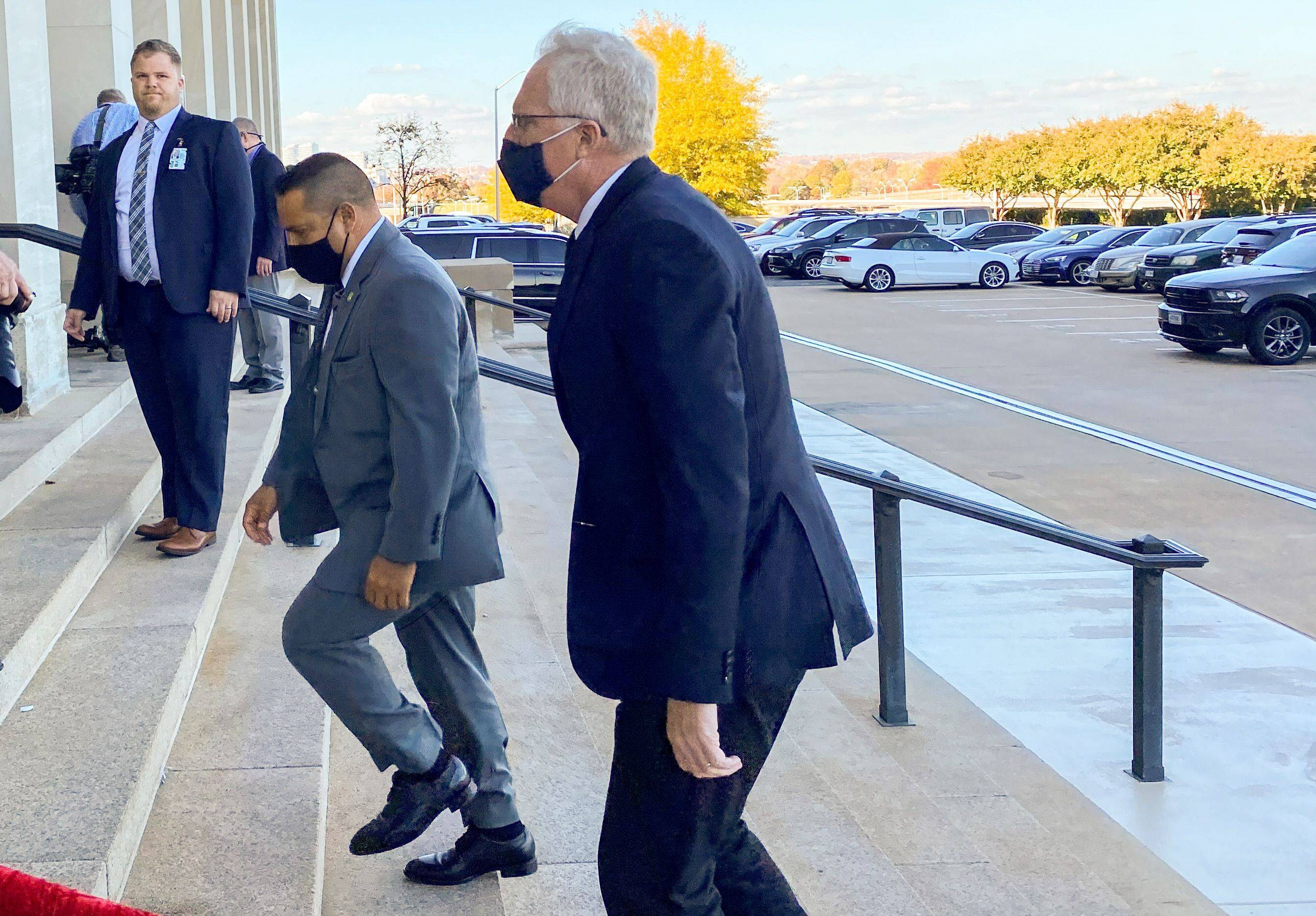 Christopher Miller arrives at the Pentagon on Monday to take control just moments after Trump tweeted that he had “terminated” Mark Esper and installed Miller as acting secretary of defense. (Adrees Ali/Reuters)
 Diane Ravitch's blog