Archives for the month of: February, 2020

Jersey Jazzman notes that charters in his state are on the horns of a dilemma: on one hand, public school advocates are suing to block charter expansion, because they drain away public school funding: on the other hand, charters want to join a lawsuit that would allow them to share in a settlement intended to provide equity for public schools in impoverished districts. JJ is a very smart guy but he doesn’t seem to understand that what matters most is not consistency but being in the right place when the money spigot is turned on. Charters are public when that’s where the money is; charters are not public when it suits them to avoid mandates.

He writes:

This was a long time coming: the Christie administration happily encouraged the expansion of charter schools without seriously thinking about appropriate oversight, regulation, and funding of the sector. Now the state has to contend with a system that imposes fiscal burdens on school districts that host charter schools, even as those districts have no meaningful say on charter school proliferation.

The fact – which I have validated empirically – is that charter school expansion is not a revenue-neutral policy. As school districts lose students to charters, they are unable to adjust immediately to enrollment declines, because districts have fixed costs like buildings and personnel that can’t be quickly scaled back. 


But charter operators appear to be unconcerned with this reality; repeatedly, they have demanded they get everything they think they are owed, even when school districts are facing serious financial pressures. During Christie’s time, this meant charter budgets weren’t touched
, even as host districts’ were slashed…

As Bruce Baker and Gary Miron pointed out years ago, charter school regulations like New Jersey’s lead to an absurd situation: the public pays for school buildings that many times used to be owned by a school district – in other words, the public – but wind up in private hands. Sometimes those hands are nonprofits aligned with the charter school; sometimes they are for-profit companies, paying off their mortgages with funds the charters receive in per pupil payments from hosting school districts.

In either case, the public is paying for a building that the public will never own. And in most cases, these are buildings that are paid for, at least in part, with local funds, even though the state is the entity that gets to decide whether charters will be granted or renewed.

This lunacy is at the heart of the serious conflicts of interest, lack of transparency, and just generally bad policymaking that surrounds New Jersey’s charter school facilities…

The legal status of charter schools has always been open to debate, but it’s clear at this point that they are not government actors. As such, they can claim immunity from oversight regulations that other governmental entities, such as school boards, must abide by. Why, then, should the taxpayers simply turn over revenues for charter facilities when they won’t even know who, if anyone, is profiting off of this system?

There are a lot of aspects of charter school policy we can debate, but this one if clear: If the public pays for a school building — including a charter school building — the public should own the building. If New Jersey’s charter schools want more funding for their facilities, the price to be paid is that those facilities stay in public hands, with public oversight and complete transparency.

If you think I’m wrong, I’d love to hear your argument. But it seems clear to me that New Jersey’s charter schools can’t have it both ways: if you want public funding, you can’t have privately owned buildings.
Teresa Hanafin writes the Fast Forward feature for the Boston Globe, interpreting the big events of the day and referring to the Old Farmer’s Almanac, the weather, and sports in Boston.

She writes today about the Department of Fake Outrage:

I am so sick and tired of this week that I was tempted to make this a TFF. But too much happened yesterday to ignore. Nonetheless, in honor of it being the Friday leading into a long weekend, I’ll try to be brief. (Ha!)

Before we get to AG William Barr’s neat political theater, let’s consider that Trump appears to have threatened to continue to ban New Yorkers from the federal Trusted Traveler programs unless NY prosecutors stopped investigating him and dropped their lawsuits against him. That guy just loves his quid pro quos!

That’s the interpretation by Walter Shaub, the former director of the Office of Government Ethics who resigned in 2017 because he was too ethical for the new administration.

The Trumpian tweet at issue: “I’m seeing Governor Cuomo today at The White House. He must understand that National Security far exceeds politics. New York must stop all of its unnecessary lawsuits & harrassment [sic], start cleaning itself up, and lowering taxes.”

Shaub was so alarmed by the tweet that he has been posting his concern on Twitter every half-hour, frantically waving his arms to try to break through the Trump fog machine. At one point he wrote in frustration, “here’s my hot take on Barr, airplane chairs, nicknames, insults, primaries, nominees, Bolton, campaign ads, comets or your lumpy oatmeal: Fresh on the heels of his acquittal and weaponizing the Justice Department, the president attempted quid pro quo extortion on Twitter.”

He did get the attention of a handful of congressional Democrats and some other ethics types, but most of the media has been focusing on Barr’s performance.


Speaking of which, here’s the background: Barr faced a revolt from career prosecutors in the Justice Department over his decision to take the extremely rare step of changing a sentencing recommendation in a case in which the defendant just happened to be a friend of Trump’s.

He didn’t insert himself into any of the thousands of federal cases that occur nationwide; he jumped into the one that involves Trump’s buddy, political adviser Roger Stone.

He also received a sharp rebuke from the New York City Bar Association, and was the subject of accusations that he was allowing Trump to compromise the integrity of the judicial system by trying to use it to help Trump’s friends and punish his many, many, many, many, many perceived enemies.

Finally, Barr was certainly aware of the rumblings that some prosecutors across the country were discussing resigning en masse in protest of Barr carrying water for Trump — an internal insurrection that would be stunning. He also realized that history may hold him responsible for the erosion of the judicial system’s historic — and vital — reputation for independence from politics.

So to salvage the situation, he quickly gave an interview to ABC News in which he said he wouldn’t be bullied by anybody, and complained that Trump’s tweets about court cases and attacking judges were making his job “impossible.” Of course, Trump’s been doing that during Barr’s entire tenure, but who’s counting.

(If the situation is so “impossible,” will he resign when Trump does it again?)

The reaction was swift: Wow! Barr is bucking the president! He’s criticizing Trump publicly! Anyone who has ever done that has either been eviscerated by Trump or fired! What is Trump going to do?

Um, nothing.

Remarkably, Trump — the guy who turns dark orange with rage whenever somebody so much as looks at him cross-eyed, let alone criticizes him publicly — just shrugged his shoulders and said that what Barr said was fine. It was almost as though … he knew it was coming.

From The New York Times: “The attorney general had let the president know some of what he planned to say and is remaining in his job, a person familiar with the events said.” Huh.

Democrats and other critics scoffed at Barr’s supposed rebellion. “The tell here will be how Trump reacts,” said Joe Lockhart, Bill Clinton’s press secretary. “If he lashes out, those who argue Barr is being genuine may be right. If he’s muted, the opposite.”

Oh, and Barr did not explain why, of all the gin joints court cases in all the towns in all the world, he walked into this one.


By the way, Trump finally admitted that he sent Rudy Giuliani to Ukraine to dig up dirt on Joe Biden after months of lying about it. Just to clarify.


Outrage and anger continue to grow today over the homophobic comment about Pete Buttigieg by radio host Rush Limbaughimplying that Buttigieg is not a real man, or not masculine, because he’s gay, and that Trump could “have fun with that” on the debate stage.

“A gay guy, 37 years old, loves kissing his husband on debate stages. Can you see Trump have fun with that? They’re looking at Mayor Pete, 37-year-old gay guy, mayor of South Bend, loves to kiss his husband on the debate stage. And they’re saying, OK, how’s this going to look, 37-year-old gay guy kissing his husband on stage next to Mister Man Donald Trump?”

Mister Man? That sounds like the stage name for a porn actor in a Stormy Daniels video.

I’m not sure if Limbaugh was wearing his Trump-bestowed Presidential Medal of Freedom at the time of these remarks, but let’s remember that Buttigieg has had one spouse; Limbaugh is on his fourth. (And Buttigieg is 38, not 37.)

And this notion that only heterosexual men are masculine is rather odd. As CNN’s Jim Sciutto said, “What’s more manly: volunteering for military service, as Pete Buttigieg did, or avoiding it?”

Pete Buttigieg went to Afghanistan. Where did Trump go? Oh, yeah, bone spurs.

Charter advocates have reacted with astonishment and outrage at the Trump-DeVos decision to fold the federal Charter Schools Program into a block grant to the states, along with 29 other programs. The Trump administration’s goal is to shift federal funding to states and let them decide how to spend the money.

Matt Barnum of Chalkbeat writes the story here, detailing the administration’s rationale and charter advocates’ reaction. 

Jim Blew, formerly of the Walton Family Foundation, which claims to have launched one of every four charters in the nation, brushed off the charter lobbyists: 

“The federal lobbyists for charter schools sound a lot like the lobbyists for all of the other competitive grant programs,” Assistant Secretary Jim Blew told Chalkbeat in a statement. “In their desperate communications, they have exaggerated the importance of CSP — just like other lobbyists,” he added, referring to the Charter Schools Program.

It’s not clear that the program is in real jeopardy, since Congress has previously disregarded the Trump administration’s proposed budgets. But the budget proposal and combative rhetoric suggest that charter advocates do not have as staunch an ally in the administration as they previously believed.

“We are saddened and puzzled by the Department of Education’s comments,” said Nina Rees, president of the National Alliance for Public Charter Schools, which has receivedfederal charter dollars. “We advocate for the federal Charter Schools Program because we believe it is a lifeline for students.”

Rees formerly was education advisor to Vice President Dick Cheney and to entrepreneur MIchael Milken, who engaged in education philanthropy after serving a term in prison for financial crimes.

Strangely, Barnum refers to Democrats for Education Reform (DFER) as “left of center,” which is laughable since they were founded by and funded by hedge fund managers, some of whom are billionaires and may not even be Democrats. DFER’s funding has gone to supporters of school choice, and their beneficiaries show no interest in funding, class size, teachers’ salaries, integration or other issues that matter to progressive Democrats.

It is ironic that the Republican-dominated charter industry will now have to count on Democrats in the House to save the federal Charter Schools Program, which DeVos has used to fatten avaricious corporate charter chains.

The federal CSP has funded a large proportion of the nation’s charter schools, acting like “the Small Business Administration” for charters entrepreneurs, as NPE executive director Carol Burris said recently on Twitter.

Barnum wrote:

A recent presentation from the Department showed the figure was slightly higher: as of 2016, more than 3,100 existing charter had received such a grant, with the program helping to fund close to 45% of all operating charters. (Morabito, the spokesperson, acknowledged the error when asked about it by Chalkbeat.)

For charters that opened between 2006 and 2016, the share was even higher — 60% had received a federal grant.

Studies of the federal Charter Schools Program by the Network for Public Education found that it was riddled with waste, fraud, and abuse. More than 1/3 of the federally funded charters either never opened or closed soon after opening. This is a program that should be eliminated.

What will the Democrats do?


When Rudy Guiliani was planning to run for mayor of New York City in 1993, he commissioned a study of his vulnerabilities so that he would be prepared to respond to attacks.

The vulnerability study compiled a long list of his deeds and misdeeds that would give ammunition to critics.

After he read it, Guiliani ordered that it be destroyed, lest it fall into the wrong hands.

Apparently, one copy was not destroyed, and it was handed over to Guiliani critic Wayne Barrett, who wrote a biography of the Mayor. Barrett has since died, but he turned over his copy to the author of this article, Fred Smith. 

Smith and his co-writer Jarrett Murphy contend that the Guiliani of 1993 is the same as the one we see today, with all the same flaws.


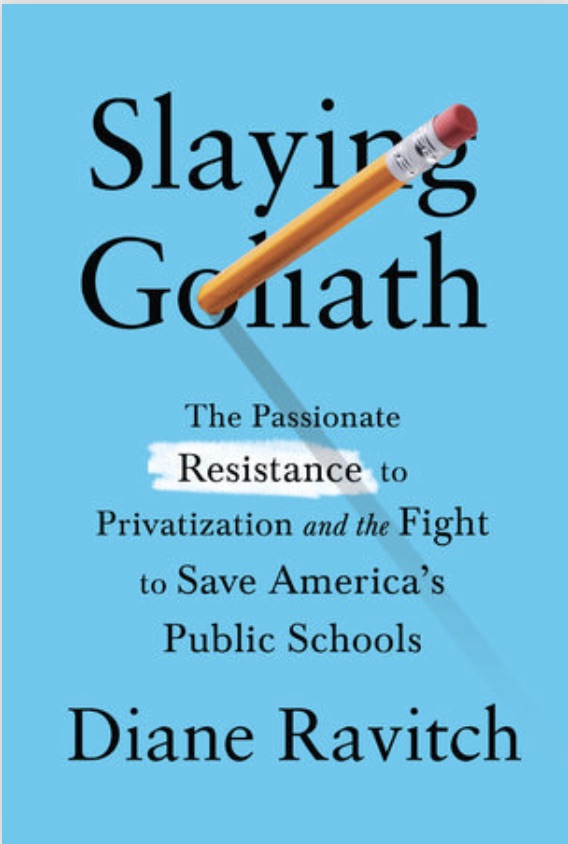
John Thompson, historian and retired teacher in Oklahoma, reviews SLAYING GOLIATH. This is the second part of his review.

This is an excerpt of a long and thoughtful review.

This second post will focus on Ravitch’s analysis of the research which predicted the defeat of accountability-driven, charter-driven policies. Perhaps the most striking pattern documented in Slaying Goliath is how they failed in the way that scholars and practitioners anticipated.

Decades of Disruption-driven reform began with the false claim “that American education was failing and the only way to fix it was with standards, tests, competition, and accountability.” As Arne Duncan’s public relations officer and Walton-funded reformer Peter Cunningham said, “We measure what we treasure.”

Ravitch’s response was, “I was taken aback because I could not imagine how to measure what I treasure: my family, my friends, my pets, my colleagues, my work, the art and books I have collected.” And that foreshadows the victory of the Resistance over Goliath. Most educators, patrons, and students agree that children are more than a test score.

No Child Left Behind and the Race to the Top set impossible test score targets. They were based in large part on the weird idea that “no-excuses” behaviorist pedagogies could be quickly “scaled up,” providing poor children of color a ladder to economic equality. Drawing on the tradition of Edward Thorndike and B.F. Skinner, reformers “rigidly prescribed conditioning via punishments and rewards.” Previewing their fatal flaw, Ravitch observes, “Behaviorists, and the Disrupters who mimic them today, lack appreciation for the value of divergent thinking, and the creative potential of variety. And they emphatically discount mere ‘feelings.’”

When educators resisted, corporate reformers became livid and doubled down on the punitive. Perhaps their worst debacle was using value-added teacher evaluations to hold each individual educator accountable for test score growth. It combined inappropriate test outputs with an unreliable and invalid algorithm, the VAM, as a club to enforce compliance. In the short run, it forced educators, who had previously tried to keep their heads down and “monkey wrench” testing mandates to join patrons and students in the Resistance. By 2018, however, pent up anger exploded as teacher strikes spread across the nation.

Today, many or most of Goliath’s coalition have become disenchanted with standardized testing, but their Disruption model can’t function without it. Few have gone as far as Paymon Rouhanifard, the former Camden superintendent who abolished report cards after listening to complaints, and denounced standardized testing as he left the job.

The more common path is to spin their punitive tests as “personalized” learning, and their incentives and disincentives as the “portfolio model.” As Ravitch explains, “A portfolio district is one where the local board (or some entity operating in its stead) acts like a stockbrokerage, holding onto winners (schools with high test scores) and getting rid of losers (schools with low test scores).”

As was also predicted by Campbell’s Law, test-driven accountability (made more intimidating by the dual threat of test-driven competition with charters) led to corruption. The cheating was far greater than just the scandals where adults erased and changed bubble-in answers. Graduation rates were easy to manipulate. For instance, NPR reported a “heartwarming story” in 2017 about a school with 100% graduation rate. A subsequent FBI investigation and a district audit found 1/3rd of the school’s graduates lacked credits and only 42% were on track to graduation.

And that leads to the corruption associated with school choice. Today’s Disrupters seem to be doubling down on charters to drive transformative change. As explained in a previous post, in 1988 Al Shanker saw charters as a path towards innovation. Within two years, however, the promise of win-win experimentation started to be undermined when conservative reformers Terry Moe and John Chubb claimed “choice is a panacea.”

In this case, it was choice-advocate Paul Peterson who predicted the political future. Charters didn’t take off because of the balanced approach of Shanker, but because reformers “radicalized” the concept. And, of course, there was plenty of big bucks available for pushing their radical but false narrative.

Within a decade, a shocking number of non-educators had been convinced by Goliath’s spinsters that the KIPP’s behaviorist model could be scaled up. As Slaying Goliath explains, “The biggest innovation in the charter sector was the invention of ‘no-excuses’ schools.” It took nearly another decade for policy makers to accept the fact that charters get average results except for those with high attrition.” And it took nearly as long to reveal the much greater down sides of charters…

Regardless of whether we’re discussing high-stakes testing, charter expansion, or the other pet theories, we should all heed Ravitch’s most important lesson of the past few decades is that “Reform doesn’t mean reform. It means mass demoralization, chaos, and turmoil. Disruption does not produce better education.”

Slaying Goliath celebrates a great victory for public education and democracy. However, Ravitch reminds us that the Disrupters are still threatening. She compares today’s danger to that which faced a man who decapitated a rattlesnake but who nearly died after being bitten by the detached head.

So, we can’t lower our guard until the principles that inspired the Resistance are safe in our schools.


John Thompson, historian and retired teacher in Oklahoma, reviews SLAYING GOLIATH in two-parts.

This is part one. 

He begins:

Diane Ravitch’s Slaying Goliath: The Passionate Resistance to Privatization and the Fight to Save America’s Public Schools is the history of the rise and fall of corporate school reform, but it is much more. It isn’t that surprising that a scholar like Ravitch, like so many researchers and practitioners, predicted over a decade ago how data-driven, competition-driven “reform” would fail. Technocratic “reformers,” who Ravitch calls “Goliath,” started with a dubious hunch, that socio-engineering a “better teacher” could overcome poverty and inequality, and then ignored the science that explained why evaluating teachers based on test score growth would backfire.

It may be surprising that Ravitch, an academic who had once worked in the Education Department of President George H. W. Bush, and served on the board of the conservative Fordham Foundation, become the leader of the grass roots uprising of parents, students, and educators which she dubs the “Resistance.” But it soon became clear why Ravitch inspired and guided the Resistance. In contrast to Goliath, who “ignored decades of research” and assumed the worst of their opponents, Ravitch respected and listened to practitioners and patrons.

One big surprise, which is explained in Slaying Goliath, is how Ravitch presciently understood why output-driven, charter-driven reform devolved into “privatization.”  She had firsthand experience with the hubris of the Billionaires Boys Club, understanding the danger of their desire to hurriedly “scale up” transformational change. And being an accomplished scholar, she had insights into how top-down technocrats’ embrace of behaviorism in the tradition of Edward Thorndike and B.F. Skinner, led to their commitment to “rigidly prescribed conditioning via punishments and rewards.”

Ravitch was among the first experts to fully grasp how, “Behaviorists, and the Disrupters who mimic them today, lack appreciation for the value of divergent thinking, and the creative potential of variety. And they emphatically discount mere ‘feelings.’”

Ravitch witnessed how corporate reformers “admire disruptive innovation, because high-tech businesses do it, so it must be good.” Rather than take the time to heed the wisdom of those who had no choice but to become Resisters, Goliath’s contempt for those in the classroom drove an evolution from “creative destruction” to “Corporate Disruption.”

Disrupters were in such a rush that they used children as “guinea pigs in experiments whose negative results are clear.” But they “never admit failure,” and remain oblivious to the fact that “The outcome of disruption was disruption, not better education.”  And these billionaires not only continue to “fund a hobby injurious to the common good.” They’ve ramped up their assault on public education and its defenders, perpetuating a “direct assault on democracy.”

Ravitch predicts, “Historians will look back and wonder why so many wealthy people spent so much money in a vain attempt to disrupt and privatize public education and why they ignored income inequality and wealth inequality that were eating away at the vitals of American society.”

Thompson goes on to tell some of the important events in which I was a participant. Such as the decision within the first Bush administration to trash the infamous Sandia Report, which disputed the desperate findings of “A Nation at Risk.” And my discussions with Albert Shanker about what charter schools should be in the American system. He saw them as part of a school district, operating with the approval of their peers as collaborators, as R&D labs, not as competitors for funding and students. And my 2011 meeting at the Obama White House, when the top officials asked what I thought of  Common Core and I urged them to launch field trials; they rejected the idea out of hand.

And Thompson quickly understood that, unlike the Disrupters, who wanted to reinvent and disrupt the public schools, I listened to practitioners. I assumed they knew far more than I, and I was right about that. I understood the negative effects of NCLB and the Race to the Top because I saw them through the eyes of those who had to implement shoddy ideas.

Thompson concludes:

Ravitch observes that in contrast to the Resistance, “So as long as billionaires, hedge fund managers, and their allies are handing out money, there will be people lined up to take it. But their transactions cannot be confused with a social movement.” Moreover, “The most important lesson of the past few decades is that “Reform doesn’t mean reform. It means mass demoralization, chaos, and turmoil. Disruption does not produce better education.”

I’ll conclude this post with Ravitch’s words on the two dogmas that the Disruption movement relied on:

First, the benefits of standardization, and second, the power of markets. Their blind adherence to these principles has been disastrous in education.    These principles don’t work in schools for the same reasons they don’t work for families, churches, and other institutions that function primarily on the basis of human interactions, not profits and losses.

Jeff Bryant has written a powerful story that reveals the growing dominance of corporations in schools.

In the expanding effort to privatize the nation’s public education system, an ominous, less-understood strain of the movement is the corporate influence in Career and Technical Education (CTE) that is shaping the K-12 curriculum in local communities.

An apt case study of the growing corporate influence behind CTE is in Virginia, where many parents, teachers and local officials are worried that major corporations including AmazonFord and Cisco—rather than educators and local, democratic governance—are deciding what students learn in local schools.

CTE is a rebranding of what has been traditionally called vocational education or voc-ed, the practice of teaching career and workplace skills in an academic setting. While years ago, that may have included courses in woodworking, auto mechanics, or cosmetology, the new, improved version of CTE has greatly expanded course offerings to many more “high-demand” careers, especially in fields that require knowledge of science, technology, engineering, and math (STEM).

Education policy advocates across the political spectrum, from Education Secretary Betsy DeVos to former First Lady Michelle Obama, have praised expansions of CTE programs in schools. Fast-tracking federal funds for CTE programs in schools has become the new bipartisan darling of education policy. CTE lobbyists and advocates have successfully pressed for expanded funding of their programs at federal and state levels. And a 2019 study by the American Enterprise Institute, a right-wing advocacy group based in Washington, D.C., found that since 2004, mentions of CTE in U.S. media outlets “have grown over tenfold, and they have doubled since 2012.”

According to a September 2019 analysis from Brookings, “more than 7 million secondary school students and nearly 4 million postsecondary students were enrolled in CTE programming.” And a 2018 review of CTE programs by the federal government’s National Center for Education Statistics found 73 percent of school districts offered CTE courses that give students both high school and postsecondary credit, a potential benefit for students and parents who want to reduce the cost of college.

What has folks in Chesterfield County, Virginia, concerned is the particular brand of CTE that has come to their district. At a September 2019 community event, middle school teacher Emma Clark and others mentioned the district’s collaboration with Ford Next Generation Learning (NGL), an offshoot of the Ford Motor Company that claims, according to its website, that it “mobilizes educators, employers, and community leaders to create a new generation of young people who will graduate from high school both college- and career-ready.”

Chesterfield parents I spoke with also pointed to the district’s collaboration with the Cisco Networking Academy, an offshoot of the computer networking giant that has its own branded course offering in the Chesterfield CTE curriculum.

In a phone conversation, Clark described the district’s collaborations with these companies as “new layers” of school privatization. First, corporations like these can use the rush to CTE to flood schools with new course offerings that require technology the schools have to buy. And another layer is the CTE programs businesses help to create provide them with free job training.

The concern Chesterfield teachers and parents have about corporate influence in K-12 public school curricula is magnified enormously due to the entrance of Amazon into the equation.

The “centerpiece” of Virginia’s successful effort to lure Amazon to build a new headquarters in the state, according to state-based news outlets and state-issued reports, was a commitment to more than double Virginia’s tech-talent pipeline, beginning in K-12 schools.

“Virginia’s ultimate proposal was centered around an effort to provide Amazon—or any other tech firm that wanted to come—with all the educated workers it needed,” according to a report in the Washingtonian, and the state sealed the deal with a pledge “to plow $1.1 billion into tech schooling.” The state’s commitment to developing a tech-talent pipeline providing workers for Amazon and other companies was key to inking the deal, says an Amazon spokesperson in the Cincinnati Business Courier.

“We’re being hijacked in Virginia,” Kathryn Flinn explained to me. Flinn is a 20-year resident of Chesterfield and mother of two children, one a special-needs child, who both have attended Chesterfield County Public Schools.

The Washington Post reports that school bullying is following the model created by the Big Bully in the White House, who delights in ridiculing others.

Two kindergartners in Utah told aLatino boy that President Trump would send him back to Mexico, and teenagers in Maine sneered “Ban Muslims” at a classmate wearing a hijab. In Tennessee, a group of middle-schoolers linked arms, imitating the president’s proposed border wall as they refused to let nonwhite students pass. In Ohio, another group of middle-schoolers surrounded a mixed-race sixth-grader and, as she confided to her mother, told the girl: “This is Trump country.”

Since Trump’s rise to the nation’s highest office, his inflammatory language — often condemned as racist and xenophobic — has seeped into schools across America. Many bullies now target other children differently than they used to, with kids as young as 6 mimicking the president’s insults and the cruel way he delivers them.

Trump’s words, those chanted by his followers at campaign rallies and even his last name have been wielded by students and school staff members to harass children more than 300 times since the start of 2016, a Washington Post review of 28,000 news stories found. At least three-quarters of the attacks were directed at kids who are Hispanic, black or Muslim, according to the analysis. Students have also been victimized because they support the president — more than 45 times during the same period.

Although many hateful episodes garnered coverage just after the election, The Post found that Trump-connected persecution of children has never stopped. Even without the huge total from November 2016, an average of nearly two incidents per school week have been publicly reported over the past four years. Still, because so much of the bullying never appears in the news, The Post’s figure represents a small fraction of the actual total. It also doesn’t include the thousands of slurs, swastikas and racial epithets that aren’t directly linked to Trump but that the president’s detractors argue his behavior has exacerbated.

“It’s gotten way worse since Trump got elected,” said Ashanty Bonilla, 17, a Mexican American high school junior in Idaho who faced so much ridicule from classmates last year that she transferred. “They hear it. They think it’s okay. The president says it. . . . Why can’t they?”

Asked about Trump’s effect on student behavior, White House press secretary Stephanie Grisham noted that first lady Melania Trump — whose “Be Best” campaign denounces online harassment — had encouraged kids worldwide to treat one another with respect.

A few people in Los Angeles who think a great deal about education issues decided to launch a new website. They are real people who are not funded by billionaires Eli Broad, Reed Hastings, the Waltons, Bill Bloomfield, Michael Bloomberg, or Bull Gates. Imagine that!

Blogger Sara Roos writes an introduction:

Dears:

With this I am announcing the launch of the Los Angeles Education Examiner, a site for news about things-educational in LA and beyond.

Included on my blog, RedQueenInLA.com are two of LAEdEx’s first two new postings, attempting to stake out the reaches of our coverage. I am embarking on this effort with friend, neighbor and colleague Damien Newton of StreetsBlogLA.comfame. LA EdEx will be a non-profit, online news website covering the education beat in and around Los Angeles.

So please look here or at la-edex.org at these introductory pieces as we start exploring what it means to educate kids in LA, how their world is at once insular and intensely important within one’s own little family, while also being politically critical in a very big sense, a microscosm of all the whirlings of money, power, and social interactions beyond.

Thanks for your support by reading, forwarding and maybe even considering – gasp – contributing!

-Sara.

http://redqueeninla.com/2020/02/12/rqila-passes-a-marker-launching-the-los-angeles-education-examiner/
http://redqueeninla.com/2020/02/12/schools-reach-beyond-the-classroom/

http://la-edex.org/welcome-to-and-from-the-los-angeles-education-examiner/
http://la-edex.org/schools-reach-beyond-the-classroom/

Fred Smith was the testing expert at the New York City Board of Education for many years. After he retired, he became a relentless truth-teller about the flaws of standardized testing and the clever means of distorting the stats to produce the desired results. He currently acts as an unpaid advisor to opt-out parents.

Smith sent this article from 2007 that shows how Mayor Bloomberg and Chancellor Klein played games with the data, in this case blaming “immigrant kids” for a drop in test scores.

Mayor Bloomberg and his schools chancellor, Joel Klein, have reaffirmed that old Mark Twain saying about the three kinds of lies: lies, damn lies and statistics.

Using a PowerPoint presentation filled with glitzy graphs and color charts, Klein reached a new low yesterday by attempting to blame a sharp drop in this year’s third-, fourth- and fifth-grade reading scores on thousands of immigrant pupils.

According to the chancellor, the drop in the lower grade scores was solely because of the federal government’s new requirement that all children classified as English-language learners, or ELLs, must take the regular state tests after being in the country just one year.

Because of that requirement, some 30,000 more ELLs took the state test this year than in 2006, Klein said, and their lower scores dragged down overall city results.

Fred Smith was outraged when he heard Klein’s explanation. Smith, you see, spent three decades analyzing tests for our city’s school system, so he knows a thing or two about how chancellors paint the prettiest picture for the public.

“They never told you that back in 2005, during the mayoral race, the school district quietly increased the number of exemptions for ELL kids and then claimed a record boost in scores,” Smith said.

In 2009, with Bloomberg’s fellow billionaire Meryl Tisch, in charge of the New York Board of Regents, test scores in the city went through the roof. After the mayoral primary election was safely past, the Regents commissioned a report by professors Daniel Koretz and Jennifer Jennings showing that the test questions had become familiar, leading to score inflation, and that the dramatic rise was not real.

Also, in an amusing turn of events, New York City won the Broad award in 2007 as the most improved urban district, right before the NAEP gains were released, showing that the city had made no gains on NAEP.

In 2010, Jennifer Medina of the New York Times wrote about the perils of over reliance on standardized tests and how it affected New York City in particular. 

She wrote:

When New York State made its standardized English and math tests tougher to pass this year, causing proficiency rates to plummet, it said it was relying on a new analysis showing that the tests had become too easy and that score inflation was rampant.

But evidence had been mounting for some time that the state’s tests, which have formed the basis of almost every school reform effort of the past decade, had serious flaws.

The fast rise and even faster fall of New York’s passing rates resulted from the effect of policies, decisions and missed red flags that stretched back more than 10 years and were laid out in correspondence and in interviews with city and state education officials, administrators and testing experts.

The process involved direct warnings from experts that went unheeded by the state, and a city administration that trumpeted gains in student performance despite its own reservations about how reliably the test gauged future student success.

It involved the state’s decision to create short, predictable exams and to release them publicly soon after they were given, making coaching easy and depriving test creators of a key tool: the ability to insert in each test questions for future exams. Next year, for the first time, the tests will not be released publicly.

It involved a national push for numbers-based accountability, begun under President George W. Bush and reinforced by President Obama. And it involved a mayor’s full embrace of testing as he sought to make his mark on the city, and then to get re-elected.

“They just kept upping the stakes with the scores, putting more pressure on the schools but not really looking at what it all means,” said Pedro Noguera, an education professor at New York University who has worked with the city’s Department of Education to help improve struggling schools.

New York has been a national model for how to carry out education reform, so its sudden decline in passing rates may be seen as a cautionary tale. The turnaround has also been a blow to Mayor Michael R. Bloomberg and his chancellor, Joel I. Klein, who despite warnings that a laserlike focus on raising scores could make them less and less reliable, lashed almost every aspect of its school system to them. Schools were graded on how much their scores rose and threatened with being closed if they did not. The scores dictated which students were promoted or left back, and which teachers and principals would receive bonuses.

Even now, the city believes that the way it uses the tests is valid. The mayor and the chancellor have forcefully defended their students’ performance, noting that even after the changes this year, student scores are still better than they were in 2002. They have argued that their students’ progress is more important than the change in the passing rate, and that years of gains cannot be washed away because of a decision in Albany to require more correct answers from every student this year.

The test scores were even used for a new purpose this year: to help determine which teachers should receive tenure.

“This mayor uses data and metrics to determine whether policies are failing or succeeding,” said Howard Wolfson, the deputy mayor for government affairs and communications. He also helped run Mr. Bloomberg’s re-election campaign in 2009, using the city’s historic rise in test scores to make the case for a third term. “We believe that testing is a key factor for determining the success of schools and teachers.”

“Under any standard you look at,” he added, “we have improved the schools.”

But given all the flaws of the test, said Prof. Howard T. Everson of the City University of New York’s Center for Advanced Study in Education, it is hard to tell what those rising scores really meant.

“Teachers began to know what was going to be on the tests,” said Professor Everson, who was a member of a state testing advisory panel and who warned the state in 2008 that it might have a problem with score inflation. “Then you have to wonder, and folks like me wonder, is that real learning or not?”

New Generation of Tests

The problems that plagued New York’s standardized tests can be traced to the origin of the exams.

In 1996, New York set about creating tests for fourth and eighth graders as a way to measure whether schools were doing their jobs. A precursor to the widespread testing brought about by Mr. Bush’s No Child Left Behind law, the tests replaced more basic exams that had been given in the same grades, which simply determined whether students needed remedial instruction. (The city had also given its own tests for many years.)

Teachers pushed back, saying they could gauge their students’ performance better than any mass-produced tests could. “There was a lot of resistance from throughout the education community to having the tests,” said Alan Ray, who was the chief spokesman for the State Education Department in the 1990s and in 2000, and retired this year after overseeing data for the office.

But education officials in New York, and many other states, were coming to the conclusion that some measurement system, no matter how limited, was necessary.

The officials sought advice from dozens of educators across New York to figure out what the tests should encompass, Mr. Ray said. Teachers and principals asked that the standards be specific, to make it clear what they were expected to teach at each grade level, and superintendents pleaded to keep the tests relatively short so that students would not spend days filling in bubbles. The state obliged both requests.

The decision to keep the tests narrow and short — the fifth-grade math test, for example, had 34 questions this year — would have a lasting impact, said Daniel Koretz, a professor at Harvard’s Graduate School of Education who specializes in assessment systems. The same types of questions would be trotted out every year, he said.

“In many cases you could not write an unpredictable question no matter how hard you tried,” Professor Koretz said. He oversaw the study of New York’s tests that led to the state’s conclusion that they had become too easy to pass.

The state also continued making tests public after they were administered. Coupled with the questions’ predictability, the public release of the tests, which started long before the nationwide accountability movement, provided teachers with ready-made practice exams….

A Mayor Chases Results

The state tests’ flaws would not become evident for years. But by 2001, the tests had a champion.

During his first campaign, Mr. Bloomberg said that education was his top priority. He pledged to take control of the city’s public schools, then under the supervision of the Board of Education, which had been ridiculed for budget troubles and stagnant academic performance.

Projecting the image of a bottom-line-oriented, pragmatic businessman, Mr. Bloomberg latched on to test scores as a clear way of seeing just how well students were doing.

“If four years from now reading scores and math scores aren’t significantly better,” Mr. Bloomberg said in a radio interview in 2001, “then I will look in the mirror and say that I have been a failure. I’ve never failed at anything yet, and I don’t plan to fail at that.”

After Mr. Bloomberg persuaded the Legislature to give him control of the schools, he appointed Mr. Klein, a former Justice Department lawyer and media executive, as his chancellor. Mr. Klein was seen as a technocrat who was eager and able to produce tangible results, the kind that could be measured.

Scores in the city and state were on their way up. In 2004, for example, the proportion of fourth graders in the city meeting math standards increased to 68 percent, up 16 percentage points since 2001. Only 42 percent of eighth graders met that mark, but that was still a significant improvement from just a few years earlier. By 2009, that rate would jump nearly 30 points.

“What is encouraging is that for two or three years in a row now, the tests have gone in the same direction — up,” the mayor said on a radio show in October 2004. “So there’s reason to believe we’re headed to the correct place.”

In 2003, Mr. Bloomberg ended the practice of “social promotion” in certain grades, requiring students performing at the lowest levels on the tests be held back unless they attended summer school and showed progress on a retest. That year, Mr. Klein released a list of 200 successful schools, the only places where teachers would not have to follow the citywide math and English curriculums. The list was primarily based on test scores.

More and more of the mayor’s educational initiatives were linked to the scores. They were used to help decide which schools should be closed and replaced with new, smaller schools. The new A-through-F grading system for schools was based primarily on how their students improved on the tests. Teachers and principals earned bonuses of up to $25,000 if their schools’ scores rose. Teachers’ annual evaluations and tenure decisions are partially dependent on test results.

Each new policy was met with denunciations from the teachers’ union or from education experts like Diane Ravitch. Ms. Ravitch, a supporter of standardized testing when she was an adviser to the Clinton and Bush administrations, became one of the biggest critics, arguing that schools were devoting too much time to the pursuit of high scores.

“If they are not learning social studies but their reading scores are going up, they are not getting an education,” Ms. Ravitch said in 2005, as the mayor coasted to re-election.

The mayor and chancellor dismissed these criticisms as the hidebound defenses of an old, failed system devoid of meaningful standards. But some questions were also being raised by people close to the administration.

In the Education Department headquarters on Chambers Street, some officials argued that the A-through-F system of grading schools should incorporate not only the English and math tests, but also the science and social studies exams given by the state. “We wanted to draw this as broadly as possible,” said a former school official who spoke on the condition of anonymity to avoid publicly disagreeing with Mr. Klein.

But after months of running models and tweaking formulas, Mr. Klein decided to stick with the two core subjects. After all, he often argued, if students could not master essential math and English skills, it would be impossible for them to grasp other concepts.

Dr. Noguera, the N.Y.U. education professor and adviser to the city, applauded Mr. Klein for creating a grading system that rewarded improvement from year to year so that schools in poor neighborhoods had the same chance of achieving a good grade as those in wealthier areas.

But it also was risky, Dr. Noguera said. “That got schools fixated on how to raise scores, not looking for more authentic learning,” he said.

Dr. Noguera expressed his views publicly and to some of Mr. Klein’s deputies, but never directly told the chancellor, he said.

Mr. Klein said in recent interviews that while the tests were imperfect, they were still the best measurements available for a school system that previously had no yardsticks. They also were not the only signs proving the city had been making progress, he said: On more difficult federal tests given to a sample of fourth and eighth graders, the city had steadily improved.

And the city’s main goal, he said, was not simply giving out laurels for students’ scoring 3s (“proficient”) and 4s (“advanced”) on the state tests.

Instead, its system of school grades and teacher incentives gave considerable weight to scores that showed improvement from year to year at all levels.

“Nobody else was doing this,” Mr. Klein said. “We never said it was good enough to get to passing and just stay there.”

In 2006, the state added tests for the third, fifth, sixth and seventh grades, in order to align with the requirements of No Child Left Behind. Scores jumped in 2007.

There were improvements at every grade level across the state and in New York City, where 65 percent of all students met state standards in math, an improvement of eight percentage points in one year.

“I’m happy, thrilled — ecstatic, I think, is a better word,” Mr. Bloomberg said at the time. “The hard work going on in our schools is really paying off.”

After Mr. Bloomberg’s first full term as mayor, the new scores seemed to ratify his claims of success. They also raised more alarms.

As a superintendent in the Brownsville section of Brooklyn, Kathleen Cashin had seen several schools improve throughout the early part of the decade. But when she saw the sudden jump, she said, she was shocked.

“I said to my intimate circle of staff, this cannot be possible,” Ms. Cashin recalled. “I knew how much effort and how much planning any little improvement would take, and not all of these schools had done any of it.”

But Ms. Cashin, who retired in February, held her tongue at the time. Asked why she did not take up her concerns with Mr. Klein or his deputies, she said, “I didn’t have their ear.”

A Proposal for a Fix

The following winter, Professor Koretz, of Harvard, and Professor Everson, of CUNY, who was a member of a state testing advisory group, sent a memo to state education officials.

“Research has shown that when educators are pressured to raise scores on conventional achievement tests, some improve instruction, while others turn to inappropriate methods of test preparation that inflate scores,” they wrote in the Feb. 5, 2008, memo. “In some cases, the inflation of scores has been extreme.”

The researchers proposed to devise a kind of audit. While tests tended to be similar from year to year, they would add to each exam some questions that did not resemble those from previous years. If a class performed well on the main section of the test but poorly on the added questions, that would be evidence that scores were inflated by test preparation. If a class performed well on both, the researchers wrote, that teacher might have methods worth emulating.

In addition, they wrote, such a system would give teachers “less incentive to engage in inappropriate test preparation and more incentive to undertake the much harder task of improving instruction.”

State education officials, the professors said, did not give them a hearing.

The 2008 results showed even more large gains — 74 percent of city students were deemed proficient in math, an increase of nine points in one year; and the city’s passing rate in reading was now 58 percent, up from 51 percent two years earlier. Statewide, the passing rates jumped to 81 percent in math and 69 percent in reading.

Professor Koretz and Professor Everson wrote another memo in September 2008, again proposing to create a way to make test results more reliable. But the idea went nowhere….

The city’s Department of Education constantly mines test score data for patterns to show where improvement is happening and where it is needed. In 2008, it noticed an incongruity: Eighth graders who scored at least a 3 on the state math exam had only a 50 percent chance of graduating from high school four years later with a Regents diploma, which requires a student to pass a certain number of tests in various subjects and is considered the minimum qualification for college readiness.

The city realized that the test results were not as reliable as the state was leading people to believe.

Mr. Klein and several of his deputies spoke by phone with Merryl H. Tisch, the vice chancellor of the Board of Regents, and Mr. Mills, trying to persuade them to create a statewide accountability system similar to the city’s, one that gave improvement at least as much weight as the score itself.

The state said it would consider moving to such a system, but would need more time.

Neither the city nor state publicly disclosed the concerns about the scores. By then, students across the state were preparing for the 2009 tests, filling in bubbles on mock answer sheets, using at least three years of previous state tests as guides.

The scores arrived in May, and with them, the bluntest warning yet.

Just before the results were released, a member of the Regents named Betty Rosa called Ms. Tisch, who had recently become chancellor.

Ms. Rosa, who had been a teacher, principal and superintendent in the Bronx for nearly three decades, said the unprecedented high scores simply seemed too good to be true. She suggested the unthinkable: the scores were so unbelievable, she said, that the state should not publicly release them.

“The question was really are we telling the public the truth,” Ms. Rosa said in a recent interview. Ms. Tisch, she said, relayed that she, too, found the scores suspicious, but that it would be impossible to withhold them. “It was like a train that was already in motion and no way to stop it,” Ms. Rosa said.

The English test scores showed 69 percent of city students passing. Mr. Bloomberg called the results “nothing short of amazing and exactly what this country needs.”

“We have improved the test scores in English,” he continued, “and we expect the same results in math in a couple of weeks, every single year for seven years.” Four weeks later, it was announced that 82 percent of city students had passed the math tests.

Because of the widespread improvement in the scores, 84 percent of all public schools received an A in the city’s grading system, something Mr. Klein said he later regretted. This year, the city limited the number of A’s to 25 percent of schools.

The 2009 numbers came out as the mayor was trying to accomplish two goals: to persuade the Legislature to give the mayor control of the schools for another seven years; and to convince city voters that he deserved a third term.

Mr. Bloomberg’s opponent, Comptroller William C. Thompson, had once been president of the Education Board.

“Mike Bloomberg changed that system,” said one of the mayor’s campaign advertisements. “Now, record graduation rates. Test scores up, violence down. So when you compare apples to apples, Thompson offers politics as usual. Mike Bloomberg offers progress.”

In his debates, Mr. Bloomberg hammered home the theme. “If anybody thinks that the schools were better when Bill ran them, they should vote for him,” he said in one face-off. “And if anybody thinks they’re better now, I’d be honored to have their vote.”

Indeed, according to exit polls, 57 percent of those who said education was their primary concern voted for Mr. Bloomberg, who won the election by a five-point margin.

Mr. Wolfson, the deputy mayor and 2009 campaign strategist, said the mayor had no regrets about focusing on the exams as a matter of policy, and during the election.

“What’s the converse?” he said. “The converse is that we don’t test and we have no way of judging success or failure. Either you believe in standards or tests, or you don’t — and life is not like that. There are tests all the time.”

Ms. Tisch, in releasing the 2009 test results, had not heeded Ms. Rosa’s radical request. But the very day she put out the English test results, she began openly acknowledging doubts about the scores, irking the mayor and chancellor, who privately seethed that she was seeking to undermine their success. “As a board, we will ask whether the test is getting harder or easier,” she said.

Although the Regents did not immediately opt to create an entirely new test, Ms. Tisch and David Steiner, the new education commissioner, asked Professor Koretz, who had been rebuffed in previous requests, to analyze the ones that were in use. His conclusion — and that of another researcher, Jennifer L. Jennings — was that the tests had become too easy, and hence the scores were inflated. That led the State Education Department to raise the number of correct answers required to pass each test.

The state intends to rewrite future tests to encompass a broader range of material, and will stop publicly releasing them.

“We came in here saying we have to stop lying to our kids,” Ms. Tisch said in a recent interview. “We have to be able to know what they do and do not know.”

Bloomberg was first elected to the mayoralty in 2001. There was a two-term limit. He ran again in 2005, for what should have been his second and last term, and won easily. In 2009, he used his vast resources to persuade the City Council to vote to give him and themselves a third term. And that he is how he qualified to run for a third term and used his education record as a reason to be re-elected.
Now, after all this investment in testing, test prep, interim assessments, etc. what were the results?
New York City has shown no gains in reading on NAEP from 2003-2019, in either fourth or eighth grades.
Make of it what you will.
If Bloomberg is the Democratic candidate against Trump, I will vote for him.
But please don’t believe the boasting about the New York City education miracle.
It never happened.
An update on some of the individuals mentioned in the New York Times’ 2010 article. Betty Rosa is now Chancellor of the State Board of Regents. Kathleen Cashin is a member of the Board of Regents. Meryl Tisch is now on the board of the State University of New York (which has the power to authorize new charter schools, including those of Eva Moskowitz’s Success Academy chain). David Steiner–now a professor at Johns Hopkins University– served for two years as State Commissioner, during which time he approved Mayor Bloomberg’s choice to succeed Joel Klein as NYC Chancellor, a retired magazine publisher named Cathie Black, who lasted three months. Steiner was also in charge of the State Education Department when it won a Race to the Top grant and committed the state to using student test scores to evaluate teachers, increasing the number of charter schools, and adopting the Common Core standards. These changes, in turn, created the parent-led Opt Out movement, in which parents refused to let their children take the state tests and grew to represent 20% of the eligible students. John King succeeded David Steiner and eventually replaced Arne Duncan in the last year of President Obama’s second term. When Joel Klein stepped down, he hired a Department of Education vendor named Wireless Generation and created a technology company called Amplify. Rupert Murdoch bought Amplify and invested a reputed $1 billion; newspaper stories predicted that Amplify would usher in a new age of hardware and software. However, the biggest sale of Amplify tablets and software was made to Guilford, North Carolina, purchased with Race to the Top funding; it turned into  a disaster when chargers melted and other problems emerged. Guilford canceled the contract. Murdoch, having lost about $500 million, put the company up for sale. Laurene Powell Jobs bought it, and Amplify is now part of her Emerson Collective, selling “personalized learning.” Klein works for an online healthcare company called OSCAR, co-founded by Joshua Kushner, brother of Jared Kushner.