Tentative Agreement
Tonight’s Vote to Conditionally Suspend the Strike
CTU’s House of Delegates met tonight to consider a new tentative agreement. The terms of the tentative agreement can be downloaded from the MemberLink Portal. Delegates voted 364 to 242, with four abstentions, to accept the revised tentative agreement on the condition that Mayor Lightfoot agree to make up the days lost in the strike. The text of the resolution reads:
Be it resolved, that the Chicago Teachers Union House of Delegates will suspend the strike against the Chcago Public Schools immediately upon a CPS agreement with the CTU to restore with pay student instructional days lost during the strike. Per the CTU Constitution and By-laws, a referendum by the CTU’s entire CPS membership on contract ratification will be held within ten (10) days of suspending the strike.
So far, the mayor still insists that she will not schedule makeup days for students to regain class time and for us to recoup our lost workdays. Her hypocrisy, though, is clear to see. She and her bargaining team fanatically insisted that elementary teachers couldn’t have a 30-minute morning prep because it would “reduce instructional time.” Yet, now they have the opportunity to make up days of instruction. What reason, other than sheer vindictiveness, would they have for passing up this opportunity? That’s why we’ll still be on strike Thursday and until the mayor and CPS come to their senses and close this deal.
Tentative Agreement Highlights
Some major elements of the Tentative Agreement include:
- A nurse in every school community every day.
- A social worker in every school community every day.
- Staffing Pipeline: $2.5 million in recruitment and training programs for clinicians, $2 million in tuition and licensure for nurses, increased investments in “grow your own” teacher pipeline programs and 50 percent tuition reimbursement for English Language and bilingual endorsement programs.
- $35 million annually to reduce oversized K-12 classrooms across the district, prioritizing schools serving the most vulnerable students.
- Unprecedented enforcement mechanisms for class size relief.
- Sports Committee with an annual budget of $5 million (33 percent increase in annual funding) for increases to coaching stipends and new equipment/resources.
- January 2019 0.8 percent increase in health care contribution rate rescinded as of 7/1/19; no plan changes to health insurance benefits and reductions in co-pays for mental health services and physical therapy.
- Bank of sick days earned after July 1, 2012, increased from 40 to 244 days.
- Development of special education Individual Education Plans (IEP) made solely by the IEP team; principals required to use substitutes or release time to provide adequate time for special education duties to the extent possible; common preparation periods with general education teachers where possible; special ed teachers last to be called to cover classes; $2.5 million annual fund to reduce workload.
Clarification on class size language
Many members have read the new language in Article 28 on Class Size and found the table and language confusing. We want to clarify how the new language improves on the class size language in our recently expired 2015-19 contract.
In that last contract, there were advisory class size limits for different grade levels. However, to relieve oversized classes only $6 million per year was allotted for the entire district. When a class was over the limit, the teacher would have to file for relief, a weak joint committee came and investigated. If there was money, and if there was will, the class might get a remedy.
In the tentative agreement, that protection still remains, but is strengthened. The same class size guidelines are maintained andthe pool of money to remedy oversized classes is increased more than five times, from $6 million to $35 million. The committee also has more power to award remedies.
The truly new part, however, is the automatically triggered hard cap on class sizes. Those classes that are over the limit by a set amount (differing based on grade level) will be immediately and automatically referred to the committee and relief for the those classes is mandated in the contract. There will be no need for a teacher to report their class and ask for help, the committee will automatically come out to relieve the problem.
Some have mistakenly read the higher numbers as eliminating the previous class size guidelines and raising them to allow even larger classes. That isn’t so. This language keeps the previous numbers and improves the enforcement mechanism quite a bit. Once the automatically triggered classes have been relieved, there is still a larger pool of money to relieve classes that may be over the existing guideline, but under the automatic trigger mark. Those classes will need to request relief, but will still have the stronger committee come to their aid and there will be more money available to solve their problems.
Day 11, Thursday
At 10:00 a.m. all members should meet at City Hall to demand Mayor Lightfoot agree to make up the strike days. Costumes are encouraged, especially if they’re red (no costume weaponry, though, please). We will not have pickets at school, but schools are encouraged to arrange breakfast or lunch meetings or conference calls to discuss the tentative agreement and our next steps as a union.
Day 10 Recap
Wednesday’s Actions
Our members maintained picket lines at every school today. At noon, in the cold and pouring rain, hundreds of CTU members met to protest “The 78” luxury real estate development. Like Lincoln Yards, The 78 got a huge TIF giveaway to develop already valuable land. The $700 million that Rahm and Lori gave them would have made a huge difference for our schools. We won’t stop reminding the public and the politicians that Chicago isn’t broke, the City’s priorities are.
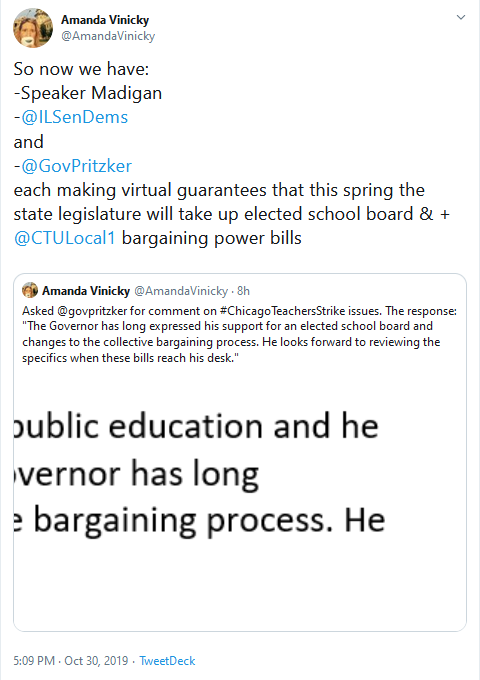
New support from Springfield
As the bargaining team finalized the deal, new information emerged from Springfield.
Looking ahead and building power
As you talk about the tentative agreement, it’s worth thinking about the conditions at your school. Whether or not this TA is ratified, we will eventually have a contract. It’s important that everyone build on the solidarity and momentum you’ve developed together on the picket line to enforce it. If the fight for good working and learning conditions were a war, the strike would be the “air war.” It can win a lot, but what ultimately determines day-to-day conditions is the “ground war”—the back-and-forth between administrators and staff in each school and workplace.
Read the TA (and the existing contract, for that matter) with an eye to the changes you want in your school. Try to come up with one change—big or small—that CTU members, together, want to see in your work environment. Then you can use our Campaign Planning Worksheet to brainstorm your campaign for when we return to work. When members at your school have agreed on a rough plan, check in with your organizer and/or field rep to talk through the details of putting it into action.
Union staff will continue to work hard in support of your rights. In your campaigns, they’ll help you refine your strategy and back you up. And they’ll always stand up for your rights in grievances and arbitration. If you organize well, you can make change without the long process of a grievance and help build your school’s solidarity and power. |


 Diane Ravitch's blog
A large minority voted against the TA in the CTU delegate assembly. The class size provision is cause enough to vote against this TA. It sounds bureaucratic, slow, after-the-fact instead of before-the-fact of overcrowding. There is $35mil to reduce oversize classes, increased from $6mil. But there’s a “trigger” which will certainly frustrate teachers carrying oversize loads. The class size “cap” is not numerically specified in the summary(I could not access the TA itself). Class sizes of 15 are best, above 20 already put each class in a toxic condition for teaching and learning. According to the summary above, when a class goes above the “cap,” the overload first has to reach an even higher “trigger” before relief can be requested. That relief is a complicated appeal process requiring admin. confirmation and action. This is sadly bureaucratic and complex enough to guarantee an ordeal for teachers trying to get their loads below the “cap.” Such a bureaucratic process will be slow to remedy overloads and if they do, will then require the sudden transfer out of a class of some students who have already settled into that teacher and room. Such a poor remedy builds more disruption into the school day and culture. Obviously, the simplest, most effective and non-bureaucratic solution is to set a rigid low cap on all classes and assign to every class prior to day one no more students than the cap allows. Class size counts greatly in the quality of teaching and learning, we know that, so this is too important an issue to throw under the bus or to paper over with byzantine non-solutions.
LikeLike
Process aside, the idea that a commitment of $35 million — conditional on the availability of that funding — will reduce class sizes in a system as large as CPS seems pretty ridiculous on its face.
(reposting because meant to place this as a response to your comment)
LikeLike
Process aside, the idea that a commitment of $35 million — conditional on the availability of that funding — will reduce class sizes in a system as large as CPS seems pretty ridiculous on its face.
LikeLike
I just read a copy of the TA from an earlier post here. Class sizes stay the same at 28-32 depending on grade level. When the complex appeal process does identify an “oversize” class, the contract language indicates a second instructor will be placed in the room in the lower grades while a new section can be opened in the high schools. This too is byzantine b/c suddenly bringing in a co-teacher without the two teachers collaborating in advance is not smart. Seems to me, though, that the contract language is in effect throwing class size under the bus via byzantine work-around. The abandonment of class reduction also happened in the earlier Oakland teachers’ strike. Teacher power still is not compelling the most important changes to transform mass education.
LikeLike
“When a class was over the limit, the teacher would have to file for relief, a weak joint committee came and investigated. If there was money, and if there was will, the class might get a remedy.”
Would someone with more brains than I have and far less naivete please tell me why a law would be made like that. It seems like a law ought to read that the number of students in a single class would have to be under a logically set ceiling. period.
LikeLike