Archives for the month of: June, 2019

Mercedes Schneider wrote a post about the abysmal failure of Measure EE in Los Angeles, which needed a 2/3 vote to pass but did not receive a majority. The turnout was shockingly low. Probably the measure should have been added to a general election. Special one-issue elections always have low turnout. That could cut either way but in this case it cut against the needs of children to have a quality education.

She zeroes in on the issue of teacher salary. The average pay for teachers in Los Angeles is $74,000. She notes that Rick Hess of the rightwing think tank American Enterprise Institute sees that number as “reasonable,” and that sets Mercedes off.

In his June 06, 2019, Forbes piece about the failure of Measure EE, American Enterprise Institute (AEI) career think-tanker Frederick Hess does not address the issue of low voter turnout. Instead, he focuses mostly on the teacher salary component.

Hess implies that the average LAUSD teacher salary of $74,000 a year “strikes a lot of Americans as pretty reasonable.”

Let us take a moment to contextualize AEI and Hess.

The mission of AEI as listed on its tax forms is as follows:

The American Enterprise Institute is a community of scholars and supporters committed to expanding liberty, increasing individual opportunity, and strengthening free enterprise. AEI pursues these ideals through independent thinking and the highest standards of research and exposition.

It should be noted that in 2018, Hess drew a comfortable $235K (up from $197K in 2013) as an AEI “resident scholar,” which has our armchair educator hovering nowhere near that “pretty reasonable” $74K he mentions. Furthermore, AEI president Arthur Brooks garnered an amazing salary boost from 2017 to 2018, doubled from $1.1M to $2.2M, and executive VP David Gerson also doubling his salary, from $526K to $1.1M.

At the end of 2018, AEI listed total net assets of $321M.

Hess pens his think-tankery about education from a plush perch.

Is $74,000 a “reasonable” salary for a professional in Los Angeles (or for those professionals who make less)?

Mercedes says she makes $60,000 after many years of teaching in Louisiana. Is that reasonable? It would be unreasonable in Los Angeles or D.C. or New York City.

Well, read it. It’s Mercedes doing what she does best: using her razor-sharp intellect to dissect condescension.


Civil rights icon Jitu Brown and Rochester activist Rosemary Rivera write that state takeover of the Rochester public schools is a bad idea. 

They write:


We know that Rochester residents want the same thing: excellent public schools where it is a joy to teach and learn. The fact that this vision hasn’t been realized on a district-wide basis is painful, and there’s a growing sentiment that something has to be done, anything, to turn the tide. However, dissolving a democratically elected school board takes Rochester further from its goal and disempowers the very community it should be lifting up….

To pin the problems in the RCSD on the school board is misguided. There is no quick fix for school performance when large numbers of children are struggling with poverty, hunger, and housing insecurity….

We have failed to fully contend with the role of structural racism in education outcomes. Students of color face disproportionately high rates of suspension and excessive discipline. When students are suspended for weeks at a time, they fall behind and their academic performance suffers.

Schools like Enrico Fermi School 17 have emphasized restorative practices to repair school relationships and keep students engaged in the classroom… The strides made by School 17 should serve as a model for the rest of the Rochester City School District.

Enrico Fermi is a community school that provides wraparound services, including an on-site recreation center with after-school programs and meals for children. The board is strongly in favor of expanding the community school model and restorative practices, but these programs require investment. Addressing the problems faced by students and families in poverty takes a “whole student” approach.

Moments of crisis can lead us to take rash actions. The Chamber of Commerce and pro-business groups will use this crisis as an opportunity to push privatization and charter expansion – an approach we’ve already seen fail in New Orleans, Newark, and Detroit. These are the same groups that have worsened the crisis through the shameless promotion of austerity budgets and anti-worker policies that keep people trapped in poverty.

A recent study by the Education Justice Network shows that countries that invest in public education with a focus on equity outperform countries that have privatized their education systems. Canada outperforms the United States, Cuba outperforms Chile, and Finland outperforms Sweden. What children in New York and other urban communities across the United States need is equity.

Progress in our schools has been slow and uneven, but we know what works. Our focus should be on expanding the successful programs we see at Enrico Fermi School 17, Francis Parker School 23, World of Inquiry School 58, and many other outstanding schools in the district. Taking away the voice of voters and community members isn’t the answer.


Peter Smagorinsky is a Professor of English Education at the University of Georgia. He often contributes to Maureen Downey’s blog at the Atlanta Journal-Constitution. In this post, he lets his students explain why they were inspired by Stephanie Johns, who teaches at Classic City High School in Athens, Georgia.

As you read about this model teacher, Stephanie Johns, you may realize that experience matters. She has distilled her dedication, love, and concern for her students into a daily practice, which enables her to reach them and teach them.


Larry Lee reminds one and all that what matters most in education is not what happens in the State House or the think tanks or the conferences, but what happens when teachers meet students.

He writes:

All the battles we wage in the legislature, all the money spent to lobby, all the grand schemes we import from distant think tanks, all the paperwork we choke principals with, all the talk about “data driven”, all the hand wringing because we are not ranked number one in such and such.

Then I visit a school and the world I have just described is a million miles away.  A room of fourth graders could care less about what may happen in the statehouse.  Neither does their teacher.  Once again I am forcefully reminded that there are no classrooms at the state house, in the state capitol, in the think tanks or in the Gordon Persons building that houses the Alabama Department of Education.

I am reminded that education is all about what takes place when a teacher and her students interact.  It is just that plain and simple.

Unfortunately we have hordes and hordes of folks who seem to have forgotten this.  Or did they ever know it?


In a nail-biter, the Texas State Board of Education turned down a request to authorize a Gulen-affiliated charter school by a vote of 8-5.

The applicant was Soner Tarim, who is leader of the Harmony Charter chain and applicant for a charter school called Woodlands Hills Charter School in rural Washington County in Alabama.

Gulen charter schools always deny that they are Gulen charter schools but they are typically led by Turkish men and have a board dominated by Turkish men and a large number of Turkish teachers who have visas.

Soner Tarim was hoping to start a new charter chain called Royal. After the state board turned down his request, he promised to appeal the rejection.

The Gulen charter chain is the second largest in the nation, after KIPP.

It is odd, don’t you think, to outsource community public schools to a foreign entity?

To learn more about the Gulen schools, see Mark Hall’s documentary “Killing Ed.”

To See a list of Gulen schools, see Oakland parent activist Sharon Higgins’ website.


In Flint, Michigan, all charges were dropped against the state officials who made the disastrous decision to change thesource of the city’s water supply, to save money. 

The Michigan solicitor general, Fadwa Hammoud, who took control of the investigation in January after the election of a new attorney general, said “all available evidence was not pursued” by the previous team of prosecutors.

“This week, we completed the transfer into our possession millions of documents and hundreds of new electronic devices, significantly expanding the scope of our investigation,” Hammoud and the Wayne county prosecutor Kym Worthy said in a statement.

Our team’s efforts have produced the most comprehensive body of evidence to date related to the Flint water crisis. We are now in the best possible position to find the answers the citizens of Flint deserve and hold all responsible parties accountable,” they said.

They said it’s possible that Lyon and others could be charged again.

Flint was one of the worst manmade environmental disasters in US history. While waiting for a new pipeline to bring water from lake Huron, the majority-black city of 100,000 pulled water from the Flint River without treating it to reduce corrosive effects on old pipes. Lead infected the distribution system in Flint, where 41% of residents are classified by the government as living in poverty.

Opposition research—negative information about one’s political opponent—costs thousands of dollars. It is valuable. President Trump told George Stephanopoulos that he would be willing to listen if a foreign government offered dirt about a political opponent. The law says that such offers should be reported to the FBI at once. Trump seems to be unfamiliar with the law and the Constitution (e.g., freedom of the press, the emoluments clause, etc.). Guess they didn’t teach civics at the Hill School or Wharton.


Statement from Ellen L. Weintraub, chairwoman of the Federal Election Commission:

“Let me make something 100% clear to the American public and anyone running for public office: It is illegal for any person to solicit, accept, or receive anything of value from a foreign national in connection with a U.S. election. This is not a novel concept. Electoral intervention from foreign governments has been considered unacceptable since the beginnings of our nation. Our Founding Fathers sounded the alarm about ‘foreign Interference, Intrigue, and Influence.’ They knew that when foreign governments seek to influence American politics, it is always to advance their own interests, not America’s. Anyone who solicits or accepts foreign assistance risks being on the wrong end of a federal investigation. Any political campaign that receives an offer of a prohibited donation from a foreign source should report that offer to the Federal Bureau of Investigation.”

She tweeted this and titled her tweet:

I would not have thought that I needed to say this.


FOR IMMEDIATE RELEASE 
June 11, 2019
Contact: Owen Kilmer, SPLC
Owen.Kilmer@splcenter.org // (334) 956-8209
John McDonald, UCLA
JMcDonald@gseis.ucla.edu // (310) 206-0513


Report: Black students, students with disabilities among

most likely to be struck in schools practicing corporal punishment


Civil rights groups offer new insight into practice banned in majority of states


MONTGOMERY, Ala. – Children attending the small percentage of the nation’s public schools that allow corporal punishment face a much greater likelihood of being struck than previously understood, with black students and students with disabilities among the most likely groups to be struck, according to a report released today by the Southern Poverty Law Center (SPLC) and the Center for Civil Rights Remedies at the University of California at Los Angeles’ Civil Rights Project.


The report – The Striking Outlier: The Persistent, Painful and Problematic Practice of Corporal Punishment in Schools – provides the clearest look yet at a practice outlawed in a majority of states and, even within states that legally permit the practice in schools, ban it in a host of other public settings for children and adults. The report includes a foreword by Derrick Johnson, president and chief executive of the NAACP.


The report found that at least one in every 20 children attending schools that practice corporal punishment were struck in 2013-14 and 2015-16. Black girls were more than three times as likely to be struck as white girls (5.2 percent vs.1.7 percent) during the 2013-14 school year. Black boys were nearly twice as likely as to be struck as white boys (14 percent vs. 7.5 percent).


Such racial disparities are trou­bling, because other research shows that black students do not misbehave more than white students. The report also found that in more than half of the schools practicing corporal punishment, students with disabilities were struck at higher rates than those without disabilities, raisingconcerns that they may have been struck for behaviors arising from their dis­ability.


“These findings show that corporal punishment disproportionately affects the nation’s most vulnerable students,” said Zoe Savitsky, SPLC deputy legal director. “It also destroys a child’s trust in educators, which damages learning relationships. Quite simply, corporal punishment doesn’t belong in schools, and states should bring schools in line with the many other institutions, from foster care to juvenile detention, that already ban the practice.”


The report recommends that states ban the practice in schools and that schools use evidenced-based discipline programs as alternatives to corporal punishment rather than punitive disciplinary measures, such as out-of-school suspension. 


“If an adult hit someone with a weapon, it’s considered aggravated assault. An educator using violence to discipline students, however, is considered corporal punishment, and we found it’s still happening over 100,000 times every year in public schools,” said report co-author Amir Whitaker, researcher with the Center for Civil Rights Remedies at UCLA. “Like other forms of discipline and state-supported violence, it’s disproportionately used on black students. The legacy of slavery and racial terror continues through its use, and decades of research finds the practice is extremely harmful to students.”


The report’s methodology differs from previous studies, which typically examine student populations at the state or school district level where corporal punishment was practiced – even when corporal punishment was only used in a small fraction of schools in those jurisdictions. That approach skews corporal punishment rates downward. This report only examined data from schools where corporal punishment was used, relying primarily on data from the U.S. Department of Education’s Civil Rights Data Collection from the 2013-14 school year.


Within the schools that practice corpo­ral punishment, the report found about 5.6 percent of stu­dents were struck during the 2013-14 school year. The rates in individual states, however, were as high as 9.3 percent (Mississippi), 7.5 percent (Arkansas) and 5.9 percent (Alabama).


What emerges is a picture of a practice that remains deeply entrenched in the South. Ten Southern states account for more than three-quar­ters of all corporal punishment in public schools. Just four of those states – Mis­sissippi, Alabama, Arkansas and Texas – account for more than 70 percent.


“There are far more effective and safer ways to manage a classroom,” said report co-author Dan Losen, director of the Center for Civil Rights Remedies at UCLA. “That is why most public schools in the United States ban the practice.


“This report demonstrates how in most states that still allow corporal punishment of children of color and those with disabilities are frequently struck. They bear the brunt of this outdated and ineffective practice compared to their white and nondisabled peers. Our documentation of the uneven and heavy-handed practice suggests that the use of corporal punishment is likely violating the civil rights of public school children throughout the South.”


Mis­sissippi alone is responsible for almost one-quarter of all corporal punishment. And nearly half (43.8 percent) of all black girls receiving corporal punishment in U.S. public schools in 2013-14 were in Mis­sissippi (4,716 black girls). No other state came close to eclipsing Mississippi’s corporal punishment rate of black girls.


Despite corporal punishment’s ubiquity in the South, a review of the law in five Southern states that allow the practice in schools (Alabama, Florida, Georgia, Louisiana and Mississippi) found that these states not only prohibit adults from striking children in most other settings – such as child care centers, foster care settings and juvenile detention centers – but often describe corporal punishment as inappro­priate, abusive and unethical in such settings, the report found.


“This data should shock our conscience,” the NAACP’s Johnson writes in the report’s foreword. He adds: “[T]he impact of corporal punishment can be devastating on a student’s ability to learn and succeed. There are much more effective ways to promote positive behavior, ways that keep students safe and in the classroom.”


Thirty-one states have banned corporal punishment in schools, according to the report. In the remaining 19 states, there are nearly 8,000 schools within dis­tricts that practice it. Of those schools, how­ever, almost 45 percent do not use corporal punishment. This means that children attending different schools in the same district can have vastly different experiences when it comes to discipline. One school may use evidence-based practices that provide pos­itive, corrective consequences for students. But, at a nearby school, children engaging in the same mis­behavior may be struck despite research showing the practice to be ineffective and unsound for education.


###


The Southern Poverty Law Center, based in Alabama with offices in Florida, Georgia, Louisiana and Mississippi, is a nonprofit civil rights organization dedicated to fighting hate and bigotry, and to seeking justice for the most vulnerable members of society. For more information, visit www.splcenter.org.


Three teachers at Summit Public Schools (privately managed charter schools calling themselves ”public”) were terminated without cause. The three were trying to organize a union to improve working conditions and had been offered contracts for next year when they were suddenly informed that they were no longer wanted. No teachers other than these three were fired.

The Summit charter schools are funded by the Chan-Zuckerberg Initiative and are noted for their infusion of computer instruction into classrooms.

This is the teachers’ website.

This is their petition on Change.org.

In January, teachers at Summit Public Schools, a group of charter schools in the Bay Area, formed a union, Unite Summit, in order to promote teacher retention, improve student support services, and increase teacher voice in important decisions.

On June 7, the last day of the school year, three Summit teachers and union leaders were fired without cause. We believe this action is unlawful, unethical, and harmful to our students.

In each case, employees were not provided any rationale for their termination beyond “business reasons.” The removal of such outstanding teachers from our school communities not only impacts the quality of education provided to our students, it also shows that Summit is not respecting teachers’ democratic decision to form a union.

Unite Summit has worked to promote the retention of high-quality educators who are invested in our students’ success. Educators have the right to speak out about how to improve their schools without fearing retaliation. The California Educational Employment Relations Act, Section 3543.5.a, states that it is unlawful for an employer to “impose or threaten to impose reprisals on employees, to discriminate or threaten to discriminate against employees, or otherwise to interfere with, restrain, or coerce employees because of their exercise of rights guaranteed by this chapter.”

We are therefore calling on SPS leadership to respect Summit teachers’ legal rights to unionize, to own their responsibility to refrain from intimidation, harassment, threats or retaliation, and to immediately reinstate the three fired teachers — Aaron Calvert, Evelyn DeFelice, and Andrew Stevenson.


Citizens for Public Schools needs you now to stand up for public schools in Massachusetts.

mail

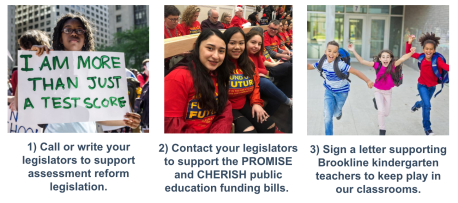
Three ways you can stand up and speak out for public education today!

Screen Shot 2019-06-14 at 6.53.46 AM

Take a few minutes today to raise your voice about these three important issues for our schools.

1) Less Testing, More Learning
Citizens for Public Schools members will testify at a public hearing before the Joint Education Committee Monday in favor of a moratorium on the high-stakes uses of standardized testing and other crucial reforms to improve assessment in the Commonwealth.
You can make a difference by asking your legislators to support five bills to reform and improve state assessment practices. Collectively, they would: stop the high stakes uses of standardized test results, establish a grant program to develop alternatives to high-stakes standardized testing, inform parents about their rights vis a vis state testing, allow local districts to determine graduation requirements, and make other improvements.
Read more about CPS’s priority education legislation here.
ACT TODAY! #StandUpForPublicEducation and ask your legislators to testify in support of these bills at Monday’s Joint Education Committee hearing, 10am, Room A-1. And then, spread the word. Thank you. (Email us if you would like to testify or submit written testimony to the committee.)
2) Fund Our Future
Thanks to all of you, our message about the urgent need to update the state school funding formula is getting through and resonating! A recent poll found 60% of voters believe our schools are not adequately funded, and nearly 60% are willing to pay more in taxes to fix funding disparities.
And today, parents are filing a lawsuit naming four state education officials for “violating the civil rights of low-income, black, and Latino students by failing to provide them with the same quality of education as their mostly white affluent peers.” (CPS is a member of the Council for Fair School Finance, backing the lawsuit.)
Now’s the time to keep up the pressure on legislators to pass urgently needed education funding legislation!
Contact your state senator and representative to support the PROMISE and CHERISH public education funding bills. Click below to find out if your legislators support the bills, then call to thank them or urge them to take a stand. Urge them to contact the appropriate committee chairs and express their support of these two crucial bills!
3) Keep Play in our Kindergarten Classrooms
A courageous group of Brookline kindergarten teachers are speaking out about program and curriculum practices, implemented without meaningful educator input, causing “everlasting negative impact” on their young students’ social-emotional well-being. In their letter, they say kids need play-based learning, not only stressful academic blocks that aren’t developmentally appropriate, create anxiety and hamper the joy of learning. Watch a video of their public comment here. Click the button below to sign a letter from a group of Brookline parents supporting the kindergarten teachers, and don’t forget to mention that you’re a CPS member in the comments! (You don’t have to be from Brookline to sign.)