Archives for the month of: October, 2018

This is Jan Resseger’s third report on her experience at the Network for Public Education annual conference in Indianapolis last weekend. In this post, she reports on what she learned by attending a panel about the NPE-Schott Foundation study of state support for public schools vs. privatization of public schools.

One of the most fascinating workshops at the conference explored the complexity of researching the groundbreaking, June 2018 report, Grading the States: A Report Card on Our Nation’s Commitment to Public Schools, and the importance of the report, the first comprehensive effort to track and compare the growth of privatization and the characteristics of state vouchers and charters. The report, a collaboration of the Network for Public Education and the Schott Foundation for Public Education, defines its purpose: “States are rated on the extent to which they have instituted policies and practices that lead toward fewer democratic opportunities and more privatization, as well as the guardrails they have (or have not) put into place to protect the rights of students, communities and taxpayers. This is not an assessment of the overall quality of the public education system in the state—rather it is an analysis of the laws that support privatized alternatives to public schools.” (emphasis in the original)

The primary assumption of a report about the privatization of education but whose title incorporates these words, “a report card on our nation’s commitment to public schools,” is that the growth of several privatized education sectors at public expense—charter schools, vouchers, tuition tax credits and education savings accounts—reflects diminishing commitment to the inclusive mission of public education. Sure enough, the report confirms that assumption, most clearly in the diversion of tax funds away from public schools: “Vouchers and charters do not decrease education costs, but instead divert tax dollars ordinarily directed to public schools thus limiting the capacity of public schools to educate the remaining students.”

Last weekend’s workshop featured three speakers: the Executive Director of the Network for Public Education (NPE), Dr. Carol Burris, who was one of the report’s researchers; Tanya Clay House, the report’s primary author and researcher—also an attorney and consultant who has previously served as a Deputy Assistant Secretary in the U.S. Department of Education, the Director of Public Policy for the Lawyers’ Committee for Civil Rights Under Law, and the Public Policy Director at People for the American Way; and Derek Black, an attorney and professor of school finance law at the University of South Carolina…

As a participant in last weekend’s workshop, I was fascinated, as Burris and Clay House described the difficulties they faced as they tried to collect the most basic data about what is now nearly 20 years of expanding school privatization. The two women told of one data set they had assumed the report would cover only to be forced to omit that issue from the report because the the records had not been kept by enough states to make it possible to draw any comprehensive or meaningful conclusion. What became clear to me as I listened is that the promoters of school privatization trusted their own ideological belief that the marketplace would provide its own accountability. They assumed that as parents voted with their feet, parents themselves would identify high quality schools and seek them out; then schools of poor quality would not be marketable. Of course we know from research in Chicago and New Orleans and elsewhere that parents choose schools for all sorts of reasons that have nothing to do with school quality—a site near home or work, the presence of a childcare or after-school program, the reputation of the football team, the advertising on the side of the bus, the incentive of the gift of a computer upon enrollment. Several years ago, Margaret Raymond, a fellow at the pro-market Hoover Institution and director of the Stanford Center for Research on Education Outcomes (CREDO), shocked listeners at the Cleveland City Club by announcing that it has become pretty clear that markets don’t work in what she calls the education sector: “This is one of the big insights for me because I actually am a kind of pro-market kind of girl, but the marketplace doesn’t seem to work in a choice environment for education… I’ve studied competitive markets for much of my career… Education is the only industry/sector where the market mechanism just doesn’t work… I think it’s not helpful to expect parents to be the agents of quality assurance throughout the state.”

The third presenter in the NPE workshop was Derek Black, a civil rights attorney and school finance professor who explored what he believes is the overall significance of the Grading the States report. I was unable to capture verbatim Derek Black’s comments at the workshop, but in a blog post when the Grading the States report was published in June, Black made the same points in eloquent detail: “The report is, in many respects, the one I have been waiting for. It fills in key facts that have been missing from the public debate and will help move it in a more positive direction. In my forthcoming article, Preferencing Educational Choice: The Constitutional Limits, I also attempt to reframe the analysis of charter schools and vouchers, arguing that there are a handful of categorical ways in which states have actually created statutory preferences for charters and vouchers in relation to traditional public schools. I explain why a statutory preference for these choice programs contradicts states’ constitutional obligations in regard to education… My research, however, analyzes the issues from a relatively high level of abstraction, highlighting problematic examples in particular states and districts and synthesizing constitutional principles from various states. This new report drills down into the facts in a way I have never seen before. It systematically examines charter and voucher laws in each state with a standardized methodology aimed at identifying the extent to which each state’s laws represent a de-commitment to public education.”

Black continues: “Each year, the National Alliance for Public Charter Schools (NAPCS) releases a report detailing charter school laws, with the frame of reference being the extent to which states have laws that promote the expansion of charters. The report normatively assumes that charter schools are good and state laws that overly restrict them are bad… Because there hasn’t been any systemic response to NAPCS’s reports, it has been able to skew the conversation. This new report brings balance.”

When the Grading the States report was released in June, this blog summarized its conclusions. Needless to say, I came home from last weekend’s conference in Indianapolis and explored the report in more depth. Here is what jumps out at me as an Ohio citizen this fall, after I’ve been watching the fallout across Ohio all year since the state’s final closure of the giant online charter school, the Electronic Classroom of Tomorrow, after it ripped off Ohio taxpayers and students for 17 years. The report examines charter schools. Forty-four states and the District of Columbia have passed laws to permit charter schools. Of those 38, including my state, earned F grades. The report explains they are “states that embrace for-profit charter management, weak accountability and other factors that make their charter schools less accountable to the public.” “Twenty-eight of these states and the District of Columbia fail to require the same teacher certification as traditional public schools… Thirty-eight of the states and the District of Columbia have no required transparency provisions regulating the spending and funding by the charter school’s educational service providers… Of the 44 states and the District of Columbia with charter school laws, students with disabilities are particularly disadvantaged in 39 states and the District of Columbia, which do not clearly establish the provision of services. Twenty-two states do not require that the charter school return its taxpayer purchased assets and/or property back to the public if the charter school shuts down or fails.” The details on the various voucher programs are equally alarming.
Peter Greene begins with a tweet by Jose Luis Vilson and then proceeds to address the question that is the title of this post.

High expectations are free. So are hopes and dreams. But are they enough?

He writes:

It was a tweet by Jose Luis Vilson that drew my attention to the quote:

“It doesn’t cost one penny more to have higher expectations for kids, to actually believe that kids–low-income kids, kids of color, English-language learners–can succeed,” he says.

The speaker is TNTP CEO Dan Weisberg, speaking about TNTP’s latest “report.” I’ve addressed that report elsewhere, but this particular idea is worth a closer look because it has been so persistent. Arne Duncan was a big believer in the magic of expectations, and Reformsters have often touted its powers– perhaps precisely because it is a “reform” they can have for free.

But are expectations free?

I suppose expectations themselves are free, just as wishes and dreams are free. But creating the conditions and providing the tools that allow those expectations to be met– that’s not so free. And without support, some expectations are just cruel.

I mean, I can expect someone who is confined to a wheelchair to live a full and active life– but somebody needs to provide that person with the actual wheelchair as well as appropriate physical therapy. Stephen Hawking’s super-cool chair, computer interface, and voice synthesizer were not free.

And when we talk about education, there’s a problem with free if by “expectation” we mean that a teacher should expect a child who is hungry, who lives with poverty every day, who lacks support for education at home, who lives with fear and instability in her world– well, if we’re just supposed to “expect” that child to handle school as if she lived a comfortable, stable, well-fed existence, that’s just wrong.

It is also wrong to “expect” that students who go to school where there are not enough books, not enough desks, not enough supplies, but plenty of mold and decaying corners of the building– to expect those students to approach school as if it were well-supported, well-funded, shiny and clean. Too often this business about the soft bigotry of low expectations is another way to say, “No, we’re not going to fully fund this school, nor are we going to address the systemic racism and poverty that surrounds it– just get in there an expect harder.”

There is, of course, a solid core of truth to this talk about expectations. Every decent teacher understands that expectations are important in a classroom, that if you approach students with an attitude of “Well, these are just the dumb kids, so let’s not expect much, try much, or do much” you are failing those students.

But. But but but.

Read the rest. You know how good Peter Greene is when he begins to eviscerate foolishness. How many TFA teachers have been told that high expectations are enough, then run into the harsh reality that students are hungry or need a winter coat or are worried about an ill parent?

Beware, he writes: Expectations are just a form of faith, and even the Bible tells us that faith without works is dead. Expectations matter, but expectations are only a foundation and no, you can’t build the house for free. “Teachers should just expect harder,” is just an excuse for politicians and policy wonks to avoid the issue of giving underserved, underfunded schools the resources they need, the kind of resources and funding that politicians and policy wonks would give them if those guys really, truly believed in the success of those students.

A corollary: Teachers should have high expectations, and teachers should have the resources and supports they need, and states should raise taxes to pay for the schools that students and teachers need. If they are not willing to pay for good education, they won’t have the schools and teachers that students deserve.

As Leonie Haimson explains in this post, the New York Times published a front-page article on the failure of Mayor Bill deBlasio’s $773 Million Renewal Schools Program. The Mayor touted it as the antidote to former Mayor Bloomberg’s preference for closing schools. Ironically, many of the Klein-Bloomberg people were left in place to run the new program.

But, says Haimson, that’s not why Renewal Schools failed. The program failed because its leaders resolutely ignored the one reform that has proven to get the best results: reducing class size.

The few Renewal Schools that did reduce class size actually succeeded.

Those that didn’t struggled and failed.

Leonie Haimson writes about it here.

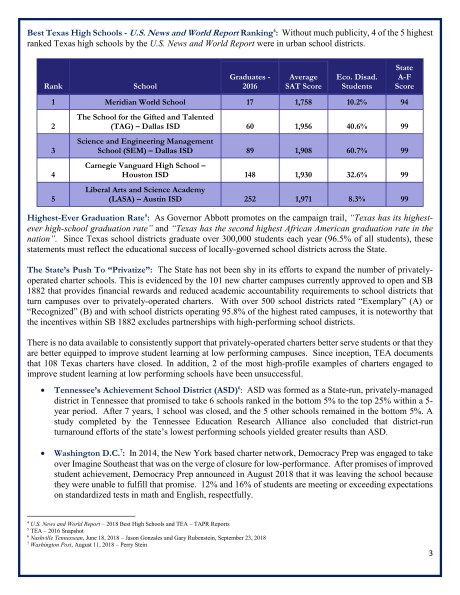
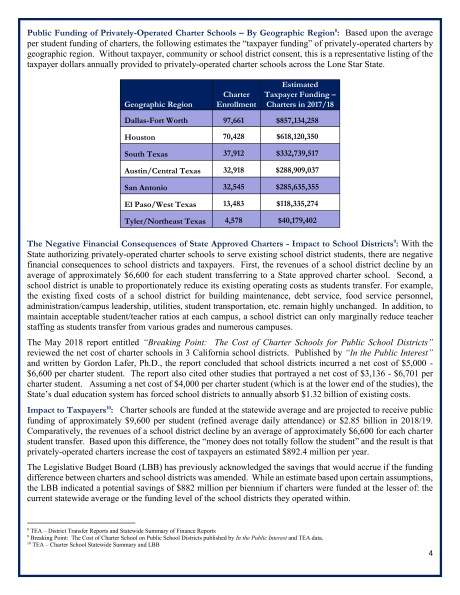
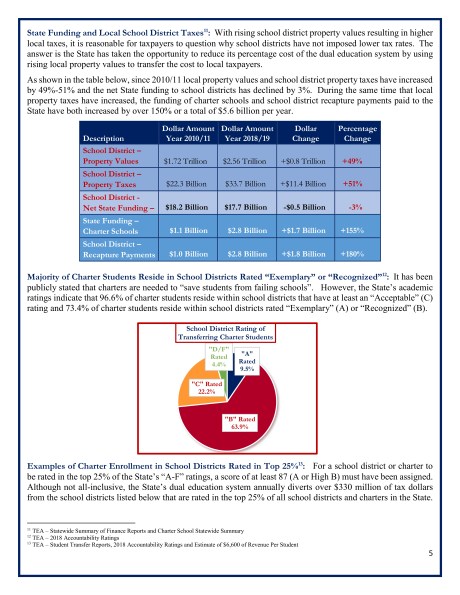
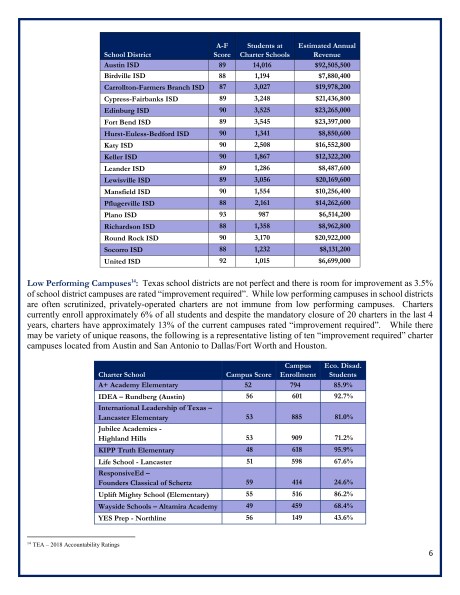
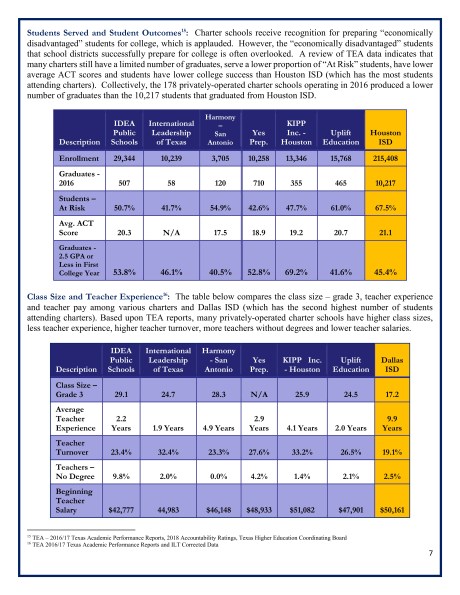
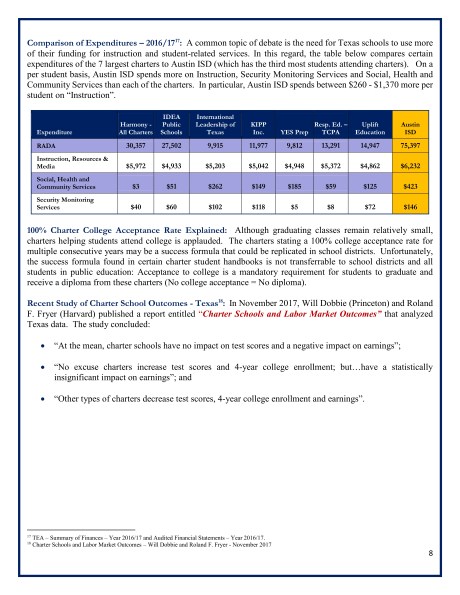
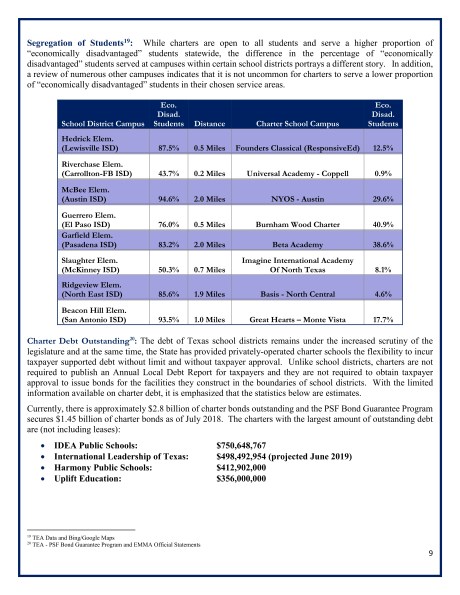
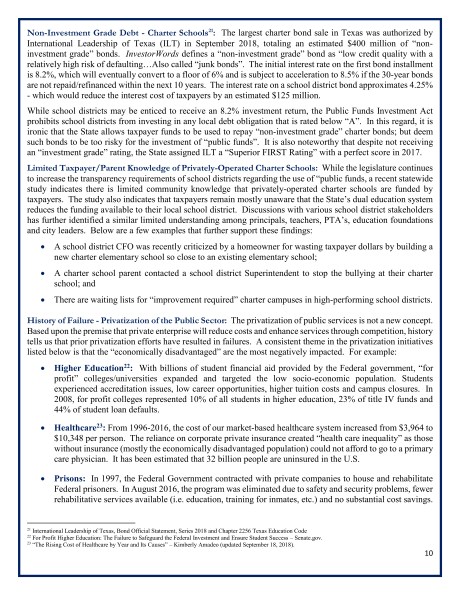
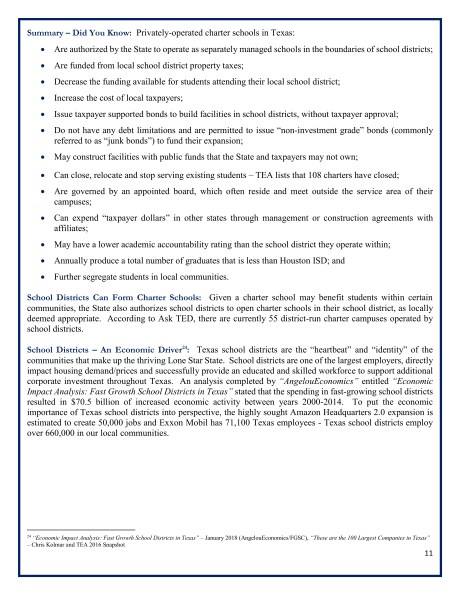
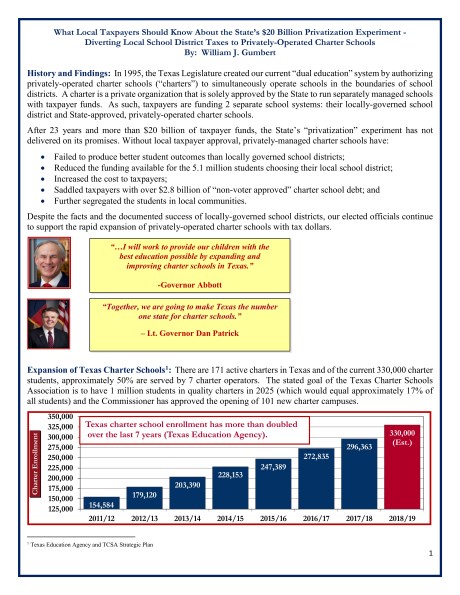
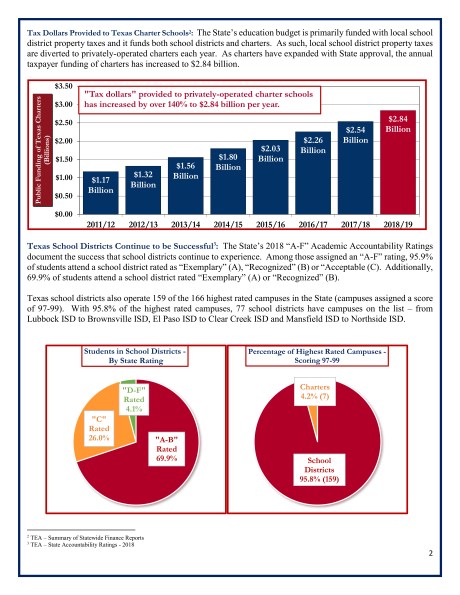
This is an important collection of data about the funding of public schools and charter schools in Texas. Do you think that taxpayers know that they are funding two separate school systems, one governed by elected, accountable school boards and the other governed by private, self-selected, unaccountable school boards? Do you think that the public knows that district public schools outperform charter schools?

What Local Taxpayers Should Know About the State's $20 Billion Privatization Experiment (October 2018)tax2tax3tax4tax5tax6tax7tax8tax9tax10tax11tax12

Earlier today, I posted about FUD, but I didn’t link to the article I wrote in Huffington Post in 2014.

The article was called “Understanding the Propaganda Campaign Against Public Education.”

Here it is.

Here is the Wikipedia history of FUD.

If you understand the purposeful uses of FUD, you can see the propaganda techniques employed by “reformers” to undermine public education.

The FUD campaign says “our public schools are failing,” “our public schools are obsolete,” “our public schools haven’t changed in a century,” but it is all disinformation.

It is FUD.

Our public schools are NOT failing. Our public schools are NOT obsolete. Our public schools have changed in many ways in the past century

The FUD purveyors will not tell you that charter schools do not get better test scores than public schools and usually get worse scores. They won’t tell you that more than 90% of charter schools are non-union, and that union-busting is part of their funders’ purpose (e.g., the Waltons). They won’t tell you that charter schools are more segregated than public schools, even in segregated districts. They won’t tell you that teacher turnover at charter schools is far higher than in public schools. They won’t tell you that suspension rates at charter schools are far higher than in public schools.

The FUD propaganda machine won’t admit that the research on vouchers shows that voucher schools harm children and lower their academic performance. They won’t tell you that children who enter voucher schools abandon their federally protected rights (e.g., students with disabilities have no IDEA rights in voucher schools). They won’t tell you that voucher schools are not required to have certified teachers. They won’t tell you that voucher schools are excused from state tests in most states and are not held accountable. They won’t tell you that many voucher schools teach racism, misogyny, and discriminate against those who do not share their religious views.

The best schools are public schools!

The way to build strong communities is to build strong public schools!

If you live in Santa Clara County, California, I urge you to re-elect Claudia Rossi to the County Board of Education.

Her opponent has tweeted his support for Sheriff Joe Arpaio and other Trump policies. He recently received $7,000 from a “Reform” campaign funding group.

Claudia Rossi is a strong advocate for public schools.

Last May, Rossi asked questions about the operations of a charter school that was up for renewal. As a county trustee, it is her job to ask questions. The CEO of the charter school threatened her with a defamation lawsuit, and the ACLU stepped in to defend Rossi’s right to ask questions.

California needs more trustees with Claudia Rossi’s integrity and courage. It does need another rubber-stamp for the charter lobby.

Please vote for Claudia Rossi.

Dana Milbank spots a NATIONAL EMERGENCY!

I hope this is not behind a paywall. Then you could see the picture of the Honduran baby in diapers, brushing his teeth, and the video of the “caravan.” In a few weeks, that baby will be separated from his parents and put into a cage.

Milbank begins:

This is an emergency!

A caravan of unarmed, destitute people, many of them women and children, is snaking its way through Mexico toward the United States at the breakneck pace of about three miles per hour. Still 1,000 miles from America, the ill-nourished pedestrians travel as a pack for protection against gangs; the few who make it to the border, perhaps next month, will likely apply, legally, for asylum.

But the leader of the most powerful nation on Earth is in a panic.

“Mexico’s Police and Military are unable to stop the Caravan,” President Trump tweets. Without evidence, he adds: “Criminals and unknown Middle Easterners are mixed in. I have alerted Border Patrol and Military that this is a National Emergy.”

Yes, a national emergy! So urgent Trump doesn’t have time to add three letters to make it “emergency”! This is bad. Unpresidented, even. Covfefe!

Trump, again without evidence (or, in this case, logic), says Democrats arranged the caravan (from their little-known party headquarters in Honduras, presumably) but have now decided their brainchild was a “big mistake.” Trump accuses the bedraggled migrants of “an assault on our country” and says the group contains “some very bad people.”

The genius in Trump’s pre-election emergency: The asylum seekers, if they reach the border at all, won’t arrive until after the election. Therefore, he can frighten everybody about the menace they pose, and voters will be none the wiser.

The flaw in Trump’s pre-election emergency: Others can play this game. Using the same evidentiary standard Trump has used — none — I have identified various factual explanations for why the caravan spooks the president enough to declare a national emergency. The migrants in the caravan:

●Have his tax returns and are planning to release them.

●Are members of Nikki Haley’s presidential exploratory committee.

●Have the Russian kompromat on Trump.

●Are Russian colluders coming to turn themselves in to Robert Mueller.

●Are climate-change scientists.

●Have the n-word tape Omarosa claims to have heard.

●Are Simon & Schuster employees carrying a reprinting of Bob Woodward’s “Fear.”

●Are deported mothers coming to reclaim the detained children Trump lost.

●Are accountants coming to put Trump’s businesses into a blind trust.

●Are Saudi bankers coming to demand Trump repay their loans.

●Are vendors and business partners stiffed by Trump.

●Are Trump University alumni demanding their money back.

●Are hedge-fund managers coming to thank Trump for protecting their carried-interest loophole.

●Are threatening to release Brett Kavanaugh’s Sports Illustrated swimsuit calendars.

●Are all clients of Michael Avenatti.

As Trump likes to say: We’ll see what happens!

Alternatively, and again using Trump’s standard of proof (“I think the Democrats had something to do with it”), it would be 100-percent accurate to say Trump is the one who thought up and financed the caravan, for the purpose of fabricating a wedge issue two weeks before the midterms. It would be similarly accurate to conclude that the caravan, when it arrives, will be loaded, like the old Wells Fargo wagon, with good things for Trump.

Maybe the caravan will finally deliver on all those unmet promises that have so far eluded Trump and substantiate his unsupported claims:

●Tax cuts for the middle class.

● “Beautiful” and cheap health insurance for everybody.

●The benefits of Trump’s trade war.

●Lower prices for prescription drugs.

●A $1 trillion infrastructure package.

●The FBI “spy” who infiltrated Trump’s campaign

●The payments from George Soros for protesters.

●All the money and jobs promised from Saudi weapons deals.

●His missing contributions pledged to charities.

●The guy who impersonated Trump’s voice on the “Access Hollywood” tape.

●President Barack Obama’s instructions to tap Trump’s phones.

●All those coal mining jobs that are coming back.

Maybe the migrants are those 3,000 Puerto Ricans whose hurricane deaths the Democrats faked. Or they are coming to build a border wall. Or they are Mexican bankers coming to pay for it. Or they are carrying Trump’s promised ethics rules on their backs. Maybe they will bring proof, finally, that Antonin Scalia was murdered and Obama was born in Kenya.

The only limit is Trump’s imagination — which is prodigious.

“We’re going to be putting in a 10 percent tax cut for middle-income families,” Trump claimed Monday, as he has repeatedly the last few days. “It’s going to be put in next week.”

Huh? A tax cut? Next week? Even Trump allies were baffled. Congress isn’t in session until after the election. How is he going to make good on this bluff?

It’s a national emergy! Quick, load a tax cut onto the caravan!

The issues are clear in the contest between Republican Congressman Steve Russell and his Democratic challenger Kendra Horn in the Fifth District of Oklahoma: He is a Trump supporter; she will protect health care, education and Social Security. Mitch McConnell already made clear that last December’s tax cuts for the rich and corporations blew a huge hole in the deficit and the Republican party plans to make significant cuts in Medicare, Medicaid, and Social Security. Democrats must gain control of the House to block cuts to our nation’s social safety net.

If you care about American public education, vote for Kendra Horn.

If you want to protect our citizens from policies that make the rich richer and everyone else suffer, please vote for Kendra Horn.

The future of our democracy is on the ballot. Please vote.

The Network for Public Exucation Action Fund is delighted to endorse Bob Peterson for the Milwaukee School Board. Seldom has there ever been a better qualified candidate. Maybe never.

NPE Action enthusiastically endorses Bob Peterson for the at-large seat on the Board of School Directors of the Milwaukee Public Schools (MPS).

Bob started as a Paraprofessional in MPS and later became a bilingual educator, teaching in the classroom for 30 years. Bob was active in his union for 35 years, including service on the executive board of the Milwaukee Teachers’ Education Association (MTEA). He was MTEA president for four years immediately following Gov. Walker’s ACT 10 legislation.

Bob is also a founding editor of the Rethinking Schools magazine.

Bob’s campaign message is clear. “We must come together to defend and transform Milwaukee Public Schools.”

He told NPE Action that “MPS has been ground zero for school privatization starting in 1990. The privatizers continue to increase private voucher schools and privately-run charter schools. We need to simultaneously fight privatization attempts AND improve our public schools.”

He plans to fight privatization and improve Milwaukee’s public schools by building “a social movement to secure adequate and equitable funding so that we can lower class sizes, have strong professional development on issues of restorative practices, anti-racist culturally relevant curriculum, social-emotional learning, and the replacement of mass standardized testing with forms of authentic assessment.”

Please head to the polls on November 6th and cast your vote for Bob Peterson.

I have waited a few days to digest the exciting events of last weekend.

My first thought is: I wish you had been there.

You would have seen teachers, parents, school board members, superintendents, researchers, college students, and lots of others who want to save their schools from privatization and save their students from endless over-testing. They came not to defend the status quo, but to fight the status quo.

At every NPE conference–in Austin, Chicago, Raleigh, Oakland, and Indianapolis–the spirit and goodwill were infectious. The same was true in Indianapolis.

Many people saw friends that they met at last year’s conference, or met their favorite blogger or researcher.

Every year, I hear the same statement: “This was the best conference yet.” And I believe it.

This was the first year that NPE awarded the Phyllis Bush Award for Grassroots Activism. The winners were the teacher-activists in Arizona who won the right to put a referendum on the ballot about vouchers. This was a high point of the first day. The award will be given out every year for teachers, parents, and other activists who display courage, tenacity, and heroism on behalf of public education and the common good.

I won’t report on all the keynotes but want to be sure that you watch Pasi Sahlberg.

Pasi Sahlberg was amazing. He talked about the “Global Education Reform Movement” (GERM) and accompanied his talk with slides and even a video (all of which were posted by him on Twitter @pasi_sahlberg. Pasi wrote the wonderful book Finnish Lessons and Finnish Lessons 2.0. His new book, with William Doyle, is Let the Children Play. Pasi talked about the birth of GERM as a reflection of the exuberant belief in the 1980s that markets and standardization solved all problems. Pasi showed the spread of GERM, especially in English-speaking countries. He is now based in Australia, and he told us that the government of New Zealand has dropped national standards and will soon eliminate national testing. He predicted that Australia would drop its NAPLAN tests and standards in the not-distant future. You can watch him on this video; his presentation begins at 27:00.

I attended several panels. One was exhilarating, another was very sad.

The exhilarating one was a presentation by teachers from Arizona who are active in #RedForEd and in the effort to stop a legislative plan for universal vouchers. The teachers pointed out that 95% of the children in Arizona attend public schools, which are underfunded. They described their fight against the Koch brothers, whom they beat in court when the brothers tried to get their referendum knocked off the ballot. The vote on the referendum takes place November 6. VOTE NO on PROP 305! Congratulations to these wonderful teachers, who have done all this work on their own dime and stood up to the most powerful rightwing machine in the nation!

The other panel was a presentation by four Puerto Rican activists, who described the effort to close and privatize the Island’s public schools. The Governor is working with the hedge fund managers who are salivating over the chance to close down public education. Nothing seems to stand in their way, although it was clear that the Island’s teachers are adamantly opposed to the takeover. A woman named Julie Keleher was imported to do the dirty work for Wall Street.

I also sat in on a panel led by Mercedes Schneider, Darcie Cimarusti, and Andrea Gabor, in which they explained in detail how to “follow the money.” They gave specific directions about sources that tell you who is funding what, how to unearth “Dark Money.” The session was packed, and attendees took notes. Darcie is our communications director and half-time staff at NPE, she is a school board member in her community, and she is an expert on following the money.

The closing speaker was the national chairman of the NAACP, Derrick Johnson. I will post his remarks as soon as the video is available. He was eloquent and spoke without a note. He talked about the systemic racism that has harmed African American children and teachers for many generations; about promises made and broken; and about the importance of making the child the center of all education. He was brilliant in recounting the history of legal efforts to establish rights for black children and about efforts to sabotage those rights. He gave us all a lesson in legal history. He stayed to answer every question. The leaders of the NAACP in Indiana and Indianapolis expressed their great concern about the Mind Trust and its plans to privatize the public schools of Indianapolis. The session–and conference–ended with yet another standing ovation.

It was a wonderful conference, well organized, well attended, filled with energy. As soon as videos are prepared for the sessions that were live-streamed, I will post them here.

I can’t begin to tell you how proud I am to be a part of this inspiring organization, how happy I am that Carol Burris is the executive director, how grateful I am to the other members of the board, and to the many volunteers that made it work. NPE can’t match the dollars of the billionaires, but we far exceed them in numbers, passion, dedication, and conviction. NPE expects to support grassroots organizations in every state for many years to come. We expect to work with them in making our schools better and more responsive to the needs of our children.

The next conference will be better still!