Archives for the month of: April, 2015

Tom Wolf, the newly elected Governor of Pennsylvania, may turn out to be true friend of public education. In a landscape crowded with foes of public education, like Scott Walker, John Kasich, Doug Ducey, Rick Scott, and Andrew Cuoo, this is quite a distinction for Governor Wolf.

After years of devastating cuts by Governor Tom Corbett, Wolf has vowed to fund public schools. He appointed a one-time rival, John Hanger, as secretary of policy and planning (Hanger is strongly pro-public schools).

Governor Wolf recently visited a public school in Philadelphia. At a time when so many governors have sworn their fealty to charter schools, it is refreshing to read about a governor who recognizes public responsibility for public schools.

John Hanger told the Lancaster Chamber of Commerce and Industry that the Wolf administration would focus on public education and economic development in its spending plan.

Governor Tom Wolf could build a national reputation if he reverses the school privatization and defusing of public schools that Corbett encouraged .

Steve Nelson wrote a powerful case for opting out from state testing.

“”Opt-out” may be the most important political movement of this generation. It may seem, at first glance, a small ripple in the education reform debate — an understandable reaction to the frustration over increased testing and test-prep in America’s schools. I suggest that it is much more important than meets the eye.

That “first glance” is important in its own right. There is no reasonable argument in support of the tedious, stressful mess that education reform has made of the nation’s schools. Even within its own circular, self-fulfilling paradigm, the testing and accountability era has been a dismal failure. Test scores are essentially meaningless as a measure of real learning, but even by this empty standard, no progress is evident. For this analysis, let us just stipulate that it has not even achieved the limited objectives on which policy is predicated.

The broader issue is hidden within plain sight: This growing struggle over the future of American education may be proxy for the future of our democratic republic.

Most folks who follow education policy debates are familiar with the players and high stakes. Dozens of AstroTurf organizations are funded by the same Daddies Warbucks: Bill and Melinda Gates, Eli Broad, the Walton Family Foundation. The incestuous network they’ve created, aided and abetted by the Brothers Koch and the publishing cartel, Pearson, ETS, McGraw Hill, are engaged in a hostile takeover of the entire education enterprise in America.

The Common Core and its primary architect, David Coleman, are parts of a well-oiled, cradle-to-grave machine. It has been going on for years, beginning when George W. Bush was Governor of Texas and helped the industry-led Phonics First movement begin the insidious commercialization of education. Many others, especially “Mercedes Schneider in her wonderful book, A Chronicle of Echoes: Who’s Who in the Implosion of American Public Education,” have exposed this process in alarming detail.

Fed up by the dreadful experiences their children are having in school, parents and teachers are beginning to resist. In New Jersey, Illinois and New York, for example, the opt-out movement is gaining strength. A national organization called United Opt Out is working tirelessly to unite the many strands of this genuine grassroots effort.

Many of these parents may not be aware of the broader importance of this nascent national movement. They are just standing up for the well-being of their children. It is this simple, yet powerful, impulse that is at the root of every critical political movement in our history. Institutionalized social injustice is, at its core, the aggregate impact of highly personal injury. And millions of American children are indeed being injured in the stark, punitive, increasingly barren wake of so-called education reform.

The stakes are high already, but this battle is going to dramatically escalate. Mark my word. Every incremental growth in the opt-out movement is going to draw increasingly severe response. This is not even about education any more. It is about money. There is no reliable estimate of the overall investment in testing, the Common Core, and the various sub-industries education reform has spawned. As frequently noted, pre-secondary education is at least a $500 billion market and the capital invested to date will not be squandered without a fight. Hundreds of millions if not billions of dollars are in the pot, and these folks don’t like losing…..

“If enough parents are willing to join the movement, keep their children home on test days, ignore the threats, the battle lines will be clear. School officials, local school boards, state legislators and members of Congress will be faced with a real school choice: Whose side are you on? America’s children and families or a shadow government of plutocrats, investment bankers and publishing companies?

“Opt-out! Even if your child likes tests, keep her home. Like every other powerful movement in American history, this one requires a snowstorm of small acts of defiance. Which side of history will you be on?”

A few days ago, I posted an article by Finnish educator Pasi Sahlberg, in which he explained that Finnish teachers are not “the best and the brightest,” but those who are bright, caring, and committed to a career in education.


One of our regular readers, who often is a contrarian, posted the following critical comment:


I would like to hear Sahlberg’s thoughts on the massive gender gap in Finnish reading scores. Finnish boys’ PISA scores are statistically indistinguishable from US boys’, and Finland’s boy-girl gap is by far the largest in the world, about twice as large as the US gap.


Perhaps there are some reasons to hold off on emulating Finland.


I contacted Pasi, who is a personal friend, and he replied:

 
Thanks for the question. Indeed, this is a big issue in Finland and has been
for awhile. And not only in reading but across the board of academic
subjects. One thing that makes gender gap in reading so big is
exceptionally high reading literacy performance (and positive reading
habits) among Finnish girls. Researchers are well aware of this and
policymakers try to find ways to engage boys more in reading and schooling
in general. Recent emphasis on theme or phenomenon based teaching and
learning is one step.


I asked him whether girls outperform boys in math as well, and he said yes, but not so much as in reading. Finland is the only OECD nation where the gender gap favors girls.


There is your answer, Tim.


Professor Celia Oyler has started her own blog, called “Outrage on the Page.”

She is a teacher educator at Teachers College, Columbia University. She has been a brave critic of “reform”

She has opened her blog to a anonymous guest blogger, who explains why so many are offended by Chancellor Merryl Tisch’s efforts to defend high-stakes testing.

The local chapter of the NAACP in Seattle voted to encourage parents to opt out of state testing.


On Tuesday, April 7, 2015 Gerald Hankerson, the President of the Seattle/King County NAACP and Rita Green, the Education Chair of the Seattle/King County NAACP, began our press conference with a powerful idea and a call for action that holds the potential to help produce a tremendous social transformation. Together their opening remarks at the press conference—a gathering of parents, teachers, and community leaders that I helped to organize in opposition to the Common Core “Smarter Balanced Assessment Consortium” (SBAC) tests—represent a clarion call to both education advocates and social justice activists across the country. Their simple, yet mighty, proposition is that the movement to oppose high-stakes standardized testing and the Black Lives Matter movement (and other struggles against oppression) should and can unite in a great uprising in service of transforming our schools into an environment designed to nurture our children, in body and intellect, rather than to rank, sort, and reproduce institutional racism.
Seattle NAACP President Hankerson (font left) and Education Chair Rita Green (front right) with supporters outside of the press conference.
Hankerson, kicking off the event, referenced the “long and ugly history” of using standardized tests in an effort to establish white supremacy. This is a history that the corporate “testocracy” is desperate to insure remains hidden from the public, as the uncovering of this history would bury their attempts to claim that standardizing testing is the key to closing  “achievement gap.”

Civil rights groups, led by Kati Hatcock of Education Trust, assert that standardized testing is a civil right. Without it, they say, black and brown children would be overlooked, neglected, forgotten. No one would know about the achievement gaps.

Of course, we do know about the achievement gaps in the nation, states and major cities whose NAEP scores are reported every other year. It is not necessary to test every child every year to report what is already known.

Nonetheless:

““Removing the requirement for annual testing would be a devastating step backward, for it is very hard to make sure our education system is serving every child well when we don’t have reliable, comparable achievement data on every child every year,” Kati Haycock, president of the Education Trust, said in recent testimony before the Senate education panel. Her group joined 20 civil rights organizations to lobby Congress to keep the requirement to test all children each year in math and ­reading.

“The civil rights argument adds a new dimension to one of the most contentious education issues in decades: whether standardized testing is good for students. Congress is wrestling with that question as it reauthorizes No Child Left Behind. The Senate education panel is expected to begin debating a bipartisan bill next week that would maintain annual testing, but it is unclear how the bill will fare in the House, where conservative Republicans want to drastically scale back the federal role in education.”

But Gary Orfield, a long-time civil rights watchdog, says that testing does not help minorities:

““The main victims of this misguided policy are exactly the people the civil rights groups want to help: teachers and students in high-poverty schools,” said Gary Orfield, co-director of the Civil Rights Project at UCLA. The focus on math and reading has squeezed out science, social studies and the arts from high-poverty schools, he said.

“Tests don’t address the social problems that poor children bring to school or the fact that many start kindergarten already lagging behind more affluent children, he said.

“They also don’t fix the inequality of a public education system funded primarily by real estate taxes, where schools in wealthy communities are well equipped and attract the strongest teachers, while high-poverty schools often have fewer resources and weaker teachers, he said.

“The idea that you can just ignore the conditions that create inequality in schools and just put more and more pressure on schools and if that doesn’t work, add more sanctions, makes no sense,” Orfield said. “As if it’s just a matter of will for the students and teachers in these schools of concentrated poverty.”

The civil rights groups apparently are unaware if the history of standardized testing, and its ties to the eugenics movement. I wrote about that in chapter 4 of “Left Back.” Historically, standardized tests were used to deny educational opportunities to under served groups and to re-enforce theories of white supremacy, based on test scores.

Like school choice, standardized testing was a weapon used by racists to deny civil rights, not a force for civil rights.

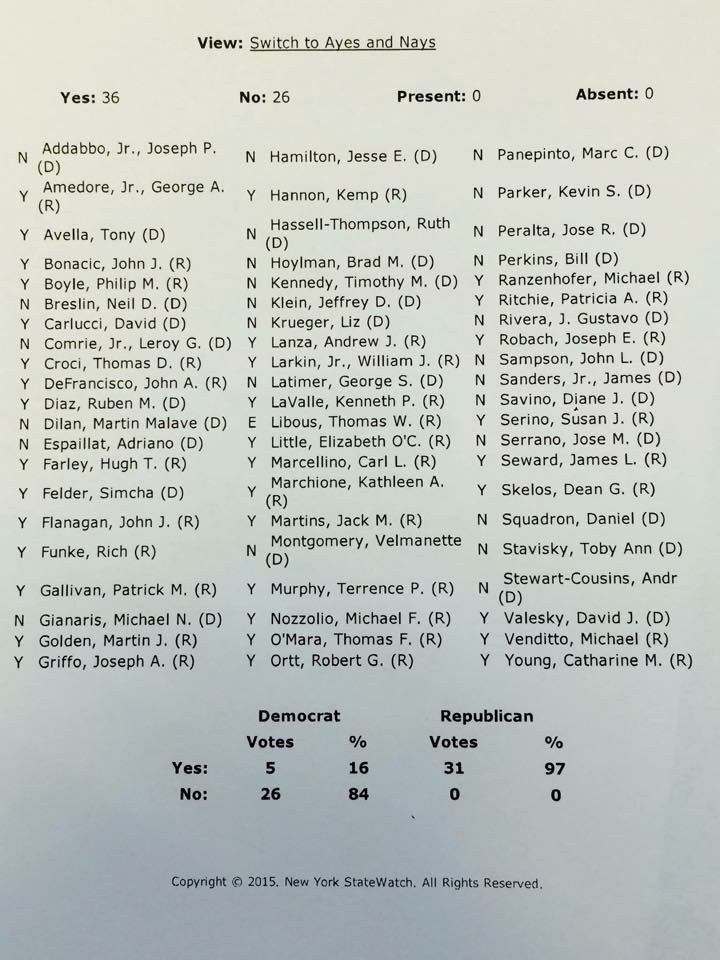
When Governor Cuomo’s budget was passed by the Néw York State Senate, it included mandates for test-score based evaluation of teachers and other provisions that teachers found insulting. Here is the State Senate’s Wall of Shame and Wall of Fame, identifying those who voted for and against this anti-teacher legislation. I previously posted a similar chart for the New York Assembly. Save this list for the next election if you live in New York.


IMG_7076

Arne Duncan hailed the Senate bill produced by Senators Alexander and Murray as a good bipartisan effort.


Duncan was generally positive about the Alexander-Murray bill but said the Obama administration wants a final law to expand early childhood education and to place stronger demands on states to improve their worst-performing schools, among other things.


For example, “turning around schools” by closing them, firing teachers and principals.

Mercedes Schneider continúes her close reading of the Senate reauthorization bill, crafted by Republican Senator Lamar Alexander and Democratic Senator Patti Murray. This is part three. The others are linked inside her post.


You will find this an interesting post. You will see that the bill penalizes states that cut their education budget by more than 10%; that it allows but doesn’t mandate merit pay; that it includes a big loophole for Teach for America; and much more.


Mercedes is going through this bill line-by-line. Members of Congress would learn much by reading her reports.

John Merrow posted an important reflection on the broader issues raised by the Atlanta cheating scandal.

““Things fall apart; the centre cannot hold,” William Butler Yeats wrote in 1919 in ‘The Second Coming.’ Yeats was describing the world after the Great War, but it aptly describes American education today[1]: polarized, shouting at, but rarely listening to, each other. We disagree about dozens of issues: the Common Core; whether ‘opting out’ of the Common Core tests is appropriate (or even legal); the role of unions; the effectiveness of charter schools; the federal role; the amount of standardized testing; how to evaluate teachers; poverty’s impact on children’s learning, and more.

“Now, out of the blue, we have two[2] points of agreement: 1) Draconian punishment for the Atlanta cheaters is unjust, unseemly and counter-productive; and 2) students are the losers when adults cheat….”

“Everybody’s got a villain, whether it’s Arne Duncan’s Race to the Top; an obsession with ‘data-driven decision-making; education profiteers; greedy teacher unions; or a right wing vendetta against those same unions. [5]

“Can’t we agree on something else? I suggest two big ideas that everyone who is genuine about putting kid first can support. One, expose hypocrites and hypocrisies, wherever they may be. Two, school spending should be transparent, because we are talking about taxpayer dollars, and sunlight is the best disinfectant.

“Of course, the two are related, because hypocrisy often involves money and secrecy.

“To me, the biggest hypocrites are those who preach, “Poverty can never be offered as an excuse” (for poor student performance) but then do nothing to alleviate poverty and its attendant conditions. What they are saying, bottom line, is “It’s the teachers’ fault” when kids in poverty-ridden schools do poorly on tests or fail to graduate…..

“OK, poverty is not an excuse, but surely substandard housing, inadequate health care, poor nutrition, abuse and abandonment (all of which are more likely in high poverty areas) are factors in poor academic performance. So why are these hypocrites either standing by silently or actively opposing efforts to alleviate poverty and thereby improve the lives of students outside of school?….

“Even if these so-called “thought leaders” genuinely believe that poverty is not an excuse, shouldn’t they be outraged that most states are actively making things worse for poor kids [6]? At least 30 states are systematically shortchanging poor areas when they distribute education dollars, as the Hechinger Report made clear recently. “The richest 25 percent of school districts receive 15.6 percent more funds from state and local governments per student than the poorest 25 percent of school districts, the federal Department of Education pointed out last month. That’s a national funding gap of $1,500 per student,” Jill Barshay reports.”……

“We might want to start the investigation with charter schools, both the for-profit and the non-profit varieties [8] (because, when it comes to money, they’re almost indistinguishable). Rarely do they disclose how they spend their public tax dollars. And why should they, when their political enablers don’t demand it?

“I hope you are following Marian Wang’s reporting on this issue for Pro Publica. She documents how some charter operators are laughing all the way to the bank, taking your dollars to put in their accounts….

Merrow then describes an egregious case of charter profiteering, which he brought to the attention of Nina Rees, the Executive Director of the National Alliance for Public Charter Schools (who formerly worked for Dick Cheney and Michael Milken).

Merrow asked her in a letter:

“What I wonder is how many Charter Management Organizations [9] are playing fast and loose with the system. Here’s one case in point: We are looking into a CMO that is growing; its records indicate that its President owns the building his charter schools operate in, and so he bill the CMO for rent—a hefty sum. The CMO pays him a salary, a 16% management fee and an additional 7% or so for ‘professional development’ for the staff. In recent years he has added categories, notably ‘back office & support’ for nearly $300,000 and ‘miscellaneous equipment rent’ for $317,000. In FY 2008 he billed for $2.6M, but in FY 2012 the number climbed to $4.1M. His 5-year total is $15.8M….and he’s a CMO, not an EMO.

“We have a number of other examples, which prompts my questions: who’s minding the store, and whose responsibility is it?

“Is it the role of national organizations like yours to set standards for transparency? State politicians? I have no idea but would love to hear your thoughts.”

She said this was the authorizers’ responsibility.

Merrow summarized her response:

“She seems to be saying that her national organization bears no responsibility for policing the charter movement, for pushing states to write tighter rules, or for calling out the profiteers. That’s someone else’s job.”

And his last suggestion:

“Remedial education” is another money pit. Follow the money, you will discover that big bucks being spent on remedial education at every level, and, while some kids get ‘remediated,’ the situation never changes. The adults in charge may be wonderful, likeable human beings, but their jobs depend on a steady stream of failed students, meaning that they do not have a stake in fixing the system. I wrote about this three years ago when I announced that I was leaving PBS [10] to make my fortune in remedial education.

“Follow the money: How many millions of the $100 million Mark Zuckerberg donated to ‘fix’ Newark’s public schools have gone to consultants? How much money goes into the trough labeled ‘professional development’ and is never seen again? How much are school systems spending on highly paid central office staff ($100K+ per year) whose job it is to go watch teachers they don’t trust to do their jobs? How much of the increase in college costs is directly attributable to spending on administrators? Quite a lot, according to the New York Times.

“Schools would be improved if we’d agree to: Follow the money. Call out the hypocrites. Demand transparency. And stop blaming teachers.”

A wonderful column!