Archives for the month of: January, 2015

Politico.com’s reporters are closely watching as interest groups inside the Beltway maneuver around the important issue of testing and the reauthorization of No Child Left Behind. NCLB is the name given to the basic federal education law, which was originally titled the Elementary and Secondary Education Act of 1965. The crucial question now, as Senator Lamar Alexander begins the revision of NCLB is what will happen to the mandate of annual testing from grades 3-8. Accountability hawks love it, especially when it is attached to high-stakes testing. Most teachers and parents hate it, because it narrows the curriculum, encourages constant test prep, promotes teaching to the test, and incentivizes cheating and gaming the system. And so the various interest groups are staking out their positions, and decisions will be made by Congress about whether to allow districts and states to decide about how to test students or whether to stick with the status quo. The latest news is that the AFT issued a Solomonic joint statement with the Center for American Progress (a neoliberal think tank that is close to the Obama administration) supporting annual tests with no stakes and grade-span tests for accountability. Previously, the AFT and NEA were in solidarity against annual testing. Nothing would prevent states from continuing to use the annual tests for accountability. No high-performing nation gives annual tests or uses test scores to evaluate teachers.


Here is Politico’s latest update:


THE CHANGING TIDE ON TESTING: Statements of principles on No Child Left Behind reauthorization have been flying all week, and amid the platitudes, there have been some surprises – position shifts that strongly hint at an emerging consensus on the issues of testing and accountability. Just six months after demanding an end to mandatory annual testing [http://bit.ly/1KKTaFS], the American Federation of Teachers did a 180 and called [http://politico.pro/1BscqnE ] for keeping that requirement in the law. The union’s only condition: Congress has to dial down the high stakes and let states pick which test scores they include in their school accountability systems, as long as they use at least one set of scores per grade span. The AFT also called for accountability systems to include multiple metrics beyond the test scores, such as graduation rates, school climate surveys and measures of “social and emotional learning.” The Center for American Progress joined the AFT in that statement.


– Catherine Brown, CAP’s vice president of education policy, said the think tank’s position is evolving as it learns more and conducts more research about testing. The principles outlined with AFT aren’t a “radical departure” from what CAP has said in the past, she said, and the think tank fully supports the agenda laid out [http://politico.pro/1IEi5qI] by Education Secretary Arne Duncan earlier this week. The centrist think tank Third Way opposes CAP and AFT’s proposal, saying none of the testing or accountability requirements should be rolled back: http://bit.ly/1xqux71.


– The National Education Association continues to call [http://politico.pro/1yiFL2R ] for an end to the testing mandate. But President Lily Eskelsen García has also said one of the union’s top priorities is to spotlight equity issues through accountability systems that look at everything a school does, so test scores carry far less weight. She told Morning Education last week that the NEA wants to be crystal clear it doesn’t oppose tests – just their misuse. “We know you have to assess kids against benchmarks and determine if they’re learning or not,” she said. “We want good data used in good ways, so we understand how kids are progressing.” That sounds a lot like the AFT/CAP view.


– The Council of Chief State School Officers, which represents the views of superintendents from both parties, is also calling for flexibility. It’s in favor of keeping the testing mandate, but wants districts to be able to opt out of the statewide tests in favor of their own assessments. Executive Director Chris Minnich told Morning Education that CCSSO thinks one of the testing options proposed in Republican Sen. Lamar Alexander’s NCLB discussion draft is “too loose,” making it impossible to compare tests statewide. On the evolving positions of the education policy world, he said it’s natural while the bill is in negotiations. “I think everybody is trying not to draw hard lines around this has to be in it and that has to be in it,” he said.


– Conservatives, meanwhile, have lined up to praise Alexander’s NCLB
discussion draft, which toys with the idea of letting local districts opt out of statewide tests and gets the feds out of the business of prescribing accountability systems. One surprise came from Fordham Institute President Michael Petrilli. He has long been a very vocal supporter of annual tests. Yet in an op-ed in the National Review, he called the idea of winnowing testing to once per grade span “both modest and sensible.” Petrilli later told Morning Education that he still supports annual testing and should have been “more careful with the wording” of the piece, which he co-wrote with Frederick Hess of the American Enterprise Institute. But Petrilli also said he’s open to other concepts; his chief goal is simply to be able to track kids’ progress over time. “If some state comes up with an idea on how to do it differently, we should be open to it,” he said.


– So, could all this maneuvering signal a potential compromise in which Congress would continue to require annual tests in theory, but in practice give states and districts a heap of flexibility? Hess said he sees such a middle ground emerging – and notes that it sounds an awful lot like the framework President Bill Clinton proposed 20 years ago. “We’ve taken a long road home,” he said.
Veteran educator Elliot Self says it is long past time to revise No Child Left Behind, and he urges everyone to make their voices heard.

My first recommendation to Congress would be to restore the original name of this landmark 1965 legislation, whose primary purpose was equity for poor children and districts, not accountability: the Elementary and Secondary Education Act (ESEA), not President Bush’s colorful NCLB.

Self offers nine recommendations in this article. The balance of the article explains each recommendations.

“I believe that we need a new National policy that supports a 21st century education for our children. I am suggesting nine broad changes to the law that would help schools and teachers across the country better meet the needs of diverse students and schools in a complex 21st century world. The recommendations suggest a very different type of law that, instead of a set of top down mandates, emphasizes collaborative working relationships with states, schools and districts and local flexibility, creativity and innovation. They suggest that NCLB should be focused around a 21st century education mission statement and set of goals and should support the development of high quality standards that make significant learning possible.

“The recommendations promote a broader view of accountability and assessment policies and practices, emphasize the development of a rigorous, expansive, high quality curriculum and school programs, and promote the use of powerful instructional strategies. They are designed to address the deep-seated problems with the current law.

Self’s nine recommendations are the following:

“Create a law designed to encourage and guide states, districts and schools to develop 21st century schools, rather than coerce them into submission.

Create a 21st century education mission and vision statement to focus the law.

Encourage the development of high quality state standards.

Support the development of curricular programs that are consistent with high quality standards.

Reduce the amount of standardized testing and encourage the use of multiple types of assessments to measure success and progress.

Encourage districts and schools to develop and implement benchmark and graduation projects.

Encourage districts to provide a variety of elective courses and comprehensive extra-curricular activities and programs.

Encourage professional development that supports the use of powerful instructional strategies.

Create the means for greater collaboration and sharing among states, districts and schools.”

What are your recommendations for the federal role?

New Hampshire teacher Shawna Coppola wonders how to define a good school. She explains why the school she teaches in is an excellent school that defies all the current reforms and educates all children to meet their needs, not to raise their scores. The school may be closed because of the cost of renovations; besides, it does not have the cachet of the districts with high scores. This crazy notion that beloved community public schools should be closed is recent in our history, dating only to No Child Left Behind. That now discredited law decreed that schools must be subject to a cascade of sanctions, including closure, if their test scores don’t move towards 100% proficiency in grades 3-8. Never before in our history were public schools closed except for shrinking enrollments or consolidation of facilities—but not for test scores. Many states have adopted A-F grading systems, but those are overly simplistic and they rely too much on standardized test scores. How should we judge a school?


Here are Shawna’s thoughts on what makes a good school:


Recently a news item came out on our local NH station, WMUR, which listed the top 50 elementary schools in the state of NH. Previous to this, Newsweek had published their 2014 list of America’s Top High Schools. Both times, the district in which I live made the list. Our local high school was listed as the one of the best high schools in America, while our two elementary schools ranked near the top in the state of NH, respectively. You can find Newsweek’s list here (http://www.newsweek.com/high-schools/americas-top-schools-2014) and WMUR’s list here:http://www.wmur.com/news/30456516.


Over ten years ago, my husband and I moved to this highly-rated district so that our children could attend the schools here, which we had heard wonderful things about. By most accounts, the schools in the district are “excellent” schools. What people tend to mean by this is that the students in our district perform well on state-wide standardized assessments and on AP exams, graduate from the high school, and tend to matriculate at college immediately following graduation.


This used to impress me–at least, it did when I was still a wide-eyed classroom teacher only a few years out of college. With each passing year, however, it impresses me less and less.


The reason for this is because over the years, and through my experience as an educator, I have come to understand what it really means to be a school of excellence versus a school that is merely good at playing the game (or is lucky enough to be situated in an involved, highly literate, financially stable community). I do not believe ours is a bad or a poor district–far from it–but is it excellent? Does it deserve its place at the “top?” The short answer for me, as a parent to two students in the district, is…well, no. (I would be happy to elaborate further if you are interested.)


Alternatively, I believe that the school I work in now, Rollinsford Grade School, is one of the most excellent schools in which I have ever worked–even ever set foot in. If I were not here, working as a literacy specialist in grades K-6, I likely would not be working anywhere (in public school, that is). We have a long way to go, and can always improve, of course, but in all essence, Rollinsford is my dream school. At Rollinsford, we truly attend to the whole child. The social, emotional, and physical development of our students is just as important, if not more important, as their academic growth. We have worked hard to incorporate a sense of authentic inquiry into everything we–and our students– do. Our students have a voice, and their voice is heard and acted upon. We believe that there are a myriad number of ways that students can–and do–succeed. Each member of the faculty and staff identifies as a learner herself. Each of us goes above and beyond what is expected.


And yet, Rollinsford Grade School placed 130th out of 243 NH schools–in the bottom half. When I dug into the methodology used to complete these rankings, I wasn’t surprised to learn that it was highly flawed (you can find my somewhat detailed analysis here: http://mysocalledliteracylife.com/2015/01/04/unique-insight-into-schools-um-no/). Flawed not because of the science used, but because of the factors that were analyzed. Not one factor that went into ranking NH’s elementary schools included the factors that I, and most of my fellow educators, value– classroom pedagogy, school culture, student voice and choice, community outreach, etc. Sure, the rankings included analysis of surveys that were sent out to students, parents, and alumni of each school, but a district only needed 11 completed surveys per district to have its results counted toward the ratings. I’m sure it’s no surprise that the most affluent districts in the state, and the ones most likely to have more highly educated parents, fewer transient families, and less poverty (including the one in which I live), came out on top.


And now, with our enrollment decreasing each year and the need for minimal renovations that would bring a 78 year-old building up to code, Rollinsford Grade School is in the position of potentially being shut down, our students shipped off to a mediocre school district in the next town over. My colleagues and I–and many of our parents, whose children thrive here–are heartbroken. Not because we could potentially lose our jobs, but because one of the best schools with some of the most thoughtful, knowledgeable, progressive-minded educators may, someday soon, no longer exist. Because we have worked so hard to honor all of our students, not just those who fit the mold of the “typical” student. Because the children of this community will no longer have an alternative to the traditional, testing-focused, CCSS-centric types of schooling they will get in most other schools.


What I often write about–and what I think there needs to be a lot more conversation about, not only within the wider community, but within the world–is what truly makes a school “good” (or even “excellent”). (And is this the same everywhere?) Not for the sake of ranking schools, which is not something I believe does anyone any good, but for the sake of identifying those factors that make a school one in which both teachers and students are happy, safe, and engaged in the joy and the challenge of learning. So that schools that are not excellent can aspire to something–can make positive change toward excellence.


I think that in today’s educational culture, it is more important than ever to talk about what truly makes a good school vs. one that is only good at “playing” school. I would love to hear your ideas for how to make this happen.


Thank you for taking the time to read this.


Best,

Shawna Coppola

Literacy Specialist, Rollinsford Grade School

Rollinsford, NH 03869

As Congress debates whether to continue the status quo of annual high-stakes testing, the leading figures of the Opt Out Movement are convening a national meeting in Broward County January 16-18.


Join them if you can.


Standing Up For Action Conference Ft. Lauderdale, Fl. – Administrators of the public education advocacy group UNITED OPT OUT NATIONAL are hosting a conference at the Broward Convention Center January 16th – 18th. Their fourth annual event, taking place on the second floor of the convention center in Palm Room A, is open to the public. Three-day attendees are asked to register in advance at http://www.eventbrite.com/e/united-opt-out-national-standing-up-for-action-tickets-13247047275 . One day attendees are asked to RSVP at https://www.facebook.com/events/1507022726224662/?ref_dashboard_filter=upcoming and register upon arrival.


Standing Up For Action is a working session for local and national activists, concerned parents, educators, students and all who have a general interest in equitable and quality public education. Attendees will leave equipped with plans of action to refuse, resist, and disrupt corporate and for-profit education reforms that have destroyed the democratic voice in public education decision making and have forced the implementation of policies damaging to students, educators, and communities.


Standing UP For Action will include keynote speakers, Q/A panels, and networking gatherings. Working groups, speakers, and panelists will focus on these topics: media, organized labor, parent/citizen rights, human rights, student empowerment, and civil disobedience. Speakers, panelists, and group leaders include author and educator Sam Anderson, Living in Dialogue blogger and author Anthony Cody, Chicago Teachers Union activist Michelle Gunderson, author and University of Southern California Professor Stephen Krashen, Massachusetts Teachers Association President Barbara Madeloni, Holyoke, Ma. Teachers Association President Gus Morales, HispanEduca President Lourdes Perez, former Orange County School Board member and Florida state Senate candidate Rick Roach, author and University of Massachusetts, Dartmouth Professor Ricardo Rosa, FairTest Public Education Director Bob Schaeffer, author and City University of New York Professor Ira Shor, and youth representatives from Dream Defenders, Baltimore Youth Dreamers, and Detroit BAMN.


Rachel M. Cohen writes in “The American Prospect” about the true cost of Teach for America and its impact on urban schools.


She notes that districts Re required to pay a finder’s fee to TFA for every recruit they hire, typically between $2,000-$5,000 per year.


“To put the finder’s fees in perspective: If one city’s TFA cohort, consisting of 200 corps members, comes with an annual finder’s fee of $4,250 for each teacher recruited from the organization—then that cohort’s two-year commitment will cost the district an additional $1,700,000 in dues to the organization. This is not a trivial sum for school districts experiencing massive budget shortfalls.”


Why are districts willing to pay a finder’s fee when they could hire a traditionally trained teacher or a veteran teacher with no finder’s fee? The research does not show a marked superiority for TFA over regular teachers. Some states and districts have TFA alumni in charge or on the school board. But others see an advantage in hiring young teachers who will leave in 2-3 years: they are at the bottom of the salary scale and will not be around long enough to get paid more or to collect a pension.


The long-term harm of the TFA model is that it popularizes the belief that “great teachers” need only five weeks of training. TFA would work well if their recruits entered schools as “teaching assistants” or paraprofessionals. To call them “teachers” after five weeks of training undermines teaching as a profession. No profession requires so little specialized education. Except, as a reader reminded me recently, “the oldest profession.” In every other real profession, experience is considered a plus. Who would go to a brand-new “lawyer” who had only five weeks training when they could hire a senior partner for the same fee? Who would see a “doctor” with five weeks training instead of an experienced surgeon? Is teaching a profession or a trade?

When I spoke to the Texas School Boards Association a few years ago, a member of the audience got up and identified himself as a school board member and an engineer. He said that he didn’t understand why the government tests every child every year. He said that in the industry where he works, it is customary to test the products periodically, on a sampling basis. I will never forget what he said: “If we tested every product, we would spend most of our time testing the product, and we wouldn’t have time left to manufacture or to improve the product.”


I was reminded of that statement when I received this comment from Doug Garnett, who is a specialist in marketing, advertising, branding, communications, and technology. Garnett wrote, just minutes ago:


Where I’m mystified is this belief that in order to have “accountability”, EVERY child has to be tested in the entire nation.


In business, we rely heavily on statistical sampling because it’s flat out too expensive to measure every item. Sampling in manufacturing, sampling in store satisfaction, sampling in purchasing, sampling in advertising impact, sampling, sampling sampling.


The NAEP relies on sampling…because it’s EFFECTIVE!


Imagine this: IF we shifted to a sampling test approach an amazing array of issues would be mitigated. The tests would lose their intensely punitive nature – and evolve toward being instructive and enlightening. They would lose the “high stakes” and become simply learning that informs. And, WE could use their reduced presence to focus on the totality of education instead of creating testing farms.


So…why don’t these so-called “business people” behind reform endorse smart business approach like sampling? Mind boggling…unless we embrace the conspiracy to redirect all of that government spending into the profits of private corporations.

The American Federation of Teachers and the Center for American Progress issued a joint statement expressing their agreement on what should be contained in the reauthorization of the Elementary and Secondary Education Act (NCLB). The key point is that the AFT agreed to support annual testing so long as it was used for information, not accountability; and the CAP agreed to using grade span tests for accountability instead of the annual tests. As the article below notes, the AFT had previously opposed annual testing. The CAP’s point person is Carmel Martin, a former assistant secretary for civil rights in the Obama administration, who is a strong supporter of testing.


My view, for what it’s worth: The mandate for annual testing in grades 3-8 should not remain in federal law. Even though the signatories to this agreement say the scores should not be used for accountability, habits die hard. They will be, even though doing so is inaccurate and invalid. There really is no point to testing every child every year unless you want to know whether they have mastered the art of test-taking. Grade span testing (elementary, junior high school, and high school) should be quite enough. No high-performing nation tests every child every year from 3-8. Unless you happen to be a shareholder in Pearson or McGraw-Hill, it is a massive waste of children’s time and taxpayer’s money.


***************


AFT, Obama-Linked Think Tank Champion Annual Testing—With a Caveat

By Alyson Klein <http://www.edweek.org/ew/contributors/alyson.klein.html&gt; on January 14, 2015 2:41 PM

By guest blogger Stephen Sawchuk. Crossposted from Teacher Beat. <http://blogs.edweek.org/edweek/teacherbeat/2015/01/aft_obama_linked_think_tank_promote_annual_testing.html&gt;


UPDATED


As you should know by now, the hottest issue over the pending rewrite of the No Child Left Behind Act is whether the law’s core requirement for accountability based on the results of annual student tests should be maintained, or scrapped in favor of fewer exams. <http://www.edweek.org/ew/articles/2015/01/09/nclb-rewrite-could-target-mandate-on-annual.html&gt;


Now, the American Federation of Teachers and the Center for American Progress, a left-leaning think tank long associated with the Obama Administration, have proposed a sort of compromise. Their statement <https://cdn.americanprogress.org/wp-content/uploads/2015/01/AFT-CAP-Shared-Principles-on-ESEA.pdf&gt; , first reported <http://www.washingtonpost.com/local/education/aft-backs-annual-testing-with-an-asterisk/2015/01/14/56a6675a-9c0a-11e4-96cc-e858eba91ced_story.html&gt; by The Washington Post, says that annual testing in grades 3-8 and once in high school should be maintained. But, the scores from the exams should only factor into state accountability systems once in each grade span (elementary, middle, and high school).


This is a big surprise, marking a significant policy shift for both groups. The AFT has been among those leading the charge against the annual testing requirement. See the accountability resolution it passed <http://www.aft.org/resolution/real-accountability-equity-and-excellence-public-education&gt; just six months ago saying such tests should not be given annually, for example.


Similarly, CAP’s Executive Vice President for Policy, Carmel Martin, is a former Education Department employee who had supported the annual testing-and-accountability requirements at the heart of the law. (Is the Obama administration signalling what it might be willing to compromise on through a trusted channel?)


Both groups add that new state accountability systems should take factors other than test scores into account, a change the AFT has been pushing for a while.


“These systems should also include high school graduation rates at the high school level and other academic measures. While academic indicators should be substantial factors, states should also—as some are doing currently–include qualitative criteria such as school-quality reviews, climate and safety measures, success of students on college-preparation curricula, and/or measures of social and emotional learning,” the statement reads.


And the groups say that the federal government should double the currently $2.4 million federal teacher-quality grants to invest in better teacher preparation and professional development. New money for teacher quality is something U.S. Secretary of Education Arne Duncan hinted at in a recent wide-ranging speech defending annual tests.


Read the full statement here. <https://cdn.americanprogress.org/wp-content/uploads/2015/01/AFT-CAP-Shared-Principles-on-ESEA.pdf&gt;


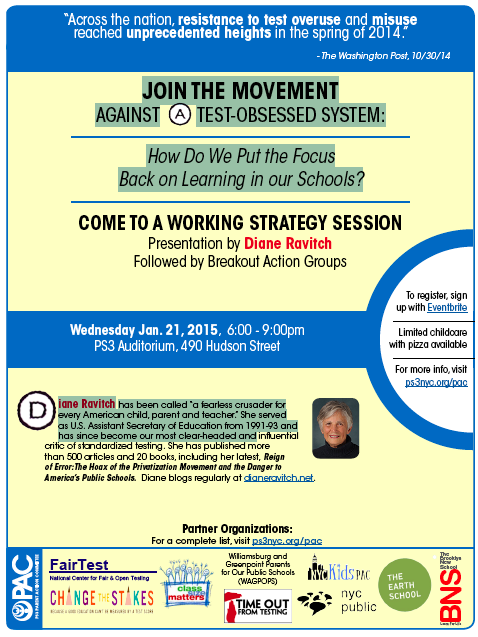
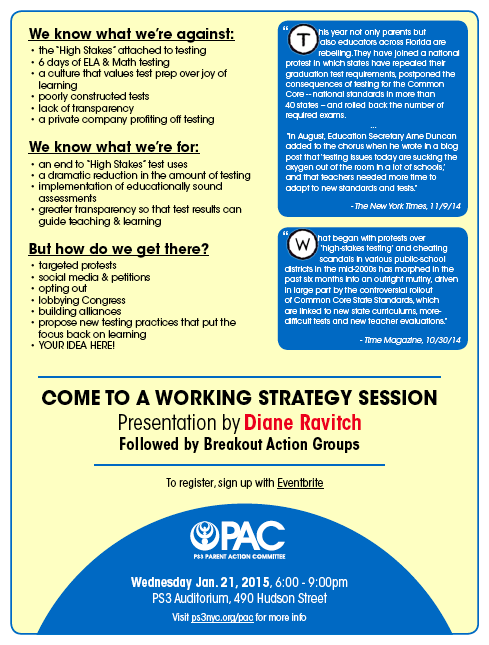
Screen shot 2015-01-08 at 10.10.22 PMScreen shot 2015-01-08 at 10.10.36 PM

To download the flyer click here

According to Politico.com, Senator Lamar Alexander is considering eliminating the federal mandate for annual testing in grades 3-8. Charles Barone of the hedge fund managers’ “Democrats for Education Reform” is alarmed by this proposal, claiming it is an “equity” issue that would make it impossible to compare states.

Why the need to compare test scores is an equity issue is unexplained. Apparently Barone–who used to work for Congressman George Miller, senior Democrat on the House Education Committee–is unfamiliar with NAEP. That is the National Assessment of Educational Progress, which has been testing American students since 1969. It has been comparing states since 1992 and disaggregating scores by race, gender, language, and disability status. I hope proponents of annual testing will soon explain how comparing states creates equity. We know that Mississippi has lower scores than Massachusetts, whether we test annually or every three years. The gap is not changed by knowing about it more frequently but by funding schools attended by low-performing students so they can have smaller classes, more arts programs, more specialists, better paid professionals, and amply supplied and staffed libraries.

Here is the story:

THE GOP DRAFT YOU’VE BEEN WAITING FOR: Republican Sen. Lamar Alexander unveiled a discussion draft Tuesday night detailing his plan for reauthorizing No Child Left Behind. It borrows heavily from his 2013 proposal [http://1.usa.gov/1C4GZNS ] and if passed, it would take the federal government right out of some of the Obama administration’s most contentious policies – providing relief to states that haven’t met the administration’s bar for accountability systems and teacher evaluations. The bill would give states the option to make more than $14 billion in Title I funding portable across public schools. Alexander’s draft also makes clear that the federal government would have no involvement in states’ academic standards – although states would have to set high standards. When it comes to testing, one option would allow districts to forgo annual exams. Maggie Severns reports: http://politico.pro/14SYoPQ Read the discussion draft here: http://1.usa.gov/1swgqBH

– Some feel that testing option would make it impossible to compare results at the state level. “This, by extension, becomes an equity issue,” said Charles Barone, policy director for Democrats for Education Reform. “Any effort to advance equity requires comparability of student circumstances across zip codes, incomes, race, disability, etc. Any accountability system that drives to improve the achievement of those students and target resources toward them is out the window if every school or district is held accountable based on a different set of numbers.”

The Parent Coalition for Student Privacy welcomes President Obama’s support for student privacy and suggests ways to strengthen his proposal:

Contact: Leonie Haimson, leonie@classsizematters.org, 917-435-9329;
Rachael Stickland, rachael.stickland@gmail.com, 303-204-1272

Parent Coalition for Student Privacy on President’s Announcement of
Need for new Federal Student Privacy Protections

The Parent Coalition for Student Privacy thanks the President for recognizing the need for new federal student privacy protections, but points out how the California law that the President lauded as a model cannot be used without strengthening its provisions around parental notification, consent, security protections and enforcement.

“Any effort to ban the sale of student information for targeted advertising is a good first step, but the White House’s proposal appears to allow companies to sell and monetize student data for unspecified ‘educational purposes,’ including to develop products that would amass enormous personal profiles on our children. Profiling children based on their learning styles, interests and academic performance and then being able to sell this information could undermine a student’s future. Parents want to ban sale of student data for any use and demand full notification and opt-out rights before their children’s personal information can be disclosed to or collected by data-mining vendors,” said Rachael Stickland, co-chair of Parent Coalition for Student Privacy.

Leonie Haimson, Parent Coalition co-chair and Executive Director of Class Size Matters said, “We also need strong enforcement and security mechanisms to prevent against breaches. Schools and vendors are routinely collecting and sharing highly sensitive personal information that could literally ruin children’s lives if breached or used inappropriately. This has been a year of continuous scandalous breaches; we owe it to our children to require security provisions at least as strict as in the case of personal health information.“

Here is a summary of the gaps and weaknesses in the California student privacy bill, which the President said should serve as a model for a federal law:

· Bans vendors using personally identifiable information (PII) student data to target advertising or selling of data, but not in case of merger or acquisitions, or presumably in case of bankruptcy, as in the recent Connectedu case. The President’s proposal would be even weaker, as it would apparently allow the sale of student data for unspecified “educational purposes”;

· Only regulates online vendors but not the data-sharing activities of schools, districts or states;

· Provides no notification requirements for parents, nor provides them with the ability to correct, delete, or opt out of their child’s participation in programs operated by data-mining vendors;

· Unlike HIPAA, sets no specific security or encryption standards for the storage or transmission of children’s personal information, but only that standards should be “reasonable”;

· Allows tech companies to use children’s PII to create student profiles for “educational” purposes or even to improve products;

· Allows tech companies to share PII with additional and unlimited “service” providers, without either parent or district/school knowledge or consent – as long as they abide by similarly vague “reasonable” security provisions;

· Allows tech companies to redisclose PII for undefined “research” purposes to unlimited third parties, without parental knowledge or consent –without requiring ANY sort of security provisions for these third parties or even that they have recognized status as actual researchers;

· Contains no enforcement or oversight mechanisms;

· Would not have stopped inBloom or other similar massive “big data” schemes designed to hand off PII to data-mining vendors – and like inBloom, would also be able to charge vendors or “service providers” fees to access the data, as long as states/districts consented.

###