Archives for the month of: January, 2014

This teacher has an idea why the costs of American education are going up while teachers are being laid off, and teachers must pay for supplies out of their own pocket. It is no paradox to her. She left this comment:


When I think of the money that has been diverted from classrooms to testing and teacher evaluation companies, it makes me sick. The extra supports (after school programs, counseling, smaller classes, electives, etc.) have been sucked away by corporate greed. This borders on plain stupidity and theft.

Bruce Rauner is a fabulously wealthy equity investor who is running for Governor of Illinois.

He is also one of the most important financial backers of charter schools in Chicago. He even has a charter school named for him, part of the Noble network of charters.

In his gubernatorial campaign, he recently made headlines when he broke ranks with the other Republican candidates on the issue of the minimum wage. Democratic Governor Pat Quinn has called for an increase in the minimum wage to $10 an hour from its current $8.25 an hour. Four Republican candidates say it should be kept where it is. Rauner proposes to lower the minimum wage to $7.25 an hour to keep Illinois “competitive.”

According to this story, Rauner’s income in 2012 was $53 million.

“Despite his appearance as an average Joe who stays at cost effective motels and starts his day with Raisin Bran just like everybody else, Rauner need only shake his hammer for an hour to make what minimum wage earners make in a year. Rich Miller at Capitol Fax provides the breakdown:
To put this into a little perspective, somebody earning minimum wage in Illinois today (before any Rauner-enforced pay cut) would have to work 6,424,242 hours to match Rauner’s 2012 income of $53 million. That works out to 803,030 days, 160,606 40-hour weeks, or 3,088 years.
Rauner’s income averages out to $204K a day for a five-day work week, or $25,550 every hour of an eight-hour day. It would take a minimum wage employee 399 days to earn as much money as Rauner made in a single hour last year. And, again, that’s before any pay cut.”

To show what an average Joe he is, Rauner should try living on $7.25 an hour for one week, just one week.

I had a personal encounter with Bruce Rauner. Two years ago, I received the Kohl Education Award from Dolores Kohl, the woman who created it, a great philanthropist who cares deeply about the forgotten children and annually honors outstanding teachers. After the awards ceremony, Ms. Kohl held a small dinner at the exclusive Chicago Club. There were two tables, 8 people at each table. I sat across from Bruce and of course, we got into a lively discussion about charter schools, a subject on which he is passionate.

As might be expected, he celebrated their high test scores, and I responded that they get those scores by excluding students with serious disabilities and English language learners, as well as pushing out those whose scores are not good enough. Surprisingly, he didn’t disagree. His reaction: so what? “They are not my problem. Charters exist to save those few who can be saved, not to serve all kinds of kids.” My response: What should our society do about the kids your charters don’t want? His response: I don’t know and I don’t care. They are not my problem.

This was not a taped conversation. I am paraphrasing. But the gist and the meaning are accurate.

EduShyster wrote about Rauner’s charter school–part of the Noble network–here. The Noble network is known for fining parents if their children don’t follow the rules.

Oh, and one other interesting story about Bruce Rauner: The Chicago Sun-Times reported that he pulled strings with his friend Superintendent Arne Duncan to get his daughter admitted to Chicago’s very selective Walter Payton College Prep school after she was rejected; eighteen months later, Rauner donated $250,000 to the school’s private fund. Rauner also gave a handsome gift to the CPS foundation, run by “the school system’s top administrators”:

Rauner’s gift to the Payton Prep Initiative came two months after his foundation gave $500,000 to the Chicago Public Schools Foundation, run by the school system’s top administrators. His foundation previously had given money to that organization.

Rauner, a venture capitalist, called Chicago school officials in early 2008. Within days, his daughter was admitted to Payton for the 2008-09 academic year by the school’s principal, according to a source familiar with the matter.

After reading Jeff Bryant’s article on abuses in charter schools, a teacher posted this letter on the site where it was originally posted:


She writes:

      Charter schools suffer from the problems that this article highlights–gobs and gobs of public money with virtually no public supervision.
      That money is a magnet to profit motivated conmen/conwomen, simple disarmingly pious crooks, and megalomaniacs. The truth is that those millions of dollars keep flowing with few questions once the charter is granted and the school opened.
      The school systems are run by an executive staff that is answerable to almost no one except their hand picked board. Administrators often draw huge salaries not merited by the student population density (or their expertise and contribution to their charter systems).
      I can speak with authority because I was a “teacher” at a charter school. I say “teacher” because I have no training in anything but the the subjects which I supposedly taught.
      Teaching is a craft like any other I discovered when I tried to teach for a single year. A craft that I had not learned.
      I was underpaid, over worked, and, to be honest, had no idea what I was doing. I also had no curriculum to teach from in either of my subjects. Believe it or not I was not the worst teacher there.
      While I was trying to teach without any sort of training and without text books or a curriculum the President of this educational Potemkin village was drawing $250,000 per year for a total student count over seven schools of less than 1000. He once remarked to me that he “didn’t give a damn about education!” and proved it every day..
      Technically he wasn’t even stealing. The board had voted him one bonus and pay increase after another for doing very little positive. I won’t go into all of the issues with run down buildings, bathrooms that didn’t work, roofs that leaked, no toilet paper/paper towels, special Ed….
      When a system without controls is created these sorts of abuses are invited and they, indeed, come right in.

Jeff Bryant, director of the Education Opportunity Network, here catalogues the abuses that have become all too common in the world of charter schools.

Although there are responsible and caring charter schools, there is a growing number who take advantage of their freedom from supervision, from oversight, from audits, and from state laws governing public schools to engage in child abuse, corruption, nepotism, and financial fraud.

This is a valuable article, as it shows that these abuses are inherent in the fact that charter schools are given large amounts of public money without necessary financial oversight. In some cases, charter operators get freedom from accountability because of their political connections. But there is even more than Jeff describes. He doesn’t mention Ohio’s biggest charter operators, who rake in millions in profits, while making generous campaign contributions. Nor does he mention the padded closet used to discipline small children at KIPP in NYC’s Washington Heights. Nor did he mention the rampant conflicts of interest in Arizona charter schools.

This is Mercedes Schneider’s critique of AFT’s position on the Common Core. The post includes many, many links. If you want to see the links, open the original post on her blog.

Schneider writes:

AFT’s 10 Myths: Unyielding Devotion to the Common Core

December 31, 2013

In my hands I am holding the latest issue of the American Federation of Teachers (AFT) quarterly publication, American Educator. It is open to page 43, Tools for Teachers: 10 Myths About the Common Core State Standards (CCSS).

The piece was written by AFT’s Educational Issues Department.

Their position is one of unreserved support for CCSS.

Of course.

I find it remarkable the degree to which AFT and Randi Weingarten will go in order to protect and promote CCSS. One of the more telling pieces is a post Weingarten wrote for Huffington Post entitled, Will States Fail the Common Core?– As though CCSS is a personality, complete with feelings that will be hurt by states’ betrayal.

In that post, Weingarten maintains that CCSS is “not a silver bullet” but that the problem is not with CCSS but with “bad execution.”

Here’s a question– How can Weingarten state with such certainty that CCSS is not the issue? Has she or anyone else piloted these so-called standards?

No.

If CCSS is “not a silver bullet,” why have neither AFT nor Weingarten herself published anything remotely appearing to be a critical evaluation of CCSS, standard by standard, grade level by grade level, for both English Language Arts (ELA) and math?

Now that would be a critical examination.

Instead, the AFT/Weingarten tact resembles that of the Fordham Institute’s President Chester Finn, who states that CCSS is “not perfect” and even grades it accordingly– then promotes it without reservation.

Ergo, the AFT propaganda, 10 Myths about the Common Core State Standards.

CCSS Is Not Meant to Stand Alone

An important component to making this propaganda work involves divorcing CCSS from other reforms. After all, by itself, CCSS more easily appears innocuous. However, do not forget that in June 2009, the National Governors Association (NGA) promoted a set of “internationally benchmarked standards and assessments” as part of a larger reform package that includes teacher evaluation/pay for performance, “turning around” schools (i.e., handing traditional public schools over for charter operation), and building data systems.

These reforms are meant to be a set.

The federal government was at that 2009 NGA symposium. US Secretary of Education Arne Duncan endorsed the spectrum of reforms and even commented about “more enlightened union leadership” in regard to the NGA effort.

CCSS is a critical component in the vehicle of American education privatization. So, don’t be distracted by AFT/Weingarten insistence of the innocence of this single reform component.

No carburetor alone ever drove a car off of a cliff. No flint alone ever burned down a building. No bullet alone ever shot a human being.

However, introduce the carburetor, the flint, and the bullet as components of a given destructive system, and each contributes toward an end result of destruction.

That, my friends, is CCSS: A component of a dangerous, NGA- and Duncan- (and Aft/Weingarten-) promoted system.

In its 10 Myths, AFT steers readers away from CCSS as part of an intended reform system. I cannot emphasize this enough.

For now, let us consider what AFT is promoting in each of its 10 “myths.”

AFT Myth One

In Myth One, AFT maintains that “the standards tell us what to teach” is a myth. AFT regurgitates the oft-heard CCSS slogan that CCSS “defines what students need to know.”

Where is the evidence for this? What students need to know for what? The outcome assessments that PARCC and Smarter Balanced consortia are throwing together? PARCC is supposed to field test this school year, as is Smarter Balanced. Florida dropped out as PARCC’s fiscal agent. Maryland took over, as a “favor to Obama.”

AFT maintains, “Teachers will have as much control over how they teach as they ever have.”

Says who? AFT cannot guarantee this, and AFT cannot prove this. What they are trying to say is that the inflexible, copyrighted CCSS allows for teacher freedom within the classroom.

On one level, AFT is right:

Most prisoners are allowed to pace inside their cells.

What teachers don’t get to do is modify CCSS based upon their own expertise and for a given set of students in a given class in a given school in a given district in a given state.

One size fits all. And AFT’s answer: You could always pace, and you still get to do so. Pay no attention to the fact that you’ve been placed in a cell.

AFT Myth Two

The second so-called myth is that CCSS “amount(s) to a national curriculum.” Here AFT goes for the “voluntary adoption” of CCSS.

For the sake of space, let me outline only one key point here:

If CCSS were truly “voluntarily adopted,” it could easily be “voluntarily un-adopted.” However, CCSS “adoption” is primarily tied to federal, Race to the Top (RTTT) funding, the contract for which is quite detailed.

If CCSS adoption is truly voluntary, why is Weingarten partnering with former Michigan Governor (and businessman) John Engler to tell governors to “stay the course” with CCSS?

Note that Weingarten and Engler offer no cautions about governors signing on for CCSS before it was finished. They offer no encouragement for governors to critically consider what exactly they have signed onto with the now-completed, inflexible CCSS, especially as concerns the cost of implementing CCSS, monetary and otherwise.

Instead, Weingarten and Engler offer the overused privatizer’s creed of forging ahead despite notable resistance in at least half of the states that “adopted” CCSS.

On to so-called Myth Three.

AFT Myth Three

Here’s AFT’s Myth Three: “The standards intrude on student privacy.”

One reminder here: Carburetors don’t drive cars off of cliffs. CCSS is part of the package of reforms that includes increased data collection efforts– Data Quality Campaign.

Consider this excerpt from a 2009 speech by Duncan:

The Data Quality Campaign, DQC, lists 10 elements of a good data system. Six states, Alabama, Arizona, Delaware, Florida, Louisiana, and Utah, have all 10 elements. Other states are also making progress. For example, Arkansas has a data warehouse that integrates school fiscal information, teacher credentials, and student coursework, assessments, and even extracurricular activities.

The system has allowed for better student tracking to enable the state to identify double-count enrollments and is saving it more than $2 million in its first year.

We want to see more states build comprehensive systems that track students from pre-K through college and then link school data to workforce data. We want to know whether Johnny participated in an early learning program and completed college on time and whether those things have any bearing on his earnings as an adult. [Emphasis added.]

AFT wants to downplay this issue of unprecedented data collection and tracking by observing that “some states already had data systems.”

Never before has any group of general-populous Americans run the risk of being tracked by the federal government from cradle to grave like this current cohort of American citizens of ages preschool through young adulthood.

The public should be concerned.

AFT Myth Four

Now, for Myth Four: “The English standards emphasize nonfiction and informational text so much that students will be reading how-to manuals instead of great literature.”

Here AFT gets it right. However, the idiocy behind CCSS proportions of nonfiction and fiction amazes me every time I write about it.

In order to determine proportions of nonfiction and fiction present in CCSS, some CCSS “architect” decided to model these proportions after the proportion of nonfiction vs. fiction questions on the 2009 National Assessment of Educational Progress (NAEP).

For example, since 70 percent of the questions for grade 12 on the 2009 NAEP involve nonfiction, inexperienced CCSS creators decided that there would be some magic in having seniors exposed to 70 percent nonfiction and 30 percent fiction across all subjects, that these proportions would somehow guarantee that seniors would graduate (tongue in cheek) “college and career ready” with “the knowledge and skills to help students succeed.”

Now keep in mind that NAEP is not the CCSS assessment. Keep in mind that even if NAEP were the CCSS assessment, this attempt to match proportions with NAEP is a partial-lobotomy rationale for proportions of nonfiction vs. fiction included in CCSS.

AFT offers no explanation for how the above “logic” supposedly “prepar(es) them (students) for college and work.” However, AFT insists that it does.

AFT Myth Five

For Myth Five: “Key math concepts are missing or appear in the wrong grade.” AFT explains this away as an artifact of shifting from standards for 50 states to one set.

If the goal is to standardize, something has to go. Oh, well.

AFT notes that “educators and experts alike” are fine with the CCSS math standards. AFT cites no particular studies. I wonder who those “experts” are who are not “educators” (a term already loose enough to include those who never taught). I’m guessing one is Chester Finn of the Fordham institute. He actively promotes CCSS even though calculus is missing from the math standards and even though other state standards outrank CCSS math in Fordham’s own published estimation.

Here is what CCSS “lead architect” David Coleman had to say at the 2011 Institute for Learning (IFL) senior leadership meeting– in a keynote address, no less– about his company’s central involvement in writing CCSS :

Student Achievement Partners, all you need to know about us are a couple things. One is we’re composed of that collection of unqualified people who were involved in developing the common standards.
With one foot in mouth, Coleman continues:

I’ll probably spend a little more time on literacy because as weak as my qualifications are there, in math they’re even more desperate in their lacking.

Feel free to watch the entire Coleman train wreck for yourself: http://vimeo.com/35318592

And here is more information on SAP, “founding partner” Sue Pimentel, and the $4 million from GE.

AFT Myth Six

Moving on to supposed Myth Six: “Common Core is a federal takeover.” AFT writes, “The federal government had no role in developing the standards.”

Bill Clinton said, “I did not have sex with that woman.” While technically true (ahem..), Clinton’s words were carefully chosen with the intent to deceive.

So too are AFT’s words in this case. Here is what AFT attempts to downplay: Duncan is undeniably and deeply involved in promoting CCSS and its assessments. Duncan publicly defends CCSS. Duncan awards money for CCSS.

American Enterprise Institute (AEI) “Scholar” Rick Hess has even advised the federal government to “come clean” regarding its involvement with CCSS.

The federal government is all over CCSS.

AFT’s line that CCSS was “created by state education chiefs and governors” is not true. These two groups own the copyright on CCSS, but that does not mean that they actually “created” CCSS.

AFT’s next point is that teachers “were included” in CCSS development.” So, who created CCSS? Governors? State superintendents? David Coleman and his Student Achievement Partners?

We must include teachers in the mix in order to sell the product.

AFT Myth Seven

In its Myth Seven, “Teachers weren’t included,” AFT is again careful with its wording. “Included”– to the degree that “many teachers report seeing their feedback added verbatim.”

That sounds impressive.

How about the feedback from teachers who did not agree with CCSS at all? Or feedback from those who thought CCSS was happening too fast? Or feedback from those who wondered why highly-paid non-educators were at the CCSS epicenter?

What happened to their feedback?

If “hundreds of teachers” were involved on state review teams, certainly not all agreed.

AFT presents the number “hundreds of teachers nationwide” as though it is impressive. So, let’s follow that vein for a moment.

In its CCSS survey, AFT reported surveying 800 teachers. It also reported that 75 percent “overwhelmingly support” CCSS. I take issue with this survey, but allow me to set that aside for a moment and pretend that 75 percent of 800 teachers do support CCSS.

That leaves 25 percent (or 200 teachers) who do not.

So, according to AFT, for every three teachers who support CCSS, one does not.

That would present notable dissension in a group of “hundreds of teachers nationwide who served on state review teams.”

Skipping to AFT Myth Ten (With a Splash of Myth Nine)

At the conclusion of its 10 Myths, in so-called Myth Ten, AFT states, “Unions support the Common Core because their members do.”

Not all of their members. Thus, according to AFT’s own reporting, AFT is willing to dismiss– to leave wholly unaddressed– the concerns of 25 percent of its teachers. AFT publishes nothing opposed to CCSS. Instead, AFT “opposition” is against faulty or rushed implementation– including the testing. (In supposed Myth Nine, “Common Core accelerates overtesting,” AFT does not write against CCSS assessments– it merely attempts to delay the testing.)

AFT cites other surveys of “teacher support” for CCSS (AFT is careful to avoid Gates’ name in connection with the Scholastic survey).

I dissect a number of these surveys:

AFT CCSS survey (and here)

NEA CCSS survey

Gates/Scholastic CCSS survey

Stand for Children Louisiana CCSS survey

NAESP CCSS survey (principals)

Each of these survey results has been shaped. It is easy enough to do via 1) Word selection in the question, 2) word selection and limiting response choices, and 3) select reporting.

(Unlike AFT in its 10 Myths, I provide references to support my assertions. Do read my work on the shaping of pro-CCSS survey results to see how malleable survey results truly are.)

Back, to AFT Myth Eight

I skipped around a bit. I don’t want to overlook Myth Eight: “The standards make inappropriate demands of preschoolers.”

Another smooth choice of words. AFT dodges the issue of CCSS’ making inappropriate demands of elementary and middle schoolers.

However, let’s address what AFT offers. Indeed the current CCSS is for kindergarten thru grade 12. However, if CCSS is part of the reform package in which standardization is the order of the day (reread AFT’s Myth Five), and if Duncan has designs on extending data collection from preschool to age twenty, then why shouldn’t the public be concerned that preschool would be grafted into CCSS? After all, CCSS is finding its place in higher ed.

AFT attempts to explain, “[CCSS] were written for grades K – 12. Several states added their own guidance foe preschools.”

If CCSS is supposedly “state led,” why does AFT try to distance CCSS from the “state leading” of CCSS into preschools?

AFT Sell Out: Not a Myth

In supposed Myth Ten, AFT offers this sentiment: “Rank and file teachers don’t support it– and their unions sold them out.”

CCSS development did not follow the democratic process. Teachers are not key decision makers in CCSS. They have been relegated to a role on the fringes. Upon first glance, their “verbatim” commentary makes the CCSS paint-by-number appear to be an original work of art.

AFT and Weingarten never question why teachers are not key decision makers regarding CCSS. Their silence on this point is deafening. Instead, AFT and Weingarten are expending much effort in trying to preserve CCSS.

Well done, AFT. And well done, Randi Weingarten. For your attempts to sell out your constituency in an effort to preserve CCSS, I give you a solid “C.” Sure, your arguments could strain cooked pasta, but you persevere.

I’m sure your next pro-CCSS sales pitch is already in press.

__________________________________________

Note: Randi Weingarten and I are to be members of the CCSS panel scheduled for Sunday, March 2, 2014, as part of the Network for Public Education conference in Austin, Texas, (March 1 and 2).

Anthony Cody will also be part of the CCSS panel, as will Paul Horton and Ethan Young.

Come hear us.
The latest issue of the AFT American Educator publication contains an article that presents “Myths of the Common Core” and responds to each one with “facts.”

Tim Farley, principal of the Ichabod Crane Elementary/Middle School in Valatie, New York, did not agree with the publication’s definition of the facts. Here is his rebuttal:

The magazine contains an “informational” article about the Common Core standards. Over the past few years, AFT has received millions of dollars from the Bill & Melinda Gates Foundation, which has invested heavily in the development, evaluation, and dissemination of the Common Core. Below each of the “Myths of the Common Core”, AFT has enumerated some “FACTS.” What I have added to each “Myth/FACT” is what I consider to be the “TRUTH” (or information that was conveniently left out).

1. “The standards tell us what to teach.”

FACT: The Common Core State Standards define what students need to know. How to achieve that is up to teachers, principals, school districts, and states. Teachers will have as much control over how they teach as they ever have.

TRUTH: When teachers’ jobs are literally at stake, they will inevitably “teach to the test” or teach what is being demanded by their administrators. Many teachers in NYS are being directed to use the poorly designed scripted lessons/modules from engageNY.

2. “They amount to a national curriculum.”

FACT: The standards are shared goals, voluntarily adopted. They outline what knowledge and skills will help students succeed. Curricula vary from state to state and district to district.

TRUTH: The standards are not “shared goals”, just as they were not “voluntarily adopted”. The CCSS were written and developed by a group of non-educators and the architect was David Coleman. The only two content specialists (Dr. Sandra Stotsky and Dr. James Milgrim) served on the Validation Committee and refused to sign off on the standards because they were not good enough. As for the curricula varying from state to state, I find it difficult for AFT to back up that claim. However, whatever curricula are available, they are aligned to the developmentally inappropriate designed CCSS.

3. “The standards intrude on student privacy.”

FACT: Long before the Common Core, some states already had data systems allowing educators and parents to measure student achievement and growth; those states remain responsible for students’ private information, whether or not they’ve adopted the Common Core.

TRUTH: No one is disputing that some states/school districts had data systems allowing parents and educators to measure student achievement and growth. What parents are concerned about is that NOW this sensitive data is being given to third party vendors and stored in a “cloud”. Third party vendors like inBloom (financed by Gates) take no responsibility for any student information that may be compromised.

4. “The English standards emphasize nonfiction and informational text so much that students will be reading how-to manuals instead of great literature.”

FACT: The standards require students to analyze literature and informational texts, with the goal of preparing them for college and work.

TRUTH: The concern from educators is HOW MUCH emphasis is being placed on informational text on the CC-aligned state tests. Student results on these state tests could result in the loss of the teacher’s JOB. Where do you think the emphasis will be?

5. “Key math concepts are missing or appear in the wrong grade.”

FACT: Moving from 50 state standards to one means some states will be shifting what students learn when. Educators and experts alike have verified that the Common Core progression is mathematically coherent and internationally benchmarked. And now, students who move across state lines can pick up where they left off.

TRUTH: Again, Dr. James Milgrim (the only math specialist that served on the Validation Committee) refused to sign off on the standards. The CC math standards were NOT internationally benchmarked, and if you go to the Common Core State Standards website, you can see that they corrected that claim to now read, “relevant to the real world”. The standards were never internationally benchmarked.

6. “Common Core is a federal takeover.”

FACT: The federal government had no role in developing the standards. They were created by state education chiefs and governors, and voluntarily adopted by states. States, not the federal government, are implementing them.

TRUTH: The CCSS were created by NGA and CCSSO (two lobbying groups financially supported by Gates) and mostly written by David Coleman. States that “adopted” CCSS were the same states that accepted Race to the Top (RTTT) funds in the false belief that the money being “given” would help stop the laying off of teachers. Adopting CCSS was a requisite for “winning” RTTT monies. This also allowed states to receive a waiver from the unfair and onerous NCLB requirements. What they call “voluntary”, I call “extortion”.

7. “Teachers weren’t included.”

FACT: Lots of teachers were involved in developing the standards over several years, including hundreds of teachers nationwide who served on state review teams. Many teachers are pleased to report seeing their feedback added verbatim to the final standards.

TRUTH: Again, I would like to see proof of that claim. Technically speaking, there were teachers “involved in the process”, but their role was perfunctory at best.

8. “The standards make inappropriate demands of preschoolers.”

FACT: They were written for grades K–12. Several states added their own guidance for preschool.

TRUTH: When you have developmentally inappropriate expectations for Kindergarten students, wouldn’t the logical thought be that the expectations for Pre-K students rise to a level that is also developmentally inappropriate? And, although not in its implementation phase yet, there are plans for a P-20 initiative developed by the Data Quality Campaign (financially supported by Gates).

9. “Common Core accelerates over-testing.”

FACT: The standards say nothing about testing. Some states are falling into the trap of too much assessment—by testing before implementing or rushing to impose high stakes. Others, however, are taking a more sensible approach. Before administering new tests, states must get implementation right.

TRUTH: It is RTTT that demands over-testing. If your state accepted RTTT money, you adopted CC AND agreed to the over-testing of students. If your state did not accept RTTT, then your state is still held to the NCLB mandates which require over-testing of the students.

10. “Rank-and-file teachers don’t support it—and their unions sold them out.”

FACT: At least four national polls, conducted by the AFT, the NEA, Education Week, and Scholastic, show that teachers overwhelmingly support the standards, though some haven’t had the time or tools to implement them correctly. Unions support the Common Core because their members do.

TRUTH: AFT polled 800 teachers. (I strongly recommend you read this: (http://www.aft.org/newspubs/press/2013/050313.cfm) to see all of the results that AFT left out. NEA’s poll surveyed 1200 teachers. Again, please read the full survey results to see what data was left out (http://neatoday.org/2013/09/12/nea-poll-majority-of-educators-support-the-common-core-state-standards/).

Part of the information from these two polls that AFT neglected to print was that teachers overwhelmingly support a moratorium on the student test results being tied to their effectiveness rating. The other piece that was left out was that most teachers felt that they did not receive enough “training” for the implementation of CC. The large sums of money from Gates to NEA, AFT, and NYSUT were earmarked for Teacher Professional Development. I have two questions. One, why are Teachers’ Unions receiving money to provide professional development? Isn’t that the job of the school districts? Also, since they have received so much money for this purpose, why don’t teachers feel that they haven’t had enough training?

Lastly, my question to AFT is, “Whom do you represent, Bill Gates or your teachers?” You cannot have it both ways.

Thanks,

Tim Farley

Kinderhook, NY

The American Federation of Teachers is a strong supporter of national standards and has been for many years.

Soon after the release of the Common Core State Standards, the AFT emerged as one of its strongest advocates.

Randi Weingarten, president of the AFT, contends that the standards are valuable but the implementation has proceeded without adequate preparation. Last year, she called for a one-year moratorium on Common Core testing until teachers had time to learn the standards, resources with which to teach them, and time for students to learn them. She told a breakfast meeting of the Association for a Better New York, attended by the city’s civic and political elite, that the standards would fail unless implementation was done appropriately, with enough time for teachers and students to prepare for the demands of the new standards.

In the current issue of the AFT journal, American Educator, the AFT educational issues department published a memorandum called “Debunking Myths of the Common Core,” and responded to each of them in turn.

For example, the article maintains, it is a myth that the standards tell teachers what to teach. It is a myth that the standards are a national curriculum. It is a myth that the standards were imposed by the federal government and are mandatory. Etc.

Thanks to blogger TeacherKen for drawing my attention to this startling story about a failed voucher school in Milwaukee.

A small religious school called LifeSkills Academy closed “in the dead of night” in December, after collecting $200,000 in taxpayer funds for the year. It became a voucher school in 2008 and had collected some 2 million dollars since then. By the time it closed, its enrollment had dwindled to only 66 students.

In the 2012-2013 school year, only one of its 66 students was proficient in reading or math.

Recall that Governor Scott Walker wants more voucher schools in Wisconsin.

This debate between Bruce Fuller of the University of California and me was just posted online by the New York Times.

Bruce takes the position that de Blasio and Farina should maintain some or many of the changes that Bloomberg made.

I argue that de Blasio has a mandate to stop closing schools, to get rid of the A-F grading system, to drop the failed Leadership Academy, and to drop the former administration’s attitude of hostility towards parents and educators. I also call for a revival of what was once a highly reputable research department, to take the place of the PR machine.

Feel free to make your comment on the NY Times website.

This post was written by Charles J. Morris, Emeritus Professor of Psychology at Denison University, who lives in Indianapolis.

Does the ISTEP Measure School Quality and Teacher Effectiveness?

Charles J. Morris1

While there appears to be general agreement that teachers can make a big difference in the lives of students, there is little evidence that performance on standardized tests provides a valid assessment of teacher effectiveness. Nonetheless, at the national, state, and local levels, we are seeing increasing use of test scores to evaluate both schools and teachers, to award merit pay, and even sanction low performing schools and corporations.

This growing trend toward using test scores to evaluate schools and teachers fails to recognize the evidence that factors beyond the control of schools account for most of the variation we see in test scores among school districts throughout a given state. Matthew Di Carlo of the Shanker Institute sums it up this way: “…roughly 60 percent of achievement outcomes is explained by student and family background characteristics…schooling factors explain roughly 20 percent, most of this (10-15 percent) being teacher effects.”2 (The remaining variation is unexplained and considered error variance.) What this basically means is that schools and teachers are being judged to a substantial degree on the basis of factors over which they have little control.

Is the above conclusion also true for the ISTEP, Indiana’s test for measuring student performance and evaluating school quality and teacher effectiveness? The purpose of this short piece is to briefly summarize some evidence which indicates that the same conclusion holds for the ISTEP: Out-of-school factors, namely the socioeconomic profile (SES) of a school district, explain most of the variation we see in test performance from one district to the next.

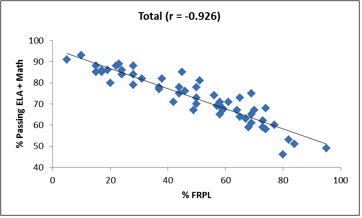
Consider, for example, the following chart which shows the percent of students who passed both the ELA (English/Language Arts) and Math portions of the 2013 ISTEP as a function of the percentage of students in the corporation (Indiana’s districts) who qualify for free- or reduced-price lunches (FRPL, a commonly used measure of SES):

istep1

These data are based on the 56 corporations that have at least 5000 students in the district. As can be seen, there is a very strong correlation between the two variables: The higher the percentage of kids who qualify for FRPL, the lower the passing percentage. Another way of putting it is, if we know the socioeconomic profile of a corporation we can make a very good prediction of where that corporation stands compared to other corporations on the ISTEP. This should not be a surprise to those familiar with the research literature. The same relationship has been found for the various standardized tests used throughout the country.

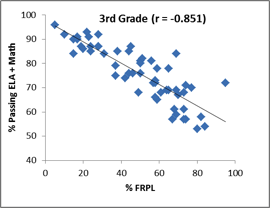
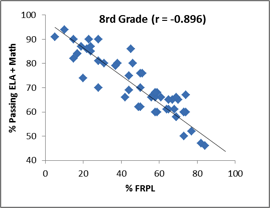
The above results are based on the performance of all students in each corporation. The following charts show the results separately for 3rd and 8th graders:

istep2istep3

Again, we see the same pattern for both grade levels, basically unchanged after 5 years of schooling in a high-scoring or low-scoring corporation. The SES influence is quite strong independently of the schools and teachers in a particular corporation. In fact, if anything, the SES impact appears to become slightly stronger as students progress from the 3rd to 8th grade.

So what are we to make of this obvious association between ISTEP scores of SES? The seemingly inescapable conclusion is that corporations and teachers deserve neither praise nor criticism for how their student compare to other corporations and teachers. Clearly, the socioeconomic profile (SES) of the corporation plays a decisive role. So I ask a simple question: Does anyone seriously believe that if Carmel and Gary (a high and low-performing corporation, respectively) exchanged teachers, the ISTEP scores would suddenly reverse themselves? I don’t think so.

The challenge thus becomes how to respond to the fact that poorer kids are not performing well in our schools. Is there less parental involvement in these communities? Are expectations lower? Do these parents need additional help in becoming more effective mentors? Are after-school tutoring programs a possible solution? What about summer programs? Or pre-school programs? Perhaps all of the above, along with addressing the well-documented and devastating effects that poverty has on the health and well-being of poor children long before they even enter school3.

But one thing seems clear: Judging school and teacher quality on the basis of test scores offers little in the way of a solution. We need to look beyond our schools and teachers if we are going to better prepare all kids for the world they will face in the days ahead.

1Charles J. Morris is an Emeritus Professor of Psychology from Denison University. He resides in Indianapolis.

2Matthew Di Carlo, Shanker Institute (see http://shankerblog.org/?p=74#more-74)

3Diane Ravitch, Reign of Error (New York: Knopf, 2013, pp. 91-98).