Archives for the month of: January, 2013

Abby Rappaport is one of our best education journalists, and she is mostly covering Texas politics these days.

In this article, she explains the escalating revolt against testing in Texas, where it all started.

The bottom line: Texas has been obsessed with testing for the past two decades, and people are just plain sick of it. The last legislature cut $5.4 billion from the schools’ budget, but managed to find $500 million for Pearson. Abby estimates that in the next few years, Pearson will collect over $1 billion from Texas taxpayers.

That’s a lot of money by anyone’s reckoning.

The school boards are sick of it. More than 80% have passed resolutions against high-stakes testing.

Parents are sick of it. Legislatures are getting complaints in the grocery store and wherever they run into parents in their district.

Happily, Texas Republicans are sick of all the testing. Many come from small towns and rural areas and their constituents are button-holing them. They don’t want to tear up their local public school and close it down because of test scores.

Last September 30, I spoke to a joint meeting of the Texas Association of School Administrators and the Texas School Boards Association. I got a wonderful, wild, Texas-size reception. They don’t like what’s going on. They talk to their legislators. Nobody had a good word for the reign of Pearson.

So, please, all eyes on Texas. Let’s all cheer for the testing revolt that’s growing there by the hour.


Jeannie Kaplan is an elected member of the Denver Board of Education. She has been critical of corporate-style reform and of the heavily-funded effort to persuade the public that it is successful. When she heard that Jonah Edelman of Stand for Children told an audience in Tulsa recently that Denver was a national model of success, she decided to review the score card for the district. (Stand for Children boasts of its civil rights credentials but supported a slate of Republican candidates for the state legislature in 2012, as part of its campaign for corporate reform).

Kaplan wrote for this blog:

So Much Reform. So Little Success

Denver, Colorado is a poster child for much of what reformers like to see: standardized testing, teacher accountability, charter schools, choice, co-location, and oh, did I mention testing? Denver Public Schools is trying or has tried almost all of them. Why, even Jonah Edelman, founder of one of the most well-funded, prominent reform organizations, Stand for Children, just today, January 10, 2013, pointed to Denver as a leader in reform because of its “portfolio” of school choice led by its charter schools. So, how is reform really working in Denver?

Let’s start by focusing on achievement, meaning test scores, since that is the focus of all things reform. (This post will have a lot of data since reform and data go hand in hand these days, especially data that can be spun). Denver Public Schools have been rated by the Colorado Department of Education as “Accredited with Priority Improvement Plan,” for the last three years. Out of five grades this is the second to the bottom. To be fair, DPS is inching toward the next category, “Accredited with Improvement plan.” The cut point is 52% of eligible points; Denver is at 51.7%. I am not sure how meaningful this data point is, since the GROWTH points count for 35 points out of 100 and ACADEMIC ACHIEVEMENT, meaning proficiency, counts for only 15.

Colorado now places enormous emphasis on “the growth model.” While no one would contest you need to have growth to get to proficiency, I believe this model masks what is really happening, and so the data I am citing is all about proficiency. To further emphasize how growth can mask proficiency, allow me to quote from one of Denver’s most ardent reformers, Alexander Ooms, who said on in a commentary on EdNewsColorado:

“Denver can celebrate academic growth for years to come without making much progress in the exit-level proficiency of students. And that is simply not the right direction. Growth is means, not end.”http://www.ednewscolorado.org/2012/05/23/38581-commentary-our-unhealthy-obsession-with-growth to read his entire commentary.

I could not have said it better. The data I cite are proficiency numbers, not growth numbers.

In 2005, when reform was in its infancy, Denver Public Schools hired its first non-educator superintendent: Michael Bennet, former businessman/lawyer, former mayoral chief of staff . Mr. Bennet’s childhood friend and fellow businessman, Tom Boasberg, was hired to replace him when Bennett became a Senator. Denver has been experimenting with reform since then. Oh, and BTW, Jonah Edelman grew up as Tom Boasberg’s neighbor in Washingon, D.C.

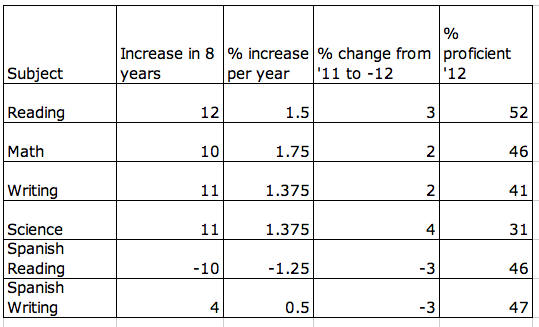
After 8 years, what academic changes has reform produced?

The following data is from 2005 through 2012, according to Colorado standardized tests. Here is the website for a deeper delve into the data

http://www.schoolview.org/performance.asp

ACHIEVEMENT:

Screen shot 2013-01-12 at 4.32.48 PM
We can’t leave achievement without looking at the State of the Union shout-out school, Bruce Randolph. Bruce Randolph Middle School in 3 years of state tracked data shows a gain of 2% in reading to 28%, stayed at 19% in math, increased by 3% in writing to 17%, and increased 7% in science to 17%. It is tied for last in proficiency – 52nd – for all of Denver’s middle schools.

Bruce Randolph High School has declined 10% to 33% in reading, declined 3% in math to 10%, declined 2% in writing to 14% increased 1% to 12% in science. Bruce Randolph is 24th out of 27 high schools in academic achievement.

ACHIEVEMENT GAP increases based on 7 years of CSAPs/TCAPs

Elementary School

Reading 4.17
Writing 5.78
Math 6.46

Middle School

Reading 3.23
Writing 4.71
Math 6.72

High School

Reading 3.01
Writing 5.82
Math 6.30

According to DPS data, the gap between FRL and paid-lunch students has widened by 9% since 2005. In 2005, percent proficient for FRL was 29%, paid was 58%. In 2012 the numbers were 41% for FRL, 79% for paid. The gap has grown to 38%.

ACT RESULTS: (A composite score of 21 is generally accepted as a college readiness benchmark)

From a DPS presentation of September 2012​

2005 17
2012. ​17.6

GRADUATION for 2011 – we are still waiting state numbers for 2012 but the number of students graduating increased from 2,642 in 2005 to 3,414 in 2012, for a total of 772 more graduates in 8 years…or an average of 96.5 more graduates each year.

Here is how Denver Public Schools compares with the state:

State​​ 73.9%
Denver ​ 56.1%

REMEDIATION (from Fall of 2010)

From the Fall of 2007, when this data was first available to the Fall of 2010 (the latest data available, remediation numbers have increased from 57.1% to 59.7%. The state of Colorado is at 31.8%.

This is the achievement for 8 years of reform.

Need I say more?
Many people have written to ask for a link to Gary Rubinstein’s “open letters to ‘reform’ leaders.”

Those who read them say they are brilliant, and indeed they are.

As you may know, Gary was one of the first alums of TFA. He became a career teacher.

He teaches mathematics at Stuyvesant High School in New York City.

He blogs regularly and whatever he writes is worth reading.

He is one of the best informed and reasonable critics of corporate-style reform in the blogosphere.

Jeannie Kaplan is an elected member of the Denver Board of Education. She has been critical of corporate-style reform and of the heavily-funded effort to persuade the public that it is successful. When she heard that Jonah Edelman of Stand for Children told an audience in Tulsa recently that Denver was a national model of success, she decided to review the score card for the district. (Stand for Children boasts of its civil rights credentials but supported a slate of Republican candidates for the state legislature in 2012, as part of its campaign for corporate reform).

Kaplan wrote for this blog:

So Much Reform. So Little Success

Denver, Colorado is a poster child for much of what reformers like to see: standardized testing, teacher accountability, charter schools, choice, co-location, and oh, did I mention testing? Denver Public Schools is trying or has tried almost all of them. Why, even Jonah Edelman, founder of one of the most well-funded, prominent reform organizations, Stand for Children, just today, January 10, 2013, pointed to Denver as a leader in reform because of its “portfolio” of school choice led by its charter schools. So, how is reform really working in Denver?

Let’s start by focusing on achievement, meaning test scores, since that is the focus of all things reform. (This post will have a lot of data since reform and data go hand in hand these days, especially data that can be spun). Denver Public Schools have been rated by the Colorado Department of Education as “Accredited with Priority Improvement Plan,” for the last three years. Out of five grades this is the second to the bottom. To be fair, DPS is inching toward the next category, “Accredited with Improvement plan.” The cut point is 52% of eligible points; Denver is at 51.7%. I am not sure how meaningful this data point is, since the GROWTH points count for 35 points out of 100 and ACADEMIC ACHIEVEMENT, meaning proficiency, counts for only 15.

Colorado now places enormous emphasis on “the growth model.” While no one would contest you need to have growth to get to proficiency, I believe this model masks what is really happening, and so the data I am citing is all about proficiency. To further emphasize how growth can mask proficiency, allow me to quote from one of Denver’s most ardent reformers, Alexander Ooms, who said on in a commentary on EdNewsColorado:

“Denver can celebrate academic growth for years to come without making much progress in the exit-level proficiency of students. And that is simply not the right direction. Growth is means, not end.” http://www.ednewscolorado.org/2012/05/23/38581-commentary-our-unhealthy-obsession-with-growth to read his entire commentary.

I could not have said it better. The data I cite are proficiency numbers, not growth numbers.

In 2005, when reform was in its infancy, Denver Public Schools hired its first non-educator superintendent: Michael Bennet, former businessman/lawyer, former mayoral chief of staff . Mr. Bennet’s childhood friend and fellow businessman, Tom Boasberg, was hired to replace him when Bennett became a Senator. Denver has been experimenting with reform since then. Oh, and BTW, Jonah Edelman grew up as Tom Boasberg’s neighbor in Washingon, D.C.

After 8 years, what academic changes has reform produced?

The following data is from 2005 through 2012, according to Colorado standardized tests. Here is the website for a deeper delve into the data

http://www.schoolview.org/performance.asp

ACHIEVEMENT:

8 yr increase–% incrse per year–% chnge from ’11-’12–% proficient

Reading – — 12———-1.5 ———– 3 –————— 52

Math — — 10———–1.75————–2———————-46

Writing —- 11——— 1.375————2———————41

Science —– 11 —— 1.375 ——— 4 ——————31

Lectura -10 /—–// -1.25 /// -3 /// 46
Spanish Reading

Escruita 4 ////—/ .5 ///// -3 ////// 47
Spanish Writing

We can’t leave achievement without looking at the State of the Union shout-out school, Bruce Randolph. Bruce Randolph Middle School in 3 years of state tracked data shows a gain of 2% in reading to 28%, stayed at 19% in math, increased by 3% in writing to 17%, and increased 7% in science to 17%. It is tied for last in proficiency – 52nd – for all of Denver’s middle schools.

Bruce Randolph High School has declined 10% to 33% in reading, declined 3% in math to 10%, declined 2% in writing to 14% increased 1% to 12% in science. Bruce Randolph is 24th out of 27 high schools in academic achievement.

ACHIEVEMENT GAP increases based on 7 years of CSAPs/TCAPs

Elementary School

Reading 4.17
Writing 5.78
Math 6.46

Middle School

Reading 3.23
Writing 4.71
Math 6.72

High School

Reading 3.01
Writing 5.82
Math 6.30

According to DPS data, the gap between FRL and paid-lunch students has widened by 9% since 2005. In 2005, percent proficient for FRL was 29%, paid was 58%. In 2012 the numbers were 41% for FRL, 79% for paid. The gap has grown to 38%.

ACT RESULTS: (A composite score of 21 is generally accepted as a college readiness benchmark)

From a DPS presentation of September 2012​

2005 17
2012. ​17.6

GRADUATION for 2011 – we are still waiting state numbers for 2012 but the number of students graduating increased from 2,642 in 2005 to 3,414 in 2012, for a total of 772 more graduates in 8 years…or an average of 96.5 more graduates each year.

Here is how Denver Public Schools compares with the state:

State​​ 73.9%
Denver ​ 56.1%

REMEDIATION (from Fall of 2010)

From the Fall of 2007, when this data was first available to the Fall of 2010 (the latest data available, remediation numbers have increased from 57.1% to 59.7%. The state of Colorado is at 31.8%.

This is the achievement for 8 years of reform.

Need I say more?

The conservative journal Ednext has a poll that may be of interest to readers of the blog.

The last time the editors had a poll, it was for best education book of the decade (2000-2010), my book won the contest, much to the consternation of the editors.

This time, almost every book on the list promotes corporate reform, except for two: Diana Senechal’s “Republic of Noise,” which is a plea to restore quiet time for reflection and repose. And Paul Tough’s “How Children Succeed,” which makes the case that character matters more than test scores. Please note that my half-sentence descriptions are vast oversimplifications of thoughtful books.

I will vote for those two.

I hope you have the time to cast a ballot if you are familiar with the books.

Vic Smith sends out bulletins about statehouse politics in Indiana. This is his latest, which includes a good summary about the current plan to expand vouchers in Indiana.


Dear Friends,
The Senate Education Committee will vote on the voucher expansion bill, Senate Bill 184, on Wednesday afternoon, Jan. 16th.  Please contact the Senators on the committee before the vote to express your
opposition.
 
The hearing on Senate Bill 184 sponsored by Senator Yoder revealed a division within the committee.  Even before public testimony on the bill began, Senator Kenley expressed his continued support of the position the Senate took when the voucher bill was passed, that is, that students should try public schools first.  Eligibility for vouchers required a year in public schools for that reason.  Then if students move to a private school, there is a cost savings. Under Senate Bill 184, the cost savings disappear when siblings who have not been in public schools receive a voucher and a new fiscal cost must be funded in the budget.
Senator Kenley, as quoted in Scott Elliott’s story in the January 12th Star, said it well:  “We passed the original bill on the assumption that you go to public school first.  This changes the premise.  It’s a pretty fundamental change.”
Fiscal Cost for Indiana Taxpayers
 
Scott Elliott’s story also quoted the testimony of ICPE lobbyist Joel Hand citing the extra fiscal costs that a sibling voucher expansion would bring: “Based on the $3932 average voucher, he said, if just one in 10 of the 9,130 students in the program had a sibling not in public school who used a voucher next year it would cost Indiana about $3.5 million annually. If a quarter of the students had a sibling who used a voucher it would cost Indiana nearly $9 million a year.”
The extra fiscal cost in the millions of dollars is clear and substantial, in a state that in the last budget zeroed out state funding for professional development, which in the previous budget was given $5.5 million a year.  Is helping private school parents pay tuition a higher priority than professional development?
Financial Relief for Private School Parents
 
Keep in mind that the biggest impact of SB 184 would be financial relief for private school parents.  With the exception of incoming kindergarten and first graders, it would allow no new students to go to a private school.  The older students covered by this bill are already in private schools.
Instead for all older siblings, this bill is about giving financial relief to the parents of current private school students, parents who happen to have another younger child who has qualified for a voucher.
 
Giving a voucher to an older sibling who is already in a private school does nothing to expand school choice.  The choice was already made. Now this bill helps parents pay for their previous choice with your tax money.
Giving financial relief to parents of private school students would be a generous thing for the state to do, but other parents would wonder why they aren’t being favored by the state with financial relief as well.  Public school parents have been asking for financial relief for school textbook rental for over a decade.  Why, they should ask, are private school parents getting relief when we are not?
 
Testimony on the Bill
 
In public testimony on Senate Bill 184 last Wednesday, five speakers spoke in favor of the bill followed by eight speaking against the bill.  Karen Combs of Lafayette in her testimony against the bill gave a timely reminder to the Senators that Gov. Daniels himself in a speech given at Harvard explained to his audience how Indiana did it right by having families go to public school first before they are eligible for a voucher.
No additional testimony will be taken, but the committee vote on SB 184 is scheduled for this Wednesday, January 16th in the Senate Chamber, along with votes on three other bills, including the cursive writing bill.  Then the rest of the afternoon is scheduled for testimony on SB 193, the Common Core bill.  Apparently a large crowd is expected which accounts for scheduling the hearing in the Senate Chamber.
As of Monday evening, no meeting has yet been scheduled for the House Education Committee.
Contact the Committee Members
 
It is time to contact Senators on the committee on Tuesday and Wednesday before the vote to express your opposition to expanding the voucher program in a way that will for the first time add new and expensive fiscal costs to the program.  That this bill was taken up first in the session shows the wrong priority.  The Senators to contact are as follows:
Chair:  Sen. Kruse
Republican Members:  Senators Yoder, Banks, Buck, Kenley, Pete Miller, Leising and Schneider
Democrat Members: Senators Rogers, Broden, Mrvan, Taylor
You should also add your own Senator to the contact list.  If you made contacts last week, it would not hurt to send another email or note before the vote.  They need to know that public school advocates are watching every step of the way.  One strong advocate opposing Senate Bill 184, Patricia Logan, had an excellent letter to the editor printed in the Indianapolis Star just this morning, January 14th.  Thanks, Trish!  Let’s all turn up the volume!
Thank you for speaking up for public education!
Vic Smith      vic790@aol.com
ICPE is working to promote public education in the Statehouse as efforts are made to take public money away from public schools through an expansion of vouchers.  We are well represented by our lobbyist Joel Hand, but to keep him in place we need all members from last year to renew and we need new members who support public education.
Go to www.icpe2011.com for membership and renewal information.
 
 
Some readers have asked about my background in Indiana public schools.  Thanks for asking!  Here is a brief bio:
I am a lifelong Hoosier and began teaching in 1969.  I served as a social studies teacher, curriculum developer, state research and evaluation consultant, state social studies consultant, district social studies supervisor, assistant principal, principal, educational association staff member, and adjunct university professor.   I worked for Garrett-Keyser-Butler Schools, the Indiana University Social Studies Development Center, the Indiana Department of Education, the Indianapolis Public Schools, IUPUI, and the Indiana Urban Schools Association, from which I retired as Associate Director in 2009.  I hold three degrees: B.A. in Ed., Ball State University, 1969; M.S. in Ed., Indiana University, 1972; and Ed.D., Indiana University, 1977, along with a Teacher’s Life License and a Superintendent’s License, 1998.

G.F. Brandenburg is the unofficial watchdog for the D.C. public schools.

In this post, he includes a link to the court documents that contains Adell Corthorne’s account about the cheating that she saw, what happened when she reported it, and her belief that the district received Race to the Top funding based on inflated test scores.

This is a jaw-dropper.

Mother Crusader is angry again.

Despite the success of parents in keeping a Hebrew charter school from opening in Highland Park, one opened in East Brunswick called the Hatikvah International Academy Charter School. Since there was not enough demand in East Brunswick for the school, it draws students from 17 other districts, including Highland Park, which previously rejected a charter.

What is striking here is that the new charter is enrolling students who never attended public schools, but the public schools lose money by paying for them from their budget.

So, for example, there are students transferring out of Jewish day schools to the new charter, but the public school in their home district must pay their tuition. A

And there are students starting kindergarten who never attended public school, but their tuition comes out of the public school budget.

As she explains:

Only 110 of their 194 students are from East Brunswick, which seriously undermines the idea that this school was “needed” or “wanted” in the community it was approved to serve.  If they need to cast such a wide net to fill their seats, what does that mean about the NJDOE’s decision to approve this charter, and it’s decision to keep it open despite the VERY limited interest in East Brunswick?

According to the official enrollment numbers, Hatikvah serves 13 students from Highland Park, costing our district just shy of $165,000.  Highland Park had absolutely NO SAY in the approval process when Hatikvah was being considered by the NJDOE, yet proportionately the school is having almost the same impact it has in East Brunswick (Hatikvah serves .08% of Highland Park’s public school students, and 1.3% of East Brunswick’s).  

Highland Park administrators have found that the majority of children attending Hatikvah have never been served in our public schools – either parents place their children into Hatikvah in Kindergarten, or they transfer from private, religious schools. Nonetheless, our district is billed $12,692 (13 students at a cost of $165,000 = $12,692) per student, so the Hatikvah bill is just a loss of revenue from our district with no cost savings at all.  

In addition, the sending districts must pay transportation of the charter students, another $900 per student.

Who are the losers in this deal?

First, the traditional Jewish day schools lose enrollment and are harmed, just as Catholic schools are harmed when charters open.

Second, the competition has cost the East Brunswick school. It added full-day kindergarten to compete, which is good, but made up for the lost revenue by cutting:

The elementary foreign language program
The summer Academy for at-risk students
21 extra-curricular clubs
3 sports programs

So, to open a charter for several dozen students, the children in the entire district lose.

And 20 more such charters are in the works.

Jonathan Pelto has unearthed a shocking story of a school district in Connecticut that is being pulled apart, privatized, and spit out by pseudo-saviors.

Windham, Connecticut, was in academic trouble so the state board of education appointed a “special master” to oversee school reform and the legislature appropriated $1 million per year extra. The district of 3,500 students has many who are impoverished and/or non-English-speaking.

Of the $2 million allocated in the first two years, some $750,000 went for the salary and benefits of the “special master” and his personal staff. More money went for consultants. Charters will open , one run by a group with the amazingly candid name “Our Piece of the Pie.” Among their sterling credentials: they run a charter school with six (6) students.

It is not clear that any of the new money will directly benefit students, such as, hiring another social worker or providing after-school programs.

Is anyone in Connecticut paying attention? Does anyone care?

Parents in the Binghampton district in Tennessee are furious that the state took over their school, changed the name and colors, brought in an inexperienced staff, and no one thought to consult them.

Tennessee created the “Achievement School District” and put charter founder Chris Barbic in charge. Barbic, a graduate of the unaccredited Broad Superintendents Academy, has promised to take the schools scoring in the bottom 5% and put them in the state’s top 25% in five years. He has the authority to take control of low-performing schools to turn them around.

One of them is Lester School, now renamed Cornerstone Preparatory School and turned into a charter.

At the community meeting, feelings ran high:

“Parents resent an outside group coming in and taking over, particularly, they say, when there is scant evidence teachers and staff are experienced enough to know what they are doing.

“They are furious that the school’s name and colors were changed without input. And they question why the principal has never led an inner-city school and earned her education degree only two years ago.

“And you think you and this gentleman here know what African-American children need?” radio show host Thaddeus Matthews asked Wednesday, pressing Settle to explain why more than half the teachers in the school are in the process of being licensed to teach, but not yet certified.

“It is disrespectful to this community that you are going to come in and make a decision about the lives of children in this community and get no community input. The people in this community have a right to be represented,” he said.”

Barbic promised to work with the community to try to “work out the issues.”

It won’t be easy. Apparently the Cornerstone staff is applying “no excuses” behavior policies, and the parents call it child abuse. “Anger first boiled over in a meeting Dec. 19 at the Lester Community Center. One little girl told the crowd of 120-plus people in a three-hour meeting that her teacher refused to let her use the restroom or get her fresh clothes when she wet her pants. She also said the teacher took her shoes, apparently because she was slow tying her laces. Other parents said teachers twisted their children’s arms or took their shoes as punishment.”

The school is trying to calm the situation: “Cornerstone called more than 100 parents during the holiday break, sent letters to each family and scheduled grade-level meetings with parents, starting last week, to talk over their concerns.”

Let me add that I like Barbic’s pledge. It is concrete and it has a five-year deadline. He can be held accountable in five years. It is not clear what happens if he doesn’t meet his goal. Will he be fired? If he accomplishes it, he can then go to work on the next group of schools in the bottom 5%. Statistically, there is always a bottom 5%.