A few readers asked for more information about the men who spent two years building a handmade boat. Here they are.
I subscribed to Jay Kuo’s blog, The Status Kuo, and I hope he will forgive me for quoting today’s post at length. Jay is a multi-talented man. This is his Linked In profile:
I am the CEO and founder of The Social Edge, a social media and digital publishing company based in New York City.
I am also a composer/lyricist/playwright. My show Allegiance–a story of love, loss and heroism during the Japanese American internment, starring George Takei and Lea Salonga–opened in the fall of 2015 and had its LA premiere in 2018. Tokyo Premiere in March 2021. London January 2022.
I am a two-time Tony winning Broadway co-producer (Hadestown, The Inheritance)
My background is in law. I am an appellate litigator admitted to practice in California, the Ninth Circuit and the U.S. Supreme Court.
Here is Jay’s report on Trump’s Acceptance speech, which I’m glad I missed:
Someone didn’t have the cajones to tell Trump not to write his own speech and to stay on script. The result was an embarrassing end to the entire Republican National Convention.
Trump began as expected, leaning into his new-found martyrdom and sporting a bandaged ear. Many MAGA faithful decided to wear bandages, too, as a symbol of fealty because “they aren’t sheep.”
Then it got weird. Trump veered off into la-la land with references to Hannibal Lecter, 2020 election denialism, praise for authoritarians like Viktor Orbán, and (checks notes) how he could stop wars with a single telephone call.
“This is the first good thing that’s happened to Democrats in the last three weeks,” observed David Axelrod, with a characteristic backhanded slap to his own party. “This really reminded everyone why Donald Trump is fundamentally unpopular outside this room.”
Pundits watching in real time were scathing. Because it’s Schadenfriday, I pulled together some of the commentary for your consumption, organized into basic buckets of why his speech sucked.
Trump has the discipline of a five year old
Earlier in the week, I conveyed my skepticism that Trump could ever recast himself and avoid being the petty, vindictive man he truly is, even after nearly being killed by a lone shooter. His speech last night proved this prediction correct.
Right after he got through talking about the shooting—a beginning that was carefully scripted and in fairness he pulled off fairly well—there was “a jarring tone shift” per Washington Post editorial board member Shadi Hamid. “It almost seems schizophrenic,” he observed.
That’s because Trump’s brain is actually not okay. The media underreports this, but it was on full display last night.
In reverting to his standard campaign speech—a hodge-podge of political grievance, personal attacks, meandering stories, and truly bizarre references—Trump forgot he had a national television audience before him, speaking instead to the MAGA faithful who already know this weird and disquieting speech well.
Even the New York Times, which has been stanning for Trump in its headlines by calling him “muscular” and referring to the “coronation” he would receive on Thursday, conceded that Trump has a “challenge with discipline.” That’s a candidate for understatement of the year. After the scripted part was over, the Times reporters agreed that Trump “could not resist falling back into the kind of rambling, unscripted diatribe that has long been his signature style.”
“Trump has reverted to factory settings,” noted Jim Geragthy, who is the senior political editor of the National Review and not exactly a liberal. “Biden is watching this in Delaware and saying to Jill, ‘See? I’m not that bad!’” he joked.
Unity is for suckers and losers
“Trump the unifier” is a laughable idea. It stands in contrast to everything we know about the man, who has done more to divide this country than any single person since the Civil War.
And certainly in the speech last night, there was none of the unity Trump had promised. The Times headline read, “Trump Struggles To Turn the Page on ‘American Carnage,’” noting,
He derided former House Speaker Nancy Pelosi as “Crazy Nancy.” Less than four years removed from office, he said America was already a “nation in decline.” He waxed hyperbolic about the immigration crisis, calling it “the greatest invasion in history” and compared undocumented migrants to Hannibal Lecter, the fictional serial killer and cannibal from “The Silence of the Lambs.”
Those in CNN’s focus group in Michigan agreed. “I gave his speech a D,” said one undecided voter. “He started out great, but then he went into mistruths and grievances and attacks. It just totally contradicted itself in terms of what he wanted to achieve with unity.” (CNN’s fact-checker Daniel Dale counted no less than 22 false claims in the speech.)
As Aaron Blake of the Washington Post reported, the “initially subdued manner and calls for unity didn’t match the content of an often divisive speech.” In addition to the moments the Times recounted above, Blake observed that Trump also called for the firing of the head of the United Auto Workers, called a Democratic senator a “total lightweight,” and cited the “China virus.”
When that phrase popped up, it was like we time traveled to 2020…
We know that Trump thrives on division and chaos. And he couldn’t even manage to stick to a prepared speech after promising unity just four days ago.
Long, winding, and boring
Historians take note: This was the longest presidential nomination acceptance speech since they began timing these things. It clocked in at 93 minutes.
”[H]e hasn’t given any speeches for nearly a week, and he has a lot of pent-up words that he is releasing now,” observed Washington Post opinion columnist Charles Lane rather dryly.
Notably absent from his speech, as the Biden Campaign pointed out, were any references to Project 2025, how he has harmed American women by getting Roe v. Wade overturned, or his promise to pardon the January 6 insurrectionists.
There was also no organization to his words, which is indicative of Trump’s management style. He not only rambled but circled fully back to things he already said earlier, like trashing on electric vehicles. His speeches are “like lazy Susans,” remarked Washington Post contributing columnist Ramesh Ponnuru.
Near the 90 minute mark, Alexandra Petri, whose work in McSweeney’s I adore, quipped, ”When I agreed to do this live blog, I did not realize I was signing the best years of my life away.” She compared it to the movie Up. “The first 10 minutes had emotion and were unlike anything I’d seen. The remaining 70 minutes were just an angry man roving wildly at large for unclear reasons.”
The only possible good news for Trump is that people probably stopped watching it after the first 45 minutes. But the folks in the convention hall, who normally get to start leaving a Trump rally early, were stuck listening to him as the speech stretched past midnight Eastern time.
Even pollster and analyst Nate Silver, who has been particularly hard upon President Biden for not dropping out of the race, went through all the stages of Trump fatigue in real time, first calling it a weird but pretty good speech, then calling it boring AF, then fully retracting and rescinding this earlier statement, saying “it seems both parties are trying to throw this election…”
“Is… is it over?” asked Jim Geraghty. “Quick, someone release the balloons, before he starts talking again!”
The speech was so bad that Ana Navarro had a strong message for Democrats who soured on Biden after his poor debate performance:
“If this clinically-insane Trump speech does not get Democrats out of their defeatist doldrums, and focused and energized around electing their nominee—instead of tearing him down—I don’t know what will.”
The paper tiger
On Monday I observed that an orange tiger like Trump can’t change his stripes, the attempt on his life notwithstanding. But I also called him a paper tiger for a reason: He isn’t invincible, scary or dominating at all. He’s an old man operating on autopilot, full of piss and vinegar and entirely unlikeable.
No matter what Democrats are going through presently and who the party’s nominee ultimately is, the Donald Trump that was up there on the most important night of his future political career is someone the majority of voters would resoundingly reject, just as they did in 2020. We need to understand that and then lean into it hard. Make this election about him, and we win it.
Yeah, we can beat this guy.
Glenn Kessler is the fact-checker for the Washington Post. In this column, he identifies misstatements and lies in Trump’s speech at the Republican National Convention.
He wrote:
Former president Donald Trump’s 92-minute speech accepting the Republican presidential nomination on the final night of his party’s national convention rambled, often incoherently, through a hit parade of his favorite falsehoods, many of them ad-libbed instead of drawn from his prepared remarks. Here are 34 claims that caught our attention, in the order in which he made them. As is our practice, we do not award Pinocchios for a roundup of statements made during convention events.
“When we handed over a stock market that was substantially higher than just prior to covid coming in, did a great job, never got credit for that.”
Trump as president frequently touted the rise of stock prices during his presidency. The S&P 500 index gained about 70 percent during his first term. But it has gone up 50 percent under Biden. Moreover, the record under Barack Obama beat both men.
“The biggest tax cuts ever.”
This is one of Trump’s favorite falsehoods. Trump’s tax cut amounted to nearly 0.9 percent of the gross domestic product, meaning it was far smaller than President Ronald Reagan’s tax cut in 1981, which was 2.89 percent of GDP.
Trump’s tax cut is the eighth-largest tax cut in the past century — and even smaller than two tax cuts passed under President Barack Obama. Trump’s tax cut was heavily tilted toward the wealthy and corporations.
“The biggest regulation cuts ever.”
Trump’s claim of the most or biggest regulation cuts cannot be easily verified and appears to be false. There is no reliable metric on which to judge this claim — or to compare him with previous presidents. Many experts say the most significant regulatory changes in U.S. history were the deregulation of the airline, rail and trucking industries during the Carter administration, which are estimated to provide consumers with $70 billion in annual benefits. A detailed November 2020 report by the Penn Program on Regulation concluded that “without exception, each major claim we have uncovered by the President or other White House official about regulation turns out to be exaggerated, misleading, or downright untrue.” The report said that the Trump administration had not reduced the overall number of pages from the regulatory code book and that it completed far more regulatory actions than deregulatory ones once the full data set was examined.
“‘Right to Try’ was a big deal. We got Right to Try. They were trying to get that for 52 years.”
Right to Try wasn’t a protracted battle — the idea emerged in 2013. (Trump often falsely claims it was a 45-year or 50-year battle, or as he did here, 52 years.) The initiative allowed for the use of experimental drugs, not approved by the Food and Drug Administration (FDA), as a last resort for those unable to participate in clinical testing who have also exhausted all other treatment options. The FDA had already approved 99 percent of requests for access to unapproved drugs, but supporters thought these policies too restrictive.
“We have an inflation crisis that is making life unaffordable, ravaging the incomes of working and low-income families, and crushing, just simply crushing, our people like never before.”
The monthly inflation headlines are often about the year-over-year inflation rate, as measured by changes in the consumer price index. Inflation reached a high of 9 percent in June 2022. Annualized inflation has dropped significantly since then. The year-over-year figure in June was 3.0 percent.
Inflation initially spiked because of pandemic-related shocks — increased consumer demand as the pandemic eased and an inability to meet this demand because of supply chain issues, as companies had reduced production when consumers hunkered down during the pandemic. Indeed, inflation rose around the world — with many peer countries doing worse than the United States — because of pandemic-related shocks that rippled across the globe.
Wage growth lagged inflation initially in Biden’s term, but it has since caught up. Wages have risen 19.4 percent, compared to cumulative inflation of 19.2 percent. That’s basically treading water, but it’s not as dire as Trump claims.
“I will end the devastating inflation crisis immediately, bring down interest rates, and lower the cost of energy. We will drill, baby, drill.”
Trump has proposed a number of the policies that economists consider to be inflationary, such as a proposal for across-the-board tariffs. (Trump has thrown out a figure of 10 percent, but his staff has said the actual number has not been determined.) Trump has also suggested he would impose a 60 percent tariff on all Chinese goods. While Trump frequently claims tariffs are paid by countries, that’s wrong; the cost of the tariffs generally are passed onto consumers, so it is a form of tax.
The Federal Reserve sets interest rates and Biden has respected its independence, even as it kept interest rates high to keep inflation in check. Cutting interest rates too rapidly could spark inflation.
The Wall Street Journal, in its quarterly survey of forecasters this month, reported “most economists believe inflation, deficits and interest rates would be higher during a second Trump administration than if Biden remains in the White House.”
It also defies economic logic to claim that higher oil production will bring prices down. Domestic oil production and natural gas production are already at record highs under Biden.
“By doing that, we will lead a large-scale decline in prices. Prices will start to come down. Energy raised it.”
Continuing this theme, Trump jumps the shark to claim the solution to inflation is to expand domestic oil production. Energy costs are volatile, and so many economists prefer to focus on what is known as “core inflation” — the price of goods and services excluding energy and food. That’s because energy, like food, is a staple, and demand doesn’t change much no matter the price. People generally need to keep driving cars and eating food. Oil and gas, along with some food products like pork, are also commodities and trade on exchanges, making prices subject to speculation depending on weather, wars and other unforeseen events. Egg prices, in fact, spiked as much as 230 percent in January 2023 because of the bird flu.
“We’ll start paying off debt and start lowering taxes even further.”
Trump often has magical thinking about the national debt. When he first ran for president, Trump confidently claimed that he could eliminate the national debt — then $19 trillion — in just eight years through better trade deals. We gave him Four Pinocchios. He walked back the pledge, saying he would reduce a percentage of the debt. That didn’t happen. Instead, under Trump, the debt climbed to $27.8 trillion from not quite $20 trillion, a gain of $7.9 trillion. (More than half of the debt under Trump came in the last 10 months of his term because of the pandemic.)
Running again for president, Trump now claims the debt would be reduced by money generated by oil and natural gas reserves in the ground. But most of the money is earned by oil producers, not the federal government. The federal government might own some of the land and earn leasing fees. Such fees on U.S. federal lands, federal waters and Native American lands amounted to about $20 billion in fiscal 2022,according to CRFB. The government also earns fees from taxes on sales, with a substantial portion already dedicated to transportation projects. All told, the federal government earns about $100 billion a year from fees and taxes on fossil fuel, according to a 2022 report from Resources for the Future, a nonprofit research group.
The United States had a budget deficit almost four times as high — $383 billion — just in the first two months of fiscal 2024 (which began Oct. 1), showing the folly of Trump’s logic.
“People don’t realize I brought taxes way down, way, way down. And yet we took in more revenues the following year than we did when the tax rate was much higher.”
This is poppycock. Before the pandemic, government revenue under Trump was always supposed to go up year after year, despite the tax cut. That’s because the tax cut merely slowed the growth of revenue; it did not reduce it. As predicted by congressional budget analysts, revenue went way down from what had been anticipated before Congress approved Trump’s tax cut, which (along with higher spending) was the reason the federal budget deficit soared despite a good economy — when ordinarily that would mean a reduced budget deficit.
“I will end every single international crisis that the current administration has created, including the horrible war with Russia and Ukraine, which would have never happened if I was president and the war caused by the attack on Israel, which would have never happened if I was president.”
There is no evidence that the invasion of Ukraine or the Hamas attack on Israel would not have happened if Trump had been president. In fact, before Russia’s invasion of Ukraine in February 2022, Trump called Russian president Vladimir Putin a “genius” and “very savvy” for advancing on Ukraine.
“You got to say, that’s pretty savvy,” Trump said on a conservative talk radio show of Putin’s decision to declare certain breakaway regions in Ukraine as independent. “And you know what the response was from Biden? There was no response. They didn’t have one for that. No, it’s very sad. Very sad.” “This is genius,” Trump said. “Putin declares a big portion of the Ukraine … Putin declares it as independent. Oh, that’s wonderful.”
Trump, in his speech, suggested that Iran funded the attack by Hamas but a link has not been established.
“They were ready to make a deal. Iran was going to make a deal with us.”
There is no evidence this is the case. Trump has sometimes claimed that Iran personally warned him they would attack a U.S. base and deliberately miss it. In reality, a vague warning without a target was given to the Iraqi president — and most of the missiles hit the base. No one was killed, but that was more a result of a well-planned evacuation than Iranian targeting. Despite no fatalities, many soldiers suffered serious brain injuries.
“They [Democrats] used covid to cheat [in the election] and [we’re] never going to let it happen again.”
More than sixty lawsuits were filed over the 2020 election, but not a single court identified fraud.
“Now Iran is very close to having a nuclear weapon, which would have never happened.”
Trump pulled out of an international nuclear agreement restraining Iran’s nuclear ambitions that had been negotiated over many years. European allies rejected Trump’s efforts to dismantle the deal and Iran ramped up its nuclear efforts. Biden tried to resurrect the deal, but could not bring Iran back to the negotiating table.
“Just a few short years ago under my presidency, we had the most secure border [in the history of our country].”
Annual apprehensions at the southwest border totaled 310,531 in fiscal year 2017, which included part of the Obama administration, and that was the lowest since 1971. But then the numbers spiked in Trump’s term, reaching 859,501 in fiscal year 2019, the highest since 2009. Apprehensions plunged in April 2020 because of lockdowns at the start of the pandemic.
“We had the greatest economy in the history of the world”
One of Trump’s favorite falsehoods is that he created the greatest economy in U.S. history, but he amps it here to encompass the whole world. That’s ridiculous.
Before the coronavirus pandemic shuttered businesses and sent unemployment soaring, the president could certainly brag about the state of the economy in his first three years as president. But he ran into trouble when he made a play for the history books to say it was the best economy ever.
By just about any important measure, the economy under Trump did not do as well as it did under Presidents Harry S. Truman, Lyndon B. Johnson and Bill Clinton. The gross domestic product grew at an annual rate of 2.3 percent in 2019, slipping from 2.9 percent in 2018 and 2.4 percent in 2017. But in 1997, 1998 and 1999, GDP grew 4.5 percent, 4.5 percent and 4.7 percent, respectively. Yet even that period paled in comparison with the 1950s and 1960s. Growth between 1962 and 1966 ranged from 4.4 percent to 6.6 percent. In postwar 1950 and 1951, it was 8.7 percent and 8 percent, respectively.
The unemployment rate reached a low of 3.5 percent under Trump, but for several months in 2023, the unemployment rate under Biden fell to as low as 3.4 percent. The unemployment rate dipped as low as 2.5 percent in 1953.
“We had no inflation.”
There was inflation under Trump — about 1.9 percent a year. That was pretty good but it was 1.4 percent a year under Obama.
“We’ve suffered the worst inflation we’ve ever had.”
Inflation under Biden has been the highest in four decades, but 9 percent is not the worst in history. It was 18 percent in 1946, more than 12 percent in 1974, more than 13 percent in 1979 and 12.5 percent in 1980. Many other years were at or near 9 percent.
“Our cities are flooded with illegal aliens. Americans are being squeezed out of the labor force and their jobs are taken. And by the way, you know who’s taking the jobs? The jobs that are created, 107 percent of those jobs are taken by illegal aliens.”
Trump falsely says that undocumented immigrants are taking jobs from U.S. citizens. Employment for the native-born population has increased by more than 7.2 million under Biden, according to the Bureau of Labor Statistics. (We start from February 2021, the first full month that reflects employment under Biden.)
Meanwhile, employment of foreign-born workers increased about 5 million from February 2021 through June, BLS says. The agency says this figure includes more than just undocumented immigrants; it also includes legally admitted immigrants, refugees and temporary residents such as students and temporary workers.
“Under this administration, groceries are up 57 percent, gasoline is up 60 and 70 percent. Mortgage rates have quadrupled.”
These numbers are inflated. Food prices overall have risen 21.4 percent since Biden took office, according to the Bureau of Labor Statistics data that measures inflation for dairy products, meats, and fruits and vegetables.
As for gasoline, the price of crude oil was unusually low when Trump was in office because the coronavirus pandemic flattened economies around the world. After mass vaccination helped reopen many economies, demand increased again. But supply was lacking because oil producers decreased their production levels.
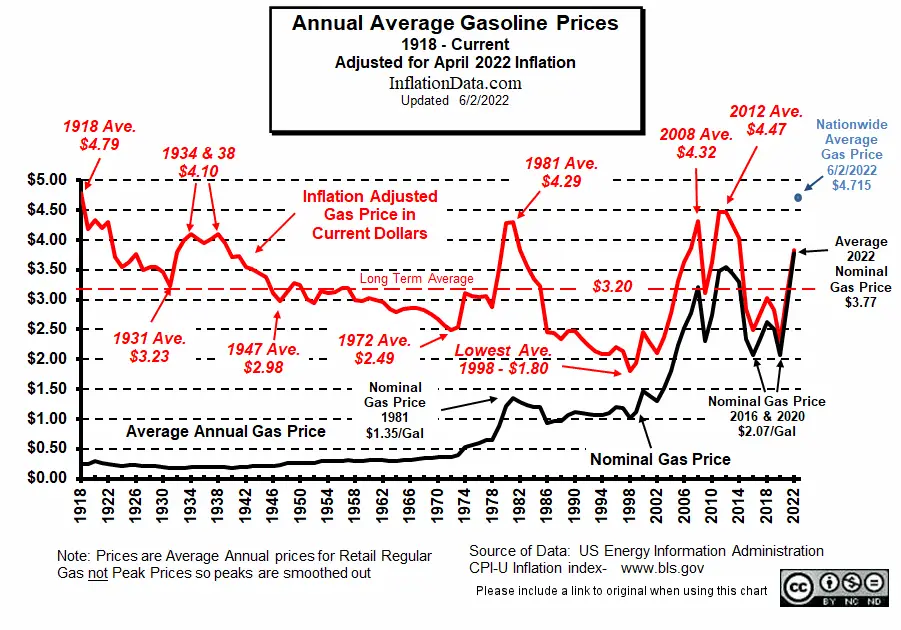
The retail price of gasoline was $2.64 a gallon in January 2021 when Trump left office. The price of regular gasoline now averages $3.52 a gallon, according to AAA. That’s an increase of 33 percent. (On an inflation-adjusted basis, gasoline now is slightly higher than the average of $3.20 over the last 106 years.)
As for mortgage rates, that is the result of Federal Reserve policy designed to tamp down inflation. But they did not quadruple. The average 30-year rate was 2.96 percent in 2021and now is about 7 percent.
“We have more liquid gold under our feet than any other country by far. We are a nation that has the opportunity to make an absolute fortune with its energy.”
This is false. According to the Energy Information Administration, the United States has proven crude oil reserves of 44 billion barrels, which would put the country in 10th place. Venezuela, with 304 billion barrels of oil reserves, is in first place, followed by Saudi Arabia (259 billion), Iran (209 billion), Canada (170 billion) and Iraq (145 billion). The United States ranks fourth in the world in natural gas reserves.
“Under the Trump administration, just three and a half years ago, we were energy independent.”
Trump claims the United States energy independent because it exported more crude and refined products than it imported. (The United States still relied on other countries for its energy needs.) The situation has not changed under Biden. In 2023, the United States imported about 8.51 million barrels per day of petroleum and exported about 10.15 million barrels per day, according to the Energy Information Administration, making the United States still a net exporter.
“This is the only administration that said we’re going to raise your taxes by four times what you’re paying now.”
This is false. For five years, Biden has been consistent in saying he will not raise taxes on people making less than $400,000 a year, which leaves about the top 2 percent of taxpayers. Biden reiterated this pledge in the budget plan he released earlier this year.
“I will end the electric vehicle mandate on day one, thereby saving the U.S. auto industry from complete obliteration, which is happening right now.”
In April, the Environmental Protection Agency issued a regulation designed to promote a transition to more electric vehicles — part of a worldwide trend. The European Union, for instance, has mandated the sale of only zero-emission new cars by 2035.
There is no evidence that electric vehicles will lead to the end of the auto industry. Automakers have invested billions of dollars in electric-vehicle and battery manufacturing. A reportissued by the Environmental Defense Fund in August said $93 billion of announced EV investments and nearly 85,000 in announced jobs took place in the 12 months after passage of the Inflation Reduction Act. In a December research report, Goldman Sachs said that as a result of the Inflation Reduction Act, the United States could be self-sufficient in EV battery production — including mining, components and battery production — by 2030.
“I got rid of NAFTA, the worst trade deal ever made, and replaced it with USMCA, which is, they say, the best trade deal ever made.”
Trump falsely suggests he significantly overhauled the North American Free Trade Agreement (NAFTA) when he replaced it with USMCA. But the new agreement only made modest tweaks to NAFTA, such as modernizing trade rules in effect from 1994 to 2020, giving some wins to U.S. farmers and blue-collar workers in the auto sector. Some elements of the deal were borrowed from the Trans Pacific Partnership, the trade deal Trump scrapped at the start of his term. The U.S. International Trade Commission, which is tasked with evaluating the impact of trade agreements, calculated USMCA would have a relatively minor impact: The USMCA would raise U.S. real gross domestic product by $68.2 billion (0.35 percent) and U.S. employment by 176,000 jobs (0.12 percent).
As for NAFTA being the worst deal ever made, the nonpartisan Congressional Research Service in 2017 concluded that the “net overall effect of the North American Free Trade Agreement on the U.S. economy appears to have been relatively modest, primarily because trade with Canada and Mexico accounts for a small percentage of U.S. GDP,” though it noted that “there were worker and firm adjustment costs as the three countries adjusted to more open trade and investment among their economies.”
“If you go back 20, 25 years, they’ve stolen, going to China and Mexico, about 68 percent of our auto industry manufacturing jobs.”
It’s unclear where Trump gets this figure; as president he would claim the number was 32 percent, but his administration never produced a source. Millions of manufacturing jobs and thousands of U.S. manufacturing establishments have disappeared since NAFTA took effect in 1994, but it’s difficult to isolate how much of that was because of NAFTA and not other factors, such as automation. The studies we reviewed indicate NAFTA had a modest effect on the U.S. economy.
“They’ve just hired, as you know, 88,000 [IRS] agents to go after them even more.”
Trump made this comment after he recounted a story about a waitress complaining about being taxed on her tips. This 88,000 figure is wildly exaggerated. The IRS employees have not yet all been hired and they are not all agents.
When Congress passed a bill to provide the IRS with an additional $80 billion in funding over 10 years, that money was to be used in part to hire 86,852 full-time employees in the next decade. But many of those employees would not be enforcement “agents” but people hired to improve information technology and customer service.
Treasury officials say that because of attrition, after 10 years of increasing spending, the size of the agency will have grown only 25 to 30 percent when the hiring burst is complete. The administration’s strategic plan for the IRS estimated that an additional 1,543 full-time employees would be hired for enforcement in 2023, or about 15 percent of newly hired staff. That would grow to 7,239 in 2024, or 37 percent of new staff. Biden administration officials have pledged that enforcement efforts to collect unpaid taxes will concentrate on those earning more than $400,000.
“I’m going to protect Social Security and Medicare. Democrats are going to destroy Social Security and Medicare because all of these people, by the millions, they’re coming in.”
This is false. Undocumented immigrants improve the health of Social Security and Medicare by paying payroll taxes without receiving benefits. In a fact check, we calculated the figure for Social Security payments made by undocumented immigrants is now about $27 billion. For Medicare, it should be at least $6 billion, as the Medicare tax is about 23 percent of the Social Security tax.
“The other countries weren’t accepting them back. And I called up and I said, tell them that we’re not giving them economic aid anymore.”
Trump told a long story about how he convinced countries that were not accepting the deportation gang members. He specifically mentioned MS-13, a transnational gang that formed in Los Angeles in the 1980s among members of the Salvadoran community who had fled violence and civil conflict in El Salvador. But he suggested the countries would not accept these gang members until he threatened to withhold aid. In his retelling, he claimed one official called him “sir” — usually a sign that Trump is telling a fable.
In reality, the United States deported hundreds of thousands of immigrants from Guatemala, Honduras and El Salvador years before Trump took office. From 2013 to 2018, such deportations totaled 550,186. In fact, the Obama administration prioritized the deportations of gang members and individuals with criminal records. Trump, upon taking office, scrapped that priority list and allowed officials to prioritize nonviolent immigration offenders over violent ones.
“They’re coming from everywhere. They’re coming at levels that we’ve never seen before. It is an invasion, indeed. And this administration does absolutely nothing to stop them. They’re coming from prisons, they’re coming from jails. They’re coming from mental institutions and insane asylums.”
This is fantasy. Immigration experts know of no such effort by other countries.
As someone who came to prominence in the late ’70s and early ’80s, Trump appears to be channeling Cuban leader Fidel Castro’s 1980 Mariel boatlift. About 125,000 Cubans were allowed to flee to the United States in 1,700 boats — but there was a backlash when it was discovered that hundreds of refugees had been released from jails and mental health facilities.
Helen Fair, research associate at the Institute for Crime & Justice Policy Research in Britain, which tracks the world prison population(except for a handful of countries), says the numbers keep growing. In 2013, 10.2 million people were in prison — and that had grown to 10.77 million in 2021. A preliminary estimate for February 2024, not ready to be published, indicates the population has grown even more. “In short, I would disagree with Donald Trump’s assertion,” she said.
“Meanwhile, our crime rate is going up.”
This is false. Violent crime rates, especially for homicide in large cities, have fallen sharplyduring Biden’s presidency, after a surge during the pandemic. The violent crime rate is believed to be near its lowest level in 50 years.
“In Venezuela, Caracas. High crime, high crime. Caracas, Venezuela. Really a dangerous place, but not anymore. Because in Venezuela, crime is down 72 percent.”
There is no reliable data on crime in Venezuela — the government stopped publishing official data in 2015 — so it’s unclear where Trump gets this number. But it’s higher than what even the government says. In May, Venezuelan security officials announced that crime indicators had fallen by 25.1 percent compared to 2023, claiming that security forces had been successful in large-scale operations against criminal groups. Some experts believe the impossible-to-verify numbers are intended to boost the sagging popularity of the Nicolás Maduro government.
“We defeated 100 percent of ISIS in Syria and Iraq, something that was said to take five years. ‘Sir, it will take five years, sir.’ We did it in a matter of a couple of months.”
It took the United States and coalition partners more than two years to defeat the Islamic State (ISIS) after Trump took office. In fact, President Barack Obama set up virtually all the structure that did the key fighting against the Islamic State under Trump, and more fighters were trained and munitions dropped under Obama than under Trump.
Under Obama, all Iraqi cities held by ISIS (with the exception of the western half of Mosul) — such as eastern Mosul, Fallujah, Ramadi and Tikrit — were retaken by the end of his term, as was much of the northeastern strip of Syria along the Turkish border. The basic plan of attack in 2017 was also developed under Obama, though Trump sped up the tempo by changing the rules of engagement.
As for “100 percent,” that’s exaggerated. The loss of physical territory did not mean the group was defeated. In August 2019, the Defense Department inspector general warned: “Despite losing its territorial ‘caliphate,’ the Islamic State … solidified its insurgent capabilities in Iraq and was resurging in Syria. The reduction of U.S. forces has decreased the support available for Syrian partner forces at a time when their forces need more training and equipping to respond to the ISIS resurgence.”
“It began to unravel with the disastrous withdrawal from Afghanistan, the worst humiliation in the history of our country.”
Biden essentially adhered to the timeline of withdrawal of troops from Afghanistan negotiated by Trump. The outcome might not have been much different if Trump had been reelected and was serving a second term at the time.
In March 2020, Trump approved an agreement with the Taliban (not the Afghan government) for U.S. forces to leave the country by May 2021. Despite abandoning many of Trump’s policies, President Biden decided to stick with this one, just stretching out the departure by a few months.
Trump originally celebrated Biden’s decision to stick with his original plan. “Getting out of Afghanistan is a wonderful and positive thing to do. I planned to withdraw on May 1st, and we should keep as close to that schedule as possible,” he said in a written statement after Biden announced he would continue the departure set in motion by Trump.
At a political rally on June 26, weeks before the collapse of the Afghan government, Trump bragged that he had made it difficult for Biden to change course. “I started the process. All the troops are coming back home. They couldn’t stop the process,” he said. “Twenty-one years is enough, don’t we think? Twenty-one years. They [the Biden administration] couldn’t stop the process. They wanted to, but it was very tough to stop the process.”
Trump’s tone changed after the Afghan military crumbled faster than intelligence officials predicted.
“We also left behind [in Afghanistan] $85 billion worth of military equipment.”
This is a highly inflated number for which we have previously awarded Trump Three Pinocchios. It’s not invented out of whole cloth. But it reflects all the money spent to train, equip and house the Afghan military and police — so weapons are just a part of that. U.S. military equipment was given to Afghan security forces over two decades. Tanks, vehicles, helicopters and other gear fell into the hands of the Taliban when the U.S.-trained force quickly collapsed. In 2022, CNN reported that a Defense Department report estimated that $7 billion of military equipment had been left behind.
Susan B. Glasser of The New Yorker reviewed Trump’s acceptance speech and quickly discovered that there was no new Trump. Some thought, after he narrowly escaped assassination, that Trump would lower the temperature on his rhetoric. No way, she reported.
Despite promises to tone down the rhetoric, it didn’t happen.
Soon enough on Thursday night, the audience was back to its comfort zone, booing as Trump criticized “crazy Nancy Pelosi” and warned that the hated Democrats were “destroying our country,” cheering him on as he demanded the firing of union leaders and rambled about the “China virus” and the “plunder” of our nation by rapacious foreigners. The second coming of George Herbert Walker Bush this was not. All the Trump standbys were there: the supposed “invasion” at the southern border, the “caravans” and the illegal alien crime wave, the 2020 election that was stolen from him by Democrats “who used covid to cheat,” the weakness and incompetence of everyone else. The theme of the speech, of the night, of the campaign, was the same theme of Trump’s entire life, summed up in the one word that he had shouted in Pennsylvania on Saturday, before he was carried off the stage, bloodied but intact: “Fight!”
…listening to Trump talk on and on and on this Thursday evening, more than an hour and a half of strange and untruthful and incoherent freestyle rambling, it was hard to think that America was truly on the brink of reëlecting this man. He may have had a brush with death but he has not been reborn. He is the same Trump, only four years older, angrier, and far, far more incoherent than anyone who has any business being President of the United States. If Biden can’t beat him, then surely someone else can—and must.
Sarah Jaffe wrote in The American Prospect about the latest way to extract profit from consumers: surge pricing. It’s not only Uber and Lyft. It’s spreading into every corner of business.
She writes:
The internet nearly exploded this February when Wendy’s CEO Kirk Tanner announced that the fast-food chain intended to embrace “surge pricing,” raising the prices of a burger and a Frosty in line with customer demand.
The company had included a mention of “dynamic pricing” in its fourth-quarter earnings presentation, but clarified after the kerfuffle that the announcement of its new digital menu displays had been “misconstrued in some media reports as an intent to raise prices when demand is highest,” and said that it had “no plans to do that.” Instead, the new system would merely allow Wendy’s to “offer discounts and value offers to our customers more easily.”
The snark, which included Sen. Elizabeth Warren (D-MA), ranged from pure outrage to questions of whether the company would also offer “surge pay” to its low-wage workforce. But it’s not like Wendy’s invented price-gouging. A quarter-century earlier, Coca-Cola’s CEO mused about equipping its vending machines with thermometers, and triggering them to raise the price of a soda on a hot day. People hated that too; we just didn’t have social media then.
Wendy’s and Coke aside, surge pricing is spreading. Since deregulation in the late 1970s, airlines have used a form of it, with flights costing more at short notice or at high-demand times of year. Now, the practice has crept into golf courses, hotel rooms, gyms, pubs, and concert venues. Amazon alters its prices every ten minutes. Like Wendy’s, brick-and-mortar retailers are moving to digital price tags, allowing them to surge at will. Consulting firms like Sauce Pricing promise automatic surge pricing at restaurants to boost revenues. A chain bowling alley called Bowlero charged $418.90for two lanes one day last year. Surge pricing “will eventually be everywhere,” the Financial Times, that chronicler of modern capitalism, said last September.
Customers tend to want to know in advance how much something will cost, and though we’re used to the cost of a gallon of gas, or even a quart of milk or a can of Coke, changing over time, those things tend not to fluctuate rapidly over the course of a day or even an hour. People make a distinction between things you need right away and things you could wait for; between luxury items, like market-price lobster at the hottest restaurant in town, and something we all know is cheap and easy, like a Wendy’s cheeseburger.
As companies gather more data available on consumer preferences, the process of algorithmically adjusting prices rapidly based on supply and demand will get easier, affecting all sorts of goods and services we’ve grown to count on. And there’s a case study in how this affects not only consumers but the workers who serve them. You encounter it every time you hit up your phone to find a way home.
IN RECENT YEARS, “SURGE PRICING” has been mostly associated with rideshare companies like Uber and Lyft. It was one of Uber’s earliest sources of bad press, even back when the tech press mostly penned breathless paeans to genius founder-disruptors. Uber took advantage of dysfunctional taxi systems in cities like Washington, D.C., to win goodwill, according to Kafui Attoh, associate professor of urban studies at the City University of New York’s School of Labor and Urban Studies and co-author of Disrupting D.C.: The Rise of Uber and the Fall of the City.
The pricing system was justified as a way to encourage drivers to come out at peak times by offering them more money, something that a regulated taxi system could not offer. It worked, ostensibly, by some combination of three incentives: reducing demand for rides because fewer people could afford the higher price; offering drivers a higher rate if they hit the road; and getting already-working drivers to head to the high-rate zone.
But regulated taxi systems at least offered a steady price that users could count on, whereas Uber’s sudden price spikes turned a short ride home into a luxury good. Uber spokespeople would suggest that riders simply wait for prices to fall again, but anyone who’s ever been stranded at closing time or missed the last subway knows that waiting sometimes isn’t an option.
Please keep reading by opening the link.
A reader named Quickwrit summed up why “Medicare Advantage” is inferior to Medicare. Medicare is a federal program. Medicare Advantage is run for profit by private insurance companies. They make a profit by denying services.
Quickwrit writes:
WARNING TO ALL RETIREES!!! So-called “Medicare Advantage” plans TAKE YOU OUT OF FEDERAL MEDICARE and put you into A PRIVATE INSURANCE PLAN!!! So-called “Advantage” plans are aimed at privatizing all of federal Medicare for the profit of private insurance companies. Read pages 61 and 62 of your “Medicare & Me” booklet where it tells you that Medicare Advantage plans are PRIVATE insurance plans and that “each Medicare Advantage plan can charge different out-of-pocket costs and have different rules for how you get your [medical] services.” In so-called “Medicare Advantage” plans you lose your freedom to choose your own doctors and you get hit with all sorts of out-of-pocket costs and copays. And you must use the “Advantage” plan’s so-called “Preferred Provider Organization” (PPO) doctors, specialists, and hospitals. The only “advantage” in a “Medicare Advantage” plan is for the private insurance company’s profits. More and more healthcare providers are dumping so-called “Medicare Advantage” plans and preferring Medicare Supplement (“Medigap”) plans. https://www.usatoday.com/story/news/health/2023/10/27/hospitals-terminate-medicare-advantage-contracts-over-payments/71301991007/
Quickwrit also wrote:
$600 BILLION MEDICARE ADVANTAGE FRAUD THREATENS THE CONTINUED EXISTENCE OF ORIGINAL MEDICARE
A new study published in the respected JAMA Internal Medicine reveals that privatized Medicare Advantage plans have defrauded U.S. taxpayers of at least $600 BILLION in recent years and calls for the abolition of the program before the ongoing fraud kills original Medicare.
“Medicare Advantage plans have, in effect, stolen hundreds of billions from taxpayers,” points out
Dr. Adam Gaffney, professor of medicine at Harvard Medical School and the lead author of the new study, said in a statement that “Medicare Advantage is a bad deal for taxpayers.”
“Money that could be used to eliminate all copayments or shore up Medicare’s Trust Fund is instead lining insurers’ pockets,” said Gaffney. “And the private insurers keep Medicare Advantage enrollees from getting needed care by erecting bureaucratic hurdles like prior authorizations and payment denials.”
Citing data from the nonpartisan Medicare Payment Advisory Commission, the report shows that Medicare Advantage (MA) plans have overcharged the federal government to the tune of $612 billion since 2007 — $82 billion last year alone.
PRIVATE MEDICARE ADVANTAGE INSURANCE COMPANIES ARE BANKRUPTING FEDERAL MEDICARE — which is the purpose for which the Medicare Advantage program was set up in the first place, so that nonprofit government insurance would die and private for-profit insurance companies could go back to business-as-usual.
Gaffney says that the time has come to abolish Medicare Advantage plans in order to save government Medicare.
Today, seniors feel trapped in so-called “Advantage” plans: https://www.npr.org/sections/health-shots/2024/01/03/1222561870/older-americans-say-they-feel-trapped-in-medicare-advantage-plans
For those of who have watched Trump over many decades and seen him as a rich playboy who hangs out in nightclubs with a different woman on his arm every time, for those of us who know him as a publicity-seeker who used to call the tabloids and pretend to be his own PR agent hawking tips about his latest exploit, for those who remember him as a crony of Roy Cohn, the elevation to Saint of the Republican Party is incomprehensible. For those of us who watched the insurrection on January 6, the GOP adulation of Trump is baffling.
Will Bunch, a columnist for the Philadelphia Inquirer, attended the Republican Convention in Milwaukee and reported:
MILWAUKEE — I came to the American Heartland to cover a political convention, but all I found was a tent revival, Brother Trump’s Traveling Salvation Show.
The Republican National Convention took just minutes after Monday’s opening gavel to officially nominate its Dear Leader for the third and probably not the last time. The roll call, once the highlight of past conventions, is now an empty ritual. A party platform that was probably written on a Mar-a-Lago cocktail napkin was rammed though with no dissent. RNC schedulersquickly liberated all four nights for the only real purpose they had here in Wisconsin.
The deification of Donald J. Trump.
The undulating white hats that staked a claim for Texas; the buttoned-down accountants under their ill-fitting, newly purchased red MAGA hats; and the tightly-wound blonde women in their adult cheerleading outfits — all of them populated the crowded floor of the Fiserv Forum wearing a badge that read “Delegate,” but they were only extras in the ultimate reality show. They mildly whooped for the transphobic jokes and Second Amendment bravado of faceless GOP Congressional candidates but by 8 p.m. Central most were sucked by a cosmic force toward the back corner of the floor, iPhones aloft to capture a moment of political transubstantiation.
It reaches fever pitch as the Village People’s gay disco anthem “Y.M.C.A.” floods the massive basketball arena, with images of the Leader’s goofball dancing on a big screen. A house band segues into The Romantics’ “What I Like About You” as he finally enters the long tunnel and climbs to his seat, white bandage covering the stigmata of his right ear, which bled from Butler, Pa. to Milwaukee for the salvation of America and this delirious throng.
In the minutes that follow, vanquished rivals like Nikki Haley or Florida Gov. Ron DeSantis plead for mercy by pledging their undying fealty. The faithful thank their God for intervening Saturday to save Trump and save America. Eventually, the speeches all start sounding like a riff on The Manchurian Candidate: “Donald J. Trump is the kindest, bravest, warmest, most wonderful human being I’ve ever known in my life.”
But the camera is drawn, like a moth to flame, to Trump — head-cocked, absorbing the adulation, probably hoping the TV talking heads are speculating wildly about this obviously changed man. Here in Milwaukee, the political pundits finally saw the thing they’ve been pleading for — unity — and what that really looks like. It looks a lot like Jonestown.
“It seems that our party is really getting unified quite well,” Daniel Bobay, an ex-Californian who retired near Sulphur Springs, Texas, and was attending his first RNC as an alternate delegate, told me inside the Fiserv Forum. It was a variation of a quote I heard again and again and again. Bobay said he hopes the Trump shooting will reduce overheated rhetoric — but only from the media, and not especially from Republicans. “That’s always been the message,” he said with a slight chuckle, referring to tough talk on immigration. “You can’t only build half the wall, or deport only half the people.”
Like any cult, the real mysticism in Milwaukee was the things that went unsaid. I never thought I’d see a four-day national celebration of a presidential candidate who just 45 days earlier had been convicted on 34 felony charges, stemming from his efforts to win the 2016 election by paying off the porn star who would later testify she had sex with him.
But I’m much, much more flabbergasted by how quickly those convictions just vanished from your TV screen and the national conversation — just like the massive financial fraud, just like the E. Jean Carroll rape case, just like the taking of our top secret documents, just like the role he played in trying to tamper with his 2020 election defeat, and his summoning of a violent mob to the U.S. Capitol.
Any need to “tone it down” or “lower the national temperature” after Saturday’s shooting in Butler doesn’t undo the fact that all of those disqualifying things have happened. But here’s the other thing: Nobody at the RNC was really toning it down or lowering the temperature. Instead, it was like a weeklong heat dome of baseless accusation settled over eastern Wisconsin.
The harsh tone was set early on Monday, when Wisconsin GOP Sen. Ron Johnson welcomed the faithful to his home state by declaring “the Democrat agenda, their policies, are a clear and present danger to America, to our institutions, our values and our people.” Johnson then claimed that “the wrong speech” had been stuck into the teleprompter.
Really? In that case, the teleprompter guy must have brought all the wrong speeches. Because if there was some kind of memo about a new GOP message of peace, love, and understanding, it was not widely circulated. As I looked on from the upper deck Tuesday night, I heard a string of “everyday Americans” present a nonstop saga of murder, rape, and drug-related deaths. I wasn’t sure at times if I was watching the RNC or if Comcast had reactivated FEARnet. While some of the crimes were committed by undocumented migrants and others they sought to blame on liberal prosecutors, these truly awful, heartbreaking incidents were always tied back to President Joe Biden.
“I hold Joe Biden and Kamala Harris — the border czar, what a joke — and every Democrat who supports open borders, responsible for the death of my son,” a Southern California mom named Anne Fundner, who lost her 15-year-old son to a fentanyl overdose, told the delegates. Fundner burst into tears while the crowd erupted in chants of “Joe must go!” It was a moment which, like so many at the RNC, turned only emotional dials, without context about any link between Biden’s actual policies — or Trump’s, for that matter — and the calamity that befell Fundner’s son.
And look, no one expects convention goers to mount the RNC podium and admit that Biden’s border policies — which refugee advocates say are too strict and too similar to what Trump did — and his recent curbs on asylum have brought southern border crossings to their lowest levels of the 2020s, But did anyone expect that emotional dog-whistle speeches like Fundner’s would be greeted with delegates waving pre-made placards, “Stop Biden’s Border Bloodbath.”
Did they bring “the wrong signs,” just like Johnson brought “the wrong speech”? Or is this how the Republican Party lowers the temperature, even as it commits a type of stochastic terrorism by describing the most awful rapes and murders and telling America: Biden did this? Their version of “tone it down” is…”bloodbath”? Seriously? And yet when I walked around the inner bowels of the Fiserv Forum, RNC delegates swore that only Democrats are responsible for violent rhetoric.
“The level of violent rhetoric on the left has been escalating for years — they’re awful,” Bob Witsenhausen, the GOP county chair of Santa Fe, N.M., an alternate delegate wearing a red MAGA hat autographed by Laura Loomer, told me. He insisted that the “bloodbath” signs were OK because they address undocumented migrants — but he claimed Biden is “trying to label every MAGA Republican as a domestic terrorist.” He slammed Black Lives Matter but when I asked about the violence on Jan. 6, 2021, he replied with debunked tales about undercover FBI and “antifa” infiltrators. “Jan. 6 was a set up. Anybody who has their eyes open can see that.”
But paranoia strikes deep. Big-time Republicans here in Milwaukee like Donald Trump Jr. and the veep pick, Ohio Sen. JD Vance, both said in interviews that “they” had tried to kill the GOP nominee in Butler County. Wait, I thought the GOP absolutely hates “preferred pronouns.” Why are they calling a 20-year-old registered Republican male “they”? What’s more outrageous — that Republicans only want the rhetoric cooled off toward them? Or that the elite media is letting them get away with it?
The bubble of disinformation walled off in downtown Milwaukee from the rest of America by a maze of concrete barriers could be suffocating at times. I kept wondering one thing: What would the great gonzo journalist Hunter S. Thompson have made of all of this? How long before he started seeing hideous green lizards crawling from underneath the MAGA hats of these rhinestone cowboys, before the numbing conformity revealed the psychedelic terror of the grim American future that crawls just underneath the surface?
But even if everything they said here about Biden and his porous border were actually true, there still wouldn’t be enough illicit pharmaceuticals to satisfy the Hunter S. Thompson of 1972, or to make sense of this Republican Kool-Aid acid test. Besides, America needs less hallucination and more clarity.
The 2024 RNC is indeed all about unity, but only the creepiest and most cultist kinds. I saw unity of fear, in a party of ritual humiliation where dissenters like Mitt Romney or Liz Cheney are tossed down the memory hole. I saw the unity of people professing their love of community and a so-called “real America” that looks like the floor of the Fiserv Forum, overwhelmingly white, with any “different” folks pushed down the escalators.
We should be worried about the far right’s Project 2025, but we should be horrified by what we’re seeing right now in 2024, right here in the all-American city of Milwaukee. The cult of personality around Donald Trump is already creating its own reality, starting with his campaign’s refusal to release any medical information about his treatment or prognosis after Saturday’s shooting.
Monday’s shock cancellation of MSNBC’s Morning Joe proved that Big Media can be cowed from asking any tough questions that might pierce this bubble. The mostly desolate city blocks here — with cops on bicycles and helicopters and in large gaggles of officers on street corners — feel like a sneak peek at what Trump has in store for Democratic-run cities if he wins in November.
On Tuesday afternoon, five members of the RNC’s massive security force — imported from Columbus, Ohio, patrolling in a unfamiliar neighborhood one mile away from the Fiserv Forum — confronted a 43-year-old homeless man wielding a knife in an apparent altercation and killed him. The incident is still under investigation, but it felt like an opening volley of a Trump presidency that promises to send law enforcement and even troops into cities like Milwaukee, to round up the homeless or knock on the doors of undocumented migrants.
“Had that been Milwaukee PD, that man would be alive right now,” a neighborhood resident, David Porter, told the Huffington Post. “I know that because they know him.” You could argue that the homeless man, Samuel Sharpe, from the wrong side of the concrete barriers, is the first victim of a Trump restoration. And as the cult of Donald Trump swoons and sways toward November with little resistance, you can probably guarantee he won’t be the last.

Dan Rather is gobsmacked by the short memories of the delegates at the RNC. How could they have wiped their memories of the insurrection of January 6? How could they take pride in nominating a convicted felon? How could they opine for the Trump economy when Biden’s economy has been so successful? How could they endorse a man who still insists that he won in 2020 without a scintilla of evidence? Sore loser.
At their convention in Milwaukee, Republicans see themselves as celebrating what they are convinced is going to be not only a win in November, but an overwhelming one. Among delegates and others on the convention floor and around the hall, there is much chatter about an “avalanche” building.
This, as they have nominated for president a man who tried to overthrow our government.
Their hope is that a majority of voters will simply forget all Donald Trump has done to help himself and hurt this country. That strikes many Americans as falling in the narrow space between revolting and appalling.
And my goodness, the lies are flying fast and furious at the Republican fantasy convention. This glitzed-up affair is full of speeches that don’t even come close to the truth. Here’s how bad it is: Some major news organizations (although unfortunately not all) are fact-checking the speeches live, calling out the lies in real time.
But it’s more than that. Republicans must believe Americans are in a mood to forgive and forget. To forgive the insurrection of January 6 and forget the fact that the former president kept top-secret documents strewn about Mar-a-Lago like last month’s junk mail, among many other indiscretions.
How much airtime and how many column inches will be devoted this week to what the previous president has done to harm our democracy? My guess is almost none. Instead there will be a celebration, one devoid of context. It will be an anointing without proper perspective and analysis. And there will be misleading speech after misleading speech.
Tip of the Stetson to The Washington Post and The New York Times, whose fact-checkers are calling out a myriad of false claims. MSNBC is doing the same in real time. CNN is airing a fact-checking segment after the convention coverage. Unsurprisingly, Fox “News” is airing live speeches unchallenged and unchecked.
So far, the speeches have been riddled with stunning yet emphatically stated lies. Trump, the liar-in-chief, is getting a run for his money in the telling of tales. Over two days, the Post’s fact-checkers have found that convention speakers have made false claims about border crossings, gas prices, fentanyl, tax cuts, Vice President Kamala Harris, peace during Trump’s presidency, voting by migrants, energy independence, the relative wealth of young Americans, and Easter Sunday.
The lies and misinformation are meant to rile and to scare. Texas Senator Ted Cruz actually said this out loud from the convention podium: “Americans are dying, murdered, assaulted, raped by illegal immigrants that the Democrats have released.”
And then there’s the old chestnut, election denialism. According to the Post, 62 convention speakers have previously questioned President Biden’s 2020 election win.
Nikki Haley and Ron DeSantis have capitulated, forgiving Trump for his miserable and untruthful treatment of them when they were running against him. They both gave speeches endorsing him on Tuesday night.
And don’t forget House Speaker Mike Johnson’s claim that the Republican Party is “the law and order team,” as it nominates a convicted felon.
It is no secret that the political nominating conventions lost their significance decades ago. Today, they are nothing more than hour upon hour of campaign advertising, which makes them a great place to court undecided voters. This MAGA convention will be hard-pressed to appeal to middle-of-the-roaders. Republicans can no longer claim to be the party of Lincoln or even of Reagan. It is wholly the party of Trump and his MAGA extremist followers. Their newly anointed vice presidential candidate, JD Vance, is even more extreme on issues like gun control and abortion than Trump.
Vance and the convention speakers are talking some about America’s need for unity, and that’s good, if they actually mean it. But after only two days, they seem to have abandoned the calls for unity and reverted back to the MAGA talking points. Against the backdrop of Republicans celebrating in Milwaukee, let’s hope that most of the rest of the country gives itself a gut check on Trump’s record and the reality of what his victory in November would mean.
Thom Hartmann explains here the importance of one of the U.S. Supreme Court’s recent cases, in which the extremist majority overturned what is known as “the Chevron Deference.” When I first read about this decision, it sounded bad—it basically strips federal agencies of their regulatory powers—but I didn’t realize how bad this decision was the future of the nation until I read Hartmann’s article. He summarized the decision in this way: “The billionaires and polluters who bribed SCOTUS Republicans just legalized poisoning our children and grandchildren.”

In 1904, O. Henry coined the phrase “banana republic” to describe a country where the government supports big business for the exclusive benefit of the morbidly rich. A government of, by, and for what that generation called the “fatcats” or the “robber barons.”
The banana republic-ication of America just kicked into high gear, and, curiously, there’s been a virtual mainstream media blackout about it.
Here’s how it’s happening.
When Steve Bannon was in the Trump White House, he declared one of their goals was to “deconstruct the administrative state.” That same type of language also appears in Project 2025.
Now, fewer than two weeks ago, the six Republicans on the Supreme Court began that process by kneecapping the ability of regulatory agencies to protect the American people from out-of-control polluters, rip-off banks and insurance companies, Big Pharma, and hundreds of other industries and massive corporations that put profits above humans.
They did it by blowing up the Chevron Deference. It’s part of their long-term commitment to turning America into a billionaire- and corporate-run banana republic with an autocrat as president.
The case of Loper Bright Enterprises v. Raimondo ends the power of most regulatory agencies that are so hated by America’s most exploitative industries and the rightwing billionaires they’ve made.
As Senators Whitehouse, Hirono, Feinstein, and Warren noted:
“This case is the product of a decades-long effort by pro-corporate interests to eviscerate the federal government’s regulatory apparatus, to the detriment of the American people.”
So, how did the Supreme Court put the EPA and other regulatory agencies functionally out of business?
It has to do with something called the Chevron deference, a policy established by the Court decades ago to protect just such agencies.
Here’s how regulatory law — using the example of the EPA — is supposed to work (in super-simplified form):
1. Congress passes a law that says, for example, that the Environmental Protection Agency should limit the damage that pollutants in the environment cause to the planet. Congress (the Constitution’s Article I branch of government) defines the broad goal of the legislation, but the Executive Branch (Article II, which encompasses the EPA and other regulatory agencies) has the responsibility to carry it out.
2. The EPA, part of that Executive Branch and answering both to the law and the President, then convenes panels of experts. They spend a year or more doing an exhaustive, deep dive into the science, coming up with dozens or even hundreds of suggestions to limit airborne pollutants, ranging from rules on how much emission cars can expel to drilling and refining processes that may leak or pour poisons into our atmosphere, waters, etc.
3. The experts’ suggestions are then run past a panel of rule-making bureaucrats and hired-gun rule-making experts for the EPA to decide what the standards should be. They take into consideration the current abilities of industry and the costs versus the benefits of various rules, among other things.
4. After they’ve come up with those tentative regulations, they submit them for public review and hearings. When that process is done and a consensus is achieved, they make them into official EPA rules, publish them, enforce them, and the deadly emissions begin to drop.
This is how it worked, for example, with regard to CO2 until June of last year, a process that simply comports with common sense, as the Supreme Court ruled in 1984 when they established the Chevron deference to legitimize and defend our regulatory agencies.
Functionally, this process dates back to 1887, when Congress established America’s first regulatory agency — the Interstate Commerce Commission — to prevent railroads from ripping off shippers and passengers.
It was nailed into law and doctrine with the Chevron deference, articulated by the Supreme Court in 1984, reflecting a century-and-a-half of the will of Congress and presidents of both parties who signed regulatory agencies into existence. It says that once a regulatory agency does its due diligence and determines reasonable rules for a substance or behavior, they then have the legal authority to regulate and the courts should “defer” to the agency (thus the “deference” in the doctrine that emerged from the ruling when Chevron tried to negate an EPA ruling in 1984).
Congress passes laws that empower regulatory agencies to solve problems, the agencies figure out how to do that and put the rules into place, and the solutions get enforced by the agencies. And when somebody sues to overturn the rules, if the courts determine they were arrived at through a reasonable process without corruption, those rules stand.
Then came a group of rightwing Supreme Court justices — including Neil Gorsuch (the son of Reagan’s EPA Administrator, Anne Gorsuch, who resigned in disgrace after trying to destroy the agency — who overturned rules made by the EPA about CO2 emissions from power plants in their June, 2022 West Virginia v EPA decision, taking the first big bite out of the Chevron deference.
Their rationale was that because the legislation that created the EPA doesn’t specifically mention “regulating CO2” but instead let the EPA itself determine what pollutants are dangerous to America and the planet, the agency lacks that power to regulate CO2. And now it has lost that power, the result of that West Virginia v EPA decision two years ago.
The coal, oil, and natural gas industries have been popping champagne corks for two years now, as CO2 levels continue to increase along with the temperature of our planet and the violence of our weather.
In addition to Gorsuch, the Court’s decision-makers in West Virginia v EPA included Amy Coney Barrett whose father was a lawyer for Shell Oil for decades, and John Roberts, Samuel Alito, and Brett Kavanaugh who are all on the Court in part because of support from a network funded by fossil fuel billionaires and their industry (among others) that brought that case and then brought this year’s Loper v Raimondo.
And, of course, there’s Clarence “on the take” Thomas, who supported the Chevron deference 15 years ago but, since being wined and dined by rightwing billionaires, in 2020 wrote:
“Chevron compels judges to abdicate the judicial power without constitutional sanction. … Chevron also gives federal agencies unconstitutional power.”
Giving us a clue to how this went down, all six Republicans on the Court voted to gut the EPA’s ability to regulate CO2 in West Virginia; all 3 Democratic appointees opposed the decision.
Justice Elena Kagan wrote that the Court:
“[D]oes not have a clue about how to address climate change…yet it appoints itself, instead of congress or the expert agency…the decision-maker on climate policy. I cannot think of many things more frightening.”
Their ruling was, essentially, that all of that research into the specifics of anticipated regulations — all those hundreds of scientists, millions of public comments, and hundreds of thousands of science-hours invested in understanding problems and coming up with workable solutions — must now be done by Congress and the courts rather than administrative regulatory agencies.
As if Congress and the courts had the time and staff.
As if they was stocked with scientific experts, a much larger budget, and had millions of hours a year for hearings.
As if Republicans in the pockets of fossil fuel billionaires wouldn’t block any congressional action — or those billionaires wouldn’t lavish more gifts on Thomas, Roberts, Alito, Gorsuch, Barrett, and Kavanaugh even if it did.
Republicans on the Supreme Court succeeded in dancing to the tune of the billionaire’s fossil fuel network in the West Virginia v EPA case, but it was narrowly focused on CO2.
In the Loper v Raimondo case, however, the Court explicitly expanded that victory by blowing the entire Chevron deference out of the water, thus ending or severely limiting most protective government regulations in America and opening the door to court challenges to every decision by every regulatory agency established since the last decades of the 19th century.
They’re saying, essentially, that the EPA (and any other regulatory agency) can’t do all the steps listed above: instead, that detailed and time-consuming analysis of a problem, developing specific solutions, and writing specific rules has to be done, they say, by Congress or the courts themselves.
A Congress where arcane rules and gerrymandering have given Republicans the ability to block pretty much any legislation their billionaire patrons pay them to block. And courts filled with lawyers who never set foot in a science classroom.
So now, starting just hours after the Loper Bright ruling, those industries and companies that have chafed under rules and regulations protecting us are on the march. They hope to rule the new banana republic the GOP envisions for us.
So far in the past two weeks, federal courts have stripped over 4 million Texas workers (and soon to be all Americans) of Department of Labor rules requiring overtime payments. It happened hours after the SCOTUS ruling, specifically referencing that ruling.
In Kansas on July 2nd, a federal judge ruled that Title IX “gender identity” non-discrimination protections promulgated by the Department of Education no longer apply to queer students, with the judge specifically citing and quotingLoper Bright:
“The Supreme Court recently held that [this] court ‘need not and under the APA may not defer to an agency interpretation of the law simply because a statute is ambiguous.’ Loper Bright Enter. v. Raimondo. [This] court must exercise its ‘independent judgment in deciding whether an agency has acted within its statutory authority, as the APA requires.’”
It’s been fewer than two weeks since the Court accomplished what Trump and Project 2025 publicly aspired to, but the floodgates have opened.
Dozens of other challenges to protective regulations are already in the works, including, but not limited to:
“[R]egulation by the Food and Drug Administration (FDA), healthcare and product reimbursement, white collar enforcement and investigations, intellectual property, Federal Trade Commission and antitrust enforcement, international trade and national security regulation, public company disclosures, environmental regulation, government contracting, business transactions, and litigation….”
Thousands more will soon clog the federal courts (including the legal status of mifepristone and birth control). The six Republicans on the Supreme Court have unleashed a legal tsunami that, if not reversed by Congress or through expanding the Court, threatens to take Americans back to 1876, when morbidly rich robber barons, landlords, and employers could rip off and poison Americans with impunity.
It’s past time to stand up and speak out, and Dick Durbin’s Senate Judiciary Committee is the logical place to start with subpoeas to bare this Court’s naked corruption. If you agree, you can find Durbin’s phone numbers and addresses here and a list of the Committee’s members here.
And, of course, we must vote a straight Democratic ticket this November.
Every day that goes by without these corrupt judges being held to account by the Senate is another day closer to the end of the functional “government of the people, by the people, [and] for the people,” and our final transition into a genuine, and perhaps irreversible, banana republic.

 Diane Ravitch's blog