Archives for category: Vouchers

Steven Singer’s post criticizing school choice as “a lie” was blocked by Facebook.

Facebook refuses to accept ads from the Network for Public Education critical of school choice or any other ads from NPE supporting public schools and its two sites on Facebook.

Campbell Brown was hired by Facebook earlier this year to be a liaison with news media and to help avoid “fake news.” Whatever it is she is doing, she plays an important role at Facebook.

Now we know that Facebook has admitted selling at least 3,000 ads to Russian troll farms that disseminated fake news about issues and Clinton, concentrating on key states like Wisconsin and Michigan. Brown was not working at Facebook at the time those 3,000 Russian ads were aimed at voters in strategic states. [The original version of this post suggested that she was there but I was wrong: she was hired by Facebook in early 2017, after the election, as noted above in the link.]

Why did Facebook sell ads to Russian troll farms in 2016 but refuses to sell any ads at all to the Network for Public Education?

Campbell Brown is a friend of Betsy DeVos. She wrote a post at her website “The 74” defending DeVos when she was nominated by Trump. She was on the board of DeVos’ pro-voucher, pro-choice, pro-charter, anti-public school American Federation for Children. DeVos gave money to Campbell Brown’s anti-tenure, anti-union website “The 74.” Brown’s husband Dan Senor is active in Republican politics.

Is there a pattern here?

“BACKPACK FULL OF CASH” IS THE INDEPENDENT DOCUMENTARY THAT FRIGHTENS CORPORATE REFORMERS.

IT WAS MADE BY PROFESSIONAL FILMMAKERS.

IT IS NARRATED BY MATT DAMON.

PUBLIC TELEVISION IS AFRAID TO SHOW IT (CAN YOU BELIEVE IT?).

IT IS A TRUE GRASSROOTS FILM, MADE BY FILMMAKERS WITH PASSION, AND SHOWN COMMUNITY BY COMMUNITY.

YOU CAN ARRANGE TO SEE IT IN YOUR COMMUNITY!

The photograph below is, from the left, filmmaker Vera Aronow; Nancy Carlsson-Paige (mother of Matt Damon and Professor Emeritus of Early Childhood Education at Lesley College); narrator Matt Damon; and filmmaker Sarah Mondale.

backpackfullofcash_title_CC_wboy

BACKPACK moving full speed ahead!

Clegg_Cheryl_MattDamon_NancyCarlssonPaige_SarahMondale_VeraAronow2_364A4086

BACKPACK in the spotlight, igniting conversations worldwide!
Have you heard? “Backpack Full of Cash” is moving full steam ahead––thanks in great part to your support! Recently, we attended a wonderful screening in Albany, NY, and a big event in Boston with Matt Damon, the film’s narrator, and his mother Dr. Nancy Carlsson-Paige, which drew a crowd estimated at 650. There have been multi-city screenings in New Zealand and an encore event in Canada this fall. Two recent screenings in Denver were sold out, and many others are planned in the months ahead. The film is also continuing its festival run, showing at the Heartland Film Festivalin Indianapolis and the Ellensburg Film Festival in Washington state.
There’s been a lot of positive press, although as you can imagine, there’s push back from advocates of school privatization. Just yesterday, The Hollywood Reporter published an interview with Jeanne Allen, founder of the Center for Education Reform who formerly worked for the Reagan administration and the Heritage Foundation, and who was interviewed for the film. Although she has yet to see “Backpack Full of Cash”, Allen attacks it, Matt Damon, and us, personally.  She also attacked our film today in The Boston Globe.
We stand by our reporting and believe Ms. Allen’s words are used in their proper context in BACKPACK. We regret that she doesn’t like her portrayal in a film that she hasn’t seen, but also appreciate that she’s kept the conversation going on the national level about the health of our public school system. Given the policy directives of the Trump administration and Education Secretary Betsy DeVos, we feel strongly that these discussions should be taking place in every school, library and community center across the country.
We spent five years making the film to generate deeper discourse on the state of public education — especially the consequences of privatization on public schools and the most vulnerable students who rely on them — and hope that future media attention will focus more on the issues.
Meanwhile, our grassroots screening campaign is catching fire. BACKPACK screenings are turning out to be a powerful tool for informing communities about what is happening in public education today. To find out more about how you can host a screening in your community, go to www.BackpackFullofCash.comand click on Host a Screening. Thanks for your ongoing support!
Sarah Mondale, Vera Aronow, and the BACKPACK team


SIGN UP TO HOST A SCREENING

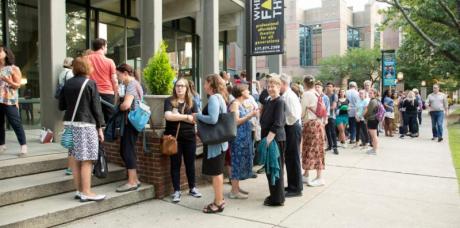
Clegg_Cheryl_Peoplegatheroutsidetheater3_364A4054

Steven Singer was blocked by Facebook for a week because of the post you are about to read. This post “violated community standards.” Steven Singer was censored by an algorithm. Or, Steven Singer was censored by the Political Defense team that tries to prevent any criticism of charter schools and TFA. This team swarms Facebook and other social media and complains that a post or tweet is “offensive” and the machine blocks the offending post.

This is the post by Steven Singer that has been blocked. This is the lie about “school choice” that DeVos and ALEC and charter promoters don’t want you to read.

He writes:

Neoliberals and right-wingers are very good at naming things.

Doing so allows them to frame the narrative, and control the debate.

Nowhere is this more obvious than with “school choice” – a term that has nothing to do with choice and everything to do with privatization.

It literally means taking public educational institutions and turning them over to private companies for management and profit.

He adds:

There are two main types: charter and voucher schools.

Charter schools are run by private interests but paid for exclusively by tax dollars. Voucher schools are run by private businesses and paid for at least in part by tax dollars.

Certainly each state has different laws and different legal definitions of these terms so there is some variability of what these schools are in practice. However, the general description holds in most cases. Voucher schools are privately run at (at least partial) public expense. Charter schools are privately run but pretend to be public. In both cases, they’re private – no matter what their lobbyists or marketing campaigns say to the contrary.

They take money from public schools that serve all students and give it to privatized schools that choose their students and expel those they don’t want.

Charters and vouchers are the Walmartization of public education. They introduce corporate chains to run what used to be neighborhood public schools. The only difference is that everyone may shop at Walmart, but not everyone who applies will be accepted at a choice school. The school does the choosing, not the family.

Steven reinforces what I wrote in Reign of Error: The Hoax of the Privatization Movement and the Danger to America’s Public Schools. “School choice” is a hoax, a lie. It is promoted by rightwing ideologues and by Democratic politicians hungry for funding by the financial sector, which sees schools as an emerging industry. Don’t be fooled.

School choice is privatization. And privatization is very bad for those who are not chosen. And very bad for our democracy.

Starbucks is my favorite brand of coffee, but I won’t be buying it anymore.

I just learned that Starbucks supports the Washington Policy Center, a rightwing policy group in Washington State that supports right-to-work (for less) laws, opposes a $15-an-hour minimum wage, and supports charters and vouchers. Bear in mind that the Supreme Court of Washington State ruled that charter schools are not public schools and not entitled to public funding. The Washington Policy Center supports school privatization.

Its last event featured Nigel Farage, the British politician who led the movement for Britain to secede from the European Union, or Brexit.

WPC has invited Betsy DeVos as its keynote speaker at its annual dinner on October 13 in Bellevue. Her views on school privatization are the same as those of the Washington Policy Center.

Melissa Westbrook, community activist, contacted Starbucks for their response. The statement she received by Email confirmed that Starbucks sponsors the Washington Policy Center but had nothing to do with the choice of speaker. This is an irrelevant answer. Why is Starbucks supporting a rightwing policy center at all? Next year the speaker might be Scott Walker or Charles Koch.

Express your disappointment with this hashtag: #whyStarbucks. Or sign this petition.

Corporations that bill themselves as “progressive” should not support rightwing policy centers that promote school privatization.

Starbucks is free to support any cause it chooses, and I am free not to buy their coffee anymore.

Kari Lydersen explains the story behind the Illinois tax-credit program, in this article.

In exchange for sending more money to Chicago, the Illinois legislature (controlled by Democrats) included a $75 million provision for tax credits for private school scholarships.

This is a voucher by another name.

It is the way to enact vouchers in a state where the state constitution bars them.

The nation’s best known tax credit program is in Florida, where Jeb Bush tried and failed to convince voters or the state supreme court to roll back the state constitutional ban on vouchers.

Betsy DeVos wants a national tax credit program, to drain students and resources from public schools.

Learn about it.

It is another way to privatize public education without public consent.

Professor Ellie Bruecker of the University of Wisconsin at Madison completed a study of the fiscal impact of the statewide school vouchers in Wisconsin. It was published by the National Education Policy Center.

Here is the executive summary:

“Executive Summary

“In 1989, Wisconsin created the Milwaukee Parental Choice Program (MPCP), the nation’s first publicly funded private school voucher program. Over the next two decades, the Milwaukee program was steadily expanded, but remained the sole voucher program in the state. In 2011, Wisconsin added a voucher program in Racine (RPCP), and in 2013 it created the statewide Wisconsin Parental Choice Program (WPCP). Initially the statewide program was limited to 500 students and 25 schools in its first year and 1,000 students and 50 schools in its second. In 2015, the state legislature lifted the cap on participating schools and students, but limited student participation to a percentage of district enrollment—currently 2% for the 2017-18 school year. The cap will gradually increase by 1% each year until it is eliminated in 2026. Wisconsin Act 55 (2015) additionally amended the funding of the WPCP.

“Previously funding had been provided by a state general purpose revenue allocation; Act 55 generates voucher funding for incoming students by deducting the cost of a student’s voucher from the state aid allocated to the school district in which a student resides.

“As a result, the program now shifts millions of dollars from public school districts to private schools. The fiscal impact of the statewide voucher program, however, is not evenly distributed across Wisconsin’s public schools.

“This policy memo describes how the statewide Wisconsin Parental Choice Program alters the relative share of public education spending borne by the state and by local districts and estimates the differential fiscal impact of the program on Wisconsin school districts. The analysis finds that school districts could lose a substantial portion of their state aid as participation in the voucher program grows, and that small districts would be the most negatively affected.

“Currently, participation rates in the statewide program are low and students in some districts lack access to voucher schools. Nevertheless, this analysis finds that the majority of students currently eligible to participate in the program live within range of a voucher school and that, even given low participation rates, the program will have a significant effect on the fiscal support the state provides to local school districts. As more states enact or expand their voucher programs, the case of Wisconsin demonstrates that one-size-fits-all statewide programs have the potential to exacerbate funding disparities in the public system.”

You can read the report here .

Jersey Jazzman is a teacher, blogger, and doctoral student in New Jersey. He has been writing brilliant statistical analyses of the differences between charter schools and public schools for years. He is no ideologue. He is a pragmatist.

In this post, he concludes what I long ago concluded: the so-called “reform movement” is a rightwing endeavor. I believe its real goals are to stamp out unions, deprofessionalize teaching (think TFA), and turn a profit on school funding.

JJ (aka Mark Weber) notes that Eva Moskowitz gets sizable funding from Wall Street and such notorious right wingers as the Mercer Family, which is also funding Steve Bannon. He notes the racist comments of the chairman of her board, as well as the Republican ties of other board members.

It is no secret that the notoriously rightwing Walton Family Foundation claims credit for opening one of e rey four charter schools in the nation. The Waltons hate unions.

One could go on and identify ALEC model legislation for charters. The connections are too glaring to overlook or excuse.

Betsy DeVos, Trump, ALEC, the Waltons, the Mercers…it is hard to find a rightwing politician or organization that is not pushing charters and vouchers.

That’s why the subtitle of my last book was “The Hoax of the Privatization Movement and the Danger to America’s public schools.”

The “hoax” was that the “reform movement” was actually a rightwing privatization movement.

As JJ writes:

“I really don’t know how much more clear this could be:

“- The education “reform” movement provides a pretext for underfunding public schools, which aligns with right-wing values.

“- The education “reform” movement is inherently anti-union, which aligns with right-wing values.

“- The education “reform” movement thrives when communities of color lose agency over their schools, which aligns with right-wing values.

“- The education “reform” movement is financed by wealthy people who openly profess conservative values.

“Can we please, then, stop this nonsense about charter schools and vouchers being a policy embraced by the left? Yes, there are some Democrats and other folks who are otherwise liberals who support “choice.” But their embrace of “reform” — whether out of ignorance or hypocrisy or, yes, even genuine belief — is inconsistent with the liberalism they espouse in other policy areas.

“Education “reform” is a right-wing movement. There is nothing remotely liberal about privatizing schools, demonizing unions, and making excuses for underfunding education. If you support charter schools and vouchers and call yourself a liberal, that is, of course, your right. But it’s really no different than being a pro-assault weapon liberal, or a pro-life* liberal: you’re holding a position on at least one issue (and likelyothers) that is philosophically aligned with the right.”

Early in her tenure as Secretary of Education, Betsy DeVos admitted that she is not a “numbers person.” She is also not a research person. The research shows that none of her favorite reforms improve education. Bu that never deters her. When the U.S. Department of Education study of the D.C. voucher program showed that the students actually lost ground as compared to their public school peers, she didn’t care. Nonetheless, she did recently cite a study from the Urban Institute claiming that the Florida tax credit program (vouchers) produced higher enrollments in college.

William Mathis, research director of the National Education Policy Center and Vice-Chair of the Vermont Board of Education, took a closer look at the study and found that the study did not prove what she thinks it does and offers no support for vouchers because of the confounding variable of selection effects. Someone at the Department should explain to her what a “variable” is and what “selection effects” are.

Do Private Schools increase College Enrollments for Poor Children?

A Closer Look at the Urban Institute’s Florida Claims

William J. Mathis

A review of:

Chingos, Matthew M. and Kuehn, Daniel (September 2017). The Effects of Statewide Private School Choice on College Enrollment and Graduation; Evidence from the Florida Tax Credit Scholarship Program, Urban Institute. 52 pp.

The Urban Institute reports that low income students who attended a private school on a Florida tax credit scholarship (“neovouchers”), in pre-collegiate grades had higher percentage enrollments in community colleges than traditional public school students. Using language such as the “impact of” and “had substantial positive impacts,” the findings are presented as causal. This purported effect was not found by the study’s authors in four year institutions or in the awarding of degrees – just in matriculation to community colleges.

Nevertheless, for school choice advocates, this report was hailed as good news on the heels of recent negative statewide school voucher reports coming out of Louisiana, Indiana, DC and Ohio. While community colleges are non-selective, most would agree that increased community college attendance is a good thing.

That said, a closer look indicates there is less to this latest report than first meets the eye. The primary problem—selection effects—is obliquely acknowledged by the report’s authors but is far too critical to push to the background.

There are at least three important differences that likely exist between the voucher group and the non-voucher group.

• Motivation, Effort, and Seeking Out Education Options – The very act of opting to enroll in a private school signals a very significant difference between the groups. Such an action requires considerable effort on the part of parents and students in selecting, applying, and transporting the child to the private school. These private school parents demonstrate, almost by definition, a higher involvement in their child’s education. Logically, these families would also be more likely to seek out community college options.

• Finances – While the program is available only to less affluent families, private schools can charge an amount higher than the $6,000 maximum available through the neovoucher. (Currently, eligibility rules require that the student’s household income not exceed 260 percent of the federal poverty level). Parents who can arrange or pay these supplemental tuition and fees to attend a private school represent the upper economic end of this means-tested group.

• Admissions – Private schools can continue their usual admissions policies, which may exclude children with special needs or deny admission on the basis of other characteristics. We cannot know the specific differences this introduces between the treatment and comparison groups, but we can be reasonably certain that these differences exist.

The study is based on “matching” private school students with traditional public school students and then comparing the two groups. While a common technique in voucher research, troubles arise when trying to pair up each student with her doppelganger from the other camp. As the authors acknowledge, “the quality of any matching can vary” (p. 12). While the researchers did an admirable job of matching, the entire process runs the risk of leaving out very important and determinative missing variables, as described above.

The study’s regression analysis also attempts to control for differences among students. In theory, an absolutely inclusive model can “confirm” a theory, and thus the researcher can claim a causal effect. But that’s a slippery slope. Regression is simply multiple correlation – and despite many inferences in the report, that is not causation. This is particularly true in this case, where selection effects are so strong.

In summary, it is the selection effects that primarily limit the study. A reasonable interpretation of the data is simply that the difference between the groups in their enrollment rates at community college is primarily due to different characteristics of families and students. In any case, the claim of private schools causing higher community-college attendance rates—let alone high college attendance in general—is a reach too far.

Politico reports that a key position at the U.S. Department of Education will go to one of the nation’s most outspoken opponents of public schools, Jim Blew. Blew has long experience at the charter-loving, union-hating Walton Family Foundation and served as president of Michelle Rhee’s public school-bashing Students First. The position he is slated to assume is the policymaking arm of the department. It is supposed to be a nonpartisan, expert role, judging the efficacy of Department initiatives. It might as well be abolished because we already know that school choice, charters, vouchers, union-bashing, and inexperienced teachers will be the policies of this administration.

“TRUMP TO NOMINATE JIM BLEW FOR ED SPOT: Jim Blew, director of the education advocacy group Student Success California, is Trump’s pick to become the Education Department’s assistant secretary of the Office of Planning, Evaluation and Policy Development. POLITICO reported he was the frontrunner in July. The administration announced late Thursday that the president plans to formally nominate him for the role. The announcement touted Blew’s experience as the former president of Students First, a national advocacy organization founded by former D.C. Public Schools Chancellor Michelle Rhee. It also said that for more than a decade, he was a key adviser to the Walton family, serving as director of K-12 reform investments for the Walton Family Foundation.”

Betsy DeVos is the keynote speaker today at a conference on “The Future of School Choice,” sponsored by Paul Petersen’s Program on Education Policy and Governance at the Kennedy School at Harvard.

Might as well be called “The Glorious and Lucrative Future of School Choice” because there are no critics invited, no supporters of the public schools attended by 85-90% of American students. She will be surrounded by adoring fans, which may help her forget that she is the most unpopular member of the Trump cabinet.

DeVos will be introduced by the dean of the Kennedy School, who is not at all embarrassed to host a conference utterly lacking in balance or fairness. Apparently, he is hoping the students ask questions, since the panelists won’t.

Curiously, the names of the funders–which originally included the foundations of Charles Koch and Bill Gates–have been scrubbed from the program. The only named sponsor is EdChoice.

Click to access future-of-school-choice-agenda.pdf

Hundreds of protestors are anticipated.

https://m.facebook.com/events/131082490873746/

DeVos has devoted her life’s work to privatization of education. Her own state of Michigan has been her plaything, since she has funded so many politicians. Thanks to her intervention, education in Michigan is a hot political mess, and the state’s standing on NAEP has fallen substantially.

She owes her home state an apology.