Archives for category: Texas

Lynn Davenport is a parent activist in Texas. She wrote the following post to alert her fellow Texans about the invasion of Kitamba Consultants, who bring with them the so-called “portfolio model” of privatization.


She writes:

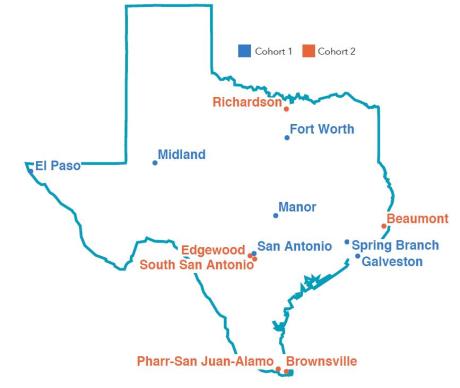
The LA teacher strike thwarted a concealed plot to use Kitamba consultants to reinvent LAUSD with a portfolio model of privatization. Kitamba has a contract with TEA right now for these districts, including RISD:

tea1

I just got a 228 page public information request from the Texas Education Agency and Region 13 service center in Austin for their MOU with Kitamba.

Texas is spending big bucks on the same Kitamba consultants exposed in the LAUSD strikes against philanthropist/private equity reformer and Supt Austin Beutner:

https://www.chalkbeat.org/posts/us/2019/04/09/los-angeles-consultants-recommendations-reimagine-kitamba-consultants/
“Created by the consulting firm Kitamba, the documents lay out an aggressive timeline for assigning schools to 32 support networks, giving principals more power, and cutting the central office by fall 2019.

The January strike appears to have derailed the plans. A spokesperson for Los Angeles Unified declined to comment.

During the January strike, United Teachers of Los Angeles criticized what it described as the district’s portfolio plan and its partnership with Kitamba. (A spokesperson at the time said Los Angeles Unified is not pursuing a portfolio approach.) Kitamba won a $765,000 contract for its work, paid by a slate of outside donors, including the Eli and Edythe Broad Foundation.

Details of Kitamba’s contract and scope of work were reported in February by the Los Angeles Times after school board member Scott Schmerelson criticized Beutner for not disclosing contracts with consultants, including Kitamba, or the work they had done for the district.”

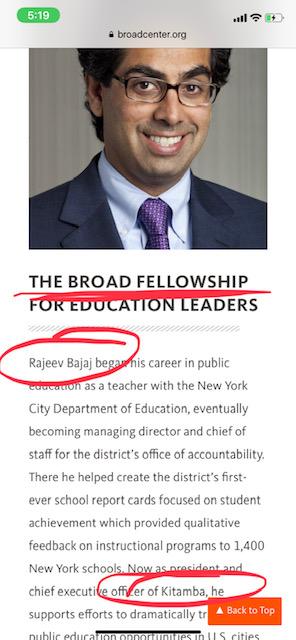
Rajeev Bajaj is a Broadie:

tea2

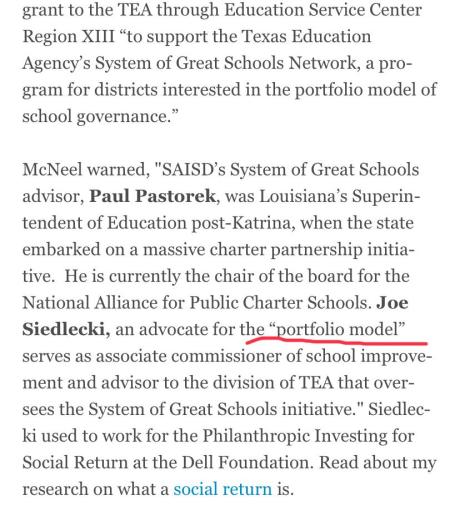
I researched all of this during my System of Great Schools LinkedIn article in December, I just didn’t see the magnitude of the Kitamba contract at the time:

tea3

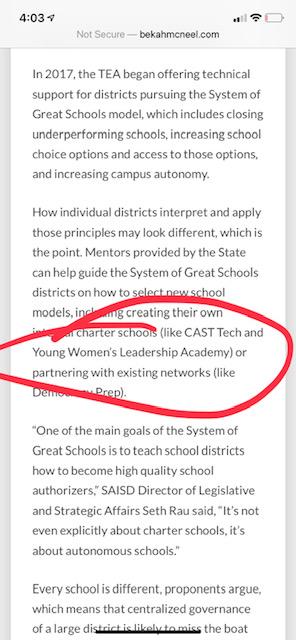
Please read my SGS Takeover article again:
https://www.linkedin.com/pulse/privatization-system-great-schools-takeover-lynn-davenport

tea4

Blogger Bekah McNeel found that, “In 2017 the Laura and John Arnold Foundation gave a two-year $85,000 grant to the TEA through Education Service Center Region XIII “to support the Texas Education Agency’s System of Great Schools Network, a program for districts interested in the portfolio model of school governance.”
http://bekahmcneel.com/in-becoming-a-system-of-great-schools-saisd-is-fighting-for-its-life/

Interesting that Dallas mayoral candidate Lynn McBee’s org was mentioned:

tea5


We need to stop this with the help of Texas AFT, parents, and trustees who see the harm of the portfolio model. We also need to loop in the California union to get their advice. I would like to hire Brett Shipp Media to help expose this. If we don’t stop it, our neighborhood schools, teachers, and elected boards will be eliminated in favor of a charter-like model of “autonomy”.


The superintendent of a Houston charter school and a school employee have been charged with embezzling more than $250,000 from the school’s bank account. 

The head of a Houston-area charter school and another school employee have been indicted on federal embezzlement charges, accused of siphoning more than $250,000 from the school for themselves and using some of the money to buy a car and condominium.
A grand jury in the U.S. District Court’s Southern District of Texas handed up charges this week against Houston Gateway Academy Superintendent Richard Garza, including one count of conspiracy, two counts of theft concerning programs receiving federal funds, three counts of wire fraud and two counts of engaging in monetary transactions involving criminally acquired property. Ahmad Bokaiyan, a technology support specialist at the school, was charged with conspiracy and three counts of wire fraud. They are now considered fugitives, according to a federal court records…
According to the indictment, Garza awarded a $280,841.85 no-bid contract in 2014 to a group called Hot Rod Systems to build an IT infrastructure at the new school, even though construction on the school had not yet begun. Hot Rod Systems was owned by Bokaiyan. Prosecutors say the two Houston Gateway Academy employees agreed that Bokaiyan would wire some of that contract money into one of Garza’s personal bank accounts. Within days of receiving the contract money from Garza, Bokaiyan wired the superintendent $164,381.
The indictment alleges Garza used more than $50,000 of those funds to buy a new Nissan Armada sport utility vehicle, more than $86,500 to help purchase a condominium, and nearly $26,000 to help make payments on a house loan in Cypress.
Garza’s school enrolls 2,400 students. He had plans to expand to nearly 10,000. He took over the school when it had low scores.
He began an aggressive plan to improve academics on state-mandated standardized tests, placing countdown clocks to test days in all classrooms and requiring even the youngest students to complete three-ring binders filled with practice tests and worksheets. As a result, their Coral middle school campus shot up the nonprofit Children at Risk’s annual school report card rankings, rising to the ranking’s number three spot. All of its 110 fifth and sixth grade students passed the math portion of the STAAR, an exceedingly rare feat for any school, let alone one that serves predominately low-income students. 
One wonders whether he worked the same magic with the test scores that he did with the finances.

A new study of the STAAR tests in Texas finds that the readability levels are far above the grade levels tested.

Professor Susan Szabo and Professor Becky Barton Sinclair of the Texas A&M at Commerce reviewed STAAR tests and report that readability levels were 1-3 years above the grade level tested.

Why is the state giving children tests that are above their grade levels?

Is it trying to fail children so that more public schools will be given low ratings and there will be more opportunities for privatization?

Or is it that the folks in charge of testing are not paying attention or don’t care?


This is a clever and short video explaining the magnitude of Texas’s school finance problem.

Texas has more than 5 million students. Its schools are perennially underfunded. They took a big hit in 2011 when the legislature cut their budget by more than $5 BILLION dollars, which the schools have never recovered from.

For the past several years, the State Senate and Lt. Governor Dan Patrick have tried to promote vouchers as an alternative to adequate funding but in the wake of the 2018 elections, the voucher plans are dead (thanks in large part to the good work of Pastors for Texas Children and to the spillover effect of the Beto get-out-the-vote operation).

Right now, the charter industry is making a big move on Texas, seeing the state as the next frontier for charter expansion.

But choice is a distraction. The real dilemma facing the Lone Star State is whether the boys in Austin are willing to pay to have a decent education system for all those millions of children, or whether they will stick with their low-tax, corporate-tax-cutting philosophy.

At bottom, my own fear as a native Texan is that the white men who run the state don’t care about those children. Not their children. But those children are the future of the state.


Texans Advocating for Meaningful Student Assessment (TAMSA) [aka Moms Against Drunk Testing] needs your help to fight abusive testing. We learned recently that the state tests (STAAR) is set two grade levels above where children are. Third-graders are tested on fifth-grade material and vocabulary, fifth-graders on seventh-grade material and vocabulary, etc. The tests are rigged to fail the kids. This is madness with no purpose other than to make kids and schools look bad so that the state has a rationale for closing public schools and opening charter schools.


URGENT: TAMSA needs your voice!

The Texas Monthly article got the attention of the House Public Education Committee. The committee is meeting Tuesday, March 5, 2019 on issues related to STAAR. Several assessment bills are on the agenda.

If you have a child that has been adversely affected by the STAAR test and are willing to testify in Austin, please email boardmember@tamsatx.org.

Tom Ultican tells a sad story about the takeover of the Dallas school board by the Dallas Chamber of Commerce and other wealthy elites, who don’t send their children to the public schools.

After their failed experiment with Mike Miles, a Broadie who surrounded himself with young but very well-compensated aides from TFA, the elites decided to buy control of the school board. It became too expensive for an ordinary citizen to compete with the money that the elites were pouring in. One candidate, Lori Kilpatrick, almost upset an incumbent, even though her resources were meager. The corporate elites decided not to take any chances in the run off. Her opponent won by outspending her 34-1.

The business elites have an agenda. Hire as many TFA as possible and drive out experienced teachers. Close public schools and replace them with charter schools. So far, none of their plans has benefitted the children of Dallas.

It is a sad story and I hope you will take the time to read it.

Tom Ultican often refers to the “Destroy Public Education” movement.

Dallas elites are in the forefront of that movement. Shame on them. They belong on the Wall of Shame.

Wesley Null, vice provost for undergraduate education at Baylor University, and I wrote this piece for the Dallas Morning News.

Texas legislators are revising the state’s school finance laws. We wanted to put before the public the importance of paying teachers well.

Some legislators are enthusiastic about what they call “outcomes-based funding,” which would send more money to affluent districts and less money to needy districts. This would be a huge mistake for obvious reasons. It’s reverse Robin Hood.

Long ago, Texas had visionaries in the legislature who understood that the future of the state relied on having a strong public education system. Current legislators think they can use charters as a substitute for adequate funding.

In 1948, those visionaries proposed a dramatic increase in state funding and equalization. Gilmer and Aiken persuaded their colleagues to raise the state share of funding to 75-80% of costs. This year, the state share will fall to 39%, shifting the burden of financing schools to localities, which favors the richest districts.

We wrote:

The heart of any school is the teacher. The only way to ensure that every Texas child receives a quality education is to place a well-educated, well-prepared teacher in every classroom. That truth will never change.

The attractiveness of teaching, however, continues to decline. The results are tragic. Labor Department statistics reveal that public educators are leaving the profession at the highest rate in 20 years. Low pay and disrespect are key factors in this alarming decline.

The Texas Legislature this session will have the job of remedying the state’s public school finance system. As historians of education, we think some background is helpful.

The last time Texas overhauled public school finance was immediately following World War II. The need for change was great. Many young Texans had been denied the opportunity to serve during the war because of their poor level of education. Such news was embarrassing to Texas leadership. 

Compulsory attendance laws existed, but they had many loopholes. Only 65 percent of school-aged children attended school. Only 40 percent of adults had a high school education. Many school buildings were dilapidated and dangerous. 

School finance was based on a census count of how many school-aged kids lived in a county regardless of whether those students attended school. Consequently, funds were commonly distributed but no education took place. Pay for teachers was embarrassingly low, leading to difficulties with recruitment and retention.

Fortunately, Texas had leaders who were driven by foresight and determination. Named in honor of legislators Claud Gilmer and A.M. Aikin, the Gilmer-Aikin Laws modernized Texas education. They revolutionized school finance, substantially increased pay for teachers, rebuilt dilapidated buildings, and redesigned teacher education and certification.

Please read it all!


The Longview (Texas) News-Journal doesn’t understand why Longview needs charter schools. A chain of 7 is opening.

But the answer, the newspaper says, is money.

The charters will get more money than the public schools. After all, they need more money for field trips, for international field trips. What?

The charter industry is making its move in Texas.

Will Beto stand up for public schools even though his wife operates a charter?

If he doesn’t, he can write off the votes of teachers and public school parents.

At the last legislative session in Texas, Governor Greg Abbott and Lt. Gov. Dan Patrick attended the major school choice really to show their enthusiastic support for vouchers. This week, neither of the state’s top elected officials showed up at the school choice rally.

Two years ago, Gov. Greg Abbott and Lt. Gov. Dan Patrick stood on the steps of the Texas Capitol before a throng of waving yellow scarves and urged lawmakers to vote for programs that give parents state money to attend private schools.

This Wednesday, those two top Republicans may not even attend the rally for National School Choice Week, let alone have speaking roles. [They didn’t attend the rally.]

Although “school choice” supporters will still excitedly don their signature bright yellow scarves Wednesday, they will likely be fighting an uphill battle the rest of this session to get support in the Capitol.

In the months after 2017’s rally, House lawmakers unequivocally voted to reject school vouchers or similar programs that allow parents to use public money for private education. In 2018, a key election ousted some of the programs’ largest supporters, including Rep. Ron Simmons, R-Carrollton, one of the loudest cheerleaders in the House. And as state Republicans tour the state making constituents a new set of education-related promises, many have swapped the words “school choice” for “school finance.”

So far, even Abbott and Patrick have rarely brought up their former pet issue without being asked — beyond Abbott’s routine proclamation for this year’s School Choice Week. New House Speaker Dennis Bonnen, an Angleton Republican, said last week that the House would not pass legislation approving vouchers — and that he had consistently voted no on similar bills.

“I’m not willing to say, ‘Hey, this issue is dead.’ But leadership seems to be saying that, at least for this particular session,” said Monty Exter, lobbyist for the Association of Texas Professional Educators, one of the biggest opponents of those programs.

As vouchers fade off into the sunset, choice advocates are doubling down on charters. There is a major push in every city in Texas to expand the number of charters. In San Antonio, the big charter push came from Mayor Julian Castro, who pledged to put 20% of all students into charter schools and invited major chains to set up shop in his city. Castro recently announced his candidacy or the 2020 Democratic presidential nomination, joining Cory Booker as an openly pro-charter candidate.

Newly elected Governor of Tennessee, Bill Lee, picked a privatizer from the Texas Education Agency to be State Commissioner of Education. Penny Schwinn, chief deputy commissioner for academics in Texas, is Lee’s choice. She is a supporter of school choice, including vouchers, which was never passed in Texas despite multiple efforts by the hard-right there. For some reason, she is described as a “reformer.” Apparently if you want to underfund public schools by diverting money to religious and private schools, that qualifies you to be called a “reformer.” The word “reformer” has become anathema.

In Texas, rural Republicans combined with urban Democrats to stymie vouchers in the legislature, year after year.

Tennessee also has rural Republicans who will question why public money should be diverted from their community schools to religious schools.

Schwinn has promised to fix Tennessee’s longstanding testing mess. Testing in Texas has been used to label and stigmatize schools and students. Remember the phony claims of a “Texas miracle” that brought NCLB to the nation? Legislators in the Lone Star State still has a zealous faith in standardized tests.

Worse, Schwinn was controversial in Texas.

Schwinn moves from Texas amid controversy there.

A September audit found Schwinn failed to report a conflict of interest between her and a subcontractor who got a $4.4 million contract to collect special education data. As a result, the Texas state commissioner canceled the contract, according to the Dallas Morning News.

The canceled contract cost the state more than $2 million, according to the Texas Tribune.

The Dallas Morning News also reported that Schwinn told auditors that while she had a professional relationship with the subcontractor, she didn’t try to influence the contract. In the wake of audit, Texas revamped its procurement process, the Texas Tribune reported.

Schwinn will need to help secure an assessment vendor to administer the TNReady test with the state’s contract with Questar Assessment set to expire.

This is not an auspicious start.