Archives for category: Testing

This is a personal message from actor Matt Damon and early childhood educator Nancy Carlsson-Paige, addressed to the teachers of Garfield High:

We are writing to support all of the teachers at Garfield High School.  We admire your strong and unified stand against the district mandated standardized test. Teachers, students, and parents do not have to accept practices that are harmful to them and to the whole meaning and purpose of education. We know it takes courage to risk your jobs in order to stand for what you know is right.  But your example holds the promise of inspiring teachers in school districts all over the country to take similar action.  Thank you for your strength and courage.  We admire you and are behind you all the way.

Hey, Garfield teachers, Matt and Nancy think you are great!


Nancy Carlsson-Paige and Matt Damon

In the Frontline documentary, John Merrow confronted Michelle Rhee with statistics from certain schools showing dramatic increases in test scores followed by equally dramatic declines. And they had this exchange:

JOHN MERROW: What’s your reaction to those numbers? That the gains are phony.

MICHELLE RHEE

Yeah. I mean, I—again, I—I feel like when you look at a situation like that does it call things into question? Absolutely. And should those things be investigated? A hundred percent. No—there’s no doubt about it. // But I can point to, you know, dozens and dozens of schools where, you know, they saw very steady gains over the course of the—the years that we were there, or even saw some dramatic gains that were maintained. So I think, in isolated places—could something have happened? Maybe.

Retired D.C. teacher and blogger extraordinaire G.F. Brandenburg has started an investigation of the “dozens and dozens of schools” that allegedly saw “steady” or “even some dramatic gains” when Rhee was chancellor.

He will continue his search for the “dozens and dozens” of schools in future posts.

See how great it is to be a math teacher?

Here on this blog we have math teacher Gary Rubinstein correcting the mistakes of the Gates Foundation’s $50 million MET project and now math teacher Brandenburg fact-checking the most divisive figure in American education today.

Abby Rappaport is one of our best education journalists, and she is mostly covering Texas politics these days.

In this article, she explains the escalating revolt against testing in Texas, where it all started.

The bottom line: Texas has been obsessed with testing for the past two decades, and people are just plain sick of it. The last legislature cut $5.4 billion from the schools’ budget, but managed to find $500 million for Pearson. Abby estimates that in the next few years, Pearson will collect over $1 billion from Texas taxpayers.

That’s a lot of money by anyone’s reckoning.

The school boards are sick of it. More than 80% have passed resolutions against high-stakes testing.

Parents are sick of it. Legislatures are getting complaints in the grocery store and wherever they run into parents in their district.

Happily, Texas Republicans are sick of all the testing. Many come from small towns and rural areas and their constituents are button-holing them. They don’t want to tear up their local public school and close it down because of test scores.

Last September 30, I spoke to a joint meeting of the Texas Association of School Administrators and the Texas School Boards Association. I got a wonderful, wild, Texas-size reception. They don’t like what’s going on. They talk to their legislators. Nobody had a good word for the reign of Pearson.

So, please, all eyes on Texas. Let’s all cheer for the testing revolt that’s growing there by the hour.


Jeannie Kaplan is an elected member of the Denver Board of Education. She has been critical of corporate-style reform and of the heavily-funded effort to persuade the public that it is successful. When she heard that Jonah Edelman of Stand for Children told an audience in Tulsa recently that Denver was a national model of success, she decided to review the score card for the district. (Stand for Children boasts of its civil rights credentials but supported a slate of Republican candidates for the state legislature in 2012, as part of its campaign for corporate reform).

Kaplan wrote for this blog:

So Much Reform. So Little Success

Denver, Colorado is a poster child for much of what reformers like to see: standardized testing, teacher accountability, charter schools, choice, co-location, and oh, did I mention testing? Denver Public Schools is trying or has tried almost all of them. Why, even Jonah Edelman, founder of one of the most well-funded, prominent reform organizations, Stand for Children, just today, January 10, 2013, pointed to Denver as a leader in reform because of its “portfolio” of school choice led by its charter schools. So, how is reform really working in Denver?

Let’s start by focusing on achievement, meaning test scores, since that is the focus of all things reform. (This post will have a lot of data since reform and data go hand in hand these days, especially data that can be spun). Denver Public Schools have been rated by the Colorado Department of Education as “Accredited with Priority Improvement Plan,” for the last three years. Out of five grades this is the second to the bottom. To be fair, DPS is inching toward the next category, “Accredited with Improvement plan.” The cut point is 52% of eligible points; Denver is at 51.7%. I am not sure how meaningful this data point is, since the GROWTH points count for 35 points out of 100 and ACADEMIC ACHIEVEMENT, meaning proficiency, counts for only 15.

Colorado now places enormous emphasis on “the growth model.” While no one would contest you need to have growth to get to proficiency, I believe this model masks what is really happening, and so the data I am citing is all about proficiency. To further emphasize how growth can mask proficiency, allow me to quote from one of Denver’s most ardent reformers, Alexander Ooms, who said on in a commentary on EdNewsColorado:

“Denver can celebrate academic growth for years to come without making much progress in the exit-level proficiency of students. And that is simply not the right direction. Growth is means, not end.”http://www.ednewscolorado.org/2012/05/23/38581-commentary-our-unhealthy-obsession-with-growth to read his entire commentary.

I could not have said it better. The data I cite are proficiency numbers, not growth numbers.

In 2005, when reform was in its infancy, Denver Public Schools hired its first non-educator superintendent: Michael Bennet, former businessman/lawyer, former mayoral chief of staff . Mr. Bennet’s childhood friend and fellow businessman, Tom Boasberg, was hired to replace him when Bennett became a Senator. Denver has been experimenting with reform since then. Oh, and BTW, Jonah Edelman grew up as Tom Boasberg’s neighbor in Washingon, D.C.

After 8 years, what academic changes has reform produced?

The following data is from 2005 through 2012, according to Colorado standardized tests. Here is the website for a deeper delve into the data

http://www.schoolview.org/performance.asp

ACHIEVEMENT:

Screen shot 2013-01-12 at 4.32.48 PM
We can’t leave achievement without looking at the State of the Union shout-out school, Bruce Randolph. Bruce Randolph Middle School in 3 years of state tracked data shows a gain of 2% in reading to 28%, stayed at 19% in math, increased by 3% in writing to 17%, and increased 7% in science to 17%. It is tied for last in proficiency – 52nd – for all of Denver’s middle schools.

Bruce Randolph High School has declined 10% to 33% in reading, declined 3% in math to 10%, declined 2% in writing to 14% increased 1% to 12% in science. Bruce Randolph is 24th out of 27 high schools in academic achievement.

ACHIEVEMENT GAP increases based on 7 years of CSAPs/TCAPs

Elementary School

Reading 4.17
Writing 5.78
Math 6.46

Middle School

Reading 3.23
Writing 4.71
Math 6.72

High School

Reading 3.01
Writing 5.82
Math 6.30

According to DPS data, the gap between FRL and paid-lunch students has widened by 9% since 2005. In 2005, percent proficient for FRL was 29%, paid was 58%. In 2012 the numbers were 41% for FRL, 79% for paid. The gap has grown to 38%.

ACT RESULTS: (A composite score of 21 is generally accepted as a college readiness benchmark)

From a DPS presentation of September 2012​

2005 17
2012. ​17.6

GRADUATION for 2011 – we are still waiting state numbers for 2012 but the number of students graduating increased from 2,642 in 2005 to 3,414 in 2012, for a total of 772 more graduates in 8 years…or an average of 96.5 more graduates each year.

Here is how Denver Public Schools compares with the state:

State​​ 73.9%
Denver ​ 56.1%

REMEDIATION (from Fall of 2010)

From the Fall of 2007, when this data was first available to the Fall of 2010 (the latest data available, remediation numbers have increased from 57.1% to 59.7%. The state of Colorado is at 31.8%.

This is the achievement for 8 years of reform.

Need I say more?
Many people have written to ask for a link to Gary Rubinstein’s “open letters to ‘reform’ leaders.”

Those who read them say they are brilliant, and indeed they are.

As you may know, Gary was one of the first alums of TFA. He became a career teacher.

He teaches mathematics at Stuyvesant High School in New York City.

He blogs regularly and whatever he writes is worth reading.

He is one of the best informed and reasonable critics of corporate-style reform in the blogosphere.

Jeannie Kaplan is an elected member of the Denver Board of Education. She has been critical of corporate-style reform and of the heavily-funded effort to persuade the public that it is successful. When she heard that Jonah Edelman of Stand for Children told an audience in Tulsa recently that Denver was a national model of success, she decided to review the score card for the district. (Stand for Children boasts of its civil rights credentials but supported a slate of Republican candidates for the state legislature in 2012, as part of its campaign for corporate reform).

Kaplan wrote for this blog:

So Much Reform. So Little Success

Denver, Colorado is a poster child for much of what reformers like to see: standardized testing, teacher accountability, charter schools, choice, co-location, and oh, did I mention testing? Denver Public Schools is trying or has tried almost all of them. Why, even Jonah Edelman, founder of one of the most well-funded, prominent reform organizations, Stand for Children, just today, January 10, 2013, pointed to Denver as a leader in reform because of its “portfolio” of school choice led by its charter schools. So, how is reform really working in Denver?

Let’s start by focusing on achievement, meaning test scores, since that is the focus of all things reform. (This post will have a lot of data since reform and data go hand in hand these days, especially data that can be spun). Denver Public Schools have been rated by the Colorado Department of Education as “Accredited with Priority Improvement Plan,” for the last three years. Out of five grades this is the second to the bottom. To be fair, DPS is inching toward the next category, “Accredited with Improvement plan.” The cut point is 52% of eligible points; Denver is at 51.7%. I am not sure how meaningful this data point is, since the GROWTH points count for 35 points out of 100 and ACADEMIC ACHIEVEMENT, meaning proficiency, counts for only 15.

Colorado now places enormous emphasis on “the growth model.” While no one would contest you need to have growth to get to proficiency, I believe this model masks what is really happening, and so the data I am citing is all about proficiency. To further emphasize how growth can mask proficiency, allow me to quote from one of Denver’s most ardent reformers, Alexander Ooms, who said on in a commentary on EdNewsColorado:

“Denver can celebrate academic growth for years to come without making much progress in the exit-level proficiency of students. And that is simply not the right direction. Growth is means, not end.” http://www.ednewscolorado.org/2012/05/23/38581-commentary-our-unhealthy-obsession-with-growth to read his entire commentary.

I could not have said it better. The data I cite are proficiency numbers, not growth numbers.

In 2005, when reform was in its infancy, Denver Public Schools hired its first non-educator superintendent: Michael Bennet, former businessman/lawyer, former mayoral chief of staff . Mr. Bennet’s childhood friend and fellow businessman, Tom Boasberg, was hired to replace him when Bennett became a Senator. Denver has been experimenting with reform since then. Oh, and BTW, Jonah Edelman grew up as Tom Boasberg’s neighbor in Washingon, D.C.

After 8 years, what academic changes has reform produced?

The following data is from 2005 through 2012, according to Colorado standardized tests. Here is the website for a deeper delve into the data

http://www.schoolview.org/performance.asp

ACHIEVEMENT:

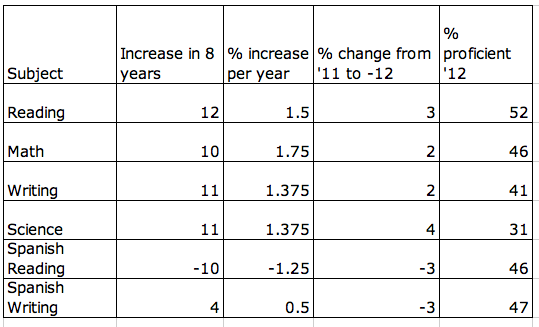
8 yr increase–% incrse per year–% chnge from ’11-’12–% proficient

Reading – — 12———-1.5 ———– 3 –————— 52

Math — — 10———–1.75————–2———————-46

Writing —- 11——— 1.375————2———————41

Science —– 11 —— 1.375 ——— 4 ——————31

Lectura -10 /—–// -1.25 /// -3 /// 46
Spanish Reading

Escruita 4 ////—/ .5 ///// -3 ////// 47
Spanish Writing

We can’t leave achievement without looking at the State of the Union shout-out school, Bruce Randolph. Bruce Randolph Middle School in 3 years of state tracked data shows a gain of 2% in reading to 28%, stayed at 19% in math, increased by 3% in writing to 17%, and increased 7% in science to 17%. It is tied for last in proficiency – 52nd – for all of Denver’s middle schools.

Bruce Randolph High School has declined 10% to 33% in reading, declined 3% in math to 10%, declined 2% in writing to 14% increased 1% to 12% in science. Bruce Randolph is 24th out of 27 high schools in academic achievement.

ACHIEVEMENT GAP increases based on 7 years of CSAPs/TCAPs

Elementary School

Reading 4.17
Writing 5.78
Math 6.46

Middle School

Reading 3.23
Writing 4.71
Math 6.72

High School

Reading 3.01
Writing 5.82
Math 6.30

According to DPS data, the gap between FRL and paid-lunch students has widened by 9% since 2005. In 2005, percent proficient for FRL was 29%, paid was 58%. In 2012 the numbers were 41% for FRL, 79% for paid. The gap has grown to 38%.

ACT RESULTS: (A composite score of 21 is generally accepted as a college readiness benchmark)

From a DPS presentation of September 2012​

2005 17
2012. ​17.6

GRADUATION for 2011 – we are still waiting state numbers for 2012 but the number of students graduating increased from 2,642 in 2005 to 3,414 in 2012, for a total of 772 more graduates in 8 years…or an average of 96.5 more graduates each year.

Here is how Denver Public Schools compares with the state:

State​​ 73.9%
Denver ​ 56.1%

REMEDIATION (from Fall of 2010)

From the Fall of 2007, when this data was first available to the Fall of 2010 (the latest data available, remediation numbers have increased from 57.1% to 59.7%. The state of Colorado is at 31.8%.

This is the achievement for 8 years of reform.

Need I say more?

A comment from a reader:

It is alarming that Rocketship can be allowed to grow as it is – they just received city approval for a contested area of public land in San Jose for another campus while they already have 7 running. Rocketship’s strag

Rocketship says parents have a quota for volunteer hours – 30 per year to be exact. The most recent “volunteer” opportunity afforded to me was that I would get 5 hours for EVERY adult I brought with me to this event – that’s why there is always a sea of purple where ever Rocketship tries to “make a stand” at the expense of the public. If public school teachers all had this kind of parent engagement in the children’s actual learning and not the school’s political demonstrations, the children would be much better served. I believe the elected/appointed officials that are placed on the city council and board of education in San Jose are simply being politicians – say or do anything that will get them “cheers.”

Scheduled visits the media make mean nothing. Be a teacher or a student or a parent. I had my son at two of the campuses before I finally pulled him out midyear and placed him in a regular public school. No attention is being made to the numbers of teachers or families who defect from the school. They claim they need 20 more campuses when their current seven aren’t even full! Further they pander to parents as often as they can to “recruit” because they don’t have enough applicants. Their biggest “group” of applicants are kindergartners whom I’m sure are picked up from visiting Head Start Centers throughout Santa Clara County.

The “model” needs to be scrutinized. Rocketship has no model – in the few years they have been in operation they have constantly changed things up because they really aren’t producing the results they expect, they call it “innovation” all while parents have no input or informed of these “changes” until the day before the “changes” go into affect.

With a stripped-down teach-for-the-test curriculum that requires longer days for students and insame amounts of uselss, busy “homework,” you can’t expect to encourage the students to be innovative when art and music fall to the wayside as well as allowing time for constructive chores or freetime during weekends or vacations. My son was one of the top-performing kids in his grade level, and was most diligent with completing the really unnecessary amounts of homework and even he had trouble finishing many times – at 3rd grade! I haven’t been able to have him fold his own clothes or help with dinner preparation which I believe are just as important in character development as any “words” written on cheap paper posted on any of the Rocketship walls.

Even 15 minutes of “tangible Lego time” would help the kids get some enjoyment and encourage creativity. STEM subjects are the pieces that will be needed in most jobs today and in the future. STEAM (A for Art) is the more accurate idea – as art is necessary for innovation and what will prepare children today for in-demand jobs today and in the next decade. We don’t even have to say college. College is absolutely necessary.

Irony: the same companies and executives who support Rocketship operate/live in the affluent counties that have rejected Rocketship from entering their own neighborhoods. If Rocketship’s ideas are really valuable, you would think they would send their own children to those campuses.

Rocketship is just a business reaping public funds at the expense of property tax payers, at the same eradicating public education, and preying on the most vulnerable – the young children of the non-English speaking poor and being detrimental for their futures.

This is a joke.

A reader sent the following observation:

Here’s a devastating article that points up Bill Gates’ hypocrisy when it comes to the variation between what he demands for his own children, and what he subjects children from lower income communities:

THE SEATTLE TIMES’ Danny Westneat takes Gates to task for promoting policy all over the country that jacks class size sky high, with Gates using the common-sense-defying logic that kids will fare better in larger classes.

Well, Westneat sends his own kids to public schools, and will eventually attend Garfield High School (in the news of late). These are the schools that—once Gates has his way—will have obscenely large class sizes… A bit fed up, Weastneat did what perhaps no other writer has yet dared to do:

he investigated the two rich kids’ private school where Gates sends his own children and—doncha know it? —these schools major selling point is that they have… wait for it… EXTREMELY SMALL CLASS SIZES:

WESTNEAT: “I bet (Gates) senses deep down as a parent that pushing more kids into classes isn’t what’s best for students. His kids’ private-sector grade school has 17 kids in each room. His daughter’s high school has 15. These intimate settings are the selling point, the chief reason tuition is $25,000 a year — more than double what Seattle schools spends per student.”

Calling out Gates’ hypocrisy, Weastneat ends the article with a knockout finish:

WEASTNEAT: “Bill, here’s an experiment. You and I both have an 8-year-old. Let’s take your school and double its class sizes, from 16 to 32. We’ll use the extra money generated by that — a whopping $400,000 more per year per classroom — to halve the class sizes, from 32 to 16, at my public high school, Garfield.

“In 2020, when our kids are graduating, we’ll compare what effect it all had. On student achievement. On teaching quality. On morale. Or that best thing of all, the “environment that promotes relationships between teachers and students.”

“Deal? Probably not. Nobody would take that trade. Which says more than all the studies ever will.”

The Carnegie Corporation doesn’t have as much money to throw into the corporate reform movement as the Walton Foundation, the Broad Foundation, and the Gates Foundation but it is definitely on the same page as the big guys. Here is its report on 2011 spending. The education grants begin on p. 24. And there they are: charter schools, Jeb Bush’s favorite “digital learning,” Common Core, Race to the Top policies, and the usual reformy organizations.

Spring is coming.

People are standing up and speaking up.

Teachers at Garfield High in Seattle say “no more.”

Teachers at Ballard High School support their colleagues at Garfield.

The Seattle Education Association supports the Garfield and Ballard teachers.

Randi Weingarten tweeted her support.

Superintendents, one after another, are saying the testing obsession is out of control.

The principals of New York State stand together to demand professional evaluation, not trial by testing.

Parents are defending their children by supporting their teachers and their community schools.

The PTA of Niagara County in New York say hands off our public schools.

Communities are opposing school closings and corporate takeovers.

Students are speaking out because they know what is happening to them is not right.

Journalists are starting to recognize that the “reformers” are not real reformers but privatizers.

It is starting to happen.

We will put education back into the hands of educators and parents and communities.

We will work to make our schools better than ever, not by competition, but by collaboration.

Last year, someone emailed and asked me to create and lead the movement to stop the corporate reformers, and I said I couldn’t do it, that all I can do is write and speak.

That truly is all I can do, but when I started this blog in late April, it turned into a platform for the movement, and leaders are emerging all over the country, and learning about each other. They are communicating.

I am not the leader, I am the facilitator. You are the leaders.