Archives for category: Testing

Those who follow the twists and turns of the “reform ” movement are aware of a growing number of books that exposé the false narrative of reform. The reform narrative is funded by billionaires and philanthropists who believe in the free market and scorn government regulation. It fastens on genuine problems–like the low performance of children who live in poverty–and blames their teachers rather than the poverty that limits their opportunity. The reformers divert their eyes from poverty, segregation, budget cuts, and loss of vital services. What began, arguably, as a well-intentioned effort to shake up schools and unleash innovation has now become a vehicle for privatization of the public schools.

The struggle to save public education will require an informed public. Only an informed public will have the motivation to vote for representatives to defend what belongs to the entire community and to stop the headlong rush to consumerism. Fortunately, teachers and other educators are publishing books to tell the story. The blogosphere and social media have become invaluable means of democratic communication, enabling dissenters from top-down reform to meet and exchange ideas and information.

Videos are appearing too, to get the story to the public. It is not easy for them to get on television or to be distributed commercially. Unlike the charter propaganda “Waiting for Superman,” or “Won’t Back Down,” the films that exposé the dark side of the testing and privatization movement do not have the support of billionaires.

Here are a few of the recent must-see videos that challenge the corporate reform movement.

Vicki Abeles’ “Race to Nowhere” makes the case against high-stakes testing and shows how it distorts the lives of adolescents. Abeles has taken the film to churches, synagogues, community centers across the nation, wherever she can show it.

The film “Rise Above the Mark” was written and produced by educators in West Lafayette, Indiana. It shows what high-stakes testing is doing to the children, teachers, and schools. It is a powerful film.

Daniel Hornberger’s “Standardized” shows how standardized testing is ruining education. The subtitle is, fittingly, “Lies, Money, and Civil Rights: How Testing Is Ruining Public Education.” It includes interviews with prominent educators who denounce the standardization that is now imposed by the federal and state governments.

One of the first videos was released in 2011. “The Inconvenient Truth Behind ‘Waiting for Superman,'” depicts the battle in New York City against corporate education reform, with parents and teachers fighting fruitlessly to save their schools from closure against an unhearing may orally-controlled board. The film was created by a team of teachers and parents called the Grassroots Education Movement.

There are others, and I welcome readers to submit additions to this list. And more are on the way. Help me compile a list of videos that challenge the dominant narrative that fills the airwaves and is destroying public schools, hurting children, dissolving communities, and opening new frontiers for corporate profit.

Many of these films are online for free or the producers will send a video for a nominal fee. Consider showing these films at your next parent and/or teacher meeting. Be informed. There can be no democratic debate when only one side can afford to present its views on television and in commercial films.

While visiting his sister in Albuquerque, Paul Horton encountered the same corporate reform claptrap that he read regularly in the Chicago Tribune and sent the following letter to the editor:

“Dear Editor,

I read your banner article, “SBA scores in NM lower now than five years ago” with great interest. As a teacher with thirty-two years experience, I am very concerned with the obsessive focus on SBA scores in the article.

While I understand that lower test scores might be a concern, I am more concerned with the scripted response of Hannah Skandera, New Mexico Education Secretary designate.

Ms. Skandera is clearly on the bandwagon of a national education reform movement that is funded by the Walton Foundation, the Broad Foundation, the Bill and Melinda Gates Foundation, and the American Legislative Exchange Council that is heavily funded by the Koch brothers.

Ms. Skandera clearly serves the interests of these organizations and not the children of New Mexico. Her agenda insures that millions of hard-earned tax dollars of the citizens of New Mexico will flow to Pearson Education, an English company that has taken over the standardized testing industry in the United States.

The biggest issue facing the students in New Mexico is increasing levels of poverty exacerbated by increasing levels of income inequality. Your education reporters need to disaggregate the SBA scores to correlate them to average income levels in schools and districts.

Ms. Skandera will tell you in the coming months that scores for the new PARCC tests will decline by 30% on average. She does not tell you that Pearson Education will control the determination of “cut scores.” This is a part of the script that she will continue to read. She has no real direct knowledge of education issues, she is simply following the “toolkit” that is being used in many other states and the citizens of New Mexico are being played for suckers.

In point of fact, the NAEP (National Assessment of Educational Progress) has been measuring student achievement for over forty years and it remains the best and most accurate reflection of student achievement across the United States. The fact that scores across the country have flattened on average over the last several years is mostly the result of increasing poverty, rising income inequality, and the deteriorating living conditions and shortage of jobs in urban and rural areas all over the country.

Even more important, the current flattening and decline of scores in areas where poverty is prevalent is more the result of the failure of national policies that focus teaching on producing higher test scores. In this regard, the NCLB and Mr. Duncan’s Race to the Top (RttT) are only making these issues worse with their obsessive focus on standardized testing and the defunding of public schools.

The citizens of the great state of New Mexico need to stop paying Pearson Education and start paying for lowering class size, hiring more special education teachers, librarians, art teachers, language teachers, and clinical social workers.

Human investment, not investment in education corporations, will lead to better results for the state of New Mexico. Ms. Skandera is more concerned about pleasing Pearson Education that the parents of New Mexico. Wake up and smell the green chilies cooking! Pearson Education does not care about your kids!

Paul Horton
History teacher and former APS student
The University of Chicago Laboratory Schools
phorton@ucls.uchicago.edu
http://www.ucls.uchicago.edu”

New York proposed to exempt up to 2% of students with severe disabilities from federally required state tests.

The U.S. Department of Education said no. Last year, 95% of students with disabilities failed the new Common Core tests in New York.

Leaders of national organizations supposedly representing students with disabilities hailed the DOE’s de is ion to hold these students to the same standards, which the overwhelming majority will fail.

Peter Goodman wrote about the Common Core exams:

“Parents and teachers across the state protested – the exams were poorly prepared, school staffs not trained and parents of SWD were especially critical – the tests were far beyond the cognitive ability of their children and were emotionally harmful. After months of discussions the state, in its application for an extension of the NCLB Flexibility Waiver asked for a change.

New York State had proposed allowing up to 2 percent of New York students with severe disabilities to be tested at their instructional ability — not their chronological grade year — up to two full grade levels below current grade level. The change would, for example, allow a 5th grader with autism to be tested on exams written for third graders.

New York State has abandoned the Regents Competency test, and, in spite of the SWD safety net (the passing Regents score for SWD is a grade of 55) the barrier to graduation for SWD was substantial even before the implementation of the Common Core exams.

Students, due to their cognitive disabilities, who had no chance of passing the exam, were forced to sit in rooms for hours taking exams, to their teachers and parents it was a cruel punishment.”

Goodman writes:

“The feds, and some of the advocates, seem to be saying SWD have a cognitive illness that is curable within classrooms, which with the accommodations and teacher preparation SWD can achieve proficient scores on Common Core exams. I would agree that is a goal; however, for many students no matter the accommodation, no matter the skills of the teacher, their cognitive impairment will never allow the student to score proficient on the Common Core exams as presently constituted.

The current requirement violates the Eighth Amendment; it is a “cruel and unusual punishment.” To force students to sit for hours staring at pages and pages of problems well beyond their cognitive skills are damaging to the student.

It saddens me that so-called advocates are willing to sacrifice students for their own ideology.

We should develop tools, for examples, portfolios of student work aligned to IEP goals, instead of timed exams, as evidence of student progress.

The gap between the United States Department of Education and parents and teachers is incredible. The best decisions impacting children are made in classrooms by teachers and school leaders. The further from the classroom the more wrong-headed the decision.”

Secretary Arne Duncan has frequently pointed to the high test scores of students in South Korea as a model for American students to copy. We have heard again and again that we are losing “the global competition” to nations like South Korea where students and parents take tests very seriously. Our students, the Secretary never tires of telling us, are slackers. Their parents want them to be well-rounded when they should all be enrolled in Advanced Placement courses, burning the midnight oil, or attending after-school programs in ever-longer school days.

On Sunday, the New York Times published an article that refuted the myth of South Korea as the acme of educational excellence. The South Korean system, the author writes, is “an assault upon our children.” If all you care about is test scores, South Korean schools look great. But if you want students who are thoughtful, creative, and engaged in their learning, look elsewhere, writes Se-Woong Koo, whose family moved from Seoul to Vancouver to avoid the stress of South Korean schooling. Most parents pressure students to excel in their studies and to do whatever it takes to get high scores.

“Thirteen years later, in 2008,” the author writes, “I taught advanced English grammar to 11-year-olds at an expensive cram school in the wealthy Seoul neighborhood of Gangnam. The students were serious about studying but their eyes appeared dead.”

“The world may look to South Korea as a model for education — its students rank among the best on international education tests — but the system’s dark side casts a long shadow. Dominated by Tiger Moms, cram schools and highly authoritarian teachers, South Korean education produces ranks of overachieving students who pay a stiff price in health and happiness. The entire program amounts to child abuse. It should be reformed and restructured without delay…..

“Cram schools like the one I taught in — known as hagwons in Korean — are a mainstay of the South Korean education system and a symbol of parental yearning to see their children succeed at all costs. Hagwons are soulless facilities, with room after room divided by thin walls, lit by long fluorescent bulbs, and stuffed with students memorizing English vocabulary, Korean grammar rules and math formulas. Students typically stay after regular school hours until 10 p.m. or later.”

“This “investment” in education is what has been used to explain South Koreans’ spectacular scores on the Program for International Student Assessment, increasingly the standard by which students from all over the world are compared to one another.

“But a system driven by overzealous parents and a leviathan private industry is unsustainable over the long run, especially given the physical and psychological costs that students are forced to bear.

“Many young South Koreans suffer physical symptoms of academic stress, like my brother did. In a typical case, one friend reported losing clumps of hair as she focused on her studies in high school; her hair regrew only when she entered college.”

The South Korean system is institutionalized child abuse. Children exist either to glorify the family or to build the national economy. What has been sacrificed? The happiness of the children; the right to live a normal life in which they are not cogs in a national economic machine.

Are you listening, Secretary Duncan? Are you listening, “New York Times” columnists and editorial board? Are you listening, television pundits?

Long Island, New York, is home to the state’s biggest concentration of parents and educators who are in search of a better alternative to the state’s obsession with high-stakes testing. It is also home to a vigorous opt-out movement. This event promises to be a first-rate evening of discussion about where we go from here to improve our schools and find a better philosophy than test-and-punish.

BUILDING PROFESSIONAL CAPITAL
SUMMER INSTITUTE

DEVELOPING AN ALTERNATIVE PATH
FOR SCHOOL IMPROVEMENT

Join community members and fellow educators in exploring the

Business Capital
vs.
Professional Capital

Models of Education

In this latest and most important collaboration, renowned educators Andy Hargreaves and
Michael Fullan set out a groundbreaking new agenda to transform the future of teaching and
public education. Ideas-driven, evidence-based, and strategically powerful, Professional
Capitalcombats the tired arguments and stereotypes of teachers and teaching It includes
action guidelines for classroom teachers, administrators, schools and districts, and state and
federal leaders. This is a book that no one connected with schools can afford to ignore.

August 21st,2014

8:30am-3:00pm

First 10 DISTRICT
TEAMS to register
receive a free copy of
the book!

HOSTED BY DOWLING COLLEGE
150 Idle Hour Blvd, Oakdale, NY 11769

Registration
Fee $25

DISTRICT TEAMS consisting of 4-6 participants-BOE members, teachers,
administrators, union and PTA representatives are encouraged to attend.

First 10 teams to register receive a free copy of the book in advance of the event.
All others, register by August 15th to receive a 40% discount on the book.

FOR MORE INFORMATION AND TO REGISTER, GO TO: http://bit.ly/1n3wCVE
OR CONTACT DAVID GAMBERG AT (631) 765-5409 EXT. 304 or at
Dgamberg@southoldufsd.com

LUNCH AND BREAKFAST PROVIDED

This teacher expresses frustration with the policymakers’ obsession with testing, thinking of it as a form of instruction and a measure of instruction, and as a measure of teacher quality and school quality. In New York, for example, State Commissiomer Zjohn King recently a bounced that he would release more questions and more results earlier. But he steadfastly refuses to tell teachers how students answered specific questions, so they will learn nothing from the tests about their students’ needs.

This teacher wrote:

“I personally am not opposed to standardized assessments that inform our instruction, but the high-stakes testing of today does not do that. Getting results after the school year has ended doesn’t allow a teacher to change anything. Retaining a child to repeat the same instruction and curriculum he/she supposedly failed the previous year doesn’t help either. The “cut scores” on these tests are designed to fail almost half of the student body which tells us nothing. If we assessed at the beginning of the year and were able to see test items and responses in order to be able to specifically target missing foundation skills it would be better (not perfect, but better). Then give teachers time to collaborate to create a plan for those students who need additional support…teachers know who those kids are and often know what needs to be done, but the time, personnel, and differentiated materials are simply not available. Nor will they ever be when districts are forced to spend ad nauseum for tests and data entry systems.This “test ’em and then test ’em more” is devastating public education financially and emotionally. Students, teachers, schools and districts are being held to an accountability which is impossible to achieve or change, so all are left feeling like failures. There’s no benefit in that but there are other ways. Plus, we should never be making high stakes decisions based solely on the results of tests that are only testing 3-4 subjects anyway (of which usually only 2 matter: reading and math).”

I read Jeff Bryant’s interview with the President-elect of NEA, Lily Eskelsen, and I think I love her.

She is smart, strong, and she doesn’t mince words.

She was a classroom teacher for many years, and she speaks from experience teaching many kinds of kids, including kids in special education and kids in a homeless shelter.

She knows that VAM is ridiculous.

She knows that tests can be valuable when used for diagnostic purposes, but harmful when used to pin a ranking on students, teachers, principals, and schools.

She gets it.

Here is a small part of the interview. Jeff asked why NEA delegates voted for a resolution calling on Duncan to resign.

“Bryant: So what’s the frustration for teachers?

“Eskelsen: Here’s the frustration – and I’m not blaming the delegates; I will own this; I share in their anger. The Department of Education has become an evidence-free zone when it comes to high stakes decisions being made on the basis of cut scores on standardized tests. We can go back and forth about interpretations of the department’s policies, like, for instance, the situation in Florida where teachers are being evaluated on the basis of test scores of students they don’t even teach. He, in fact, admitted that was totally stupid. But he needs to understand that Florida did that because they were encouraged in their applications for grant money and regulation waivers to do so. When his department requires that state departments of education have to make sure all their teachers are being judged by students’ standardized test scores, then the state departments just start making stuff up. And it’s stupid. It’s absurd. It’s non-defensible. And his department didn’t reject applications based on their absurd requirements for testing. It made the requirement that all teachers be evaluated on the basis of tests a threshold that every application had to cross over. That’s indefensible.

“Bryant: So any good the Obama administration has tried to accomplish for education has been offset by the bad?

“Eskelsen: Yes. Sure, we get pre-K dollars and Head Start, but it’s being used to teach little kids to bubble in tests so their teachers can be evaluated. And we get policies to promote affordable college, but no one graduating from high school gets an education that has supported critical and creative thinking that is essential to succeeding in college because their education has consisted of test-prep from Rupert Murdoch. The testing is corrupting what it means to teach. I don’t celebrate when test scores go up. I think of El Paso. Those test scores went up overnight. But they cheated kids out of their futures. Sure, you can “light a fire” and “find a way” for scores to go up, but it’s a way through the kids that narrows their curriculum and strips their education of things like art and recess.

“Bryant: Doesn’t Duncan understand that?

“Eskelsen: No. That reality hasn’t entered the culture of the Department of Education. They still don’t get that when you do a whole lot of things on the periphery, but you’re still judging success by a cut score on a standardized test and judging “effective” teachers on a standardized test, then you will corrupt anything good that you try to accomplish.”

This is a must-read article.

One of the best education writers in New York State is Gary Stern of lohud.com, which covers the Lower Hudson region. This article shows how the passing marks (“cut scores”) were set for the state’s Common Core tests. It is a story that should have appeared in the New York Times. The State Education Department likes to boast that the cut scores are set by teachers. This is supposed to make them legitimate, on the assumption that the teachers have reasonable expectations and know the students’ capacity. All 95 teachers who participated in the process of setting cut scores were required to sign a confidentiality agreement, but Gary Stern persisted and found 18 who were willing to talk about the process without violating the agreement.

What Gary Stern found was that Pearson called the shots, not the teachers.

Here are some quotes.

“How does the state determine the crucial break between a 2, which means that a student is not quite proficient in, say, fifth-grade math, and a 3, which signifies that he or she is on track for college?

“These scoring scales were set last summer by a group of 95 educators that the state gathered at a hotel in Troy for several days. Teachers, administrators and college professors from across New York signed confidentiality agreements and were given the task of setting the cuts between 1 and 2, 2 and 3, and 3 and 4 for the new tests. But the scores would be widely questioned and even ridiculed after one-third of New York students were deemed to be on pace……”

“To most parents, passing a test means earning 65 out of 100 points. Cut and dried.

“The process of setting a scoring “scale” and cut scores for an annual test, based on all-important, predetermined goals, is an entirely different animal that is not easily described. In fact, the panelists met to set the 1-4 cut scores after students took the first new tests in spring 2013 and the raw data was in.

“It’s like you’re jumping over a hurdle that’s 2 feet high, but after you jump they say it was 3 feet and you missed,” said Cary Grimm, another panelist who is math chairman for the Longwood school district on Long Island.

“In brief, panelists were assigned to small groups that looked at several grades’ exams in math or English language arts. They were given detailed descriptions of what students should know in each grade — prepared by state officials and experts from Pearson Inc., the mega-corporation signed to create New York’s tests…..”

“Panelists were told whether various cut scores would jibe with research on what it supposedly takes to succeed in college.

“Jane Arnold, an English professor at SUNY Adirondack, said the Pearson people provided confusing data that didn’t seem to apply to grades 3-5, her group’s focus.

“Then they gave us a chance to change our minds,” she wrote in a statement. “In other words, we all knew that most of the student scores would be substandard…..”

“Maria Baldassarre Hopkins, assistant professor of education at Nazareth College in Rochester, said the process was driven by the introduction of outside research about student success.

“I question how much flexibility and freedom the committee really had,” she said. “The process was based solely on empirical data, on numbers. … There are ways to make the numbers do what you want them to do.”

“Tina Good, coordinator of the Writing Center at Suffolk County Community College, said her group produced the best possible cut scores for ELA tests in grades 3 to 6 — playing by the rules they were given.

“We worked within the paradigm Pearson gave us,” she said. “It’s not like we could go, ‘This is what we think third-graders should know,’ or, ‘This will completely stress out our third-graders.’ Many of us had concerns about the pedagogy behind all of this, but we did reach a consensus about the cut scores.”

“Eva Demyen, superintendent of the Deer Park district on Long Island, said she still doesn’t grasp how the state determined that two-thirds of students were not proficient in English and math.

“How they got the 33 percent (passing) was beyond us,” she wrote. “It just seemed very strange to me … and I’m a mathematician!….”

“Another panelist, Karen DeMoss, a professor of education at Wagner College on Staten Island, said she is increasingly convinced that standardized testing is “scarring” students and not promoting achievement.

“Our process was perfectly fine, and the Common Core standards may be the best thing the country has ever had in education,” DeMoss said. “The problem is the underlying assumption that these tests are helping us. They’re not. Pearson’s tests were unbelievably bad, the worst I’ve seen, and the reality of using tests designed to rank students is something we haven’t gotten our heads around.”

There are at least three lessons are to be learned from this fiasco: one, it was Pearson, not the educators, that decided what students should know; two, Pearson’s standards will cause massive failure wherever they are used; three, as many panelists noted, teachers did not have the training to teach the standards.

And there is one more lesson: if the standards themselves are developmentally inappropriate–if the tests expect fifth-graders to learn material that is appropriate for seventh graders, failure is inevitable. Unless, that is, Pearson and the State Education Department decide to lower the cut scores to give the illusion of progress.

As Gary Stern wrote: “A 2006 primer on cut scores prepared by the Educational Testing Service found that cut scores can be reliable, but are based on a group’s opinions.

“It is impossible to prove that a cut score is correct,” the report said.

Remember that the cut score is NOT an objective measure. It is a judgment call, a matter of group opinion, shaped by assumptions, and it can be manipulated to make scores appear higher or lower, depending on what the state wants. If New York’s scores go up, it means that the State Education Department decided to reduce parent anger by lowering the failure rate.

This is what happened in New York. It is wrong, it is cynical, it is misguided. Thousands of children were falsely labeled as failures. This is not good education. This is not about the needs of children. This is institutional incompetence.

If your state plans to use Pearson and PARCC for Common Core testing, consider this a cautionary tale. As Peter Greene writes in his blog,

“In fact, among the CCSS supporters who spoke (and really– did you think NYS would fill this committee with people who didn’t love the Core), there was a recognition that the implementation is a hash and the tests are a bogus joke. Yes, they haven’t figured out that what we’ve got is exactly what the Core were designed to give us, but at least they recognize some of the suckage, and not simply from a practical political calculus angle (and remember– everyone must take calculus now). This is undoubtedly part of the reason that CCSS enjoys the kind of support in NYS usually reserved for politicians who cannot keep their private parts off the internet.

“It’s an illuminating batch of reportage, well worth your time to read. Because you may not live in New York, but wherever you are in America, you’re still living in the United States of Pearson.”

Erik Hanushek, Paul Peterson, and Ludger Woessmann take issue with David Berliner and Gene Glass’s view about how high levels of child poverty in the U.S. affect our students’ performance on international assessments. In the following post, David Berliner responds to their critique.

Criticism via Sleight of Hand

David C. Berliner

​Hanushek, Peterson and Woessmann (2014) (HPW) criticize Berliner, Glass, and Associates (2014). They label Berliner et al. “apologists,” and as misleaders of the American people. But their critique of our work seems bizarre. They never address the issue we deal with. We talk about the role of income and poverty in national and international assessments. They do not. Here is what they do:
​“To ascertain whether the challenges facing the United States are concentrated among the educationally disadvantaged, we identify for each state and country the proficiency rate of students from families with parents of high, moderate, and low levels of education.”
​Their analysis suggests that the children of America’s better educated families do not do as well as the children of better educated parents in other countries. If true, that would certainly not make us happy. But it is an irrelevant criticism of our analysis which convincingly demonstrates that poverty, along with its sequelae and correlations, is the greatest barrier to high achievement test scores for U.S. students on both domestic and international tests. Theirs is criticism via sleight of hand—we talk “level of poverty” and the outcomes of assessments, they talk “level of parental education” and the outcomes of assessment.

​Everyone knows that there is a relationship between educational level and income. But HPW blithely assume that the correlation between these two variables is quite high, when it is not. In fact the raw correlation between an individual’s educational level and that individual’s income actually is surprisingly low. In Arizona, for example, among employed individuals 25-55 years old, the correlations between wage income and education level are about .20 for workers at younger ages, the child-bearing ages. This correlation increases with age, but is still relatively weak, only about .40 (accounting for only 16% of variance) at the upper end of the age scale examined. One’s level of education and one’s level of income simply do not provide the same information, something often referred to as status inconsistency in the sociological literature.

To criticize us with their data set requires HPW to show two things. First, that the correlation between educational level of the parents of school children and income level of those parents is quite high in the U.S. Second, they must show that the relationships of parental education and parental income is about the same in all the OECD countries. They do not provide either of these two analyses. Nor could they, since it is highly unlikely that similar correlations are the case.

​Moreover, HPW do not acknowledge that much recent data suggest that education and income are not highly correlated in the U.S. For example, we know that in 1970, only 1 in 100 taxi drivers and chauffeurs in the U.S. had a college degree. Today, 15 of 100 do. Highly educated taxi drivers are likely not to be able to afford to live in the areas where school poverty rates for families are below 10%. In those public schools, U.S. students are among the top scoring in the world. Even in the schools where about 10-25% of the families are in poverty, U.S. public school students compete remarkably well. The question is whether all those well-educated taxi drivers live in the areas served by those kinds of school? Probably not! Thus their children are unlikely to be getting as good an education as are the children whose parents, regardless of their educational level, can afford to live in those areas.

​Educational achievement on domestic and international tests is related to where you live and with whom you go to school. The children of these well-educated taxi drivers are more likely living in schools attended by people of more modest means, and this is possibly a reason for the findings of HPW. But it is not just taxi drivers with college degrees that have grown in numbers. In 1970, only about 2 percent of firefighters had a college degree. Now 15 percent do. Are they sending their kids to the schools attended by richer Americans, or to schools that serve the working and middle classes?

​About 1 in 4 bartenders has some sort of college degree. Are they high earners? If they have children, with whom would those children go to school? Our critics know as well as we do that who you go to school with is more important for your performance on tests than is your teacher, or any other influence. James Coleman made that clear fifty years ago and no credible refutation of this argument yet exists.

​So if many of America’s highly educated people are not earning high salaries, and thus not sending their children to the schools attended by the children of the advantaged, guess what? They will not do as well as might be expected of highly educated people—which is the point made by HPW. So not only does their data not refute our argument, if our hypothesis about education and income in contemporary U.S. is credible, their data actually confirm ours! Parental income and their child’s school achievement are strongly related, perhaps even more so than is parental education level and their children’s school achievement. In modern America, parental income rather than parental education more often determines who your children go to school with.

​Even more evidence suggests that the correlation between education and income (and therefore, the correlation between education and the neighborhood one lives in) is not as high as HPW suggest. More than a third of recent college graduates hold jobs that do not require a college degree. This underemployment or “mal-employment” rate appears to be over 36% for college-educated workers younger than 25. People don’t go to college to be a waiter or a bartender, but that is now a common outcome of their education. Nearly 8% of college graduates are working part-time, but would like full-time positions, and these highly educated people are not counted in the mal-employment rate of 36%.

​Not surprisingly, hospitality and retail are the most common occupations of the mal-employed. Of the nearly 3 million recent college grads, 152,000 are working in retail sales and nearly 100,000 work as waiters, bartenders or in other food service posts. Another 80,000 serve as clerks or customer service representatives, and 60,000 work in construction or manual labor.
​These are Americans of child-bearing age, and they will be sending their children to school now, or quite soon. Will they live in neighborhoods where less than 10% of the families served by the schools are in poverty? Or are these now and future parents more likely to live in neighborhoods where 25-50% of the families are in poverty? Those would be the neighborhoods and schools that serve the working and the middle classes, and the students in these schools score about the national or international average on most assessments. Not great, but certainly not bad. Furthermore, going to the suburbs is no escape: Recently, and for the first time, suburban poverty rates exceeded urban poverty rates. So these poor and modest-earning well-educated Americans, often with large debts from college, are likely to wait a long time before they can move to a neighborhood with a school that has less than 10% of its children living in poverty and thus a likely very high performing school.

​As is clear, HPW switched the argument from poverty to education. Perhaps children of America’s highly educated parents are not doing as well as children of the highly educated in other countries. We did not study that issue, but we have doubts about their findings, given what we have presented above about the relationship between education and income and where children are likely to be brought up in the contemporary U.S. More important is that their argument is irrelevant to our argument. We are quite sure we are correct in stating that youth poverty is our biggest education problem (see also, Biddle (2014)). What follows is why we hold this belief.
​On the Trends in International Mathematics and Science Study [TIMSS] tests, on the Progress in International Reading Literacy Study [PIRLS] test, and on the Program for International Student Assessment [PISA] tests of reading, science and mathematics, public school students in five groups were assessed. One group attended schools where fewer than 10% of the families were in poverty, others attended schools where approximately 10-25% of the families were in poverty, or where 25-50%, 50-75% or over 75% of the families served by the school were in poverty. On each of these three international tests, U.S. public school students did terrific in the schools where poverty rates of families were under 10%, or even when poverty rates were between 10% and 25%. But we did not do well in schools where poverty rates were above 50%, and we did even worse on those tests in schools where poverty rates for families were in the 75-100% bracket.

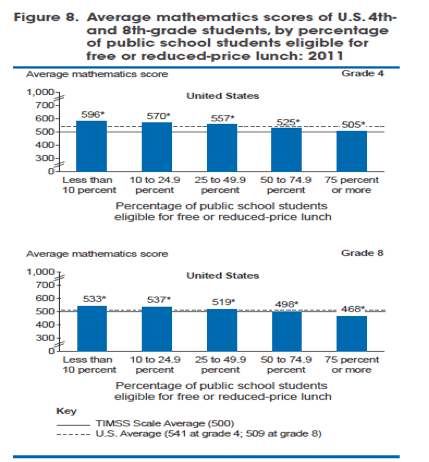
Here is the recent TIMSS data for grades 4 and 8 by poverty of the families served by the school.
Untitled1

​ Although many nations in this analysis were not developed nations, the competition did include Singapore, Korea, Hong Kong, and many OECD countries. The data are clear. First, to the amazement of everyone, the U.S. mean score in mathematics was above the international average, a finding conveniently underreported in the U.S. But averages always hide trends in data. When U.S. scores are broken down by the poverty of the families served, as in this graph, we see that the higher the percent of poverty among the families served by the schools, the lower the score in math. The science assessment showed the same trend.
​Less well known is that the two groups on the left constitute about 12 million students, and they handily beat the average score of Finland. Even the middle group beat Finland at both the 4th and 8th grade, and that means that about 50% of U.S. school children who are not greatly affected by poverty, about 25 million children, are doing as well as the nation whose scores other nations envy. But internationally high, or quite respectable test scores, are not the lot of those students attending schools with high rates of poverty. That is our simple point.
​Let’s switch to PIRLS.

Untitled2


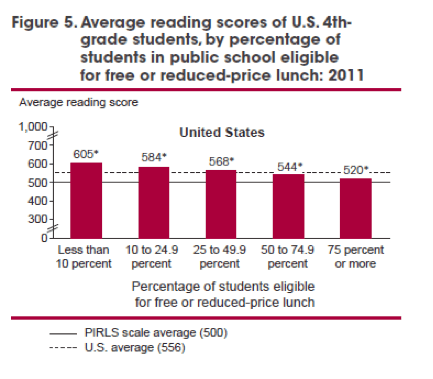
​U.S. public school students, where poverty rates were low, the two bars on the left, outscored every other nation in the world, and there were more than 50 other countries and jurisdictions in this study. Underreported, once again, was that even our children in schools that serve the poorest families, the bar on the right, scored above the international average. The gap, however, between the children in schools that serve the wealthy and those that serve the poor is huge. That is our point. If we want better test scores in the U.S. we should probably stop blaming unions, tenure, the curriculum, teachers and administrators, and instead create programs to reduce poverty and the housing segregation that accompanies low earnings.
​Now let’s go to PISA, the test that HPW use to argue that we do not have it right. Here are math scores for the five groups we focus on.
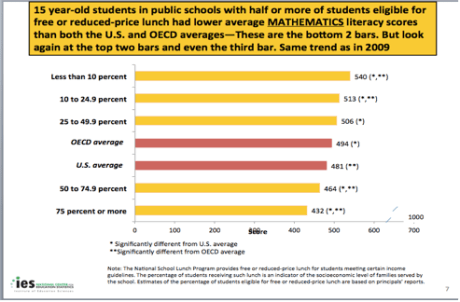
Untitled3


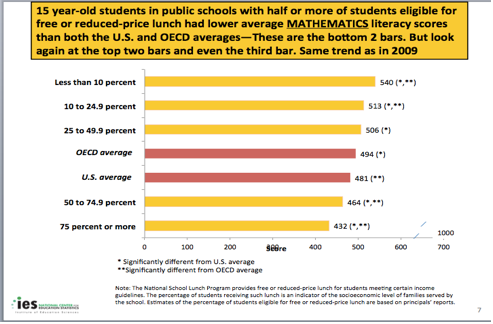
​Even in math, often our weakest subject, those students in schools where poverty rarely is seen, the first bar in this graph, placed 6th in world—and they placed higher than Japan. The next group, schools with less than 25% of the children living in poverty families, placed 17th in world, well above most of the countries in OECD. But here is our national problem: The U.S. average score was low because the schools attended by children whose families are in poverty score poorly. Those in the schools most heavily affected by poverty may not have the mathematics skills needed to compete in the market. But other U.S. children certainly do, and they are predominantly those attending schools low in family poverty.

Here are science scores.
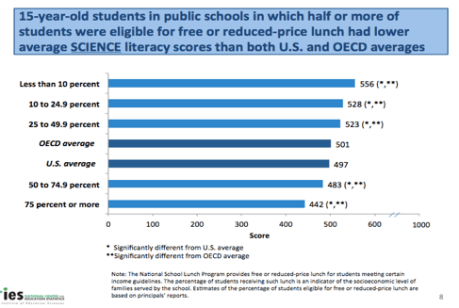
Untitled4

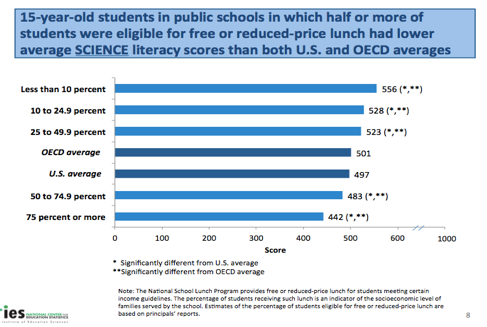
​The first bar in this graph displays PISA science scores for students in schools with under 10% of their classmates living in families that experience poverty. They were beaten by only one country, Shanghai, which as we know is not a country but a city. And it is a city with the highest rate of college graduates in China. Apparently it also does not test the children of its illegal immigrants (those from rural areas living in Shanghai illegally: Their number may approach 200,000). The second bar, representing students in schools where under 25% of the students are from families in poverty tied for 8th in the world. Not too shabby a performance for about 12 million American public school students. But once again the trend is clear. Children in schools high in poverty do not do well. The difference between the schools serving the wealthy and the poor is over one standard deviation.

Here is the reading data. The trend is clear once again.
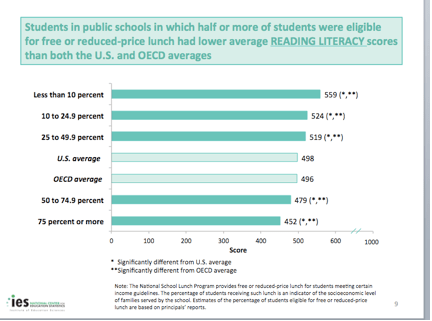
Untitled5

​Reading is an area of US strength, as PIRLS revealed. We see that again in PISA. US students in schools where under 10% of the families served are in poverty placed 2nd in the world. In the group where under 25% of the students were in poverty the students placed 6th in the world, tied with Finland. So, again, around 12 million of our student’s did great. And if we assess the performance of students represented by the third bar, the one showing students in schools with 25-50% of the families served in poverty, they also did well. They came in 10th. So approximately half of all US students, about 25 million of them, are doing pretty good, but that is not true for the other half of our school population—those attending schools where over 50% of the students come from families that are eligible for free and reduced lunch, our marker of family poverty.

​We conclude that in contemporary America parental income, not parental education buys neighborhood, and neighborhood plays a big role in determining the composition of the class ones child is in, the composition of the cohort at the grade level one’s child is in, and the characteristics of the community in which one’s child goes to school. If there is not a very strong correlation between parental education and parental income, or more to the point, between parental education and where you can afford to live, HPW are wrong in both their interpretation of their own data, and their criticism of us. But we would like to add one more criticism of HPW, namely, that reliance on PISA and other international assessments to draw conclusions about characteristics of the U.S. system of education is foolish, even though we challenged their interpretations of our work by using those same questionable tests. The remarkably insightful Chinese born scholar Yong Zhao has a book coming out soon (Zhou, 2014). In it he makes it quite clear that PISA, in particular, and for international tests in general, it is impossible to draw valid conclusions about the strengths and weaknesses of national systems of education. Zhao (and many others) would caution, and we would agree, that HPW are on extremely shaky ground when they use PISA data to do so.

References

Berliner, D. C., Glass, G. V and Associates. (2014). Fifty myths and lies that
​threaten America’s public schools. New York: Teachers College Press.

Biddle, B. J. (2014). The unacknowledged disaster: Youth poverty and
educational failure in America. Boston. MA: Sense Publishers.

Hanushek, E. A., Peterson, P. E., & Woessmann, L. (2014). Not just the
​problems of other people’s children: U.S. Student Performance in Global
Perspective. Harvard University, Program on Education Policy and Governance & Education Next, PEPG Report No. 14-01, May 2014.

Zhao, Y. (2014). Who’s afraid of the big bad dragon? Why China has the best
​(and worst) education system in the world. San Francisco, CA: Jossey-
​Bass.

Robert Berkman, who has been teaching math for thirty years, takes issue with the article by Elizabeth Green in the New York Times magazine called Why Americans Stink at Math. While he has great admiration for Green’s writing skills, he thinks she is an American who is not good at math.

He writes:

“The first place where Green goes wrong is when she cites “national test results” about mathematics achievement in the U.S.. First, I wonder which “test results” Green is referencing here (you have to be suspicious when, in the days of the omnipresent interweb, a link is not included to the data supporting this point.) It may be significant that 2/3 of all 4th and 8th graders are not “proficient” in math, but again, this is a national standard, not an international standard, so this only points to the fact that U.S. children are not achieving according to some standard that was created where, in some dark cave where Dick Cheney and his family reside?

“Green goes on to state that half the 4th and 8th graders taking the National Assessment of Educational Progress could not read a thermometer, or that 3/4 of the test takers could not translate a simple word problem into an algebraic expression. Note that this is the National Assessment of Educational Progress – it doesn’t say anything about whether U.S. children are better or worse than anybody else around the globe; for all we know, 7/8 of the children in Helsinki and 11/13 of the children in Ibaraki couldn’t successfully answer these questions either. Look, I’m not the sharpest pencil in the box, but even I know these numbers are insignificant without a context.”

If I may interject my view, NAEP proficient is a very high standard of academic proficiency, not a benchmark for what all students should know. Michelle Rhee constantly makes this mistake. It is like complaining that not all students are A students.

Berkman then chastises Green for comparing Massachusetts, a state, with Shanghai, a city (which excludes a significant number of students from the tests because their parents are migrants).

I confess I am tired of the constant barrage of articles and books about how terrible the U.S. is and how our public schools are the reason that we fail at this, that, or everything. I think this is a wonderful country, and I hope that one day soon we can take control back from the oligarchs that want to turn our children into standardized widgets (but not their own).

I like Elizabeth Green. I have known her for several years. I hope her next book will celebrate the success of American public schools in accepting all children and unleashing the genius of our best thinkers and creators, despite the contempt of the uber-rich and the war on the teaching profession. There is a reason that teachers say they work “in the trenches.” It’s time to celebrate their perseverance in the face of budget cuts and stupid federal policy.