Archives for category: Testing

Levi Cavener, a teacher of special education in Idaho, learned that Idaho will give the Common Core test SBAC) to tenth graders even though it includes eleventh grade content.

“However, I was shocked during this exchange when the Director told me that the decision was due to the fact the state was worried students wouldn’t take the test seriously, and they didn’t want their data set tainted…because, you know, then the results wouldn’t be valid.

“Here is the Director’s response to my question of the logic in giving 10th graders the SBAC instead of 11th graders:

[The director said “Grade 11 is optional this year as your juniors have already met graduation requirements with the old ISATs and might not take the new tests seriously if they were used for accountability.”
Well, that’s convenient. I’m glad the State Department can cherry-pick the students who take the SBAC “seriously” and which students will not; I’m sure they will give that same privilege to teachers…oh..err…I guess not.]

See, here’s why my jaw was left open: The Director of Assessment admitted, rightfully and logically, that if students won’t take the test seriously, then there is no point in assessing them because the data will be invalid. And, if that’s true, let’s not assess those kidos because it would be a total waste of time and resources, not to mention the fact that the data would be completely invalid.

Thus, it would be logical to conclude that if the data is not accurate, then the SDE surely wouldn’t want to tie those scores to something as significant as a teacher’s livelihood.

Oh wait…they want to do exactly that? Shucks!

According to the the Idaho State Department of Education’s recent Tiered Licensure recommendations, SBAC data will be tied directly to a teacher’s certification, employment, and compensation.

Yet, If the Dept. of Ed admits SBAC data isn’t accurate, then what in the world are they doing on insisting that the data be tied to a teacher’s certification, employment, and compensation?

The insistence of tying data that is admittedly invalid is synonymous to tying a fortune cookie to real-world events. I don’t know about you, but my lucky numbers haven’t hit the lottery; what a scam!”

The test is more than eight hours long.

Writes Levi, “Isn’t it logical to conclude that at some point that kidos decide they would rather go outside to recess rather than reading closely on a difficult text passage or spending more time editing a written response? When the kido makes that decision, do we hold the teacher responsible for the invalid data?”

And what about special education kids? “Let’s compound that scenario for special education teachers who work with a population of students qualifying for a special education eligibility under categories of Attention Deficit Hyperactivity Disorders, Emotional Disturbances, and Autism Spectrum diagnosis.

“Yup, I’m sure these students will always take the multi-day SBAC with the utmost earnestness; it’s not like the very behaviors they demonstrated to qualify for special education services to begin with would impede their ability to complete the SBAC with total validity of the results?”

“Tony Little, headmaster of Eton, says that the U.K.’s testing system is unimaginative and misleading.

“England’s “unimaginative” exam system is little changed from Victorian times and fails to prepare young people for modern working life, Eton’s headmaster has said.

“Tony Little said there was a risk that “misleading” test scores may become more important than education itself, and warned against a narrow focus on topping rankings.

“There is a great deal more to an effective and good education than jostling for position in a league table,” Little wrote in a Viewpoint article for the Radio Times.

“He said England’s attempts to copy the highly academic schooling offered in areas of the far east such as Shanghai was ironic, since schools there were now looking at the value of giving children a more rounded education.

“Here is the irony; we seem intent on creating the same straitjacket the Chinese are trying to wriggle out of,” he wrote. “We should be wary of emulating Shanghai just as they themselves see some value in the liberal values of an all-round education – something we have traditionally been good at.”

“Shanghai is rated the top education system in the OECD’s Pisa tests (Programme for International Student Assessment), which compare the performance of children in 65 countries.

“English children’s comparatively poor performance in the rankings was cited by Michael Gove, the former education secretary, as justification for introducing more traditional exams, academies and free schools. Liz Truss, a former education minister, visited to Shanghai to learn the secrets of its success…..

“But Little said England’s exam system was outdated. “[The exam system] obliges students to sit alone at their desks in preparation for a world in which, for much of the time, they will need to work collaboratively.”

“Little, who is due to retire next year, gave his support to a Lancashire primary school that found itself in the spotlight after a letter telling pupils them not to worry about their test results went viral.”

Whoever thought it was a good idea to turn education into a political issue should hang his or her head in shame.

In the midst of a heated gubernatorial race, Connecticut Governor Dannel Malloy, heretofore an admirer of testing and the Common Core and more testing, has written a letter to the U.S. Department of Education saying that students are tested too much, especially in the 11th grade.

“Gov. Dannel P. Malloy appealed to the U.S. Department of Education on Friday to consider whether juniors in Connecticut really need to take a statewide standardized test in the same year that they have SATs, ACTs, AP exams and finals.

“Federal law requires states to test students from grades 3-8 and again in 10th grade. But the new high school test for the Common Core standards is given to 11th graders, with the thinking it yields better data on student learning. This was the first year the test was given to juniors, causing an uproar from some parents.

“I am eager to explore solutions for the students who may be our most overtested: our 11th graders,” Malloy said in the letter to the U.S. Education Department.”

You can’t blame New York parents for feeling baffled and angry at state education officials.

From 2006-2010, the state told them that their children were making incredible gains on the state tests.

Many people thought that the gains were so high that it couldn’t be true.

So state education officials brought in Professor Daniel Koretz of Harvard and Professor Jennifer Jennings of New York University to review the tests and the scores. They reported that the tests had become too predictable, that too few standards were tested, and that the results were inflated. So in 2010, scores dropped across the state as the scores were adjusted.

Then came the switch to Common Core, and the scores across the state collapsed in 2013. Two-thirds of all students “failed” to reach what the state called proficiency. Parents were furious, especially in districts where the graduation rate was well over 90%, and most students were accepted at good colleges. How did their children go from success to failure in such a short time? How could their children be both college-bound yet not, in the state’s telling, “college ready.”

Well, the main reason scores collapsed was that the state education department insisted on aligning New York’s “proficiency” mark with that of the federal NAEP. This was a huge error. NAEP proficiency is a mark of “solid academic achievement.” It is not a grade-level mark; it is not a passing mark. Typically, only 35-40% of students in every state reach NAEP proficient. In my seven years on the governing board of NAEP, I considered it to be akin to an A or a B+. The only state where as many as 50% of students achieve NAEP proficient is Massachusetts.

So if the Common Core tests are not only harder but have a grading scale that is sure to “fail” more than 50% of all students—including 80% of black and Hispanic students, 97% of English learners, and 95% of students with disabilities–what will the state do with all those kids who are not college and career ready?

Want to know more about how the New York State Education Department has fiddled with the test scores? As activist Leonie Haimson says, “do not trust data from the New York State Education Department.”

Blogger Perdido Street calls for an investigation.

Blogger Lace to the Top expresses frustration at the fluctuation in scores.

Many parents are angry at the state and angry at Pearson for concealing 50% of the questions and for the poor quality of many of the questions that were released.

What a mess!

When local school board members in Lee County and Palm Beach County began talking about opting the entire district out of state testing, the state warned them they would face punishment if they dared.

“But the district better be prepared to pay the price of skipping the new exam — quite literally. Skip the exam and the state is likely to withhold money.

“The ramifications could be pretty dramatic for a district that wanted to do this,” says Florida Department of Education spokesman Joe Follick. “This is uncharted waters. No districts have done this.”

“Follick added the state could withhold state funds, grants and lottery money. Lawmakers could decide on additional sanctions, he said. Most K-12 public school operations are funded through the state.

“School board members say opting out an entire school district is unlikely.

“I believe in assessment,” Palm Beach school board member Karen Brill said last week. “I believe in testing that’s used for measurement, not punishment. I believe that we as a district need to research opting out from the new Florida Standard Assessments.

“Sometimes it takes an act of civil disobedience to move forward.”

A district court judge in Baton Rouge ordered State Superintendent John White to release information about setting cut scores.

Veteran educator Mike Deshotels posted this on his blog:

“Breaking News: On Thursday, August 28, Judge Bob Downing of the 19th Judicial District Court in Baton Rouge ordered State Superintendent John White and the LDOE to produce detailed information about the setting of cut scores for the Mastery level student ratings for the 2014 Spring LEAP test that was designed to be more aligned with the Common Core standards. The LDOE had already released the minimum percentages of correct answers used for the setting of Basic level ratings just before the lawsuit demanding this information was filed. John White was found to be in violation of the public records law for refusing to release the score setting percentages on the 2014 LEAP test and for failing to produce the written communications with the testing company relating to the setting of cut scores. The LDOE was also required to pay all court costs and attorney’s fees necessary to the prosecution of my public records lawsuit filed to extract this vital information from White, the LDOE, and the testing company. This post on The Louisiana Educator Blog had already analyzed the drastic lowering of the minimum percentage of correct answers on some areas of LEAP apparently designed to imply that Louisiana students were doing just fine on the new CCSS aligned tests. Apparently manipulation of test scores to produce predetermined results has now become standard operating procedure in the implementation of Common Core. The video referred to above shows how scores were set in New York to create the perception of failure of the entire New York state system.”

It is striking and sad that judges are now deciding basic education issues or that people have to appeal to judges to get basic information that ought to be available to the public.

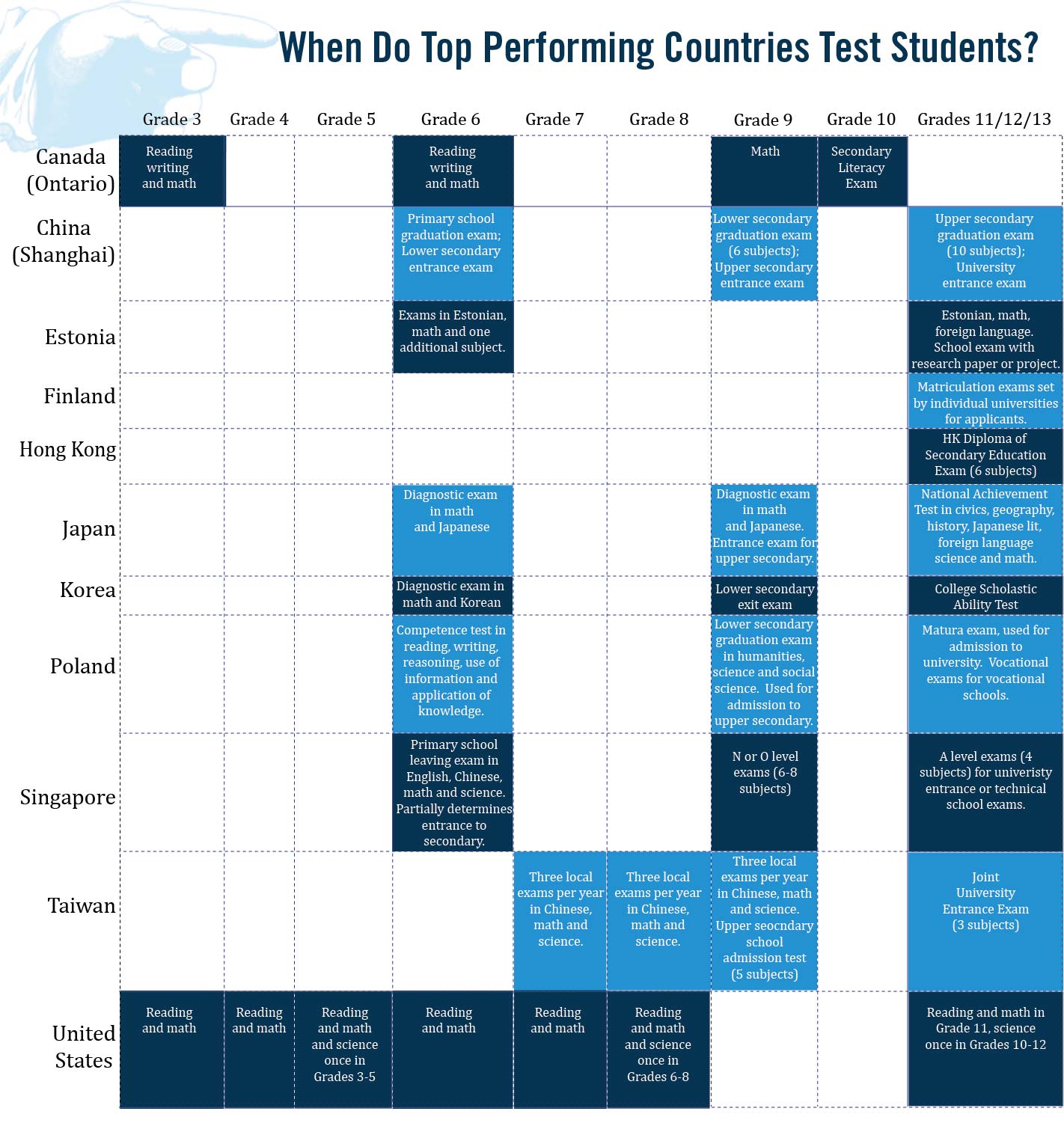
Marc Tucker writes that we test students more than any of the high-performing nations in the world.

Here is a graph that demonstrates the differences.

Tucker proposed a new accountability system for the U.S. that puts us more in line with common practice.

Here are his key points:

“The ideas outlined by Marc Tucker in Fixing Our National Accountability System signify a departure from conventional thinking on the issue of accountability. Rather than focus on punishing teachers for the results of a system that others designed, the core components of this report rest on three fundamental principles:

1) Testing: Instead of testing all of our students every year with low-quality tests, students would take high-quality accountability tests, covering a full core curriculum, only three times in their school career. In some off years, tests in math and ELA would be administered only to samples of students by computer and would not carry high stakes for teachers or students.

2) Use of Data: Data from these tests would be used to identify schools that might be in trouble, and to deploy a team of expert educators to assist in resolving the issues with the help of districts and/or states. This data would be available to the general public but it would not include a rank or grade.

3) Policies for Professionals: Enact policies that make it attractive for our nation’s strongest teachers and principals to work in the most at-risk schools – these very same policies would also make teaching an attractive career for some of our best high school graduates and transform teaching into a high status profession.”

In the brave new world of Common Core, all tests will be delivered online and graded by computers. This is supposed to be faster and cheaper than paying teachers or even low-skill hourly workers or read student essays.

But counting on machines to grade student work is a truly bad idea. We know that computers can’t recognize wit, humor, or irony. We know that many potentially great writers with unconventional writing styles would be declared failures (EE Cummings immediately to mind).

But it is worse than that. Computers can’t tell the difference between reasonable prose and bloated nonsense. Les Perelman, former director of undergraduate writing at MIT, created a machine, withe help of a team of students, called BABEL.

He was interviewed by Steve Kolowich of The Chronicle of Higher Education, who wrote:

“Les Perelman, a former director of undergraduate writing at the Massachusetts Institute of Technology, sits in his wife’s office and reads aloud from his latest essay.

“Privateness has not been and undoubtedly never will be lauded, precarious, and decent,” he reads. “Humankind will always subjugate privateness.”

Not exactly E.B. White. Then again, Mr. Perelman wrote the essay in less than one second, using the Basic Automatic B.S. Essay Language Generator, or Babel, a new piece of weaponry in his continuing war on automated essay-grading software.

“The Babel generator, which Mr. Perelman built with a team of students from MIT and Harvard University, can generate essays from scratch using as many as three keywords.

“For this essay, Mr. Perelman has entered only one keyword: “privacy.” With the click of a button, the program produced a string of bloated sentences that, though grammatically correct and structurally sound, have no coherent meaning. Not to humans, anyway. But Mr. Perelman is not trying to impress humans. He is trying to fool machines.

“Software vs. Software

“Critics of automated essay scoring are a small but lively band, and Mr. Perelman is perhaps the most theatrical. He has claimed to be able to guess, from across a room, the scores awarded to SAT essays, judging solely on the basis of length. (It’s a skill he happily demonstrated to a New York Times reporter in 2005.) In presentations, he likes to show how the Gettysburg Address would have scored poorly on the SAT writing test. (That test is graded by human readers, but Mr. Perelman says the rubric is so rigid, and time so short, that they may as well be robots.)

“In 2012 he published an essay that employed an obscenity (used as a technical term) 46 times, including in the title.

“Mr. Perelman’s fundamental problem with essay-grading automatons, he explains, is that they “are not measuring any of the real constructs that have to do with writing.” They cannot read meaning, and they cannot check facts. More to the point, they cannot tell gibberish from lucid writing.”

The rest of the article reviews projects in which professors claim to have perfected machines that are as reliable at judging student essays as human graders.

I’m with Perelman. If I write something, I have a reader or an audience in mind. I am writing for you, not for a machine. I want you to understand what I am thinking. The best writing, I believe, is created by people writing to and for other people, not by writers aiming to meet the technical specifications to satisfy a computer program.

This is a surprising story. State Commissioner Deborah Gist and other state leaders will review whether there is too much testing in the schools of Rhode Island. This is a battle that the Providence Student Union has been waging for the past two years. They held rallies and staged political events to call attention to the state’s testing program. They criticized high stakes testing, standardized testing, and too much testing. They fought Gist’s and the state board’s plan to use a standardized test as a high school graduation requirement. The kids knew that many of their classmates would not pass because of the nature of the test itself. It is too soon to say they have won, but not too soon to say that they changed the public debate in Rhode Island.

“In a letter to school superintendents, Katherine E. Sipala, president of the Rhode Island School Superintendents’ Association, and Gist wrote:

”Over the past year or more, many of us have heard from some students, teachers, and parents who expressed their concerns about over-testing in our schools. We share their concerns, and we want to take action on this matter. None of us wants to test students too much, and each of us can consider ways to streamline the assessment process, to eliminate assessments that do not advance teaching and learning, and to ensure that we use assessments to help us make good decisions about instruction. If assessments do not give us information that informs instruction, we should not administer those assessments.”

By the way, if you live in District 4 in Rhode Island, one of the leaders of the Providence Student Union is running for state representative. Aaron Regunberg deserves your support. He is a thoughtful, hard-working, dedicated young man. Just what we need to improve the politics of our nation.

If you live in

The purpose of testing is for students and teachers to learn about students’ strengths and weaknesses. Teachers can look at student performance and learn what they taught well and what they didn’t teach well.

When states, in collaboration with testing companies, keep tests confidential, reeves long nothing to students and teachers but test scores, they vitiate the value of the test. It’s akin to going to your doctor for a checkup and learning nothing but a score, with no context or interpretation of what you should do now.

A reader from Pennsylvania writes:

“What’s worse are the Pennsylvania Keystone Exams. They have not published a single question from any exam given nor any questions from the Classroom Diagnostic tests, practice tests for the Keystone. Instead they have only published a few sample questions some of which are poorly written. When asked about this, an official said that the sample questions were reject questions that would never be used on the exams. Basically students and teachers are being kept in the dark about these high stakes exams which will be used to determine if a student can graduate or not, how a school district is rated and how a teacher is evaluated.”