Archives for category: Testing

Nancy Bailey explains here that if you are dissatisfied with your public school, blame the Disruption Machine, the ones who call themselves “reformers,” like Betsy DeVos.

They have run public schools into the ground for the decades.

They have imposed their malevolent ideas and policies on public schools, with no accountability for their mistakes.

She writes:

Frustrated by public schools? Look no further than the corporate education reformers and what they have done to public education.

Education Secretary DeVos and her corporate billionaire friends have been chipping away at the fabric of democratic public schools for over thirty years!

The problems we see in public schools today are largely a result of what they did to schools, the high-stakes testing and school closures, intentional defunding, ugly treatment of teachers, lack of support staff, segregated charter schools, vouchers that benefit the wealthy, Common Core State Standards, intrusive online data collection, and diminishing special education services.

Big business waged a battle on teachers and their schools years ago. The drive was to create a business model to profit from tax dollars. Now they want to blame teachers for their corporate-misguided blunders! It’s part of their plan to make schools so unpleasant, parents will have no choice but to leave….

I student taught in an elementary school in Detroit, in 1973. Schools were certainly not perfect, but my modest school did a good job.

The third-grade teachers were excellent reading teachers. They organized rotating small groups of students based on their skill needs decoding letters and words. There were no data walls. No child appeared to compare themselves unfavorably to other children.

Students were encouraged to read, did free reading, lots of writing, and had access to plenty of books. The school had a nice library with a librarian who often read beautiful and funny stories to the class. They spent time studying social studies, science, and art and music. Teachers worked closely with the PTA and reached out to parents.

There was no testing obsession. Students didn’t fear failing third grade. They were continually learning, and most liked school. There were twenty-two students in the class.

Teachers did their own assessment, and they discussed the results with each other at their grade level meetings. The school had a counselor and I believe a nurse stationed at the school. We worried about the students and addressed concerns about issues like why some showed up without mittens in the cold weather.

Students did class projects to help remember what they learned in their subjects. For science, we created a rocket out of a huge cardboard box. We painted it and spent time studying the solar system. Children took turns sitting in the rocket pretending they were astronauts.

This school had an excellent Learning Center where teachers could share materials to cut down on costs. They had a nice collection of resources for every subject.

My supervising teacher was kind, well-prepared, and tough. She expected daily written lesson plans which she reviewed with me before I taught. She was an excellent mentor!

Where’s that school today? I wish I could go back and visit, but it closed years ago, razed and turned into a housing development. It was shuttered like 225 other public schools in Detroit!

Lyndsey Layton of the Washington Post interviewed Bill Gates in 2014 and told the full story of the origin of the Common Core “State” Standards.

In case the Washington Post is behind a paywall, the full text of the Layton article is here.

Secretary of Education Arne Duncan and other friends of the CCSS insisted that the standards were developed by governors, state superintendents, education experts, and teachers. No, they were developed by David Coleman, formerly of McKinsey, now CEO of the College Board, and a committee whose members included no working teachers but a full complement of testing experts from ACT and SAT. Google David Coleman and “architect” and you will see that he is widely credited with shepherding the CCSS to completion.

It would not have happened without the enthusiastic support and funding of Bill Gates.

Layton writes:

On a summer day in 2008, Gene Wilhoit, director of a national group of state school chiefs, and David Coleman, an emerging evangelist for the standards movement, spent hours in Bill Gates’s sleek headquarters near Seattle, trying to persuade him and his wife, Melinda, to turn their idea into reality.

Coleman and Wilhoit told the Gateses that academic standards varied so wildly between states that high school diplomas had lost all meaning, that as many as 40 percent of college freshmen needed remedial classes and that U.S. students were falling behind their foreign competitors.

The pair also argued that a fragmented education system stifled innovation because textbook publishers and software developers were catering to a large number of small markets instead of exploring breakthrough products. That seemed to resonate with the man who led the creation of the world’s dominant computer operating system.

“Can you do this?” Wilhoit recalled being asked. “Is there any proof that states are serious about this, because they haven’t been in the past?”

Wilhoit responded that he and Coleman could make no guarantees but that “we were going to give it the best shot we could.”

After the meeting, weeks passed with no word. Then Wilhoit got a call: Gates was in.

What followed was one of the swiftest and most remarkable shifts in education policy in U.S. history.

The Bill and Melinda Gates Foundation didn’t just bankroll the development of what became known as the Common Core State Standards. With more than $200 million, the foundation also built political support across the country, persuading state governments to make systemic and costly changes.

Bill Gates was de facto organizer, providing the money and structure for states to work together on common standards in a way that avoided the usual collision between states’ rights and national interests that had undercut every previous effort, dating from the Eisenhower administration.

The Gates Foundation spread money across the political spectrum, to entities including the big teachers unions, the American Federation of Teachers and the National Education Association, and business organizations such as the U.S. Chamber of Commerce — groups that have clashed in the past but became vocal backers of the standards.

Money flowed to policy groups on the right and left, funding research by scholars of varying political persuasions who promoted the idea of common standards. Liberals at the Center for American Progress and conservatives affiliated with the American Legislative Exchange Council who routinely disagree on nearly every issue accepted Gates money and found common ground on the Common Core.

One 2009 study, conducted by the conservative Thomas B. Fordham Institute with a $959,116 Gates grant, described the proposed standards as being “very, very strong” and “clearly superior” to many existing state standards.

Gates money went to state and local groups, as well, to help influence policymakers and civic leaders. And the idea found a major booster in President Obama, whose new administration was populated by former Gates Foundation staffers and associates. The administration designed a special contest using economic stimulus funds to reward states that accepted the standards.

The result was astounding: Within just two years of the 2008 Seattle meeting, 45 states and the District of Columbia had fully adopted the Common Core State Standards.

Even Massachusetts, the state with the highest academic performance in the nation, replaced its excellent standards with CCSS and won a federal grant for doing so.

Some states adopted Common Core before it was publicly released. The state chief in Texas, Robert Scott, refused to adopt the CCSS sight unseen, but he was a rarity.

Without Gates’ money, there would be no Common Core.

Opposition came from Tea Party groups, then from independent teacher groups like the BadAss Teachers Association.

The promise of the Common Core was that it would lift student test scores across the board and at the same time, would close achievement gaps.

The Common Core was rolled out in 2010 and adopted widely in 2011 and 2012.

Districts and states spent billions of dollars on new textbooks, new tests, new software and hardware, new professional development, all aligned to the CCSS.

This was money that the districts and states did not spend to reduce class sizes or to raise teachers’ salaries.

Test scores on NAEP and on international tests have been stagnant since the rollout of the Common Core.

Teacher morale down. New entries into teaching down. Test scores flat. Achievement gaps larger.

Edu-entrepreneurs enriched. Testing industry happy. Tech industry satisfied.

Disruption achieved.

If you want to read more about the origins of the Common Core, read Mercedes Schneider’s Common Core Dilemma: Who Owns Our Schools? and Nicholas Tampio’s https://www.amazon.com/Common-Core-Nicholas-Tampio-ebook/dp/B079S2627M/ref=sr_1_fkmr0_1?keywords=nicholas+campion+common+core&qid=1575909356&s=books&sr=1-1-fkmr0Common Core: National Education Standards and the Threat to Our Democracy.

Bottom line: What the Gates’ billions spent on Common Core proved was that the basic problem in American education is not the lack of common standards and common tests, but the growing numbers of children who live in poverty,  who come to school (or miss school) ill-nourished and lacking regular medical care and a decent standard of living.

He spent more than $4 billion on failed experiments in education over the past 20 years. Wouldn’t it be great if he invested in children, families, and communities and improved their standard of living?


Jan Resseger is upset that the New York Times posted an article seeking to revive the moribund Common Core standards.

Some states dropped the CC standards; some kept them but gave them a new name. Most dropped the CC-aligned tests.

In her view, the CCSS died because it was hated by significant numbers of teachers and parents. It launched the Opt Out movement in New York State, which annually enlists the non-cooperation of nearly 20 percent of the state’s test-eligible students.

They were hated because it was not “developed by governors, educational experts, state superintendents, and teachers,” as the founding myth claims, but by a small number of people who wrote them with minimal consultation of classroom teachers.

They were hated because they were funded by one man–Bill Gates–and never validated by any field trial in real classrooms.

They were pushed on the states not by consent but by the lure of $5 billion in Race to the Top funding. The only state officials who had to agree were the governor and the state superintendent, and most of those have since moved on. The states that did not agree to accept the CCSS were not eligible to compete for RTTT billions

They fell into disfavor because activists on the right saw them as federal overreach and activists among teachers and parents in the center and on the left disliked the standards and hated the tests.

They lost support when the testing consortia that Arne Duncan funded with $360 million arbitrarily decided to align the CCSS test standards with those of the NAEP, which was totally inappropriate. The NAEP standard for “proficiency” is not grade-level, nor is it pass-fail. It represents a high level of achievement, like a B+ or an A-. Massachusetts is the only state in the nation where as much as 50% of students score NAEP proficient, yet the Common Core testing groups expected that most American students would reach that high mark. They did not, and the CCSS tests wrongly generated headlines that inaccurately labeled students, schools, and districts as “failing” when they did not reach an impossible benchmark.


Sue Legg is a leader of the League of Women Voters in Florida and a member of the board of the Network for Public Education.

She writes here about Miami, a district that is “all in” for school choice. 

Miami seems to have taken the place of Denver as their favorite district, now that the choice Majority was booted out of power.

Legg writes:

Miami is the school choice capital!  According to this EducationNext article, 20% of Miami’s public schools are charters.  Another 20% of students are in private schools, and approximately half of those are paid for with vouchers and tax credit scholarships.  It does not stop there.  District-run choice programs now enroll 61% of public school children.  Is this a school choice dream or a nightmare?

Dade County schools tout high academic achievement.  The district receives an ‘A’ grade from the state and no failing school grades.  Of course, there are only 15 schools in the state that have an ‘F’ rating, so Miami is not unique there.  An ‘A’ school only has to earn 62% of the possible points based on state assessment test scores etc.  Over one-half of all Florida’s schools earn an ‘A’ or ‘B’ grade.

Miami’s  fourth grade students rank above the national average on the National Assessment of Educational Progress (NAEP) reading test, but there is no statistically significant difference between Duval, Hillsborough and Dade Counties’ scores.  Could it be that third grade retention pushes Florida scores up because so many fourth graders were retained?

The Dade County eighth grade NAEP scores also seem to be higher in comparison to other cities.  Yet, the average Miami-Dade score is right at the national average.  Miami’s high school graduation rate is just below the national average.  It would seem that Miami-Dade is good at hype.  The reality is quite different on the ground.

According to the report ‘Tough Choices‘, Miami is the second most segregated district in the state.  Of 460 schools in Miami, 214 are considered isolated.  They are more than 85% single race.   Miami’s lowest performing schools are overwhelmingly black.  Hispanic students also tend to be enrolled in segregated schools.

Is this what Florida is striving for?  Our schools are driven by grades which are easy to manipulate.  Yet, Florida, the third largest state in the nation, is just average in student achievement and children are increasingly separated by race and economic status.

Florida is ground zero for school choice, since it has been controlled by Jeb Bush and his allies since 1998. By now, it should have surpassed Massachusetts on the NAEP, but its eighth grade scores continue to be mediocre.


Owen Davis writes here about the enrichment of the testing industry by No Child Left Behind and Race to the Top.

The testing and accountability craze started before No Child Left Behind, but that federal law turned it into a bonanza for Pearson and other companies and led to a consolidation of the testing industry.

We now know, almost 20 years after NCLB was signed into law on January 8, 2002, that it has had very little effect on student test scores, on closing achievement gaps, or on any of the other wild promises made first by George W. Bush, echoed by Rod Paige and Margaret Spellings, and reiterated again by Arne Duncan and John King.

Who in Congress or the federal government will have the courage to call a halt to this insane investment of billions of dollars into the testing industry?

Davis writes:

Three days after taking office, George W. Bush unveiled his signature domestic policy, No Child Left Behind. The bill would triple the number of exams the federal government required of students, while dangling stiff penalties over struggling schools. For many educators it felt like a depth charge.

The mood was different at Pearson Education, a division of the London-based conglomerate Pearson PLC. As the education community was still absorbing the shock in February 2001, Pearson Education chief executive Peter Jovanovich spoke to a group of Wall Street investment analysts. He pointed them to the proposed annual testing requirements and school report cards. “This,” Jovanovich said, “almost reads like our business plan.”

Pearson Education was a relative newcomer to the education market. Three years earlier, Pearson PLC had paid $4.6 billion to buy the textbook wing of publishing house Simon & Schuster. In 2000, the company acquired a leading standardized test provider. Now Pearson’s stars had aligned.

“Content has been king,” Marjorie Scardino, Pearson’s top executive, said at the time. “But now we’ll have the ability to put content and applications together and that will really allow us to be king.” With a hand in both delivering curriculum and testing students over that curriculum, Pearson would capitalize on America’s newfound school accountability kick.

Pearson Education’s profits increased 175 percent in the decade following No Child Left Behind. The company, whose properties included Penguin Books and the Financial Times, soon derived most of its profits from American education. Test sales jumped fivefold between 2000 and 2006. “Our assessment businesses are in the sweet spot of education policy,” Scardino told investors in 2005 – a year when more than 60 percent of American school kids lived in states giving Pearson tests.

Since 2000, the testing market has roughly tripled in size, to nearly $4 billion a year, with annual achievement tests spawning a range of more frequent tracking assessments. As testing has flourished, more and more functions of the school publishing industry the have fallen into fewer and fewer hands. In 1988, ten publishers shared 70 percent of the textbook market. Today, the “Big Three” —McGraw-Hill, Houghton Mifflin Harcourt and the juggernaut Pearson—control at least 85 percent of the market. These lucky few have since expanded their offerings; Pearson hawks everything from student data trackers to online credit-recovery courses to ADHD diagnostic kits.

But along the way the American public grew wary of the companies’ influence in education. Parent groups on both the left and right have cast testing mandates as political favors to test makers, a notion that has helped spark a recent nationwide pushback against accountability policies. Hundreds of thousands of parents across the country have opted their children out of mandatory tests last year, and entire schools have held test boycotts.

The sense that students are over-tested is no illusion. A 2013 study from the Organization for Economic Cooperation and Development found the stakes attached to testing in the U.S. to be the highest in the developed world. One study of the 66 largest urban school districts found the average student took 112 standardized tests from kindergarten to graduation, spending an average 22 hours a year just taking the exams, let alone preparing for them.

The efforts of testing companies to secure and expand their business have helped pushed American schools toward an overbearing focus on assessment – one that has failed to achieve its desired result of dramatically improving student and school performance. Here’s the story of how we got to this point.

It is a sad story, an awful story, that involves lobbyists, business plans, and billions of dollars. Nothing good there for students or teachers.

Every blogger who has written about MSNBC’s Public Education Forum expressed gratitude that a big cable network paid attention to our most important democratic institution.

Nancy Bailey is angry about the issues that were ignored, the ones that threaten the future of students, teachers, and public education.

She is also streamed that the program was not on live TV. Public education not important enough for live TV? 50 million children are in public schools. They have parents. Quite an audience to overlook.

Good work, Nancy!

She writes (in part, read it all):

Candidates talked about making the wealthy pay their fair share of taxes to help schools, but no one mentioned Bill Gates, the Waltons, Eli Broad, Mark Zuckerberg or any of the corporate reformers who are taking control of public schools.

They didn’t mention Common Core or the failure of the initiatives funded by the Gates Foundation and taxpayers. Nor did they speak about portfolio schools, the latest corporate endeavor to push choice and charters.

No one mentioned using Social Impact Bonds or Pay for Success to profit off of public schools. See: “Wall Street’s new way of making money from public education — and why it’s a problem” by Valerie Strauss.

CEO Tom Steyer mentioned corporate influence towards the end, but it was brief, and no moderator attempted to explore what he said.

Ed-Tech

No one mentioned what might be the biggest threat to public education, the replacement of teachers and brick-and-mortar schools with technology.

Disruption was initially described by Clayton Christensen and Michael Horn in their book Disrupting Class: How Disruptive Innovation Will Change the Way the World Learns. This is seen as the revolution by those in business and the tech industry and is being played out in online charter schools like Summit and Rocketship. Summit also has an online virtual school.

Many students across the country get school vouchers to be used for substandard online instruction like K12 and Connections Academy.Preschoolers are subjected to unproven Waterford UPSTART.

The candidates might want to review Tultican’s “Ed Tech About Profits NOT Education.”

Wrench in the Gears is another blog good at describing the threat of technology.

Teach for America

Teach for America corps members with little training have taken over classrooms, and they run state departments of education!

Do Democratic candidates have Teach for America corps members as consultants on their campaigns? It’s troubling if they do. They should not be wooing teachers with professional degrees and experience while relying on TFA behind the scenes.

Other insidious reform groups are also about replacing education professionals. Relay Graduate School, The New Teacher Project, New Leaders are a few.

This needs to be addressed, sooner, not later.

Betsy DeVos et al.

I don’t know anyone who doesn’t enjoy hearing Democratic candidates say they’re going to boot Education Secretary Betsy DeVos out.

But President Obama had individuals from the Bill & Melinda Gates Foundation, and other corporate reform groups, working in the U.S. Department of Education. Arne Duncan was no friend to teachers or public schools.

So, while applause against DeVos are justifiable, now’s the time to address the role Democrats have played (and continue to play) in corporate school reform.

The fact is, many groups and individuals are working to end public education, who wear Democratic name tags. It’s imperative that Democratic candidates address this.


IT WON’T BE OFFICIALLY PUBLISHED UNTIL JANUARY 21, BUT YOU CAN PRE-ORDER YOUR COPY FROM YOUR BOOKSELLER OR AN ONLINE BOOK DEALER (PLEASE PATRONIZE INDEPENDENT BOOKSTORES, IF YOU STILL HAVE ONE NEAR YOU!).

I PROMISE YOU WON’T BE DISAPPOINTED!

IF YOU COME TO THE ANNUAL MEETING OF THE NETWORK FOR PUBLIC EDUCATION IN PHILADELPHIA MARCH 28-29, I WILL PERSONALLY INSCRIBE YOUR COPY OF THE BOOK!


EDUCATION

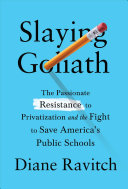
Slaying Goliath: The Passionate Resistance to Privatization and the Fight To Save America’s Public Schools

Knopf. Jan. 2020. 352p. ISBN 9780525655374. $27.95. ED
COPY ISBN

In this incisive, meticulously researched book, Ravitch (education, New York Univ.; The Death and Life of the Great American School) argues persuasively that the U.S. school privatization movement has resulted in poor test scores, the closure of public schools, and attacks on the teaching profession. Ravitch blames the so-called school reformers, whom she renames the disruptors, such as Bill Gates, Alice Walton, Michelle Rhee, Mark Zuckerberg, and Eli Broad, who spend millions to replace public schools with charter schools and private institutions that are run like businesses. Though disruptors view themselves as opposing the status quo, Ravitch contends that they are doing everything they can to maintain it. She devotes most of her book to the resisters, or the teachers, parents, and union leaders who have taken on the disruptors and are working to keep their local public schools open. Through this lens, Ravitch discusses the Common Core teaching standards, standardized testing, the Obama administration’s Race to the Top grant program, and Teach for America.

VERDICT This extensive analysis is required reading for anyone concerned about American education. [See Prepub Alert, 7/8/19.]

John Thompson, historian and retired teacher in Oklahoma, shares his thoughts about what matters most. What matters most for the future is not test scores, yet we have spent an entire generation–now almost two generations of young people who have passed through our schools since 2000–focusing only on test scores. Will we pay a price? Will they?


As I left the computer to walk the dog, a thought provoking title jumped off the screen, “2019 NAEP Results Show There’s Something Wrong Going On.” Our neighborhood is gentrifying too much, but the park still offers a wonderful place for cross-generational, cross-cultural conversations about what is going right and wrong. Only our spoiled dogs complain when daily discussions last a long time when recounting the latest Trump assaults on our constitutional democracy.

In contrast to corporate school reformers, who claimed that schools could be the answer to inequities, when a dog walker shared a link about another path to progress, we knew there is no single, silver bullet. We loved the New York Times’ “Dogs Will Fix Our Broken Democracy,” but we knew that the doggies, on their own, can’t teach us “to step outside of our narrowest selves.”

https://www.the74million.org/article/petrilli-2019-naep-results-show-theres-something-wrong-going-on-3-theories-about-what-might-be-happening-in-our-schools-and-beyond/
https://www.nytimes.com/2019/08/31/opinion/dogs-democracy.html

The NAEP title also provoked contemplation on the school reform blinders which blocked out conversations about issues outside the school building. For two decades, as test-driven, competition-driven reform treated schools as a sped-up Model T assembly line, school segregation was increased and the curriculum was narrowed. The Billionaires Boys Club undermined instruction about issues outside of the classroom, such as deindustrialization, globalization, the increase of economic inequality, mass migration, climate change, and the decline in a sense of community.

Most inexplicably, schools ignored the moral dilemmas prompted by the digital revolution and we mostly failed to help our kids face its challenges, ranging from the gig economy to social media.

During the entire 21st century, both sides of the school wars have fought off their opponents with their metaphorical right hands, barely able to use our left hands for tackling the problems of poverty and segregation. Sure, the privatizers started this unnecessary battle, but why can’t they accept a truce? Why can’t we focus on the big picture issues that could explain the NAEP decline?

Shouldn’t we also wrestle with the biggest tragedies that are going on, threatening our democracy and our planet, and that contribute to NAEP scores declines?

Imagine my initial rejoicing when I returned from the dog walk to the NAEP story. The author of this appropriately-titled essay focused on what was going on outside the classroom, (as well as the minds of reformers, I would add.) He hypothesized that the Great Recession hurt student performance in two ways, “first, via its devastating impact on fragile families and their young children; and second, through its negative impact on school spending, as many state coffers ran dry.”

The author also noted that “the roaring ’90s led to a huge decrease in ‘supplemental’ child poverty rate … And that could explain much of the NAEP gains we saw in the 2000s, gains that were most dramatic for low-performing children and kids of color.” He then followed the cohorts of students who endured the years from 2009 to 2012 when the unemployment rate was 8 percent. He noted the correlation between the rise and fall of 4th grade scores and the stagnation and decline of 8th grade scores for low-income kids to the unemployment rate and education spending cuts. More affluent students, who didn’t have to face those challenges, continued to show steady gains.

A similar pattern was described in terms of screen time, and the anxiety and isolation it can cause. He notes, “Children from lower-income families spend an average of three and a half hours each day on screen media, … That amount is 40 percent longer than middle-income children (two hours and 25 minutes) and almost double the screen time spent by affluent children (one hour and 50 minutes).” As “screen time for low-income kids has absolutely skyrocketed in recent years,” their reading scores declined.

So, it seems logical that we should help teach children to use, but not be used by the cell phones. Given the massive and rapid economic transformations, that are unnerving adults, we should be preparing children not for worksheets and drill and kill, but for a healthy, productive, meaningful life in the 21st century. Contrary to corporate school reformers’ theory, which fought the legacies of segregation with segregation by choice, and the stress of poverty with the stress of high stakes testing, the logical conclusion would be that poor children need holistic and culturally relevant instruction.

But then the author, called for a “recalibration” including “much more demanding academic standards that were aligned to readiness for college and career.” He would do this by …?

For some reason that I still can’t understand, this author – who often acknowledges the failures of school reform – dug in his heals and called for a return to “the form of the Common Core; much higher-quality and more rigorous assessments, in the form of Smarter Balanced and PARCC and their successors.”

Readers, you probably guessed that the author who twisted himself into a pretzel when so contradicting  himself, was the Fordham Institutes’ Mike Petrilli. And he then called for “tougher tests and accountability systems.”

In other words, corporate reformers like Petrilli do provide at least one valuable feature. They are a great case study in how to present “alt facts.” Fordham et. al start with something we can agree on, something unifying, for instance like our shared,  heart-warming desire to cuddle a kitty. But they always end on a note of survival of the fittest, demanding the defeat of the educational institution that kitty-hating educators defend. Their spin could be featured in a great lesson of how political propaganda is spread on the web!

Seriously, “2019 NAEP Results Show There’s Something Wrong Going On” illustrates the huge opportunity costs of having to fight off reformers when we should have been concentrating on the existential dangers that that our youth face. And a New York Times Magazine special edition that was published the same week offers a horrifying glance at the battle we should have been engaging in.

The Magazine’s “The Internet Didn’t Turn Out the Way We Hoped” is so direct in its warning that its cover features the meanest-looking, ugliest kitty they could photograph. Kevin Roose’s “A Cleaner Internet” is illustrated with a cat embodying the beauty we hoped for, along with three stained kittens. He cites Marc Andreesen who said, “in the future there will be two types of people: ‘people who tell computers what to do, and people who are told by computers what to do.’”

Below are just a few of the special issue’s examples of today’s and tomorrow’s virtual realities that we haven’t educated our kids about. Jamie Lauren Keiles describes the “cursed dynamics on online fandom,” and explains, “Today’s fandom is more like a stateless nation, formed around a shared viewing heritage, but perpetuated through the imaginations and interrelations of those who enjoy and defend it” (It sounds to me that “fandom” also describes corporate reform.)

Yiren Lieu describes the “much more powerful apps” that are “flowering in China,” and concludes, “Whatever it is that takes place when Chinese –style super-app-dom meets the American teenager, it sounds like the future of the internet.”

The article that made me feel sickest was Elizabeth Weil’s “All My Selves Are My Favorite.” It begins with 15-year-old’s “Ninth Grade Makeup Transformation” YouTube video. She used “dozens” of brushes and powders, “bouncing between one shell of identity and the next.” And, “45 minutes later, tender, glittering and shellacked with cosmetics, she was ready for school.”

The teen’s commentary was full of expressions like, “I need to not be annoying, and I’m not doing a good job of that.  … I also look ugly, and I’m really depressed!”

Fortunately, at the end, she at least listened to, even if she didn’t hear, a 23-year old’s wisdom, “I’m like, Oh, this is what happens when someone is raised on the internet.”

https://www.nytimes.com/interactive/2019/11/14/magazine/internet-future-dream.html

Yes, behind the NAEP decline, there is “something wrong.” As John Merrow recently noted, “we have managed to teach our children how NOT to think, and today not even 14% of American 15-year-olds are able to distinguish facts and opinion.”

So, it’s a terrible shame that we educators have been distracted from one of our biggest tasks – helping kids learn how to control their own destinies. A generation of students has attended schools where they have been treated as test scores. Worse, venture philanthropists’ market-driven reforms are just one part of venture capitalists who see humans –  inside and outside of schools –  as data points.

https://themerrowreport.com/2019/12/05/the-national-assessment-of-educational-paralysis-naep/


Carol Burris led the delegation from the Network for Public Education at the Public Education Forum in Pittsburgh. Here are her reflections on the candidates;


There were roughly 1000 attendees at yesterday’s Public Education Forum 2020.  The group was diverse in both race and age. Students accompanied by parents sat side by side with senior citizens. It was a captivated audience, the vast majority of whom stayed until the end at around 4:00 pm. 


Outside the forum there was a small protest. When I entered the building in the morning, I counted 35 people. One news report said that the protest grew to 100. Michael Bennet was the only candidate who engaged with the protestors—that encounter can be viewed here.


Support was voiced by the candidates for community schools, increased school funding for Title I schools, increased pay for teachers, support for unions, fully-funded pre-schools, increasing the number of teachers of color, student loan forgiveness, and other equity issues which have commonly appeared in candidates’ platforms. In short, it was a positive agenda that acknowledged that resources do matter and recognized the complex difficulties that our schools and our teachers face.


It is not my intent to influence anyone’s vote with this account. What follows is my review of the candidates’ performance by giving each the award I believe they most deserve based on what I heard during the forum as well as with speaking with others afterwards. 


My award for Best Performance is shared by Elizabeth Warren and Amy Klobuchar. I thought their answers were the sharpest, but I am willing to acknowledge I may see the world through my gender lens. 


Upon entering the stage, Elizabeth Warren received cheers. Many stood and applauded. Warren stood her ground when the interviewer claimed she wanted to defund charter schools (she does not). She logically argued her platform on charter schools and ended by saying, “Public school money needs to stay in public schools,” which earned loud applause. She argued throughout for increased funding for public education, funded by her proposed wealth tax.


Klobuchar won hearts with the story of her mom who taught elementary school until she was 70 years old. Her mom would dress up as a Monarch butterfly every year when teaching a unit on butterflies. Klobuchar recounted how a former student with a disability came to her mother’s funeral due to the kindness mom had extended to him long after he left her class. She was warm and encouraging when a nervous student came to the microphone to ask a question. Many in the audience who were not familiar with the candidate were impressed. 


The You Still Don’t Get it Award goes to Michael Bennet. 


The first audience question came from a New Orleans student, Maria Harmon, who expressed concerns about charter schools, which she said are “targeting black and brown children without delivering on their promise of equity.” Maria referred to the Washington Post’s story on our Network for Public Education report, Still Asleep at the Wheel. Her question on charter school accountability received loud applause. 


Bennet claimed that in Denver only the Denver School Board can authorize a charter school. What he did not mention is that the Denver Board’s decision to not authorize a charter school can be overturned by the state board. From the Colorado State Board of Education website—


“The State Board may also, upon its own motion, decide to review any charter decision of a local board of education. Under the act, the State Board has the authority to direct the local board to grant, deny, or revoke the charter.”

So much for local control. Like other pro-charter Democrats, Bennet tried to create a false distinction between “private” and “public” charter schools, saying there are only public charter schools in Denver. “We don’t have private charters,” he said. Denver’s charters are managed by private boards. In addition, Denver allows charter schools to be managed by for-profit CMOs. For example, Life Skills Denver Charter School, was operated by the notorious for-profit White Hat Management Corporation. It was open throughout Bennet’s term as superintendent and was finally shut down by his successor, Tom Boasberg. I have no idea how Bennet’s defines a “private” charter school.


During the interview he defended his merit pay program, which has been largely abandoned, as well as the evaluation of schools by growth scores. 


Bennet’s suggestion that the school year be longer and that students attend school six days a week was not well received by students and teachers in the audience. 


Bennet told us he was “against privatization” and then left to meet with the charter school parents who were protesting the event. 


The Most Loved Award goes to Bernie Sanders


When Bernie came on the stage, nearly everyone was on their feet applauding. He made a vigorous case against high-stakes testing (it was noted by the moderators that he had voted against NCLB) as well for increased funding for public schools. Bernie was Bernie, and the crowd loved it.  His refusal to sit down resulted in the moderators getting up from their chairs to ask their questions. 


The award for Best DFER in Disguise goes to Pete Buttigieg 


Mayor Pete’s melodious even-toned voice was soothing, but no one I spoke with seemed impressed. He received polite applause. When he told the audience that a guy on his policy team (I assume Raj Chetty with whom he attended college) had done a study that showed the positive impact of “great teachers” on students’ economic futures, eyebrows went up. That study was often used by Arne Duncan to justify the evaluation of teachers by test scores.  His teacher training plan sounded an awful lot like Teach for America to me. Rachel Cohen recently reported that prominent charter schools supporters have been doing fundraisers for Mayor Pete.  With Booker and Bennet tanking, it is likely DFERs are looking to Buttigieg as their candidate. 


The James Joyce Award goes to Joe Biden 


Biden was animated and immersed in his usual stream of consciousness style. Listening to Biden is rather like reading Joyce’s Ulysses. You are just not quite sure where his inner Molly Bloom is going next. 


While he did not distance himself from Race to the Top, which I believe was not mentioned at all throughout the forum, I think he said he was against high-stakes testing (sometimes it is hard to tell with Joe). He got a smile from me with his line, “If I’m president, Betsy DeVos’ whole thing from charter schools to ignoring sexual harassment is done.” He was warmly received and frequently applauded. Afterwards many I spoke with said that although he is not their first choice, they would support him if he were the candidate or seemed to have the best chance of beating Trump. 


The Nice Guys Finish Last Award goes to Tom Steyer


Those I spoke with characterized the billionaire activist as a well-meaning guy whose funds would be better spent supporting a candidate with progressive ideas. My assessment is that he cares and wants to make a difference. He demonstrates none of the know-it-all arrogance of Bill Gates or Michael Bloomberg. I hope he will remain on the side of public schools when the campaign is over. 


All in all, the forum was a day well spent. 


Leonie Haimson writes that the New York State Board of Regents (the state board of education) hired Achieve to review the evidence about the value of exit exams.

Achieve presented a report saying that 28 states require tests for high school graduation.

Haimson says that Achieve confused end-of-course exams with high-school graduation exams that students must pass to get a diploma. 

In 2003, 30 states had exit exams, but most of them dropped them. Today, only 12 states still have exit exams.

Haimson writes:

When challenged on Twitter about the disparity in their figures compared to other sources, Achieve responded that they “define them [exit exams] as assessments that matter for students – impacting course grades or graduation.”  Yet to conflate states that require students to pass a test to graduate from high school with those that assign ordinary end of course exams is extremely misleading.

The trend, she says, is against high-stakes exit exams.