Zephyr Teachout, the Fordham University law professor who ran against Governor Andrew Cuomo in the recent gubernatorial election, released a powerful and shocking—but well documented—report on the powerful hedge funds that seek to gain control of education in New York state. They are very, very rich. They have no particular expertise in education, nor are they accountable to anyone. Yet they are attempting to privatize one of the most important public institutions of our society. Teachout’s co-author was Mohammad Khan. His contact information is listed below.
A pdf of the report can be downloaded here. It is 11 pages. You should read it in full.
Corruption in Education: Hedge Funds and the Takeover of New York’s Schools
The Washington Park Project
December 2, 2014
ZEPHYR TEACHOUT
MOHAMMAD KHAN
About the Washington Park Project
The Washington Park Project is a public policy organization dedicated to
fighting legal corruption, challenging concentrated corporate power, and
advancing a fearless populist vision for New York.
Freed from corrupt political practices and an increasingly monopolistic
marketplace, New York can lead in 21st century democracy, education, clean
energy, transportation, and a small business economy. New York is abundant
with talent, drive, resources, and people from all over the world. We at the
Washington Park Project reject scarcity, and work to build a democracy and
economy that works for all of us, not just the wealthy and well-connected.
Contact
Mohammad Khan, Senior Policy Associate
m@mohammadkhan.nyc
“They were careless people, Tom and Daisy- they smashed up things and
creatures and then retreated back into their money or their vast carelessness or
whatever it was that kept them together, and let other people clean up the mess
they had made.” – The Great Gatsby
Introduction: Wall Street Hedge Funders’ Takeover of Albany
Education Policy
New York State is plagued by legal corruption: campaign contributions and outside spending explicitly
designed to buy policy outcomes. In 2014, a tiny group of powerful hedge fund executives,
representing an extreme version of this corruption, spent historic amounts of money in order to take
over education policy.
This paper details this fast-paced purchase of political power, and the threat it poses to democracy
and public education in New York State.
A small cadre of men, including Carl Icahn, Paul Tudor Jones, and Dan Loeb, poured more than $10
million into state lobbying and election campaigns since the beginning of 2014, with electrifying
results.i Their campaign bears the signature components of the corporate takeover world which they
occupy: rapid action on multiple fronts; highly secretive activity shielded from the public view; high
stakes, big spending; and top-down power plays that are not accountable to the public.
First, in a span of 10 weeks they spent $6 million on lobbying that won unprecedented public funding
to pay for charter school rent. ii
This was done as part of a campaign orchestrated with Governor Cuomo, designed to frustrate Mayor
Bill de Blasio’s efforts to win universal full-day pre-K, paid for entirely through expanded taxation of
New York City millionaires.
Phase two of the attack came in the fall elections.
Twelve individuals spent $4.3 million on a PAC apparently designed to purchase control of State
Senate education policy.iii
Their effort depended on misleading voters about the actual intentions of the PAC. Rather than
honestly advocating for more public funding for privately-run charter schools, and explaining who
was behind it, the TV ads, mailers and radio spots paid for by the PAC attacked Senate Democrats
for doing the bidding of New York City and Mayor de Blasio.iv
Ironically, the PAC’s priority was actually to win more money for charter schools located in New York
City. The PAC also attacked candidates for supporting the vital anti-corruption measure of publicly
funded elections.v
These Wall Street titans cemented their power play by securing the political allegiance of Governor
Andrew Cuomo through campaign donations and outside spending.
They worked together with Governor Cuomo during the state budget process to orchestrate the
lobbying campaign that undermined Mayor de Blasio and secured the charter rent deal. Immediately
after the pro-charter pro-millionaires tax budget was passed, the Governor was rewarded by his charter
school supporters by being the “honorary chairman” at a political strategy retreat they held in the
Adirondacks.vi
Their partnership was just as tight on the electoral front. Just one week before the November election,
Governor Cuomo described public schools as a “monopoly” he intended to “break” up by expanding
privately run charter schools and increasing their public funding.vii His remarks matched the agenda
of the PAC funding the Senate Republicans at a time when he had committed that he himself would
be campaigning for Senate Democrats.
The Governor and the legislature are negotiating now on a potential special session for December,
2014. Some members of the Senate have threatened to radically overhaul the fundamentals of the
public education system in New York State.
This week the New York Daily News reported that Governor Cuomo is pushing to use a December
special session to raise the charter cap, perhaps in exchange for a long-awaited pay increase for
legislators.viii
The 2014 effort, a kind of lightning war on public education, is important for many reasons: it is hasty
and secretive, depending on huge speed and big money, and driven by unaccountable private
individuals. It represents a new form of political power, and therefore requires a new kind of political
oversight.
Because these hedge fund managers directly involved themselves in New York politics, we should
examine them like politicians, attempting to understand their policies and their sources of authority,
asking them daily questions about their activities and reasons. They are not mere contributors.
Like the Koch brothers, these hedge fund managers are openly seeking to influence policy in a massive
and comprehensive way. The degree of their attempted power grab could make them — if they are
successful — an invisible, unelected, unaccountable government.
Faced with legal corruption on a grand scale, the public must respond. Together, we should bring
accountability and scrutiny to the aristocracy that would establish itself as the authority on education
public policy in New York State.
At stake is public school funding, attention to the crisis in our public schools, and the very nature of
our public commitment to public education.
I. A Lightning War to Privatize Public Education
Since 2008, big banks and big finance have wielded outsized political power in Washington, DC. They
have used direct methods, like campaign contributionsix and lobbyingx, and indirect methods, like
placing bankers with similar ideologies in positions of power.xi They are political actors as well as
market actors.
Here in New York, the financial capital of the country, Wall Street firms and associated individuals
have been accumulating influence over state and local government.xii With some of the most lax
campaign finance laws in the country, Wall Street is able to spend millions of dollars per campaign
cycle to influence legislation and action in New York.
But this year’s hedge fund effort to take over education policy represents one of the fastest and biggest
efforts to privatize public policy processes in recent history.
Phase One: Lobbying
In early 2014, a new hedge-fund-financed lobbying group made a rapid-fire power play in Albany.
The lobbying campaign, done in the name of Families for Excellent Schools, included a massive $5.95
million in spending, mostly on television ads.xiii Families for Excellent Schools has refused to disclose
its donors, but major hedge fund moguls have been publicly associated with its campaigns.xiv
This explosion of lobbying and money power led to a dramatic revision of state law to require New
York City to turn public school building space over to privately-run charter schools for the first time.
As an alternative, New York City and New York State would be required to pay rent for these privately
run charter schools to occupy private space.xv
From a legal and policy perspective, this dramatic change was unprecedented. Politically, the outcome
was the rapid emergence of hedge fund managers as a powerful force in Albany, with an education
agenda focused on privatization and testing as the leading, public face of their agenda.
Phase Two: Elections
In two months before the 2014 general election, twelve individual hedge fund managers banded
together to finance a takeover of the State Senate.
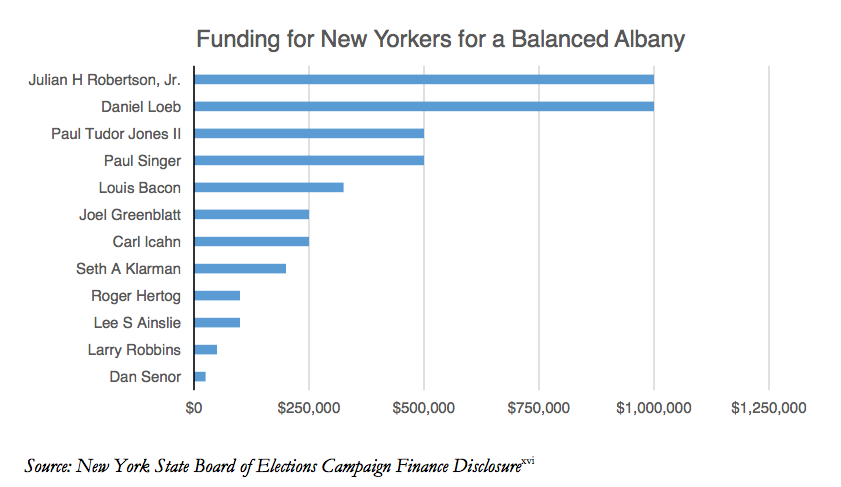
These twelve set up a new PAC, New Yorkers for a Balanced Albany, and capitalized it with $4.3
million.
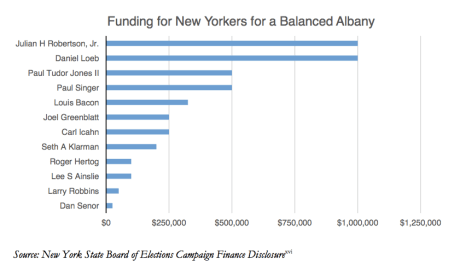
This PAC was remarkable for a number of reasons.
The speed of its creation is one of its most striking features. The PAC was first announced after the
primary election, on September 12, 2014. It was first reported in the New York Post on October 20,
2014xvii, less than three weeks before election: by then it had already spent over $1 million.
The New York Times first covered it on October 30, 2014xviii, less than a week before the election. In
most parts of the state, there was no reporting on this powerful group until after the election.xix
In the seven weeks that the PAC raised and spent almost $4.3 million, there were no serious
investigative reports about the agenda or goals of backers of New Yorkers for a Balanced Albany.
Most voters never learned about who was trying to influence them, or why.
New York State is overwhelming Democratic, with two times as many registered Democrats as
Republicans. Most of the money spent by this billionaire-funded PAC went to TV ads and mailers to
support Republican State Senate candidates and oppose their Democratic opponents. They focused
on Districts 3, 7, 40, 41, 55, and 60.
In just two of those races, in Districts 40 and 41, the group spent $2.8 million on negative TV and
radio ads, running an estimated 289 attack ads xx
This was the largest independent expenditure in state senate races by any single group.xxi
The PAC was also notable for the methods by which its true agenda was hidden from voters.
New Yorkers for a Balanced Albany was known as a pro-charter school PAC, but the hundreds of
ads that they ran did not reveal these motives to voters. The ads focused less on specific policy issues
and instead warned of a left-wing takeover of New York State government spearheaded by New York
City Mayor Bill de Blasio.
Ironically, the PAC’s agenda actually seeks to drive more state funds to New York City by way of
expanding privately run charter schools there. The ads made no mention of the political agenda of the
twelve wealthy individuals who funded them.
Here is the full text of one such television ad from Senate District 40:
Enter the distorted world of Justin Wagner, candidate for State Senate: a bizarre universe where
Democrats led by Bill De Blasio would control state government. The last time that happened, it
led to 9 billion dollars in new taxes and 12 billion in new spending. Where Justin Wagner’s support
for New York City-style campaign finance means hundreds of millions of our tax dollars paying
for…political ads? Justin Wagner‘s distorted world, a place we just can’t go. xxii
At the same time, the financiers of New Yorkers for a Balanced Albany also made significant
contributions to Governor Andrew Cuomo.
Hedge-fund donors gave to Cuomo in amounts greater than many families’ yearly income. Daniel
Loeb contributed over $60,000 to the Cuomo campaign, Larry Robbins gave $55,000, Joel Greenblatt
donated $50,000, Louis Bacon over $85,000, Paul Tudor Jones gave $45,000 and Carl Icahn gave
$50,000. This does not represent all of the hedge fund-charter school money raked in by Governor
Cuomo’s campaign.xxiii
Voters, of course, do not know the nature of the private conversations between Governor Cuomo
and these donors, and we can only speculate whether there was any discussion about education policy
(or tax and fiscal policy, or corporate subsidy and wage policies) — but the size of the donations,
accompanied by the size of the outside spending, suggests that these donors may have been seeking—
and may have received—a major say in Andrew Cuomo’s choice of priorities and policies.
Just days before the election, Andrew Cuomo, in a meeting with the New York Daily News’s editorial
board, called public schools a “monopoly” that he would “break up” if re-elected.xxiv
II. The Privatization Agenda
The hedge fund powers behind this push are not publicly elected, have never had to engage in a debate,
and have never had to explain—as a politician might—the connection between their private interests
and their public policy priorities. But their agenda fits within a broad, Wall Street vision of education,
where public schools are starved of resources, children are subject to high stakes testing, and public
education is privatized.
This hedge fund group is part of an interlocking effort across the country to privatize education that
uses consistent talking points around the country—they call themselves “reformers,” insist that
charter schools are “public schools,” and refer to high stakes testing as “student performance.”
When Governor Cuomo described public schools as “monopolies,” he was echoing a talking point
already used by another Governor heavily supported by the hedge fund education “reformers”: in
May 2013, Florida Governor Jeb Bush described public schools as “public-run monopolies.”xxv
The hedge fund- and corporate-sponsored organizations that portray themselves as “education
reformers” include Families for Excellent Schools, New Yorkers for a Balanced Albany, StudentsFirst
(the parent group of New Yorkers for a Balanced Albany)xxvi, Democrats for Education Reform
(whose Advisory Board member, Joel Greenblattxxvii, gave $250,000 to New Yorkers for a Balanced
Albany), 50CAN (including NYCAN), Stand for Children, and Partnership for Educational Justice,
among others.
These billionaires have a clear method and goal: replicate market forces in public education.
The Executive Director of StudentsFirst made it very clear that the hedge-fund-sponsored
organization wants even greater reliance on standardized testing, not less. Regarding the use of
standardized tests to evaluate teaches she said, “they’re the only tool that allows us to make
comparisons”xxviii and described these test scores as “objective and a reliable way of evaluating teacher
performance.”xxix
Through standardized testing, schools, teachers, principals, and students can all be bottom-lined, just
like a Wall Street balance sheet.
As one New York City principal put it, “The profit margin in this business is test scores. That’s all
they measure you by now.”xxx Tying test scores to high stakes consequences is indeed a powerful
market force.xxxi
The two big priorities being promoted by the hedge funders involved in education policy right now
are expanding the number of privately run charter schools in New York and obtaining fully-publicly-
funded facilities for privately-run charter schools.
Currently there are 197 privately-run charter schools in New York City and 51 in the rest of the state.
The state now caps the number of privately-run charter schools at 460 statewide with 256 for New
York City.xxxii,xxxiii
The hedge fund-sponsored campaign is focused on raising or eliminating the cap on privately-run
charter schools — and on winning billions of dollars in taxpayer funding for capital and construction
for privately-run charter school facilities.
Sadly, these billionaires have never made public school funding or equitable school funding a priority,
and have actively opposed it.
Strong public school funding is necessary to ensure small class sizes, arts, sports, counseling, and a
rich supportive environment for all children. But billionaire charter champions and their lobbyists
have actively worked against it, and even praised massive cuts to public schools.
Democrats for Education Reform advocated against increased school aid in the state budget in
2014.xxxiv StudentsFirst funded a statewide coalition in Ohio that was actively supporting deep cuts in
school aid.xxxv
The Republican Senate control sought (and bought) by New Yorkers for a Balanced Albany is widely
recognized as being a major impediment to equitable funding that prioritizes high-needs school
districts. The Senate Education Committee Chairman, Republican John Flanagan, recently said that
new funding should prioritize the needs of wealthy and middle class districts rather than prioritizing
high needs districts.xxxvi
III. Standing in the Way of Great Public Schools
The hedge fund agenda is problematic not only because it represents a secretive, unaccountable source
of power, but because it stands in the way of a full commitment to making great public education
available to all children. Our public schools, especially those in high needs communities, are
desperately underfunded. New York State remains a leader in educational inequity. Now is not the
time to divert more funds from our public schools to privately run charter schools, especially with
increased evidence that the existing charters are plagued by conflicts of interest and
mismanagement.xxxvii The hedge fund agenda stands in the way of basic features of providing New
York kids with the best public schools in the country.
New York State is a national leader in educational inequity, ranking 7th from the bottom.xxxviii There is
an $8,601 per pupil funding gap between the wealthiest and poorest school districts in New York
State.xxxix The state has frozen and slashed state education funding, provided a fraction of the funds
needed to implement its Common Core requirements, and demanded teacher performance
evaluations without funding them.
The New York State Constitution, Article XI, § 1, provides that: “The legislature shall provide for the
maintenance and support of a system of free common schools, wherein all the children of this state
may be educated.” The Court of Appeals has interpreted this provision to “impose[] a duty on the
Legislature to ensure the availability of a sound basic education to all the children of the state.” That
includes giving every child the preparation they need to be “civic participants,” to be able to capably
and knowledgeably serve as a juror, vote, learn skills, information, and the “capacity to continue to
learn over a lifetime.”
The state is at least $5.9 billion dollars short on its constitutional obligations to its public school
children.xl In 2006, the State Court of Appeals found that New York was unconstitutionally failing its
children. Governor Andrew Cuomo and the legislature have failed to comply with the 2007 agreement
to fully fund public schools that came about after that case. The state is now being sued by parents
and students from eight small cities across the state asserting that their schools are receiving inadequate
funding to fulfill their constitutional obligation. It is scheduled to go to trial on January 21, 2015. A
second lawsuit recently overcame the state’s motion to dismiss in the trial court.
Instead of fighting the lawsuit, Andrew Cuomo and the legislature should quickly move to provide
public schools fair, full, equitable funding.
Without basic public school funding, New York classrooms are overcrowded. In New York City,
nearly one out of every four 1-5th grader is in classes with more than 30 children, and 43% of 6th-8th
graders are in classes with more than 30 children.xli In Buffalo, 63% of Kindergarten classes had more
than 24 students with 6% of those having more than 30 students.xlii The professional judgment of a
panel of educators assembled by the Campaign for Fiscal Equity called for class sizes of no more than
14-17 students per class in elementary schools, 23 students per class in middle schools, and 18-29
students in high schools, depending on the poverty level of the school.xliii A survey of New York City
principals said that for a quality education, there should be classes no larger than 20 in grades K-3, no
larger than 23 in grades 4-5, and no larger than 24 in all other grades.xliv There is no excuse for
elementary school children in classes twice as large as the recommended range.xlv Instead of
unconstitutionally low levels of funding, New York can aim towards no more than 17 students in all
elementary school classes.xlvi
The funding crisis has also led to less art education, meaningful sports, and access to counseling. Arts
are essential to the full development of every child, and are even more important for children from
poor and disadvantaged backgrounds.xlvii With New York having some of the greatest overall
inequality of any state in the country, access to arts for all children is essential for giving all children
the chance to thrive in school and society. Kids who are involved in drama, music, and dance do better
at reading, writing, and math.xlviii Kids from high arts backgrounds (whether high or low
socioeconomic status) are more likely to vote, volunteer, and engage in politics. Arts education, in
other words, is part of the foundation of a full democratically engaged future.
In New York, we do not currently provide an arts education to all of our kids. In the last six years,
NYC schools have lost over 200 art teachers (according to the NYC DOE). Across the state, 33% of
schools districts reduced Arts and Music (according to the annual survey conducted by NYS Council
of School Superintendents). Children from disadvantaged backgrounds—those most likely to benefit
from arts—are not getting the access to arts that they need.
The state has a responsibility to ensure that all schools have resources to meet the standards set for
the arts. Likewise, without adequate funding children are not getting the athletics they need.
While funding has dropped, class sizes have risen, and children have lost arts and sports, kids and
teachers have had to take on the extra burden of high stakes testing, including the testing related to
Common Core. New York needs to halt the implementation of the Common Core and start over.
High stakes testing has been very damaging to our public school system. Consequences tied to these
standardized tests create inordinate stress on students, teachers, principals and parents. These
consequences include shaming and closing schools and evaluating teachers and principals with
possible job loss at stake. Students spend too much time taking these tests and too much instructional
time is lost to test prep.
While much of the current testing regime is governed by the federal government, New York State
should pursue every avenue possible to reduce standardized testing and to eliminate high stakes
consequences associated with these tests.
Until we have addressed these basic needs in our public schools, we must keep the current cap on all
privately run charters.
Charter schools become a drain on overall performance of children in many ways: Privately run charter
schools are funded by diverting money away from public schools leaving public schools further
stretched financially. Privately run charter schools do not reflect the communities they serve. They
educate smaller percentages of special education students and non-English speaking students than
traditional public schools. Unlike public school districts, charter schools can expel students entirely.
These students then become the responsibility of the district to educate. Charters do not educate every
child in the community, leaving the public school district with the most expensive to educate students
and those with the greatest challenges.
The most fundamental problem with charter schools is that they separate public education from the
public itself. They are not responsive to public school boards, let alone to public scrutiny. Even those
charters that succeed in the short term fundamentally take public education into a private realm, where
charter school managers can make money off of children—in fact some make as much as $500,000 a
year. The opportunities for profit in charter schools is a fundamental tension that can lead, in the long
term, to abuse of children.
Many parents choose charters because their schools are not working well. Their individual decisions
make a lot of sense. But the parental solution and the public solution diverge here. Our job in New
York is to build the best public education in the country in traditional public schools.
IV. Conclusion
“Not the rich more than the poor.” – James Madison, Federalist 57
Our country was founded in part on a commitment to end the corrupting influence of money in
politics. When New Yorker Alexander Hamilton described the American Constitutional Convention,
he said that the framer’s purpose was that “every practical obstacle should be opposed to cabal,
intrigue, and corruption.” 2014 saw a revolution in the impact of corrupting money on New York
State education policy, characterized by cabal, intrigue, and corruption.
A cabal of hedge fund managers privately intrigued to use unprecedented amounts of money to buy
unprecedented influence and power over state education policy. Their power is based on legal
corruption, not legitimate political authority.
This lightning war is a war on public education, but also on the fundamentals of democracy in New
York: who should decide, and how, the future of our children’s education?
Some political theorists have argued, in essence, that mere power creates political legitimacy—Hobbes,
for instance—but in a democracy, legitimate political authority depends upon more than that.
The hedge fund managers’ claim to the exercise of political authority comes from money alone. There
is no evidence of superior access to facts or technical expertise, on the part of these men. They were
not elected. Their ideas were not subject to rigorous public debate. They spent money using arguments
that had nothing to do with the underlying reason for their spending money.
The claim that access to money alone, combined with a personal belief set, is a legitimate reason for
exercising power, is a radical one, far more radical even than the claim in Citizens United (that the state
cannot stop companies from spending money in politics).
If the mere capacity to spend money, along with a view about public policy, is sufficient grounds for
political authority, we quickly move to absurd conclusions: the lottery winner has more moral authority
for coercive action moments after winning the lottery than before, because she has more capacity to
spend money to achieve her preferred results.
Taking the hedge fund managers at their word, with the most generous understanding: their interest
in a Republican Senate is due to a charitable interest in changing education policy in a way that they
deeply, personally, believe is better for all New Yorkers. In practice, this means that they used private
money to help create a Senate that is not representative of New York politics, with deep and enduring
policy implications, including tax laws that benefit them and the wealthiest at the expense of everyday
New Yorkers, an inadequate minimum wage, continued resistance to the DREAM Act, and great
difficulty in passing the public financing of campaigns that would dramatically lessen the corrupting
influence of money on politics.
These individuals unilaterally decided, based on the authority of their own wealth, that their personally-
held beliefs about privately-run charter schools were more important than doing something about
corruption in Albany, changing the way campaigns are funded, making it possible to adequately and
equitably fund public schools, and changing energy policy.
New Yorkers may not have the right to stop them from spending money, but that does not mean it is
not worthy of public notice — and even anger.
The hastiness with which the war of the billionaires came together, the seven-week creation of a
campaign, the nature of the private money and private preferences, all of this suggests something more
reminiscent of Gatsby, a kind of public carelessness.
We know where the few, elite hedge fund managers stand: they stand in favor of an all-out attack on
public schools that was succinctly described by Governor Cuomo when he called our schools a
“monopoly” he would “break up.” We fear where the Governor and the Senate Majority stand: with
the money of the hedge fund puppeteers who are poised to pull the politicians’ strings to privatize
public education.
Now we must see New Yorkers take a stand.
We have enough privately-run charter schools at this time. As a state we need to focus our energies,
and our resources, on making every public school a great school. That means we need to invest in our
children, particularly in our high needs communities, and we need to ensure every child, regardless of
race, family income, language or zip code, has an equal opportunity to succeed. We can do this if we
provide every child with pre-kindergarten, small class sizes, a diverse curriculum including art, music
and sports, as well as academics. We must do this. It is our constitutional obligation; it is a moral
imperative. We cannot afford to be diverted from this mission and we cannot afford to divert even
more resources away from the 97% of children who are in public schools for the 3% of children who
are in privately run charter schools.
And we must also make a stand for democracy. Hedge fund pluralism is not democracy. America, and
New York, should be governed through a representative electoral process based on the hard-fought
principle of one-person, one-vote – not ‘he who has the most gold rules.’
i Compiled using various reports from the New York State Board of Elections Campaign Finance Disclosures
ii Campanile, Carl. “Charter Advocates, Teachers Union Are State’s Biggest Lobbying Spenders.” New York
Post, 29 Oct. 2014. <http://nypost.com/2014/10/29/charter-advocates-teachers-union-are-
states-biggest-lobbying-spenders/>.
iii Independent Expenditure Report – New Yorkers for a Balanced Albany.” Campaign Finance Disclosure Reports.
New York State Board of Elections, 01 Dec. 2014. Web. 01 Dec. 2014.
<http://www.elections.ny.gov/plsql_browser/ind_exp_report?filerID_in=A20133&type_in=E&
e_year_in=2014>.
iv Velasquez, Josefa. “Pro-charter Group Ties Senate Dems to De Blasio.” Capital New York, 17 Oct. 2014.
<http://www.capitalnewyork.com/article/albany/2014/10/8554801/pro-charter-group-ties-
senate-dems-de-blasio>.
v New Yorkers for a Balanced Albany. “SD40 Zone.” YouTube, 24 Oct. 2014. Web. 01 Dec. 2014.
<https://www.youtube.com/watch?v=DDUNWB74pVE>.
vi Karlin, Rick. “Cuomo Accepts Pro-charter Role.” Times Union, 14 Apr. 2014.
<http://www.timesunion.com/local/article/Cuomo-accepts-pro-charter-role-5402460.php>.
vii Lovett, Kenneth. “Cuomo Vows to Bust School ‘monopoly’ If Re-elected.” NY Daily News, 27 Oct. 2014.
<http://www.nydailynews.com/news/politics/cuomo-vows-bust-school-monopoly-re-elected-
article-1.1989478>.
viii Lovett, Kenneth. “Sheldon Silver Faces New Heat in Sex Harass Suit.” NY Daily News, 01 Dec. 2014.
Web. <http://www.nydailynews.com/news/politics/lovett-sheldon-silver-faces-new-heat-sex-
harass-suit-article-1.2028478>.
ix Lipton, Eric, and Ben Protess. “Banks’ Lobbyists Help in Drafting Financial Bills.” DealBook. The New
York Times, 23 May 2013. <http://dealbook.nytimes.com/2013/05/23/banks-lobbyists-help-in-
drafting-financial-bills/>.
x “Finance/Insurance/Real Estate.” Opensecrets. Center for Responsive Politics, 25 Oct. 2014. Web. 01 Dec.
2014. <http://www.opensecrets.org/industries/indus.php?Ind=F>.
xi De La Merced, Michael J. “New Opposition to Lazard Banker’s Nomination to Treasury Post.” DealBook.
The New York Times, 19 Nov. 2014. <http://dealbook.nytimes.com/2014/11/19/new-
opposition-to-lazard-bankers-nomination-to-treasury-post>.
xii Then-Attorney General Andrew Cuomo granted bankers immunity from prosecution during the financial
crisis. As Attorney General, Andrew Cuomo was in the position to investigate and prosecute the worst financial
criminals, those who brought about the 2008 crash. Instead, he gave immunity to Clayton Holdings, the firm
that oversaw tens of thousands of fraudulent loans which were then packaged and sold by Wall Street. Clayton
was a client of his close aide, Howard Glaser. He also agreed to take no action against ratings agencies and
“terminate all investigations” against them, and they admitted no wrongdoing. Andrew Cuomo also took no
action on the foreclosure fraud scandal.
xiii Campanile, Carl. “Charter Advocates, Teachers Union Are State’s Biggest Lobbying Spenders.” New York
Post, 29 Oct. 2014. <http://nypost.com/2014/10/29/charter-advocates-teachers-union-are-
states-biggest-lobbying-spenders/>.
xiv Hernandez, Javier C., and Susanne Craig. “Cuomo Played Pivotal Role in Charter School Push.” The New
York Times, 02 Apr. 2014. <http://www.nytimes.com/2014/04/03/nyregion/cuomo-put-his-
weight-behind-charter-school-protections.html>.
xv Harris, Elizabeth A. “17 Charter Schools Approved for New York City, Expanding a Polarizing Network.”
The New York Times, 08 Oct. 2014. Web. 02 Dec. 2014.
<http://www.nytimes.com/2014/10/09/nyregion/17-new-charter-schools-approved-for-new-
york-city.html>.
Sources
xvi Independent Expenditure Report – New Yorkers for a Balanced Albany.” Campaign Finance Disclosure
Reports. New York State Board of Elections, 01 Dec. 2014. Web. 01 Dec. 2014.
<http://www.elections.ny.gov/plsql_browser/ind_exp_report?filerID_in=A20133&type_in=E&
e_year_in=2014>.
xvii Campanile, Carl. “De Blasio Battling Charter School-backers over Senate Control.” New York Post, 20
Oct. 2014. <http://nypost.com/2014/10/20/de-blasio-battling-charter-school-backers-over-
senate-control/>.
xviii Kaplan, Thomas. “Outside Donors Focus More Attention on New York State Senate Races.” The New
York Times, 30 Oct. 2014. <http://www.nytimes.com/2014/10/31/nyregion/outside-donors-
focus-more-attention-on-new-york-state-senate-races.html>.
xix Spector, Joseph, and Jon Campbell. “Republicans to Take NY Senate Majority.” Democrat & Chronicle, 05
Nov. 2014. <http://www.democratandchronicle.com/story/news/2014/11/04/new-york-
senate-election/18492749/>.
xx “New Yorkers for a Balanced Albany.” Center for Public Integrity, 17 Nov. 2014. Web. 01 Dec. 2014.
<http://www.publicintegrity.org/who-calls-shots/new-yorkers-for-a-balanced-albany>.
xxi Compiled using various reports from the New York State Board of Elections Campaign Finance
Disclosures
xxii New Yorkers for a Balanced Albany. “SD40 Zone.” YouTube, 24 Oct. 2014. Web. 01 Dec. 2014.
<https://www.youtube.com/watch?v=DDUNWB74pVE>.
xxiii Compiled using various reports from the New York State Board of Elections Campaign Finance
Disclosures
xxiv Lovett, Kenneth. “Cuomo Vows to Bust School ‘monopoly’ If Re-elected.” NY Daily News, 27 Oct. 2014.
<http://www.nydailynews.com/news/politics/cuomo-vows-bust-school-monopoly-re-elected-
article-1.1989478>.
xxv Strauss, Valerie. “Jeb Bush’s Disdain for Public Education.” Answer Sheet. The Washington Post, 31 May
2013. <http://www.washingtonpost.com/blogs/answer-sheet/wp/2013/05/31/jeb-bushs-
disdain-for-public-education/>.
xxvi Blakeman, Jessica. “National Pro-charter Group Forms New York PAC.” Capital New York, 12 Sept.
2014. <http://www.capitalnewyork.com/article/albany/2014/09/8552469/national-pro-charter-
group-forms-new-york-pac>
xxvii Blakeman, Jessica. “Cuomo to Be ‘honorary Chair’ of Pro-charter Retreat | Capital New York.” Capital
New York, 15 Apr. 2014.
<http://www.capitalnewyork.com/article/albany/2014/04/8543706/cuomo-be-honorary-chair-
pro-charter-retreat>.
xxviii Harris, Elizabeth A. “Critics Question High Ratings on New York State Teacher Evaluations Amid Poor
Test Scores.” The New York Times, 28 Aug. 2014.
<http://www.nytimes.com/2014/08/29/nyregion/new-york-state-releases-localized-teacher-
evaluations.html?>.
xxix Ramaswamy, Swapna V. “Teacher Evaluations: Subjective Data Skews State Ratings.” The Journal News,
15 Sept. 2014. <http://www.lohud.com/story/news/education/2014/09/12/state-teacher-evals-
skewed/15527297/>.
xxx Winerip, Michael. “Bitter Lesson: A Good School Gets an ‘F'” The New York Times, 10 Jan. 2006. Web.
02 Dec. 2014. <http://www.nytimes.com/2006/01/11/education/11education.html>.
xxxi Doing so has resulted in teaching to the tests in schools throughout the country and in some
cases has resulted in dramatic test score cheating scandals—as occurred in Atlanta and
Washington, D.C. (where Students First founder Michelle Rhee was Chancellor). Strauss,
Valerie. “Atlanta Test Cheating: Tip of the Iceberg?” Answer Sheet. The Washington Post, 01 Apr.
2013. <http://www.washingtonpost.com/blogs/answer-sheet/wp/2013/04/01/atlanta-test-cheating-tip-
of-the-iceberg/>.
xxxii “Charter School Facts.” Charter School Office. New York State Education Department, 01 Dec. 2014.
Web. 01 Dec. 2014. <http://www.p12.nysed.gov/psc/CharterSchoolsFact.html>.
xxxiii Baker, Al. “Success Academy Seeks 14 More Charter Schools in New York City.” The New York Times,
10 June 2014. <http://www.nytimes.com/2014/06/11/nyregion/success-academy-seeks-14-
more-charter-schools-in-new-york-city.html>.
xxxiv Democrats for Education Reform. “DFER-NY Releases Statement on AQE March.” Democrats for
Education Reform, 12 Mar. 2014. Web. 01 Dec. 2014.
<http://www.dfer.org/blog/2014/03/index.php?page=3>.
xxxv Simon, Stephanie. “National Education Reform Group’s Spending Shown.” Thomson Reuters, 25 June
2012. <http://www.reuters.com/article/2012/06/26/us-usa-education-reform-studentsfirst-
idUSBRE85O1CN20120626>.
xxxvi Blakeman, Jessica. “Senate Ed Chair Wants to Eliminate School Cuts Formula.” Capital New York, 20
Nov. 2014. <http://www.capitalnewyork.com/article/albany/2014/11/8557127/senate-ed-
chair-wants-eliminate-school-cuts-formula>.
xxxvii “Risking Public Money: New York Charter School Fraud” Center for Popular Democracy, Alliance for
Quality Education, Nov. 2014.
<http://populardemocracy.org/sites/default/files/CPD_AQE_Charter-Schools-NewYork-
Report.pdf>.
xxxviii Baker, Bruce D., David G. Sciarra, and Danielle Farrie. “Is School Funding Fair? A National Report
Card.” Education Law Center, Jan. 2014.
<http://www.edlawcenter.org/assets/files/pdfs/publications/National_Report_Card_2014.pdf>
xxxix “Confronting the Opportunity Gap” Alliance for Quality Education, 28 Feb. 2013.
<http://www.aqeny.org/ny/wp-content/uploads/2013/03/AQE_2013_Confronting-the-
Opportunity-Gap.pdf>.
xl “Billions Behind: New York State Continues To Violate Students’ Constitutional Rights.” Alliance for
Quality Education, Aug. 2014. <http://www.aqeny.org/wp-
content/uploads/2014/08/REPORT-NY-Billions-Behind.pdf>.
xli “Class Size Report.” NYC Department of Education, 14 Nov. 2014. Web. 24 Nov. 2014.
<http://schools.nyc.gov/AboutUs/schools/data/classsize/classsize.htm>.
xlii Tan, Sandra. “Buffalo School Board Approves Proposal to Cut Kindergarten Class Sizes.” Buffalo News,
22 Oct. 2014. <http://www.buffalonews.com/city-region/buffalo-school-board-approves-
proposal-to-cut-kindergarten-class-sizes-20141022>.
xliii “The New York Adequacy Study.” American Institutes for Research and Management Analysis and
Planning, Inc., Mar. 2004
<http://www.goodflow.net/pdfs/resources/resources_FINALCOSTINGOUT.pdf>
xliv Horowitz, Emily, and Leonie Haimson. “How Crowded Are Our Schools?” St. Francis College and Class
Size Matters, 3 Oct. 2008 <http://www.classsizematters.org/wp-
content/uploads/2011/04/principal_survey_report_10.08_final1.pdf>
xlv Two recent studies (2014) examining the impact of small class sizes show that small class sizes may be the
most important direction to support fully equal and meaningful education for all children. Diane
Whitmore Schatzenbach of Northwestern University reviewed all the academic literature on class
sizes. She showed how small class sizes are related to improved test scores and, more importantly,
have overall lifetime impacts. She concludes that “All else being equal, increasing class sizes will
harm student outcomes.” Small class sizes are particular important for children from
disadvantaged backgrounds, who benefit directly from the individualized attention of teachers.
In Tennessee in 1985 to 1989, 11,500 students were randomly placed in classes of either 13-17
students, or 22-25 students. The students in the smaller class sizes performed “unequivocally” better
than in the larger class sizes. Students of color, and students from lower economic status families
were particularly helped by small class attention. The teachers in the small classes were able to pay
attention to individual students, and adjust learning strategies when the particular method of
conceptual introduction wasn’t working: Schanzenbach, D.W. “Does Class Size Matter?” Boulder,
CO: National Education Policy Center. Retrieved 11/24/2014
<http://nepc.colorado.edu/publication/>
A 2014 literature review by David Zyngier also found that reducing class sizes can have an
“important and lasting impact” on children’s intellectual and social development. He examined 112
different peer-reviewed articles.
Zyngier, David. “Class size and academic results, with a focus on children from culturally,
linguistically and economically disenfranchised communities”, Evidence Base
Issue 1. <https://journal.anzsog.edu.au/publications/9/EvidenceBase2014Issue1.pdf>
xlvi Washington State just passed a referendum calling for class sizes of no more than 17 in K-3 & 25 in other
grades. Washington requires smaller classes of 15 in K-3, 22 in 4th and 23 in 5-12 with schools
having more than 50% of their students qualify for free and reduced lunch.
<http://sos.wa.gov/_assets/elections/initiatives/FinalText_578.pdf>
xlvii “New NEA Research Report Shows Potential Benefits of Arts Education for At-Risk Youth.” National
Endowment for the Arts, 30 Mar. 2012. <http://arts.gov/news/2012/new-nea-research-report-
shows-potential-benefits-arts-education-risk-youth#sthash.pqjRNdvD.dpuf>.
Henry, Tamara. “Study: Arts Education Has Academic Effect.” USA Today, 19 May 2002.
<http://usatoday30.usatoday.com/news/education/2002-05-20-arts.htm>.
Bowen, Daniel H., and Jay P. Greene. “Does Athletic Success Come at the Expense of Academic
Success?” (n.d.): n. pag. University of Arkansas. Web.
<http://www.eeraonline.org/journal/files/v22/JRE_v22n2_Article_1_Bowen.pdf>.
Trost, Stewart G., and Hans Van Der Mars. “Why We Should Not Cut P.E.”Health and
Learning 67.4 (2009): 60-65. Educational Leadership. Web. <http://www.cahperd.org/cms-
assets/documents/ToolKit/Resources/5347-957381.whyweshouldnotcutpe.pdf>.
xlviii Research supports the common sense notion that arts are essential to long-term success. In 2013, the
National Endowment for the Arts conducted a study of the impact of arts education, and found
that students with less arts involvement had worse grades, lower college enrollment, and less civic
engagement than students with greater arts access (see xlviii). The most striking difference was
that “students with access to the arts in high school were three times more likely than students who
lacked those experiences to earn a bachelor’s degree.” They also found an interaction between arts
and sports and other extracurricular activities: students with high arts access were more likely to get
involved in sports after school and other activities, like the newspaper. They were likely to dream
bigger and achieve more.
Arts help with higher achievement and success as well as higher order thinking: “Are We There
Yet?” (n.d.): n. pag. Alliance for Quality Education. Web. <http://www.aqeny.org/wp-
content/uploads/2012/03/Are-We-There-Yet-College-and-Career-Readiness-Report-Card.pdf>.