Archives for category: Teacher Evaluations

Patricia Fahy, a member of the Néw York State Assembly, tries to explain her vote on Governor Andrew Cuomo’s budget bill. The worst part of the budget, she knew, was his demand to make 50% of teachers’ evaluations dependent on test scores. If no budget passed, Cuomo could impose his plan by fiat. Democracy, anyone?

The Assembly got the Governor to agree to allow the state Board of Regents to make the final determination on teacher evaluation, although they still must rely on an “independent evaluator” (an unfunded mandate) and test scores. Fahy refers to the Regents as “education professionals.” That is true of some, not all, of the Regents.

Readers in Néw York, how many Regents are “education professionals,” people who have had careers in education? To the credit of the Assembly, they recently elected four new members who are education professionals. In the past, that has not been a requisite. (Several years ago, my name was suggested as a candidate for the Regents. I talked to elected officials in Brooklyn, and they encouraged me to meet with the Speaker of the Assembly, whose word was determinative. Accompanied by an elected official, I was interviewed by Speaker Sheldon Silver’s top assistant. After half an hour of questions, she told me I knew too much to be a Regent. Unbelievable but true.)

From Fahy’s article:


“In the final few days of the budget negotiations, the most contentious part was the teacher evaluations (APPR) linked with excessive testing – an issue which has been debated for the last three out of four years in the legislature. I had and continue to have serious misgivings about this final bill language and have been actively advocating to ensure the most flexible interpretation of the language along with amendments where needed. While the language was troubling and rushed, one positive was delegating the evaluation issue away from the legislature and the Governor to the Board of Regents, who are the appointed education professionals. Despite having strongly opposed some of the previous work of the Regents with regard to testing and implementation of the common core standards, we have a slate of new Regents, who have been given parameters to work within.


“We need to change the conversation about education. We can no longer look at the very people who can help our children – our teachers – as the scapegoats for problems in education. We can no longer continue to value a standardized test that is so flawed parents are more concerned about their children taking it than passing it. We can no longer focus on underperforming schools and expect the teachers and staff to correct every social ill of the community and society. The solution must be multi-pronged and go beyond the school doors.


“I understand the frustration and the concern, I share it, and have already reached out to the Regents and more to begin work to maximize flexibility and seek changes where needed. This omnibus bill was not an easy vote and our work does not end with this vote.”

The following was posted as a comment on the blog:


Dear Dr. Ravitch,


I have spent the last week and a half reeling from the shot across the bow that public education took on March 31st when the New York State Legislature ostensibly signed off on its destruction with the passing of the New York State Budget, and its attached legislation, S2006B-2015. As a teacher who is passionate about what she does, with two years of failing State Growth Scores, I know my days as a teacher are numbered. I am left with only one choice, to continue to act out of love for my students until the day comes when my district will be forced to remove me from the classroom and students I graciously serve.


My first act of love for my students, since the passing of this legislation and the absolute betrayal of my own elected officials, is the following letter I sent to the Board of Regents this afternoon.


Dear New York State Board of Regents:


This letter is in response to New York State Law S2006B-2015, dated March 31, 2015. I write you as a teacher of thirteen years who loves her profession and her students more than words could possibly capture. There has not been one day in the classroom that I wished away. Not one paycheck that I did not regard with awe over the fact that I could be paid to do a job I loved so deeply. Not one August that I did not greet with excitement in anticipation of new students, new challenges and new victories. Nor one end of school year I did not confront with sadness over the end of a ten-month partnership with my students filled with reading and writing and thinking and questioning.


Teaching is my passion. Every single day I ask myself what went wrong? Who did I not reach? What can I do tomorrow to push harder and support the growth of my students? I sincerely love teaching because after thirteen years, I am clear on only one thing – I will never have all of the answers. And I like that challenge. Each year brings new students, new families, new strengths and new areas of opportunity into my classroom. My voracious appetite for meeting their respective needs is confronted by the infinite possibilities that education offers.


This year, we had an interesting scenario. It became very clear on reading comprehension assessments that students understood what they were reading, but of the fifteen students in my class receiving Academic Intervention Services (AIS) for reading, out of a total of twenty-seven students, eight continuously earned failing scores on weekly assessments. We asked ourselves, is it the vocabulary in the questions? No. Is it vocabulary in the choices? No. We realized that students could not see the correct answers in the choices because they lacked the transferal skills to get themselves from what they knew the answers were to the choices given. We started giving the students the questions without choices, and having them write their own answers. Then we gave them the choices and they had to select the choices that most closely resembled their answers. Our failure rate dropped substantially from eight students to one to two students. This is what teaching is. Every single day we must go in, assess what our students need from us, and devise ways to meet those needs.


I often tell people that a teacher’s job is never, ever done. I could work around the clock twenty-four hours a day, seven days a week and still have things I want to accomplish in the classroom. As teachers, we have to eek out as much time as we can before school, during school and after school, and spend that time on the work we determine offers our students the greatest return on investment. This is why grading assessments we provide is so important to us. Students and teachers require continual assessment feedback so instructional time can best serve students’ needs.


Where is all of this going? It boils down to assessment. Your board has been asked to craft an APPR plan that bases 50% of a teacher’s APPR on assessments you deem appropriate for this purpose. Much of what I am about to discuss pertains solely to the current grades three through eight state testing program, but please keep in mind that these thoughts relate to any assessment we deem appropriate for removing a child’s teacher from his/her classroom.


Any assessment we use for the state’s 50% of the APPR must:


1. Include reliability and validity testing that demonstrates the instrument’s ability to measure what we are asking it to measure. Assessment in New York State public school classrooms must measure a student’s progress toward New York State Standards.


2. Be created by an entity that does not also sell curricular materials to school districts. The 2013 New York State 6th ELA exam included proprietary material that Pearson had also included in its series, Reading Street, which it sells to districts. This is a serious conflict of interest.


3. Have the ability to measure all growth a student experiences during a school year. The current methodology provides simple scores of one, two, three and four limiting its ability show us where growth has or has not transpired, for a variety of reasons.


4. Inform teachers and parents of information both parties do not already know. We know who has difficulty reading and who does not. We must use an assessment that offers rich details about where our students struggles are, as well as what students are doing well.


If we continue on our current path, teachers like me who love what we do, and have an innate desire to be the best teachers we can for our students, will be gone. For the last two years, I have been given a one and a two respectively for my State Growth Score. If you proceed with the State Legislature’s plan, and your current method of assessments, you will be taking good teachers away from the students who need them, using fraudulent instruments. With your June 30th deadline looming, I beg you to contemplate the gravity of this system, and as the law prescribes, use the next few months to speak with teachers and parents who are invested in this system, to craft a plan that places children first.


In all earnest, I am willing to meet with you anytime to discuss the frailties of our current system and measures we can take to meet the law’s deadline in a way that best serves public school children. They are what matter most.


Warm wishes,


Melissa K. McMullan
6th Grade Teacher
Comsewogue School District
Port Jefferson Station, NY
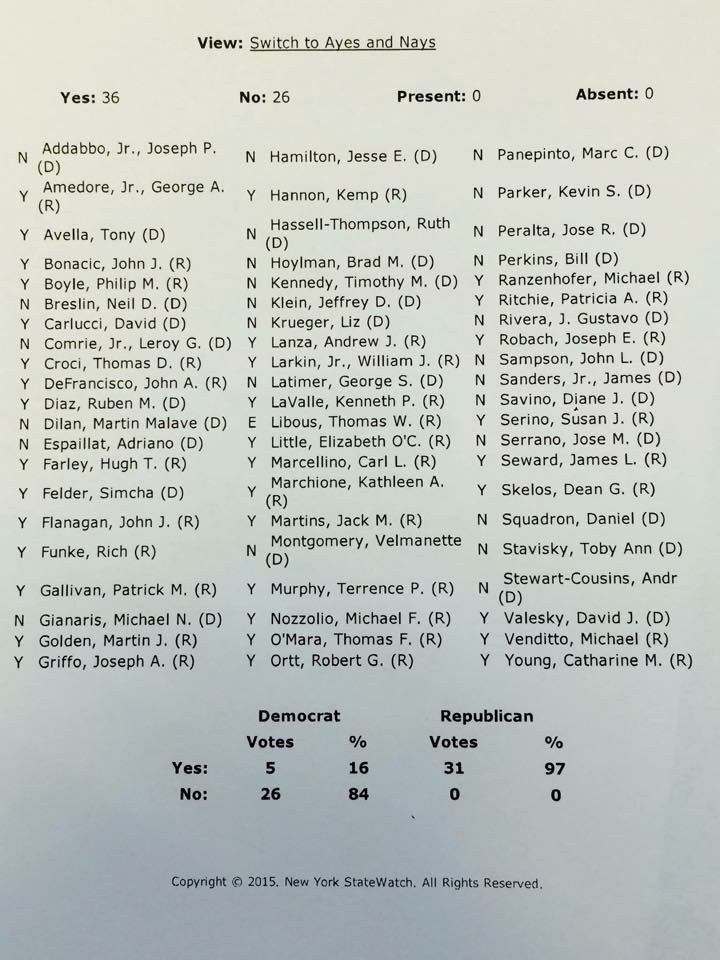
When Governor Cuomo’s budget was passed by the Néw York State Senate, it included mandates for test-score based evaluation of teachers and other provisions that teachers found insulting. Here is the State Senate’s Wall of Shame and Wall of Fame, identifying those who voted for and against this anti-teacher legislation. I previously posted a similar chart for the New York Assembly. Save this list for the next election if you live in New York.


IMG_7076

David Greene taught for many years and most recently has been mentoring new teachers. He read Pasi Sahlberg’s post this morning which said that Finnish teachers are not “the best and the brightest,” but those who are both capable and are committed to becoming career educators. Reflecting on Pasi’s article, he wrote this one of his own. 

David is upset by the suggestion of the Chancellor of the New York Board of Regents that “high-performing districts,” with high test scores and high graduation rates might be exempted from the teacher-principal test-score based evaluations. Her purpose, one suspects, is to tamp down the opt out movement, which is especially strong in suburban districts.

He asks:

So, according to [Chancellor Merryl] Tisch, those who teach our “best and brightest” (i.e. mostly wealthier and whiter) would be exempt as a result of New York’s two-tier education system that also is the most highly segregated in the nation.

Tisch makes me wonder. Was I a highly effective teacher in wealthy and white Scarsdale High School when I taught her nephew? Was I a developing or effective teacher in mostly middle class and integrated Woodlands High School? And did that make me an ineffective teacher at Adlai Stevenson High School in the Bronx, the nation’s poorest urban county, regardless of the huge number of success stories that emanated from there?

The House members of the Tennessee legislature voted unanimously to reduce the role of test scores in teacher evaluations, at least temporarily. Controversy continues about whether teachers and other school staff should be evaluated by the scores of students they don’t teach. (Note: readers, please tell Andrew Cuomo that other states are reducing the role of test scores, not increasing them.)


A bill that temporarily would alter the amount that student test score growth impacts teacher evaluations in Tennessee passed unanimously in the House Thursday. But first, lawmakers debated the merits of a system that grades teachers based on scores in subjects they don’t teach.
The proposal, brought to the legislature by Gov. Bill Haslam’s administration, now awaits consideration by the full Senate.
The bill proposes to phase in the weight of test scores as the state transitions to its new assessment, called TNReady, which will be rolled out during the 2015-2016 school year. Under the proposal, scores from the new test would account only for 10 percent of the teacher evaluation score in 2015-16 and 25 percent in 2016-17, before returning to the current 35 percent in the 2017-2018 school year.
The policy also addresses concerns that teachers of non-tested subjects — such as art and physical education, as well as school counselors — can be penalized for test scores they don’t directly impact. The bill proposes that student growth for those positions count for 10 percent in 2015-16, down from 25 percent, and move to 15 percent in subsequent school years.
Some legislators said that provision is inadequate, however. House Minority Leader Craig Fitzhugh (D-Ripley) offered an amendment that would prohibit test scores from impacting evaluations of non-testing teachers at all. He said allowing educators to be graded based on the scores of other teachers is akin to grading students based on the scores of their peers.
“Parents would be outraged,” Fitzhugh said.
Rep. Mark White maintained the bill is fair without the amendment, however, because no teacher works in isolation. “Does the librarian not have an effect on student reading?” he asked. “Can a guidance counselor not play a role in affecting student performance?”

Merryl Tisch is the Chancellor of the New York Board of Regents. She has been a Regent for 20 years. She is a strong supporter of high-stakes testing. In this article, she criticizes those who opt out and who encourage others to opt out. She says they are hurting the kids who need help the most. She thinks the schools would neglect the neediest children if they were not tested every year. Since no high-performing nation tests every child every year, they must be overlooking their neediest children.


She writes:


“It used to be easy to ignore the most vulnerable students. Without assessments, it was easy to ignore the achievement gap for African-American and Latino students. Without an objective measure of their progress, it was easy to deny special education students and English Language Learners the extra resources they need. Obviously we still need to do more for those students, but now is not the time to put blinders back on.


“Without a comparable measure of student achievement, we risk losing track of the progress of all of our students in all of our schools. This risk applies not only to students of color, urban and rural students, and students with special learning needs. Many students from affluent districts do not make the year-to-year progress necessary in today’s world and need early support to get back on track. It’s far better to find that out while they’re still in the classroom than wait until they’re out of school and faced with real world challenges in college or the work place without the skills they need to overcome those challenges.”


One would think after a dozen years of high-stakes testing that there might be evidence that the children she names have benefitted, that poverty has decreased, but she fails to mention any evidence of the benefits of high-stakes testing.


Celia Oyler, a faculty member at Teachers College, Columbia University, read Chancellor Tisch’s letter and drew different conclusions. She wrote the following comment to The Hechinger Report, where Tisch’s article appeared:


Professor Celia Oyler wrote:


“Very few parents would be refusing the New York State Pearson tests if they were decent measures of learning. And if they were decent measures of learning from year to year there would be no Teachers of Conscience movement of teachers who are refusing to administer the high stakes tests. There are so many flaws with what Chancellor Tisch and Commissioner King have done:


“(1) These tests are not measures of what an individual student has learned from year to year: they are not vertically aligned. State Ed has created what they call growth scores, but calling something by a name does not make it real. In fact, these scores do not measure growth from year to year, but measure the score on the test one year and the score on a different test the next year.


“(2) The NYS tests are too blunt to measure learning of the students Chancellor Tisch proclaims to care most about: the children who do not do well on standardized measures (whether due to horrible stresses that often accompany poverty and affect learning, or from a print or language or intellectual disability, or because they are learning English as an additional language). And we also know from numerous adequately designed studies that a teacher accounts for only about 10-15% of test score variance on any child: to hold one teacher 50% responsible for a single test score is scientifically unjustifiable. And doing so damages the chances for such children to receive the education they need. Children who struggle with school tasks do not need more test prep curriculum (which is what they are mostly getting — get out to schools more, Chancellor Tisch!), they need more rich, integrated, experiential, three-dimensional learning that is organized around meaning and not memorization. Punishing children, their schools, and their teachers for poor scores on poor tests is not the way to promote the rich learning environments they desperately need.


“(3) The misuse of so called Value Added Models or Measures takes lousy tests and then puts them through a formula not even designed to measure one teacher’s influence on the score from year to year: VAMs have greatest reliability when used on groups of teachers across multiple years. To make matters worse, most all researchers continually agree that a teacher accounts for about 10-15% of any standardized score variance. So teachers in NYS are punished by giving them a score that was not even designed to measure what Chancellor Tisch has made it measure. Study after study after study demonstrates that VAM has confidence intervals of as much as 60%! This is utterly insane and has enraged educators who understand what is being done to them.


“(4) Chancellor Tisch has just announced that some districts and schools should be exempt from this high stakes bad math folly that she and her cronies have wrought upon the children and teachers of New York State. This is an abomination. We have decades of research demonstrating the link between wealth and standardized test scores. Yes, there are exceptions: we have schools where children from low-income schools have learned to do well on a high stakes test. We need to learn more from these anomalies. But even within the anomalies researchers continually find that doing well on one high stakes test does not transfer to other high stakes tests. This means that students can be taught how to do well on a high stakes test. It does not mean they are learning content, concepts, and skills of value, that transfer. This raises the question: Do we want learning, or do we want achievement test scores?


“It is apparent to many parents who are refusing the tests, and to many teachers who are taking up activism against these brutal educational “reforms,” that Chancellor Tisch and her ilk care way more about a reductive number on a spreadsheet than they care about real learning and about actually improving the possibilities for the most marginalized children in our society. New York State teachers and children deserve support and assistance, particularly in economically distressed communities. Tisch and her millionaire friends can do much better than punish us all with their willful ignorance.”


Celia Oyler, PhD
Box 31 Teachers College
525 W. 120th Street, NY, NY, 10027
office phone: 212.678.3696
office location: 312 Zankel Hall

The Colorado legislature is considering legislation permitting parents to opt their children out of state testing. The legislation is opposed by corporate reformer State Senator Michael Johnston and corporate reform groups like Colorado Succeeds.

Johnston, drawing on his experience in Teach for America and a brief stint as a principal, was author of legislation passed in 2010 that made test scores count for 50% of teacher evaluations.

I was in Denver the day his dreadful legislation came to a vote, and we were supposed to debate before about 100 civic leaders. Johnston waited outside the room for me to finish my presentation, so he heard nothing to contradict his love of high-stakes testing. As soon as he entered the room, he told the audience about the passage of his “great schools, great teachers” bill.

I was happy to see this part of the AP story about legislation in Colorado:

“Several more testing-related bills await hearings this week, including proposals to reduce social studies testing and to eliminate all statewide tests not required by the federal government. Another bill would dismantle a 2010 requirement that teacher evaluations rely at least 50 percent on student test scores.”

That last item is Mike Johnston’s “historic” bill.

Across the river in New Jersey, teacher-scholar Jersey Jazzman watched the shenanigans. Perhaps he saw one Democratic member of the Assembly after another stand up to recount his sad feelings, her heavy heart, his misgivings, and then vote “yes” to a cockamamie scheme that will be a nightmare to implement and that will be an enormous unfunded mandate, all meant to discover, identify, and remove those BAD TEACHERS who are dragging down test scores. He refers to the controversy as “New York’s Absurd Debate about Teacher Evaluations and Test Scores.”


That’s putting it mildly.


Governor Cuomo, he says, has made a bad system worse.


He writes (and this is only a small part of his analysis):


APPR, like New Jersey’s AchieveNJ, is predicted on the idea that the educator — and only the educator — is responsible for the “growth” of his or her students. It ignores the impacts of funding inequities or district-level curriculum decisions or inadequate facilities or non-random assignment of students or any of the many factors that impact student learning that are completely out of the control of teachers and/or principals.


In New Jersey, the test-based components of AchieveNJ also ignore student characteristics, even though SGPs — Student Growth Percentiles, the test-based measures of student achievement used in teacher evaluations — are clearly biased against teachers who work in high-poverty, low-resourced schools.


New York’s growth model at least attempts to account for differences in student characteristics. According to the state’s Technical Report, the bias against teachers and schools serving high-needs students has been significantly reduced compared to earlier versions of the model.


But that doesn’t make New York’s growth measures any less statistically noisy or invalid. According to the Technical Report, one-third of New York’s teachers changed ratings from 2012-13 to 2013-14 (p. 43). The report crows that this is relatively stable compared to other growth measures, but in reality, it only means that the measures are merely the best of the worst.


Think about it: does it make any sense whatsoever that a full one-third of New York’s teachers significantly changed in their “effectiveness” within the span of a year? Should a high-stakes decision be compelled by a measure that is this unstable?


Here are the Technical Report’s growth ratings for teachers in “tested grades” over the last two years. If we add together all of the teachers who had at least two consecutive “Developing” or “Ineffective” ratings, we are only dealing with the bottom 5 percent of the teaching corps.


I know that the reformy line is these 5 percent are keeping us from competing with Singapore and Finland, but let’s get real: this small number is not worth Angry Andy’s disproportionate response. Yes, we need to remove bad teachers from classrooms, but does anyone really think the vast majority of these teachers couldn’t be identified through their classroom practices?


Angry Andy doesn’t think so; he is convinced that large numbers of administrators are, for reasons known only to Andy, fudging their observations so they can retain poor teachers. That’s why Andy wants to impose a huge unfunded mandate on school districts and require them to bring in outside observers to evaluate teachers.


It never occurs to Angry Andy that it may be possible administrators retain less-than-optimal teachers simply because there are not enough qualified candidates standing ready to replace them. Angry Andy has actually helped to create this situation in his own state, imposing “financially crippling” exams on teacher candidates (more on this later).


Even more foolishly, Angry Andy Cuomo thinks his demonization of teachers won’t have an effect on the number of bright young people willing to enter the profession. He believes his own inability to properly fund New York’s schools has no effect on the quality of teachers; no, it must be all these deceitful, lazy administrators, handing out phony high marks to lazy, ineffective teachers.


Paul Karrer teaches fifth grade in California. He writes frequently about education.


Don’t Let Hillary Do An Obama On Public Education


I write to the leaders of our many education organizations. The time has come for educators collectively to push back.


If you are honest, you must admit we have not fared well politically. In fact it would be fair to say we have been vilified, punished, and demoralized. Teachers must face the ugly fact that President Obama has done the institution of public education and educators irreparable, long-term damage with his shocking warm embrace of “Ed Reform Inc.”


In the previous election the many arms of education threw their weight, money, and support behind President Obama far too early. Hillary Clinton was one of the few candidates to come out against No Child Left Behind. No Child Left Behind was the seminal poisonous blueprint for the destruction and financial demolition of our democratic public schooling institutions.


We received no return on our support for President Obama. Incredibly just the opposite occurred. He made Arnie Duncan his hatchet man and Arnie started chopping. President Obama became wedded to Wall Street, hedge funders, school privatizers, technocrats, and initiated the cannibalism of our educational system. Who would have conceived that the greatest educational betrayal in contemporary history would be by a Democrat and a minority member to boot? His Race To The Top, leveraged with more charter schools, was the ugly stepchild of NCLB. Strategically we thought we had to support Obama. He could only be better than any Republican we chanted. Sadly, in retrospect this is no longer a certainty.


We find ourselves in a similar juncture in the political road. Hillary seems to be our candidate BUT…she has said some very disturbing things of late. Things which make many of us a little questioning of her new leanings. I say this as an ardent Hillary supporter. She claims that the most important book she has ever read was the bible. No problem with that except she’s never mentioned this previously. Also, she’s made a very sharp right turn regarding Syria and probably Iran. She is now a big proponent of invasion – to show she’s tough. Both of these moves reek of pandering to polls. And they indicate a throwing out of previous values. Scary question is…will she throw public education and teachers under the bus for votes too?


We need Hillary, if she is to be our candidate, to be supportive of us in deeds not platitudes. Not just because of our power, and strength but also because we are the good guys. We believe in public service. That is why we teach.


Hillary needs to understand she does not automatically have our support and resources unless she guarantees the death of NCLB, teachers evaluated on testing, and the end of excessive testing. We need a presidential candidate who restarts a public schooling system based on what is good for children – not what is good for: politicians, hedge funders, Pearson, or charter school corporations.


So you our education leaders at the top of the food chain need to have a little sit-down with Hillary. She can’t do An Obama on us. An Obama is where he meets with a few teachers, tells them how great they are. Parades them on T.V. and blathers how society needs great teachers. And adds that we shouldn’t test too much.


And then he promotes industries many harmful reforms. That’s An Obama.


Don’t let Hillary do a Hillary on us.


Paul Karrer
5th grade teacher

Castroville Elementary School
2009 North Monterey LULAC Teacher of The Year
Monterey, California
93940

A reader recommends the two videos below, which were made during the debate about the New York state budget. Assemblyman Jim Tedesco, a Republican, spoke out against the anti-teacher, anti-public education bill devised by Governor Cuomo. In the second video, he dares the Governor to take the fifth grade math test! Mr. Tedesco has served in the New York State Assembly since 1983. In the legislative chamber, he stands out because he has a graduate degree in special education, was a teacher and a guidance counselor. For his defense of a noble profession and common sense, he joins the honor roll of this blog.


New York is circling the drain. But this guy belongs on the honor roll! https://www.youtube.com/watch?v=XhTwcqP4xjE&feature=youtu.be Jim Tedesco. Republican and an ex teacher. He shouldn’t have said he was an ex educator, like saying I used to work at Enron. After this he dared the Governor to take the 5th grade exam.https://www.youtube.com/watch?v=v2tXbPzXcPQ&feature=youtu.be


The second video is more entertaining than the first.