Archives for category: School Choice

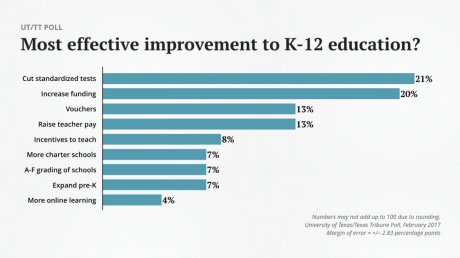
The University of Texas and the Texas Tribune conducted a statewide poll of public opinion about the direction of education reform.

Here are the results. The public makes more sense than their elected officials, who waste their energy and breath advocating for school choice. But the public wants less testing and more funding. School choice has a low priority.

c5cvpsqu0ae2uy8

By the way, I will be speaking in Austin on March 29 at the Austin Marriott North at Round Rock, sponsored by Friends of Texas Public Schools. If you want to attend, contact Jennifer Storm, at stormj@fotps.org for information.

For me, this is a makeup session for the event in 2014, when FOTPS honored me as Friend of the year, and I got stuck in New York City by a blizzard. The fake media called Snowmageddon.

I owe a debt to the public schools of Texas, which educated me. To quote Hank Williams, I’m hoping to set the woods on fire and stop the cranks in the legislature who want to defund public schools and spend public money on nonpublic schools.

During his speech to Congress last night, Teump singled out a young woman in the audience as an exemplar of the benefits of vouchers. He said:

“Joining us tonight in the gallery is a remarkable woman, Denisha Merriweather. As a young girl, Denisha struggled in school and failed third grade twice. But then she was able to enroll in a private center for learning, with the help of a tax credit scholarship program. Today, she is the first in her family to graduate, not just from high school, but from college. Later this year she will get her masters degree in social work.”

Mitchell Robinson, professor of music at Michigan State University, sent the following comment:

“Denisha Meriweather is not simply “an intelligent, dynamic and motivating individual whose life was changed by the school choice policies promoted by Betsy DeVos.” She’s an employee of “Step Up For Students”, a state-approved nonprofit scholarship funding organization that helps administer the very Florida Tax Credit Scholarship Program she benefitted from. [My note: Step up for Students has more than $500 million in assets. https://www.stepupforstudents.org/wp-content/uploads/2012.13-SUFS-Form-990.pdf]

“Ms. Meriweather has also been writing versions of this article at least since she graduated from college in 2014. So, to date, the only job Ms. Meriweather has secured as a result of receiving her voucher is working for the organization that gave her the voucher, and trying to influence public opinion on the worth and value of vouchers.”

Why we must NOT give Betsy DeVos and school choice “a chance”

The title of this post may strike you as a strange question, in light of the well-known history of the Trump Organization in discriminating against blacks who sought to rent their properties and the DeVos’s longstanding role as the antagonist of government programs of all kinds, especially in education. History in this country shows that government, not the private sector, is the most faithful guarantor of rights and equity.

Yet in his speech last night, Trump picked up on the deceptive line that we have heard from free-market ideologues for the past 15 years:

Education is the civil rights issue of our time.

I am calling upon Members of both parties to pass an education bill that funds school choice for disadvantaged youth, including millions of African-American and Latino children. These families should be free to choose the public, private, charter, magnet, religious or home school that is right for them.

Joining us tonight in the gallery is a remarkable woman, Denisha Merriweather. As a young girl, Denisha struggled in school and failed third grade twice. But then she was able to enroll in a private center for learning, with the help of a tax credit scholarship program. Today, she is the first in her family to graduate, not just from high school, but from college. Later this year she will get her masters degree in social work.

We want all children to be able to break the cycle of poverty just like Denisha.

In reality, the true civil rights issue of our time is the fight to save public education as a public responsibility, responsible for all, doors open to all, staffed by well-prepared teachers.

Trump may have given a big boost to the school choice movement–vouchers, charters, cybercharters, homeschooling–but his embrace should be the kiss of death for those who know that his bona fides as a leader of the civil rights movement are non-existent, and that our public schools are vital to our democracy.

It is not difficult to open the public coffers and have a free-for-all for anyone who wants part of the public treasury. The for-profit fly-by-night charter schools that populate Michigan’s education landscape must have been heartened by Trump’s declaration. The basement voucher schools no doubt have dreams of public dollars coming their way. The fraudulent cybercharter operators who rake in millions in profit must be rubbing their hands with glee.

It is hard, by contrast, to build and sustain high-quality public schools in every community.

Clearly this administration has neither the will nor the heart to do what society needs. They do not intend to increase federal funding; they intend to divide it up among all who want a share. That will cripple community public schools, and they know it. The victims will be the great majority of children who are still enrolled in public schools.

The New York Times this morning blasted Betsy DeVos’ “fake history” of Historically Black Colleges and Universities, recognizing that they began not as “school choice,” but as a response to racism and exclusion.

The same editorial board has faithfully parroted the virtues of charters and school choice, and one day may have to deal with its contradictory stance.

Privately owned and managed charters do not improve public schools; they take funding away from public schools, thus disadvantaging them even further. In the name of “choice” for the few, they weaken the schools that serve whoever arrives at the schoolhouse doors.

Let’s be clear about “school choice,” at least in this country. It was born of racism in the mid-1950s as a way to evade the Brown v. Board decision of 1954. Southern governors and senators took up “choice” as their rallying cry. For many years the term itself was stigmatized because of its history.

The fact that it has been revived by entrepreneurs, well-meaning advocates, and closet racists doesn’t change its history or its purpose: It will undermine public education. It may “save” a child here or there, while most children will be lost in a free-market system of competition in which the public abandons its responsibility to provide the best possible education for all children.

We cannot let that happen. If choice were the answer, we would all look to Milwaukee as a national model, which has had vouchers, charters, and public schools since 1990. Twenty-six years is time enough for an experiment to demonstrate its worth. Milwaukee today has a public system that disproportionately enrolls the high-needs children that the other schools don’t want. It is also one of the lowest performing urban districts in the nation on the federal tests. Not even Trump or DeVos would have the nerve to call it a national model.

Our public schools need our support. Trump and DeVos are wolves in sheep’s clothing. Their sheep’s clothing is transparent. No one should be fooled by their phony advocacy for poor kids or education. They advocate for an unregulated free-market in education that will leave most children behind, especially those who are the most disadvantaged by their social and economic circumstances.

They must not be permitted to destroy public education. They must be stopped: by parents, teachers, students, and everyone of us who attended public schools. In every community, we must fight for our democracy and stop the raid on our public treasury.

Kevin Carey is the director of education research at the New America Foundation in D.C., a think tank funded by tech magnates.

He writes in the New York Times that researchers are reacting with surprise at the “dismal results” from vouchers.

I am not sure why this is news, because vouchers have been tried out since 1990 in Milwaukee and elsewhere and have been subject to numerous evaluations, almost all of which have reached the same conclusion: vouchers don’t have a significant effect on test scores.

This conclusion has been reported again and again over the past 25 years.

It doesn’t seem to have much effect on the pro-voucher crowd, who have been promising since 1955 (when economist Milton Friedman published his seminal essay about vouchers) that school choice would have dramatic positive effects. Back in 1990, John Chubb and Terry Moe predicted in their book “Politics, Markets, and Schools” that school choice was a “panacea,” and that the problem with schools is that they are democratically controlled. Take away the democratic governance, and all will go well, they said.

Anyone who looks at the many evaluations of the voucher programs in Milwaukee, Cleveland, D.C., Indiana, and Louisiana has to search hard for any positive news.

Still, it is good to see this research consensus publicly acknowledged in the New York Times.

Carey is part of the neoliberal Democratic consensus in the D.C. think tank world that favors charters, but not vouchers. So he takes care to say that charters in Massachusetts produce higher test scores than public schools, although he does not note the vote last November in which the people of Massachusetts voted overwhelmingly not to expand the number of charter schools. (He did mention it in his article in the Times last November, when he assured readers that DeVos could not possibly privatize public schools.) Nor does he make any reference to the numerous financial scandals associated with charters schools, nor to their frequent practice of excluding children with special needs and English language learners, nor to the fiscal burden they impose on public schools by draining away resources from them.

Carey is still trying to salvage the charter idea–which DeVos embraces wholeheartedly–from Trump’s wrecking ball approach to public education. The difficulty is that phony reformers like DeVos can use charters to destroy public education as easily as they can use vouchers. Michigan, after all, is a paradise for school choice, as is Florida, and neither has the sort of voucher program that DeVos prefers. They are hotbeds of rapacious, for-profit charter operators.

Neoliberals are caught on the horns of a dilemma. They think they can advance their kind of school choice (charters) while resisting going “all the way” with vouchers. But once you say that school choice is good, it is very tough to draw a line in the sand against vouchers. It is like being just a little bit pregnant. School choice produces community dissension and segregation. Its true forebears are not Milton Friedman but the racist leaders of the South after the Brown decision.

Full disclosure: Carey wrote an unfriendly article about me in The New Republic (referenced in his Wikipedia listing) in 2011. He sought to belittle my scholarship and credentials, although I had just been awarded the Daniel Patrick Moynihan Award by the American Academy of Political and Social Science for scholarship in the interest of the public good. That was Carey’s way of defending charters at that time, which was then and remains the favorite idea of the neoliberal consensus in DC. The neoliberals are still trying to save charters from their embrace by DeVos and Trump.

All that is past. I forgive him. I look forward to the day that Carey examines the charter scandals in Ohio, Michigan, Arizona, Florida, and Pennsylvania, and considers what they are doing to the public schools that are defunded by charters. The majority of students still go to public schools, not charter schools, and they have fewer resources as a result of a dual system. If deregulation makes schools better, why not deregulate them all?

But all that aside, I am pleased to see him skewer vouchers, which have failed again and again and again. They don’t help poor kids; they are all about diverting taxpayer monies to nonpublic schools. The majority of the public has consistently said that they don’t want their taxes to fund religious schools. Regardless of the religious school, taxpayers say no. Whenever there is a referendum, they vote against vouchers. But that doesn’t stop DeVos or her allies.

Rhode Island’s Governor Gina Raimondo is an avid proponent of charter schools and a former hedge fund manager (synonymous terms these days).

Last year, she and the new State Commissioner of Education Ken Wagner announced a campaign for “empowerment schools,” which is an empty slogan meeting that principals have more autonomy and students can ignore district lines and choose whatever school they want.

But the money wasn’t forthcoming for whatever it is they proposed, and empowerment seems to be dead for now.

Watch as Raimondo looks for a way to jump on the DeVos bandwagon while still claiming to be a Democrat.

The Detroit Free Press published this article last May about the state’s academic decline since 2003. That covers the DeVos era.

http://www.freep.com/story/news/education/2016/05/18/michigan-students-sliding-toward-bottom/84535876/

“In 2003, Michigan ranked 28th in fourth-grade reading. In 2015, the state was ranked 41st.
“We’re certainly not on track to become a top 10 state any time soon,” said Amber Arellano, executive director of the organization. “It’s totally unacceptable for the economy, for business and especially for kids themselves.”

Among the 2015 NAEP results highlighted in the report:

• Michigan ranked 41st in fourth-grade reading, down from 28th in 2003.

• The state ranked 42nd in fourth-grade math, down from 27 in 2003.

• It ranked 31st in eighth-grade reading, down from 27th in 2003.

• It ranked 38th in eight-grade math, down from 34th.

The report is focused on the fourth-grade reading results because of how crucial it is for students to be able to read well by the end of third grade. But students have also struggled in math.

The achievement problem crosses demographic lines. Consider how various demographic groups in Michigan compared with similar demographic groups nationwide in fourth-grade reading in 2015: White students in Michigan ranked 49th, higher-income students in Michigan ranked 48th, and black students ranked 41st.

The problem? Many other states are outpacing Michigan, which has posted mostly stagnant — and in some cases declining — results.”

Will DeVos inflict her failed methods on the nation?

In rural communities across America, the public school is the hub of the community.

Destroy it with school choice, and you destroy the community.

https://www.washingtonpost.com/national/where-school-choice-isnt-an-option-rural-public-schools-worry-theyll-be-left-behind/2017/02/10/03e7146a-ef23-11e6-9973-c5efb7ccfb0d_story.html?utm_term=.d114dea33e95&wpisrc=nl_rainbow&wpmm=1

Mercedes Schneider reprinted Secretary of Education Betsy DeVos’s first public speech.

The one point that comes through is that she is totally in the dark about why her nomination encountered massive public resistance. To the public, she is an unqualified, uninformed enemy of public schools.

But Betsy thinks she ran into opposition because public school educators are opposed to her innovative ideas!

Privatization is not new. Charters have been around since 1990–26 years–and is is now well-established that most are no better than public schools, some are far worse, and they are not innovative.

Vouchers are not innovative. Milwaukee has had since 1990, Cleveland since 1995, and DC since 2004. There are among the lowest performing urban districts in the country.

DeVos has no new ideas. She is wrapped around School choice, the cause celebre of segregationists for the past 60 years.

Here is the official transcript issued by the White House of Trump’s “listening tour.” Note how he gushes over every parent or teacher not in a public school and how quickly he breezes past a Teacher of special education in a public school. He seems to promise near the end to reduce the rate of autism. He says he visited an amazing charter school in Las Vegas but clearly doesn’t know that most of the charter schools in Nevada are failing schools.

The White House
Office of the Press Secretary
For Immediate ReleaseFebruary 14, 2017
Remarks by President Trump at Parent-Teacher Conference Listening Session

Roosevelt Room

10:50 A.M. EST

THE PRESIDENT: Well, I am delighted to welcome everybody to the White House. And Betsy DeVos, who has gone through — our new Education Secretary — she went through an interesting moment. And you’re going to do a fantastic job, and I know you would have done it again if you had to do it again, right? (Laughter.)

SECRETARY DEVOS: Probably.

THE PRESIDENT: She had no doubt that final night, waiting for the vote. So I just want to congratulate you. You showed toughness and genius.

As I said many times in my campaign, we want every child in America to have the opportunity to climb the ladder to success. I want every child also to have a safe community, and we’re going to do that very much. We’re going to be helping you a lot — a great school and some day to get a really well-paying job or better, or better; own their own company. And a lot of people are looking at that.

But it all begins with education, and that’s why we’re here this morning. And I’m here also to celebrate a little bit with Betsy because we started this journey a long time ago, having to do with change and so many other good things with education. And I’m so happy that that all worked out.

Right now, too many of our children don’t have the opportunity to get that education that we all talk about. Millions of poor, disadvantaged students are trapped in failing schools and this crisis — and it really is a crisis — of education and communities working together but not working out. And we’re going to change it around, especially for the African American communities. It’s been very, very tough and unfair. And I know that’s a priority and it’s a certainly a priority of mine.

That’s why I want every single disadvantaged child in America, no matter what their background or where they live, to have a choice about where they go to school. And it’s worked out so well in some communities where it’s been properly run and properly done. And it’s a terrific thing.

Charter schools, in particular, have demonstrated amazing gains and results. And you look at the results — we have cases in New York City that have been amazing in providing education to disadvantaged children and the success of so many different schools that I can name throughout the country that I got to see during the campaign. I went to one in Las Vegas; it was the most unbelievable thing you’ve ever seen. And they’ve done a fantastic job.

So there are many such schools and we want to do that on a large-scale basis. We can never lose sight of the connection between education and jobs. I’m bringing a lot of jobs back. We’re bringing a lot of big plants back into the country — everyone said it was impossible. And before I even took office, we started the process and tremendous numbers of plants are coming back into this country — car plants and other plants. And I have meetings next week with four or five different companies, big ones that are going to bring massive numbers of jobs back.

So we’re doing it from the jobs standpoint, but education only makes it better. Our goal is a clear and very safe community, great schools, and we want those jobs that are high-paying jobs — we’ve lost a lot of our best jobs to other countries and we’re going to bring them back.

So I’m going to do my job, and Betsy, at the education level, will do her job. And just to do it very, very formally, I want to congratulate you on having gone through a very tough trial and a very unfair trial, and you won. And there’s something very nice about that. And I’ll tell you the real winner will be the children — I guess a couple of adults (inaudible) — but will be the children of this country. And I just want to congratulate you.

SECRETARY DEVOS: Thank you, Mr. President.

THE PRESIDENT: Perhaps we’ll go around the room. And everybody knows our fantastic Vice President, Mike Pence. But if we went around the room, it would be very nice. So why don’t we start? Betsy, you might want to say a few words to us.

SECRETARY DEVOS: Well, Mr. President and Mr. Vice President, I am just very honored to have the opportunity to serve America’s students, and I’m really excited to be here today with parents and educators representing traditional public schools, charter public schools, homeschools, private schools, a range of choices. And we’re eager to listen and learn from you your ideas for how we can ensure that all of our kids have an equal opportunity for a high-quality, great education and therefore an opportunity for the future.

So again, I just wanted to have the opportunity to serve, and looking forward to fulfilling the mission that you set forward.

THE PRESIDENT: It’s our honor — believe me, Betsy.

Kenneth.

MR. SMITH: Ken Smith, educator helping at-risk kids get through school. Vice President, it actually has the largest application of jobs for America’s graduates in the country. And in a minute we’ll talk about that as a solution.

THE PRESIDENT: Great. Good.

Laura.

MS. PARRISH: Laura Parrish, I’m from Falls Church, Virginia. I homeschool my 10- and my 13-year-old.

THE PRESIDENT: Good. Very good.

Mary.

MS. RINER: My name is Mary. I’m a charter school parent here in D.C., and considered the best school in America.

THE PRESIDENT: You think, huh? (Laughter.)

MS. RINER: I know.

THE PRESIDENT: I like that.

MS. RINER: According to U.S. News & World Report.

THE PRESIDENT: Really? Is that right? Wow.

Jennifer.

MS. COLEMAN: I am Jennifer Coleman. I am from Prince William County, Virginia. I am the mother of six, and I homeschool my oldest four; they are grades kindergarten through seven. And before that I was a private school teacher.

THE PRESIDENT: Very good.

MR. CIRENZA: Bartholomew Cirenza. I’m a parent of seven, and my kids have gone through both private and public school, and I see differences, and —

THE PRESIDENT: Big difference.

MR. CIRENZA: Big difference.

THE PRESIDENT: Okay.

MS. BAUMANN: Good morning, I’m Julie. I teach special education at a public school in New Jersey.

THE PRESIDENT: Very good. Thank you.

MS. QUENNVILLE: Hi, I’m Jane Quennville, and I’m a principal of a special-ed center in Virginia serving children ages five through twenty-two with autism and physical and medically fragile conditions.

THE PRESIDENT: How is that going?

MS. QUENNVILLE: Well —

THE PRESIDENT: Have you seen an increase in the autism with the children?

MS. QUENNVILLE: Yes, yes. In fact, our school has shifted its population — saw more children with autism, definitely.

THE PRESIDENT: So what’s going on with autism? When you look at the tremendous increases, really, it’s such an incredible — it’s like really a horrible thing to watch, the tremendous amount of increase. Do you have any idea? And you’re seeing it in the school?

MS. QUENNVILLE: Yes, I think — I mean, I think the statistics, I believe, are 1 in 66, 1 in 68 children are diagnosed with autism.

THE PRESIDENT: And now it’s going to be even lower —

MS. QUENNVILLE: Probably.

THE PRESIDENT: — which is just amazing. Well, maybe we can do something.

MS. BONILLA: I am Carol Bonilla. I teach Spanish in a private elementary school in Arlington. I teach the students in fourth through eighth grade.

THE PRESIDENT: Very good. Thank you.

MS. VIANA: Good morning, Mr. Vice President, Mr. President. My name is Aimee Viana. I’m the parent of two children — fifth grade and second grade — and I live right outside of Raleigh, North Carolina in Cary, and I’m also a former educator in public and private schools.

THE PRESIDENT: Fantastic. Thank you. So thank you all very much. Let’s get going.

END
10:58 P.M. EST
Julian Vasquez Heilig is a scholar of education who is devoted to the advancement of equity. His pathbreaking work aims to strip away rhetoric and fake claims and to show which policies help or harm children of color. His blog, “Cloaking Inequity,” is always provocative.

In this post, he explains why vouchers were created: for profit and for segregation.

He is right. Vouchers and school choice intensify and facilitate segregation–by race, class, religion, and socioeconomic status.

In the Deep South, vouchers and school choice were the rallying cries of hardline segregationists (for more detail, read Mercedes Schneider’s fine new book, “School Choice.”

I was recently on an NPR show (Warren Olney’s “On Point), with a panel that included Emma Brown of the Washington Post, Randi Weingarten, and Matt Frendewey, a spokesman for Betsy DeVos’ American Federation for Children. Randi said that vouchers were originated in the South by segregationist politicians. The DeVos guy became furious and said that Randi was making it up., it wasn’t true, just union propaganda.


When I finally got my turn, I said that my field is the history of American education. I pointed out that the history of voucher advocacy was indisputable: it began with white segregationists trying to block desegregation.