Archives for category: School Choice

Christine Langhoff, retired educator, wrote the following information about the corporate reform assault on Boston Public Schools. Voters overwhelmingly rejected expansion of charter school, but the privatization movement is never dissuaded by public opposition. They think democracy is the problem and have no qualms about ignoring the will of the people when it conflicts with their ambition.

Langhoff writes:

Last week, this rather odd Tweet appeared from the Boston Public Schools Twitter account:

The language about “choice” made me remember that NPR featured this article about how “coaches” are helping parents choose schools for their children.

https://www.npr.org/sections/ed/2017/11/27/551853951/confused-by-your-public-school-choices-hire-a-coach?utm_source=twitter.com&utm_medium=social&utm_campaign=npr&utm_term=nprnews&utm_content=2055

Of course, most BPS parents don’t have money for this sort of help. No worries! There’s an edu-business non-profit for that: EdNavigator https://www.ednavigator.com

And they’re coming to Boston! After a successful run in – New Orleans?

So who is behind EdNavigator? The “leadership” page shows a bunch of folks from TNTP and some KIPPsters

https://www.ednavigator.com/who-we-are/leadership

And the Board of Directors is full of a bunch more charteristas, including Chris Stewart, aka @CitizenStewart, as Director of Outreach and External Affairs:

https://www.ednavigator.com/who-we-are/board-of-directors

Their partners page shows many hotels, i.e. low income workers. Remember that the Pritzker hedge fund family of Chicago own Hyatt Hotels :

https://www.ednavigator.com/who-we-are/our-partners

The plan is to offer school choice counseling as a “benefit” to low income workers and by developing this “trust” in their workers, the public school system is supplanted as the knowledgeable entity on education.

“Our Navigators combine expert knowledge of schools with a deep understanding of our communities. Most are accomplished former teachers, school leaders, or counselors, and all have passed a background check, received privacy training and adhere to a strict code of confidentiality.

They’re like pediatricians for your educational health, and they’re always ready to answer questions, troubleshoot problems, and get things done. In a recent survey, 95 percent of EdNavigator members said that their Navigator is “the person I trust most for information and advice about education issues.”

https://www.ednavigator.com/how-we-help

Here in Boston, EdNavigator goes by the name of Boston School Finder
https://www.bostonschoolfinder.org/about

About Boston School Finder
“Boston School Finder is being developed and distributed by a committed and diverse team of Parent Ambassadors supported by local non-profits. These parents and guardians represent nearly all the neighborhoods of Boston, and enroll their children in BPS, charter, Catholic, and private schools.
Funding for Boston School Finder was provided through the Boston Schools Fund and the Barr Foundation, two local non-profit organizations. Web design and development was provided by a team of volunteers who work at Wayfair, a Boston-based e-commerce company specializing in home goods.
Many other organizations, including the City of Boston, Boston Public Schools, the Boston Charter Alliance, the Roman Catholic Archdiocese of Boston, and community organizations from all around the city are providing guidance and input on the site.”

They’ve hired “Parent Ambassadors”
https://www.bostonschoolfinder.org/about/contact

And have detailed information about enrollment for public, private, charter and religious schools
https://www.bostonschoolfinder.org/about/enrollment

Since November 29, some pages for the website have been removed, but here’s some of the information that has gone missing:

2017 Barrr Foundation grants:
Ed Navigator Inc.
To support the EdNavigator expansion to Boston.
• Year Awarded: 2017

• Amount: $500,000

• Term: 24 months

• Program: Education


Boston Schools Fund Inc. To support the development and implementation of the Boston School Finder Family Information Tool.
• Year Awarded: 2017
• Amount: $300,000
Term: 12 months

The Barr Foundation is also a champion of Unified Enrollment, which in turn is part of CRPE’s Gates Compact, all of which will have a detrimental effect on Boston’s public schools.

http://www.bostonschoolsfund.org/boston-compact/

Also in the missing link from November 29, was this list of Board members

PRESIDENT WILLIAM F. AUSTIN
TREASURER WILLIAM F. AUSTIN
CLERK JILL SHAH
DIRECTOR WILLIAM F. AUSTIN
DIRECTOR JILL SHAH
DIRECTOR KATHRYN EVERETT

Austin taught math at Roxbury Prep, which is the charter where John King was a founding teacher before he moved on to New York state and then to replace Arne Duncan. (It is also the school with the persistently highest suspension rate in the state of Massachusetts.) Austin has overseen its four-campus expansion. Shah and her husband own the on-line furniture store Wayfair; her husband is a director of the Federal Reserve Bank.

On Tuesday, Austin confirmed to a member of the Boston Teachers Union that the above is accurate.

So, charteristas and billionaires. Color me skeptical that these organizations are well suited to helping Boston parents choose public schools for their children. It seems, too, that the parents most likely to utilize the bostonschoolfinder.org website are the best educated and most advantaged to begin with.

The Boston City Council held a hearing on Tuesday evening, December 5, which I attended, with the purpose of getting this information on the record. The hearing was on the school assignment process, which has been a colossal boondoggle, featuring algorithms written by MIT students. The current plan was enacted in 2013, and there were supposed to be yearly reports about progress, or lack of and necessary improvements along the way. No reports have been issued over the past four years.

When Councilor Tito Jackson (who supported the “No” position on last year’s charter expansion ballot question) probed for a reason for the lack of reporting, the School Department’s answer was that we’ve had three different standardized state tests, so no judgments can be made about the quality of the schools, information parents need to choose a school. When Jackson asked about Unified Enrollment, the School Department claimed to know nothing about it, that there had been no meetings on the topic. But Mayor Marty Walsh has filed legislation to fast track Unified Enrollment, then later denied he did so after reports became public.

“Currently, students have a list of school options comprising only district schools and can apply also to as many charters as desired. Under unified enrollment, unless school list lengths are expanded, the presence of any charter school on the list necessarily will bump a district school off of it, reducing district school options, states QUEST in its report published on Sept. 18, 2017. Under bill H.2876 filed by Rep. Alice Peisch and co-sponsored by Walsh, Carvalho and Rep. Dan Hunt, charter schools could elect to give enrollment preference to students living near the school.”

http://baystatebanner.com/news/2017/oct/11/quiet-push-unified-enrollment/

(Rep. Alice Peisch, by the way, has been a staunch supporter of charter expansion and was one of their spokespeople during last year’s Question 2.)

On Friday, December 8, the School Department released another plan informed by an MIT algorithm for start times for our schools. Ostensibly, the goal was later start times for high schools, many of which begin now at 7:15. There are no school buses for high schools, which means kids often need to leave home by about 6:00 to arrive at school on public transportation. There has been an uprising among parents since new times were revealed because they have changed start times in 105 of 125 schools (84% of all BPS schools) ostensibly in order to change 21 high school start times.

Under the new plan, many elementary schools are scheduled to begin at 7:15, with afternoon dismissals as early as 1:15. Adding before and after school care to schedules for the littles could mean an 11 hour day away from home. When parents began to push back, asking how they could be expected to juggle work schedules with these new school hours, these pieces of advice were offered:

“My new bell time doesn’t work for me, what can I do?
• For students who are eligible for transportation and where we have capacity on our buses, BPS will provide transportation from off-site, before-school programs to school; and from school to off-site, after-school programs.
• Your school likely has before- or after- school programming. More than 90% of all BPS schools have after-school programing and 90% of BPS schools starting after 9:00 AM have a before-school program. Additionally, we will continue to work with programs and schools to expand available before- and after-school programming across BPS.
• BPS is happy to provide parents, guardians, and students with letters to employers notifying them of a school scheduling change and explaining why this may necessitate a change of working hours. For this, please email starttimes@bostonpublicschools.org.
• We realize that in some cases, the only option for families may be to change schools. For more information on this process, please visit a BPS Welcome Center, its website, bostonpublicschools.org/welcomeservices, or call 617-635-9010. Please also consider attending the BPS School Showcase on Saturday, December 9, at TD Garden; the event begins at 9:00 am and ends at 1:00 pm. For more information, visit bostonpublicschools.org/registrationevents.”

https://www.bostonpublicschools.org/Page/7016

The Boston Globe weighed in, essentially telling parents to suck it up:

http://www.bostonglobe.com/opinion/editorials/2017/12/09/new-school-schedules-are-worth-hassle/tjfhF0WLfE6O1Et90SW7vL/story.html?camp=bg%3Abrief%3Arss%3Afeedly&rss_id=feedly_rss_brief&s_campaign=bostonglobe%3Asocialflow%3Atwitter#comments

Parents have posted a petition which has garnered over 4,700 signatures since Saturday.

https://www.change.org/p/tommy-chang-and-mayor-walsh-stop-immediate-changes-on-school-start-times-in-boston

When I start to add up all this chaos, I come to one conclusion: it’s deliberate.

It makes enrollment in traditional schools more difficult.

It makes school schedules more onerous for parents and kids.

It will destabilize the entire school system.

It will drive families away.

It will make the privatizers gleeful.

It will subvert the voters’ emphatic NO to an expansion of the charter industry.

Right here in the cradle of public education.
North Carolina is one of the states where the legislature has been working overtime to pass programs to harm public schools. Charters, vouchers, cybercharters, Teach for America, and regular assaults on the teaching profession.

That context makes it especially surprising and gratifying to see that the editorial board of the News-Observer wrote a strong critique of the GOP Tax Plan because it hurts public education.

This is a fantastic editorial:

There’s no doubt that tax-cut proposals in the House and Senate will increase income inequality today, but provisions in the bills could also weaken the earning power of many in the future by eroding the quality and the diversity of public schools.

One change that as approved by the Senate and also found in the House bill extends a tax benefit for college savings accounts to cover tuition for private elementary and secondary education. The change means that those who can afford to save money for non-public school tuition will be able to see that money grow tax-free.

Extending the tax break won’t mean much for families of modest incomes since they can’t afford to save large amounts for pre-college schooling, but it will have the effect of making high-priced private schools less costly to the wealthy. The Senate version of the change offered by Republican Sen. Ted Cruz of Texas even allows those who home school to draw up to $10,000 annually out of the tax-favored accounts to cover loosely defined school expenses. In the end, the change reduces tax revenue to give the wealthy a break on private education costs.

This relatively narrow adjustment will be joined by sweeping proposals in both the House and Senate tax bills that limit federal deductions for state and local taxes. Those changes will make it harder for local and state governments to raise taxes to support public schools. Together, the changes will lighten the tuition bill at private schools while adding to the tax burden that supports public schools.

Of course, higher education is also threatened by provisions in the tax plans that would include levies on endowments and on tuition benefits provided to graduate students and children of college employees. But the plans’ broader threats are to public schools, which are already being undermined by Republican-backed efforts to increase the number of charter schools – publicly funded but privately run – and to expand the use of tax funds for private schools through voucher programs. Now that “school choice” movement has gained support at the federal level with the appointment of Betsy DeVos – a charter and private school advocate – as the U.S. education secretary.

Fueling re-segregation

As Republicans cut away at the financial foundation of public schools they are also accelerating the re-segregation of all schools at the elementary and secondary levels. Adding charters and using tax dollars to subsidize private and sectarian school tuition is leading to a great sorting by race. And that, rather than enhancing education, deprives children of learning through exposure to classmates of different racial groups and economic backgrounds.

In a recent report on charter schools, The Associated Press found the number of charter schools has tripled over the last decade and racial isolation has grown with them. Charters tend to be overwhelmingly white, or overwhelming one minority. The AP reported: “While 4 percent of traditional public schools are 99 percent minority, the figure is 17 percent for charters. In cities, where most charters are located, 25 percent of charters are over 99 percent nonwhite, compared to 10 percent for traditional schools.”

The trend worries even some charter school advocates. Pascual Rodriguez, principal of a Milwaukee charter where nearly all the students are Hispanic, told the AP: “The beauty of our school is we’re 97 percent Latino. The drawback is we’re 97 percent Latino … Well, what happens when they go off into the real world where you may be part of an institution that’s not 97 percent Latino?”

The AP report mirrors what an October News & Observer report found about racial segregation in North Carolina charter schools. The report found that the schools are more segregated and have more affluent students than traditional public schools.

Christine Kushner, a member of the Wake County Board of Education and a former chair of the panel, said that despite efforts to foster diversity in the Wake County school system, the state’s largest, minorities are the majority, largely because of an increase in Hispanic students and more white students enrolling in schools outside of the system. She said Wake schools remain strong, but their reduced diversity both in race and income is a setback.

“It’s troubling to me that we are going backward because I think diverse schools are what’s best for all children and economics and history affirm that,” she said. School choice is fine, she said, but public schools need to have the resources “to be the first choice for all parents.”

Good public schools and strong support through taxes are inseparable. But the tax bills in Congress are adding to the forces that are splitting that bond and jeopardizing public education.

Read more here: http://www.newsobserver.com/opinion/editorials/article188972429.html#storylink=cpy

Mercedes Schneider’s reviews Betsy DeVos’s speech to her friend Jeb Bush’s Foundation for Educational Excellence.

Betsy and Jeb have this in common: They both hate public schools and have devoted their life to demeaning, belittling, and attacking the schools that 85-90% of American children attend. They are in love with consumer choice, and they would like nothing better than to direct public funds to religious schools, for-profit schools, cyber schools, and homeschooling.

As Mercedes notes, Betsy (or more likely, a speechwriter) discovered “A Nation at Risk,” The 1983 jeremiad that blamed public schools for the loss of industries to Germany and Japan. The report was written in the midst of the 1982 recession, and the commissioners decided that the schools were to blame for the downturn. When the economy recovered, no one bothered to thank the schools.

Betsy devoutly believes that choice will fix everything, but “A Nation at Risk” didn’t mention choice.

And she continues to ignore the evidence of the past 25 years of choice. Her home state of Michigan is overrun with charter schools, and its standing on NAEP fell from the middle of the 50 States to the bottom 10 from 2003 to 2013. The news out of the New Orleans all-Charter District throws cold water on the Charter Movement, as New Orleans continues to be a low-performing District in a low-performing State. The evidence on vouchers continues to accumulate, and it is not promising. In the most recent voucher studies, students actually lose ground. After three or four years, those who have not left to return to public schools catch up with their peers who stayed in public schools, but that’s probably because the weakest students left.

Now that Betsy is talking numbers, maybe she will pay attention to the research on charters and vouchers and admit that her favorite panacea is not working.

But I’m not holding my breath.

Peter Greene has unearthed another libertarian, this one writing for CATO (founded by the Koch brothers), who explains why government should not run schools, but private corporations should.

Corey DeAngelis is a scholar (I know because he says so) who has had a busy couple of years suckling off various Libertarian teats. He’s a Fellow for the Cato Institute, policy adviser for the Heartland Institute, and a Distinguished Working-on-his-PhD Fellow at the University of Arkansas, all of this built on a foundation of a BBA (2012) and MA (2015) in economics from the University of Texas in San Antonio (because nobody understands education like economists). And while plugging away on that Masters, he worked first as the Risk Management Operations Coordinator and then the Fraud Coordinator for Kohl’s. So yet another education expert with no education background.

He also hangs out with the fine folks at the Foundation for Economic Education (FEE, not to be confused with the Jeb Bush FEE), where he writes pieces with catchy titles like “Legalizing Discrimination Would Improve the Education System” and “Governments Shouldn’t Even Certify Schools, Much Less Run Them.” So we should not be surprised to find his name attached to an article arguing that schools should belong to businesses.

A “Fraud Coordinator” for Kohl’s? Is that a security guard? Someone checking to see if customers are shoplifting? An accountant in the main office?

This is one of the best pieces I have read about the pernicious effects of “education reform” on the the Democratic Party. I have consistently argued that the Democrats triangulated so far during the Clinton administration that they blurred the distinct lines between the parties, then ended up supporting the Republican policies of testing, accountability, and choice, which previously they abhorred.

Jennifer Berkshire here fills in the details with her sharp eye and wit. So thoroughly have Democrats joined with Republicans in demonizing teachers and unions, that there is hardly a dime’s worth of difference between them on education issues. Things have gotten so bad that one Democrat espousing privatization recently co,pare the teachers unions to Alabama governor George Wallace, blocking children as they try to escape public schools to enter charter nirvana.

She writes:

“To begin to chronicle the origin of the Democrats’ war on their own—the public school teachers and their unions that provide the troops and the dough in each new campaign cycle to elect the Democrats—is to enter murky territory. The Clintons were early adopters; tough talk against Arkansas’s teachers, then among the poorest paid in the country, was a centerpiece of Bill’s second stint as Governor of Arkansas. As Hillary biographer Carl Bernstein recounts, the Arkansas State Teachers Association became the villain that cemented the couple’s hold on the Governor’s mansion—the center of their Dick Morris-inspired “permanent campaign.” The civil rights language in which the Democratic anti-union brigade cloaks itself today was then nowhere to be heard, however. And little wonder: Civil rights groups fiercely opposed the most controversial feature of the Clintons’ reform agenda—competency tests for teachers—on the grounds that Black teachers, many of whom had attended financially starved Black colleges, would disproportionately bear their brunt.

“Hillary made the cause her personal crusade in 1983, trotting out anecdote after anecdote about teachers she’d heard about who couldn’t add or read. The reform package passed, cementing Bill’s reputation as a new breed of Democratic governor, one who wasn’t afraid to take on entrenched interests in order to tackle tough problems. “Anytime you’re going to turn an institution upside down, there’s going to be a good guy and a bad guy,” recalls Clinton campaign manager Richard Herget. “The Clintons painted themselves as the good guys. The bad guys were the schoolteachers.”

“By the early 1980s, there was already a word for turning public institutions upside down: neoliberalism. Before it degenerated into a flabby insult, neoliberal referred to a self-identified brand of Democrat, ready to break with the tired of dogmas of the past. “The solutions of the thirties will not solve the problems of the eighties,” wrote Randall Rothenberg in his breathless 1984 paean to this new breed, whom he called simply The Neoliberals. His list of luminaries included the likes of Paul Tsongas, Bill Bradley, Gary Hart and Al Gore (for the record, Gore eschewed the neoliberal label in favor of something he liked to call “neopopulism”). In Rothenberg’s telling, the ascendancy of the neoliberals represented an economic repositioning of the Democratic Party that had begun during the economic crises of the 1970s. The era of big, affirmative government demanding action—desegregate those schools, clean up those polluted rivers, enforce those civil rights and labor laws—was over. It was time for fresh neo-ideas.

“Redistribution and government intervention were out; investment and public-private partnerships were the way to go. Neoliberal man (there are no women included in Rothenberg’s account) was also convinced that he had found the answer to the nation’s economic malaise: education, or as he was apt to put it, investment in human capital. “Education equals growth is a neoliberal equation,” writes Rothenberg.

“But this new cult of education wasn’t grounded in John Dewey’s vision of education-as-democracy, or in the recent civil-rights battles to extend the promise of public education to excluded African-American communities. No, these bold, results-oriented thinkers understood that in order to fuel economic growth, schools had to be retooled and aligned in concert with the needs of employers. The workers of the future would be prepared to compete nimbly in the knowledge-based post-industrial society of the present, For the stragglers still trapped in older, industrial-age models of enterprise and labor, re-training—another staple of the neoliberal vision—would set them on the path to greater prosperity….

“Today’s Democratic school reformers—a team heavy on billionaires, pols on the move, and paid advocates for whatever stripe of fix is being sold—depict their distaste for regulation, their zeal for free market solutions as au courant thinking. They rarely acknowledge their neoliberal antecedents. The self-described radical pragmatists at the Progressive Policy Institute, for instance, got their start as Bill Clinton’s policy shop, branded as the intellectual home for New Democrats. Before its current push for charter schools, PPI flogged welfare reform. In fact, David Osborne, the man so fond of likening teacher unions to arch segregationists in the south, served as Al Gore’s point person for “reinventing government.” Today the model for Osborne’s vision for reinventing public education is post-Katrina New Orleans—where 7,500 mostly Black school employees were fired en route to creating the nation’s first nearly all-charter-school-system, wiping out a pillar of the city’s Black middle class in the process.”

Read the article.

It brilliantly describes how Democrats attacked their own base, embraced Republican ideas, and merged their thinking with that of Republicans. A sure-fire recipe for disaster, since Republicans are so much better at being Republicans than Democrats are. You can’t win by destroying your base.

Carol Burris and Darcie Cimarusti of the Network for Public Education argue here that the candidates who forcefully stand up for public schools and speak out against privatization will win in November 2018.

Their evidence is the Elections of 2017.

Start with the remarkable results in Virginia.

“The most important race of 2017 was the hotly contested race for the governor of Virginia, in which a strong public education advocate, Democrat Ralph Northam, faced off against Republican Ed Gillespie. Gillespie fully embraced the entire DeVos agenda — charter expansion, online virtual schools, home schools, and vouchers in the form of tax credits and education savings accounts. There was not an inch of policy daylight between Gillespie and DeVos.

“This should come as no surprise. Gillespie received over $100,000 in campaign contributions from the DeVos family, including a donation from the Secretary’s husband, Dick DeVos. Americans for Prosperity, which is controlled by the Koch brothers, launched a digital video in which a charter school leader criticized Northam for being the vote that stopped the neo-voucher “educational savings accounts.”

“Northam, who was supported by the teachers union, has been a strong and consistent supporter of public education. As stated on his website, “Ralph took tie-breaking votes to protect Virginia’s public education from being raided with unconstitutional private school vouchers and to keep decisions about public charter schools in the hands of local school boards.”

“The election of Gillespie would have been a game changer for public education in the Commonwealth. Virginia is one of a handful of states that allow charter schools to only be authorized by local school boards. In Virginia, charters are subject to the same transparency guidelines as public schools in the state. There are only eight charter schools in Virginia, much to the chagrin of charter advocates.”

Northam, who calls himself a “friend of public schools,” will keep privatization out of the state and instead work to strengthen and improve Virginia’s public schools.”

Friends of public schools will win. Democrats who abandon public schools will not be able to take advantage of “The DeVos Effect.”

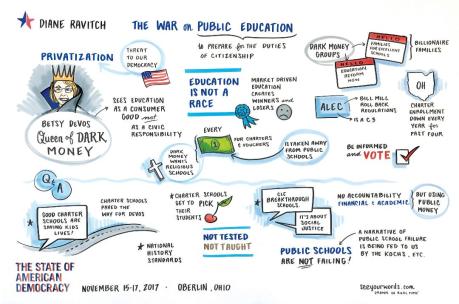
This fabulous graphic is a summary of my speech at the conference on “The State of American Democracy,” identified by the acronym SAD. The conference was sponsored by Oberlin College at the college in Oberlin, Ohio, and it will be held with different participants in three other locations over the next several months. I spoke about the “War on Public Education.” In my talk, I forgot to mention that more than 90-95% of charters are non-union, and that their primary sponsor is the Walton Family Foundation, which is anti-union. That was an important omission in an audience that is mostly comprised of progressives. Jonathan Alter, who is very knowledgeable about national politics, leapt up to defend charter schools and objected to being lumped in with the DeVos agenda, which includes both charter schools and vouchers; Jon loves KIPP. I cited Katherine Stewart, who said in her article in “The American Prospect” that religious extremists had made “useful idiots” of the charter movement.

Early in my talk, I asked how many of those in the room had gone to public schools, and about 90% of the 300 or so people raised their hands. That included the new President of Oberlin College, Carmen Twillie Ambar, who graduated from public schools in Little Rock, Arkansas. She is the first African American female president of this historic college.

This is the wonderful graphic that was created as I spoke, by a brilliant artist, Jo Byrne (seeyourwords.com):

devos

Stuart Egan, NBCT High School Teacher in North Carolina, writes here about the lessons learned from a TV series set in the 1980s called “Stranger Things.” Remember the 1980s? There were no charter schools, no voucher schools. Public were and still are the heart of their communities. But some communities have been ripped asunder by false notions of choice and competition, whose main goal seems to be to sow division and break community spirit.

“The fictional town of Hawkins, Indiana became the epicenter of a lot of “binge-watching” in the last month as the second season of the hit series Stranger Things was released in nine episodes.

“Following the trials and tribulations of these school-age kids and their families is rather surreal; the music, the fashion, and the hair styles are as authentically presented now as they were actually in the 1980’s, especially if you are a middle-aged public school teacher who listens to The Clash like he did growing up in a small rural town in Georgia where he rode his bike everywhere without a digital link to everything else in the world.

“He just had to be home by dinner.

“While the kids and adults in this fictional town battle forces from the “upside down” amidst a government cover-up during the Cold War, it is easy to get lost in the sci-fi aspects of this well-written show. And it is very well-written and produced. But there is one non-human entity that is foundational and serves as the cornerstone to those people in a small section of Indiana: Hawkins Middle School, Home of the Tiger Cubs…

“If there ever was a cornerstone for the characters in Hawkins, IN, then it is the public school. It serves as the greatest foundation of that community.

“The AV Room. Heathkit. School assemblies. The gymnasium. Science class. Mr. Clarke. Eleven channeling Will. Makeshift isolation tank. Portal to the Upside Down. The Snow Ball. Parents were students there. Ghostbusters suits.

“Those are tied to Hawkins Middle School.

“So is growing up, coming of age, hallway conversations, epiphanies, learning about others, following curiosities, finding answers to questions you learned to ask.

“Those are also tied to Hawkins Middle School.”

The question that we should all try to answer is how “conservatives” became devoted to the idea of destroying community institutions.conservatives used to serve on the school board and lead the PTA. When did it become conservative doctrine to oppose public schools?

If you are near a TV at 2:30 pm and afterwards, please report back on these hearings:

From Politico:

TWO EDUCATION NOMINEES FACE CONGRESS TODAY: The Senate Health, Education, Labor and Pensions Committee this afternoon will take up the nominations of two people for top Education Department jobs – Mick Zais for deputy secretary and Jim Blew for assistant secretary of the Office of Planning, Evaluation and Policy Development. Both are expected to face tough questions from Democrats about Education Secretary Betsy DeVos’ record on education issues and her decisions this year. They could field a number of tough questions about their own records as well.

– Zais, a retired Army brigadier general, checks off a lot of conservative boxes. He was most recently superintendent of South Carolina schools until he announced in 2014 that he wouldn’t run for reelection. As superintendent, Zais refused to participate in the Obama administration’s signature Race to the Top program, which encouraged states to adopt more rigorous academic standards like the Common Core in exchange for federal grants. Zais saw the standards, which were never mandated by the Obama administration, as federal overreach.

– Ranking Democrat Patty Murray could raise concerns about Zais’ past support for expanding school choice and his skepticism over early childhood education, according to prepared remarks shared by a Democratic aide with Morning Education. Zais previously opposed expanding public kindergarten for 4-year-olds, citing costs and that it could put private- and faith-based programs out of business. He has also been skeptical about the lasting benefits of early childhood education, citing studies of Head Start, a federal preschool program for low-income families.

– Murray could also raise concerns about Zais’ past support for abstinence-based sex education and about comments he made in 2014, reported by The Post and Courier at the time, about the teaching of natural selection in schools. Zais said, “We ought to teach both sides” of the principle “and let students draw their own conclusions.” Murray is expected to tell Zais that his comments “make me question your ability to help set a course for this agency based on facts, science and evidence.”

– Blew, in turn, is the director of the advocacy group Student Success of California, which advocates for performance-based systems for teachers and supports charter schools. He has also served as president of Students First, the national advocacy organization founded by former D.C. Chancellor Michelle Rhee. Murray plans to raise concerns about Blew’s history of supporting school choice, noting that the office he has been nominated for “is critical in developing and implementing policy – which impacts every student in the country. So your record of promoting school vouchers gives me pause that you will not stand up for students and public schools.”

– Chairman Lamar Alexander is expected to say that Zais “has an excellent and deep background” for the position of deputy secretary, according to prepared remarks provided by a Republican aide. Alexander will also note that Blew has spent two decades working to improve “educational opportunities for families and children by overseeing grants to low-income, high risk schools.”

– Absent from the hearing will be Michigan state Rep. Tim Kelly, after the Trump administration this week formally pulled his nomination for a top career and technical education post at the Education Department. Kelly, a Republican, was axed because of statements that he made on his blog, the “Citizen Leader,” between 2009 and 2012. In his blog, Kelly called for banning all Muslims from air travel, said that women aren’t interested in science careers and labeled low-income preschool parents “academically and socially needy.” In an interview with POLITICO last week, Kelly accused the “deep state,” “haters” and federal employees who don’t like President Donald Trump for making the nomination process “toxic” and “intrusive.”

– The hearing starts at 2:30 p.m. in 430 Dirksen. Watch the livestream here.

Phyllis Bush writes a blog about her battle with cancer. So far, she is winning, which is not surprising because Phyllis is a fighter. She also has an irrepressible sense of humor and insists on calling the disease “cancer-schmanzer.” Many years ago, people called it simply “the C word,” fearful of saying the word. Phyllis refuses to be cowed.

This post is not about cancer.

It is about a cause dear to Phyllis’s heart.

Phyllis lives in Indiana. She is a retired teacher. She has seen the Pence-DeVos privatization movement up close. It is divisive, unproductive, anti-democratic.

I hope you will honor her fight by joining her in the battle to save public education.