Archives for category: Privatization

We have a problem in this society. We have many problems. One of them is the role of private equity in destroying products and services that were once household names.

Here is an example: One of the stores that many New Yorkers love is Fairway Markets. It started as one store on the Upper West Side. It was the place to go for an amazing selection of cheeses and fresh produce and dozens of varieties of olive oil and more.

But it started to grow, and it turned to equity investors for new capital to expand. The investors had big plans. They paid themselves big salaries. They loaded up the company with debt. They went public and took on more debt. And before long this once-successful chain was doomed.

This article appeared at Bloomberg News by Joe Nocera.

There is more. This article in Slate describes how private equity investors have pillaged well-known retail operations. Jordan Weisman wrote:

The list of retailers that have been bought and wrecked by private equity firms keeps on growing. This week, the beloved New York grocery chain Fairway filed for its second bankruptcy in less than four years and announced plans to sell off its stores, thanks to a disastrous run of mismanagement by a series of buyout shops. It’s on a list of casualties that now includes Toys R Us, Payless ShoeSource, and Sports Authority, among many others. That’s on top of financially troubled names like Neiman Marcus that have managed to avoid Chapter 11 or liquidation (so far).

Last year, a group of progressive nonprofits reported that of the 14 largest retail bankruptcies since 2012, 10 had involved companies owned by private equity. The thud of corporate failures has become so constant that it’s essentially become a meme in the financial press.

This is the marketplace that choice advocates favor as the future of schooling.

Scott Maxwell, a columnist at the Orlando Sentinel, tweeted a few days ago:

”Berate public schools all you want. There will never be a day when you take your child to aPublic school only to find it’s gone out of business.”


New Hampshire’s Governor is a Trump-style extremist, Chris Sununu, whose father John advised the first President Bush. Sununu appointed Frank Edelblut as state commissioner of education. The state commissioner home-schooled his children and follows the ideology of Betsy DeVos. He thinks government money should go wherever children go, regardless of who gets the money. That’s called “Learning Everywhere.”

Edelblut is an extremist libertarian.

Now he wants to pilot online leaning for pre-schoolers. This is his response to the growing recognition of the value of early childhood education.

Not surprisingly, advocates for ECE are alarmed that sitting in front of a computer is being substituted for play, where children learn to cooperate with others and make things and use their imagination. One group said:

Kids aren’t meant to sit still in front of a screen. They use their whole bodies to learn, and they want and need to move. Let’s not forget that some of the essential milestones for preschoolers are gross and fine motor skills. They need to practice galloping, throwing a ball, zipping up their jackets to go outside, and holding a pencil. Having good motor control is essential for children’s growth and independence. They cannot develop it by sitting at a computer.

You may recall that DeVos offered New Hampshire $46 million to double the number of charter schools in the state. The Democrats in the legislature have twice turned down her offer. New Hampshire has declining student enrollment, and the Fiscal Oversight Committee said it would be irresponsible to add new charter schools, which would drain students and resources from existing public schools.

Edelblut came back with his own analysis, claiming that adding more charter schools in a time of declining enrollment would save money.

According to the report from Education Commissioner Frank Edelblut, doubling the number of charter schools over the next 10 years could translate into at least $60 million in savings for local taxpayers as 4,000 students leave traditional public schools.

Edelblut’s report points to studies that warn declines in enrollments not related to charter schools will be at least 24,000 by 2030 — and could approach double that figure.

“If the visceral reaction is how are we going to manage a declining student enrollment due to public charter schools, the answer is you are going to have to deal with this issue regardless of this grant,” Edelblut said…

This report clearly responds to analysis from Reaching Higher New Hampshire, which supports traditional public schools.

The group has warned the charter school grant could cost the state an additional $57 million to $104 million in its first 10 years.

The same organization found in its analysis of 20 of the state’s charter schools that at least 1,083 of the 4,025 seats available went unfilled in the 2018-2019 school year.

Reaching Higher New Hampshire also maintains state funding alone often doesn’t cover operating costs for these charter schools, which make them unsustainable.

Senate Majority Leader Dan Feltes, D-Concord, said the new report doesn’t change his view that the panel should keep rejecting this grant.

“We need to support our public schools and the successful existing charter schools, work on the over 1,000 open spots in existing charter schools, and protect New Hampshire taxpayers. This fiscally irresponsible grant will cause our already record high property taxes to continue to increase, which is unacceptable,” Feltes said in a statement.

With 25% of the state’s charter school seats empty, it should be hard to make the case that NH needs more charters.

Reaching Higher NH’s research on the charter grant is cited here.

Edelblut welcomes the Trump administration’s plan to turn all education funding into a block grant as he feels it will give him more control over federal money. His own philosophy is that public schools are unnecessary, which is rooted in the practices of the 18th century.


Jan Resseger, tireless champion for social and economic justice, reflects on the fading reputation of the charter industry. The decision by the Trump administration to axe the federal Charter Schools Program (DeVos’s slush fund for corporate charter chains) is the latest affront to an industry that once was regarded as the great hope for innovation and effectiveness but got overwhelmed by scandals and profiteering.

Resseger credits the dramatic turn in the public reputation of the charter industry to the work of the Network for Public Education and its executive director Carol Burris.

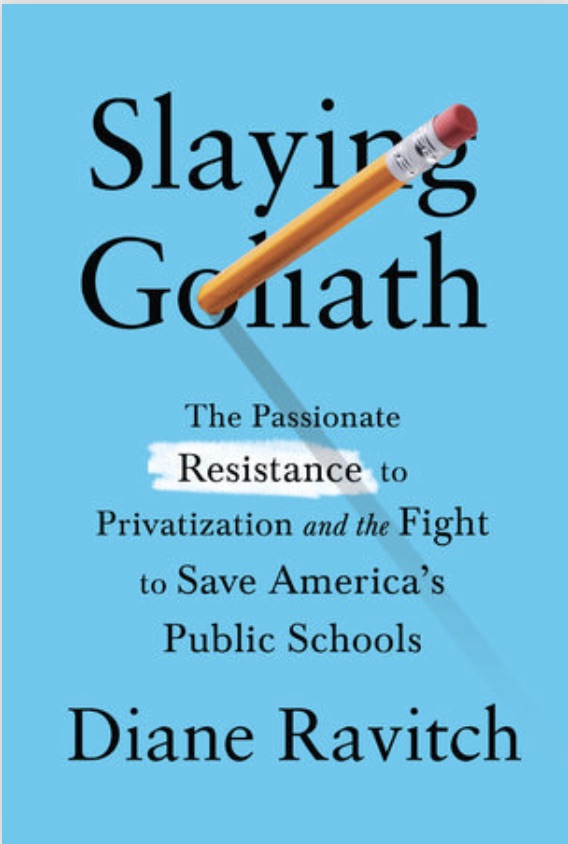
Burris brings to her work the experience of a veteran educator, a teacher and principal who spots scams quickly. Burris also has a rock solid sense of integrity that makes her unwilling to tolerate organizations that are designed to benefit the adults, not the students. She is the quintessential embodiment of the “David” I wrote about in my book SLAYING GOLIATH. She works with passion and dedication because of a sense of mission, not for love of money. She is a mortal threat to the Goliaths who wear the fake mantel of education reform. She can’t be bought and she can’t be stopped. Unlike the hirelings of Goliath, she really does work for the children, for whom she has worked all her life.

The munificently-funded Thomas B. Fordham Institute, based in D.C., controls Educatuon Policy, graduation requirements, curriculum, and testing in Ohio. Mr. Fordham, for whom the institute is named, had no known interest in education, but his namesake is part of the rightwing ALEC nexus, where contempt for public schools, hatred for unions, contempt for gun control and environmental regulation are reflexive.

Laura Chapman, who lives in Ohio, writes:


This numbers game is routinely pushed by the Ohio arm of Thomas B. Fordham Institute/Foundation. Oped’s written by employees at criticize the Fordham routinely criticize teacher unions for pointing out the debilitating affects of poverty on students. In a typical rhetorical move, the Fordham “expert” will find one exceptional school with an “A” rating of the state report card rigged to ensure few schools are rated A. Then when you read in detail, you will see that the most exceptional thing about this school is really rare. The same principal has been there for 18 years, lives in the community, and has an uncommon level of trust from her community, the teachers, and students. Test scores were a byproduct of that not the aim of her work as an educator.

In Ohio, the writer most responsible for this misleading journalism and “research” is Aaron Churchill, the Institute’s Ohio Research Director. The Institute says this: Since 2012, Aaron has worked on “strengthening” Ohio policy on standardized testing and accountability, school evaluation, school funding, educational markets, human-resource policies and charter school sponsorship. He writes for the Fordham’s blog, the Ohio Gadfly Daily and contributes op-eds to the Columbus Dispatch, Cleveland Plain-Dealer, Dayton Daily News, and Cincinnati Enquirer. Aaron previously worked for Junior Achievement.”

He has not an ounce of documented experience in teaching or studies of education as an undergraduate or graduate student. He gets a free pass on almost everything he submits to the Columbus Dispatch, Cleveland Plain-Dealer, Dayton Daily News, and Cincinnati Enquirer. These local newspapers are shrinking and have few if any staff available for questioning this “throughput” of misleading but ready to post news.

This is an extraordinary story, which I hope you will read to the end. It was published by Chalkbeat.

A group of concerned leaders in Detroit, including some retired educators, decided to open a charter school.  They won the endorsement of the city’s leading philanthropies. They won a federal grant from the Charter Schools Program.

The school struggled from the beginning. It struggled initially to attract students, because it was competing with so many other charters for the same students. It took in students from a closing charter, who were far behind. It searched for an educational management company, which drew off a large share of its income.

It housed its students in a closed elementary school, where there was far more space than the charter could use.

There was no shortage of potential authorizers. The sponsors were turned down by one, then found another.

Efforts to regulate charter schools in Michigan have run into fierce political headwinds, in large part because of DeVos and her family, who have used their considerable fortune to support a free market education system that allows charter schools to open wherever they believe they’ll succeed.

DeVos and her allies have been so successful in blocking efforts to regulate charter schools in Michigan that when the founders of Delta Prep began looking for permission to open back in 2012, they had no shortage of options. They could pick from roughly eight colleges and school districts that were empowered to authorize charter schools, some of which would provide more oversight than others. When it finally opened in 2014, Delta Prep was one of more than a dozen schools that opened in Detroit and began competing for the same students.

The problems multiplied. Low enrollment. Discipline problems. A rotating cast of principals, year after year.

Delta officials had promised that “90 percent of students will attend every class, on time, every day.” But in the school’s third year, just 20 percent of students came to class with any regularity.

Officials said they would boost student achievement by borrowing from the playbook of a New York-based education nonprofit. Their goal: “85% of students will demonstrate competency in all core subjects via exit tests.”

But within three years, not a single Delta Prep 11th-grader was deemed proficient in math, compared with 13.2 percent in Detroit’s troubled main district. Just 10 percent of 11th-graders posted passing scores in SAT English, compared with 37 percent in the district.

Delta Prep had promised that “100% of graduates will be accepted to college.” But in 2016, the only year the state recorded graduate data for Delta Prep, just over half of the school’s graduates enrolled in college. Just six students — 10 percent of that first graduating class — went on to complete a year’s worth of college credits within a year of graduating.

If the data was concerning, the situation inside the school was even more dire. When Brandi North was hired as principal in 2017, the first thing she did was hire security. The sprawling school was built during an era when Detroit couldn’t find enough classroom space for all of its students, but now it sat mostly unused, and students tended to disappear into vacant classrooms. Teacher-student relations were antagonistic. North said her assistant principal’s hand was broken during an encounter with a student, and that she regularly contacted the police about student behavior.

The year before she arrived — and the year after the influx of students from recently closed schools — Delta Prep had slapped more than half of its students with out-of-school suspensions, resulting in nearly 1,000 missed days of school.

“In 15 years of education, it was the most stressful position I’ve ever had,” North said. “I worked in south central Los Angeles, and Delta was still my most stressful situation.”

North started at the school in March 2017, after the previous principal resigned and an interim principal decided not to take the job. She says she found tutors for students, brought consistency to a patchwork curriculum, even drove to students’ houses on test day to make sure they took Michigan’s standardized exam. But she left that June following disagreement with the management company that she declined to discuss.

She was not the only administrator unable to cut it at the school. Within a few years of its hopeful start, Delta Prep had become another Detroit school desperate to find the rare principal capable of quarterbacking a long-shot school turnaround. It had five principals in less than five years of operation…

In Detroit’s crowded education landscape, Delta Prep kept falling short of its 400-student target, creating a financial situation so bleak that students lacked textbooks and other basic supplies.

When officials from Ferris State came to check in on the school, they noted that only one-third of its budget was spent on instruction, while far too much went to the management company and other operating costs. Delta Prep’s reserve fund, set aside to protect the school against unforeseen problems, dipped to $217 in 2017-18.

Twenty-two days after the start of school in the fall of 2018, Delta Prep closed its doors, to the shock of students and parents, who suddenly had to find a new school.

In the business world, closings are not uncommon. In the charter world, school closings are not uncommon. Anyone who thinks it is easy to run and manage a school should read this story and think again.

Customers can find another place to shop when a store goes out of business. When a school closes, children, parents, teachers, and families are disrupted.
 

Charter advocates have reacted with astonishment and outrage at the Trump-DeVos decision to fold the federal Charter Schools Program into a block grant to the states, along with 29 other programs. The Trump administration’s goal is to shift federal funding to states and let them decide how to spend the money.

Matt Barnum of Chalkbeat writes the story here, detailing the administration’s rationale and charter advocates’ reaction. 

Jim Blew, formerly of the Walton Family Foundation, which claims to have launched one of every four charters in the nation, brushed off the charter lobbyists: 

“The federal lobbyists for charter schools sound a lot like the lobbyists for all of the other competitive grant programs,” Assistant Secretary Jim Blew told Chalkbeat in a statement. “In their desperate communications, they have exaggerated the importance of CSP — just like other lobbyists,” he added, referring to the Charter Schools Program.

It’s not clear that the program is in real jeopardy, since Congress has previously disregarded the Trump administration’s proposed budgets. But the budget proposal and combative rhetoric suggest that charter advocates do not have as staunch an ally in the administration as they previously believed.

“We are saddened and puzzled by the Department of Education’s comments,” said Nina Rees, president of the National Alliance for Public Charter Schools, which has receivedfederal charter dollars. “We advocate for the federal Charter Schools Program because we believe it is a lifeline for students.”

Rees formerly was education advisor to Vice President Dick Cheney and to entrepreneur MIchael Milken, who engaged in education philanthropy after serving a term in prison for financial crimes.

Strangely, Barnum refers to Democrats for Education Reform (DFER) as “left of center,” which is laughable since they were founded by and funded by hedge fund managers, some of whom are billionaires and may not even be Democrats. DFER’s funding has gone to supporters of school choice, and their beneficiaries show no interest in funding, class size, teachers’ salaries, integration or other issues that matter to progressive Democrats.

It is ironic that the Republican-dominated charter industry will now have to count on Democrats in the House to save the federal Charter Schools Program, which DeVos has used to fatten avaricious corporate charter chains.

The federal CSP has funded a large proportion of the nation’s charter schools, acting like “the Small Business Administration” for charters entrepreneurs, as NPE executive director Carol Burris said recently on Twitter.

Barnum wrote:

A recent presentation from the Department showed the figure was slightly higher: as of 2016, more than 3,100 existing charter had received such a grant, with the program helping to fund close to 45% of all operating charters. (Morabito, the spokesperson, acknowledged the error when asked about it by Chalkbeat.)

For charters that opened between 2006 and 2016, the share was even higher — 60% had received a federal grant.

Studies of the federal Charter Schools Program by the Network for Public Education found that it was riddled with waste, fraud, and abuse. More than 1/3 of the federally funded charters either never opened or closed soon after opening. This is a program that should be eliminated.

What will the Democrats do?


John Thompson, historian and retired teacher in Oklahoma, reviews SLAYING GOLIATH. This is the second part of his review.

This is an excerpt of a long and thoughtful review.

This second post will focus on Ravitch’s analysis of the research which predicted the defeat of accountability-driven, charter-driven policies. Perhaps the most striking pattern documented in Slaying Goliath is how they failed in the way that scholars and practitioners anticipated.

Decades of Disruption-driven reform began with the false claim “that American education was failing and the only way to fix it was with standards, tests, competition, and accountability.” As Arne Duncan’s public relations officer and Walton-funded reformer Peter Cunningham said, “We measure what we treasure.”

Ravitch’s response was, “I was taken aback because I could not imagine how to measure what I treasure: my family, my friends, my pets, my colleagues, my work, the art and books I have collected.” And that foreshadows the victory of the Resistance over Goliath. Most educators, patrons, and students agree that children are more than a test score.

No Child Left Behind and the Race to the Top set impossible test score targets. They were based in large part on the weird idea that “no-excuses” behaviorist pedagogies could be quickly “scaled up,” providing poor children of color a ladder to economic equality. Drawing on the tradition of Edward Thorndike and B.F. Skinner, reformers “rigidly prescribed conditioning via punishments and rewards.” Previewing their fatal flaw, Ravitch observes, “Behaviorists, and the Disrupters who mimic them today, lack appreciation for the value of divergent thinking, and the creative potential of variety. And they emphatically discount mere ‘feelings.’”

When educators resisted, corporate reformers became livid and doubled down on the punitive. Perhaps their worst debacle was using value-added teacher evaluations to hold each individual educator accountable for test score growth. It combined inappropriate test outputs with an unreliable and invalid algorithm, the VAM, as a club to enforce compliance. In the short run, it forced educators, who had previously tried to keep their heads down and “monkey wrench” testing mandates to join patrons and students in the Resistance. By 2018, however, pent up anger exploded as teacher strikes spread across the nation.

Today, many or most of Goliath’s coalition have become disenchanted with standardized testing, but their Disruption model can’t function without it. Few have gone as far as Paymon Rouhanifard, the former Camden superintendent who abolished report cards after listening to complaints, and denounced standardized testing as he left the job.

The more common path is to spin their punitive tests as “personalized” learning, and their incentives and disincentives as the “portfolio model.” As Ravitch explains, “A portfolio district is one where the local board (or some entity operating in its stead) acts like a stockbrokerage, holding onto winners (schools with high test scores) and getting rid of losers (schools with low test scores).”

As was also predicted by Campbell’s Law, test-driven accountability (made more intimidating by the dual threat of test-driven competition with charters) led to corruption. The cheating was far greater than just the scandals where adults erased and changed bubble-in answers. Graduation rates were easy to manipulate. For instance, NPR reported a “heartwarming story” in 2017 about a school with 100% graduation rate. A subsequent FBI investigation and a district audit found 1/3rd of the school’s graduates lacked credits and only 42% were on track to graduation.

And that leads to the corruption associated with school choice. Today’s Disrupters seem to be doubling down on charters to drive transformative change. As explained in a previous post, in 1988 Al Shanker saw charters as a path towards innovation. Within two years, however, the promise of win-win experimentation started to be undermined when conservative reformers Terry Moe and John Chubb claimed “choice is a panacea.”

In this case, it was choice-advocate Paul Peterson who predicted the political future. Charters didn’t take off because of the balanced approach of Shanker, but because reformers “radicalized” the concept. And, of course, there was plenty of big bucks available for pushing their radical but false narrative.

Within a decade, a shocking number of non-educators had been convinced by Goliath’s spinsters that the KIPP’s behaviorist model could be scaled up. As Slaying Goliath explains, “The biggest innovation in the charter sector was the invention of ‘no-excuses’ schools.” It took nearly another decade for policy makers to accept the fact that charters get average results except for those with high attrition.” And it took nearly as long to reveal the much greater down sides of charters…

Regardless of whether we’re discussing high-stakes testing, charter expansion, or the other pet theories, we should all heed Ravitch’s most important lesson of the past few decades is that “Reform doesn’t mean reform. It means mass demoralization, chaos, and turmoil. Disruption does not produce better education.”

Slaying Goliath celebrates a great victory for public education and democracy. However, Ravitch reminds us that the Disrupters are still threatening. She compares today’s danger to that which faced a man who decapitated a rattlesnake but who nearly died after being bitten by the detached head.

So, we can’t lower our guard until the principles that inspired the Resistance are safe in our schools.


Trump proposes to eliminate the National Endowments for the Arts and Humanities, which are very small appropriations, but which Republicans have always hated. I seem to recall that he wants to eliminate NOAA so the weather service can be completely privatized, and the public will have to pay to find out what the weather is and might be.

Laura Chapman adds:

In addition to the cuts to education programs, consider these cuts too.

Cuts the Environmental Protection Agency (EPA) by $2.8 billion Can’t have the EPA telling us we should be able to drink lead and contaminant-free water, breath clean air, save the land from more degradation from fracking, stop save the oceans from oil spills and micro plastics and so on.

Eliminates National Oceanic and Atmospheric Administration (NOAA) Grants and Education programs (-287 million) Can’t have full staffing of the agency that keeps information flowing about climate change. Can’t have scientists perpetuating “fake” news or predicting where hurricanes might fall, fires may flair, forests threaten by disease.

Eliminates the Institute of Museum and Library Services (-$229 million) “Musing” is dead. Move fast and break things. While you are at it trust the internet for all information, never trust a librarian. Nobody but a few elitists want to preserve these programs with full staff.

Eliminates the Corporation for Public Broadcasting (-$455 million) Everyone knows that this is a LIBERAL, news and entertainment outfit and that billionaires can fund it.

The Education Law Center is suing to block former Governor Chris Christie’s 2016 decision to expand charters in Newark:


February 11, 2020
NJ SUPREME COURT TO REVIEW STATE COMMISSIONER’S DECISION TO DRAMATICALLY EXPAND CHARTER SCHOOLS IN NEWARK
The New Jersey Supreme Court has granted a petition filed by Education Law Center (ELC) to review the State Commissioner of Education’s 2016 decision approving an enrollment increase of 8500 students in KIPP, Uncommon and other charter operators’ schools in the Newark Public School (NPS) district.
In accepting In Re Team Academy Charter School, the Supreme Court will now decide several consequential issues raised by the State’s push to rapidly grow charter school enrollments in NPS over the last decade. Under former Governor Chris Christie, Newark charter enrollments grew 320% from 4,559 in 2009, to 19,152 in 2020. NPS payments to charter schools increased from $63 million in 2009, or 7% of the NPS operating budget, to $265 million in 2020, or 26% of the budget.
The legal issues before the NJ Supreme Court in Team Academy implicate the Commissioner’s failure to comply with the Court’s 2000 Palisades Charter ruling imposing an affirmative obligation under the New Jersey Constitution to carefully evaluate the impact of charter school applications in two interrelated areas:
  • The education resources available to NPS students from the loss of funding that will occur from increasing charter school enrollments;
  • The segregation of NPS students by disability, English language proficiency and race.
The Team Academy appeal addresses the obligation of charter authorizers to protect the constitutional rights of public school students when faced with overwhelming and unrefuted evidence that expanding charters will deprive district students of essential education resources and intensify persistent patterns of student segregation in the resident district.
In 2016, ELC, on behalf of NPS students, submitted detailed evidence to the Commissioner opposing the charter school expansion. ELC’s evidence showed that, if the expansion was approved, NPS would continue to lose funding from its budget, causing further cuts to essential teachers, support staff and programs, including for English language learners (ELL) and students with disabilities. ELC also documented that the expansion would increase the concentration of more costly to educate students with disabilities and ELLs in Newark district schools and worsen the entrenched isolation of Black and Latino students in the already intensely segregated district.
After the Commissioner ignored this evidence and approved the applications, ELC appealed. The Appellate Division upheld the decision, relying on the failure of the NPS superintendent, hired by the State, to object to the expansion. At the time the charter applications were decided by the State, NPS was under State control.
Because NPS students are in the class of plaintiff school children in the landmark Abbott v. Burke school funding litigation, the Supreme Court will also decide whether the Commissioner bears a heightened burden when reviewing charter applications in those districts. Abbott district students remain the subject of continuing Abbott orders to remedy the State’s longstanding violation of their right to a constitutional thorough and efficient education.
Michael Stein of the Pashman Stein Walder Hayden law firm is serving as pro bono co-counsel on this appeal, along with ELC Executive Director David Sciarra, lead counsel for the Abbott v. Burke school children.
Argument before the NJ Supreme Court is expected in the fall.
Press Contact:
Sharon Krengel
Policy and Outreach Director
Education Law Center

Tim Slekar, one of the pioneers of the Resistance invited me to talk with him on his podcast Busted Pencils. 

We talked about SLAYING GOLIATH.