Archives for category: Privatization

MANDATORY CREDIT: NBC News
LINK: https://nbcnews.to/2ypwDBU

‘It’s like a black and white thing’: How some elite charter schools exclude minorities

By Emmanuel Felton, The Hechinger Report
June 17, 2018

This story about school segregation was produced by the Hechinger Report, a nonprofit, independent news organization focused on inequality and innovation in education, and the Investigative Fund at the Nation Institute, a newsroom for independent journalists, in partnership with NBC Nightly News and NBCNews.com.

For more on this report, tune in tonight to “NBC Nightly News”.

GREENSBORO, Ga. — This clearly was no ordinary public school.

Parents of prospective students converged on Lake Oconee Academy for an open house on a bright but unseasonably cold March afternoon for northern Georgia. A driveway circling a landscaped pond led them to the school’s main hall. The tan building had the same luxury-lodge feel as the nearby Ritz-Carlton resort. Parents oohed and aahed as Jody Worth, the upper school director, ushered them through the campus.

Nestled among gated communities, golf courses and country clubs, the school felt like an oasis of opportunity in a county of haves and have-nots, where nearly half of all children live in poverty while others live in multimillion-dollar lakeside houses.

The school’s halls and classrooms are bright and airy, with high ceilings and oversize windows looking out across the lush landscape. There is even a terrace on which students can work on warm days. After a guide pointed out several science labs, the tour paused at the “piano lab.” The room holds 25 pianos, 10 of them donated by residents of the nearby exclusive communities. The guide also noted that starting in elementary school, all students take Spanish, art and music classes. The high school, which enrolls less than 200 students, offers 17 Advanced Placement courses.

Lake Oconee’s amenities are virtually unheard of in rural Georgia; and because it is a public school, they are all available at the unbeatable price of free.

Conspicuously absent from the open house were African-American parents. Of the dozen or so prospective families in attendance, all were white except for one South Asian couple. At Lake Oconee Academy, 73 percent of students are white. Down the road at Greene County’s other public schools, 12 percent of students are white and 68 percent are black; there isn’t a piano lab and there are far fewer AP courses.

Lake Oconee Academy is a charter school. Charters are public schools, ostensibly open to all. The idea behind charters was to loosen rules and regulations that might hinder innovation, allowing them to hire uncertified teachers for example. But dozens of charters have also used their greater flexibility to limit which kids make it through the schoolhouse doors — creating exclusive, disproportionately white schools.

They do this in a variety of ways: Some pick from preferred attendance zones. Some don’t offer school bus transportation. Others require expensive uniforms.

Lake Oconee Academy is one of 115 charters around the country at which the percentage of white students is at least 20 points higher than at any of the traditional public schools in the districts where they are located, according to an investigation by The Hechinger Report and the Investigative Fund, produced in collaboration with NBC News. The analysis used the most recent year of federal enrollment data, for the 2015-16 school year. The 20-percentage-point difference is often used to define schools as “racially identifiable.”

These 115 charters, which together enrolled nearly 48,000 children, were concentrated in just a handful of states. In 2016, California had 33 racially identifiable white charters, Texas was home to 19 and Michigan, 14. At nearly 63 points, the gap between the percentages of white students at Lake Oconee Academy and at the whitest traditional public school in the area was the fourth-widest in the country.

In all, there are at least 747 public charter schools around the country that enroll a higher percentage of white students than any of the traditional public schools in the school districts where they are located.

Read the full report on nbcnews.com and watch more on “NBC Nightly News”

Jeanne Allen, CEO of the pro-choice, Pro-DeVos Center for Education Reform, does not want you to watch an NBC special tonight on charter schools. Allen’s CER is an outspoken supporter of privatization of public funding and a hyperactive opponent of public schools.

In the following letter, she reports that she warned NBC that its show was based on an article in The Hechinger Report,” which she says is biased against charter schools. Really? It’s been my observation that The Hechinger Report is completely nonpartisan and unbiased on every contentious issue.

Here is the letter that Jeanne (former education analyst for the fringe-right Heritage Foundation), sent to NBC and to her mailing list of thousands.

The Center for Education Reform

RE: NBC’s Charter School Mistake

Dear Friends:

Sunday night, June 17th, NBC News is airing a charter school story that argues charters are increasingly geared to support “white flight.” If the claims weren’t so outlandish and unfounded, it would be laughable.

The producer, who was incredibly open to receiving information countering these allegations, based his report on an analysis performed by the Hechinger Report. In one of the documents CER supplied, we demonstrated Hechinger’s bias against charter schools, as well as the folly of the argument.

Indeed, Hechinger claims to have used NCES data to calculate racial balance in charter schools across the country that justify erroneous claims that increasingly charter schools do not reflect the racial balance of surrounding schools. However, as we pointed out, no researcher can make such statements based on NCES data. One needs at least 4 data points (see link for explanation) and further review, analysis and study, to make any legitimate comparisons.

In the case of the school they use as their prime example, George’s Lake Onocee Academy, originally boundaries were drawn around the school based on a development that was responsible for its existence. The other public schools in the district were failing, and developers wanted to offer a better school to the community. The district was opposed to the creation of the school. And while the boundary no longer exists around that school, local leaders have still fanned the flames of bigotry that Hechinger seized to market the sizzling story to its media partner NBC.

The Hechinger Report journalist then called numerous other states and asked about racial composition of their schools. One might ask why they’d have to call states if they thought they had irrefutable data.

We don’t fault NBC for viewing Hechinger’s work as legitimate or being misled by their data. The thousands of policies, laws and data points that apply to charter school everywhere are complex and require a trained eye and understanding. However, if one is disposed against charters as Hechinger is because they give parents freedom to make choices rather mandate assignment based on artificial factors, then one will make any conclusion that justified their narrative.

Such is the case in this piece which some charter advocates argue is balanced. Regardless of what is said tomorrow night, there is no balance in any piece which starts with the premise that the very reform that created opportunities for millions of children who were failed by the traditional system, and which serve a higher percentage of at risk and minority children, is creating racial imbalance. Indeed, if mandatory assignment by zip code and busing were the answer, we would not have failed students for 3 generations.

All children deserve the education they need to become exceptional adults. The freedom to make that choice is fundamental, as charter schools have shown consistently since 1992.

We hope NBC and other news media will find ways to help the public understand that fact, as well as the enormous need that still exists to bring innovation and opportunity to millions more students trapped in failing schools that Hechinger and its friends in the teachers unions irresponsibility seem determined to defend at all costs, including mis-use of data.

If you’d like to discuss this or any other issue, please call us at 202-750-0012 or drop us a note here.

– Jeanne Allen, Founder & CEO

The North Carolina General Assembly believes that the only thing that matters in judging the quality of a school is its test scores. As teacher Justin Parmenter explains here, public schools are graded solely by their test scores. The grades accurately reflect the income level of the families enrolled. The state could save money by just checking family income instead of giving tests.

But wait! For voucher schools, test scores don’t matter. Voucher schools, most of which are evangelical, are not required to take the state tests.

Why? The General Assembly is afraid of seeing the results.

Maybe if the scores showed that the voucher schools are failing, they would have to send the kids back to public schools, where they would have certified teachers who have passed criminal background checks.

Hypocrites.

The California Teachers Association calls on all friends of public schools to support AB 276, which sets standards for accountability and transparency for charter schools across the state.

Charter Legislation to Stop Waste, Fraud and Abuse Up for Critical Vote

Please take a minute to contact your Senator %%Senator Full Name%% at %%Senator Phone%% and urge %%Her or Him%% to SUPPORT AB 276 by Assembly Member Jose Medina.

As responsible educators and Californians, we need to hold ALL public entities accountable for their use of taxpayer dollars, particularly when it comes to our schools.

The ongoing proliferation of charter schools is hurting students in our neighborhood public schools because of the lack of transparency and accountability, and the disparity in requirements under which charter schools operate.

The Senate Education Committee is set to vote on AB 276, which requires charter school governing boards to comply with laws promoting transparency and accountability to parents and the public in the operation of public schools and the expenditure of public funds; holding charter schools to the same requirements as traditional public schools. However, ALL senators need to hear from you since AB 276 might be up for a floor vote.

It just takes 60 seconds to contact your Senator! Those taking funds away from our neighborhood schools are also contacting lawmakers to pressure them to keep things the way they are, so it is imperative we reach out to our senators now and urge them to STOP this waste, fraud and abuse!

Contact Senator %%Senator Full Name%% at %%Senator Phone%% and urge %%Her or Him%% to SUPPORT AB 276 by Assembly Member Jose Medina.

Recent headlines are mind-boggling!
More than $149 million of waste, fraud and abuse of tax dollars has been documented in California’s charter school environment, hurting our students and communities.

Having private and secret meetings to discuss how tax dollars will be spent is not acceptable.
Too much is at risk when our students are counting on sound financial decisions that will ensure they get the quality public education they need and deserve.

The only ones benefiting from our public schools should be the students, and ultimately our community.
AB 276 prohibits charter school board members and their immediate families from financially benefiting from their schools. Public schools’ conflict of interest laws and disclosure regulations should also apply to charter schools that receive public funds.

Streamlined regulations for charter schools were never intended to grant operators total authority over taxpayer dollars without any accountability.

Show us the money!
We must require companies and organizations that manage charter schools to release to parents and the public how they spend taxpayer money, including their annual budgets and contracts. The public’s business should be transacted in public. Public agencies must take their actions openly and their deliberations must be conducted openly.

We deserve to know how our schools are being run, and our state deserves an education system that is free from unfair advantages and double standards. Companies and organizations that manage charter schools must open board meetings to parents and the public, similarly to public school board meetings.

Read more about AB 276:
Fact Sheet | Letter | Details

During the tenure of former Governor Eric Greitens, Missouri had no state school board because the legislature refused to confirm his appointees. The new governor appointed new members and at last there is a quorum. Yesterday they had a meeting to renew charter schools, which are allowed only in St. Louis and Kansas City. Five charters were renewed despite their middling performance.

Typically, the board has judged charter performance against the performance of the district, but the charters said this was unfair.

Charlie Shields, president of the state board, said that it was time to review charter school laws.

“Shields was critical of the performance of the St. Louis charter schools renewed Thursday, arguing that they do not convincingly outperform St. Louis Public Schools. He said the state Legislature allowed charter schools to operate in Missouri on the premise that charter schools would be easy to open, but poor-performing charter schools should be easy to close.”

St. Louis was taken over by the state because of low performance and is hoping to have local control restored. Yet charter schools do not outperform the district, and charter leaders say that it’s unfair to expect them to do so. Once again, we see reformers moving the goal posts and lowering expectations.

Whiners. Remember when we were told that charter schools would “save poor kids from failing public schools” and would “close the achievement gap.” They don’t and they haven’t. They fight to survive because they want to.

Under Republican control, don’t expect Missouri to set meaningful accountability standards for charters.

The question now is:

“Who will save poor kids from failing charters?”

Three Bay Area school board members joined to write an article pleading for the authority to stop the invasion of charters into their districts, stripping them of resources and students and causing fiscal crises.

Judy Appel is a Berkeley Unified School Board trustee. Roseann Torres is an Oakland School Board director, representing District 5. Madeline Kronenberg is a West Contra Costa Unified School Board trustee. Assembly District 15 includes Albany, Berkeley, El Cerrito, Emeryville, Hercules, portions of Oakland, Piedmont, Pinole, Richmond, and San Pablo.

They wrote:

“As school board members in Oakland, Berkeley and West Contra Costa, we believe in the power of a public-school education. Public schools used to be a way up for students and our state once led the way. But now we’re falling behind the rest of the country.

“Shrinking budgets and resources are one of the biggest culprits and that’s because, in large part, of the proliferation of charter schools. As school board members, we’ve seen how charter schools threaten public schools and pose a risk to the equal opportunity that public schools should provide.

“As we see more charter schools opening, we’re calling on Sacramento to give school boards like ours more control over charters.

“Many may wonder how charter schools, which are marketed as a choice for parents in search of better options for their children, are putting students at risk. Independently run charter schools take precious per-student taxpayer funding from traditional public schools and aren’t required to deliver the same quality product.

“The Chronicle report earlier this month, “Study says Oakland school district lost $57.4 million last year because of charters,” is a dismaying affirmation of what we’ve seen happening to public education in our state. The study showed a net loss to the Oakland Unified School District of $57.4 million in the past school year alone. This is a district that was forced to cut $9 million from its operating budget halfway through the school year.

“Charter school advocates point to mid-year cuts in school districts like Oakland as justification of why parents deserve school choice. But the very existence of 40 charter schools in the city of Oakland alone denies our schools the funding they need to serve our students well. Increasing class sizes and decreasing investment in programs such as foreign language, arts and music classes, counseling and library services are directly the result of charter school expansion. The majority of Oakland’s charters were created during financial receivership, which seems to have created an opening for the proliferation of charter schools that sadly has not slowed down in the past decade such that each year about four to seven new applications arrive. Oakland is not alone. Not 10 miles away, the 12 charters in West Contra Costa Unified School District are causing similar pressures.

“Though charters take taxpayer funding from public schools, they aren’t held to the same transparency standards as our traditional public schools. For example, charter schools are not subject to open government rules. They often spend public dollars on charter management companies, which in turn have used their war chests to work against collective bargaining rights of educators and counselors, protecting the opaque budgeting in the schools.

“Charter schools also have the ability to turn away students, often refusing to educate our most needy students — those with disabilities, behavioral challenges, special needs or who are new to our country. Those students require more services and ultimately more resources from our schools.

“We believe that elected school boards, like the boards on which we serve, are very limited in their abilities to prevent new charter schools from coming into the district and taking per-pupil dollars. Not only are we unable to prevent charter schools from coming to our districts, we are required by law to provide the charter school free space.

“Charter schools do all of this — siphon public school funds, dodge transparency requirements, limit collective bargaining of educators, cherry-pick students and turn others away — with the claim of providing a superior public education. However, study after study shows that outcomes don’t differ between students who attend traditional public schools and charters. Instead, charters simply bleed public schools of precious resources, leaving educators and administrators to do more with less.

“In our Assembly district alone, we have some of our state’s best-resourced and most under-resourced schools. The funding structure is not serving California’s children fairly, and an entire generation of students will feel the effects.

“That’s not OK.

“Our Legislature must act. We need to give local school districts real control to reject charter school petitions. Legislators need to pass legislation to increase transparency and reporting of existing charters before we allow another one to open its doors. We are committed to equity in education, which means making sure that all of our students have equal access to quality education.”

The Washington Post published a long story about Laurene Powell Jobs. She is of course the widow of Steve Jobs and has a net worth of $20 billion or so. The article is probably behind a paywall, though I’m not sure.

To say it is an admiring portrait would be an understatement. It is the story of St. Laurene. She went to public school in New Jersey. School saved her life. Her children went to public school. Yet one of her first hires for her Emerson Collective was Arne Duncan. She was probably impressed because he was Secretary of Education but those of us who have followed his career wonder what she saw in him other than a title. His Race to the Top was one of the worst federal programs ever to be imposed on the nation’s schools. It was a massive failure, a waste of billions of federal and state dollars. It was NCLB 2.0, and its major legacy is privatization, standardization, teacher shortages, underinvestment in teachers and schools, and demoralization.

Here are a few quotes from this hagiography.

Laurene Powell Jobs — like the inventors and disrupters who were all around her — was thinking big. It was 2004, and she was an East Coast transplant — sprung from a cage in West Milford, N.J., as her musical idol Bruce Springsteen might put it — acclimating to the audacious sense of possibility suffusing the laboratories, garages and office parks of Silicon Valley. She could often be found at a desk in a rented office in Palo Alto, Calif., working a phone and an Apple computer. There, her own creation was beginning to take shape. It would involve philanthropy … technology … social change — she was charting the destination as she made the journey.
She eventually named the project Emerson Collective after Ralph Waldo Emerson, one of her favorite writers. In time it would become perhaps the most influential product of Silicon Valley that you’ve never heard of.

Yet at first, growth was slow. The work took a back seat to raising her three children and managing the care of her husband, Steve Jobs, as he battled the cancer that killed him in 2011 at age 56, followed by a period of working through family grief.
She inherited his fortune, now worth something like $20 billion, and became the sixth-richest woman on the planet. By 2014, Emerson Collective was up to 10 employees. “For the first few years I worked here, there would be people who would say, ‘Who?’ ” says the eighth hire, Anne Marie Burgoyne, director of grants. “ ‘Is there someone in the Valley who’s famous whose last name is Emerson?’ That seemed like a fair question. The Valley is a place of reputation, so it’s logical to ask whose last name is Emerson. Nobody knew who we were.”


Powell Jobs, now 54, wanted it that way, and she wished she could stay out of the spotlight. She wrote a short essay on the sublimity of anonymous giving that she handed out to employees. One of her staff recently gave it to me to read but not to quote: Her policy on anonymity is anonymous. She was frequently seen but not heard — seated with Michelle Obama during the State of the Union address in 2012, vacationing with former D.C. mayor Adrian Fenty, whom she dated a few years ago after he moved to California. When she did speak, she seemed most comfortable having wonkishly impersonal conversations at forums with, say, a Stanford entre­pre­neur­ship professor on the subject of “Injecting Innovation Into Intractable Systems,” or with musician Will.I.Am on “Art, Activism and Impact.”


All the while, she tended to Emerson Collective, quietly assembling a kind of Justice League of practical progressives: Arne Duncan, education secretary in the Obama administration, came on board to tackle gun violence in Chicago. Russlynn Ali, assistant education secretary for civil rights in the Obama administration, co-founded Emerson’s affiliate for education reform, the XQ Institute, where none other than storied urban fashion entrepreneur Marc Ecko has landed as chief creative and strategy officer. (“I feel like everything I’ve done up until this moment was for this reason,” the former T-shirt designer for Spike Lee and Chuck D told me.) Andy Karsner, assistant energy secretary for renewable energy in the George W. Bush administration, runs environmental programs. Jennifer Palmieri, communications director for Hillary Clinton’s 2016 presidential campaign, consults on communications strategy. Dan Tangherlini, head of the General Services Administration under Obama (and D.C. city administrator under Fenty) is the chief financial officer. Peter Lattman, former deputy business editor of the New York Times, oversees media investments and grants. Marshall Fitz, former vice president of immigration policy at the Center for American Progress, runs immigration reform efforts.


Then, last year, Powell Jobs unleashed a series of dramatic moves across a three-dimensional chessboard of American culture. In July, Emerson Collective purchased a majority stake in the Atlantic, a 161-year-old pillar of the journalistic establishment. In September, an arm of the collective and Hollywood’s Entertainment Industry Foundation co-opted the four major networks in prime time to simultaneously present an hour of live television, featuring dozens of celebrities inviting the nation to reconceive high school. Over the following weeks, the collective partnered with the French artist JR to create two monumental pieces of guerrilla art on either side of the U.S.-Mexico border that went viral on social media as satirical critiques of the border wall. In October, she bought the second-largest stake — about 20 percent — in the estimated $2.5 billion holding company that owns the NBA’s Wizards, the NHL’s Capitals, Capital One Arena and several other sports ventures.


The pace continued this year. In February, Golden State Warriors star Kevin Durant announced he was committing $10 million to help create a Washington-area branch of a program that Powell Jobs had co-founded, which supports students to and through college in nine cities. In March, Emerson Collective helped bring director Alejandro Iñárritu’s shattering virtual-reality installation “Carne y Arena” — an immersive experience that simulates what it’s like for an immigrant to cross the border — to an abandoned church in Northeast Washington.
She had our attention now — but what was she doing? Emerson Collective did not appear to conform to traditional models of philanthropy. Its worldview seemed more or less clear — center-left politics with a dash of techie libertarianism — but its grand plan was unstated while its methods of spurring social change implied that simply funding good works is no longer enough. The engine Powell Jobs had designed was equal parts think tank, foundation, venture capital fund, media baron, arts patron and activist hive. Certainly, it was an original creation — and potentially a powerful one. “I’d like us to be a place where great leaders want to come and try to do difficult things,” Powell Jobs told me recently. “I think we bring a lot more to the table than money. … If you want to just be a check writer, you’d run out of money and not solve anything.”

Of course, she plans to reinvent the high school, possibly the entire American school system that gave her a life.

“Her father was a Marine Corps pilot who was killed in an airborne collision when she was 3. Her mother was left with four children under the age of 6 and not much money. She scrambled for ways to make ends meet, setting an example of “work ethic and commitment to focusing on what you need to do to be successful or, in her case, to survive,” Laurene’s older brother Brad told me. Laurene and her three brothers — two older, one younger — always had jobs. The local paper route was passed down from one sibling to the next. There was no money for the family to travel, so Laurene collected stamps of countries she would like to visit someday. (Their mother later married a school guidance counselor, and Powell Jobs has a younger sister and three stepsiblings from that marriage.)
“

“School was the thing that really worked for me,” she says. “I did well in school, and so it was a nice, positive, rewarding cycle for me to want to spend as much time there and to excel.” Fewer than half the students at her high school went on to college, according to Powell Jobs, but she and her brothers were determined. With student loans, multiple jobs, work-study and a small family commitment, she paid for enrollment in the University of Pennsylvania, where she studied economics, political science and French. “I know it in my core that, without that, I never would have had the opportunities that I have in my life,” she says. Education would become Emerson Collective’s seminal issue. “For the students who I work with, I understand that school is their way out,” she says. “It’s really their portal to anything larger than what they see around them. That was true for me.”

She went to the University of Pennsylvania, then worked at Goldman Sachs, then on to Stanford Graduate School to learn to be an entrepreneur. But there she had the good fortune to meet Steve Jobs, who was giving a lecture, and the rest is history. After his death, she set up the Emerson Collective, named for Ralph Waldo Emerson.

“She set up the collective as a limited liability company rather than a foundation, not unlike the three-year-old Chan Zuckerberg Initiative established by Priscilla Chan and Mark Zuckerberg. This gives flexibility to do more than just make grants to nonprofit groups. “When philanthropists are engaged in the type of system change that Laurene is,” Laura Arrillaga-Andreessen, a venture philanthropy expert at Stanford and a friend of Powell Jobs’s, told me later, “you have to be as nimble as possible because ecosystems are constantly shifting, stakeholders are developing new positions on particular issues, political contexts change, economic forces evolve.”

Emerson invests in private companies, Powell Jobs said, not because the goal is to make money but because Silicon Valley has shown her that “amazing entrepreneurs who … are 100 percent aligned with our mission” can find solutions that might not occur to a nonprofit. Emerson is also able to back advocacy groups, launch its own activist campaigns and contribute to political organizations. It has given $2.6 million at the federal level since 2013, primarily to Emerge America, dedicated to recruiting Democratic women candidates, and to Priorities USA, a Democratic super PAC. Powell Jobs herself is a registered independent and has made about $4 million in federal campaign contributions since 1997, mainly to Democratic candidates and organizations in line with issues of concern to Emerson.


“The LLC structure also means Emerson need not disclose details of its assets and spending. “The majority of her philanthropy, no one knows about,” Arrillaga-Andreessen said. However, a tax filing Powell Jobs signed last fall offers a clue to the scale, showing that a related entity called the Emerson Collective Foundation began 2017 with $1.2 billion available, largely from Disney stocks and bonds, a fruit of Steve Jobs’s sale of Pixar to Disney in 2006.

“
For the crew Powell Jobs has assembled, being tapped to join the collective was like being called to a mission. In early 2016, shortly after he had left the Obama administration, Arne Duncan mentioned to Powell Jobs his idea for a novel experiment to confront the gun carnage in his home town of Chicago. “I said that I can’t guarantee you that I’ll be successful — I may fail,” Duncan recalled to me. “She said basically, ‘I want to take on some of society’s most in­trac­table problems for the next 25 years and then pass the torch to someone else. So why don’t I support you in that work?’ … I think she was actually attracted to the level of difficulty.””

Another passion is immigration reform. Who did she hire to make a documentary? Davis Guggenheim. Unmentioned in the article is his turkey, “Waiting for Superman.”

“In 2013 Powell Jobs commissioned documentarian Davis Guggenheim (“An Inconvenient Truth,” “He Named Me Malala”) to make a film called “The Dream Is Now” about dreamers hoping to build lives in this country. She wanted it done in a matter of months to have a timely influence on the political debate. It was typical of Emerson Collective’s approach to issues. Alongside the usual tools of polling and policy advocacy, it will create, say, an “immigration innovation incubator” to foster tech solutions, and it will enlist artists and storytellers to appeal to the public on alternative channels.


“She was very involved in helping us pick who we should follow, how we should frame the issue,” Guggenheim told me. “We talk a lot about changing hearts and minds, about engaging people and telling stories that break through. … She is very focused on how do we tell stories that can change hearts and minds.”

Immigration is perhaps the most partisan fight into which she is pushing a stack of her billions of chips, on behalf of those who see the issue the way she does. On the other side is a countervailing apparatus of funders, thinkers and advocates pushing for tighter borders, fewer legal immigrants and more deportations. Since she entered the fray in 2001, her opponents have won nearly every battle in Washington, so she is turning her tactics away from the capital. “We’re looking for ways to activate people around the country, so that they can understand what’s at stake,” she says. “So that they can start building a chorus that Congress can’t ignore.

”
Her strategy on education policy has been similarly novel. The long list of storytellers in acting and song who participated in last fall’s prime-time education reform special — from Tom Hanks and Viola Davis to Lin-Manuel Miranda and Andra Day — did a good job of selling Emerson’s approach to reimagining high school. The XQ Institute, Emerson’s independent education arm, has pledged $115 million to 18 schools across the country pursuing their own innovative approaches, including Washington Leadership Academy, a tech-focused public charter in the District. Without prescribing exact models, the group wants schools to focus on the competence a student achieves in a given subject more than the number of hours she sits in that class. There’s an emphasis on knowledge relevant to employers of the future.“

Immigration reform is a terrific issue for LPJ. She should definitely put her eggs in that basket, but someone should explain that you can’t fix our insane policy at the grassroots, but only in Washington.

The article says the first check she ever wrote to a charity was to the Southern Poverty Law Center for $20, when she was in high school. I hope she writes lots more checks to the Southern Poverty Law Center. Their work is important. They help people. They don’t toy with their lives and institutions.

Here is Jan Resseger’s take on Laurene’s plans:

Laurene Powell Jobs’ Glitzy Projects versus School Reform that Is Basic and Essential
Last night, the San Francisco Board of Education voted unanimously to reject an “Innovate” charter school. The Walton Family Foundation has poured many millions into the Innovate chain in a sustained effort to disrupt public schools and replace them with non-union, privately managed charters.

Innovate will appeal the rejection to the County board. If they lose there, they will appeal to the state board.

The great change in last night’s hearing is that the board was not fooled. They know that the charter is there to take money away from the schools that are open to all students.

The NAACP was very effective in saying so.

http://www.sfexaminer.com/sf-school-board-shoots-charter-school-application-backed-silicon-valley-education-reform-group/

Tom Ultican, recently retired teacher of physics, has embarked on a mission to cover the Destroy Public Education movement. His posts have taken him to several cities, where the school choice movement has destroyed public education without putting anything better in its place. In fact, the “new” schools are usually worse than the public schools.

In his latest foray, he studies the destruction wrought by the Destroy Public Education movement on the public schools of Philadelphia.

The trouble started when Republican Governor Tom Ridge hired the Edison Project to conduct a study of the Philadelphia public schools and come up with solutions (such as, taking charge of the entire district themselves, nothing like conflict of interest to stir the commercial juices.)

Ultican relies heavily on Samuel Abrams’ excellent book Education and the Commercial Mindset, which began life as a study of Chris Whittle’s Edison Project.

Things went downhill from there. The whole point of “reform” was not to make the schools better, but to save money.

“Edison’s report was not impartial. Both the Philadelphia Inquirer and the Philadelphia Daily News called it a charade. (Abrams 116) The report was overly critical of the school district and recommended that the Edison Project be put in charge of running it. Edison also called for reforming “failing” schools by turning them into charter schools.

“Helen Gym (now on the Philadelphia city council) speaking for Asian Americans United, asked, “If this [privatization] is so innovative why aren’t they doing it in Lower Merion.” (Abrams 114) This turns out to have been a perceptive question. Lower Merion is 85% white and rich. Still today, there appear to be no charter schools in Lower Merion Township. Charter schools mostly exist in poor communities without the political capital to protect their schools.”

Broadies, Broadies everywhere! Closing public schools. Starving them. Opening charters. Destroying the district. The great Charade of “Reform.”

William Mathis is managing director of the National Education Policy Center and Vice-President of the Vermont State Board of Education. He sent this report to the blog exclusively. Hanushek is a strong believer in testing, accountability, and school choice, as well as annually firing the bottom 5% of teachers, as identified by their students’ test scores.

Dr. Hanushek Again Imagines Saving Trillions of Dollars

William J. Mathis

In a recent brief published by the American Enterprise Institute, economist Eric Hanushek announces that $76 trillion (that’s a “T”) dollars will be generated or saved by adopting unspecified educational reforms.[i] That’s almost a four-fold increase! The closest explanation of these mysterious school improvements is that they are “incentives” for “teachers and leaders.” In a longer technical version of the brief, the authors dismiss the need for more specifics stating “the precise source of the given improvements is not important.”[ii](p.466)


Hanushek is the Paul and Jean Hanna Senior Fellow at the conservative Hoover Institution of Stanford University, best known for his frequent testimony on behalf of defendants in school-funding litigation. But his work also includes analyses of teacher effectiveness, among other topics.


The argument made in the new AEI brief is one he and his colleagues have made repeatedly over the years. It goes like this: If we imagine that standardized test scores go up a certain amount, this will add trillions to the GDP. Alas, this argument is little more than a numerological exercise in assumptions, multiplication and extrapolation.  The astonishing increased dollar amounts are the result of “new estimates of … human capital stock” and assumptions about growth, which are then extrapolated to the nation. It assumes that NAEP test scores are a valid measure of workforce quality which will, in turn, drive the economic gains. As noted, this improved workforce is developed through unspecified “significant changes in school policies.”

The AEI brief does not present the actual methods or results, but some of these are found in the original technical paper, which itself circles back to the authors’ other work. In the end, the analyses fail in predictable ways:

  • They oversimplify the complex relationship between education and national wealth,
  • They are based on correlations which are interpreted as causal,
  • The statistical approach exaggerates the results, and
  • Workforce projections do not support this static scenario.


Oversimplifying – Education and wealth are certainly connected. But assuming education has this pervasive power over the economy ignores the complex set of interactive factors affecting the economy. This includes infrastructure, transportation, investments, political instability, climate, poverty, social changes and macroeconomic supports.[iii] In fact, two-thirds of the variance in test scores is attributable to outside of school influences.[iv]


Correlations are interpreted as causation – “Gains from school activities” certainly sounds causal. More specifically, the long paper flatly states the “… gains in annual GDP [are] due to educational reforms.” (p.470). But then, they back away and state causality is “challenging.” (p.479)

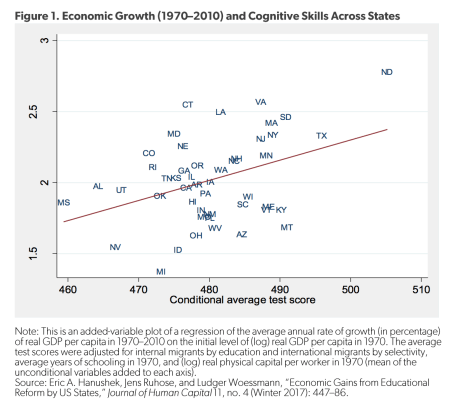
The core assumption of the piece is illustrated in a scatterplot of test scores and state economic growth (Figure 1, reproduced below). This includes an “estimated impact” of education on a state’s wealth. Little or no consideration is given to more important variables that might be the causes of the limited correlation.


Screen Shot 2018-06-04 at 9.04.13 PM


Statistical Exaggerations – Although a best fit line (regression) is super-imposed on the scatterplot, the pattern is more suggestive of a shot-gun blast than an illustration of a strong relationship. Going back to the original study, we find that test scores explain a mere 23% of the variance in economic growth – and this may be largely due to the aforementioned “third variables.” This weak relationship is far from being as strong as touted. Furthermore, achievement test scores are collapsed into “state aggregate scores.” When scores are collapsed in this manner, the effect is to exaggerate a correlation.


Mystery Methods – Beyond one short note below the study’s Figure 1, the AEI paper does not share how these numbers were derived. How these were calculated for each state goes unexplained. Improving teaching and teacher leaders is put forth as the leading reform, but this also is not defended or explained. Neither socio-economic factors nor adequate funding are addressed, although a vast and relevant literature points to their importance. Yet, improvements are claimed to be “enormous” and states should be “willing to make substantial changes.” But how these strong but unknown recommendations are derived is not explained. However, the long paper does present a rich trove of irrelevant statistical exotica.


Workforce Extrapolations – The brief misses the mark with its implicit assumption that the work force and economic needs will remain static and can be easily extrapolated. In an age of emerging artificial intelligence and with virtually every job being transformed in the next half-century, it seems a long reach to assume that the form, function and role of education (and the economic drivers) will remain unchanged.

[1]  Hanushek, Eric A. (May 2018). Every State’s Economic Future Lies with School Reform. Washington, DC: American Enterprise Institute. Retrieved May 29, 2018 from https://www.aei.org/wp-content/uploads/2018/05/Every-States-Economic-Future-Lies-with-School-Reform.pdf? FRPc013V1FcL1JnZHg4V0Vsd253Z0kzUWsxVjc3dGhUSGVzRURhWUZORyttNDlQdWR2aVgifQ%3D%3D

[1] Eric A. Hanushek, Ruhose, J. & Woessmann, L. (Winter 2017) “Economic Gains from Educational Reform by US States,” Journal of Human Capital 11, no. 4 (447-86). Retrieved June 1, 2018 from http://hanushek.stanford.edu/sites/default/files/publications/Hanushek%2BRuhose%2BWoessmann%202017%20JHC%2011%284%29_0.pdf

[1] Sala-I-Marten, X., et al. (2014). The Global Competitiveness Index. Retrieved May 29, 2018 from http://www3.weforum.org/docs/GCR2014-15/GCR_Chapter1.1_2014-15.pdf

[1] Rothstein, R. (2016). In Mathis and Trujillo, Learning from the Federal Market Based Reforms. Charlotte, N.C. : Information Age Publishing. p. 432.

[1] Hanushek, E (Summer 2011), “Valuing Teachers; How much is a good teacher worth?” Education Next, 11(3). Retrieved May 29, 2018 from http://hanushek.stanford.edu/publications/valuing-teachers-how-much-good-teacher-worth