Archives for category: Poverty

When we talk about educating all, we usually mean educating all. But as Caleb Rossiter points out, educating all is a mighty challenge when so many children are so woefully unprepared and unmotivated. Caleb quit his job in a charter school because he was asked to raise scores that were undeserved. But now he has a habit of speaking with candor about kids who have no interest in what is happening in the classroom.

In this post, he writes about his experience with KIPP, and he has much to say about the misuse of standardized testing and gaming the system.

But what bothers him most is that our society has no real plans for the kids who don’t do homework, don’t do classwork, and don’t care much about learning in school.

KIPP is part of the national turning away from vocational high schools and a boosting of watered-down college prep for students who lack the interest or skills to be successful.  From presidents down to principals there is a silly insistence that college is the holy grail in a country with probably a 75 percent true high school graduation rate, 50 percent drop-out rates in poor areas, and most poor students so far behind by 9th grade that success in college is extremely unlikely until later in their lives.  Many kids would benefit from having a real choice for a high school education, like the one we provide in upstate New York through the BOCES vocational half-day schools, that graduated them to be successful electricians, plumbers, cosmetologists, computer technicians, nurse’s aides, and carpenters.        

KIPP also is part of the bleeding of the public schools of money and talent by charters, which Diane Ravitch points out, en bloc, at the macro level of system change, have no better record than public schools when properly compared on the education of the same families and kids.  But I know that charters, good and bad, fraudulent and purposeful, are here to stay, and more are coming all the time.  

Reading Jay’s book right after Diane’s new book on the Privatization movement was unsettling.  She focuses on showing how income and education level of parents is still the primary driver of outcomes in schools — and for me, she still misses the special challenges of Post-traumatic Slave Syndrome and Currently-traumatized Segregation Syndrome that are peculiar to the progeny of the peculiar institution.  Jay focuses on how better achievement can be coaxed out of the situation.  I’d like to see the two of them get together to make some joint proposals!

I am not so sure about the “Post-traumatic Slave Syndrome and Currently-traumatized Segregation Syndrome.” But maybe Caleb knows more than I do from his experiences in the schools of D.C.

I share Caleb’s distrust of standardized testing; it has become part of the problem, rather than an answer or even a reliable measure. Somehow I think that if we expect to solve our biggest social problems, we have to come up with better answers for those kids who don’t care. They are the kids who fail and fail and fail. Kicking them out of charter schools and magnet schools may feel right to the schools that exclude them, but it doesn’t answer the larger questions. What will happen to them? What will happen to our society if we continue to ignore their fate? What kind of society are we if we think we can forget them?


This post was written by Charles J. Morris, Emeritus Professor of Psychology at Denison University, who lives in Indianapolis.

Does the ISTEP Measure School Quality and Teacher Effectiveness?

Charles J. Morris1

While there appears to be general agreement that teachers can make a big difference in the lives of students, there is little evidence that performance on standardized tests provides a valid assessment of teacher effectiveness. Nonetheless, at the national, state, and local levels, we are seeing increasing use of test scores to evaluate both schools and teachers, to award merit pay, and even sanction low performing schools and corporations.

This growing trend toward using test scores to evaluate schools and teachers fails to recognize the evidence that factors beyond the control of schools account for most of the variation we see in test scores among school districts throughout a given state. Matthew Di Carlo of the Shanker Institute sums it up this way: “…roughly 60 percent of achievement outcomes is explained by student and family background characteristics…schooling factors explain roughly 20 percent, most of this (10-15 percent) being teacher effects.”2 (The remaining variation is unexplained and considered error variance.) What this basically means is that schools and teachers are being judged to a substantial degree on the basis of factors over which they have little control.

Is the above conclusion also true for the ISTEP, Indiana’s test for measuring student performance and evaluating school quality and teacher effectiveness? The purpose of this short piece is to briefly summarize some evidence which indicates that the same conclusion holds for the ISTEP: Out-of-school factors, namely the socioeconomic profile (SES) of a school district, explain most of the variation we see in test performance from one district to the next.

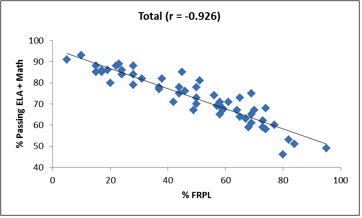
Consider, for example, the following chart which shows the percent of students who passed both the ELA (English/Language Arts) and Math portions of the 2013 ISTEP as a function of the percentage of students in the corporation (Indiana’s districts) who qualify for free- or reduced-price lunches (FRPL, a commonly used measure of SES):

istep1

These data are based on the 56 corporations that have at least 5000 students in the district. As can be seen, there is a very strong correlation between the two variables: The higher the percentage of kids who qualify for FRPL, the lower the passing percentage. Another way of putting it is, if we know the socioeconomic profile of a corporation we can make a very good prediction of where that corporation stands compared to other corporations on the ISTEP. This should not be a surprise to those familiar with the research literature. The same relationship has been found for the various standardized tests used throughout the country.

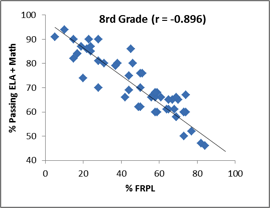
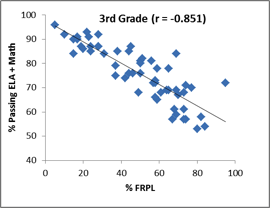
The above results are based on the performance of all students in each corporation. The following charts show the results separately for 3rd and 8th graders:

istep2istep3

Again, we see the same pattern for both grade levels, basically unchanged after 5 years of schooling in a high-scoring or low-scoring corporation. The SES influence is quite strong independently of the schools and teachers in a particular corporation. In fact, if anything, the SES impact appears to become slightly stronger as students progress from the 3rd to 8th grade.

So what are we to make of this obvious association between ISTEP scores of SES? The seemingly inescapable conclusion is that corporations and teachers deserve neither praise nor criticism for how their student compare to other corporations and teachers. Clearly, the socioeconomic profile (SES) of the corporation plays a decisive role. So I ask a simple question: Does anyone seriously believe that if Carmel and Gary (a high and low-performing corporation, respectively) exchanged teachers, the ISTEP scores would suddenly reverse themselves? I don’t think so.

The challenge thus becomes how to respond to the fact that poorer kids are not performing well in our schools. Is there less parental involvement in these communities? Are expectations lower? Do these parents need additional help in becoming more effective mentors? Are after-school tutoring programs a possible solution? What about summer programs? Or pre-school programs? Perhaps all of the above, along with addressing the well-documented and devastating effects that poverty has on the health and well-being of poor children long before they even enter school3.

But one thing seems clear: Judging school and teacher quality on the basis of test scores offers little in the way of a solution. We need to look beyond our schools and teachers if we are going to better prepare all kids for the world they will face in the days ahead.

1Charles J. Morris is an Emeritus Professor of Psychology from Denison University. He resides in Indianapolis.

2Matthew Di Carlo, Shanker Institute (see http://shankerblog.org/?p=74#more-74)

3Diane Ravitch, Reign of Error (New York: Knopf, 2013, pp. 91-98).

A new charter school is planned for Little Rock, Arkansas, to help poor black and minority kids stuck in failing schools. Unfortunately there are two obstacles. First, the school will open in a white neighborhood, far from the poor black kids stuck in failing schools. Second, the Texas operator of the charter has no transportation plans.

Max Brantley, a local columnist, has a solution.

“I have an immediate idea for partnership now that the school will be opening. It would address the concerns of those who fear Quest’s student body will reflect the predominantly white, middle- and upper-income neighborhood in which it is located. The concern is that Quest’s innovations won’t be available to inner city kids on the wrong side of the achievement gap because Quest has no meaningful transportation plan or budget.

“To be sure that a sufficient number of poor, black and underachieving kids enter the lottery for seats in Quest, I propose that the Little Rock School Board aggressively recruit black and poor students at its “failing” schools to apply to Quest, with priority to children who qualify for free lunches and are not currently proficient in test results.

“I propose also that the district promise to provide money to transport all minority, poor or underachieving students admitted to Quest with a dedicated bus service. This will insure that Quest has a student body that reflects the look of the city at large and a healthy population of the sorts of children charter schools were established to help. Quest says it wants to be diverse, though it can’t guarantee it. Let’s help them achieve their wish. Otherwise, we’ll likely look back 12 years later, as the state Board of Education did yesterday at Academics Plus of Maumelle, and be able to only express regret that promised diversity wasn’t achieved.

“Can I get a second, Gary Newton? And why not check with your backers at the Walton Foundation to see if they’d like to participate in encouraging a true laboratory of education innovation.

“Someday, too, Quest could apply to take over Henderson Middle and Hall High schools, with the students assigned to those schools now. Newton and Co. said that these schools were failing, dangerous places. It’s not the kids’ fault. Quest management should be able to solve it easily. Let’s get on with it. No need to stop quality education in the gated neighborhoods of Chenal Valley.”

Blogger redqueeninla takes a hard look at what is happening to the schools and the children and asks the inevitable question: “Where’s the outrage?”

Why do parents tolerate classes with 50 students? Teachers can’t teach such large classes. Does anyone care?

Why does the media report calmly about self-enriching deals for corporate interests without treating it as a scandal?

Why do we ignore segregation of our most vulnerable children when we know it’s wrong?

She writes:

“And yet therein lies the irony. Reported anger does not register; only blandishments do. The means to move change are so hampered by our unwillingness to hear unpleasantness. We wrap up the old year and hope for betterment in the next, but we school ourselves to ignore what ought to be infuriating. Bad things – injustice, poverty, denied opportunities — are being meted out upon our very own children. As a parent, I see the structure of our society as intended to support this next generation. Why do we do any of what we do if not to provide opportunity for them? Opting for disengagement equates to sanctioning inequity. The most important accounting this new year could bring is an acknowledgement of the harm our complacency catalyzes. Let these lists infuriate you. Hear the anger and do not just shut it off. Demand an accounting with accountability.”

What should we do this new year?

Get angry. Demand an accounting.

Get active. Reject complacency.

Find allies. Make noise.

Defend the children. Defend their teachers. Defend their schools.

United, we have the power to make a difference.

A reader comments:

“I do the alumni newspaper for Normandy High School in suburban St. Louis, a school which has lost its accreditation and gotten nothing but grief from the state education folks and certainly no realistic help. I think, however, that is about to change. The state people finally brought in experts who told them no school district serving needy communities anywhere in this country has managed to get its test scores up where the standards demand they be. What is needed is not this myopic obsession with standardized teaching and test scores but an educational philosophy where the talents and dreams of each and every child are identified and educated with that in mind and communities get help TO help children who come from one-parent homes, broken homes, multigenerational homes and blended homes and start school with almost none of the cultural equipment kids in the well-to-do-suburbs have, not to mention parttime parenting, nourishment problems, health problems and emotional problems. The parents are often working multiple jobs to keep a roof over their families’ heads and food in the kids’ mouths and it drives me nuts when THEY are blamed as the problem. They are doing the best they can. I’ve written extensively about this. I am a journalist and a teacher in his 50th year of teaching (look me up on google).”

Wayne Brasler

If we truly want better education for all, then we must be concerned about the high levels of poverty and income inequality in our society. Social scientists have long known that family income and education are highly correlated with academic performance and educational attainment. If we reduce poverty, we increase students’ chances of having good health, a secure home, and the conditions that support learning.

In this context, Robert Reich’s recent article about poverty in America is relevant. Although he says that only Romania has more child poverty than the U.S. among developed nations, Romania was stuck in a repressive dictatorship for decades until 1989, and should not be in the same comparison group with the world’s most powerful economy. We are truly–in this humiliating statistic–#1.

This is the issue that “reformers” don’t want to talk about. They say that if you talk about what matters most, you are making excuses. Hardly. Something has gone terribly wrong in the past three decades or so, says Reich.

He writes:

“Although it’s still possible to win the lottery (your chance of winning $636 million in the recent Mega Millions sweepstakes was one in 259 million), the biggest lottery of all is what family we’re born into. Our life chances are now determined to an unprecedented degree by the wealth of our parents.

“That’s not always been the case. The faith that anyone could move from rags to riches – with enough guts and gumption, hard work and nose to the grindstone – was once at the core of the American Dream.

“And equal opportunity was the heart of the American creed. Although imperfectly achieved, that ideal eventually propelled us to overcome legalized segregation by race, and to guarantee civil rights. It fueled efforts to improve all our schools and widen access to higher education. It pushed the nation to help the unemployed, raise the minimum wage, and provide pathways to good jobs. Much of this was financed by taxes on the most fortunate.

“But for more than three decades we’ve been going backwards. It’s far more difficult today for a child from a poor family to become a middle-class or wealthy adult. Or even for a middle-class child to become wealthy.

“The major reason is widening inequality. The longer the ladder, the harder the climb. America is now more unequal that it’s been for eighty or more years, with the most unequal distribution of income and wealth of all developed nations. Equal opportunity has become a pipe dream.

“Rather than respond with policies to reverse the trend and get us back on the road to equal opportunity and widely-shared prosperity, we’ve spent much of the last three decades doing the opposite.”

He asks:

“How can the economy be back on track when 95 percent of the economic gains since the recovery began in 2009 have gone to the richest 1 percent?

“The underlying issue is a moral one: What do we owe one another as members of the same society?”

These are important questions to think about on Christmas Day, as some enjoy the bounty of our beautiful land, while far too many go hungry.

Ray Salazar, a teacher in Chicago, wrote a blog post asking me to respond to four questions. I will try to do that here. I am not sure I will accurately characterize his questions, so be sure to read his post before you read my responses.

Before I start, let me say that he obviously hasn’t read my book Reign of Error. Consequently, he relies on a five-minute interview on the Jon Stewart show and a 30-minute interview on NPR’s Morning Edition to characterize my views. Surely, he knows that sound bites–which is what you hear on radio and television–are not a full representation of one’s life work or message. I am very disappointed that he did not read my book, because if he had, he would have been able to answer the questions he posed to me, and he might have asked different questions, or at least been better informed about my views and the evidence for them.

First, he objects to my statement that poverty is the most important predictor of poor academic performance, even though it is empirically accurate. He claims I am making excuses for poor teaching and that I am saying that we can’t fix schools until we eliminate poverty. But in my book, I make clear that we must both reduce poverty and improve schools, not choose one over the other. He says that teachers can’t reduce poverty, can’t reduce class size, can’t control who takes arts classes, and have no control over external circumstances. This is true, but he doesn’t seem to recognize that my book was not written as a teachers’ guide, but as a guide to national and state policy. Policymakers do control class size; do control resources; do make decisions that either lift children and families out of poverty, or shrug and say “let the schools do it.” There is no nation in the world where school reform has ended poverty, nor will school reform end it here. Salazar does not seem to understand that I am trying to open the minds of Congressmen, Senators, Cabinet officials, Governors, and State Legislatures, that I want them to take action to improve the lives of children and families; I want them to understand that they should not be cutting the jobs of librarians and nurses and increasing class sizes, and they should not be tying teachers’ compensation to test scores. I agree with Salazar that teachers make a huge difference in the lives of children, but I want him to acknowledge that the deck is stacked against poor children. It is stacked by circumstances, and it is stacked by our schools’ obsessive reliance on standardized tests. Standardized tests are normed on a bell curve. Bell curves do not produce equality of educational opportunity. They favor the advantaged over the disadvantaged. We as a society have an obligation to do something about it. He would understand all this far better if he read my book instead of listening to a TV show and a radio program.

His second point accuses me of opposing standards because I do not support the Common Core standards. That is ridiculous. I support standards, but I don’t support the federal imposition of standards that were written mostly by non-educators, that were adopted because of a federal inducement of billions of dollars, that have never been tested anywhere, and that–as the tests aligned to them are rolled out–cause the scores of students with the highest needs to collapse. In New York, for example, 3% of English learners passed the Common Core tests, along with 5% of students with disabilities, and less than 20% of African American and Hispanic students. The two major testing consortia funded by the U.S. Department of Education selected NAEP proficient as the cut score (passing mark) for their tests; that is an unwarranted decision, because NAEP proficient was never intended to be a passing mark for state tests. It represents “solid academic achievement,” not “passing.” Only in one state–Massachusettts–have as many as 50% of students reached the 50% mark on NAEP proficient. Thus, the testing consortia will either be compelled to drop the cut score (and claim progress and victory) or more than 50% of students in the U.S. (and far more in urban districts like Chicago) will never earn a high school diploma. Of course, I want to see students in Chicago and every other urban district reach high levels of performance, but that won’t happen until politicians stop cutting the school budget, stop laying off teachers, ensure that every school has the resources it needs for the students it enrolls, stop using test scores for high-stakes for students, teachers and schools, and make sure that all children have food security, access to medical care, and the basic necessities of life. Salazar seems to suggest that poverty doesn’t matter all that much, as long as teachers are creating a “college-going” culture. In effect, he is shifting blame to teachers for failing to create such a culture; but no school can create such a culture without the tools and resources and staff to do it.

Third, Salazar criticizes my concern that school choice is intended to create a marketplace of charters, leading to a dual school system. He wants more school choice. I don’t think school choice answers the fundamental challenge to school leaders: how can they create good public schools in every neighborhood? That is their duty and their obligation. Salazar says that good neighborhood schools don’t exist now, and I agree. But choice won’t bring the change we need. It will create a competition for a few good placements, but it wont create more good schools. Choice does not improve neighborhood schools. it abandons them. We will never have good neighborhood schools if we create a system where all kids are on school buses in search of a better school. In some cities, it is the schools that do the choosing, not the students or their families. Many of those “schools of choice” don’t want the kids who will pull down their all-important scores. So, what should happen right now? The mayors of big cities who want to be education leaders should make sure that every school has the resources it needs: the teachers, librarians, social workers, nurses, after-school programs, summer programs, small classes, arts classes, physical education, foreign languages, etc. In a choice system, it is left to students to find a school that will accept them and hope it is better than the one in their neighborhood. I say that students, parents, educators, and communities must demand that the politicians invest in improving every school. As Pasi Sahlberg, the great Finnish expert, has said about his nation’s schools, “we aimed for equity, and we got excellence.” As for Ray’s crack about my “choices,” I attended neighborhood schools: Montrose Elementary School; Sutton Elementary School; Albert Sidney Johnston Jr. High School; and San Jacinto High School. Were they the best schools in Houston? I have no idea. They were good neighborhood schools.

In his fourth point, Salazar repeats his belief that there is both a poverty crisis and an educational crisis. I agree. If he read my book, he would know that. The poverty crisis created the educational crisis. If we ignore the poverty crisis, we will never solve the educational crisis.
This is a mind-blowing video about wealth inequality in America today.

These are facts to reflect upon this Christmas Day.

Inequality is huge and growing in our beloved nation.

A tiny proportion of our population owns a vast amount of our nation’s wealth.

Wealth inequality, like income inequality, has grown dramatically in the past generation.

There really is a 1% that owns an unbelievable amount of the nation’s assets.

Those who live in poverty have next to nothing, a statistical blip, and the share owned by the middle class is small.

Sometimes, I am inclined to think that all the ink spilled on “school reform” is misdirected.

Maybe our attention is being purposely diverted from far more important issues, like inequality and poverty.

Why are we indifferent to the fact that nearly a quarter of our children live in poverty?

Why do “reformers” insist that poverty doesn’t matter, that “great teachers” can overcome poverty, that charters can overcome poverty, that a certain curriculum can close the achievement gap?

Why do they refuse to acknowledge that poverty is the single most reliable predictor of low academic performance?

Why are we not embarrassed that we have more child poverty than any other advanced nation?

(The studies of inequality say that child poverty is higher in Romania, but Romania is a desperately poor nation that emerged from a harsh Communist dictatorship only twenty-five years ago.)

Do the big corporations support charters and TFA as a way of diverting our eyes from the singular cause of low academic performance?

Think about it.

I am not in the custom of quoting religious leaders, being a secular Jew, but I am nonetheless impressed by Pope Francis’ advocacy on behalf of the poor and his critique of the unfettered market.

To clarify, I understand and believe in the values of a free marketplace of goods and services, but at the same time, I think that society has an obligation to make sure that the market is regulated sufficiently to prevent extremes of inequality.

A healthy society requires a balance of the private and the public sector. A society without a public sector would be (in my eyes) mean, nasty, and brutish for all except those at the very top of a pointy pyramid, for all, that is, except the top 1% or 10%. A society without a private sector concentrates far too much power in the hands of those who rule and fails (as we saw in the instance of the Soviet Union) to permit enterprise, individualism, and personal freedom.

And it is in that spirit that I here cite a short article about Pope Francis, who has emerged as a powerful voice on behalf of the world’s poor.

Pope Francis, the author writes, is critical of “a world that is about “competition and survival of the fittest.” It is a world “where the powerful feed upon the powerless.”

He questions “a crude and naïve trust in the goodness of those wielding economic power.” He is concerned that this culture has produced global indifference. Society seems content to believe that poverty is somebody else’s problem. For him, the poor are not only exploited but excluded. They have become “the outcast, the leftovers.”

He hammers the injustice of growing inequality. He sees this income gap as a “result of ideologies which defend the absolute autonomy of the marketplace.” He speaks of the “sacralized workings of the prevailing economic system.”

He also speaks of growing world-wide corruption which is at least tolerated as the world eagerly seeks to serve the “interests of a deified market which become the only rule.” He specifically mentions “self-serving tax evasion,” and “the thirst for power and possessions,” as examples of the harmful corruption that abounds and knows no limits.”

As I reflect on the growing inequality in our society, where a very small number of people enjoy vast wealth while a vast number of people live in poverty, the words of Pope Francis ring true.

Yes, we need a marketplace where people buy and sell goods and services. But the marketplace should not make us indifferent to the losers, to those who cannot succeed in the competition to buy and sell.

A healthy society takes care of all its children and builds a culture where love, kindness, and compassion are valued more than the goods we acquire.

I guess that sounds radical, but I am no radical. I just want a better world for my children and grandchildren and yours too.

Will Bunch, Philadelphia columnist, writes here about American exceptionalism.

Why do we have endless battles over small distractions while ignoring the most glaring problems in our midst?

Why do we have talk show hosts babbling about the latest burp in the culture wars while remaining silent about the stark inequality that blights our country?

Why do we celebrate the “success” of our billionaires instead of changing our tax code to assure liberty and justice for all?

Why do we call schools serving the neediest children “failing schools” instead of recognizing that their low scores are the consequence of massive social neglect and indifference? Why does our Secretary of Education insist on firing their teachers instead of thanking them for their willingness to work in schools that serve the students who struggle the most to live and learn?