Archives for category: New York City

Gary Rubinstein has been following the ups and downs of New York’s highest scoring charter school chain: Success Academy. Every year, the grades 3-8 test scores at the chain are through the roof. But Gary noticed that the high school students at Success Academy do not take Advsnced a regents exams as they do at the New York City’s highest performing high schools.

Gary examines this question:

Success Academy is a charter network with about 40 schools in the New York City area. They are known for their high standardized 3-8 test scores. Though it has been proved that their test scores are somewhat inflated by their practices of shedding their low performing students over the year and also by, at some schools, focusing exclusively on test prep in the months leading up to the tests, they still have these test scores to show their funders and the various charter school cheerleaders.

In June there was an article on the website of something called Albany Strategic Advisors, some kind of consulting firm about how well middle school students at Success Academy performed on four of the New York State Regents exams: Algebra I, Living Environment, Global History, and English. The last sentence of the second to last paragraph explains that these results are important because “Taking the exams in middle school allows students to take more advanced college preparatory courses in high school.”

These ‘more advanced college preparatory courses in high school’ include 10 other courses that have Regents exams including Geometry, Algebra II, Chemistry, Physics, US History, and Spanish. The minimum requirements for getting what is called ‘a Regents diploma’ in New York is one math Regents, one science Regents, one Social Studies Regents, and the English Regents. But to get an ‘Advanced Regents diploma’ you need all three maths and all three sciences and one foreign language Regents. Most competitive high school have their students take these other Regents which are known to be fairly straight forward tests with very generous curves.

About 8 years ago I noticed that there were no Regents scores for any of the other 10 exams in the Success Academy high school. Then 6 years ago I found that some of their students actually were taking some of the more difficult Regents but they were doing very poorly on them. And now, 6 years later, I checked up on them again to find that in the three Success Academy high schools which enroll a total of about 1,100 students from grades 9 to 12, they again do not have any scores for any of the Regents that are typically taken at competitive schools.

So why does this matter?

Well, Success Academy has spent eighteen years carefully cultivating their image. They want families to think that they have the highest expectations and that families should trust them to educate their children because those higher expectations will lead to those students learning the most. And we all know about their 3-8 state tests in Math and ELA. But it is pretty ‘odd’ that their students don’t take the more difficult Regents. The most likely reason for this is that Success Academy only wants information public that makes them look good and avoids any action that could reveal public data that reveals that they do not live up to their reputation. So I believe that they don’t allow their students to take the Regents because they believe that the scores on those Regents won’t be as impressive as their 3-8 state test scores compared to other schools. If I am right then this is an example of Success Academy choosing to preserve their inflated reputation over giving their students the opportunity to challenge themselves on these competitive exams.

Please open the link to finish the article. Nobody does this kind of close review better than Gary Rubinstein.

Leonie Haimson is a tireless advocate for better public schools and reduced class sizes. She leads a small but powerful organization called Class Size Matters. I am a member of her board (unpaid, of course, as she is).

CSM is powerful because Leonie is tireless. She attends meetings of the City Council, the Panel on Education Policy (I.e., the Board of Education); she testifies at City Council hearings and goes to Albany to testify when the education committees meet. She finds lawyers to work pro bono and files lawsuit to seek more funding for the schools. She works with parent groups to support or oppose the latest decision by the mayor. She meets with elected representatives. She writes op-Ed’s for the local press. She almost single-handedly collapsed Bill Gates’ inBloom, which hoped to collect personally identifiable information about every student in every state. She scrutizes the budget of the NYC public schools, even more intensely than those who are paid to do it. She once blocked a bad deal that saved the city $600 million, by exposing the sordid record of the contractor.

The elected officials in Albany are now considering whether to renew mayoral control of the public schools. Michael Bloomberg persuaded the Legislature to give him control soon after he was elected in 2001. He promised all sorts of miraculous improvements. He would be accountable, he said.

Leonie testified recently at a hearing on mayoral control and explained that mayoral control did not increase accountability. In fact, it decreased accountability. No one listened to parents. One of Bloomberg’s chancellors (his second, who lasted only 90 days) mocked parents who expressed their grievances at a public hearing.

The mayor hired a lawyer with no experience in education to be the schools’ chancellor. He did not trust educators and surrounded himself with people from the corporate sector.

The mayor had a majority of appointments on the city’s “Panel on Education Policy,” a toothless replacement for its Board of Education. When the members of the Panel threatened to reverse one of his decisions, he fired the disobedient appointees on the spot and replaced them with others who served his wishes.

The mayor could do whatever he wanted, regardless of the views of teachers, parents, students, communities. Beloved public schools that served the neediest of students were closed and replaced with small schools that did not accept the neediest of students. He opened scores of charter schools that were free to reject or exclude students they did not want, then crowed about their test scores. (Now a private citizen, Bloomberg continues to give hundreds of millions to charter schools; no big deal for him, as his assets exceed $60 billion).

Leonie stands on a solid foundation of knowledge, experience, and persistence. Sometimes I think she wins battles because the electeds don’t want her to pester them anymore.

She is the undisputed champion of reduced class sizes.

More power to her!

David Sirota’s blog “The Lever” reports that New York may tax two unusually rich private universities—New York University and Columbia University—for the benefit of the city’s underfunded public universities. This would be a bonanza for the City University of New York. There’s a long road ahead, and you can be sure that NYU, Columbia, and their powerful trustees will fight against taxation. As in the prior post, this piece was written by Katya Schwenk.

No More Private U Tax Breaks

Columbia and New York University (NYU) may lose hundreds of millions in property tax breaks under a new plan put forward by New York lawmakers, and the resulting new tax revenue would instead go towards New York City’s public university system.

The uber-rich private universities — both of which have endowments in the billions — pay virtually no property taxes despite being some of New York City’s largest landowners, thanks to tax breaks from the state. Columbia and NYU combined own more than 400 properties, worth over $7 billion in total. An investigation by the New York Times and the Hechinger Report in September found that the two schools together save $327 million a year thanks to the state’s tax breaks, and noted that the millions the universities spend on lobbying help them maintain such a favorable system.

On Tuesday, state lawmakers unveiled a package of legislation that aims to change this. The two bills would end property tax breaks for any private universities in New York that would owe more than $100 million in property taxes. The new tax money would be given to the City University of New York, which is facing a budget squeeze, and narrowly avoided devastating cuts to its colleges and programs this year.

Enacting the proposal will likely be a long road: The proposal will require a change to New York’s constitution, which means the issue will ultimately come before voters in a referendum. Yet its advocates say such a plan to change the tax breaks, which have stood for more than a century, is far overdue. The universities, said New York assemblyman Zohran Mamdani, the bills’ sponsor, have “gone beyond primarily operating as institutions of higher education and are instead acting as landlords and developers.”

Arthur Goldstein retired recently after a long career as a high school teacher in New York City. Now that he is registered on Medicare, he is outraged that his union (the United Federatuon of Teachers) is pressuring retirees to join a Medicare Advantage plan. Should that happen, the city government would save $600 million a year but the 250,000 retirees would be pushed into a plan that (unlike Medicare) may deny service and may not be accepted by all doctors. In this post, he points out that some hospitals no longer accept Medicare Advantage.

Full disclosure: I too am affected by what happens to the city’s retirees. I am covered by my spouse’s secondary. The retirees have sued the city and won repeatedly, because they were promised Medicare when they started their careers, not a for-profit health plan that could deny services that their doctors recommend. The city and its unions intend to appeal the judgments they lost in court. If the city prevails, we will stay on Medicare and buy our own secondary, a decision that many retired municipal workers cannot afford.

He writes:

Most developed countries have some form of national health care. That’s important, because frankly, there is nothing more important than health. It really makes me sad when I see fund-raisers for musicians or artists who have health issues. In Canada, for example, these artists wouldn’t need to resort to GoFundMe, or whatever.

In the United States, there are very few forms of public health care. We have Medicaid for those with low income, and Medicare for those with high ages. I’ve been on Medicare since July, and I can’t tell you how thrilled I am to see doctors and not pay co-pays. Of course, that entails having a Medigap program that covers the 20% Medicare does not.

As a teacher, I’ve heard a lot about value-added. Bill Gates sent his people to our school and tried to initiate a program to place cameras in rooms to find out just what those teachers who got higher test scores did differently. I can tell you, though, that I can teach the very same lesson to two groups of kids and get wildly different results. (It’s odd that education experts like Gates don’t know those things.)

It’s very, very hard to measure the value an individual teacher adds, and I’d argue that test scores are a very small portion of that value. In fact, given the quality of standardized tests, I might argue their results show nothing, or even less than nothing. 

Health care is another thing entirely. UFT President Michael Mulgrew, NYC Mayor Eric Adams, and their BFFs on the Municipal Labor Committee want to take Medicare away from not only me, but also every New York City retiree. They want to place us in a plan administered by Aetna. I can tell you precisely what value Aetna adds to Medicare—none whatsoever. 

Aetna, along with every so-called Medicare Advantage plan, takes a cut of what the government contributes to Medicare. How do they make money? They make money by paying doctors less, and by denying care they deem unnecessary. Mulgrew says Aetna will pay doctors the same Medicare does, and that may be true. But it may not be permanent. Mulgrew is always “improving” our health care by having us pay more. Which experienced city employee doesn’t believe he’d improve it further by paying doctors less? 

Mulgrew originally tried selling Advantage by saying every doctor who took Medicare would take this plan. But when members asked their doctors if that were true, they learned it was not. Is Mulgrew a liar? Well, if he isn’t, he’s woefully uninformed. Either way, it renders him unfit to lead a group which, to a very large function, regulates the health care of its members.

Mulgrew can tell retirees that this hospital, or that group of hospitals will take this plan or that. But that may not last. Hospitals are dumping Advantage plans in large numbers. 

Enticed by incessant TV ads blaring every night with those fictional characters Martha and Karen and that old shill Joe Namath pushing plans, especially those with zero premiums, more converts have signed up for potentially less health care coverage and more out-of-pocket expense when illness strikes. In return, they are told they may have no monthly premium and receive a grab bag of goodies like grocery cards and a handful of toiletries. Those goodies may be less attractive, however, when that health plan makes you wait weeks for a diagnostic test to see if you have cancer or will only pay a small portion of the bill if you do.

Do you really believe that health care companies would spend millions of dollars on advertising out of the goodness of their hearts? Do you think that their offers of this or that really mean you and yours will receive better care? I think that, if I sign up for a Medicare Advantage plan, millions of dollars that should be spent toward my health care will go to pay Joe Namath. Many, many more millions will go to Aetna, or whatever parasitical entity is withholding health care and medical compensation to profit off of me and my fellow Americans.

Aetna is not interested in your health. Aetna is interested in profiting from your health, or lack thereof.

Please open the link to finish the article.

Leonie Haimson is executive director of Class Size Matters. She has worked tirelessly to persuade legislators in New York State to limit class sizes. Her efforts were successful in the latest legislative session when both houses passed limits on class sizes.

However billionaire Michael Bloomberg, who was mayor of New York City for 12 years, has been an outspoken critic of class size reduction. In this article that appeared on Valerie Strauss’s “Answer Sheet,” Haimson explains why Bloomberg is wrong.

Strauss writes:

In 2014, I wrote this: “Every now and then someone in education policy (Arne Duncan) or education philanthropy (Bill Gates) …. will say something about why class size isn’t really very important because a great teacher can handle a boatload of kids.”


Well, some can do that, but anybody who has been in a classroom knows the virtues of classes that are smaller rather than larger even without the research that has been shown to bear that out.


Now the issue is back in the spotlight, this time in New York City, where a new state law requires the public school system — the largest in the country — to reduce class sizes over five years. Opponents of the law are pushing back, especially Mike Bloomberg, mayor of New York City from 2002 to 2013. He called for smaller class sizes in his first mayoral campaign but has now changed his mind.


In an op-ed in several publications, Bloomberg says students don’t need smaller classes but better schools — as if the two were entirely unrelated — and he ignores research, such as a 2014 review of major research that found class size matters a lot, especially for low-income and minority students.

This post, written by Leonie Haimson, looks at the issue, and Bloomberg’s position. Haimson is executive director of Class Size Matters, a nonprofit organization that advocates for smaller classes in New York City and across the nation as a key driver of education equity.

By Leonie Haimson


The knives are out against the new class size law, overwhelmingly passed in the New York State Legislature in June 2022, requiring New York City schools to phase in smaller classes over five years, starting this school year. The law calls for class sizes in grades K-3 to be limited to no more than twenty students; 23 students in grades 4-8, and 25 in core high school classes, to be achieved by the end of the 2027 school year. The law was passed despite the opposition of the city’s Department of Education officials, who insist that it will be too expensive, and somehow inequitable, because, they say, the highest-need students already have small enough classes.

Most recently, Mike Bloomberg, the former mayor of New York City and an adviser to Mayor Eric Adams, published identical opinion pieces in three major outlets: Bloomberg News (which he owns), The Washington Post, and the New York Post, inveighing against the goal of lowering class sizes. His piece is clearly meant to sway opinion leaders and legislators to repeal the law, and because of his prominent position, some may listen without knowing about fundamental problems in his op-ed.

Class size reduction has been shown as an effective way to improve learning and engagement for all students, especially those who are disadvantaged, and thus is a key driver of education equity. The Institute of Education Sciences cites lowering class size as one of only four education interventions proven to work through rigorous evidence; and multiple studies show that it narrows the achievement or opportunity gap between income and racial groups.

Bloomberg claims that because of the initiative, “City officials say they’ll have to hire 17,700 new teachers by 2028.” Actually, the estimate from the New York City Department of Education (DOE) itself is far smaller. In their draft class size reduction plan, posted on July 21, DOE officials estimated that 9,000 more teachers would be required over five years. While it’s true that the Independent Budget Office estimated the figure cited by Bloomberg, this large disparity between the two figures appears to stem from the fact that, as the IBO pointed out, the DOE’s budget already includes 7,500 unfilled teaching positions, which schools have not been allowed to fill. While Bloomberg claims the cost will be $1.9 billion for staffing, the DOE’s own plan estimates $1.3 billion — and these costs could be considerably lower if they redeployed teachers who are currently assigned to out-of-classroom positions to the classroom to lower class size.

The legislature passed the new law in recognition that the city’s DOE is now receiving $1.6 billion in additional state aid to finally settle the Campaign for Fiscal Equity lawsuit launched more than 20 years ago. In that case, the state’s highest court found that, because of excessive class sizes, the city’s children were deprived of their constitutional right to a sound, basic education.

Yet since his election, Adams has repeatedly cut education spending, and now threatens to cut it even more, by another 15 percent. As a result of these cuts, class sizes increased last year and will likely be larger this year. Hiring enough teachers to meet the law’s requirements will be a challenge in any case, but it will be impossible to achieve if the administration’s repeated cuts and hiring freezes are implemented.

Yet in the end, smaller classes would likely strengthen teacher quality by lowering teacher attrition rates, especially at our highest-need schools, as studies have shown.

In his op-ed, Bloomberg claims that creating the additional space necessary to lower class size will cost $35 billion, which is misleading. DOE did include this estimate in its original May 2023 draft class size plan. However following pushback by critics who pointed out that this figure bore no relation to reality, they deleted that inflated estimate in their more recent July class size plan. If DOE equalized or redistributed enrollment across schools, this would likely save billions of dollars in capital expenses. Right now, there are hundreds of underutilized public schools, sitting close by overcrowded schools that lack the space to lower class size.

Bloomberg, echoing an erroneous DOE claim that funds spent on lowering class size will not help the highest-need students, wrote: “Under the new mandate, only 38 percent of the highest-poverty schools would see class sizes shrink, compared to nearly 70 percent of medium- to low-poverty schools … it won’t help the students who need it most.”

Actually, only 8 percent of schools with the highest poverty levels (with 90 percent or more low-income students) fully complied with the class size caps last year, according to an analysis by Class Size Matters. Thus, 92 percent of these schools would see their class sizes shrink if DOE complied with the law, rather than the 38 percent that Bloomberg claims.

Moreover, by solely focusing on schools with 90 percent poverty levels or more, his claims are misleading. A piece in the education publication Chalkbeat attempted to make a similar argument, by using class size data provided by DOE that shows that 68 percent of classes in the highest-poverty schools met the class size limit. This is far different than Bloomberg’s claim that 68 percent of these schools are achieving the limits in all of their classes.

In addition, the class size data, analyzed in conjunction with DOE demographic data, shows that there are many more NYC public schools in the other two categories summarized by Chalkbeat, “Low-to-Mid Poverty” (schools with 0-75 percent low-income students) and “High Poverty” (schools with 75 percent to 90 percent low-income students), than those in their “Highest Poverty” category. Most importantly, these two categories of schools enroll a supermajority of our highest-needs students.

In fact, 79 percent of low-income students, 78 percent of Black students, 74 percent of Hispanic students, and 74 percent of English-language learners are enrolled in these other two categories of schools, while only 21 percent to 26 percent of these students are enrolled in the “Highest Poverty” category.

This further indicates that without a citywide mandate to lower class size, smaller classes would likely never reach most of our most disadvantaged students.

Indeed, the highest-needs students, including students of color, low-income students, and English-language learners, have been shown to gain twice the benefits from smaller classes in terms of higher achievement rates, more engagement, and eventual success in school and beyond, which is why class size reduction is one of very few education reforms proven to narrow the achievement or opportunity gap. Thus, by its very nature, lowering class size is a key driver of education equity.

There is also no guarantee that the smaller classes in our highest poverty schools will be sustained without a legal mandate to do so. In July, DOE officials omitted the promise in their May class size plan that schools that had already achieved the caps would continue to do so, as pointed out by a letter signed by over 230 advocates, parents, and teachers. In fact, we found that fewer of the schools in every category achieved the class size caps last year compared to the year before.

Only 69 schools citywide fully met the caps in the fall of 2022, compared to 89 in the fall of 2021, and the number of students enrolled in those schools declined from 18,248 to only 13,905, a decrease of nearly 25 percent. Fewer still will likely do so this year.

So given that the data does not back up his claims, why is Bloomberg so apparently enraged at the notion that public school students would be provided the opportunity to benefit from smaller classes.

One should recall that when he first ran for mayor more than 20 years ago, Bloomberg himself promised to lower class size, especially in the early grades. His 2002 campaign kit put it this way: “Studies confirm one of the greatest detriments to learning is an overcrowded classroom … For students a loud packed classroom means greater chance of falling behind. For teachers, class overcrowding means a tougher time teaching & giving students attention they need.”

Yet class sizes increased sharply during the Bloomberg years, and by 2013, his last year in office, class sizes in the early grades in public schools had risen to the highest levels in 15 years. By that time, he had long renounced his earlier pledge, and had proclaimed in a 2011 speech that he would fire half the teachers and double class sizes if he could, and this would be a “good deal for the students.”

Bloomberg’s main educational legacy in New York City was a huge increase in the number of charter schools as a result of his decision to provide them free space in public school buildings, and his successful effort to persuade state legislators to raise the charter cap. During his three terms in office, the number of charter schools in the city exploded from 19 to 183.

Since leaving office, Bloomberg has continued to express his preference for charter schools, and has pledged $750 million for their further expansion in the city and beyond. A close reading of his op-ed suggests that one of the main reasons for his vehement opposition to the new law is because lowering class size may take classroom space in our public schools that, in his view, should be used instead for charter schools.

Indeed, he concludes the op-ed by saying “it would help if Democratic leaders were more supportive of high-quality public charter schools,” and goes on to rail against a recent lawsuit to block the Adams administration’s decision to co-locate two Success charter schools in public school buildings in Brooklyn and Queens — a lawsuit filed on the basis that it would diminish the space available to lower class size for existing public school students.

Of the $750 million Bloomberg pledged for charter expansion, $100 million was specifically earmarked for Success Academy. Regarding the lawsuit, launched by the teachers union along with parents and educators in the affected schools, Bloomberg writes, “It was an outrageous attack on children, and thankfully, it failed.”

Misleading people about the value of small classes to teachers and students as well as about class size data seems to be an attack on opportunities for New York City public school children, who deserve better. Class Size Matters hopes these efforts fail.

Gary Rubinstein writes here about KIPP’s clever tactics to win a listing as one of the “best” high schools in New York State. He caught them playing similar games several years ago, and U.S. News heard about it and removed KIPP from its rankings.

He begins:

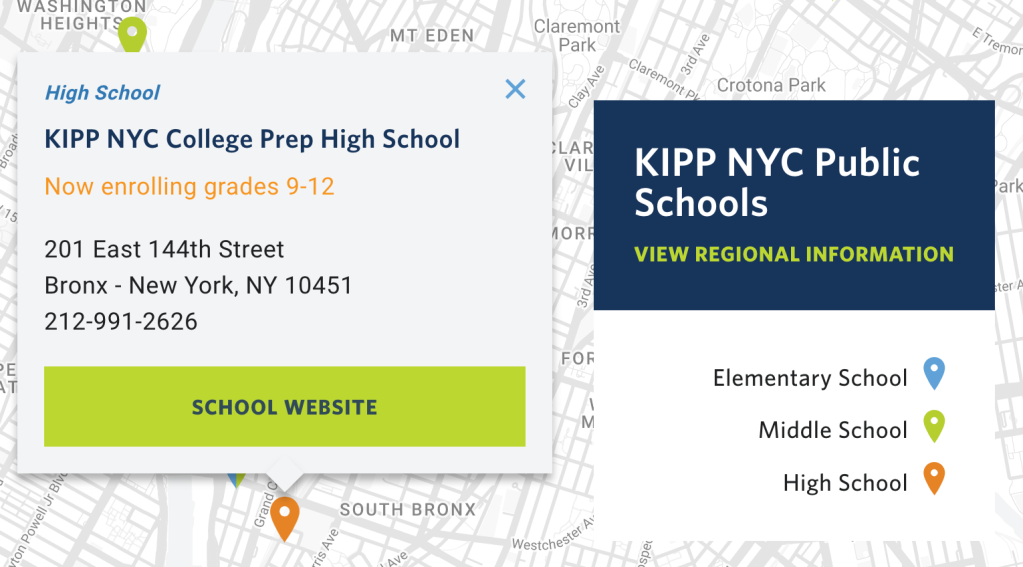
There is exactly one KIPP high school in New York City.

KIPP NYC College Prep High School was started in 2009 to serve students graduating from KIPP middle schools. In 2013 they moved into a new facility that was part of a $100 million project….

Gary figured out that KIPP gamed the system by placing its high-performing students in one middle school and its underperforming students in another middle school. But only one gets counted by U.S. News.

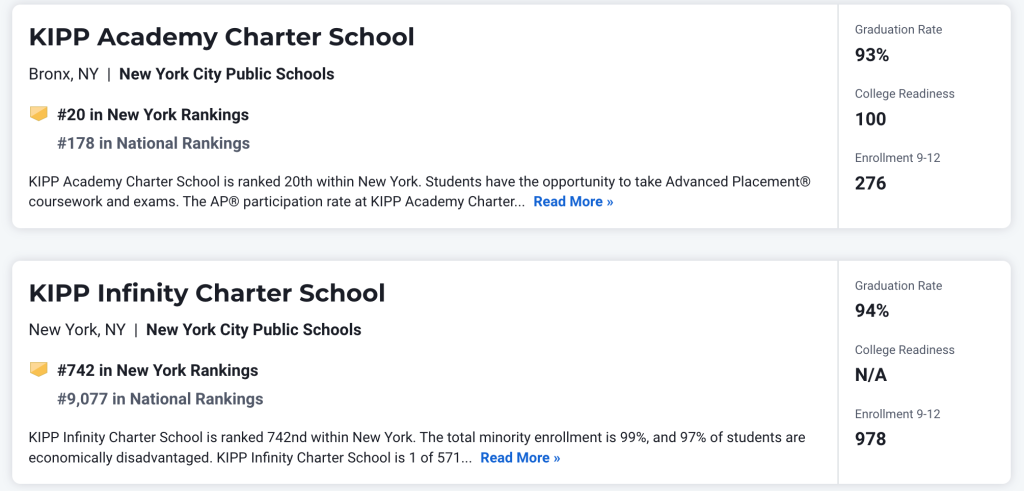
The mystery gets stranger when you search for KIPP high schools in New York and two schools come up, KIPP Academy and KIPP Infinity.

So there is the other KIPP high school in NYC according to U.S. News and that school has 4 times the number of students and in that under performing sibling of the 20th ranked school they don’t have any students passing the AP test. How can this be?

The answer is that there are not two KIPP high schools but only one. These schools, KIPP Academy and KIPP Infinity are actually middle schools. Even in the New York State data, there is not an official KIPP NYC College Prep school but these middle schools have as part of their enrollment the high school students. I don’t know why New York State allows them to do this and why they can assign all the students and only the students who pass an AP exam to KIPP Academy middle school and the students who don’t pass an AP to KIPP Academy Infinity middle school.

Please open the link to understand what a clever move this is. Why do they do it? Gary says it impresses their funders.

Gary RubInstein explains how Success Academy figured out how to game the high school ranking system of US News so that it’s high school would land on the list as one of the best high schools in New York City.

Gary begins:

In the latest U.S. News & World Report Best High School Ranking 2023-2024, the Success Academy High School was ranked the 102nd best high school in the country and the 12th best high school in New York State.

This is strange, he notes, because its graduation rate is one of the lowest in the state and the nation.

For all the schools in the top 80 in New York state, the second lowest graduation rate was 92%. The first lowest was Success Academy with a 75% graduation rate.

On this graduation rate statistic, Success Academy is actually in the bottom 10% in the state and also in the bottom 10% in the country. Nationally it is number 16,468 out of 17,680.

How is it possible that a high school with such a low graduation rate is ranked as 12th best in the state?

Open the link, and read Gary’s explanation.

Matthew Chingos and Ariella Meltzer of the Urban Institute published an essay predicting that New York City’s class-size reduction plan is likely to benefit white and Asian students most, thus adding to the inequities in the school system.

Leonie Haimson, executive director of Class Size Matters, has been fighting for class size reduction for years. She responds here to the Chingos paper.

Haimson writes:

Comments on paper by Matthew Chingos and Ariella Meltzer, “New Class Size Mandate May Reduce Education Equity in New York City”

The primary claim made in this paper is that lowering class size would inequitably benefit white and Asian students rather than Black and Hispanic students, who tend to have lower class sizes already in NYC public schools.

However, several points appear to undermine that claim:

  1. As much research shows, Black and Hispanic students as well as students in poverty tend to gain twice the benefits in terms of increased learning and non-cognitive skills from smaller classes compared to their peers. Thus class size reduction is one of only a very few reforms that have been proven through rigorous research to narrow the achievement/opportunity gap and represents a key driver of education equity;
  2. Only 8% of high-poverty NYC schools already comply with the class size caps in the law, according to the Independent Budget Office;
  3. The estimates in this paper in Table A2 project that Black students would see their class sizes reduced on average to 16.7 students per class, the smallest class size of any group, with Hispanic, low-income, and students with disabilities second at 17.3, a highly equitable outcome. English language learners would come next at 17.4. In short, all high-needs groups would receive smaller classes than non-low income students ( t 17.6), White students (at 17.7) or Asian students (at 18 students per class).
  4. Finally, the paper’s findings also show that English language learners students at the elementary school level are more likely than non-ELLs to have large classes even now, and thus would likely gain substantial benefits from class size reduction as well.

There will be challenges for sure, to ensure that lowering class size doesn’t drain more experienced teachers from the neediest schools, but this could be avoided by targeting high-poverty schools first for class size reduction, as the law requires.

In addition, there are several studies that suggest that class size reduction may lower teacher attrition, especially at the highest-poverty schools, so that in the long run, the effort may lead to a more effective, stable, and experienced teaching force over time.

Our questions are these:

  1. Why cite the IBO cost estimates of 17,700 additional teachers needed, of $1.6 to $1.9 billion annually while relegating DOE’s far lower estimates of 9,000 new teachers at $1.3B to a footnote? Did the authors decide one estimate was more authoritative than the other, and if so why?
  2. The authors also cite an early School Construction Authority estimate of $30B-$35B for capital expenses, yet the SCA has admitted that this was “a back of the envelope” estimate and now has been omitted from the DOE’s July version of their draft class size plan, as compared to the earlier version submitted in May.

1. https://classsizematters.org/research-and-links/#opportunity

2. https://www.ibo.nyc.ny.us/iboreports/how-would-the-new-limits-to-class-sizes-affect-new-york-city-schools-july-2023.pdf

3. See https://3zn338.a2cdn1.secureserver.net/wp-content/uploads/2022/06/FAQ-7-myths-6.5.22-update.pdf and https://3zn338.a2cdn1.secureserver.net/wp-content/uploads/2019/05/Summary-of-Class-Size-Reduction-Research-NY-updated.pdf

4. May version posted here: https://drive.google.com/file/d/1gv9DZ6aENexWyzozVWV0SwhnlXLVVJ2a/view July version here: https://drive.google.com/file/d/1_BOYliiFZ5U7Q3q8gN6JRRIHgIf9j_Vp/view

New York City’s retired municipal employees are battling the Eric Adams administration and their own unions, who want the retirees to switch from Medicare to a for-profit Medicare advantage program run by Aetna. The city expects to save $600 million a year by switching its employees to Aetna. (Aetna’s CEO is the highest paid person in the health insurance industry at $27.9 million per annum.)

Arthur Goldstein recently retired after a teaching career of nearly forty years, mostly teaching English language learners in high school. He is outraged that the city and his union want to take away the health insurance that he worked for and substitute an inferior Medicare Advantage plan. The city claims that MA is better than Medicare, but where will that $600 million in savings come from? Where will Aetna’s profit come from?

Two sources of savings and profits:

1. Denial of service. If Aetna does not approve a major procedure recommended by your doctor, you won’t get it. You can appeal; maybe your appeal will win. Maybe not. Medicare does not question your doctor’s medical advice.

2. If your doctor is not in network, he or she won’t be paid.

Arthur Goldstein writes:

I need a union to protect me, along with my brothers and sisters, from our adversaries. Our number one adversary is our employer, currently embodied in Mayor Eric Adams. When Mayor Eric Adams says he wants to degrade our health benefits, I’m glad to stand with my union to fight. When Mayor Eric Adams says he wants to give us a compensation increase barely one-third of inflation, I’m ready to descend upon City Hall with all my union brothers and sisters.

Our leadership, though, has asked for neither. Instead of that, they’ve asked me to stand up for a “fair contract.” The contract, though, contained both of the glaring flaws noted above. Leadership wanted me to go to Starbucks and have people there see me work. I don’t set foot in Starbucks unless one of my students gives me a gift card. Starbucks is virulently anti-union, and I have better coffee at home.

I’ve been writing for months about how our leadership has sold out our retirees (and now I am one). I have been quite active opposing private corporate insurance for retirees. I don’t want some clerk at Aetna determining I don’t need care my doctors deem necessary. In service members do not need a plan that’s 10% cheaper than GHI-CBP. How many more doctors need to drop our plan before Mulgrew climbs out of bed with Adams?

Last week, on one of the hottest days of the year, I stood outside with both retirees and active members while the independent Organization of NYC Retirees went to court to stand for us. By the next day, there was a ruling that this downgrade could cause us “irreparable harm.” They embodied not only activism, but successful activism.

Let me ask you this—if our union leadership supports things that cause us irreparable harm, why should we be at their beck and call? Why should we get out there and demand a sub-inflation raise? Why should we demand a contract that does nothing to address the downgrade of our health care?

As I’m asking this, a lot of members have more fundamental issues. A few years back, I was chapter leader of the largest school in Queens (an odd position for someone who opposes activism). I was ready to strike for safety. Members announced, with no shame whatsoever, that they’d be scabs. This tells me they don’t even know what union is.

Whose fault is that? We, as a society, don’t really teach about labor and union. I kind of learned as I went along. There is a great book called Beaten Down, Worked Up by Steven Greenhouse. If you read it, you’ll get a laundry list of things that UFT does NOT do. We could strike, or we could do a whole lot of things short of that. But that’s not how our leadership thinks. I’ll bet you dimes to dollars Michael Mulgrew, except possibly when he read my blog, has never even heard of this book.

That’s why we are asleep. We call Mulgrew and the Unity Caucus “the union,” as though we aren’t even part of it. Whole swaths of us think of Mulgrew as our mommy, and think he should come around and personally help when we are in trouble. Mulgrew’s caucus encourages that false dependency.

In fact, they are the ones who don’t want activism. The very notion of it makes them quake in their boots. If we were truly active, we would not stand for their sellouts. We would not stand for diminished health care. We would not stand for wholly insufficient compensation increases. We would not have 20% participation in union elections. Crucially, we would not have a caucus that doesn’t even know what union is running our union.

I wholly support activism. What I just saw in union leadership was a carefully choreographed rush to a contract. There were few opportunities to examine, discuss or question it. There was a kabuki dance of demonstrations to support whatever leadership wanted, and we were all supposed to believe that these petty actions had something to do with realizing a contract. The fact is the contract was set once DC37 agreed. We had absolutely nothing to say about compensation or health care, our most critical issues.

Leadership thinks we are stupid. Leadership hires people solely for the quality of obsequiousness, and many of these hires may indeed be stupid. But I know a whole lot of smart teachers. They can’t fool all of us. A lot of us who won’t be fooled are, in fact, the most active members they have.

I admire activism. That’s why I contributed to NYC Retirees, who went out and protected us from the machinations of Mulgrew and his fellow union bosses. You should do so as well, and here is how.

Let’s be active. Let’s promote activism. And let’s be done with the delusion activism what current leadership wants from us. We are union, we will stand up, and we will protect ourselves.

And very soon, we will vote those bastards out and take charge.

Open the link to read in full.

Arthur Goldstein recently retired, concluding his nearly four decades as a teacher in the New York City public schools. For those who have followed his blog, NYC Educator, it’s clear that Arthur speaks his mind and fears no one. He is devoted to his students, his profession, and his unerring sense of principle. Arthur recently moved his blog to Substack, and we can expect him to continue to speak out against the powerful with clarity and humor.

Kids are kids. They really make this job rewarding. All teachers know, though, that beyond that, the quality of your supervisor can make this job rewarding, bearable, or even unbearable.

I’ve had all kinds. I have to admit, for most of my time in Francis Lewis High School, I’ve been blessed with a few extraordinary supervisors. I had escaped from another school, from a witless administrator who tried to blackmail me to teach Spanish. I know Spanish, but I know English much better, and I love teaching it to newcomers.

I took a UFT transfer, a great thing that was unceremoniously dumped in 2005 contract. I worked for Nivea Cavallo, a very understanding AP who made it a point to actually teach every possible level of every subject she could. One of my colleagues back then was Jackie Irving. Jackie’s the best ESL teacher I’ve ever seen. This notwithstanding, she scratched and clawed her way to the top, until she became my AP. Everyone will tell you she’s a great AP, and that we’re lucky to have her. I’ll try to show you instead.

Jackie and I worked together when she was a lowly coordinator. I was the LAB-Besis coordinator. I took the job because I was chapter leader and it was the only way I could get an actual office. I was terrible at this job, and understood nothing. I had to come in on weekends to keep up with the tedious data entry. Whenever Jackie calmly said, “I have a concern,” it meant “Run for your life! The ship is sinking, it’s the end of the world and nothing will save us now!” To me, there was absolutely nothing more terrifying than that phrase.

I sometimes come to school meetings late. (Perhaps more than that). Whenever I do, I say, “Boy, this place is hard to find.” Really, there’s no excuse for being late. When Jackie observed my class, my beginning English students came late with incomprehensible explanations. I laboriously forced them to say, “Boy, this place is hard to find.” I made sure they emphasized, “Boy.” While it didn’t do much to discourage lateness, it made it more inconvenient, and also forced them to use English publicly.

Another thing Jackie noticed when observing my class is that, whenever someone said, “I’m sorry,” half the class replied, “Sorry is garbage!” I once had a young Korean student of diminutive stature, and he said it frequently. I have no idea where he got it from. But I started repeating it, and it became a part of our classroom vocabulary.

Aside from disciplinary hearings, where I was kind of relentless, Jackie and I had many borderline contentious meetings when I was chapter leader. She would never lose her temper. She would never lose view of her goal. She would sit there, and patiently explain whatever it was until I absolutely agreed with her. I can’t recall a time she didn’t persuade me she was right. No one else has that particular power over me.

Now I’m on the cusp of retirement, and our department just threw a party for new and recent retirees. As chapter leader of a very large school for 12 years, I’ve been to many such parties, but also more disciplinary hearings than I care to recall. I’ve read many a letter to file, and explained them in great detail to many members. By some miracle, over almost 39 years, I’ve never gotten one myself.

On many occasions speaking with Jackie, I’d say, “Let them put a letter in my file.” She would take a very formal tone, and say, “MISTER Goldstein. Do you know who would have to WRITE that letter to file?”

Anyway, at our retirement party, Jackie spoke touchingly of all the other retirees. To me, she gave my first letter to file, and read it aloud to all. Here it is: