Archives for category: Media

Many Twitter users are fearful for the future of the popular social media site since it was purchased by Elon Musk. He is taking the company private and will be the sole proprietor. He has said he is an absolutist on free speech, which raises questions about whether he will tolerate hate speech, lies, propaganda, anti-vaxxers, disinformation, even Donald Trump, who was permanently banned from Twitter for inciting violence.

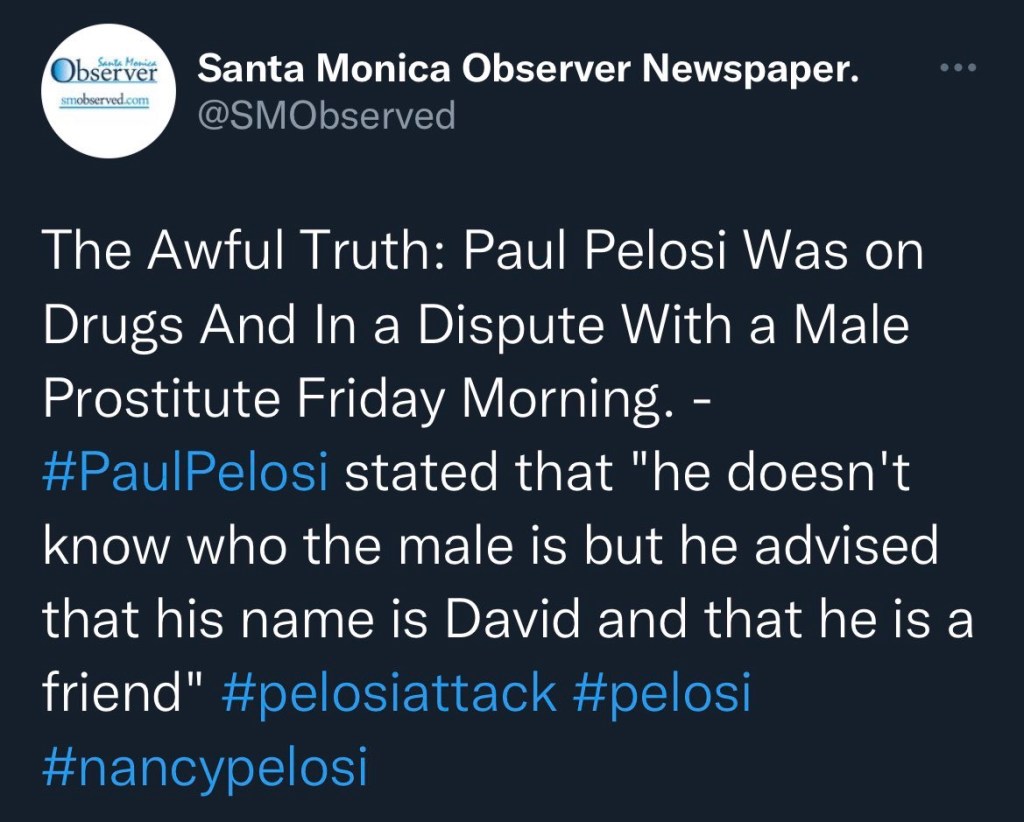
Now, the concern about Musk was stoked when he retweeted gossip from a free weekly (the Santa Monica Observer) that Paul Pelosi was drunk, high on drugs, and got into a fight with a man he picked up at a gay bar.

Musk posted that there was a “tiny possibility” that this was true. As readers began to react with incredulity that the new owner would spread unsubstantiated gossip, Musk deleted his tweet. Musk has 112 million followers on Twitter.

The San Francisco Chronicle wrote:

Musk responded Sunday at 5:15 a.m. Pacific time with a tweet that said, “There is a tiny possibility there might be more to this story than meets the eye,” and posted a link to a baseless, anti-LGBTQ article in the Santa Monica Observer. By 10:30 a.m. Sunday, the message and link had been retweeted more than 30,000 times and liked more than 110,000 times, before being deleted less than an hour later.

Last year, the Los Angeles Times reported that the Santa Monica Observer was “notorious for publishing false news,” and once claimed “that Hillary Clinton had died and that a body double had been sent to debate Donald Trump.”

Axios posted that the Santa Monica Observer is not a trustworthy site.

Why it matters: Musk linked to an article from the Santa Monica Observer, a website known for years for publishing false stories.

  • The site “is anything but trustworthy,” according to an executive at NewsGuard, a company that uses trained journalists to rate news and information sites.
  • The site has a trust score of 44.5 out of 100 points on NewsGuard’s rating scale for trustworthiness, due to repeatedly publishing numerous conspiracy theories and false claims about politics, the pandemic and more.
  • The site gets a red-rating and a warning for readers that says: “Proceed with caution: This website fails to adhere to several basic journalistic standards.”

Responsible people in the media fact-check. Musk didn’t think it was necessary. This does not bode well for the future of Twitter.

We have had our fill of conspiracy theories in the past six years.

It’s awful to think that the sole owner of Twitter will be a dupe for conspiracy theories and gossip and spread them to his millions of readers.

Just for laughs, read this article in The Intercept, which predicts that Elon Musk will regret his purchase of Twitter.

It begins:

ELON MUSK (and his consortium of much smaller investors) now owns Twitter. We need to take seriously the possibility that this will end up being one of the funniest things that’s ever happened.

That’s because as of this moment, it looks like Musk dug a big hole in the forest, carefully filled it with punji sticks and crocodiles, and then jumped in.

Greg Brozeit is a valued reader of the blog who is deeply knowledgeable about German history. In a private communication, he expressed to me his disappointment about Ken Burns’ “The U.S. and the Holocaust.” We agreed that Burns’s singular focus on Hitler’s Jewish victims slighted the other categories of people that he targeted for annihilation. They included Communists, socialists, trade unionists, the disabled, homosexuals, and Roma, as well as priests and nuns who opposed his monstrous regime. I invited Greg to write about his objections, and he did. Greg reminded me of the famous lines spoken by the German Lutheran Pastor Martin Niemoller, who was initially a supporter of Hitler but turned against the Nazi regime as he realized Hitler’s murderous ambitions:

First they came for the socialists, and I did not speak out—because I was not a socialist.

Then they came for the trade unionists, and I did not speak out—because I was not a trade unionist.

Then they came for the Jews, and I did not speak out—because I was not a Jew.

Then they came for me—and there was no one left to speak for me.

—Martin Niemöller

Greg Brozeit wrote:

The story of the Holocaust is about how the “other” could be created and marginalized through inhumane policies and practices supported by large swaths of people.

Or, if they were not supporters, they had been conditioned over years to live in fear and had little-to-no sense of civic duty or civil courage. That is a complex story in which Jews were specifically targeted, the most numerous of many contrived “groups” of victims. A large number of those classified as German Jews, who were eliminated or driven out of the country, viewed themselves as Germans first and Jews second. Both identities were equally important to many of them. The distinction was lost and later imposed on them.

I often cite the diaries of Victor Klemperer for one reason -they are the only personal, contemporary observations of what actually happened by someone who was “fortunate” to be last on the list of Jews who were to be eliminated in the
final solution. He was one of the latter; one thing few Americans know and his publishers do their best to hide from Americans is that Klemperer returned to Dresden and became a professor and loyal citizen of East Germany until his death. It would have been interesting to read his view of the Berlin Wall had he lived long enough to witness it. He knew he was persecuted by Nazis because they imposed the definition of Jew on him, one he never internalized. He was almost a victim of the Holocaust, but he would have classified himself as not being Jewish long before others would make him a Jew.

After watching the PBS/Burns program on the U.S. and the Holocaust, I was disappointed that he missed so many opportunities to tell a larger story. Burns rarely veered from the “Holocaust = six million Jews” argument and consequently undermined the message that I (and perhaps the producers) had hoped for. The term “Holocaust” is also used for political, not humanitarian or historical, purposes—the definition Burns’ narrative (naively or intentionally) underscored. And therein lies my problem. A casual viewer might easily get the impression that from the 1930s to the end of WW II, Jews were the only victims of the Holocaust. The actual history is more complex.

By focusing only on Jews we risk serious dishonor to the memory of the six million—a view confirmed in my mind after reflecting on the title of Malcolm Nance’s book, “They Want to Kill Americans.”

Nazis claimed they were eliminating Jews and other undesirables to strengthen Germany. They started out by killing Germans: communists, trade unionists, social democrats, writers, artists, ethical conservatives, Protestants, Catholics, Jehovah’s Witnesses, Christian Scientists, gays and lesbians, persons with developmental disabilities, political opponents, those who weren’t acquiescent to the new order, AND Jews, both those who identified themselves so and those who did not. Focusing almost exclusively on any one of these groups risks breeding resentment and isolation. It certainly diminishes the broad inhumanity of the Holocaust.

An accurate recounting would never gloss over the genocidal priority the Nazis tragically bestowed upon Jews, but neither would it underplay the fate so many others were consigned to in this tragedy. And in fairness, Burns occasionally hinted at this reality. In the film’s final hour a doctor who took pride in the T4 program to eliminate persons with developmental disabilities was highlighted.

But the narrative all too quickly returned to the storyline of “aggressions against only Jews.” While Burns gives an excellent introduction to US policy on Jews and the Holocaust, the series title, “The U.S. and the Holocaust,” is misleading and inevitably expands (and eventually disappoints) the expectations and hopes for viewers who are not novices. The real story of the wide compass of inhumanity subsumed under the Holocaust is a profound lesson relevant to our present circumstances. Sadly, the program missed this larger opportunity.


I don’t usually get enthusiastic about fictionalized portrayals of schools because they are typically sensationalized and hostile towards teachers and students. It’s easy to make a long list of such movies or TV programs, starting with “Blackboard Jungle.”

But wait!

Here’s a show you will love: “Abbott Elementary” is set in Philadelphia. The writer of the Emmy-award-winning show, Quinta Brunson, is also the star. She plays a first-year teacher in the first season. She is thrilled to be a teacher and her colleagues are helpful, funny, and the usual mix of personalities—real people. They care about the children. The children—all Black—are adorable. There’s not enough money for supplies, but everyone makes do. The spirit of the show is beautiful.

The show makes you feel like teaching is the very best job in the world. Don’t miss it!

The Washington Post reported a new development in the media world. The influential and respected news site Politico was bought by a German billionaire who claims to be nonpartisan. But…

BERLIN — Months after his company bought Politico, Mathias Döpfner stood atop Axel Springer’s 19-story headquarters, gazing out at the double row of cobblestones that mark the outline of the demolished Berlin Wall, and explained his global ambitions. “We want to be the leading digital publisher in democracies around the world,” he said.


A newcomer to the community of billionaire media moguls, Döpfner is given to bold pronouncements and visionary prescriptions. He’s concerned that the American press has become too polarized — legacy brands like the New York Times and The Washington Post drifting to the left, in his view, while conservative media falls under the sway of Trumpian “alternative facts.” So in Politico, the fast-growing Beltway political journal, he sees a grand opportunity.


“We want to prove that being nonpartisan is actually the more successful positioning,” he said in an interview with The Washington Post. He called it his “biggest and most contrarian bet.”


How exactly Döpfner, Axel Springer’s CEO, hopes to define nonpartisan journalism at an especially fragmented time for American politics is a question of intense interest as he aims to leave his mark on American media. His own politics have remained something of a mystery, too. But weeks before the 2020 U.S. presidential election, he sent a surprising message to his closest executives, obtained by The Washington Post:
“Do we all want to get together for an hour in the morning on November 3 and pray that Donald Trump will again become President of the United States of America?”

Please watch this fascinating series (part one and part two) by Australian television on the rank cynicism of Rupert Murdoch and FOX News.

Under his leadership, FOX turned into a propaganda machine for Trump. Its leading correspondents (Sean Hannity and Judge Jeanine) joined his rallies, urged people to vote for him. They ceased to be journalists.

The two parts are gripping and well worth watching. There are pending lawsuits against FOX, Rudy Guiliani, and Sidney Powell for slandering Dominion Voting Systems and Smartmatic, another voting machine used only in Los Angeles.

Powell and Guiliani both said numerous times that the voting systems were used to hack the vote and steal the election. Powell has since said that her claims were so ridiculous that no one took them seriously.

A must watch.

Not long ago, someone posted a comment on the blog asking how I could be so contemptuous of Donald Trump when the man was a highly successful businessman and a billionaire. I replied by referring to his multiple bankruptcies, Trump Airlines, Trump Steaks, Trump University. But I couldn’t remember them all.

Michael Hiltzik helped me out. He writes a business column for the Los Angeles Times. In this article, he takes advantage of a regulatory document that lists nearly all) of Trump’s business failures.

Trump is launching a new social media platform called “Truth Social” and hopes to raise at least $875 million. Skip over the fact that one of the most notorious liars in our nation would call his outfit “Truth Social.” He doesn’t believe in “truth,” by his own account. He (through Kellyanne Conway) gave us the term “alternative facts,” as well as “fake news” (whatever he didn’t agree with) and said the free press (though protected by the First Amendment) is “the enemy of the people.”

In order to bring a stock offering public, the risks associated with it must be made public. Thus, the publication of Trump’s many bankruptcies appears in a document called an S-4.

Since Hiltzik wrote this article, the SEC and a federal grand jury filed subpoenas to Trump’s social media company (Trump Media and Technology Group), and he resigned from its board, along with Don Trump Jr. and 4 other buddies. Open the link on this article: Trump is running away from the SEC investigation of his company.

Hiltzik writes:

The litany appears in a section of the S-4 headed “Risk Factors,” specifically “Risks Related to our Chairman President Donald J. Trump…”

Let’s delve instead into the Trump-related risks.

“A number of companies that were associated with President Trump have filed for bankruptcy,” the document states. “There can be no assurances that TMTG [that is, Trump Media & Technology Group] will not also become bankrupt.”

Let’s start with Trump’s casinos in Atlantic City:

“The Trump Taj Mahal, which was built and owned by President Trump, filed for Chapter 11 bankruptcy in 1991. The Trump Plaza, the Trump Castle, and the Plaza Hotel, all owned by President Trump at the time, filed for Chapter 11 bankruptcy in 1992. THCR, which was founded by President Trump in 1995, filed for Chapter 11 bankruptcy in 2004. Trump Entertainment Resorts, Inc., the new name given to Trump Hotels & Casino Resorts after its 2004 bankruptcy, declared bankruptcy in 2009.”

Then there’s the list of “companies that had license agreements with President Trump [that] have failed”:

“Trump Shuttle, Inc., launched by President Trump in 1989, defaulted on its loans in 1990 and ceased to exist by 1992. Trump University, founded by President Trump in 2005, ceased operations in 2011 amid lawsuits and investigations regarding the company’s business practices. Trump Vodka, a brand of vodka produced by Drinks Americas under license from the Trump Organization, was introduced in 2005 and discontinued in 2011.”

Also, “Trump Mortgage, LLC, a financial services company founded by President Trump in 2006, ceased operations in 2007. GoTrump.com, a travel site founded by President Trump in 2006, ceased operations in 2007. Trump Steaks, a brand of steak and other meats founded by President Trump in 2007, discontinued sales two months after its launch.”

The S-4 also observes that “President Trump is involved in numerous lawsuits and other matters that could damage his reputation, cause him to be distracted from the business or could force him to resign from TMTG’s board of directors.”

The document goes on to list the numerous investigations of Trump’s behavior in office and after his election defeat, as well as his business dealings before taking office.

Also, “The Trump Organization recently paid $750,000 to settle a lawsuit filed by the District of Columbia accusing the organization of misusing nonprofit funds from the 58th Presidential Inaugural Committee.”

On top of that, “President Trump is the defendant in a defamation lawsuit filed against him by E. Jean Carroll who claims that President Trump defamed her when he denied her allegations of sexual assault against him. In the past, President Trump has been involved in multiple lawsuits and settlements — and the subject of numerous accusations that did not result in legal action — related to sexual conduct and alleged misconduct.”

For investors, the scariest line in the entire document may be this: “The foregoing does not purport to be an exhaustive list.”

The S-4 cites a USA Today article from 2016 finding that “over the previous three decades President Trump and his businesses had been involved in 3,500 legal cases in U.S. federal and state courts…. In the 1,300 cases where the record establishes the outcome, President Trump settled 175 times, lost 38, won 450, and had another 137 cases end with some other outcome. In the other 500 cases, judges dismissed plaintiffs’ claims against President Trump.”

So if you’re inclined to invest with Donald Trump, don’t say you haven’t been warned.

Timothy L. O’Brien, who has written critically about Trump’s claims to be a multi billionaire, wonders whether Elon Musk is having buyer’s remorse about his offer of $44 billion for Twitter. Musk tweeted on Friday morning that his offer was “temporarily on hold” while there is an investigation of Twitter bots.

O’Brien wrote at Bloomberg News:

Elon Musk took to Twitter early Friday to say that his takeover of the company was “temporarily on holdpending details supporting calculation that spam/fake accounts do indeed represent less than 5% of users.”

Musk might be serious about this. Or he might be joking and just using his vast social media reach to have fun with the investors, Twitter Inc. employees, journalists, free-speech advocates and others who have been watching this garbage fire ignite. (A couple hours later he tweeted he was still committed to the deal.)

I’m in the camp of: “Musk is serious about this but he’s finding the most unserious of reasons to explain why he’s bailing.” As in: “I was thinking about buying that mansion, but the deal is on hold pending details about whether there are termites in some of the planters on the patio. I still have plenty of cash and can get a mortgage from the bank, believe me. It’s not about the money.”

I suspect Musk’s jitters about buying Twitter are all about the money and has nothing to do with how many bots are zooming around the platform. He just doesn’t want to say that. If the richest guy in the world wanted to be more honest about what’s going on, he might have to acknowledge that his primary credit card — his shares in Tesla Inc. — doesn’t have the buying power it once did.

Musk said last month that he wanted to buy Twitter for $43 billion — when he only had about $3 billion in cash on hand. Most of the fortune of the world’s richest man, which added up to some $259 billion at the time, was tied up in his Tesla shares. Since then, Tesla’s shares have lost about 36% of their value, and Musk’s net worth has fallen to about $215 billion.

Frankly, I would be pleased to see this purchase fall through. It’s frightening to think that one person would wield the power to control what has become the nation’s public square.

Musk has said he believes in unlimited free speech, but that too is dangerous in these times of disinformation and pervasive propaganda. In a famous Supreme Court decision, Justice Oliver Wendell Holmes wrote that free speech does not give you the right to shout “Fire” in a crowded theater. Holmes was using the reference to justify a decision against a man handing out flyers opposed to recruitment for the military during World War 1. (Schenck vs. United States). That decision was subsequently overturned but the metaphor remains apt.

Musk would not exclude those on Twitter who offer phony cures for COVID or other diseases or those who urge people not to take the vaccines that would protect their lives. He would not exclude those who peddle hatred and bigotry.

This not to say that he does not exclude anyone. A group called “Public Citizen” has complained that it was blocked by Elon Musk. It may be that he blocks groups and individuals who post tweets about the riskinesss of Tesla. Who knows?

The Twitter platform should have standards for screening and deleting tweets that incite violence or circulate medical misinformation. That’s why Trump and Marjorie Taylor Greene were banished.

Musk is apparently politically biased. He tweeted not long ago ““I strongly supported Obama for President, but today’s Democratic Party has been hijacked by extremists.” Extremists? Inciting an insurrection on January 6 doesn’t count as extremist? Invading the halls of z Congress and attacking police officers is not extremism? Insisting that the 2020 election was stolen is not extremist? If any party has been hijacked by extremists, it is the Republican Party.

Twitter is too important in our common life to be controlled by one man and his wildly inflated ego. I’m hoping the deal never happens.

NBC News debunks the conspiracy theorists who have claimed that Russia invaded Ukraine to eliminate biolabs funded by the United States. The main promoters of this claim are QAnon, Tucker Carlson, and the Russian propaganda machine.

It begins:

Russia’s early struggles to push disinformation and propaganda about Ukraine have picked up momentum in recent days, thanks to a variety of debunked conspiracy theories about biological research labs in Ukraine. Much of the false information is flourishing in Russian social media, far-right online spaces and U.S. conservative media, including Tucker Carlson’s show on Fox News.

The theories, which have been boosted by Russian and Chinese officials, come as U.S. officials warn that Russia could be preparing a chemical or biological weapons attack of its own in Ukraine.

Most of the conspiracy theories claim that the U.S. was developing and plotting to release a bioweapon or potentially another coronavirus from “biolabs”’ throughout Ukraine and that Russia invaded to take over the labs. Many of the theories implicate people who are often the targets of far-right conspiracy thinking — including Dr. Anthony Fauci and President Joe Biden — as being behind creating the weaponized diseases in the biolabs.

Disinformation experts said the biolabs theory echoes other Russian propaganda meant to justify its military efforts, which often makes allegations against other countries and populations that reflect similar attacks it plans to make.

Question: If this was the Russian goal, why are they also bombing apartment houses, maternity hospitals, schools, and residential areas? Is all of Ukraine one giant biolab?

The New York Times recently wrote about Twitter’s suspension of the personal (not the official) account of Representative Marjorie Taylor Greene. Twitter applied its rule of “five strikes and you’re out” because she posted misinformation about COVID and vaccines that could cause harm to others. Among other things, she had posted on Twitter that COVID was not dangerous and that vaccines should not be mandated; that the vaccines were “failing”; and that many people who got the vaccines had died.

While reading this article, I learned of a website called The Center for Countering Digital Hate. This organization published research on the dozen most influential social influencers who spread misinformation about vaccines.

The Center surveyed major social media platforms and found that 12 people were the source of 2/3 of the lies about COVID and the vaccines. The only name familiar to me was that of Robert F. Kennedy Jr.

The leading influencer was one Dr. Joseph Mercola. His Twitter handle was @drmercola. Perhaps he was banned by Twitter. But he now reappears as @mercola.

At the time the CCDH report was written, the COVID death toll in the U.S. was 500,000. It is now over 800,000. It’s likely that the Dirty Dozen caused some of those deaths (and will be responsible for many more) by encouraging resistance to the life-saving vaccines.

Michael Hiltzik of the Los Angeles Times explains why American copyright law benefits major corporations, not the creators of original works.

In 2022, he says, there will be a bumper crop of well-known titles that will enter the public domain, including Winnie the Pooh, Ernest Hemingway’s The Sun Also Rises, poetry collections by Dorothy Parker and Langston Hughes, and first novels by William Faulkner and Agatha Christie. A number of sound recordings, including ones by Al Jolson and Enrico Caruso will no longer be copyrighted.

Hiltzik writes:

As it happens, however, this massive release isn’t something entirely worth celebrating. Instead, it’s a pointer to the sheer absurdity of American copyright law, which long ago came under the thumb of the entertainment industry and distant heirs of artists determined to preserve what is essentially a windfall.

It’s proper to keep in mind that copyright law was not designed originally to keep cash flow running for future generations of a creator’s family. The idea was always to preserve an incentive for creators to create, by guaranteeing that they would be able to enjoy the fruits of their own labor for a set period.

The first U.S. copyright law, passed in 1790, established a limit of 14 years, and allowed the original creator, if still living, to renew the copyright for another 14 years.

Eventually, the term was extended to 28 years, plus a single renewal option of another 28. (The vast majority of copyrights were never renewed.) The 1976 Copyright Act extended the term to 50 years from the date of an author’s death, and the 1998 Sonny Bono Act increased it to 70 years after the death of the author, and to 95 years after publication for corporate works-for-hire.

The Walt Disney corporation and the families of George Gershwin and Oscar Hammerstein, among others, have lobbied effectively to keep their copyrights intact. Disney wants to protect its rights to Mickey Mouse as long as possible. Even though A.A. Milne’s book Winnie the Pooh will no longer be copyrighted, Disney owns and defends the animated forms of Winnie, as well as the trademark of ”Winnie the Pooh.” The Disney copyright on Mickey Mouse is scheduled to expire January 1, 1924, but Hiltzik bets that Disney will lobby for another extension of the law to protect its property.

A notable feature of all this maneuvering over copyright terms is that it hasn’t done much to straighten out the mazes of copyright claims afflicting some of our culture’s most important and popular creative legacies.

Emily Dickinson, for instance: The Belle of Amherst died in 1886 with the vast majority of her poems unpublished (indeed, unknown). That was 136 years ago, but most of her works are still subject to a copyright claimed by Harvard University, which maintains that “all applications to quote or reprint Emily Dickinson material should go through the Harvard University Press Permissions Department.”

Harvard zealously defends its control of Emily Dickenson’s works.

Otto Frank, the father of Anne Frank, holds the copyright to her diary until the 2040s, even though she died in 1945 at age 15 in a concentration camp.

The family of Dr. Martin Luther King holds the copyright to everything he wrote, including his speeches.

Hiltzik writes: As I reported in 2015, the King family stringently controlled broadcasting of King’s seminal “I Have a Dream” speech without royalty payments, even as the 50th anniversary of its Aug. 28, 1963 delivery on the National Mall approached in 2013.

When I compiled an antholgy of great Americans speeches, poems, and songs called The American Reader in 1990, I had to pay the family royalties to include not only the ”I Have a Dream” speech, but his important ”Letter from a Birmingham City Jail.” They are significant historical documents, and I wrongly assumed they were in the public domain.

Extending the copyright of original works for a century does not encourage creativity, especially when the creator of that work has died. The descendants should have a reasonable time to enjoy the fruitsof their relatives’ labors. But that too should be limited to a generation, not monetized through multiple generations. It is even harder to justify the century-long copyright eagerly sought and won by corporations.

Hiltzik concludes:

A return to the fundamental principles on which copyright law was originally based would point to a reduction in copyright terms, not the persistent efforts to lengthen them. That’s especially so in the digital age. As the Duke scholars [at Duke’s Center for the Study of the Public Domain], argue, “the public domain is being impoverished just as its opportunities for creativity, innovation, democratic participation, and knowledge advancement are transformed.”

Knowing the power of the corporate lobbyists, he is doubtful that the terms of copyright will be reducedn more likely, they will be extended yet again. You know, Mickey Mouse.