Archives for category: Los Angeles

Emiliana Dore wrote a powerful article at Medium about the importance of public schools and why charter schools do not promote racial or social justice. Her article was posted by Carl J. Petersen, a valiant fighter for public schools in Los Angeles.

Dore, a public school parent and advocate, wrote in response to an article at The 74 contending that charter schools were models for teaching kindness and anti-racism. Dore strongly disagreed.

In response, she wrote:

I agree with Ms. Nurick that kindness, caring and an awareness of diversity are very important qualities to teach in our schools. I also believe that we should be doing more to integrate our schools and communities. But demonizing our public schools and creating carefully curated charter schools that cater to a few select students is not the way to nurture future social justice leaders. We have a long way to go before we reach an equitable education system in this country, but charter schools are not the answer.

Dore cited the ample evidence of embezzlement and self-dealing in the charter industry and the instability of charter schools, which open and close at a dizzying rate.

Yet, despite these clear bad faith players in the charter industry, charter advocates fought tooth and nail against all of the charter accountability bills. If you really want to create schools that foster greater equity, why fight against transparency and accountability? In memos uncovered via a recent public records request, two charter advocacy groups, Los Angeles Advocacy Council (LAAC) and California Charter School Association (CCSA), gleefully celebrated their role working with pro-charter school board members to remove the Office of the LAUSD Inspector General’s (OIG) oversight of charter schools. The memo claims that this “should be seen as a major win by and for the charter community.” It may be a win for the “charter community”, but it is not a win for the BIPOC [black, indigenous, and people of color] and low-income communities that are so often targeted by questionable charters.

Both the NAACP and Black Lives Matter conducted studies about the impact of charter schools on BIPOC communities. The hope was that charter schools might be the silver bullet that they promise to be. Instead, the studies concluded that while some BIPOC families do benefit from charter schools, on the whole, charter schools do not outperform public schools, and they are causing a great deal of harm to minority and low-income neighborhoods. The NAACP study also found that charter schools were causing our schools to be more segregated. The Students Deserve group here in Los Angeles has also called for our leaders to invest in public schools and stop charter expansion. When will our local leaders start to listen?..

The problems with charters extend beyond politics. Due to the ill-conceived Prop 39, charter schools like Citizens of the World can co-locate on public school campuses. In theory, two small schools sharing space on one campus might not sound so bad, but when all of the advantages are on the charter side, it becomes a much more questionable practice. Prop 39 requires the district to provide charter schools with a list of schools that have available space. By law, that means any part of a school that isn’t actively used as a classroom is up for grabs — computer labs, gardens built by the community, after school enrichment programs — can all be taken away from local public school kids to make way for a charter. Public school families have zero say in this process. Even worse, co-location requests are based on prospective charter school enrollment. Many charters have been caught posting on local parent boards asking parents to sign up for their school, even if they do not intend to enroll. This practice of inflating enrollment means that imaginary charter school kids can take away space from actual public school kids. Charter schools are supposed to pay an over-allocation penalty for space they take from public schools but do not use. Within the LAUSD many charters are woefully behind on payments with one charter school openly scoffing at the idea of paying funds that it legally owes to the LAUSD...

My big hope is that we can start working together to make education better for all of the kids in our neighborhoods — not just the lucky few who are selected by lottery. To my fellow white parents, especially, please consider sending your child to a local public school. Ignore Great Schools, which was founded with charter money specifically to seed doubt in our local neighborhood schools. Join the Integrated Schools community and listen to podcasts like Nice White Parents or Season 2 of The Promise. Instead of creating our own schools, imagine if we pooled all of our resources and worked hard together to support and strengthen our neighborhood schools. Imagine providing exceptional learning opportunities for every single child.

Charter proponents have long pushed a narrative about our public schools failing, but maybe we need to reframe that discussion and realize that we are the ones who are failing our public schools. We have been shamefully underfunding them for years — especially here in California where we spend close to $8,500 less annually per student than New York City. I am encouraged that President-elect Biden has committed to reigning in charter failure and fraud, and has appointed public school educator Miguel Cardona as Secretary of Education. If we truly want to build an education system that works for everyone, the answer is not privately run charter schools. The only true solution is fully-funded, equitable public education.

In Los Angeles, the UTLA reached an agreement with the LAUSD and superintendent to extend remote learning as COVID surges and every ICU bed is filled in the city. The billionaire-funded “Parent Revolution” complained (billionaires are parents although they have no children in LA public schools).

https://www.latimes.com/california/story/2020-12-18/la-teachers-increase-live-online-classes-students

With children mired in distance learning and many struggling academically, Los Angeles teachers will take on more live online interaction with students next semester, under an agreement announced Friday. Also under the deal, school nurses will conduct campus-based coronavirus tests.

The pact between the teachers union and the Los Angeles Unified School District was essential for the nation’s second-largest school system; the agreement’s predecessor would have expired Dec. 31. And, based on current infection rates, a return to campus in January is almost impossible under state health guidelines. 

“This progress in online instruction reflects the shared learning of all who work in schools about the need to maximize the interaction between teachers and students and their families,” Los Angeles schools Supt. Austin Beutner said in a statement.

“We are gratified to reach an agreement to extend the distance learning agreement, which is what our students need right now,” said Cecily Myart-Cruz, president of United Teachers Los Angeles. “In the face of the upheaval we are all dealing with, educators, students and families need stability most of all.”

The new side letter to the teachers’ contract goes at least part way to addressing complaints from critics — including many parents and some community groups who have called for increased daily live interaction between students and teachers. 

“This agreement still leaves Los Angeles Unified with less learning time, less support for teachers, less partnership with families and less focus on racial equity than other large California school districts,” said Seth Litt, executive director of Parent Revolution, a local advocacy group that has provided support for a lawsuit filed on behalf of families who contendthat the district is violating their legal right to an education.

There also are parents who would settle for nothing less than a return to full-time in-person instruction. Others support remaining in distance learning, while some worry that current practices force students to remain online for too long, especially younger ones. No strategy has emerged that offers full academic support and an elimination of risk for school employees and the families they serve. Making strides in that direction has become more complicated as an alarming COVID-19 surge stretches local healthcare resources past their capacity.

The pandemic closed campuses in March, but schools in counties adjacent to L.A. were able to open in the fall, when local infection rates were lower. Campuses that opened during that period can remain open, but not every school system did so. And some districts that reopened have closed their campuses once more.

A recent district survey of employees represented by the teachers union indicated that 24% are prepared to return to schools; 55% said they are able to go back but prefer to remain in distance learning; 18% said an underlying health condition would make it potentially unsafe for them to return; 2% said they are 65 or older and would explore continuing to work remotely; and 1% said they intend to apply for unpaid leave.

The survey was conducted Nov. 30 through Dec. 6, with 26,305 responses, well over two-thirds of union members. The union represents teachers, librarians, counselors and nurses.

Under the new pact, nurses have to help carry out the district’s testing program. They will receive an extra $3.50 an hour for such work completed in person on a campus and additional pay when the work extends beyond normal hours.


This article by the superintendents of New York City (Richard Carranza), Chicago (Janice Jackson), and Los Angeles (Austin Beutner) appeared in the Washington Post. For those too young to know, the Marshall Plan was a massive American investment in foreign aid package to rebuild Europe after World War II. It was proposed by General George Marshall.

President-elect Joe Biden has described the crisis in public schools caused by the pandemic as a “national emergency.” As the superintendents of the nation’s three largest public school districts — New York, Los Angeles and Chicago — every day we grapple with the challenges that worry not just the president-elect but also the students and families we serve. Our schools, like thousands more across the nation, need help from the federal government, and we need it now.

The challenges school communities face aren’t for lack of effort by principals, teachers, staff, parents and students. Among our three districts, more than 2 million students and hundreds of thousands of educators have worked to transform teaching and learning from the inside out. We’ve seen teachers tackle long division from their kitchens and students debate the Constitution in Spanish from their living rooms.

But the fact is that for many — if not most — children, online and even hybrid education pales in comparison to what’s possible in a classroom led by a great teacher. Too many children are falling behind, threatening not just their individual futures but also America’s global competitiveness.

In Los Angeles Unified, where almost 80 percent of students live in poverty and 82 percent are Latino and African American, Ds and Fs by high school students have increased about 15 percent compared with last year. Meanwhile, reading proficiency in elementary grades has fallen 10 percent. In Illinois, students have lost more than a year of math progress. In New York City, 82 percent of students are children of color, largely from communities that have been disproportionately impacted by the virus, suffering tremendous loss and trauma that accompanies kids into the classroom. Across the country, math performance on standardized tests lags the prior year by 5 to 10 percentile points.

It’s time to treat the dire situation facing public school students with the same federal mobilization we have come to expect for other national emergencies, such as floods, wildfires and hurricanes. A major, coordinated nationwide effort — imagine a Marshall Plan for schools — is needed to return children to public schools quickly in the safest way possible.

Schools have shown that they can stay open safely despite community spread of the virus, but that demands the right set of actions, and adequate financial support, to bring students back safely and address the impact of this crisis head on.

Part of the problem is that the Cares Act and subsequent relief packages did not designate public school districts as recipients. Direct federal support for schools must be specific and targeted.

A federal relief package for schools should cover the basic building blocks of a safe, healthy and welcoming school environment so that educators and students can focus exclusively on their mission: high-quality teaching and learning. Funds should be provided directly to public school districts for four essential programs: cleaning and sanitizing of facilities and providing protective equipment; school-based coronavirus testing and contact tracing to help reduce the risk for all in the school community; mental health support for students to address the significant trauma they are facing; and funding for in-person instruction next summer to help students recover from learning losses because of the pandemic. Many local districts have poured resources into these efforts, and places such as New York City have seen success. But it’s simply not sustainable without federal support, and as covid-19 infection rates surge across the country, the pandemic shows no sign of slowing.

The cost of this lifeline for schools — an estimated $125 billion — is less than 20 percent of the total earmarked for the Paycheck Protection Program and about twice the amount provided to airlines. That’s a relatively small price to safely reopen the public schools that give millions of children a shot at the American Dream and their families the chance to get back to work.

Getting children back in the classroom and helping them recover must be addressed by the federal government with the same urgency and commitment as other disasters. Failure to do so will allow a “national emergency” to become a national disgrace that will haunt millions of children for the rest of their lives.

Journalist Florina Rodov taught for several years in a New York City public schools, but she was turned off by the testing craze and the paperwork. Then she heard about these remarkable new schools called “charter schools.” She heard they were academically superior, safe, free of the bureaucracy of public schools, and she applied to work in a charter school in Los Angeles. The principal told her that the school was like a family. It sounded wonderful.

But then her eyes were opened.

I soon realized there was a gulf between charter school hype and reality. Every day brought shocking and disturbing revelations: high attrition rates of students and teachers, dangerous working conditions, widespread suspensions, harassment of teachers, violations against students with disabilities, nepotism, and fraud. By the end of the school year, I vowed never to step foot in a charter school again, and to fight for the protection of public schools like never before.

On August 15, my first day of work, I dashed into the school’s newest home, a crumbling building on the campus of a public middle school in South Los Angeles. Greeting my colleagues, who were coughing due to the dust in the air, I realized most of us were new. It wasn’t just several people who had quit over the summer, but more than half the faculty — 8 out of 15 teachers. Among the highly qualified new hires were a seasoned calculus teacher; an experienced sixth grade humanities teacher; a physics instructor who’d previously taught college; an actor turned biology teacher; and a young and exuberant special education teacher.

When the old-timers trickled in, they told us there’d been attrition among the students, too: 202 of 270 hadn’t returned, and not all their seats had been filled. Because funding was tied to enrollment, the school was struggling financially.

Her first-person tell-all pulls the curtain away from the charter myth. On Twitter, Rodov describes herself as a “fierce advocate for public schools.” Read this article and you will understand why.

Parent advocate Carl J. Peterson writes here about a charter school in Los Angeles that figured out to game the system for more money and space.

He writes that “Citizens of the World” collects signatures of parents who are not likely to apply for the school and uses them as expressions of intent to enroll.

A Facebook post by Jirusha Lopez, the principal of COW’s Hollywood campus, provides some insight into how this charter chain scams the system. While the estimate of attendance is supposed to be based on students who have expressed a “meaningful interest” in the program, Lopez took to social media to ask parents to sign a Prop 39 form even if they had no plans to attend the charter school. In fact, she promised that completing the form would “not impact your family’s plans for what school you would like to attend or currently attend.”

While Lopez seems to think that the collection of these signatures is a “fun game schools get to play each year”, it is actually part of a legal process. By submitting names of students who never expressed any interest in attending the school, COW committed fraud against the students of the LAUSD. The district needs to take this action seriously and hold the charter chain responsible, to whatever the greatest extent possible might be. Additionally, all data provided by COW to the LAUSD needs to be audited by the Inspector General to ensure that there are not any other cases of inaccurate information being submitted.

Tom Ultican writes here about three major school board elections: Oakland, Los Angeles, and Indianapolis. These are districts that are in the crosshairs of the billionaire privatizers. No one can explain why billionaires want to privatize the public schools in these three districts (as well as dozens more). We now have nearly 30 years of evidence that neither charters nor vouchers produce educational miracles. New Orleans is not a national model: Last year, half the charter schools in this all-charter district were identified by the state as D or F-rated schools. Assignment to anyone: Why do the billionaires keep funding failure?

Ultican reports that the pro-privatization candidates vastly outspent the pro-public education candidates. In Oakland, the pro-public education slate won all but one seat (in that race, the pro-public education groups were divided, or they would have had a clean sweep).

In Los Angeles, the billionaires won one seat, enough to give them a single-seat majority of the school board.

In Indianapolis, the billionaires swamped the pro-public education candidates with their vast spending power.

It is an attack on democracy when billionaires from out-of-state (or from in-state) can drop a few million into a local school board race and make it impossible for ordinary citizens to compete. The individuals and the groups funding this assault on democracy–Michael Bloomberg, William Bloomfield, Stacey Schusterman, Arthur Rock, the Walton family, Reed Hastings, Doris Fisher, and other billionaires should hang their heads in shame. So should Stand for Children (which funnels billionaire money into races against public school advocates) and The Mind Trust.

For their ceaseless efforts to dismantle public schools and replace them with privately managed charters, I hereby place the following billionaires on this blog’s “Wall of Shame”: Michael Bloomberg, the Walton family, Reed Hastings, William Bloomfield, Doris Fisher, Arthur Rock, and Stacy Schusterman.

The same richly deserved dishonor goes to the infamous servant of the billionaires, Stand for Children.

Every two years, the future of the Los Angeles public schools hangs in the balance with the school board election. The charter industry’s billionaire backers have consistently funded candidates who will support more charter schools. Twenty percent of the students in LAUSD attend charters; eighty percent of the charter schools have vacancies.

In Tuesday’s election, the charter industry competed for two seats, one held by veteran education Scott Schmerelson. Despite a deluge of smears and lies about him, he was re-elected.

Congratulations, Scott Schmerelson!

Split Decision on Board Elections Reverses School Board Alignment – EdX News from Election 2020

The other race was an open seat, and the charter industry flooded it with money and picked up the vote they needed to gain control of the board, 4-3.

So we will keep watch to see the charter lobby’s next move in L.A.

Larry Buhl of Capitol & Main explains the LAUSD school board elections. They are shaping up as the nastiest and most expensive in school board history.

As usual, the combatants are charter school billionaires, who want more charters, versus the United Teachers of Los Angeles, who are fighting for public schools and to protect the gains they made in the strikes of 2019.

The charter side has far outspent the UTLA and their allies. The charter lobby has been entirely responsible for the vicious attack ads, especially those against incumbent Scott Schmerelson, a veteran educator. Early charter flyers against him were anti-Semitic. He was falsely accused of inflating his salary as a board member (an independent commission sets the board’s pay). Schmerelson was targeted with a barrage of lies. He was endorsed by every Democratic Club and labor union in his district, as well as the Los Angeles Times.

The biggest edge of the pro-charter forces is money. With the support of billionaires, their candidates are amply funded.

A pricey proxy war between rival factions — charter school advocates and L.A.’s main teachers union — is playing out in two runoff races that could determine control of the Los Angeles Unified School District board. On one side is United Teachers Los Angeles (UTLA). On the other are California Charter Schools Association (CCSA) and charter allies Alice and Jim Walton; philanthropist and major charter backer Eli Broad; and Netflix CEO Reed Hastings. Because the two races could tip the balance of power on the board toward teachers unions and traditional schools, or to charter schools, both sides are spending an unprecedented amount of money on their candidates – and, in the case of the charter-friendly candidates, to attack their opponents.

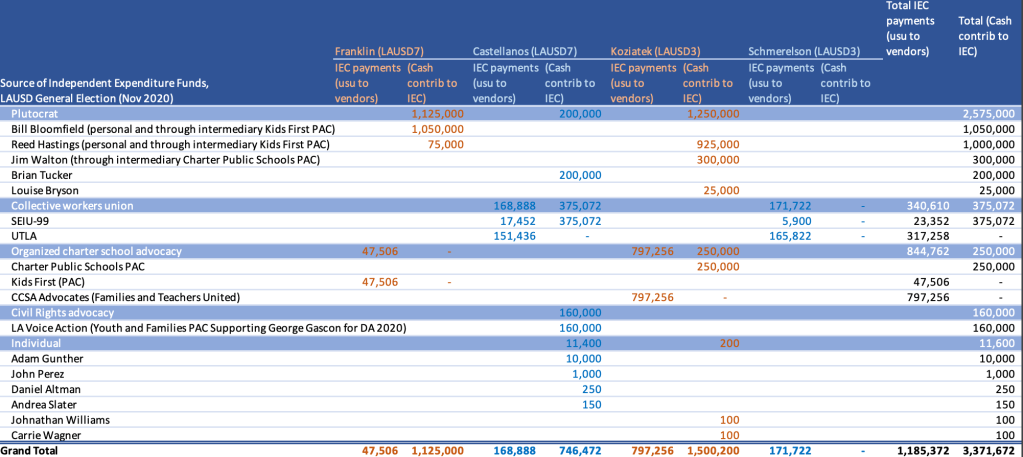
Both sides have been spending increasingly larger amounts to influence the outcomes of LAUSD races, and this year’s race has now eclipsed 2017 as the most expensive in L.A. history. Most of the ads are created with money from independent expenditure groups, called IEs or just outside spenders. These groups face no fundraising limits, and the candidates, whose campaign money is dwarfed by the influx of IE cash, aren’t allowed to influence the IE ads or approve their content. Legally they can’t coordinate with IE groups at all.

In 2020, IEs have spent more than $13 million on just these two board races. That’s $10 million more than IE money spent on all 2020 Los Angeles City Council races combined. And charter school advocates have enjoyed a lopsided financial advantage. Pro-charter forces have already spent far more than they did in 2017. The total spent on negative ads by pro-charter IEs on all LA school board races this year tops $5 million, about ten times more than money spent by UTLA and allies. And the L.A. City Ethics Commission site shows that a new mailer has gone out nearly every day in October.


The charter industry and the billionaires want to replace Scott Schmerelson with a charter employee. They want to buy control of the LAUSD school board.

Don’t let them! Stand with Scott, a veteran educator and a champion of public schools.

Tell the billionaires that the public schools of Los Angeles are not for sale!

Once again, control of the Los Angeles Unified School Distict school board is up for grabs, and once again the billionaires hope to buy control so they can expand the number of charter schools. The latest financial disclosures show that Reed Hastings of Netflix has contributed $925,000 to try to defeat veteran educator Scott Schmerelson. Billionaire Jim Walton of the Walmart family added another $300,000. The charter lobby is flush with money to buy TV ads and flyers that smear Schmerelson and use vicious anti-Semitic tropes in their attack ads. The charter lobby is angry at Schmerelson for two reasons: 1. He fights fearlessly for the 80% of students in public schools. 2. He released the explosive fact that 80% of Los Angeles’ charter schools have vacancies, not waiting lists. His opponent Marilyn Koziatek has no experience in the public schools; she holds an administrative job in a charter school.

Download the .pdf here.

Note: Sara Roos of Los Angeles (blogger Red Queen in LA) prepared the graph of political expenditures based on public records.