Archives for category: Guns

In a new ruling, the Supreme Court struck down a New York State law that limited access to guns. The New York law requires that people seeking to carry a handgun outside their homes must obtain a permit and show “proper cause.” There are similar laws in California, Hawaii, Maryland, Massachusetts, New Jersey and Rhode Island.

To those who claimed in 2016 that it didn’t matter if Trump was elected, this is what Trump’s three appointees to the Supreme Court have done: required Maine to pay for discriminatory born-again religious schools; overturned gun controls in New York; and will probably overturn Roe v Wade in the next few days. Elections have consequences. The lesser of two evils is always preferable to Pure Evil. A candidate who is good but not perfect is preferable to one who is ignorant and bigoted.

The Washington Post reports:

The Supreme Court said Thursday that Americans generally have a right to carry a handgun outside the home for self-defense and that a New York law requiring special need for such a permit is too restrictive.


The vote was 6 to 3, with Justice Clarence Thomas writing for the majority and the court’s three liberals in dissent.


“The Second and Fourteenth Amendments protect an individual’s right to carry a handgun for self-defense outside the home,” Thomas wrote, saying New York’s requirement of a specific need to carry a weapon violates that right.

“The constitutional right to bear arms in public for self-defense is not ‘a second-class right, subject to an entirely different body of rules than the other Bill of Rights guarantees.’ ” Thomas wrote, referring to a previous Supreme Court ruling. “We know of no other constitutional right that an individual may exercise only after demonstrating to government officers some special need.”


He was joined by the court’s conservatives: Chief Justice John G. Roberts Jr. and Justices Samuel A. Alito Jr., Neil M. Gorsuch, Brett M. Kavanaugh and Amy Coney Barrett.


In dissent, Justice Stephen G. Breyer pointed to the nearly 300 mass shootings since January and to data showing that gun violence has surpassed car crashes as the leading cause of death among children and teens. The majority’s decision, he said, will make it more difficult for state lawmakers to take steps to limit the dangers of gun violence.
The Second Amendment allows states to “take account of the serious problems posed by gun violence,” wrote Breyer, who was joined by Justices Sonia Sotomayor and Elena Kagan. He added: “Many States have tried to address some of the dangers of gun violence … by passing laws that limit, in various ways, who may purchase, carry, or use firearms of different kinds. The Court today severely burdens States’ efforts to do so.”

The party that claims to be “right to life” authorizes easier access to weapons of death. More people will die because this ruling. Under this court, the only protected class is the pre-born or the unborn. The born are in big trouble.

Forrest Wilder of the Texas Monthly has been trying to sort out the conflicting accounts of what happened at Robb Elementary School in Uvalde. He learned that everyone in a position of authority has gone silent. Governor Greg Abbott initiated the government response by praising the courage of law enforcement; when he learned that the shooter was left alone in the classrooms for more than an hour, he said he was “livid” about being misinformed.

One authority after another offered accounts and pointed the finger of blame for the slaughter of children and teachers. The State Senate promised a thorough investigation but Lt. Governor Dan Patrick pointedly left the Uvalde representative off the committee.

Now everyone has clammed up. Answers are not likely to be forthcoming until after the Governor’s race in November. A strategically timed response. Family members want to know what happened to their loved ones. They are not likely to get answers until Greg Abbott is safely re-elected.

Wilder writes:

More than three weeks have passed since the terrible events in Uvalde. What was once a torrent of appalling facts about the police response—many of them misleading or false—has now slowed to a trickle of leaks and lawyer-mediated, self-serving narratives. Governor Greg Abbott has pivoted to talking about the border again. Texas Department of Public Safety director Steve McCraw, last seen slipping into a closed-door meeting of a state House investigative committee, has gone quiet. The Uvalde schools chief of police, Pete Arredondo, finally emerged from hiding last week, lawyer at hand, to contradict reports that he had made the call to wait around for more than an hour while the gunman lingered in the classrooms with dead and dying children and teachers; hours later, key parts of his story were contradicted by evidence reported in the New York Times.

For anyone expecting an apology, accountability, or even a clear and concise narrative of what happened at Robb Elementary School on May 24, 2022, well, you may be waiting a while longer—perhaps forever. No one has resigned, no one has been fired, and local and state authorities from the Uvalde CISD superintendent up to the governor have stopped providing updates. Local and state agencies are refusing most requests to release information they are supposed to make available under Texas’s open records law, even to the state senator who represents Uvalde. Off-duty police from around the state, as well as mysterious motorcycle clubs whose members reportedly include former police officers, descended on Uvalde to physically block reporters from talking to families and community members, even after those locals had agreed to talk—a blockade so unusual and aggressive that one veteran Texas journalist has called it “bordering on official oppression.” It’s as if those in power concluded that the answer to communicating poorly was to stop communicating altogether, and to obstruct anyone seeking answers.

Perhaps all will be revealed soon. Perhaps ongoing investigations by the Texas Rangers and the U.S. Department of Justice will bring clarity. Perhaps the Texas House committee, which is taking testimony in private, will emerge with a full report. Perhaps someone will take responsibility. But right now, it seems that authorities are biding their time, waiting for public attention to move on to the next outrage, and hoping to insulate themselves from accountability. “People in Uvalde are angry,” said state senator Roland Gutierrez, a Democrat who represents the small city. “They want answers. They’re distrusting of law enforcement. The credibility of law enforcement is at stake,” he said. “They’re good people, but they just want honesty, man.”

The inflection point—the shift from a public reckoning to a studied silence—came on May 27, just three days after the nineteen kids and two teachers were killed. That morning McCraw gave a press conference in which he announced to a stunned world that police had committed a grave “mistake.” They had not, as Abbott and McCraw had stated in the immediate aftermath of the shooting, engaged the gunman at the earliest possible moment. Instead, the DPS director said, law enforcement had waited more than an hour before breaching the classroom and killing the shooter.

At the outset of the press conference, McCraw said his only goal that day was to “report facts” and not to “criticize what was done or the actions taken.” But faced with a barrage of pointed questions from the media, McCraw did point a finger—at Arredondo. Without using his name, McCraw said Arredondo, as incident commander that day, was responsible for the dilatory response. It was his decision—a “wrong decision, period”—to treat the gunman as a “barricaded subject” rather than an “active shooter.” It was Arredondo alone who had held back all the gathered law enforcement—Uvalde city police, the county sheriff’s deputies, Border Patrol officers, and DPS state police.

Later that day, Abbott held his own press conference. The governor, not known for his emotional range, seemed eager to convey outrage. In the immediate aftermath of the shooting, he had praised law enforcement for their “amazing courage” and averred that without their actions, “it could have been worse”—the “it” referring to the 21 deaths. Abbott wanted everyone to know that he had been wronged. “I was misled. I am livid about what happened,” he said. What happened, he explained, was that in the aftermath of the shooting “law enforcement officials and non–law enforcement officials” had debriefed him on the shooting. Abbott had taken notes by hand, writing everything down “in detail” and “in sequential order.” The information he then provided the public was a “recitation” of those facts.

Who had given him such bad information? What consequences would they face? If the governor was so angry, surely heads would roll. But Abbott offered no names, no accountability. In an unusually quick turnaround after an open records request, the governor’s office released his notes this week to a Houston television station. But the nine pages of scrawl confirmed only that Abbott had been misled, not who had done the misleading.

At the May 27 press conference, Abbott signaled that he was moving on. He admonished law enforcement leaders to “get to the bottom of every fact with absolute certainty” as part of their investigations. Ever since, Abbott, McCraw, and other officials have stopped answering questions or publicly sharing information, pointing to the ongoing investigations. It’s an all-purpose excuse. Republicans in the Legislature are using the investigations as a reason to avoid calling for a special session on gun violence prevention. They’re also conveniently postponing, perhaps forever, a discussion about gun safety; as one state senator put it, “bad facts make bad law.”

The story goes one. Subscribe to The Texas Monthly and finish reading.

The Houston Chronicle reports that the scores of police who responded to the Uvalde massacre did not try to open the doors of the classrooms where the shooter was killing children and teachers until more than an hour had passed. (The story was originally published in the San Antonio Express News.) The story is based on surveillance video.

When you read the story, you will see why Governor Greg Abbott and Lt. Gov. Dan Patrick are trying to block any public release of official investigations until after the state elections in November. More than 100 “good guys with guns”were unable to stop one bad guy with a gun. The more we learn, the more questions are raised about the training, competence, and courage of those who were supposed to protect the students and teachers.

Surveillance footage shows that police never tried to open a door to two classrooms at Robb Elementary School in Uvalde in the 77 minutes between the time a gunman entered the rooms and massacred 21 people and officers finally breached the door and killed him, according to a law enforcement source close to the investigation.

Investigators believe the 18-year-old gunman who killed 19 children and two teachers at the school on May 24 could not have locked the door to the connected classrooms from the inside, according to the source.

Interactive timeline: Minute-by-minute reconstruction of Uvalde school shooting

All classroom doors at Robb Elementary are designed to lock automatically when they close and can only be locked or unlocked from the outside with a key, the source said. Police might have assumed the door was locked. Yet the surveillance footage suggests gunman Salvador Ramos, 18, was able to open the door to classroom 111 and enter with assault-style rifle — perhaps because the door malfunctioned, the source said.

Another door led to classroom 112.

Ramos entered Robb Elementary at 11:33 a.m. that day through an exterior door that a teacher had pulled shut but that didn’t lock automatically as it was supposed to, indicating another malfunction in door locks at the school.

Police finally breached the door to classroom 111 and killed Ramos at 12:50 p.m. Whether the door was unlocked the entire time remains under investigation.

Regardless, officers had access the entire time to a “halligan” — a crowbar-like tool that could have opened the door to the classrooms even if it was locked, the source said.

Two minutes after Ramos entered the building, three Uvalde police officers chased him inside. Footage shows that Ramos fired rounds inside classrooms 111 and 112, briefly exited into the hallway and then re-entered through the door, the source said.

Ramos then shot at the officers through the closed door, grazing two of them with shrapnel. The officers retreated to wait for backup and heavy tactical equipment rather than force their way into the classrooms.

Pedro “Pete” Arredondo, the Uvalde school district police chief and the on-scene incident commander, has said he spent more than an hour in the hallway of the school. He told the Texas Tribune that he called for tactical gear, a sniper and keys to get inside. He said he held officers back from the door to the classrooms for 40 minutes to avoid gunfire.

When a custodian brought a large key ring, Arredondo said he tried dozens of the keys but none worked.

But Arredondo was not trying those keys in the door to classrooms 111 and 112, where Ramos was holed up, according to the law enforcement source. Rather, he was trying to locate a master key by using the various keys on doors to other classrooms nearby, the source said.

While Arredondo waited for a tactical team to arrive, children and teachers inside the classrooms called 911 at least seven times with desperate pleas for help. One of the two teachers who died, Eva Mireles, called her husband by cellphone after she was wounded and lay dying.

The Texas Tribune, an independent journal, has been first to report on the news about the Uvalde massacre. In this story, there are new revelations based on video footage from inside the school.

Some of our takeaways include:

  • The records show a well-equipped group of officers entered the school almost immediately. They pulled back once the shooter began firing inside the classroom. They waited for more than an hour to reengage.
  • There is no security footage that shows police officers attempted to open the classroom doors that the shooter hid behind. Law enforcement officials are skeptical, the Tribune has confirmed, that the doors were locked or that anyone physically tried to open them.
  • At least some officers on the scene seemed to believe that Arredondo was in charge inside the school, and at times Arredondo seemed to be issuing orders. That contradicts Arredondo’s assertion that he did not believe he was running the law enforcement response…

The officers in the hallway of Robb Elementary wanted to get inside classrooms 111 and 112 — immediately. One officer’s daughter was inside. Another officer had gotten a call from his wife, a teacher, who told him she was bleeding to death.

Two closed doors and a wall stood between them and an 18-year-old with an AR-15 who had opened fire on children and teachers inside the connected classrooms. A Halligan bar — an ax-like forcible-entry tool used by firefighters to get through locked doors — was available. Ballistic shields were arriving on the scene. So was plenty of firepower, including at least two rifles. Some officers were itching to move.

One such officer, a special agent at the Texas Department of Public Safety, had arrived around 20 minutes after the shooting started. He immediately asked: Are there still kids in the classrooms?

“If there is, then they just need to go in,” the agent said.

Another officer answered, “It is unknown at this time.”

The agent shot back, “Y’all don’t know if there’s kids in there?” He added, “If there’s kids in there we need to go in there.”

“Whoever is in charge will determine that,” came the reply.

Dean Obeidallah, a regular contributor to CNN, describes the Texas GOP’s defiant rejection of democracy. In an earlier post, I pointed out that the state convention booed Senator Jon Cornyn for daring to negotiate a bipartisan gun control deal (which did not include any of President Biden’s demands). That was the mildest of their actions.

He writes:

CNN) – Disturbing video from the Texas Republican Convention this weekend shows convention-goers mocking GOP Rep. Dan Crenshaw — a Navy SEAL veteran who lost his right eye to a bomb in Afghanistan — with the term “eye patch McCain.”

Fox News’ Tucker Carlson coined the derisive nickname after the Texas lawmaker dared to express support for beleaguered Ukraine following Russia’s barbaric attack on it.

But apparently even more heinous in the eyes of some attendees is that Crenshaw rejected former President Donald Trump’s claims that the 2020 election was stolen. One man wearing a red “Make America Great Again” hat can be seen yelling in an online video, “Dan Crenshaw is a traitor!” and “He needs to be hung for treason!”

As despicable as the behavior toward Crenshaw was, even more alarming were the actions taken by the Texas GOP and the convention’s 5,000-plus delegates.

The gathering rejected the outcome of a democratic election, supported bigotry toward the LGBTQ community and imposed far-right religious beliefs on others by seeking to have them enshrined into law. And that wasn’t half of it.

In fact, the convention showed us one thing: Texas Republicans are no longer hiding their extremism. Instead, they are openly embracing it.

Even before the opening gavel, they gave us a glimpse of the party’s extremism in the Lone Star State by banning the Log Cabin Republicans from setting up a booth at the convention.

Texas Republican Party Chairman Matt Rinaldi cast the deciding vote on the move to bar the group that has advocated for LGBTQ Republicans for decades. “I think it’s inappropriate given the state of our nation right now for us to play sexual identity politics,” Rinaldi told the Fort Worth Star-Telegram.

Once it formally got underway, the convention took a number of appalling and un-American actions. First, delegates approved a measure declaring that President Joe Biden “was not legitimately elected.” In short, the Texas GOP — like Trump himself — is embracing a lie because it’s unhappy with the election results. Put more bluntly, the Texas GOP voted to reject American democracy.

Republican delegates also booed John Cornyn, the senior US senator from Texas, at the convention Friday because of the Republican lawmaker’s role leading negotiations to reach a Senate deal on a bill to stem gun violence. Those legislative efforts follow last month’s horrific shooting that claimed the lives of 19 schoolchildren and two teachers in Uvalde, Texas.

The platform approved at the convention called for repealing or nullifying gun laws already in place, such as the Gun Control Act of 1968, which prevents felons and other dangerous people from being able to purchase a gun legally. Apparently, the Texas GOP believes that even dangerous people should have a constitutionally protected right to buy a gun.

The Texas GOP platform also embraced ramping up anti-abortion rhetoric in public schools. For example, the platform states that “Texas students should learn about the Humanity of the Preborn Child, including … that life begins at fertilization.” It even seeks to force students to watch “a live ultrasound” and for high-schoolers to read an anti-abortion booklet that critics say “includes scientifically unsupported claims and shames women seeking abortion care,” according to The Texas Tribune.

It sounds like the curriculum that you might find in a theocratic government such as the Taliban — not one in the United States funded by taxpayer dollars. But the GOP in large swaths of this country is no longer hesitant to support laws to impose its religious beliefs — as we see with measures some Republicans champion that would totally ban abortion. The GOP convention’s document additionally urges officials “not to infringe on Texas school students’ and staffs’ rights to pray and engage in religious speech.”

The Texas GOP platform also does its best to demonize those in the transgender community. It describes transgender people as suffering from “a genuine and extremely rare mental health condition.” And it sees sexual reassignment surgery as a form of medical malpractice.

The platform takes aim at gay Americans as well with the statement that homosexuality is “an abnormal lifestyle choice.” Instructively, the Texas GOP platform did not include such language in 2018 and 2020.

This platform gives us a glimpse into the views of the Republican base on key issues that in turn will pressure GOP elected officials in Texas — and possibly beyond the state — to adopt similarly extreme positions or run the risk of a primary challenge from an even more extreme Republican.

What caused this move to the far right? Brandon Rottinghaus, a political scientist at the University of Houston, told The Texas Tribune about the state GOP’s new extreme platform, “Donald Trump radicalized the party and accelerated the demands from the base.” He added alarmingly, “There simply aren’t limits now on what the base might ask for.”

I agree — in part. I don’t think Trump radicalized the base — rather he simply gave people permission to be who they always wanted to be.

But I agree with Rottinghaus that there are now no limits for what the GOP base might seek — be it rejecting election results it doesn’t agree with to enacting more laws based on extreme religious beliefs. And that should deeply alarm every American who wants to live in a democratic republic.

The convention also issued a call to repeal the 1965 Voting Rights Act, which guaranteed the right to vote for every citizen of voting age.

The only thing the Texas GOP neglected to do was pass a resolution congratulating the shooter at Uvalde for exercising his “God-given right” to use his AR15 as he saw fit.

Texas Senator Jon Cornyn returned to Texas, after leading bipartisan talks on a weak gun control bill, only to discover that his fellow Republicans were furious at him for participating in any deal

WASHINGTON — U.S. Sen. John Cornyn was back in Texas Friday without a final bipartisan gun bill and set to address a state GOP party whose members are furious with him for working with Democrats on reforms they say will violate their “God given rights.”

Cornyn left D.C. on Thursday evening, telling reporters that “it’s fish or cut bait at this point” on the legislation after he and other negotiators spent days ironing out details behind the scenes. But they were unable to reach a final agreement as they ran up against a self-imposed deadline to get the bill written this week.

“Indecision and delay jeopardize the likelihood of a bill because you can’t write what is undecided and without a bill there is nothing to vote on,” Cornyn tweeted. “We are still talking and the clock is ticking…”

Meanwhile, committee members hashing out the Texas GOP platform at its biennialconvention in Houston advanced a resolutionThursday night rejecting the gun deal in its current form and rebuking 10 Republicans who have publicly supported it.

“All gun control is a violation of the Second Amendment,” the resolution says.

When it came Senator Cornyn’s turn to speak at the state GOP convention, he was booed repeatedly, amid shouts of “no gun control.”

Clearly, the Texas GOP wants no limits whatever on the right of any individual to buy a gun of any kind, any size, any caliber, no matter whether they are deranged or have a criminal background or are terrorists.

Michael Hiltzik shows that California’s strict gun laws have reduced gun deaths, although their biggest foe is the federal judiciary, especially Trump-appointed judges.

The most predictable response by the gun lobby and its political mouthpieces to calls for stricter gun laws in the wake of mass shootings is that tough laws don’t work.

You’ve probably heard all the arguments: That we already have tough laws on the books, that the problem is they aren’t enforced. Or that the legislation most often proposed wouldn’t have stopped the latest perpetrator of the latest gun-related horror, such as Uvalde gunman Salvador Ramos.

None of that is true, and California, which has some of the strictest gun laws in the nation, is the proof.

As we’ve reported before, statistics from the Centers for Disease Control and Prevention show that overall firearm deaths in California, at 8.5 per 100,000 population in 2020, easily bests the rates in states with lax controls, such as Texas (14.2 per 100,000) and Louisiana (26.3).

The disparity is especially sharp when it comes to firearm deaths of those under 18. California’s rate is about half that of the national average, less than half that of Texas, and only about one-fourth that of Louisiana. 

ADVERTISING

null

It’s true that California has not been immune from the national epidemic of mass shootings. But its laws have had a measurable, positive impact. “California has not solved the problem of mass shootings,” says Ari Freilich, state policy director at the gun safety organization Giffords. “But California children are half as likely to be shot.” 

Let’s examine the key elements of California’s laws, and how they might have interfered with the latest major gun-related outrages — the killings of 19 children and two adults at Robb Elementary School in Uvalde, Texas, on May 24, and the killings of 10 people at a supermarket in Buffalo, N.Y., on May 14.

California’s firearms regulations are among the most comprehensive in America. Assault weapons, defined partially by their manufacturer and partially by their features, have been banned since 1989. Purchasers of any firearm must do so through a registered dealer and submit to a background checkammunition sales are also regulated.

Handguns can’t be sold to anyone under 21, and with certain exceptions to transfer other firearms to anyone under 18. All purchases require a waiting period of at least 10 days, or more if certain formalities haven’t been completed, such as a firearm safety course and passage of a test. Most are barred from buying more than one gun a month.

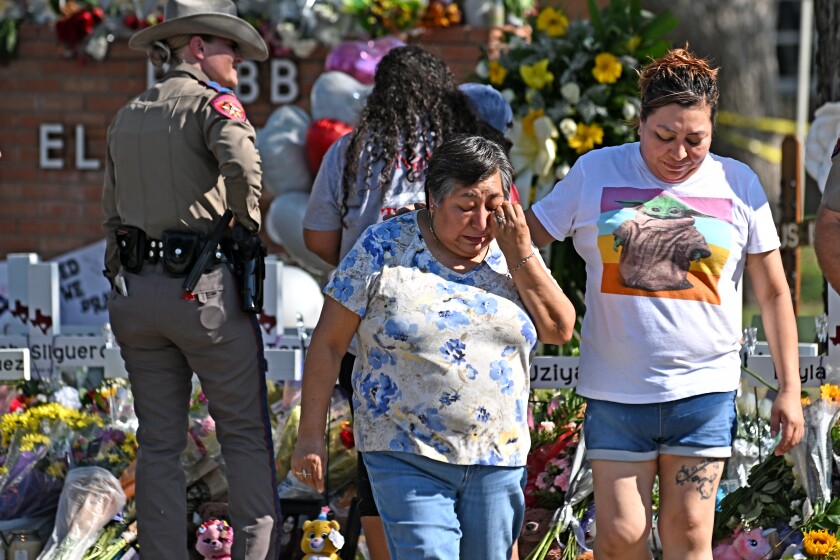
Uvalde, Texas May 26, 2022- Family members walk away after living flowers at a memorial outside Rob Elementary School in Uvalde, Texas. Nineteen students and two teachers died when a gunman opened fire in a classroom Tuesday. (Wally Skalij/Los Angeles Times)

BUSINESS

Column: Uvalde demonstrates our cowardice about guns

June 1, 2022

ADVERTISEMENT

null

Open carry of loaded firearms is generally prohibited, as is concealed carry of a loaded weapon without a license.

California also has a so-called red flag law, or “extreme risk protection orders,” which allow family members, police, employers or school personnel to alert authorities to signs of danger from a person and for a judge to order the confiscation of weapons from that person.

The California constitution has no provision protecting the right to bear arms. State law preempts all local initiatives.

One of the bizarre omissions in the bipartisan deal on gun control was the failure to raise the age to buy an assault weapon from 18 to 21. It is incomprehensible.

The Washington Post reported on studies that catalogue the sex and age of mass shooters. The killers are almost entirely male, and a large percentage are under 21. This leads the author of the study to propose raising the minimum age for buying a weapon to 21. Curiously, there is already a federal law banning the sale of handguns to anyone under 21, but no law banning the sale of long guns for that age. So the killer in Texas could legally buy two AR15s on his 18th birthday, but was not able to buy a handgun.

When Vanderbilt University psychiatrist Jonathan Metzl learned that the perpetrator of the Uvalde, Tex., school massacre was a young man barely out of adolescence, it was hard not to think about the peculiarities of the maturing male brain.


Salvador Rolando Ramos had just turned 18, eerily close in age to Nikolas Cruz, who had been 19 when he shot up a school in Parkland, Fla. And to Adam Lanza, 20, when he did the same in Newtown, Conn. To Seung-Hui Cho, 23, at Virginia Tech. And to Eric Harris, 18, and Dylan Klebold, 17, in Columbine, Colo.


Teen and young adult males have long stood out from other subgroups for their impulsive behavior. They are far more reckless and prone to violence than their counterparts in other age groups, and their leading causes of death include fights, accidents, driving too fast, or, as Metzl put it, “other impulsive kinds of acts.”

“There’s a lot of research about how their brains are not fully developed in terms of regulation,” he said. Perhaps most significantly, studies show, the prefrontal cortex, which is critical to understanding the consequences of one’s actions and controlling impulses, does not fully develop until about age 25. In that context, Metzl said, a shooting “certainly feels like another kind of performance of young masculinity.”


In coming weeks and months, investigators will dissect Ramos’s life to try to figure out what led him to that horrific moment at 11:40 a.m. Tuesday, May 24 when he opened fire on a classroom full of 9- and-10-year-olds at Robb Elementary School.

Although clear answers are unlikely, the patterns that have emerged about mass shooters in the growing databases, school reports, medical notes and interview transcripts show a disturbing confluence between angry young men, easy access to weapons and reinforcement of violence by social media.

Federal law requires people buying handguns from licensed dealers to be at least 21. But in Texas and in most other states, 18-year-olds can purchase what are known as long guns, which include assault rifles. In a prime-time address Thursday night, President Biden called for banning assault weapons but said that, if that’s not possible, lawmakers should raise the age to purchase such a weapon to 21. “The issue we face is one of conscience and common sense,” the president said.

In the wake of the 2018 Parkland shooting and other violent acts by young men, six states, including Florida, did raise the purchasing age for long guns to 21, over the objections of the National Rifle Association. The NRA calls such restrictions a “categorical burden” on the right to keep and bear arms, while Florida state attorneys argue that because “18-to-20-year-olds are uniquely likely to engage in impulsive, emotional, and risky behaviors that offer immediate or short-term rewards, drawing the line for legal purchase of firearms at 21 is a reasonable method of addressing the Legislature’s public safety concerns…”

“Age is the untold story of all this stuff,” said Metzl, who is also a sociologist. “I feel very strongly we should not have people 18 to 21 with guns.”

The United States is one of the only countries in the world where mass public shootings are a regular occurrence. Researchers Jillian Peterson from Hamline University and James Densley from Metropolitan State University, both in St. Paul, Minn., have spent their careers tracking these events, and their research shows that attacks are overwhelmingly carried out by men whose ages are strikingly clustered around two key periods in their lives.

Workplace attacks have been mostly carried out by men in middle age. School shootings, on the other hand, involve perpetrators mostly in their late teens or early 20s. Men in these same two age groups, Peterson points out, also have higher rates of suicide largely using firearms.

A Washington Post analysis of 196 mass public shootings in which four or more people were killed since 1966 shows that nearly 98 percent, or all but five, of the perpetrators were men. Forty percent of the shooters were between the ages of 18 and 29 and another third were between 30 and 45.

Based on statistics, I’d say that the best way to protect the public is to ban the sale of assault weapons and all other automatic or semi-automatic weapons. All such weapons now in private hands should be bought back and either destroyed or sent to Ukraine.

After the massacre at Marjory Stoneman Douglas High School in Parkland, Florida, the state passed a series of gun control measures. The new state leadership wants to loosen those laws. The incoming leader of the Florida House of Representatives wants to pass a state constitutional amendment guaranteeing the right to carry a gun openly, without a permit.

The Miami Herald reported:

Incoming Florida House Speaker Paul Renner told a supporter his chamber would move a “constitutional carry” policy for gun owners in Florida in the next legislative session, according to a video surreptitiously recorded at a fundraising event last month and posted online.

In the video, which was filmed at a House GOP fundraising event in Ocala on May 17, a man pulls Renner aside and asks if expanding the right for Floridians to carry guns without permits would be a legislative priority.

“I can tell you, we’ll do it in the House,” Renner tells the man. “We need to work on the Senate a little bit…”

“The issue on constitutional carry is whether government should be playing a role in saying whether you can or can’t carry outside the home when you meet the basic requirements of being able to pass a background check,” he said.

In April, Gov. Ron DeSantis promised to deliver a bill allowing permitless carry before his time as governor was through. The support of Renner, who leads one of Florida’s two legislative bodies, would mean the policy would have significant momentum next legislative session.

Current Florida law requires handgun owners to obtain a license to carry their weapons in most public places. Open carry of weapons is mostly prohibited: Florida’s licenses only allow gun owners to carry guns concealed on their person. In order to get a concealed carry permit, a handgun owner has to take a training class that includes instruction involving the live firing of a loaded gun.

In other states, “constitutional carry” has allowed gun owners to carry their weapon without a permit — and thus without going through that training. Supporters call the policy “constitutional carry” because they argue the Second Amendment’s guarantee of the right to bear arms means Americans should be able to carry without the regulatory burden of obtaining a permit.

Read more at: https://www.miamiherald.com/news/politics-government/state-politics/article262354382.html#storylink=cpy

There was a good deal of excitement about the bipartisan deal on gun control, in which 10 Republican senators agreed to endorse proposed legislation. That’s enough to block a filibuster, if all 10 Republican senators vote for the legislation. When even one Republican agrees to any form of gun control, it’s cause for celebration.

Since the Uvalde massacre, public support for gun control has solidified along partisan lines. According to the latest NPR/PBS NewsHour/Marist poll, 59% favor curbing gun violence, while 35% do not. That includes 92% of Democrats in favor, along with 54% of independents. However, “70% of Republicans say it’s more important to protect gun rights. Notably, however, 56% of gun owners say it is more important to curb gun violence than protect gun rights.”

NPR summarized the key points of the new agreement:

The proposal, which has not been written into legislative text, includes money to encourage states to pass and implement so-called “red flag” laws to remove guns from potentially dangerous people, money for school safety and mental health resources, expanded background checks for gun purchases for people between the ages of 18 and 21 and penalties for illegal straw purchases by convicted criminals.

CNN described what’s in the deal and what’s not.

It has been endorsed by major gun control groups, like Everytown for Gun Safety and Moms Demand Action, because it is the first such measure with a chance of passage since 1994, when Congress agreed to ban the sale of assault weapons, a ban that expired in 2004.

I say the proposed legislation is a nothing-burger. It is toothless, or to be fair, it has only one or two teeth.

It will not stop future massacres. It does not ban the sale or manufacture of AR15s or other automatic or semi-automatic weapons that have been used in massacres. It makes no attempt to buy back the 400 million weapons now owned by Americans.

It does not raise the age from 18 to 21 for buying a military-grade assault weapon, even though federal law prevents those under 21 from buying a handgun.

It does not require a waiting period of 2-3 weeks to buy an assault weapon, although there are heightened background checks for buyers under 21.

It does not ban internet sales of AR15s and other military-grade weapons.

It pours billions into mental health programs and school security, which is a good thing, but satisfies the Republican claim that guns are not the problem, mental health and school security are.

Under the terms of this bill, the Uvalde killer could still buy his weapons.

The murderer of 20 children and six school staff at the Sandy Hook massacre in 2012 would still have weapons because his mother bought them.

The 2016 massacre at the Pulse nightclub in Orlando, where 49 people were murdered by a man with semi-automatic weapons, would not have been deterred.

The mass murderer who killed 60 people at a Las Vegas music festival in 2017 would not have been stopped.

The 2018 massacre of 11 people at the Tree of Life Synagogue in Pittsburgh by a white supremacist and anti-Semite would not have been prevented.

This is weak tea. Even the NRA could possibly endorse this bill, although it is just as likely to raise symbolic opposition to satisfy its most zealous members. The lead Republican negotiator was Texas Senator Jon Cornyn, a favorite of the NRA. He is one of the top recipients of NRA funding. The NRA gave him an A+ rating for his fidelity to its evil agenda (and he bragged about it on his website).

With this two-tooth bill, Republicans can crow that they supported “responsible” (I.e. limited) gun control. Democrats can claim victory too simply because a gun control bill was forged and might pass. Democrats will support it because a slice of bread, even a few crumbs, is better than nothing at all.

But this bill will do nothing to prevent future massacres in schools, churches, synagogues, nail salons, movie theaters, nightclubs, anywhere that people gather.