Archives for category: Education Reform

More than 200 deans of education at scores of colleges and universities have organized to resist the corporate reformers’ efforts to deprofessionalize teaching and destroy public education. They call themselves Education Deans for Justice and Equity. They work in partnership with the National Education Policy Center. If you are a faculty member, please ask your dean to sign on. If you belong to an education organization, please consider adding its support.

“Dear Education Deans:

“As the start to a new academic year unfolds, so do increasing attacks on public education. Building on the “Declaration of Principles” that was released in January of this year and signed by 235 education deans, many of us feel compelled to continue to speak out collectively, publicly, and forcefully.

“Towards this end, we have prepared a new statement from education deans, “Our Children Deserve Better,” that counters the harmful rhetoric and actions currently coming from Washington with alternatives that are grounded in an ethical foundation, sound research, and a commitment to democratic values. The statement is a project of Education Deans for Justice and Equity, in partnership with the National Education Policy Center.

“Invited to sign are all current and former deans of colleges and schools of education in the United States (or comparable positions such as chairs, directors, and associate deans in institutions where there is no separate dean of education or school of education). We urge signing by August 30, because we are planning for the public release and distribution of the statement in early September.

“Please consider signing, and please consider committing to encouraging at least several other education-dean colleagues to sign so that we reach our goal of hundreds of signatories. The statement and the form for you to sign on is here:
https://goo.gl/forms/JXR2s1LZUcd6DaNh2.

“In solidarity,

“Kevin Kumashiro, on behalf of EDJE and NEPC”

This is a shocking story.

Trump was trying to strike a deal to build a Trump Tower in Moscow as he was running for president. He hoped to have Putin’s help.

The story was reported also in the New York Times.

Trump’s base won’t care. They admire Putin. They love Trump. Who cares if Putin chose our president?

Anne Applebaum writes about Russia and Eastern Europe for The Washington Post. She reports that Ukraine took down the last of 1,320 statues of Lenin. Her reflections about Eastern Europe bear on the question of why Confederate Monuments have suddenly become an issue under Trump when there were not, during eight years of Obama’s presidency. Why now?

She writes:

“I was in Warsaw on Nov. 17, 1989, the day that the city decided to take down its statue of Felix Dzerzhinsky. Given that Dzerzhinsky, a Polish aristocrat and dedicated Bolshevik, was best known as the founder of the organization that became the Soviet KGB, and given that hundreds of thousands of Poles were murdered or deported by the Soviet KGB, this was a popular decision. Crowds converged on the scene and cheered loudly as a crane removed the figure from its base.


“Why had it lasted so long if it was so unpopular? The statue was a symbol of Soviet domination, and while the Soviet-backed communist regime ruled the country, from 1945 to 1989, nobody dared remove it. Even after a non-communist government was finally elected in June 1989, it took some time before anybody thought about the statue. So why Nov. 17?

“Perhaps it was because eight days earlier, on Nov. 9, East Germans walked for the first time through the Berlin Wall. People felt that a historic moment had arrived. Change was in the air. Walls were falling, statues were toppling, and Warsaw wanted to participate in this symbolic revolution too.

“
A year later I was in Lviv, in western Ukraine, when that city decided to remove its Vladi­mir Lenin statue — another symbol of Soviet domination, bloody dictatorship, terror and famine. The cause of that decision was, once again, genuine political change. It was September 1990: Restrictions on politics and press had just been lifted, the debate about Ukrainian independence had just begun, and suddenly nobody was afraid of the Soviet state anymore. A crowd in the small town of Chervonograd had demolished its Lenin statue and Lviv followed suit; these things were viral, even back when there was no social media.


The removal of the Lenin statue was important not because it was political theater, but because it reflected real change, at least for some. In the space where the Lenin statue had stood, a lovely square in front of the opera house, people gathered to debate. Some felt afraid; others felt, as President Trump now says he does, that old statues were part of “history” and shouldn’t be removed. Nostalgia for the autocratic system that Lenin represented was still strong, and indeed many monuments to him remained all across Ukraine — at least until another wave of political change, sparked by a street revolution and a foreign invasion, inspired another wave of removals.

Just this month, 26 years after the U.S.S.R. ceased to exist, the Ukrainian government announced that it had finally removed every single remaining Lenin statue, all 1,320 of them.


I thought of both of these moments a few days ago, when I read the words of the writer Vann R. Newkirk II in the Atlantic about his childhood in North Carolina: “For most of my life I didn’t know Confederate statues could come down.” Nor did he know — I didn’t know either — that the statues to Confederate generals and soldiers in the American South were erected not in the immediate aftermath of the Civil War but decades later, as a part of the imposition of Jim Crow.

To anyone with experience of 1989-1990 in Europe, his earlier assumption that the statues were a hateful but an immutable part of the landscape seems familiar; so does his delight to discover, in 2017, that they can be removed.


But there is another parallel. Polish and Ukrainian statues came down as the result of a revolutionary moment, a sudden break in the political situation. In the United States in 2017, we are living through what feels to many like a similar, though not entirely analogous, revolutionary moment. The election of Trump, the first American president in decades to use unapologetically racist language — starting with his insidious slur that Barack Obama was not American, moving on to his reference to Mexican “rapists” and continuing with his refusal to condemn neo-Nazis — has smashed the ordinary rhythms of American political life. Suddenly, in Trump’s America, a statue honoring a Confederate leader looks like not just a boring monument to the distant past but a living political statement about the present.


As I’ve said, these movements have always been viral; there will be plenty of copycats, and some of them will be silly or self-serving, especially those organized by students who imagine that changing a building’s name changes something real. But the movement to topple Confederate statues is precisely the opposite: People want to change the statues because they want to resist something real — a real threat, which may be accompanied by real violence. As long as Trump is in office, the movements against Confederate monuments, from the public and from public officials, will continue. I hope they have the same success as protesters in Warsaw and Lviv did.
John Danforth was a much-beloved Senator from Missouri. He is an old-style moderate. He was in office before the rightwing billionaire Rex Sinquefield decided to buy the state. He wrote to explain why Trump is not a Republican.

John C. Danforth was a Republican U.S. senator from Missouri from 1976 to 1995.

Many have said that President Trump isn’t a Republican. They are correct, but for a reason more fundamental than those usually given. Some focus on Trump’s differences from mainstream GOP policies, but the party is broad enough to embrace different views, and Trump agrees with most Republicans on many issues. Others point to the insults he regularly directs at party members and leaders, but Trump is not the first to promote self above party. The fundamental reason Trump isn’t a Republican is far bigger than words or policies. He stands in opposition to the founding principle of our party — that of a united country.

We are the party of Abraham Lincoln, and our founding principle is our commitment to holding the nation together. This brought us into being just before the Civil War. The first resolution of the platform at the party’s first national convention states in part that “the union of the States must and shall be preserved.” The issue then was whether we were one nation called the United States or an assortment of sovereign states, each free to go its own way. Lincoln believed that we were one nation, and he led us in a war to preserve the Union. That founding principle of the party is also a founding principle of the United States.

Even when we were a tiny fraction of our present size and breadth, the framers of our Constitution understood the need for holding ourselves together, whatever our differences. They created a constitutional structure and a Bill of Rights that would accommodate within one nation all manner of interests and opinions. Americans honor that principle in the national motto on the presidential seal: “e pluribus unum” — “out of many, one.” Today, the United States is far more diverse than when we were a nation of 3 million people , but the principle remains the same: We are of many different backgrounds, beliefs, races and creeds, and we are one.

The Republican Party has a long history of standing for a united country. Theodore Roosevelt raised up the ordinary people of his day and championed their cause against abusive trusts. Dwight Eisenhower used the army to integrate a Little Rock high school. George H.W. Bush signed the most important civil rights legislation in more than a quarter-century, a bill authored by Republican senators. George W. Bush stood before Congress and the nation and defended Muslims after 9/11. Our record hasn’t been perfect. When we have pushed the agenda of the Christian right, we have seemed to exclude people who don’t share our religious beliefs. We have seemed unfriendly to gay Americans. But our long history has been to uphold the dignity of all of God’s people and to build a country welcoming to all.

Now comes Trump, who is exactly what Republicans are not, who is exactly what we have opposed in our 160-year history. We are the party of the Union, and he is the most divisive president in our history. There hasn’t been a more divisive person in national politics since George Wallace.

It isn’t a matter of occasional asides, or indiscreet slips of the tongue uttered at unguarded moments. Trump is always eager to tell people that they don’t belong here, whether it’s Mexicans, Muslims, transgender people or another group. His message is, “You are not one of us,” the opposite of “e pluribus unum.” And when he has the opportunity to unite Americans, to inspire us, to call out the most hateful among us, the KKK and the neo-Nazis, he refuses.

To my fellow Republicans: We cannot allow Donald Trump to redefine the Republican Party. That is what he is doing, as long as we give the impression by our silence that his words are our words and his actions are our actions. We cannot allow that impression to go unchallenged. As has been true since our beginning, we Republicans are the party of Lincoln, the party of the Union. We believe in our founding principle. We are proud of our illustrious history. We believe that we are an essential part of present-day American politics.

Our country needs a responsibly conservative party. But our party has been corrupted by this hateful man, and it is now in peril. In honor of our past and in belief in our future, for the sake of our party and our nation, we Republicans must disassociate ourselves from Trump by expressing our opposition to his divisive tactics and by clearly and strongly insisting that he does not represent what it means to be a Republican.

Joanne Yatvin, now retired, was a teacher, principal, and superintendent, as well as a literacy specialist.

The Myth of “Our Failing Schools” and How to Destroy It

An interesting article on the public’s perception of the quality of our public schools appeared in The Atlantic on July 15. I will summarize it today and add my opinions.

As a long time reader of the Phi Delta Kappan, an education journal, I am familiar with the results of its yearly poll reports on the public’s perception of our public schools. As long I can remember, most parents have given their children’s school an A or B rating. But when it comes to rating public schools in general, the responders are not so positive. Around 70 percent of them have consistently given those schools a C or D grade.

What’s going on here? According to Jack Schneider, a researcher at the College of the Holy Cross, the answer is simple: When evaluating their own children’s school, parents know a lot about what is happening there first hand . Most of them are pleased with their children’s experiences, and what they see or hear happening for other children. But when asked to evaluate the vast number of schools elsewhere, they only know what they read in the newspapers or hear on television. And most of those sources report that our public schools are failing to teach students what they need to know to succeed in college or the workplace.

Schneider identifies the source of this belief as the “politics of education.” He says, “Beginning with the launch of Sputnik in 1957, the leaders in Washington have argued with increasing regularity that our country’s schools are in crisis.” He adds that, “The failing-school narrative has been quite effective in generating political will for federal involvement in education.” Unfortunately, that narrative is not an accurate description of any school; it is based only on a single piece of data: students’ test scores

Although the scores for their own school may also be low, parents get a much broader range of information about the progress of their children, which includes report cards, parent/teacher conferences, individual pieces of students’ work, and school events. They may also get monthly newsletters from the principal that highlight the good things happening at school. Even if their own child is not doing well academically or behaviorally, parents may very well be receiving information about the help he is getting and the progress he is making.

Although there doesn’t appear to be any change in the dominance of data in the news media, there is one thing in the new ESSA law that may give everyone a broader picture. In the plans for improving their schools all states are now required to report to the Department of Education on several other conditions beyond test scores, such as graduation rates, school attendance, and the numbers of students enrolled in advanced courses. The only trick in reporting all this information to the public is weaving it into a seamless report that will show the full quality of any school.

Unfortunately, broader pictures would still not be enough to make all schools successful. High poverty schools need better financial support to keep class sizes small enough for all students to get attention to their needs and class behavior to be manageable. They also need sufficient funding to lure in high quality teachers and give them the school structures and extra time necessary to do a great job.

In addition, testing for all schools needs to be more reasonable than it is now. Instead of tests created to match the unrealistic expectations of the CCSS, every state should be able to get a test designed to fit its curriculum and the values of its people.

Right now it is not our public schools, but the federal government that is failing to educate our children well. We must overhaul the system to allow, support, and accurately report the greatness of which this country’s schools are fully capable.

Leonie Haimson assesses the latest test scores from New York. New York is still using the Common Core, but with a new name, so of course the majority of students in the state “failed,” which was the purpose of the Common Core standards, to make public schools look bad so that privatization would be easier to sell to the public.

Leonie has something that no one in the New York State Education Department has: a historical memory, clear knowledge of the frequent changes in cut scores, constant manipulation of the data.

Leonie writes:

“The NY state and city test scores were released this week. Proficiency rates statewide increased again though by a smaller amount than last year. In English Language Arts, the percentage of students in grades 3-8 who scored at proficient levels increased by an average of 1.9 percentage points; from 37.9% in 2016 to 39.8%. In math, the students who scored at proficiency rose to 40.2%, up 1.1 points from 29.1% last year.

“In NYC the increases were a little larger: a gain of more than two points in ELA proficiency to 40.6% and 1.4 points to 37.8% proficiency in math.

“Commissioner Elia, Mayor de Blasio and Chancellor Farina claimed that the increase in proficiency since 2013 was strong evidence that our students and schools are making progress.

“Yet the reality is that the trends over the last 15 years have not matched any of the trends on the more reliable national test called the NAEPs, for either NYC or the state as a whole.

“In fact, the NY State Education Department has appeared unable since 2002 to produce a reliable test and score it consistently enough to allow one to assess if there’s been any sort of improvement in our schools. Instead, Commissioners and their staff have repeatedly changed cut scores and set proficiency rates to make political points.

“There are many ways to show increases in proficiency — a metric notoriously easy to manipulate — including making the tests easier, shorter, giving them untimed, and/or changing the scoring by lowering the raw scores to scale scores or the cut scores need for proficiency. The state has used all these tricks over time.”

Read it all. She nails the fraud perpetrated by the state and ignored by journalists.

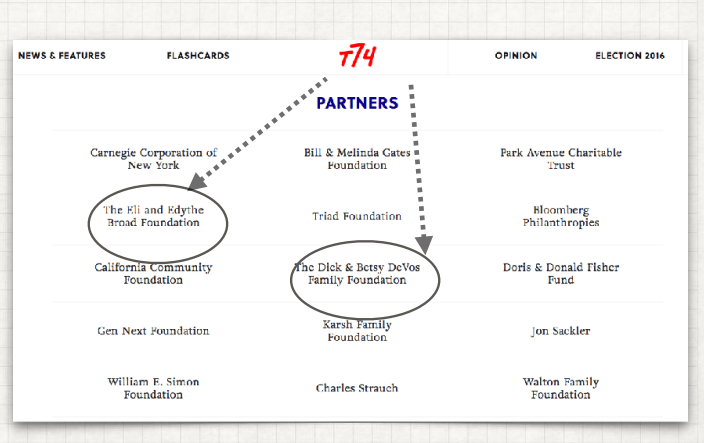
You may be familiar with an education news site called The 74. It was founded by Campbell Brown, the strident critic of unions and public schools and teachers. It now owns a website in Los Angeles called LA School Report and another called Top Sheet.

Ever wonder where the money comes from? Billionaires, of course, including billionaires who are hostile to unions and public schools. One regular contributor to The 74 is Peter Cunningham, who was Assistant Secretary for Communications (public relations) for Arne Duncan. Cunningham is editor of a website called Education Post, which is funded by some of the same billionaires, including Eli Broad, the Walton Family, Bill & Melinda Gates, the Emerson Collective (Laurene Powell Jobs), the Joyce Foundation, and Michael Bloomberg. In a recent post at The 74, he aligned his own views with those of Betsy DeVos, one of the funders of The 74. On the issue of privatization, school choice, charters, and vouchers, there is no longer any distance between the education policies of the Obama administration and those of the Trump administration. What a strange world. Sad.

Despite the many millions poured into these websites, I venture to guess that they have fewer readers than the blogs written by teachers like Anthony Cody, Julian Vasquez Heilig, Jose Vilson, Steve Singer, Mercedes Schneider, Gary Rubinstein, Arthur Goldstein, Paul Thomas, Leonie Haimson, Peter Greene, the BadAss Teachers, and yours truly. None of our blogs are underwritten by billionaires or millionaires. We write because we believe that the destruction of public schools is wrong.

In case you ever wondered who supports The 74 and its related entities, here is a screen shot:

Michael Gerson was a speechwriter for George W. Bush,

In this post, he compares Trump in Phoenix to Trump reading a prepared script.

The unscripted Trump is the real Trump. He is seriously delusional.

https://www.washingtonpost.com/opinions/trumps-rhetorical-schizophrenia-is-easy-to-see-through/2017/08/24/2163ab42-88f3-11e7-a50f-e0d4e6ec070a_story.html

Ah, Trump and his tweets.

This morning he attacked Republican leaders (again), and he tweeted a series of images showing him “eclipsing” Obama. He is obsessed with Obama and has a deep personal need to assert that he is way, way better than his predecessor. He must sense that millions of people far prefer Obama to him, which pushes Trump to double down on his ridiculing of Obama.

The military also announced that it is beginning to develop plans to oust transgender service members and to bar them completely in the future, because Trump tweeted an order.

On the recommendation of a trusted friend, I recently subscribed to the Andrew Tobias blog. I have not been disappointed. It does not appear every day, but when it does, it is always interesting. Tobias recently posted this:

He writes:

A lot of good folks think we should leave the statues where they are. (The numbers may surprise you.)

Our very own Jim Burt may have come up with the perfect solution:

“My wife and I are both originally from Memphis,” hew writes. “Close to the downtown area, the city has a park now called ‘Health Sciences Park’ – because of the proximity of the University of Tennessee medical school – which used to be called ‘Forrest Park.’ It features a large equestrian bronze statue of Nathan Bedford Forrest. The City of Memphis has been trying to remove it, but its efforts have been frustrated by a state historical commission empowered by the Republican state government to prevent such removals. This is what I wrote to the city’s most prominent newspaper (for which my father worked for many years):

“I am a white former resident of Memphis and have fond memories of playing as a toddler in Forrest Park. I did not at that age appreciate that the park was named after a monster.

“Since the Tennessee Historical Commission is performing its assigned racist task of frustrating the removal of racist monuments, I suggest that the next best action — which should be entirely within the authority of the City of Memphis — is to correct the historical record on the Forrest statue. The name on the pedestal should have the word “Traitor” added in large letters, and the account on the pedestal of his deeds should be supplemented prominently with the information that he was a slave merchant, war criminal, and founder of the terrorist organization, the Ku Klux Klan. It should also note that the statue was erected in 1904 as an expression of the power of Jim Crow and the subjugation of African Americans.

“After all, the supporters of keeping these statues claim that they’re about “history, not hate.” Just get all the history out there where it can be seen.”

☞ What say you?”