Archives for category: Education Reform

Peter Greene here makes a case for “vagueness” and against national and state standards.

“I am opposed to national or state standards. I recognize that in this I am a bit out there, and I recognize that reasonable people can believe that state and federal standards would be a good idea. I just don’t agree.

“However, I am not an advocate of completely unstructured wandering classrooms. You should know why you’re teaching what you’re teaching; you should have goals and objectives in teaching that material. So, no– I’m not lobbying for the Classroom of Do As You Please.

“Also, feel free to insert “in my opinion” in front of all the following.

“That said…

“The kind of laser-sharp focus advocated by some educational folks gives me the creeps.

“Sitting a department down to say, “We’re going to figure out how we can all teach exactly the same things for exactly the same purposes aimed at exactly the same outcomes,” diminishes the professionalism of the people in the room and does not serve the education of their students.

“Laser-sharp focus on a single objective is a bad idea, a stultifying limiting idea. I say this not just as an education viewpoint, but a life viewpoint. People who focus on one single objective are the people who throw away gold because they were focused, laser-like, on digging up diamonds. Yes, some of them find diamond mines, but mostly they barrel through a lot of other human beings and riches of another kind because of their laser-like focus.

“Laser-like focus also encourages you to view every deviation from the path as a crisis, a sign of impending disaster, instead of an opportunity. Laser-like focus fosters high-strung panic instead of sparkling improvisation.”

I posted this morning about a very poorly designed “evaluation” of North Carolina’s voucher program, whose purpose seems to have been to satisfy the wealthy school choice advocacy groups.

This additional review confirms that impression and shows how poorly constructed the evaluation was and how misleading its PR. This kind of research mars the professional reputation of those associated with it, though it may land them grants from the Walton Foundation.

“The report’s primary flaw is that it has no external validity. That is, the students tested as part of this study are different from the average Opportunity Scholarship student. As a result, there’s no reason to think that the untested Opportunity Scholarship students would similarly outperform their public school counterparts. As the Charlotte Observer‘s Ann Doss-Helms noted, just over half of the voucher schools that participated in the study were Catholic, while only 10 percent of all schools receiving Opportunity Scholarship vouchers are Catholic. Additionally, the report only looked at students who were recruited and volunteered to take a test. These students are different from the average voucher student.

“Because of these differences, you can’t use the report to make claims about the average voucher student or the impact of the voucher program overall. The effects highlighted by the researchers only apply to the 89 Opportunity Scholarship students (in the researcher’s preferred comparison) who volunteered to be tested, representing just 1.6 percent of the 5,624 Opportunity Scholarship students in the 16-17 school year. The report tells us nothing about the other 98.4 percent of Opportunity Scholarship students.”

One of the researchers told the local newspaper “the study she and her colleagues conducted provides valuable insights but doesn’t mean the average scholarship recipient is outperforming peers who stayed in public schools.”

What? Useless! What a sham!

And voucher boosters are singing its praises.

“Regardless, the report’s biggest weakness remains that the results – even if accurately measured – tell us nothing about the program as a whole. Because the report only examines the test results of a small, non-representative sample of students who volunteered to participate, these results don’t tell us whether the average scholarship recipient is outperforming peers who stayed in public schools. The report (though not the press release) makes this flaw clear. To the extent the report tells us anything about student performance of voucher students, it only tells us about the 1.6 percent of voucher students recruited to take part in the study.

“In short, this report is not an evaluation in the common understanding of the word. Despite the report’s publicity, it does nothing to tell us whether the Opportunity Scholarship is helping or hurting its students. And the roll-out, coordinated with right-wing advocacy groups, has done more to misinform, rather than inform, the public.”

The researchers might give some thought to their professional standards and ethics. They have embarrassed their profession.

The prestigious American Medical Association took a strong stand against gun violence, calling for a complete ban on assault weapons and opposing the arming of teachers.

At its annual policymaking meeting, the nation’s largest physicians group bowed to unprecedented demands from doctor-members to take a stronger stand on gun violence — a problem the organizations says is as menacing as a lethal infectious disease.

The action comes against a backdrop of recurrent school shootings, everyday street violence in the nation’s inner cities, and rising U.S. suicide rates.

“We as physicians are the witnesses to the human toll of this disease,” Dr. Megan Ranney, an emergency-medicine specialist at Brown University, said at the meeting.

AMA delegates voted to adopt several of nearly a dozen gun-related proposals presented by doctor groups that are part of the AMA’s membership. They agreed to:

— Support any bans on the purchase or possession of guns and ammunition by people under 21.

— Back laws that would require licensing and safety courses for gun owners and registration of all firearms.

— Press for legislation that would allow relatives of suicidal people or those who have threatened imminent violence to seek court-ordered removal of guns from the home.

— Encourage better training for physicians in how to recognize patients at risk for suicide.

— Push to eliminate loopholes in laws preventing the purchase or possession of guns by people found guilty of domestic violence, including expanding such measures to cover convicted stalkers.

Many AMA members are gun owners or supporters, including a doctor from Montana who told delegates of learning to shoot at a firing range in the basement of her middle school as part of gym class. But support for banning assault weapons was overwhelming, with the measure adopted in a 446-99 vote.


Whom do you trust? Physicians or the NRA?

The rabid rightwing General Assembly passed a law to allow expansion of charters, that would predictably encourage more segregation. The NAACP has threatened a lawsuit to block the charter law, as well as a voter ID requirement, which they believe is intended to suppress the black vote.

The NAACP is warning companies like Apple and Amazon not to locate in NC.

Read Jeff Bryant on the charter law. Racism. Segregation. The Old South is back.

John Merrow announced on his blog that he planned to ride his bike 77 Miles to celebrate his 77th birthday.

Not only did he reach his goal, he exceeded it!

And he raised $85,000 for three worthy charities.

Thank you, John!

Mission Accomplished:77+ miles=$85,000+

William Mathis is managing director of the National Education Policy Center and Vice-President of the Vermont State Board of Education. He sent this report to the blog exclusively. Hanushek is a strong believer in testing, accountability, and school choice, as well as annually firing the bottom 5% of teachers, as identified by their students’ test scores.

Dr. Hanushek Again Imagines Saving Trillions of Dollars

William J. Mathis

In a recent brief published by the American Enterprise Institute, economist Eric Hanushek announces that $76 trillion (that’s a “T”) dollars will be generated or saved by adopting unspecified educational reforms.[i] That’s almost a four-fold increase! The closest explanation of these mysterious school improvements is that they are “incentives” for “teachers and leaders.” In a longer technical version of the brief, the authors dismiss the need for more specifics stating “the precise source of the given improvements is not important.”[ii](p.466)


Hanushek is the Paul and Jean Hanna Senior Fellow at the conservative Hoover Institution of Stanford University, best known for his frequent testimony on behalf of defendants in school-funding litigation. But his work also includes analyses of teacher effectiveness, among other topics.


The argument made in the new AEI brief is one he and his colleagues have made repeatedly over the years. It goes like this: If we imagine that standardized test scores go up a certain amount, this will add trillions to the GDP. Alas, this argument is little more than a numerological exercise in assumptions, multiplication and extrapolation.  The astonishing increased dollar amounts are the result of “new estimates of … human capital stock” and assumptions about growth, which are then extrapolated to the nation. It assumes that NAEP test scores are a valid measure of workforce quality which will, in turn, drive the economic gains. As noted, this improved workforce is developed through unspecified “significant changes in school policies.”

The AEI brief does not present the actual methods or results, but some of these are found in the original technical paper, which itself circles back to the authors’ other work. In the end, the analyses fail in predictable ways:

  • They oversimplify the complex relationship between education and national wealth,
  • They are based on correlations which are interpreted as causal,
  • The statistical approach exaggerates the results, and
  • Workforce projections do not support this static scenario.


Oversimplifying – Education and wealth are certainly connected. But assuming education has this pervasive power over the economy ignores the complex set of interactive factors affecting the economy. This includes infrastructure, transportation, investments, political instability, climate, poverty, social changes and macroeconomic supports.[iii] In fact, two-thirds of the variance in test scores is attributable to outside of school influences.[iv]


Correlations are interpreted as causation – “Gains from school activities” certainly sounds causal. More specifically, the long paper flatly states the “… gains in annual GDP [are] due to educational reforms.” (p.470). But then, they back away and state causality is “challenging.” (p.479)

The core assumption of the piece is illustrated in a scatterplot of test scores and state economic growth (Figure 1, reproduced below). This includes an “estimated impact” of education on a state’s wealth. Little or no consideration is given to more important variables that might be the causes of the limited correlation.
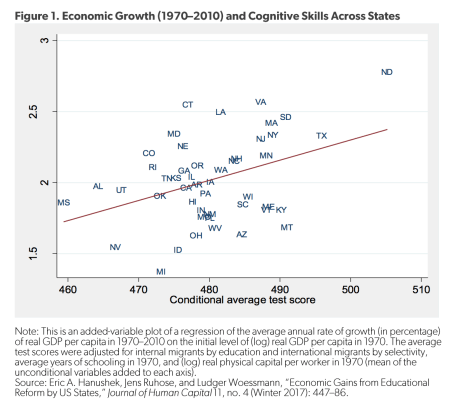
 

Screen Shot 2018-06-04 at 9.04.13 PM


Statistical Exaggerations – Although a best fit line (regression) is super-imposed on the scatterplot, the pattern is more suggestive of a shot-gun blast than an illustration of a strong relationship. Going back to the original study, we find that test scores explain a mere 23% of the variance in economic growth – and this may be largely due to the aforementioned “third variables.” This weak relationship is far from being as strong as touted. Furthermore, achievement test scores are collapsed into “state aggregate scores.” When scores are collapsed in this manner, the effect is to exaggerate a correlation.


Mystery Methods – Beyond one short note below the study’s Figure 1, the AEI paper does not share how these numbers were derived. How these were calculated for each state goes unexplained. Improving teaching and teacher leaders is put forth as the leading reform, but this also is not defended or explained. Neither socio-economic factors nor adequate funding are addressed, although a vast and relevant literature points to their importance. Yet, improvements are claimed to be “enormous” and states should be “willing to make substantial changes.” But how these strong but unknown recommendations are derived is not explained. However, the long paper does present a rich trove of irrelevant statistical exotica.


Workforce Extrapolations – The brief misses the mark with its implicit assumption that the work force and economic needs will remain static and can be easily extrapolated. In an age of emerging artificial intelligence and with virtually every job being transformed in the next half-century, it seems a long reach to assume that the form, function and role of education (and the economic drivers) will remain unchanged.

[1]  Hanushek, Eric A. (May 2018). Every State’s Economic Future Lies with School Reform. Washington, DC: American Enterprise Institute. Retrieved May 29, 2018 from https://www.aei.org/wp-content/uploads/2018/05/Every-States-Economic-Future-Lies-with-School-Reform.pdf? FRPc013V1FcL1JnZHg4V0Vsd253Z0kzUWsxVjc3dGhUSGVzRURhWUZORyttNDlQdWR2aVgifQ%3D%3D

[1] Eric A. Hanushek, Ruhose, J. & Woessmann, L. (Winter 2017) “Economic Gains from Educational Reform by US States,” Journal of Human Capital 11, no. 4 (447-86). Retrieved June 1, 2018 from http://hanushek.stanford.edu/sites/default/files/publications/Hanushek%2BRuhose%2BWoessmann%202017%20JHC%2011%284%29_0.pdf

[1] Sala-I-Marten, X., et al. (2014). The Global Competitiveness Index. Retrieved May 29, 2018 from http://www3.weforum.org/docs/GCR2014-15/GCR_Chapter1.1_2014-15.pdf

[1] Rothstein, R. (2016). In Mathis and Trujillo, Learning from the Federal Market Based Reforms. Charlotte, N.C. : Information Age Publishing. p. 432.

[1] Hanushek, E (Summer 2011), “Valuing Teachers; How much is a good teacher worth?” Education Next, 11(3). Retrieved May 29, 2018 from http://hanushek.stanford.edu/publications/valuing-teachers-how-much-good-teacher-worth


The News and Observer editorial board in North Carolina published a sharp critique of the state voucher program and a very flawed study of it.

The state gives a voucher worth $4,200 per student. The students who get vouchers do not take the state’s standardized tests. A recent “study” claimed that they were making progress, but the voucher schools and public schools don’t take the same tests, and the students in the study were not representative of the program.

“Two researchers from N.C. State’s College of Education and a third from the Friday Institute for Educational Innovation at N.C. State set out to explore this yawning accountability gap in the nation’s least regulated voucher program. They recruited 698 student volunteers in grades 4 through 8 from public and private schools to take the Iowa Test of Basic Skills in the spring of 2017. After students were sorted and some eliminated by various factors, the final comparison involved 245 students in private school and 252 in public schools. More than 7,000 students received Opportunity Scholarships in the 2017-18 school year.

“The students getting Opportunity Scholarships showed a “positive, large and statistically significant” edge on the exams, the researchers said. But that conclusion came with multiple caveats. For one, half the private school students were from Catholic schools, which represent only 10 percent of the more than 400 schools receiving vouchers. In addition, the researchers stressed how a lack of common testing requirements for public schools and voucher-receiving private schools limits the applicability of their findings.”

Most of the students in the voucher program attend evangelical Christian schools, which typically use textbooks that deny evolution and teach bigotry and invalid history based on the Bible.

Voucher proponents are cheering the results. The program is budgeted to grow by $10 million per year until 2028, when it will cost $145 million annually.

“The law creating the program contains virtually no requirements that private schools receiving public dollars account for the quality of their curricula or the performance of their students. That is in sharp contrast to Republican lawmakers’ enthusiasm for tying public school teachers’ salaries to student performance and slapping letter grades on every public school based on test results…

“We still haven’t measured the impact of vouchers. And we still don’t know if they work.”

Mayor de Blasio wants to eliminate the exam that determines admission to three top-tier high schools and replace them with another formula that includes state test scores.

I have long been opposed to the dependence on one single standardized test for admission to these schools. No college uses such a narrow, archaic method of admitting students.

My view is that multiple measures make sense: the current test, an essay, teacher recommendations, rank in class, whatever.

Here is a brave article by a recent graduate of Stuyvesant who looked at the admission process for other elite high schools.

Danielle Eisenman, now a student at Harvard, writes:

“Let my people study.”

“A movement to keep the Specialized High School Standardized Admissions Test as the sole criterion for admission to specialized high schools appropriated the line, “Let my people go,” from the African American spiritual, “Go Down Moses.”

“The protesters — mostly low-income, first- and second-generation Asian immigrants — wish to prevent Mayor de Blasio from dismantling what they consider a meritocratic system. They blast de Blasio’s plan, which would instead admit a set percentage of the highest-performing students from each city middle school, as discriminatory; another popular sign says, “End racism.”

“As Kenneth Chiu, NYC Asian-American Democratic Club member, said in an interview on NY1, “They never had this problem when Stuyvesant was all white. Now, all of the sudden, they see one too many Chinese, and they say, ‘Hey, it’s not right.’” (Stuyvesant today is 74% Asian.)

“My mom, a Chinese immigrant, also supports the SHSAT. When I told her I was writing this article, she texted me, “Everyone I know will hate you,” telling me instead to write in support of the test.

“Though I sympathize with these concerns, the appropriation of “Let my people go” reveals how the campaign to keep the SHSAT reeks of irony and ignorance. De Blasio wishes to admit more black and Latino students, who, despite making up 67% of New York City’s public school system, represent just 10% of students offered enrollment in specialized high schools. Stuyvesant is only 0.69% black and 2.8% Latino. It’s hypocritical for protesters to invoke slavery, an experience that belongs to black Americans, when they’re advocating to keep in place a system that denies disadvantaged black Americans an opportunity for social mobility.

“Defenders of the current system, hailing the test as establishing a level playing field, argue that if more black and Latino students truly wanted to attend specialized high schools, they could just study harder. I have repeatedly heard my classmates champion this mindset, implying that black and Latino students are not as hardworking, and, even more disturbingly, not as smart as their Asian counterparts.

“The SHSAT, however, does not measure work ethic or intelligence, but a student’s ability to answer over 100 tedious multiple choice questions in under three hours. It tests for access to tutors and cram schools that teach students the skills they need to answer the questions without thinking.

“I flunked my first practice tests. After a prep class and some tutoring sessions, however, I knew all the tricks. If I hadn’t had access to that class, I likely would not have gotten into Stuy.

“The exam only tests for reading comprehension and math skills — no critical thinking, ambition, creativity or other qualities that predict success at specialized high schools….”

The legislature is unlikely to allow any change.

Bret Stephens, the New York Times’ conservative columnist, wrote this about the Trump-Kim summit:

An optimistic take on Donald Trump’s historic meeting Tuesday with Kim Jong-un is that it’s Geneva Redux — a reprise of the 1985 summit between Ronald Reagan and Soviet leader Mikhail Gorbachev that established their rapport, fundamentally altered the tenor of relations between the superpowers and led within a few years to the end of the Cold War.

Let’s hope so. Because another take is that it’s the Plaza Redux, meaning the 1988 real estate debacle in which Trump hastily purchased New York’s Plaza Hotel because it looked like an irresistible trophy, only to be forced to sell it at a loss a few years later as part of a brutal debt restructuring.

The case for Geneva Redux, made this week by Peter Beinart in The Atlantic, sees parallels between Trump and Reagan, Republican presidents whose hawkish rhetoric and ignorance of policy details disguised an inner pragmatism and visionary imagination.

“Trump’s lack of focus on the details of denuclearization may be a good thing,” Beinart writes. “Like Reagan, he seems to sense that the nuclear technicalities matter less than the political relationship.”

It’s true that Reagan was able to raise his sights above the technical arcana to something few others could see. To wit: The Cold War didn’t need to last forever. The security paradigms that defined it weren’t immutable laws of history. Personal chemistry with a Soviet leader could go a long way to changing the relationship.

Could the same scenario unfold with North Korea? Probably not — for reasons that would have been obvious to most conservatives before their current Trump derangement.

First, Trump isn’t Reagan. Reagan generally acted in concert with allies. Trump brazenly acts against them. Reagan’s negotiation method: “Trust but verify.” Trump’s self-declared method: “My touch, my feel.” Reagan refused to give in to Soviet demands that he abandon the Strategic Defense Initiative. Trump surrendered immediately to Pyongyang’s long-held insistence that the U.S. suspend military exercises with South Korea while getting nothing in return. Reagan’s aim was to topple Communist Party rule in Moscow. Trump’s is to preserve it in Pyongyang.

Second, Kim isn’t Gorbachev. Gorbachev was born into a family that suffered acutely the horrors of Stalinism. Kim was born into a family that starved its own people. Gorbachev rose through the ranks as a technocrat with no background in the regime’s security apparatus. Kim consolidated his rule by murdering his uncle, half brother and various ministers, among other unfortunates. Gorbachev came to office intent on easing political repression at home and defusing tensions with the West. Kim spent his first six years doing precisely the opposite.

Third, Kim knows what happened to Gorbachev, whose spectacular fall served as a lesson to dictators everywhere about the folly of attempting to reform a totalitarian system. Kim may pursue a version of perestroika to stave off economic collapse, but there will be no glasnost. The survival of his regime depends domestically on state terror and internationally on his nuclear arsenal. He will abandon neither.

Fourth, the timetables are incompatible. Trump wants a foreign policy “achievement” by the midterms, and maybe a Nobel Peace Prize sometime before the 2020 election. Kim plans to be ruling North Korea when one of Chelsea Clinton’s kids is president. Trump’s incentive will be to make concessions up front. Kim can renege on his promises much later.

Fifth, Trump is a sucker. Kim is not. Say what you will about the North Korean despot, but consolidating power in his vipers’ nest regime, fielding a credible nuclear arsenal, improving his economy without easing political controls, playing nuclear brinkmanship with Trump and then, within weeks, getting the prestige of a superpower summit are political achievements of the first order. Machiavelli smiles from the grave.

As for Trump, the supposed success of the summit after the debacle in Quebec appeals to innate love of drama. He is where he loves to be: at the center of a stunned world’s attention.

But he is also in the place where he always gets himself, and everyone else in his orbit, into the worst trouble: panting for the object of his desire. That’s been true whether it’s the Plaza Hotel, Stormy Daniels and now the “ultimate deal” with Pyongyang. Oilman T. Boone Pickens had the smartest line on this when on Monday he tweeted: “Negotiating advice 101. When you want to make a deal real bad you will make a really bad deal.”

I’d be happy to be proved wrong. I would be thrilled to learn that Kim is a farsighted reformer masquerading, out of desperate necessity, as a thug and a swindler. It would also be nice to think that Trump is playing geopolitical chess at a level plodding pundits can scarcely conceive. Political commentators should always maintain a capacity for surprise and an ability to admit mistakes.

For now, however, it’s hard to see what the Singapore summit has achieved other than to betray America’s allies, our belief in human rights, our history of geopolitical sobriety and our reliance on common sense. For what? A photo op with a sinister glutton and his North Korean counterpart

Trump is bizarre. He attacks our allies and befriends dictators.

Dana Milbank had a great piece in the Washington Post today titled “Finally, a President with the Guts to Stand up to Canada.”

“Trump bravely punished Canada by withdrawing the United States from the communique of the weekend’s Group of Seven meeting, which was hosted by Trudeau. The communique Trump rejected is loaded with objectionable provisions such as “a clean environment,” “a healthy, prosperous, sustainable and fair future for all,” “quality work environments,” “a more peaceful and secure world” and “ending violence against girls and women.” In other words, it was like all the other bad, terrible, crazily made, one-sided, miserable deals that make us the laughingstock of the world — such as the North American Free Trade Agreement, the Trans-Pacific Partnership, NATO, the Paris climate accord and the Iran nuclear deal.
..

“The communique was particularly hostile to Trump in its call for “Russia to cease its destabilizing behavior to undermine democratic systems,” condemnation of Russia’s “illegal annexation of Crimea” and commitment to “a strong stance against human rights abuse.” Such language targets the very countries Trump has been courting. In a further insult, the other G-7 leaders had no enthusiasm for Trump’s call for readmitting Russia, which was kicked out of the club for invading Ukraine. The G-7 leaders instead scowled at Trump, called his actions a “disappointment” and criticized his “fits of anger.”


“Inexplicably, these foreigners are not putting America First. That’s why Trump needs to quit the group and make his own G-8 — the Great Eight — with more sympathetic world leaders:

“
Rodrigo Duterte of the Philippines, who enjoys “a great relationship” with Trump as he deploys extralegal killing squads.


“North Korea’s Kim Jong Un, who is “very open” and “very honorable” in running the most repressive regime on Earth.


“Egyptian dictator Abdel Fatah al-Sissi, who established himself as a “fantastic guy” with his bloody crackdown on dissidents.


“The Saudi regime, which has been “tremendous” as it purges business leaders and critics.
Turkish President Recep Tayyip Erdogan, who is “getting very high marks” as he jails opponents.

“
China’s premier, Xi Jinping, who did something “great” in making himself president for life.


“And, of course, Russian President Vladimir Putin, “getting an A” for his leadership and receiving a congratulatory call from Trump after his “election.”

“
There is no room in this G-8 for Britain, France, Germany, Italy or Japan — and certainly not Canada. Canadians say “Sorry” for everything. But Trudeau not only failed to apologize to Trump, he won praise from his political opponents for defying Trump. This is a clear and present danger to the United States. Given Canadians’ well-known instability — their currency is called the “loonie” — there can be only one solution: We are going to build a wall from Maine to Alaska — and Ottawa is going to pay.”

When Trump met with Kim, he showed him a video about how to make North Korea rich. All that excellent waterfront property just ripe for condos!

Our new best friend, the repressive Kim!