Archives for category: Education Reform

Phyllis Bush continues her fight to defeat cancer by writing about it with humor and fearlessness. In the end, we all check out of this life but Phyllis demonstrates how to do it in style.

https://qbg1.blogspot.com/2018/10/side-effects-gift-that-keeps-on-giving.html

In her latest post, she updates the state of the battle and shares her reaction to a standing ovation at the NPE conference, where the first Annual Phyllis Bush Award for Grassroots Activism was snnounced. For one brief moment, surrounded by family and friends who love her, she was speechless.

But not for long!

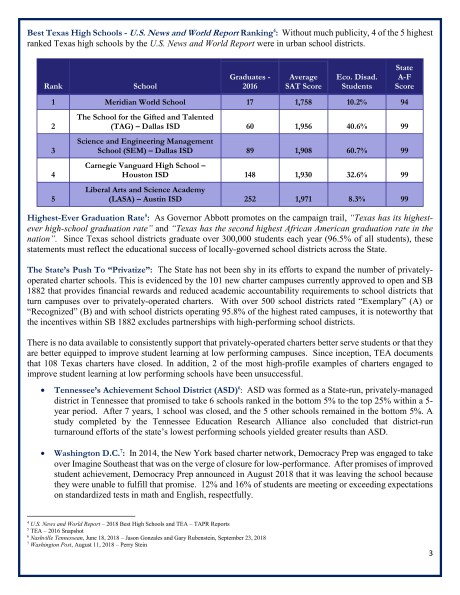
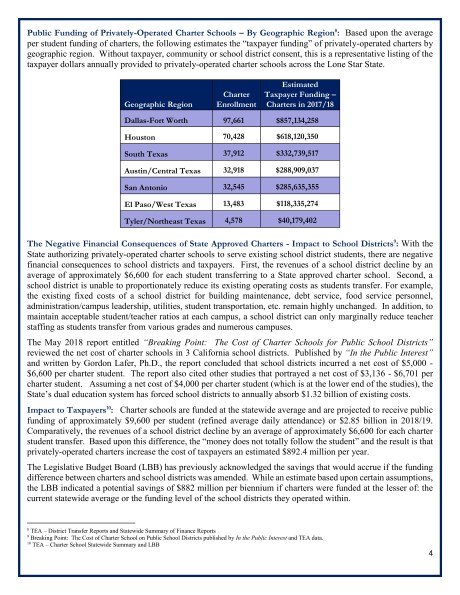
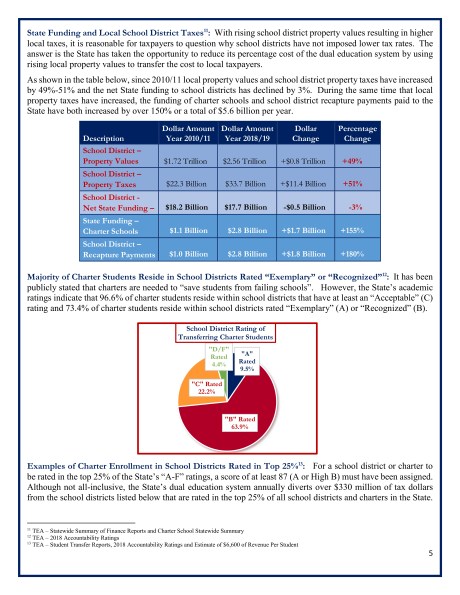
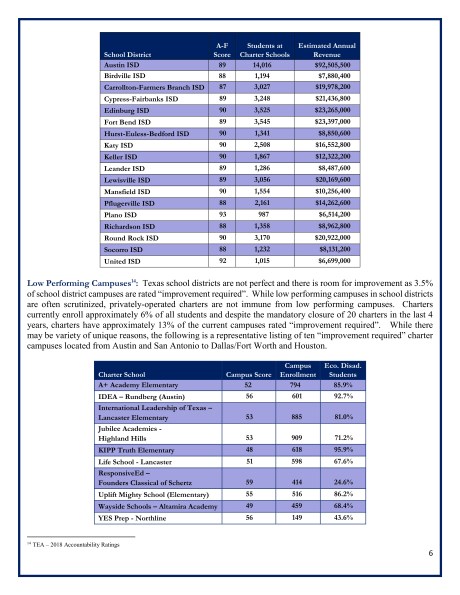
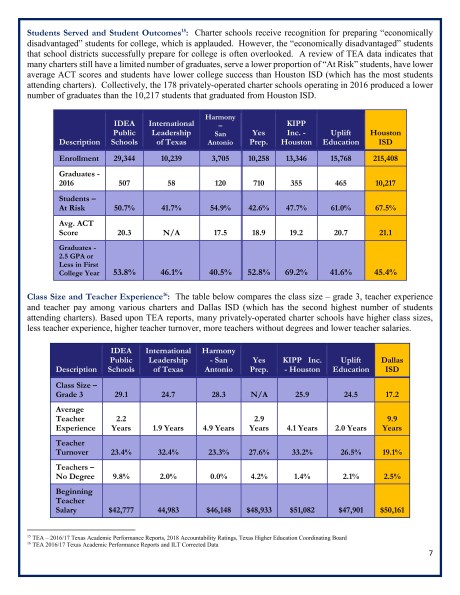
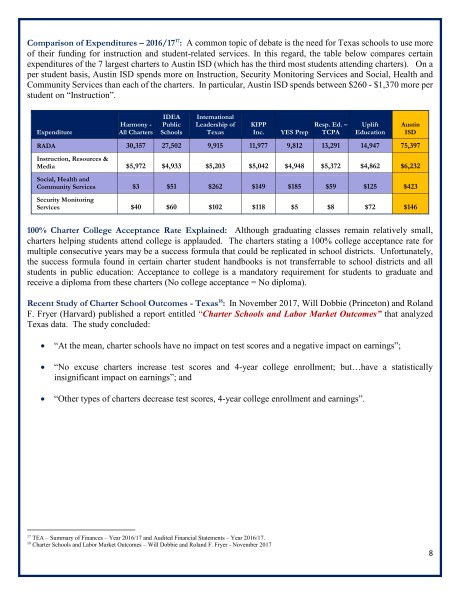
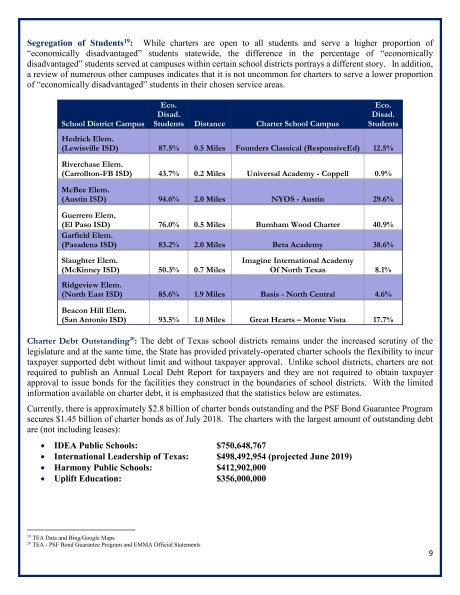
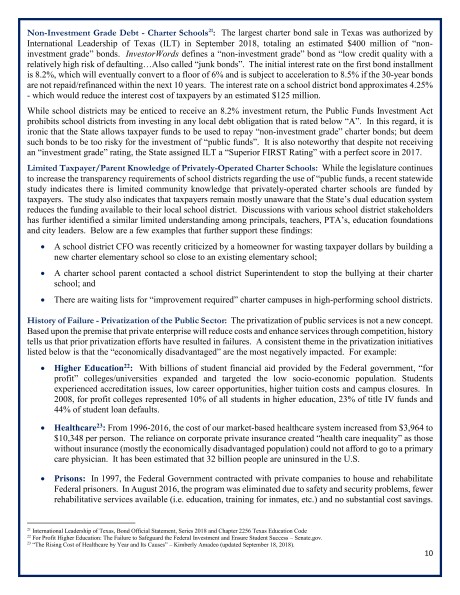
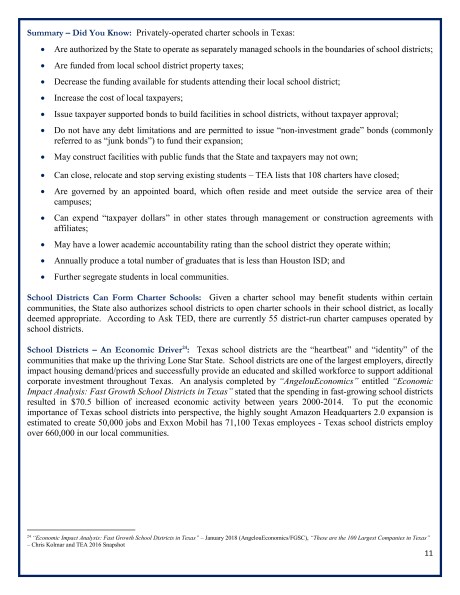
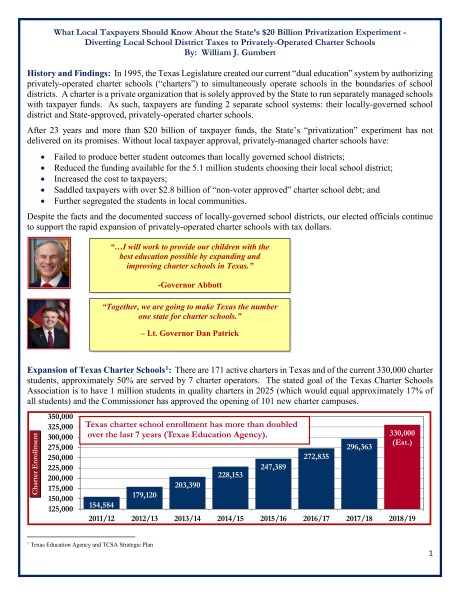
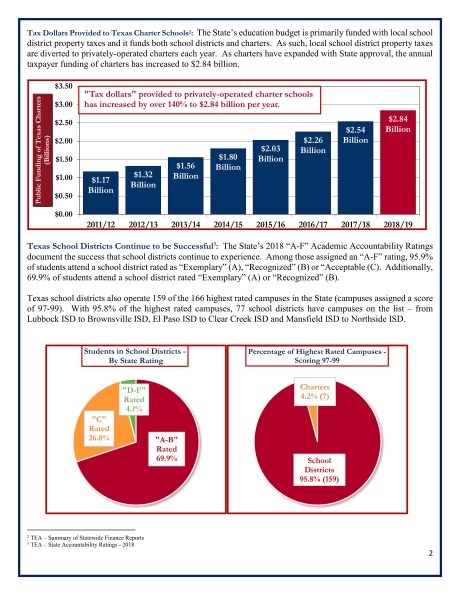
This is an important collection of data about the funding of public schools and charter schools in Texas. Do you think that taxpayers know that they are funding two separate school systems, one governed by elected, accountable school boards and the other governed by private, self-selected, unaccountable school boards? Do you think that the public knows that district public schools outperform charter schools?

What Local Taxpayers Should Know About the State's $20 Billion Privatization Experiment (October 2018)tax2tax3tax4tax5tax6tax7tax8tax9tax10tax11tax12

I was wracking my brain trying to remember an acronym that is a basic tactic of negative public relations.

I knew I had written about it but could not think of how ro find it. Finally I googled my name and “propaganda,” and this article popped up.

The acronym is FUD. It has been used in the public relations field to discredit a competitor. It is a central tactic in the game plan to undermine public education.

It is in the dictionary.

What you need to know about FUD:

https://www.huffingtonpost.com/diane-ravitch/public-education_b_4941678.html

Jackie Goldberg is one of the premier advocates for children and public education in California and, indeed, the nation. She was a classroom teacher for 17 years, a member of the Los Angeles school board, and a member of the Legislature, rising to chair of the State Assembly Education Committee. She is a legendary figure to supporters of children and public schools.

She writes in the Los Angeles Times that the LAUSD board must act to reduce class sizes, which in some schools, exceed 40 students.

A few excerpts from her excellent article:


Today, classes of 45 students or more are not uncommon in most secondary schools. (This excludes kindergarten through third-grade classes, which receive state funding specifically for class-size reduction.).

If the district truly wants its students to learn more, it should get rid of Section 1.5 and immediately begin hiring 2,000 new teachers to meet the class-size goals that are already laid out in the current contract. [Section 1.5 is a waiver from a class-Size reduction agreement.]

This would cost $200 million more each year. That may sound like a lot, but the district has a minimum of $1.8 billion in reserve.

Opposition to class-size reduction comes from the top. When I chaired the Assembly Education Committee, lobbyists would often come in and argue that the cost of reducing class sizes in California’s public schools was simply too high.

When I asked these lobbyists where their own children attended school, many if not all of them would respond that they sent their children to private schools — some to schools where tuition could cost as much as $45,000 a year and classrooms would have as few as a dozen students.

In other words, although they paid considerable tuition rates for their own kids to benefit from small classes, they considered it perfectly acceptable for children who live in poverty — 80% of the LAUSD student population — to be relegated to the third-largest class sizes in America. Really?

There is also some quiet opposition coming from a few well placed charter-school advocates. Why? Because if the district were to reduce class sizes by hiring 2,000 additional teachers, it would need to provide 2,000 classrooms to those new teachers — classrooms that some charter-school advocates are eyeing for themselves.

The Board of Education at LAUSD needs to put its students first. Though it claims to do so at nearly every meeting and on seemingly all of its printed materials, its claims are often empty rhetoric.
Enter the Fray: First takes on the news of the minute from L.A. Times Opinion »
It is common sense that smaller classes make for better learning environments and higher grades and test scores. It’s also well documented.

The New York Times reported that Governor Rick Scott created a “blind” trust that was not at all blind. He has been plagued with ethical problems because…he is unethical.

TALLAHASSEE, Fla. — Rick Scott had been governor of Florida for barely three months when questions first mounted about conflicts of interest. Fabulously wealthy but a newcomer to politics, Mr. Scott mandated random drug testing for state workers in March 2011, and was pushing the legislature to require it for welfare recipients. The Republican governor, who had made his fortune as a health care executive and investor, also proposed reorienting the state’s Medicaid system toward managed care.

As it happened, those moves would have created vast potential markets for the chain of 32 urgent-care clinics that Mr. Scott had co-founded a decade earlier, after his forced resignation as chief executive of the hospital company Columbia/HCA. News reports about the governor’s personal stake in the Solantic clinics, which he transferred to his wife shortly before taking office, stifled the momentum of his first months in office.

To shield himself from future conflict charges, Mr. Scott, who is now running to unseat the incumbent senator Bill Nelson, created a $73.8 million investment account that he called a blind trust. But an examination of Mr. Scott’s finances shows that his trust has been blind in name only. There have been numerous ways for him to have knowledge about his holdings: Among other things, he transferred many assets to his wife and neither “blinded” nor disclosed them. And their investments have included corporations, partnerships and funds that stood to benefit from his administration’s actions.

Only in late July, when compelled by ethics rules for Senate candidates, did Mr. Scott disclose his wife’s holdings. That report revealed that his wife, Ann Scott, an interior decorator by trade, controlled accounts that might exceed the value of her husband’s. Their equity investments largely mirrored each other, meaning that Mr. Scott could, if he wanted, track his own holdings by following his wife’s.

The filing revealed that the Scotts together were worth between $254.3 million and $510 million. (The Senate requires that assets be valued only in ranges.) They own a beachfront mansion in Naples, Fla., valued at $14.1 million (along with a $147,000 boathouse) and a Montana residence on 61 acres worth $1.5 million. The governor, who has banked more than $200 million in investment income while in office, forgoes his $130,000 state salary and jets across Florida in his own plane.

If he wins a tight race for the Florida seat, which is central to control of the Senate, Mr. Scott could well become the richest member of the next Congress. His broad menu of investments might regularly present conflicts that require recusal. He has declined to say whether he would use a blind trust in the Senate, where the rules controlling them are far more stringent.

Mr. Nelson, a 76-year-old Democrat who is serving his third term, has made campaign issues of Mr. Scott’s wealth and the blindness of his trust. “Governor Scott has been in public service for himself,” he charged in August.

Time for Rick Scott to return to the private sector!

Vote for Bill Nelson.

Our reader Bob Shepherd has his own blog. As you may have deduced, I’m just wild about Bob.

Here is a wonderful parody of Tennyson’s “The Charge of the Light Brigade,” who was writing about the British troops who blindly followed orders in the Battle of Balaclava in 1854 in the Crimean War and perished.

Bob calls it “The Coring of the Six Hundred.”

My generation memorized the Tennyson poem. Thanks to the Common Core, this generation will be lucky to encounter any poetry.

Here is the beginning. Open the link and read it all.

Row on row, row on row,

Row on row stationed

Sick at their monitors

Sat the six hundred.

“You may now type your Username”

Said the test proctor.

Set up for failure

Sat the six hundred.

“Enter your password key!

“Mercy upon you!

“During the testing

“No one can help you.”

Someone had blundered.

The unspoken truth. But

Theirs was not to make reply,

Theirs was not to reason why,

Theirs was but to do or die,

Theirs was but to try and cry.

Set up for failure

Sat the six hundred.

Text to the right of them

Complex, out of context,

Bubbles in front of them,

Plausible answers,

Tricky and tortured,

Boldly they bubbled and well

Though smack in the mouth of hell

Sat the six hundred.

This is what reading means,

Now that Gates/Pearson

Has reified testing

Far beyond reason.

Pearson not persons.

Plutocrats plundering

Taxpayer dollars

Spent to abuse.

The children are used.

They bubble and squirm

To reveal their stack ranking

And never again

Will know joy in learning

Never again

Humane joy in reading

And writing, no never again,

Not the six hundred.

Jack Schneider is a historian of education at the University of Massachusetts at Lowell. He is also co-host with Jennifer Berkshire of the podcast series called “Have You Heard?”

If you really want to know about the state of American education, Schneider proves, don’t ask Betsy DeVos or Arne Duncan. Ask a historian.

We have heard the laments since 1983 from the media and politicians and billionaires like Bill Gates and Laurene Powell Jobs.

As Schneider shows here, they are wrong.

He writes:

“So, how are America’s schools doing?

“In most cases, just fine. Better than ever.

“But America’s schools don’t merely reflect our nation’s material prosperity. They also reflect our moral poverty. Our schools are simultaneously an embrace and a refusal, revealing exactly who is included and who isn’t. Most of us can say our children are getting a great education. Yet whose children are “ours”? What do they look like? Where do they rest their heads at night?

“Reform rhetoric about the failures of America’s schools is both overheated and off the mark. Our schools haven’t failed. Most are as good as the schools anyplace else in the world. And in schools where that isn’t the case, the problem isn’t unions or bureaucracies or an absence of choice. The problem is us. The problem is the limit of our embrace.

“Perhaps, then, a reset is in order. Instead of telling a largely untrue story about a system in decline — a story that absolves us of any personal responsibility — we might begin telling a different story: about a system that works. It works to deliver a high-quality education to those we collectively embrace. And it works in a different way for those we have collectively refused. When a school fails, it is because we have failed.”

Arthur Camins explains why we all have a stake in the success of public schools.

I wish I had a dollar for every parent who has said, “I’d love to sent my child to a public school, but …” The but is invariably related to real and perceived deficiencies in zoned schools and by race and class prejudices insidiously driven and reinforced by persistently unaddressed planned inequity. The sequel to the but is always a justification for opting out of public schools and enrollment in a charter or private education. Some parents add, “I’m the product of public schools. I support public schools, but I’m not going to sacrifice my children.” Such are the inevitable responses to our country’s acceptance of inequality and scarcity as unalterable. The sum of thousands of these personal choices for some children– increasingly supported by tax revenues– undermines the education of all children. The blame is not on parent choices but on the politicians who refuse to address inequity, while funding policies that undermine public education. If we want a different outcome, we need to vote for politicians who represent different values.

Education in the United States is contentious. It always has been because personal and societal decisions are inextricably interwoven. Now, we are at an inflection point in which consequential questions about education are hotly debated. Consider these for the November elections.

Whose business is the education of students in the United States?

Who should get to make decisions about where, what, with whom, and how children learn?

If our nation values democracy and the common good, the answer to both questions is:

Of course, every parent cares about where, what, with whom, and how their children learn. However, decisions about education affect everyone, not just school attendees and their families. Their education is everyone’s business– but not in the mercantile sense of the word. Other people’s children grow up to be our neighbors, co-workers, and citizens (who vote or do not). Their subsequent behaviors and decisions as adults touch us all, whether or not we have school-age children. That is why decisions about education– a common good– should be made democratically on behalf of all children and not just by individual parents.

Unfortunately, the idea that education is a common good, not a commodity, and should be governed democratically is under assault.

Should decisions about education be made by and for all of us through locally elected school boards? Or, by unelected private boards? Is education literally the business of the eight families who have collectively spent over $35.5 million to influence the outcomes of local school board elections? Is it the business of would-be entrepreneurs out to make a buck?

Once again, if our nation values democracy and the common good the answers are clear:

Yes, no, no, and no.

Read on as Camins explains why Education is our responsibility, not to be handed off to the private sector.

The National Education Policy Center reported on the success of a high school in Seattle that adopted the principles of “schools of opportunity.” Open the link for sources and other links. Valerie Strauss posted an article about the school here.


These Comeback Kids Don’t Bake Cookies: The Community-Based Transformation of an Urban School

You could call it the comeback kid.

In 2010, Seattle’s Rainier Beach High School was on the edge of closure. Just 320 students occupied a building constructed to serve nearly four times that number. Its on-time graduation rate of 48 percent was among the lowest in the state of Washington.

Fast forward to today and the picture has completely changed. Enrollment exceeds 700. The graduation rate is 89 percent. And, unlike many other school turnarounds that superficially look successful, the school has continued to serve the same families and community. At Rainier Beach, nearly three-quarters of the students hail from low-income families, and 40 percent come from immigrant or refugee backgrounds. The school’s diverse population is 49 percent Black, 26 percent Asian, 14 percent Hispanic, six percent multi-racial, three percent White, and two percent Pacific Islander/Native American/Alaskan.

In 2016, NEPC recognized Rainier Beach as a School of Opportunity, making particular note of the school’s rigorous but supported classes and its thoughtful and powerful community outreach.
Too often, transformations like Rainier Beach’s are attributed to external forces such as state accountability measures or the introduction of a new and charismatic leader.

But in a recent article in the peer-reviewed Journal of Educational Administration, Ann M. Ishimaru, an associate professor of Educational Foundations, Leadership and Policy at the University of Washington’s College of Education, uses interviews, document analyses, and observations to tell a very different tale about Rainier Beach.

Truth be told, some aspects of the Rainier Beach story are not out of the ordinary. It brought in new leadership. It struggled with and benefitted from the implications and resources associated with accountability-based reforms.

But another part of the school’s story is indeed unusual—and offers important lessons for other schools now struggling to improve. Professor Ishimaru traces the school’s transformation to a groundswell of activism led by local families, students, and community members. Working together with educators, these activists were able to benefit from structures of conventional schooling by transforming those structures to better suit their needs. As Ishimaru notes, these were practices and institutions often imposed on low-income, “majority-minority” communities—structures that often do little to engage those communities or respond to their voiced needs.

For example, activists leveraged the power of the PTA, using it to spark change. As one parent leader explained:

We don’t make cookies. We’re not here to fund raise for your school. We’re here to be transformative change agents for the school. We need you to deploy us to spaces that you can’t get to, like School Board meetings and the Superintendent […] No, we don’t make cookies. […] We infiltrate, that’s right.
Other community-based strategies Ishimaru identified included:

Participating in the accountability-based school turnaround/school improvement grant process;

Holding community “cafes” to build support for the school’s new International Baccalaureate program; and

Supporting academic and behavioral interventions (such as introducing Freedom Schools and hiring a restorative justice coordinator) that empower youth.

“This study is a testament to the changes that can unfold when parents and communities drive priorities and action in school change efforts,” Ishimaru concludes.

Still, she cautions that work remains to be done at Rainier Beach: Key community leaders have moved on. Parents worry that African American students are still under-represented in the school’s International Baccalaureate program. And there’s no guarantee that the program itself will continue to attract the resources it needs to operate.
I endorse Paul Theobald for Congress in Nebraska. Paul is a professor, a farmer, and a historian of rural America. He would bring heart, soul, and brains to a Congress in need of them.

https://www.theobaldforcongress.com

https://www.omaha.com/news/politics/democratic-hog-farmer-rural-historian-paul-theobald-to-run-for/article_4c63b4ea-b9c2-11e7-b253-7783c930e8db.html