Archives for category: Education Reform


George Conway is a lawyer. He also is the husband of Kellyanne Conway, Trump’s senior advisor.

He wrote an article with the title cited here in this morning’s Washington Post. 

He writes:

”So it turns out that, indeed, President Trump was not exonerated at all, and certainly not “totally” or “completely,” as he claimed. Special counsel Robert S. Mueller III didn’t reach a conclusion about whether Trump committed crimes of obstruction of justice — in part because, while a sitting president, Trump can’t be prosecuted under long-standing Justice Department directives, and in part because of “difficult issues” raised by “the President’s actions and intent.” Those difficult issues involve, among other things, the potentially tricky interplay between the criminal obstruction laws and the president’s constitutional authority, and the difficulty in proving criminal intent beyond a reasonable doubt.

Still, the special counsel’s report is damning. Mueller couldn’t say, with any “confidence,” that the president of the United States is not a criminal. He said, stunningly, that “if we had confidence after a thorough investigation of the facts that the President clearly did not commit obstruction of justice, we would so state.” Mueller did not so state.

That’s especially damning because the ultimate issue shouldn’t be — and isn’t — whether the president committed a criminal act. As I wrote not long ago, Americans should expect far more than merely that their president not be provably a criminal. In fact, the Constitution demands it.

The Constitution commands the president to “take Care that the Laws be faithfully executed.” It requires him to affirm that he will “faithfully execute the Office of President” and to promise to “preserve, protect and defend the Constitution.” And as a result, by taking the presidential oath of office, a president assumes the duty not simply to obey the laws, civil and criminal, that all citizens must obey, but also to be subjected to higher duties — what some excellent recent legal scholarship has termed the “fiduciary obligations of the president.”

Fiduciaries are people who hold legal obligations of trust, like a trustee of a trust. A trustee must act in the beneficiary’s best interests and not his own. If the trustee fails to do that, the trustee can be removed, even if what the trustee has done is not a crime.“

Conway contrasts Trump’s active efforts to interfere and stop an investigation with Nixon’s passive role in Watergate.

”Contrast poor Richard M. Nixon. He was almost certain to be impeached, and removed from office, after the infamous “smoking gun” tape came out. On that tape, the president is heard directing his chief of staff to get the CIA director, Richard Helms, to tell the FBI “don’t go any further into this case” — Watergate — for national security reasons. That order never went anywhere, because Helms ignored it.

“Other than that, Nixon was mostly passive — at least compared with Trump. For the most part, the Watergate tapes showed that Nixon had “acquiesced in the cover-up” after the fact. Nixon had no advance knowledge of the break-in. His aides were the driving force behind the obstruction.”

Nixon tried to coverup a botched burglary, even as he was coasting to a landslide re-election. Trump tried to coverup an attack on our democracy by a foreign power.


Lynn Davenport is a parent activist in Texas. She wrote the following post to alert her fellow Texans about the invasion of Kitamba Consultants, who bring with them the so-called “portfolio model” of privatization.


She writes:

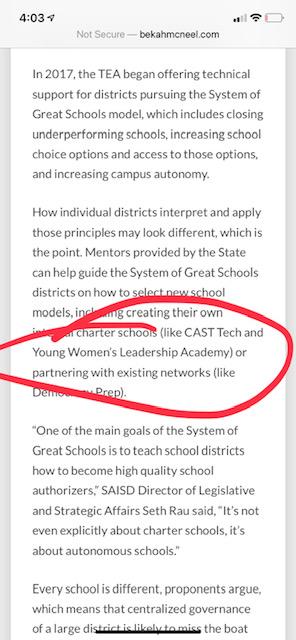
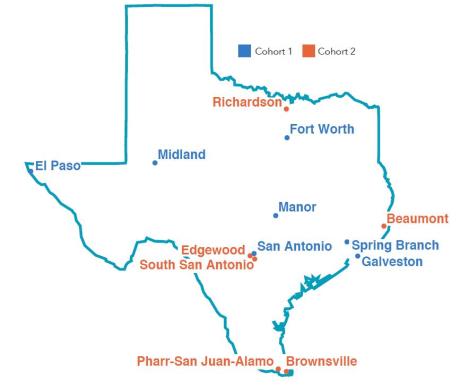
The LA teacher strike thwarted a concealed plot to use Kitamba consultants to reinvent LAUSD with a portfolio model of privatization. Kitamba has a contract with TEA right now for these districts, including RISD:

tea1

I just got a 228 page public information request from the Texas Education Agency and Region 13 service center in Austin for their MOU with Kitamba.

Texas is spending big bucks on the same Kitamba consultants exposed in the LAUSD strikes against philanthropist/private equity reformer and Supt Austin Beutner:

https://www.chalkbeat.org/posts/us/2019/04/09/los-angeles-consultants-recommendations-reimagine-kitamba-consultants/
“Created by the consulting firm Kitamba, the documents lay out an aggressive timeline for assigning schools to 32 support networks, giving principals more power, and cutting the central office by fall 2019.

The January strike appears to have derailed the plans. A spokesperson for Los Angeles Unified declined to comment.

During the January strike, United Teachers of Los Angeles criticized what it described as the district’s portfolio plan and its partnership with Kitamba. (A spokesperson at the time said Los Angeles Unified is not pursuing a portfolio approach.) Kitamba won a $765,000 contract for its work, paid by a slate of outside donors, including the Eli and Edythe Broad Foundation.

Details of Kitamba’s contract and scope of work were reported in February by the Los Angeles Times after school board member Scott Schmerelson criticized Beutner for not disclosing contracts with consultants, including Kitamba, or the work they had done for the district.”

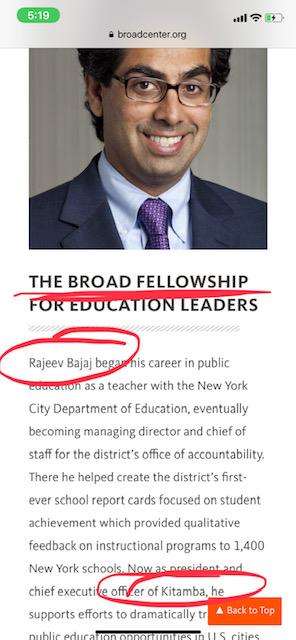
Rajeev Bajaj is a Broadie:

tea2

I researched all of this during my System of Great Schools LinkedIn article in December, I just didn’t see the magnitude of the Kitamba contract at the time:

tea3

Please read my SGS Takeover article again:
https://www.linkedin.com/pulse/privatization-system-great-schools-takeover-lynn-davenport

tea4

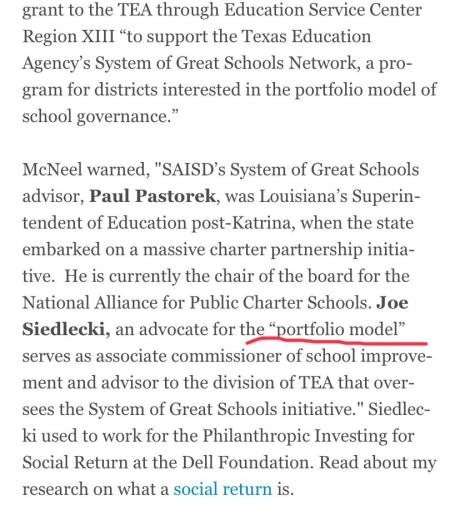
Blogger Bekah McNeel found that, “In 2017 the Laura and John Arnold Foundation gave a two-year $85,000 grant to the TEA through Education Service Center Region XIII “to support the Texas Education Agency’s System of Great Schools Network, a program for districts interested in the portfolio model of school governance.”
http://bekahmcneel.com/in-becoming-a-system-of-great-schools-saisd-is-fighting-for-its-life/

Interesting that Dallas mayoral candidate Lynn McBee’s org was mentioned:

tea5


We need to stop this with the help of Texas AFT, parents, and trustees who see the harm of the portfolio model. We also need to loop in the California union to get their advice. I would like to hire Brett Shipp Media to help expose this. If we don’t stop it, our neighborhood schools, teachers, and elected boards will be eliminated in favor of a charter-like model of “autonomy”.


John Thompson, who recently retired as a teacher in Oklahoma, here reviews Andrea Gabor’s fine book, After the Education Wars. His review appears in two parts. He is interested in Gabor’s critique of why “reform” failed and where we go next.
He writes:
We are near the end of the 21st century’s second decade, and some fervent corporate school reformers finally seem to be understanding that their experiment turned an unconscionable percentage of schools into sped-up versions of a Model T assembly line. We need a new era of humane, holistic school improvement. A first step is reading and discussing Andrea Gabor’s After the Education Wars.  Now that corporate reform failed, Gabor explains, we must learn the lessons of history and “recover the road not taken.”

https://www.kirkusreviews.com/book-reviews/andrea-gabor/after-the-education-wars/

The progressive reformers who preceded the corporate reformers of the last generation operated in a manner that was consistent with the “continuous improvement” philosophy of Edwards Deming. As Gabor and Deming explain about schools and other sectors, “Variation is as ubiquitous as air and water.” Deming said, “Only the employees closest to a given process can identify the variation that invariably diminishes quality.” That is why it was necessary to shake up the systemic hierarchy and “drive fear out of the workplace and foster intrinsic motivation.”

Gabor acknowledges the inherent flaws of the pre-reform education administrative sector. Her deepest dive into that “status quo” was her account of how progressive New York City educators, like Deborah Meier, carved out the holistic and inclusive road which reformers refused to take. Meier et.al battled the district’s “compliance managers.” Their methods embodied “creative noncompliance.” Then, Meier and her era’s reformers personified a value system consistent with Deming’s call for “a participative, collaborative, deeply democratic approach to continuous improvement.”

Meier and other progressive education reformers in New York, Massachusetts, and Leander, Tx, respected the essential role of trusting relationships. They needed educators to unite for a team effort, but they also understood the folly of trying to mandate unanimity. It would have been easier to order all teachers to obey the normative dictum which was embraced by the corporate reformers, and be “on the same page.” But they knew that the alternative to open collaboration would be “resistance, secrecy and sabotage.” If Meier and other school leaders emulated the management model of New York City and other large districts, and mandated teacher compliance, “‘the braver and more conscientious [would] cheat the most, but even the most timid can’t practice well what they don’t believe in.’”

Venture philanthropists like Bill Gates and Mike Bloomberg initially shared some of the values which motivated progressive reformers. Both groups initiated small schools in order to offer more personalized services, and the corporate reformers first seemed to not be bewildered by the key component of continuous improvement – building trust. In a sharp contrast to the reckless pace of change that would soon be imposed on public education, the Gates Foundation visited Meier’s Julia Richmond High School for a year before starting its small school campaign. I was shocked to learn that Gates’ Tom Vander Ark invested so much time in visiting schools. But, as Gabor discovered, “The Gates man was smitten with Julia Richmond, but he didn’t see what was actually happening there.”

A progressive principal told Vander Ark about 25 times that “small is a necessary, but not sufficient.” But, he was apparently so obsessed with “scaling up” reforms that the need for collaboration was subordinated to a focus on “design attributes” that could drive nationwide transformation. Vander Ark was more impressed with the “design coherence” of Success Academy than the Julia Richmond culture of trust. Because of their commitment to rapid transformations, Gates, Bloomberg, and other corporate reformers rejected the essence of Meier’s approach and pushed its “antithesis,” which resulted in the “no-excuses charter movement’s focus on behavioral conformity and control.”

Another factor was the Billionaires Boys Club’s hubris. The reformers “distrust of education culture” was combined with “suspicion – even their hatred – of organized labor and their contempt for ordinary public school teachers.” They displayed “the arrogance that elevated polished, but often mediocre (or worse), technocrats over scruffy but knowledgeable educators.” Eventually, Gabor wrote, “to be an educator in Bloomberg’s New York was a little like being a Trotskyite in Bolshevik Russia – never fully trusted and ultimately sidelined, if not doomed.”

It wasn’t just in New York City where the opportunity to learn from veteran, progressive reformers was lost. Across the nation, the accountability-driven, competition-driven reformers’ well-funded public relations campaigns “turned teacher-bashing into a blood sport.” They then sought to “teacher proof” the classroom. Consequently, canned curriculum and mind-numbing lessons drove much of the joy of teaching and learning out of the nation’s schools.

New York City’s lost opportunity morphed into a national tragedy as technocrats continued to worship data but not recognize that the most important educational factors are immeasurable. Their “Taylorism” was combined with a failure to recognize the dangers of “Schumpeterian” disruption on children. And the more that educators resisted reward and punish policies, the more reformers sought better hammers to force compliance. After tougher principal evaluations did not produce enough obedience, value added teacher evaluations sought to hold every single educator accountable for meeting their quantitative goals. Then, reformers overreached by simultaneously imposing Common Core high stakes tests and accountability metrics that were theoretically but not actually aligned with each other.

I entered the classroom as a 39-year-old rookie, but one who had a decade of experience in the inner city. Nearly 1/5th of my first years’ students would listen, learn, and yet refuse to do a single assignment. They didn’t disrupt our lessons as they often did the classes dominated by worksheet-driven instruction. Clearly, part of their noncompliance was a political statement, and they were glad to say why they resisted and why they would soon drop out of school. The common narrative was that they had been robbed of an education when growing up in our district’s teach-to-the-test era in the wake of “A Nation at Risk.” And they bitterly protested that the worst of the drill and kill was imposed on inner city schools.

This was the early 1990s and a new era of test-driven reform was being organized. During our discussions, I said that if reformers would read Catch 22, they would know that compliance couldn’t be forced, and that the system would respond with destructive games to make the accountability metrics come out right. One of my brightest students, who learned every day but who was so fed up with drill and kill that he would have nothing but zeros in every class when he dropped out, offered a better metaphor. During the famous scene in the comedy, I Love Lucy, Lucy fell behind when boxing chocolates on an assembly line. Teachers and students responded to test-driven reform in the same way, tossing out and even eating the product.

Back then, there was a common phrase which Oklahoma progressives repeated, “Feed the Teachers or They Will Eat the Kids,” which anticipates a second post on Gabor’s account of progressive reformers trying to change that reality in NYC, Massachusetts, and Leandor, Tx, as corporate reformers recreated Lucy’s sped-up assembly lines in NYC, New Orleans, and many or most urban schools. It will also review her proposals for a new era that needs to come After the Education Wars.”

Tune in tomorrow, same time, same place, to read the concluding section of Thompson’s review.


Anthony Cody was taken aback when he saw that pundit Alexander Russo was critical of the media for ganging up against Betsy DeVos when she explained at a budget hearing why she was defunding the Special Olympics. Russo seemed to think that the media critique of DeVos may have been the work of “advocates and trolls,” special interests blowing up a story that was a Nothingburger. Russo treated the hearing as a ho-hum event, nothing new.

But Cody, who sat behind DeVos throughout the hearing, saw plenty that was new.

First, Congresswoman Rosa DeLauro grilled DeVos about the new report by the Network for Public Education which documented that the federal Charter Schools Program had wasted nearly $1 billion on charter schools that either never opened or closed soon after opening. The basic issue was that the Department of Education was handing out millions of dollars without fact-checking the applications. Yet DeVos was seeking a $60 million increase for this slipshod, wasteful program while asking to cut or eliminate many other programs. Russo didn’t find that newsworthy.

There was another important story that Russo found to be not newsworthy. Anthony Cody became part of that story because of the expression on his face as he sat directly behind DeVos.

He writes:

“In fact, I wound up being a part of a whole OTHER viral story that Russo doesn’t even mention – the moment when Lucille Roybal-Allard asks DeVos to explain her absurd belief that larger class sizes may benefit students. And although I am indeed an advocate (if not a troll) I had very little to do with this clip going viral — 8.4 million views at last count.”

Cody complains that Russo has tried to set himself up as the “ethical minder” of education journalism. But anyone with an ethical barometer should be appalled every day by the unethical actions of DeVos, as she rolls back civil rights protections, undercuts students who were defrauded by for-profit “colleges,” and campaigns against the nation’s public schools. She is a novelty: the first person to lead either the Department of Education (established in 1980) or the U.S. Office of Education (established in 1867) who was actively opposed to public schools. That should be a daily story, kind of like having an Environmental Protection Agency head who doesn’t believe in protecting the environment.

I have my own beef with Russo.

In the spring of 2010, I published The Death and Life of the Great American School System: How Testing and Choice Are Undermining Education.

It got a lot of attention because I had been deeply embedded in prominent rightwing think tanks (the Koret Task Force at the Hoover Institution and the Thomas B. Fordham Institute), and in the book  I renounced policies and a worldview I had espoused for years. It became a national bestseller. The very fact that anyone had changed her mind was a big deal.

Many months later, I was contacted by Russo. He invited me to meet with him at a cafe near my home in Brooklyn. We had a nice getting-to-know-you chat. I told him that I had cast the deciding vote in his favor as a judge of the Spencer Fellowships, and he thanked me. Towards the end of our meeting, he asked if I would be willing to read his book about the Green Dot charter chain and write a blurb for the jacket. I agreed to do so. I found the book informative and I wrote a blurb.

Some weeks later, a friend sent me Russo’s latest article, in which he criticized me and said I could not be trusted because I changed my mind and could do it again. I am paraphrasing here. Basically, he implied that I was an intellectual or political whore, lacking in sincerity or conviction.

I was stunned. As soon as I got over the shock of being attacked by someone I thought was a friend, I called his publisher and asked to speak to his editor. When I reached her, I said I wanted my blurb off his book. She explained that the jacket was in production, and it was too late. I read to her what Alexander Russo had written about me, and there was a long pause. She said, “I agree with you. We will take your blurb off the jacket.”

I have never mentioned his name since then, and hope I never again have reason to do so.


Mercedes Schneider brings us up to date on the disruption caused by charters in Baton Rouge, most of which are failing schools. 

Apex Collegiate Charter School in Baton Rouge notified parents it is closing. Yet its website announces that it is accepting applications for next year. It has been open three years, and it has an F rating from the state. Two other charter schools in the city are closing, and a third is fighting the revocation of its charter. Local district officials are worried that the costs of the charters is eroding the fiscal stability of the district.

The East Baton Rouge School Board rejected Apex’s proposal in 2015 but the charter was approved by the state board.

“Note that concerns raised surrounding Apex Collegiate’s rejection by EBRSB include chartering goals too lofty to reasonably achieve as well as the reality that most EBR charter schools are graded as D or F schools. According to the Louisiana Association of Public Charter Schools (LAPCS) “find a charter” search engine (which has not been updated using 2017-18 school letter grades but appears to use 2016-17 data), there are 27 charter schools located in East Baton Rouge; 4 have no grade listed (including Apex Collegiate). Of the remaining 23 charter schools, 14 are graded D, and one is graded F.

“Apex Collegiate may have had lofty goals, but it seems that such goals do not apparently include maintaining an updated website.

“As of April 14, 2019, the Apex Collegiate website includes no information for the public regarding its May 2019 closure. On the contrary, it advertises, “We are now enrolling for the 2019-20 school year. If your child will be entering the 6th, 7th or 8th grade, please Apply now!”

“The application (misinformation in itself) includes the following misinformation for parents: “We will grow by one grade level every year until we are a full 6-12 school.””

The CEO of Apex was previously the state director of Howard Fuller’s Black Alliance for Educational Options, funded by rightwing billionaires to promote school choice among black communities, especially in the South.


Bill Phillis of Ohio urges the repeal of the state takeover law, HB 70:


It appears that the HB 70 CEO in the Lorain City School District is at odds with the Board of Education, school personnel, the Police Department and the Mayor. The CEO and the Police Department are in a tiff over a School Resource Officer matter.
The Board of Education’s Vice President says it is time for the CEO to go.
HB 70 of the 131st General Assembly was pushed through the legislature with no public discussion in a 24-hour period. It was cobbled together in secret by a former state superintendent and a half-dozen non-elected residents of the Mahoning Valley at the behest of a former governor. The premise of the bill is that a poverty-stricken school district will demonstrate significantly improved test scores and educational opportunities by removing control of the district from the elected board of education. In other words, it assumes that replacing democratic control with autocratic control of the district will solve the issue of low test scores and inadequate educational opportunities. Then if that doesn’t work, the district will be turned over to a charter operation.
The perpetrators of HB 70 presumed that when a school district registers low test scores democratic control of the district is the problem. Essentially their presumption is that, in some communities, the citizens are incapable of self-government; hence, a dictator to run the school is warranted.
The 131st General Assembly made a huge mistake in enacting HB 70 and the 133rd General Assembly must eliminate this horrific wart.
William L. Phillis | Ohio Coalition for Equity & Adequacy of School Funding | 614.228.6540| ohioeanda@sbcglobal.net| www.ohiocoalition.org


Bob Shepherd is teaching in Florida after a career in education publishing. He left this comment on the blog about his teaching experience in Florida. His contributions to the blog are consistently brilliant. On a personal note, Bob reached out to me and offered to edit my new book. We have never met. Knowing how amazing he is, I happily accepted his offer. For weeks, Bob and I exchanged chapters and emails, sometimes in the middle of the night. His edits were excellent. His sensibility, his deep knowledge of education, and his feel for language are incomparable. He made the book much much better. Publication is scheduled for January. I am in his debt forever and in awe of his knowledge and skill.


Bob Shepherd wrote:

Life as a Teacher in the Age of the Ed Deform Hamster Wheel

Many years ago, I got a degree in English from Indiana University (Phi Beta Kappa, with High Honors) and completed the education requirements, including student teaching, to get my certification to teach English in that state. I also took the Graduate Record Examination in English and received a perfect score on this. I was awarded a “Lifetime Certificate” to teach English in Grades 6-12. I taught high-school English for three years.

When I started a family, the pay simply wasn’t enough, so I took a job in educational publishing. In the course of a 25-year career in educational publishing, I planned, wrote, and edited over 50 highly successful textbooks and online instructional programs in reading, 6-12 literature, grammar and composition, and African-American literature. I also wrote a widely used book on writing the research paper, designed standardized tests, and wrote tests in ELA for many of the large textbook houses. I worked for a while as educational director for a major foundation and ended my publishing career as Executive Vice President for Development at one of the country’s largest textbook houses. At one time, it was almost impossible to find a K-12 English program, anywhere in the country, that wasn’t using one or more of my books. Throughout my career, I immersed myself in studies in my field. When I wasn’t working at my job, I was studying linguistics, rhetoric, literature and literary criticism, prosody, stylistics, educational statistics, assessment theory, the cognitive psychology of learning, pedagogical approaches, the history of education, and so on.

Then, at the end of my career, I decided that I wanted to go back to teaching, my first love, for a few years. I had spent a lifetime designing, writing, and editing materials for teachers, and deepening my knowledge of my subject, and I wanted to finish my working life sharing the accumulated knowledge of that lifetime with kids in class. So, I decided to renew my certification, in Florida this time, and go back into the classroom. Little did I know the insane hurdles I would have to go through to make this happen.

In order to get my certification in Florida, I had to pay $750 to Pearson and take seven different tests:

General Knowledge Test, Essay
General Knowledge Test, English Language Skills
General Knowledge Test, Reading
General Knowledge Test, Mathematics
Professional Education Test
English 6-12 Test, Multiple Choice
English 6-12 Test, Written

The Professional Education Test, in particular, was an obscenity. Basically, it was written from the point of Ed Deformers, and to get a good score on it, I had to adopt the Ed Deform point of view and pretend that the Common Core wasn’t a puerile joke and that standardized testing in ELA wasn’t an unreliable, invalid scam. I did that and passed. The reading test was also a complete joke. The questions were so poorly written that one had to choose the answer that the test preparer thought was correct, not one that actually made sense, if there was such a thing.

Then I had to complete 400 pages of documentation, over the course of a year, as part of something called the TIP program, that contained samples from my teaching showing various kinds of compliance (that I diversified my instruction, that my instructional appealed to multiple intelligences, that I used ESOL strategies, that I analyzed my students’ data, and so on. An enormous amount of busy work.

I also had to complete 300 hours of online ESOL instruction. The instructional materials were riddled with errors in grammar, usage, mechanics, sense, and fact and appeared to have been put together by remedial students with no education in linguistics or in English. In my responses to the materials, I took to writing long lists of the errors in grammar and usage and fact in the instructional materials. They passed me anyway. All this busywork taught me nothing that I didn’t already know. 300 hours! Mind you, in most undergraduate programs, 60 hours of instruction is sufficient to graduate with a major in a given subject.

I also had to complete a number of state-mandated “trainings” (roll over, sit up, good boy) on gangs, drugs, medical emergencies, and much else, from which, again, I learned nothing that wasn’t common knowledge.

Twice a year, I had to complete a lengthy Individualized Professional Development Plan, an inane, useless exercise in educational gobbledygook and bs.

I was required to sit through countless “professional development trainings” (roll over, sit up, good boy) of such mind-numbing stupidity that one would have thought the presenters were talking to second graders about My Little Ponies.

I was required to submit Byzantine two-page lesson plans for every class that I taught and to have a copy of these plans available for inspection at all times. One year, I had five preparations and had to prepare 15 of these (30 pages total) every week.

Each day, I had to write on one of my whiteboards, for every lesson, for every class, an enormous amount of material that included bellwork, student outcome, vocabulary, higher-order thinking skills addressed, an essential question, and homework. This alone took between half an hour and 45 minutes each day. In the year when I had five preps, I had to use two whiteboards for this.

I had to submit to three separate formal evaluations and countless informal pop-in evaluations every year, each involving a lot of paperwork. (In my nonteaching career, I always had one formal evaluation per year.)

I had to maintain and regularly update a student “data wall” in my classroom.
I had to update, weekly, a “word wall” in my classroom.

Half of my students had IEP plans, 504 plans, gifted student plans, ESOL plans, or PMPs, and I had to do regular reporting on all of these and to keep an enormous binder of all this material. I also had to attend parent meetings on all these.

I had to maintain a separate binder with paperwork related to every parent contact and yet another binder with paperwork related to any student disciplinary action—even something as minor as marking a student tardy.

I had to keep both a paper gradebook and an online gradebook and post at least two grades for every student every week. In addition, I had to record attendance for every class on paper and online.

I was required to proctor standardized tests and do daily car line duty at no additional pay. (When I taught years earlier, car line was handled by people hired and paid for this purpose.)

All of this was an enormous waste of time, effort, and money. Almost none of it had any positive effects, and the opportunity cost, in terms of time taken from actually doing my job, was enormous. When I taught years before, almost none of this was required, the teachers were no worse, and the kids didn’t learn any less.

The other thing that had changed since I taught years ago was the general attitude that was taken toward teachers. When I taught at the beginning of my career, teachers had a great deal of autonomy in choosing their materials and in planning their classes. Today, they are treated as children, not as professionals, and are continually micromanaged.

Basically, in the job as it exists today, I spent so much time doing administrative crap that I had very little time left over for doing my job. I literally spend all day, every Saturday and Sunday, simply completing paperwork. And somewhere in all this I was supposed to do grading. I taught 7 classes, with an average of about 28 students in each. If I assigned a single five-paragraph them, I would have 980 paragraphs to read and comment on—roughly two large novels’ worth of material.

So how did we get to this place? Well, I suppose that over the years, every time some person at the district or state office got a bright idea for improving teaching, it was implemented, and the requirements kept being piled on until they became literally insane. Hey, you know, we’ve got this state program that provides teachers with $70 a year for buying supplies, but we’re not doing a very good job of tracking that, so let’s create a weekly “Whiteboard Marker Usage and Accountability Report (WMUAR). It will only take a few minutes for a teacher to prepare. Great idea! You know how these teachers are. They will just run through markers like crazy unless you monitor this.

In the teacher’s bathrooms in my school, there were literally posted instructions on how to use the toilet. You know how teachers are, they can’t use the toilet properly without instruction in flushing.

Interestingly, NONE of this crap had anything to do with whether I actually knew the subject that I was teaching. Oh, I forgot. I also had twice-yearly “evaluations” by the District Reading Coordinator. This person approved the novels that we were allowed to teach. She thought that “classical literature” was anything considered a classic and that The Odyssey was a novel. So, one had to deal continually with such people—ones who were profoundly ignorant but a) made the major curricular decisions, b) did evaluations, and c) treated teachers in a profoundly patronizing and condescending manner.

Yes, we need professional standards. But these should start with teacher and administrator training programs requiring that these folks demonstrate, via studies outside those programs, mastery of the materials that they are going to be teaching or that are taught by those whom they manage. A person overseeing English teachers ought to know something about literature, grammar, and so on.

Theodore Roosevelt once said that the secret to getting something done is to hire someone who knows how to do it and then get the hell out of his or her way. The best publishing manager I ever worked under, a fellow with the altogether appropriate name of Bill Grace, once told his assembled employees, “I’m a successful guy. And I’m going to tell you the secret to my success. I hire people who are smarter than I am and leave them alone to do their jobs.”

We need a lot more of that.


Larry Lee is a native Alabamian who is an expert on rural schools. A few years ago, he wrote an excellent report about the rural schools of the state and how communities help them, take care of them, treasure them.

When he learned that the state charter officials granted a charter to a Gulen school in Washington County, he did some checking and this is what he found. 

“If you are looking for peace and quiet and not many neighbors, my advice is to head for Washington County, AL.  The first county north of Mobile County and bordered on one side by Mississippi and the Tombigbee River on the other, the last census showed only17,629 population.  For a county that covers 1,080 square miles, that is a density of 16.3 people per each one of them.  By comparison, density in Jefferson county is 592.

So it meets all of anyone’s definitions of “rural.”  And like most rural counties, its public school system is a major part of community life.  The Washington County school system has seven schools in five communities.  Communities that are remote from one another.  Chatom is the county seat.  From Chatom to Fruitdale is 14 miles, to Millry is 13 miles, to Leroy is 21 miles and to McIntosh is 26 miles.  These are where schools are located.  It’s easy to understand why 59 buses travel 3,200 miles a day ferrying students.

And I can testify from personal experience that there is not much except lots of pine trees, a few houses and some small churches between any of these sites.  Like the majority of rural school systems, Washington County is losing enrollment.  Twenty years ago there were 3,798 students.  Over the next ten years this decreased by six percent.  But in the last ten years, the decline was 24 percent.  During the last decade McIntosh high school dropped from 344 to 272.  That is 43 percent.

All of which leads to this question: why does Washington County need a charter school?

It’s a question on the minds of many local residents, the majority of whom don’t think they do.

Yet, because folks on the Alabama Charter School Commission apparently failed to do their homework and realistically consider the impact of a charter on a declining system, Woodland Prep has been approved to open this coming school year.

At best, it is a very questionable decision and one that leaves lots of people in Washington County wondering who is setting the rules and who are abiding by them.

For example, the charter law passed in 2015 says the charter commission should “take into consideration the quality of school options existing in the affected community.”  Washington County got a B on the state’s latest A-F report card.  The same score as Shelby and Baldwin counties, two of the top systems in Alabama.  (Of the state’s 67 county systems, only ONE received an A.)

So this is not a failing system, nor a C system or a D system.  It has an excellent career tech program with the only pipe-fitting program in Alabama.  They offer health science, building science, welding and  pre-engineering/drafting.  They also have dual enrollment courses with Coastal Alabama Community College.  Enrollment  has grown from 112 in 2013-14 to 192 last fall.

The law also says the commission should “require significant and objective evidence of interest for the public charter school from the community the public chart school wishes to serve.”   However, such support is almost non-extent.

Harold Crouch is in his sixth-term as mayor of Chatom.  He told me that not a single parent has told him they plan to send their child to the charter.  “I am opposed to the charter, my council is also and I don’t know a single public official in the county who supports it,” says the mayor.

Crouch also thinks those involved with the charter school have been overly secretive about what they want to do.  He  met with the charter board one time.  They wanted the city to give them a prime piece of property for the school site.  He told them they would have to make a proposal to the city council.  They refused to do so.

“This is not in the best interest of the county,” he adds.  “Our resources are too critical now.  We are struggling to do the things we need to do now.  Bringing in another school and taking money from the system we have makes no sense.”

The school system’s annual budget is $27.3 million.  Because a charter gets money intended for the local system, at 260 students (which is what their application says enrollment will be the first year), this would be a hit to the system of at least $1.5 million or more.”

Larry Lee went to Washington County and talked to local residents. No one understood why their county is getting a charter school run by a guy from Texas.

It will be interesting to see how many people sign up for this charter. Wouldn’t it be great if it opened with 2 students? Then it wouldn’t have the funds to pay Mr. Soner Tarim the $300,000 that he expects. And the charter school would go away and give up on its plan to grow its portfolio in rural America, dividing communities and defunding their  public schools.


The Gulenists must think that people in Alabama are easy marks. They proposed to open a charter school in a rural county with good schools that didn’t want a charter school. Everyone warned Alabama officials to reject the proposal, even the National Association of Charter School Authorizers, hired by the state for $100,000 to vet charters.

Not only did Alabama approve the charter, but the guy brought in to run in will have a base salary of $300,000 in one of the poorest states in the nation.

This is a story you have to read to believe. Follow the money. It was written by Josh Moon and posted at the Alabama Political Reporter website.

“Located in rural Washington County, Woodland Prep, which will open as a K-7 school this fall and add a grade level each year, is everything state leaders assured us could never happen under Alabama’s charter school laws.

“Its land is owned by a shady Utah holding company. Its building is owned by a for-profit Arizona company. It will be managed by a for-profit Texas company that doesn’t employ a single Alabamian. It will pay the head of that management company around $300,000 per year — up front. Its application was rejected by the National Association of Charter School Authorizers, which Alabama pays a hefty sum to review and approve charter applications. Woodland’s management plan failed to meet basic standards for approval in any of the three plan areas reviewed by NACSA.

“Woodland also is not welcome in Washington County, where residents turned up at a 10-1 ratio to speak out against it last year during community meetings. And maybe most importantly, the school is not needed in the poverty-stricken county, where not a single school is failing, most exceed state averages and students are free to attend any school in the county they wish.

“We never thought this school would be approved,” said Betty Brackin, an employee of the Washington County school system and an outspoken opponent of Woodland. “Before we knew any of the things about who was running it or all of that, we knew that only a small number of people in this county — people who were upset for personal reasons … with the public school system — they’re the only ones who wanted it. The rest of this county is not for this, and we’ve let everyone know it.”

“But Woodland was approved by the Alabama Charter School Commission, which appeared to violate at least three of its responsibilities in doing so.

“The Commission ignored the community outcry against Woodland and failed to even discuss the need — or lack thereof — for a charter school in the county. Both of those are specific requirements within Alabama’s charter school law for the Commission to consider during its public meetings.

“Additionally, charter schools approved in Alabama are, according to Alabama’s law, required to meet “national standards.” To assure those standards are met, Alabama lawmakers assured a concerned public that a “top-notch” national body — to quote two state representatives — would be contracted to review every application before those applications would be considered by the Commission. NACSA is that group, and Alabama pays it nearly $100,000 per year to review applications, and then the Commission ignores its advice.

“Woodland Prep’s was at least the third charter application that NACSA rejected for very specific, very detailed reasons. For example, in questioning Woodland’s operational plan, the NACSA reviewers had concerns about its hiring of Unity School Services to perform management and education services. It was unclear why USS was selected, if the company — which had just eight total employees, none of which were in Alabama — could even do the job, and what expertise it had in such areas.

“NACSA also noted that Woodland’s education plan included very few details, especially for a school scheduled to open the next school year, and had failed to identify key partnerships or assign key roles.

Commission Failings

“None of that mattered to the Commission, though. It approved Woodland’s application, and from what I can tell, the application was never reviewed by any other outside entity. (Other charter applications rejected by NACSA and later approved by the Commission were at least approved by a different entity.)

“I asked the Alabama State Department of Education, which has oversight responsibilities of the Charter School Commission, to explain why the application was approved after being rejected by NACSA and/or to provide me with an approval of an amended application by NACSA or another group. There was no response.”

Please read the rest of the post. The story gets worse as the details of the deal are explained.


Jeff Bryant was co-author of the Report by the Network for Public Education’s on waste, fraud, and abuse in the $440 million federal Charter Schools Program. It is titled “Asleep At the Wheel: How the Federal Charter Schools Program Recklessly Takes Taxpayers and Students for a Ride.”

The report found that nearly $1 billion had been wasted in the past 25 years on charter schools that never opened or closed soon after opening.

Jeff summarized the report in this article, which has been widely reprinted in regional newspapers.

The article is a condensation of one that Jeff wrote in “The Progressive.”

“In California, the state with the most charter schools, between 2004 and 2014, 306 schools that received direct or indirect federal funding closed or never opened, 111 closed within a year, and 75 never opened at all — a 39 percent failure rate. The cost to taxpayers was more than $108 million.

“Of the charter schools in Michigan that received federal money, at least 27 never opened. Many more opened and quickly closed, and of the schools that managed to stay open, we found troubling results, including a grant recipient that received $110,000 in federal funds but is actually a Baptist Church.

“In Idaho, federal grants totaling more than $21.6 million included more than $2.3 million going to schools that never opened or closed after brief periods of service. A state commission imposed a range of academic sanctions on 13 of the 25 charter schools up for renewal in the state. Of those 13 schools, nine had received federal grants.

“At the root of these problems is the slipshod process used by the Department of Education to review charter school grant applications. We often found contradictions between the information provided by applicants and publicly available data. Numerous applications cherry-picked or massaged achievement and/or demographic data that reviewers never bothered to fact-check.”

Public money must be accompanied by public accountability. In the federal Charter Schools Program, $4 Billion has been handed out with no accountability. It’s just free money for entrepreneurs, for-profit management organizations, and grifters.

This program must be eliminated. Let the Waltons and the Koch brothers and John Arnold and Michael Bloomberg and Bill Gates and other billionaires pay for their own hobby.