Archives for category: Education Reform

Can things get worse for teachers and public schools in North Carolina? Yes!

An ultra-conservative beat out a conservative for the state’s top education position in the Republican primary.

A homeschooling mother with extremist views upset the establishment incumbent for the position of state superintendent of public schools. The incumbent had a 10-1 financial advantage but still lost.

Ultra-conservative challenger Michele Morrow defeated incumbent Catherine Truitt in the Republican primary for state superintendent of public instruction.

With 99% of precincts reporting, Morrow has 52% of the vote to 48% for Truitt, who is the only incumbent Council of State member who lost to a primary challenger. Truitt had entered the Republican primary with a major fundraising lead and the endorsement of many prominent GOP elected officials.

Morrow will face off against former Guilford County Superintendent Mo Green, who has nearly two-thirds of the vote in the Democratic primary…

Truitt, 53, was elected superintendent in 2020. The former classroom teacher has political credentials such as having been senior education adviser to then GOP Gov. Pat McCrory. 

Truitt’s endorsements included U.S. Rep. Virginia Foxx; state Sens. Phil Berger and Ralph Hise; and state Reps. John Bell, Destin Hall and Jason Saine. Truitt had raised $327,003 compared to $37,764 for Morrow.

But Morrow and her supporters portrayed Truitt has being a liberal, pointing to how she had been supported by U.S. Sen. Thom Tillis, who is unpopular with many conservative Republicans.

Morrow, 52, is a home-school parent and former missionary who is an activist working with groups such as Liberty First Grassroots and the Pavement Education Project.

Morrow was among the supporters of then President Donald Trump who protested in Washington on Jan. 6, 2021, but says she did not storm the Capitol Building.

During her unsuccessful run for the Wake County school board in 2022, Morrow apologized for past social media posts that included “ban Islam” and “ban Muslims from elected offices.”

She says her plan is to “Make Academics Great Again” in North Carolina by prioritizing scholastics and safety over Critical Race Theory and DEI (Diversity, Equity and Inclusion). Morrow has accused public schools of indoctrinating students, “teaching children to hate our country” and training students in “transgender theory.”

If elected, Morrow says she will “make sound basic moral instruction priority number one.” Morrow also promises that “you better believe that our teachers will be well versed in the true history of our great nation.”

Governor Kathy Hochul has fashioned a state budget that will profoundly damage rural schools in New York. She had to trim the budget somewhere but why cut foundation aid to the state’s most important function: the education of its children?

North Country Public Radio reported that nearly half the school districts in rural upstate New York face steep cuts. Hochul has proposed the elimination of a “hold harmless” requirement that requires each year’s state aid to be no less than in the previous year. This guarantee has provided stable funding but Governor Hochul says it’s obsolete. The cuts, however, will disrupt planning and inflict damage on the schools’ programs and staffing.

Educators and lawmakers on both sides of the aisle are outraged over the way Governor Kathy Hochul is funding schools in her new budget plan.

Her proposed 2024-2025 education budget is for $35.3 billion, including a record $825 million increase for public schools. But it’s being distributed differently than in the past, and for the first time in years, many schools would actually lose funding.

Dozens of North Country districts face that scenario if the legislature doesn’t make changes.

Christopher Clapper is the superintendent of Alexandria Central School, a district of about 460 kids in Alexandria Bay, in Jefferson County.

With increases in state aid over the last few years (they got a 3% increase for two years from Foundation Aid being fully funded, and money from the American Rescue Plan Act) he says they’ve been able to do a lot.  

“That has included buying all student supplies, so that burden isn’t on parents. We’ve had free school lunch for all students since 2021,” said Clapper. They’ve also increased the number of college credit classes in the high school, and expanded their Future Farmers of America (FFA) program. 

But Clapper says he and other superintendents knew they couldn’t count on more increases. “We all assumed that that we would be dropped down to zero and there’d be no growth in foundation aid for ‘hold harmless’ districts,” said Clapper, following the two years of 3% increases. “And that [scenario] is kind of what my colleagues and I around the North Country have been budgeting for.”

Then Governor Hochul released her 2024-25 budget proposal.

“When we saw the numbers that came out, I mean, it was drastically different than a 0% increase,” said Clapper. Instead, it was a 13.2% decrease in aid, a reduction of about $517,000.

Clapper was shocked. He says “if that did come to pass, it would be absolutely catastrophic for this district.” 

The state responds that the new budget reflects declining enrollments in many rural districts.

In a recent op-ed, Blake Washington, Hochul’s Division of Budget Director, wrote: “Instead of asking the question, “how much more money are our schools getting?”; it should be “why do we have a formula that forces us to pay for students that don’t exist?”

He’s referring to the fact that New York school enrollment has declined by about 10% since 2014.

In many North Country school districts, enrollment declines have been more dramatic, as high as a 50% decline in student populations over the last decade. 

In Alexandria Central School District, public enrollment data shows about a 25% decrease in the student population since 2014, from roughly 620 to 460 kids.

But educating students doesn’t happen on a per-pupil basis, said Superintendent Chris Clapper. “If you have a kindergarten class of 20 students, and then that kindergarten class decreases to 17 students, it’s not as though there’s less cost of maintaining a classroom.” 

He says you can’t hire 75% of a teacher, you can’t heat part of a room.

Kristen Barron wrote in the Hancock Herald about the fight against Governor Hochul’s proposed cuts.

Leaders of the New York State United Teachers (NYSUT) came to Hancock to meet with teachers and students. The Hancock Teachers Association (HTA) has been organizing the Hancock community to protest the cuts. There will be a protest rally in Hancock on March 8. The town, the teachers, the parents and the students are wearing blue to show their opposition to the cuts and their support for their schools.

HCS stands to lose $1.2 million dollars in state aid if the proposed cuts are adopted in the 2024-2025 budget, which is due by April 1. 

“You’ve really stepped up here, and you have the best organized response that we’ve seen,” said Tim O’Brien, who oversees the Southern Tier for the state union. He noted the sea of blue t-shirts which were worn by students and staff on Friday as a sign of unity against the proposed aid cuts.

The HTA has also reached out in support of other area organizations facing proposed cuts such as the Delaware County ARC.

Of the twelve schools in Delaware County, 10 are getting cuts amounting to a loss of $4,919,401.00, according to a fact sheet compiled by HCS. Hancock and Franklin school districts, the smallest districts in the county, will receive the deepest losses, said Asquith during Friday’s meeting. 

HCS has around 317 students. 

Of the $4.9 million cut from the ten county districts, Hancock is shouldering $1.2 million or 24%, says the fact sheet. 

The neighboring Deposit Central School District, which operates a merged sports program with HCS, is facing a 7.4% cut in aid. Downsville Central School District is facing a 33.8 % loss and Sullivan West in neighboring Sullivan County confronts a 17.1 % loss in aid, according to an Albany Times Union map based on data compiled by the New York State Education Department and New York State United Teachers.  

Opposition to the cuts is bipartisan.

In an education budget of $35.3 billion, the cuts to rural districts look like a rounding error. And yet each cut represents lost jobs, lost courses, lost opportunities for rural students.

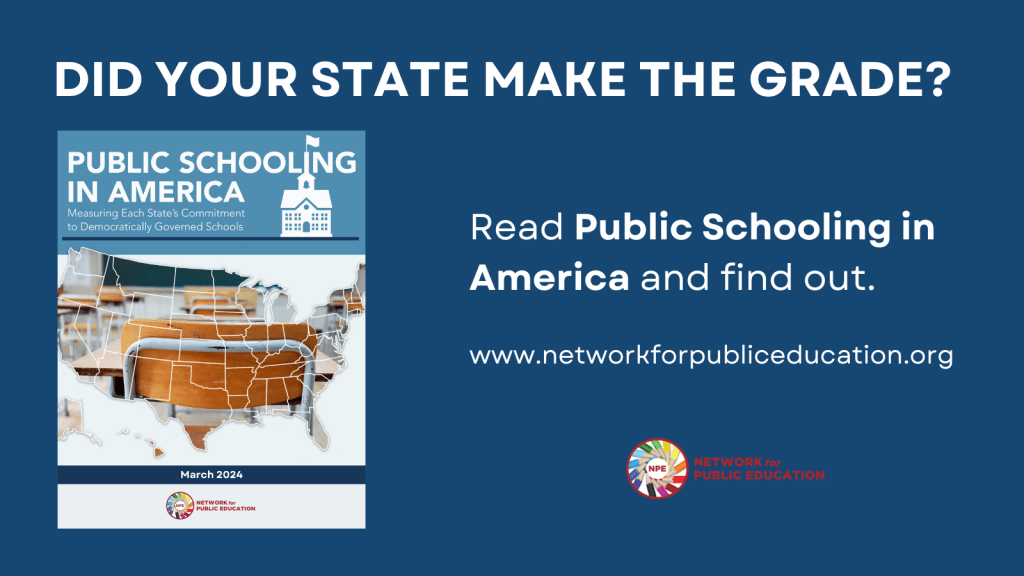
The Network for Public Education released a report card today grading the states on their support for democratically-governed public schools. Which states rank highest in supporting their public schools? Open the report to find out.

Measuring Each State’s Commitment to
Democratically Governed Schools

EXECUTIVE SUMMARY


Neighborhood public schools remain the first choice of the overwhelming majority of Ameri-
can families. Despite their popularity, schools, which are embedded in communities and gov-
erned by elected neighbors, have been the target of an unrelenting attack from the extreme
right. This has resulted in some state legislatures and governors defunding and castigating
public schools while funding alternative models of K-12 education.

This 2024 report, Public Schooling in America: Measuring Each State’s Commitment to
Democratically Governed Schools
, examines these trends, reporting on each state’s commit-
ment to supporting its public schools and the children who attend them.

What We Measure

We measure the extent of privatization in each state and whether charter and voucher laws
promote or discourage equity, responsibility, transparency, and accountability. We also rate
them on the strength of the guardrails they place on voucher and charter systems to protect
students and taxpayers from discrimination, corruption and fraud.

Recognizing that part of the anti-public school strategy is to defund public schools, we rate
states on how responsibly they finance their public schools through adequate and equitable
funding and by providing living wage salaries for teachers.

As the homeschool movement grows and becomes commercialized and publicly funded,
homeschooling laws deserve public scrutiny. Therefore, we rate states on laws that protect
children whose families homeschool.

Finally, we include a new expansive category, freedom to teach and learn, which rewards
states that reject book bans, and the use of unqualified teachers, intolerance of LGBTQ stu-
dents, corporal punishment, and other factors that impinge on teachers’ and students’ rights.

How does your state rank?

Blogger Steve Ruis pulls apart the theological ruling by the Alabama Supreme Court, holding that frozen embryos are children. The Court invoked religious language to assert that destroying a frozen embryo is murder, and anyone who does that can be sued as if they terminated the life of a child. Frozen embryos are in a freezer, not a womb, but the Justices endow them with the status of a living child.

In Vitro Fertilization clinics across Alabama—and elsewhere—are panicked. Couples use IVF when they can’t conceive; typically, they freeze more than they need because, for whatever reason, some of those embryos fail. One couple I know froze 10 embryos; they now have two beautiful, healthy children. But if the Alabama ruling were commonly endorsed, the other eight frozen embryos could never be destroyed. Long after the parents are dead, long after their grandchildren are dead, the embryos would be preserved. Forever.

Ruis writes:

Just when I thought the SCOTUS was the greatest threat to democracy we faced in our court system, the Supreme Court of the State of Alabama stepped up by deciding that frozen embryos are “extrauterine children.”

According to their Chief Justice, Tom Parker:
The Alabama constitution’s ‘sanctity of unborn life’ provision, he wrote, ‘encompasses the following: (1) God made every person in His image; (2) each person therefore has a value that far exceeds the ability of human beings to calculate; and (3) human life cannot be wrongfully destroyed without incurring the wrath of a holy God, who views the destruction of His image as an affront to Himself.’”

Apparently the Alabama Supreme Court has not heard of the separation of church and state. And I am surprised that they weren’t singing Monty Python’s song “Every Sperm is Sacred” while issuing their ruling.

This immediately put the brakes on all of the In Vitro Fertilization therapies currently under way. If you are unfamiliar with IVF it is a process where infertile couples can have fertilized embryos implanted in the woman’s uterus. The embryos are frozen awaiting this process and are willingly donated by fertile women.

So, here’s the bind the fertility clinics are in. They cannot go ahead with the IVF treatments because the “success rate is low, that is many embryos do not implant in the uterine wall and are flushed out during a waste cycle. This would be considered a wrongful death under the law and the desperate parents and doctors could all go to jail. So, all of these clinics are to put their frozen embryos on ice, as it were.

But, here is the problem. Those embryos under Alabama law cannot be implanted, so they have to stay frozen . . .in perpetuity. But what happens down there in hurricane country of the electric power is knocked out for a number of days. Without electricity, all of those embryos would thaw and “die.” Would that be considered a mass murder on the part of the clinic or an “act of God,” under their laws.

I know the solution. All of the Bible thumpers need to step up and adopt one of these “extrauterine children,” providing them with an uninterruptable supply of electricity and to take responsibility if they die. Then we will know they are truly “pro life.”

Remaining frozen forever, never to run and play in the park . . . so much for the sanctity of life.

The Houston Chronicle reported yesterday that Republicans who voted to oppose Governor Greg Abbott’s voucher program are being bombarded with fake ads, distorting their support for their local public schools. Governor Abbott received a gift of $6 million from Pennsylvania billionaire Jeff Yass to advance vouchers, as well as more from billionaire oil tycoons Wilks, Dunn, and Farris. Clearly he’s putting this bonanza into a campaign of lies. Abbott says that polls show that Texans want vouchers. If that were true (it’s not), Abbott should run honest ads saying, “Don’t vote for this guy because he opposes vouchers.”

During the regular session and four special sessions, Abbott held public school funding and teacher pay hostage. He said he would not give a penny to public schools or their teachers unless he got vouchers. Twenty-one Republicans opposed vouchers, so now Abbott accuses them of sabotaging the funding of public schools and teacher pay.

Abbott won’t run honest ads because he knows that Texans don’t want to spend their taxes to pay for religious schools and to subsidize the tuition of rich kids in private schools. His ads lie because the Governor knows vouchers are unpopular. They have been voted down in every state that has put them on the ballot.

Reporter Jason Scherer writes:

The ad opens with a dramatic message: “Steve Allison failed our teachers and kids.”

It says the San Antonio Republican stopped a bill in the Texas House last year that would have raised teacher pay, ended STAAR testing and poured more than $200 million into public schools in his district. “You deserve better,” the narrator concludes.

RELATED: Who’s behind the campaign mailers flooding GOP districts? Most lead back to megadonor oil tycoons

What the ad, from the Family Empowerment Coalition PAC, fails to mention is that Allison supported all of those measures. Gov. Greg Abbott refused to sign a package that included them into law unless it included private school vouchers, which Allison opposed.

The PAC is using similarly misleading online ads to target at least a dozen Republican state House members who voted to strip the voucher proposalfrom a $7 billion education funding bill in November. The PAC is one of several groups that have worked in conjunction with Abbott ahead of the March primaries to unseat GOP lawmakers who rejected the governor’s push last year to give parents taxpayer dollars to send their kids to private schools.

Twenty-one House Republicans joined with every Democrat in the chamber to strike vouchers from the bill. The GOP author then withdrew the entire package, citing Abbott’s threat to veto any education funding that did not come with vouchers.

Allison, a former Alamo Heights ISD board president who has long pushed for Texas to bolster school funding, said the ad’s claims are a “flat-out falsehood.”

BACKGROUND: Texas House rejects school voucher proposal, dealing blow to Abbott, private school advocates

“There was absolutely no reason in the world why the rest of that bill couldn’t have gone forward — and I think we would have passed it,” Allison said, adding that he supported the rest of the $7 billion measure. If anything, he argued, it did not go far enough to boost education funding.

Leo Linbeck, a leader and co-founder of the Family Empowerment Coalition PAC, has contended that “anti-voucher extremists” were responsible for the bill’s demise, arguing that they received major concessions and were only asked to approve a limited voucher program “that would have served 1% of kids, all poor.”

“(W)hen you strip out a major part of a compromise bill, it dies,” Linbeck wrote on X last month.

Linbeck did not immediately respond to a request for comment Wednesday.

The ads are just one example of how Abbott and the cadre of pro-voucher political groups have made only sparing reference to vouchers, instead focusing on teacher pay raises, border security and abortion in their political ads.

The Family Empowerment Coalition has been among the most active players in the state House primaries, spending some $762,000 through late January to attack anti-voucher Republicans and support their primary challengers. Other founding members include Doug Deason, a prominent Dallas GOP donor, and former state Sen. Eddie Lucio Jr., a Democrat who supported vouchers in the Legislature.

Beyond attacks on school funding, they have also accused GOP members of being “weak on the border” and promoted their challengers as stronger advocates for border security — a topic that carries far more weight among GOP primary voters than vouchers, according to a recent statewide poll.

State Rep. Ernest Bailes, a Shepherd Republican who opposes school vouchers, is another of the group’s targets. His main rival is Janis Holt, a school board trustee and owner of an air purification company who also challenged Bailes in 2022.

More than three-quarters of Holt’s campaign funding has come from the Family Empowerment Coalition PAC and Abbott, who endorsed her in January.

“Governor Abbott needs an ally to fight with him for a secure border,” one of the Family Empowerment Coalition PAC’s ads reads. “That’s why he has endorsed Janis Holt for HD 18.”

The PAC ran another ad accusing Allison of bragging “that he helped close the border, even though he didn’t. That’s why Gov. Abbott didn’t endorse him.”

But the ad leaves out that every Republican in the Texas House, including Allison and Bailes, supported a far-reaching new law that empowers state officials to essentially deport people who are suspected of crossing the border illegally. They also backed a contentious bill that establishes stiffer penalties for human smuggling and approved more than $6.5 billion for border security over the next two years, including $1.5 billion to continue building a wall along Texas’ southern border.

Allison called the border-focused ads “outrageous,” pointing to his votes for the slate of GOP immigration bills.

“I’d like to see them point to one border bill that I didn’t vote for, or show anything that I’ve ever done except being 100% behind border security,” Allison said. “I’ve been down there three times. I have voted for every appropriation — I was on (the House) Appropriations (Committee) — and voted for every request the governor has made.”

Abbott is running a digital ad promoting Allison’s main challenger, attorney and former Bexar County district attorney GOP nominee Marc LaHood, as an ally in his fight to “stop the flow of illegal immigrants, crime and drugs into Texas.” The governor has run the same version of the ad for several other candidates running to unseat anti-voucher Republicans.

The governor also invited 20 Republican House members to the border last week for a press conference where he touted their bona fides on border legislation. Abbott did not invite any voucher opponents to the press conference.

Politico reported recently that Mayor Eric Adams is pulling out all the stops in his campaign to persuade the legislature to extend mayoral control of New York Ciry’s public schools.

That’s understandable. Every mayor wants as much power as he can gather. Guiliani wanted mayoral control. The legislature turned him down. Michael Bloomberg got it after he won the mayoralty in 2001, pledging to make the schools run efficiently and successfully after years of political squabbling and disappointing academic results.

A historical note: the last time that the independent Board of Education was abolished was in 1871, when Boss Tweed pushed through state legislation to create a Department of Education, in charge of the schools. The new Department immediately banned purchase of any textbooks published by Harper Bros., to retaliate for the publication of Thomas Nast cartoons ridiculing the Tweed Ring in Harper’s magazine. The new Department steered lucrative contracts to Tweed cronies, for furniture and all supplies for the schools.

Two years later, the corruption of the Tweed Ring was exposed, and criminal prosecutions ensued. In short order, the Department of Education was dissolved and the independent Board of Education was revived.

In the 2001 race for Mayor, billionaire Mike Bloomberg campaigned on promises to rebuild the city’s economy after the devastating attacks of 9/11/2001. He also promised to take over the school system, make it more efficient, improve student performance, and able to live within its budget of $12 billion plus. He won, and many people were excited by the prospect of a successful businessman taking over the city and the schools.

In 2002, the State Legislature gave Mayor Bloomberg control of the schools in New York City. It replaced the independent Board of Education, whose seven members were appointed by the five borough presidents and the mayor. Bloomberg had complete control of the school system, with its more than 1,000 schools and more than one million students. The new law allowed him to appoint the majority of “the Panel on Education Policy,” a sham substitute for the old Board of Education.

The new law still referred to “the Board of Education,” but the new PEP was a shell of its former self. It was toothless, as Bloomberg wanted. He picked the Chancellor, and he had the policymaking powers. Early on, in 2004, he decided that third graders should be held back based on their reading scores. Some of his appointees on the PEP opposed the idea and he fired them before the vote was taken. He wanted all his appointees to know that he appointed them to carry out his decisions, not to question them. The retention policy was later expanded through eighth grade but quietly abandoned in 2014 because it failed.

I won’t go into all the missteps of the Bloomberg regime, which lasted 12 years, but will offer a few generalizations:

1. The mayor should not control the schools because they will never be his first priority. The mayor juggles a large portfolio: public safety, the economy, transportation, infrastructure, public health, sanitation, and much more. On any given day, he/she might have 30 minutes to think about the schools; more some days, none at all on others.

2. Mayoral control concentrates too much power in the hands of one person. One person, especially a non-educator, gets an idea into his head and imposes it, no need to talk to experienced educators or review research.

3. Mayoral control marginalizes parents and community members, whose concerns deserve to be heard. At public hearings of the PEP, parents testified but rightly thought that no one listened to them. In the “bad old days,” they could speak to someone in their borough president’s office; now the borough presidents have no power. No one does, Except the mayor.

4. The Mayor picked three non-educators as Chancellor. Joel Klein disdained educators and public schools, even though he was a graduate of the NYC public schools. He created a “Leadership Academy” to train non-educators and teachers to bypass the usual path to becoming a principal by serving for years as an assistant principal. Klein surrounded himself with B-school graduates and looked to Eli Broad, Bill Gates, and Jack Welch for advice. Large numbers of experienced teachers and principals retired.

5. Bloomberg loved churn and disruption. He closed scores of schools and replaced them with many more small schools. Some high schools that had programs for ELLs, special education, career paths for different fields, were closed and replaced by schools for 300/400 students, too small to offer specialized programs or advanced classes.

6. New initiatives were announced with great fanfare (like merit pay), thanks to a vastly enlarged public relations staff, then quietly collapsed and disappeared.

7. Bloomberg and Klein imposed a new choice system. But all high schools and middle schools became schools of choice. A dozen students of the age living in the same building might attend a dozen different schools, some distant from their homes. One retired executive told me that this dispersal was intended to obstruct the creation of grassroots uprisings against the new dictates.

8. Bloomberg and Klein favored charter schools. In short order, more than 100 opened. The charters were supported financially and politically by some of the wealthiest Wall Street titans. When there was any threat to charters, their wealthy patrons quickly assembled multi-millions dollar TV campaigns to defend them. Because of the deep pockets of the charter patrons, the charter lobby gave generous contributions to legislators in Albany. The legislature passed laws favoring the charters, including one that required the public schools to provide free space for them or, if no suitable space was available, to pay their rent in private facilities.

9. Bloomberg and Klein made testing, accountability and choice the central themes of their reforms. Their approach mirrored President George W. Bush’s No Child Left Behind law, which began at the same time. Raising test scores became the goal of the school system. Schools were graded A-F, depending primarily on their ability to raise test scores. Eventually, teachers were graded by the rise or fall of their students’ scores. NYC faithfully mirrored the tenets of the national corporate reform movement.

10. NYC test scores improved on NAEP during the Bloomberg years, but not as much as in other cities that did not have mayoral control.

11. To get a great overview of “The Failure of Mayoral Control in New York City,” read this great summary by Leonie Haimson, which includes links to other sources. See, especially, the recent article in Education Week on the decline of mayoral control. Chicago had mayoral control similar to that in New York City, which allowed Mayor Rahm Emanuel to close 50 schools in black and brown communities in one day, completely ignoring the views of parents. It was an ignominious example of the danger of one-man control.

12. There is no perfect mechanism to govern schools, but any kind of oversight should allow parent voices to count. 95% of the nation’s school districts have elected school boards. Sometimes a small faction gains control and does damage. That’s the risk of democracy. Whatever the mechanism, there must be an opportunity for the public, especially parents, to make their voices heard and to have a role. The mayor controls the budget: that’s as much power as he should have.

History is an excellent overview of New York City school governance—history and myths. Again, by Leonie Haimson. (Note: her history leaves out the two years of mayoral control from 1871-1873.)
By a vote of 4-3, the Los Angeles Unified Schiol District Board adopted a policy barring charter schools from co-locating in public schools with high-needs students. The charter lobby immediately threatened to sue the district. Currently one of every five students in the LAUSD district attends a charter school. For years, billionaires such as Eli Broad, Reed Hastings, Bill Bloomfield, the Walton family, and Michael Bloomberg have poured millions into school board races on behalf of privatization. But for the moment, the anti-privatization supporters of public schools have a slim majority.

The seats of two of the four-person majority—Scott Schmerelson and George McKenna—are up for election next month. Both are veteran educators and pro-public schools. Schmerelson is running for re-election; McKenna is retiring and has endorsed veteran educator Sherlett Hendy Newbill. I endorsed both Scott Schmerelson and Sherlett Hendy Newbill.

The new policy could be ditched by pro-charter replacements or by a legal challenge from the charter lobby.

Howard Blume wrote in the Los Angeles Times:

The struggle between traditional and charter schools intensified Tuesday when a narrow Los Angeles school board majority passed a sweeping policy that will limit when charters can operate on district-owned campuses. 

Access to public school campuses for charter schools is guaranteed under state law — and charter advocates immediately threatened to sue over the new restrictions.

The policy, passed 4 to 3, prohibits the new location of charters at an unspecified number of campuses with special space needs or programs. One early staff estimate put the number close to 350, but there’s uncertainty over how the policy will be interpreted. The school system has about 850 campuses, but advocates are concerned that charters could be pushed out of areas where they currently operate, making it difficult for them to remain viable.

Under the policy, district-operated campuses are exempt from new space-sharing arrangements when a school has a designatedprogram to help Black students or when a school is among the most “fragile” because of low student achievement. Also exempt would be community schools — which incorporate services for the broader health, counseling and other needs of students and their families. 

The district argued these programs need space beyond the normal allotments for classrooms, counselors, health staff and administrators — for example, rooms for tutoring, enrichment or parent centers. Such spaces had frequently been tabulated as unused or underutilized — and then made available to charters…

In the current school year 52 independent charters operate on 50 campuses, according to L.A. Unified. The number is expected to be smaller for next year and down significantly from a peak of more than 100. But even 50 schools would make for one of the larger school systems in California.

In all, there are 221 district-authorized charters and 25 other local charters approved by the county or state, serving about 1 in 5 public school students within the boundaries of L.A. Unified — about 535,000 students total. Most charters operate in their own or leased private buildings.

The L.A. school system has more charters than any other district in the nation. Most were approved under charter-friendly school boards and under state laws — since changed — that made it difficult for school districts to reject charters.

Open Secrets is a website that tracks and reports on political spending and donors. Its latest report says that the Trump political network paid more than $60 million for legal fees, which was unprecedented for him, possibly for any presidential candidate ever. The money comes not from his pockets but from his fundraising appeals. It’s surprising but true that small donors would send $10 or $25 to a man who claims to be worth $10 billion.

For many years, I was a staunch advocate of standardized testing. But I lost my enthusiasm for standardized testing after spending seven years on the governing board of NAEP (the National Assessment of Educational Progress). NAEP is the federal test administered every two years to measure academic progress in reading and math, as well as testing other subjects. The test takers are randomly selected; not every student answers the questions on any test. There are no stakes attached to NAEP scores for any student, teacher, or school. The scores are reported nationally and by state and for nearly two dozen urban districts. NAEP is useful for gauging trends.

Why did I lose faith in the value of standardized testing?

First, over the course of my term, I saw questions that had more than one right answer. A thoughtful student might easily select the “wrong” answer. I also saw questions where the “right” answer was wrong.

Second, it troubled me that test scores were so highly correlated with socioeconomic status. Invariably, the students from families with the highest income had the highest scores. Those from the poorest families had the lowest scores.

Third, the latter observation spurred me to look at this correlation between family wealth and test scores. I saw it on the results of every standardized test, be it the SAT, the ACT, or international tests. I wondered why we were spending so much money to tell us what we already knew: rich kids have better medical care, fewer absences, better nutrition, more secure and stable housing, and are less likely to be exposed to vermin, violence, and other health hazards.

Fourth, when I read books like Daniel Koretz’s “Measuring Up” and “The Testing Charade” and Todd Farley’s “Making the Grades: My Misadventures in the Standardized Testing Industry,” my faith in the tests dissipated to the vanishing point.

Fifth, when I realized that the results of the tests are not available until the late summer or fall when the student has a new teacher, and that the tests offer no diagnostic information because the questions and answers are top-secret, I concluded that the tests had no value. They were akin to a medical test whose result is available four months after you see the doctor, and whose result is a rating comparing you to others but utterly lacking in diagnostic information about what needs medication.

So, all of this is background to presenting a recent study that you might find useful in assessing the value of standardized tests:

Jamil Maroun and Christopher Tienken have written a paper that will help you understand why standardized tested is fatally flawed. The paper is on the web and its title is:

The Pernicious Predictability of State-Mandated Tests of Academic Achievement in the United States

Here is the abstract:

The purpose of this study was to determine the predictiveness of community and family demographic variables related to the development of student academic background knowledge on the percentage of students who pass a state-mandated, commercially prepared, standardized Algebra 1 test in the state of New Jersey, USA. This explanatory, cross-sectional study utilized quantitative methods through hierarchical regression analysis. The results suggest that family demographic variables found in the United States Census data related to the development of student academic background knowledge predicted 75 percent of schools in which students achieved a passing score on a state standardized high school assessment of Algebra 1. We can conclude that construct-irrelevant variance, influenced in part by student background knowledge, can be used to predict standardized test results. The results call into question the use of standardized tests as tools for policy makers and educational leaders to accurately judge student learning or school quality.

The paper was peer-reviewed. It was published last week.

I am pleased to endorse Sherlett Hendy Newbill for election to the Los Angeles Unified School District Board in District 1. The accomplished incumbent George McKenna is retiring, and Newbill would be an outstanding replacement for him.

Sherlett is a native of Los Angeles and a graduate of the Susan Miller Dorsey Senior High School in Los Angeles, where she has spent her professional career after earning her bachelor’s degree at Xavier University in New Orleans.

She has worked as a physical education teacher, department chair, director of athletics, and dean of students since 1998. As a PE teacher and dean, she has been deeply engaged in the physical and mental health and well-being of students. Since 2007, she has been the UTLA representative at her school.

In recent years, she has worked in the office of George McKenna, the District 1 board member, as an education policy advisor. She has worked with district stakeholders and understands the needs of the district.

She was endorsed by the Los Angeles County Democratic Party, the Los Angeles Sentinel, PST (Parents Supporting Teachers), a large grassroots parents organization. She has also been endorsed by the incumbent LAUSD board member, George McKenna, as well as LAUSD board members Jackie Goldberg and Scott Schmerelson.

Visit her website.

Please vote for Sherlett Hendy Newbill for LAUSD Dictrict 1!