Archives for category: Education Industry

Betsy DeVos awarded $25 million to Alabama to grow some charter schools. She gave the money to an organization called “New Schools for Alabama,” which is supposed to launch 15 new charters over the next five years. Where there is money, there will always be takers, even where there is no need. This year, two charters are in the incubation stage. One is in Perry County, which has only two K-12 public schools, declining population, and low funding. The charter will be a nail in the coffin for one of those two public schools.

Larry Lee writes about what Betsy DeVos has done:

https://www.alreporter.com/2019/12/12/opinion-perry-county-schools-threatened-by-charter-schools/

Opinion | Perry County Schools threatened by charter schools

They stand as silent sentinels of a time gone by.  Watch towers on the past.  “They” are sturdy concrete silos, rising 40-50 feet above Perry County’s black prairie land.  Head south out of Marion on Highway 5 and you’ll spy one every few miles.  Each a reminder a dairy was once there and those silos were filled with corn silage to keep milk cows well-fed.
They remind us of the struggles this black belt county has faced for generations.  Struggles that continue today.
No one understands this any more than John Heard, longtime county school superintendent.  State data shows that public school enrollment has dropped from 1,938 to 1,256 in the last decade.  There are only two schools in the system today.  Things are no better at Marion Academy, a private school, that has fewer than 100 students in pre-12 through 12th grade.

And if one number can illustrate the plight of this school system it is 137.  That is where the system ranks in terms of local revenue per pupil.  Which means out of 137 systems in the state, it is dead last.  By comparison, its neighbor to the west, Marengo County, gets $1,300 more per student from local sources than Perry does.

Marion is the county seat.  In antebellum days it was a jewel in Alabama’s crown, probably best known for its commitment to higher education.  Judson College was founded in 1838 and is still there.  What is now Samford University in Birmingham began there.  Marion Military Institute’s parade grounds still welcome visitors on the south side of town.  Alabama State University in Montgomery has its roots in Marion.
All things considered, Perry County would appear to be the last place to open a charter school.  But in our quest to sprinkle charter schools at random around the state, that is the plan.  It makes no sense.  But then, in todays world of Alabama public education, logic is too often thrown to the wind.
If a charter school opens in Perry County, it will drive a stake in what’s left of the public school system because it will siphon precious dollars away.  Since charters are public schools supported by public dollars, every student attending one of the county’s two remaining schools (one which is rated a B by the state and the other rated C) means the county system will lose all Federal and state funding for that student.  Presently, this is about $8,500 per pupil.
 
How we got to this point is a curious tale and testimony to the consequences of what we are supposed to believe are good intentions.
New Schools for Alabama is a brand new non-profit based in Birmingham.   Its mission is to bring charter schools to the state.  This year’s education budget gave them $400,000 for operating expenses.  (Yep, we are taking money from public schools to fund a group who, if successful, will take more money from public schools.  Another example of the logic practiced by the supermajority leadership of the state legislature.)
New Schools was recently awarded a $25 million grant from the U.S. Department of Education headed by Betsy DeVos, who has never seen a charter school she didn’t like.  Plans are that New Schools will award three $1.5 million grants annually to give charters a jump start.  They have also set up a fellowship program in which they fund someone to spend time at a charter school in another state so they can come back to Alabama and get a charter up and running.
This is where Perry County comes in.  New Schools recently announced that one of their first fellowships is going to Darren Ramalho to start Breakthrough Charter School in Perry County.
And here is where the irony gets even more ironic.
Ramalho is a graduate of UCLA and came to Perry County in 2014 as a Teach For America teacher.  TFA descended on Alabama in 2011.  Like many others, they came to “save the Black Belt.”  Perry County has used TFA from the outset and while most other west Alabama school systems quit TFA years ago, Perry County has continued to do so.  Which means they have spent thousands and thousands of dollars on this program which puts temporary teachers in local schools.
In other words, someone from California who has been supported by John Heard and the Perry County system for several years now has intentions to bring harm to them.  As you can imagine, Heard is upset.  And rightly so.  In this corner of the world, actions such as this are sometimes referred to as “biting the hand that feeds you.”
Perry County is struggling–and has been for generations.  They definitely do not need an effort that will only intensify their struggles.
But putting a charter school there will do just that.


The New York Times recently wrote an article claiming that many black and Hispanic families were disappointed that Democratic presidential candidates were abandoning the charter school crusade beloved by the leaders of No Child Left Behind and Race to the Top, and currently by Betsy DeVos.

Steven Singer disagrees. He responds bluntly that charter schools exploit children of color. 

He writes:

Go to most impoverished black neighborhoods and you’re bound to find three things in abundance.

Liquor stores, payday lenders and charter schools.

It is no accident.

In the inner city, the underemployed compete for a shortage of minimum wage jobs, healthcare is minimal, public transportation inadequate and the schools are underfunded and short staffed.

But that doesn’t mean money isn’t being made.

In capitalist America, we make sure to turn a profit off of everything – including our peculiar institutions of racial inequality.

Businesses are on every corner, but they aren’t set up for the convenience of those living there.

Ethnic isolation – whether caused by poverty, legal coercion, safety in numbers or white flight – often puts the segregated at a disadvantage. It creates a quarantined economy set up for profiteers and carpetbaggers to get rich off the misery of the poor.

The system is set up to wring as much blood as it can from people forced to live as stones.

Families struggle to survive in a community where they are exploited by grasping landlords and greedy grocers. And the system is kept in check by law enforcement officers who are either disposed to turn the other way or so overzealous as to shoot first and ask questions later.

As W.E.B. DuBois described it nearly a century ago, “Murder sat on our doorstep, police were our government, and philanthropy dropped in with periodic advice.”

The economy is glutted with enterprises offering cheap promises of relief but which actually reinforce the status quo.

Predominantly black, low-income neighborhoods are eight times more likely to have carry-out liquor stores than white or racially integrated neighborhoods, according to researchers at the Johns Hopkins School of Public Health.

Yet in higher income black neighborhoods in the same cities, you don’t find these same liquor stores.

They are established in the poorest neighborhoods to offer cheap, temporary respite from the trauma of living in poverty. Yet they increase the likelihood of alcoholism, addiction and violence.

The same goes for payday lenders.

These are basically legal loan sharks who offer ready cash at exorbitant interest rates.  Typically these payday loans are meant to last the length between paychecks – approximately two weeks. However, they come with extremely high interest rates. For instance, the average $375 loan ends up costing $520 (139%) in interest.

These businesses aren’t located in the suburbs or wealthy parts of town. You find them typically in the inner cities and poor black neighborhoods. They promise temporary help with one-time purchases and unexpected expenses, but in truth most are used to pay for necessities like rent or food.

They end up trapping users in a debt spiral where they have to take out payday loans to pay off previous payday loans. This is mostly because these loans are made based on the lender’s ability to collect, not the borrower’s ability to repay while meeting other financial obligations.

And these are just two of the most common features of this predatory economy – capitalist enterprises designed to enrich businesses for exploiting consumers beyond their ability to cope.

Others include high priced but limited stock grocery markets, fast food restaurants, gun stores, inner city rental properties and charter schools.

That last one may seem out of place.

Most descriptions of urban neighborhoods neglect to mention charter schools, but in the last few decades they have become an increasingly common part of the landscape. And this is no wonder. They fit the same pattern of exploitation as the other establishments mentioned above.

Think about it: (1) charter schools disproportionately locate in poor black communities, (2) offer the promise of relief from inequality but end up recreating or worsening the same unjust circumstances and (3) they are often owned by rich white folks from outside the neighborhood who profit off the venture.


Prominent groups that support public schools–not charter schools or religious schools–are meeting on Saturday in Pittsburgh to discuss the future of public education with Democratic presidential candidates.

The billionaire-funded charter industry is angry that they can’t control the event and they have released their plans to disrupt the event.

Contrary to the claims of the charter industry, charter schools are not public schools. They are private contractors that receive public money and are typically unregulated and fail to meet basic standards of accountability and transparency.

Unfortunately, their leaders insist on minimal or non-regulation, assuring that grifters and entrepreneurs will be able to receive public dollars without any accountability.

The industry resolutely refuses to acknowledge, let alone curb, the waste, fraud, and abuse that has created a backlash against charter schools.

The Center for Education Reform, led by former Heritage Foundation education analyst Jeanne Allen, sent out this email:


 Charter Schools in Pittsburgh & Leaders

 throughout Pennsylvania Unite


Issue strong message to special interest sponsors of “Public Education Forum 2020” and the Democratic candidates ignoring parental demands


WASHINGTON – Charter school leaders in Pittsburgh, joined by others throughout Pennsylvania, and by key state democratic officials issued strong statements today challenging the Democratic candidates for president who will be in Pittsburgh, Pennsylvania, this Saturday, December 14, 2019, at the David L. Lawrence Convention Center for the “Public Education Forum 2020: Equity and Justice for All.” Sponsored by unions and other interest groups, the Forum has sparked strong responses from the Pennsylvania charter school community, with its unfounded attacks upon the substantive work being carried out throughout the state and right in the city where the forum will be held.


“We call on the candidates to remember those who won’t be there: the thousands of parents from underserved communities tragically forced to watch their children suffer academically because of a failed system that refuses any real reform,” said representatives of 5 of the city’s charter schools in a statement, speaking on behalf of the state’s 143,000 charter school students and their parents.


“The Democratic Presidential candidates have been summoned to demonstrate their allegiance to the unions and special interests who they believe hold the key to their nomination,” said CER Founder & CEO Jeanne Allen. “Not invited were any charter or reform minded voices to participate in this nationally televised forum where Pennsylvania Governor Tom Wolf is expected to attend and criticize the very charter schools he has tried to keep from operating.”


Many charter educators will be on the ground in Pittsburgh to make their voices heard, including Dara Ware Allen, PhD, CEO and Principal, City Charter High School; Dr. Tina Chekan, CEO/Superintendent, Propel Schools; Jon McCann, CEO, Environmental Charter School; Vasilios Scoumis, CEO, Manchester Academic Charter School; Brian Smith, Founder & CEO, Catalyst Academy Charter School; William C. Wade, Ed.S., CEO, Urban Pathways K5 College Charter School; and David Zeiler, CEO, Provident Charter School. They have issued the following statement in response to the Public Education Forum this Saturday.


“As eight potential future presidents gather here in Pittsburgh this Saturday and are hosted by some of the nation’s most powerful special interests, we call on the candidates to remember those who won’t be there: the thousands of parents from underserved communities tragically forced to watch their children suffer academically because of a failed system that refuses any real reform. It is a cruel irony that the tagline of this weekend’s forum is ‘equity and justice for all’ when all the candidates being celebrated each oppose the very policies that help our schools give such words real meaning. Thanks to school choice, our public charter schools prevail at giving life-altering opportunity to children for whom educational success – and the more hopeful and secure future that comes with it – would likely be denied.


Steven Singer will be in Pittsburgh on Saturday as part of the Network for Public Education delegation to the MSNBC forum on public education.

Here are his questions for the candidates. 

He won’t get to ask them all, but they are all great questions!


Michael Kohlhaas, blogger in Los Angeles, writes here about a charter leader who harassed a teacher who protested his staff’s lack of qualifications.

Excelencia Charter Academy is yet another creepy little charter school run by yet another shockingly unqualified creepy little galaxy-brained grifter, this one known as Ruben Alonzo, going about the place making creepy little announcements of delusionally impending disruptive excellence while lining his creepy little pockets with public money1 at the expense of the actual human children that the state legislature, for reasons they’re going to have to answer for eventually, has seen fit to place into his care.

In this regard Alonzo is much like Sakshi Jain, shockingly unqualified founder of the ill-fated GANAS Academy, whose plan to co-locate on the campus of Catskill Elementary School conjured up such a monumental hurricane of activist opposition and scorn that, it appears, she has had to put her school’s opening on hold while she slinks back to her lair to soothe her metaphorical wounds with a salve made of equal parts boorish self-pity and Walton family megabucks.

Unlike Jain, though, Alonzo did actually manage to open his school. In the Fall of 2018 as it happens and, like Jain’s fiasco, co-located, in this case on the campus of Sunrise Elementary School in Boyle Heights. And like Jain’s folly Alonzo’s weirdo little project conjured up some opposition, most publicly from Sunrise Elementary teacher Mimi Guzman-Duncanson.

Duncanson famously parked her SUV out in front of the school covered in flyers advertising the appalling lack of qualifications of Excelencia’s teachers, let alone Ruben Alonzo, the self-proclaimed founder. Duncanson’s protest was covered in the Los Angeles Timesand by Jason McGahan, writing in The Baffler.

You can see a picture of Maestra Duncanson2 with her minivan somewhere near this sentence.That picture and another like it came from a huge set of emails released to me recently by Alonzo pursuant to the California Public Records Act.3 And if it looks like hostile photography, like surveillance, well, that’s because that’s precisely what it is. It turns out that aggressively callow hellbaby Ruben Alonzo just could not deal with the fact that anyone at all dared to question his galaxy-brained 29 year old self.


Curtis Cardine, former superintendent of both public and charter schools, is the preeminent expert on charter schools in Arizona. He created the Grand Canyon Institute to study education issues, and it keeps a close eye on charter malfeasance.

Cardine has written two books that are well worth reading to learn about the failures of the charter industry in Arizona. He is an expert in school finance, and he demonstrates in detail how charter operators are ripping off the public.

The first was Carpetbagging America’s Public Schools.

I quote that book extensively in my own new book SLAYING GOLIATH.

Cardine’s second book, recently published, is Schooling Alone, in which he compares the atomization of society caused by school privatization, and likens its effects to sociologist Robert Putnam’s classic study of social disintegration, Bowling Alone.

Cardine recently prepared a review of Arizona charter school closures and their relation to the bond debt incurred by charters.

Read his letter to two Arizona state senators here.

Thomas Ultican wrote a post about the billionaire-driven world of educational technology, which has nothing to do with education or learning, but everything to do with scoring profits.

The edtech industry is driven by greed.

He begins:

Anthony Kim founded Education Elements in 2010. He sold Provost Systems – which built virtual schools – to Edison Schools in 2008 and was ready for a new project. His new company sells personalized learning systems and consulting services to several school districts. Education Elements is one of more than a hundred ed tech companies being supported by venture capital organizations hoping for one big score. It is representative of the education technology startup business.

With education businesses there is opportunity for magnificent profits because of the large scale of education spending. The United States alone spends $650 billion dollar a year on public education. If businesses can convince people that learning at a digital screen is equivalent to or even better than a teacher led classroom, education technology would become America’s next great profit center minting many new billionaires. This allure of lavish profits is driving education technology.

The Venture Capital Firms

Crunchbase, which analyzes venture capital and startups, lists five venture capital companies investing in Education Elements.

Harmony is the only one of the five venture funds that does not focus specifically on education technology. They simply say, “Over the past 20 years, we have invested over $750 million in 80 companies.” They list their current investments which includes Education Elements.

NewSchools Venture Fund is the most strident in its commitment to disrupting public education. NewSchools is a non-profit that claims they are a “venture philanthropy working to reimagine public education investing in education entrepreneurs.” Their venture portfolio contains more than 150 companies.

Every year NewSchools hosts a “Summit” in Oakland, California which they state brings together more than 1,200 educators, entrepreneurs, community leaders, funders, and policy makers to share ideas on how to “reimagine learning.” The “Platinum” sponsors for the 2020 gathering are the Chan Zuckerberg Initiative and The Walton Family Foundation who are also well-known leaders in the movement to monetize and privatize public education.
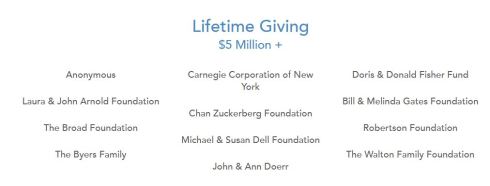
New Schools Venture Fund Donors

Twelve Organizations Contributing $5 Million Plus to NewSchools Venture Fund

Eleven of the twelve organizations listed above are known for promoting market based education reform. The twelfth, Anonymous, most likely has the same ideology.

Rethink Education is the third venture fund. It claims to focus on “Crucial Life Skills, Personalized Learning, Vocational Preparation, Curation of Workforce Learning Resources, College Dropout Prevention.” Jenny Abramson is the founder and Managing Partner of Rethink. She is a former Teach For America (TFA) corps member and a board member of the Washington DC charter school, DC Prep.

Imagine K12 is the forth fund investing in Education Elements. It was founded in 2011 as a startup accelerator for education technology companies. In 2016 Imagine merged with Y Combinator. The joint companies have invested in over 100 education technology focused companies.

Tugboat Ventures is the fifth fund invested in Education Elements which is one of its 35 listed properties.

The thread that ties together these ventures is the pursuit of profits. That is a mighty thread indeed.

He lists the members of the Board of Directors, all from the financial world.

No actual teachers in sight.

He adds:

Due to lobbying by billionaires like Bill Gates and Reed Hastings, the latest update to the national education law turned the US Department of Education (USED) into an education technology sales hub. Critically for companies like Education Elements, the federal technology pitch includes Competency Based Education (CBE). In order to have an inexpensive cyber based education system, there must be small skills that can be drilled and then tested. The USED says,

“Competency-based strategies provide flexibility in the way that credit can be earned or awarded, and provide students with personalized learning opportunities. These strategies include online and blended learning, dual enrollment and early college high schools, project-based and community-based learning, and credit recovery, among others.”

Unfortunately CBE is just an update of previous failed teaching strategies. In the 1970’s it was called Mastery Learning and in the 1990’s it was called Outcome Based Education. CBE is simply putting Mastery Leaning on a computer instead of using worksheets and paper assessments. It is still bad pedagogy. Computer based credit recovery is the fraud engendering the recent soaring graduation rates.

What is called “education reform” is a giant scam. It is not about “education” and it is not about “reform.” It is about money.

Steven Singer discovered that the Pennsylvania Department of Education invited citizens to comment on the state’s charter law.

Now is your chance to be heard.

Steven has some definite ideas about what needs to change and he tells you where to send your own comments.

He writes:

This is a huge opportunity for residents fed up with the nonsense the school privatization industry has been getting away with in the Commonwealth for decades.

Pennsylvania has one of the worst charter school laws in the nation.

Charter schools are taxpayer-funded but privately operated.

Though there are about 180 of these privatized institutions throughout the state with more than 137,000 students, that represents only about 6 percent of the kids enrolled in public school.


Yet the state funding system pits authentic public schools against charter schools for the financing needed to stay open.

Charter schools siphon money from authentic public schools serving the neediest students creating a deficit spiral. Money gushes out of public districts which have to cut teachers and programs to patch budget gaps which in turn result in even more parents pulling their children out of the public schools and trying to enroll them in charters.

Though the legislature used to help authentic public schools by reimbursing them for 30% of the charter school costs, that funding has been eliminated.

Meanwhile, the charter school law has barely changed at all since it was enacted in 1997.

Gov. Tom Wolf has promised to correct that with sweeping reforms in 2020 – even if it means bypassing the gerrymandered and gridlocked legislature with executive orders.

But before he can begin, he needs to hear from commonwealth voters.


Rahm Emanuel is gone. The boosters of privatization are out of power in Chicago. Mayor Lori Lightfoot has committed to improving the public schools that the vast majority of students attend.

No new applications to open charter schools this year in the city of Chicago.

It is a new day in Chicago, with new leadership.

Yana Kunichoff writes in Chalkbeat:

No new charter schools are applying this year to expand or open in Chicago, a sign of the shifting environment for the independently run, publicly funded schools in Chicago and at the state level.

Last summer Illinois abolished the state agency hearing appeals of charter school denials. Chicago schools, both district- and charter-run, are experiencing an ongoing drop in enrollment, leaving schools competing for fewer students. 

A charter school operator named Destiny STREAM Academy for Girls Charter School initially applied to open a new charter, focused on math and technology education for girls, but then withdrew its application. 

Chicago has more than 120 charter schools; the school district runs more than 500 schools. The number of charter school applications has diminished by half over the past three years, according to a Chalkbeat analysis. 

After more than two decades of expansion in Chicago, charter school growth has tapered off.

Last year, the district denied three new charter proposals.

In 2017, nine schools sent in proposals. One was approved, one denied, and seven schools withdrew their applications. In 2016, there were 10 submissions, one of which was incomplete, and the rest were withdrawn. 

That’s a wildly different landscape to just a few years before, when more than 16 schools threw their hat in the ring for a new charter or expansion in 2014-2015 school year (the majority later withdrew their proposals). 

The district is also recommending that two charter schools be closed: Chicago Virtual Charter School, which offers primarily online classes for elementary and high school grades, and Frazier Preparatory Academy Charter School, a K-8 school in North Lawndale that shares a building with a district-run school.

The virtual school is under investigation by the district’s Office of Inspector General and has “the lowest School Quality Rating Policy score, used to rate how schools are performing, of any charter high school, the lowest Freshman OnTrack rate, and one of the lowest graduation rates in the district,” according to the district. Last year, it received a rating of 2, the second-lowest possible. 

Chicago Virtual Charter School has held a charter with the district since 2006. The district renewed its charter in 2015 for five years. 

The district is recommending that the board revoke the Frazier Preparatory Academy charter because it hasn’t been able to get off the academic warning list, which is for schools who received a low school rating three years in a row. During the 2017-18 school year the board proposed the school’s charter be renewed for three years, with conditions. The board approved a co-location with Theodore Herzl Elementary School in 2014. 


Rachel Cohen writes here about the charter supporters backing Pete Buttigieg. 

Billionaire Reed Hastings held a fundraiser for Mayor Pete. Hastings, CEO of Netflix, has given millions to the California Charter Schools Association. He has said he looks forward to the day when there are no elected school boards. He likes schools run by corporate boards. He says they didn’t discuss charter schools, which is one of Hastings’ causes about which he is passionate.

Cohen writes:

Linda Lucy, who has served as the president of the South Bend teachers union since June 2018, told VICE she had never met with Pete Buttigieg, and had “nothing to add” about the union’s relationship with the mayor. “Politicians have hijacked the teaching profession in our public schools,” she said.

Buttigieg does appear to have made time for Heather Willey, one of Indiana’s top charter school lobbyists, who co-hosted a fundraiser for Buttigieg in Indianapolis on October 4, according to an invitation obtained by VICE.

Willey served on the board of the Institute for Quality Education, an Indiana school choice advocacy group, for years, and co-chairs her law firm’s “Charter School and School Innovation” group. In 2019, the Institute for Quality Education, Teach for America Indianapolis, and Charter Schools USA, Inc., a for-profit charter company, all listed Willey’s firm, Barnes & Thornburg LLP, as a hired lobbyist. According to her professional biography, Willey “has been intimately involved in the charter school and school reform movements since the inception of the laws in Indiana in 2001.” She did not return repeated requests for comment.

In Silicon Valley, meanwhile, Buttigieg has also had fundraisers with several prominent charter school supporters.

Satya Patel, a venture capitalist who formerly worked as a vice president of product at Twitter, co-hosted an event for Buttigieg in the Bay Area in late August. Between 2007 and 2017, Patel served on the board of KIPP Bay Area Schools, part of the nation’s largest charter school network, which has received tens of millions of dollars in federal grants. He did not return requests for comment.