Archives for category: Democrats

Over the past week, the nation was treated to the return of Trump chaos. Congress needed to pass a “continuing resolution” to fund the federal government or it would shut down at midnight last Friday. Because of the process that Republican House Speaker Mike Johnson used, the CR required a vote of two-thirds of the House. The House is almost evenly divided between the two parties, with a slight Republican majority. Mike Johnson had to get a bipartisan deal that satisfied both parties, and he did. On the day of the vote, Elon Musk unleashed a flurry of tweets ridiculing the deal, warning that he would fund primary challengers for any Republican who supported it and lying about the contents of the bill.

Several hours after Musk attacked the bill, Trump chimed in and warned Republicans to vote against it. He too said that any Republican who voted for it would be challenged by another Republican in the next election. Trump demanded that any CR raise the debt limit, so he could renew a big tax cut for the rich and corporations in the spring. The new round of tax cuts is expected to cost $1-2 trillion. The onus for raising the debt limit would be Biden’s, not his, he hoped.

Musk tweeted that the government should be shut down until Trump was inaugurated. Only 33 days, he tweeted. He didn’t care that government employees and members of the military would go without a paycheck for 33 days. Or that many would not have enough to get by. How would he–the world’s richest man–know?

Under pressure from Musk and Trump, the bipartisan deal failed. Speaker Johnson then cobbled together a new budget to please Trump and Musk. It raised the debt limit and deleted items that Democrats wanted. All but two Democrats and 38 Republicans voted against it, and it too failed.

Then Speaker Johnson tried again, forging a deal that members of both parties supported. It passed 366-34.

Here are the 34 Republicans who voted against the bill.

Rep. Andy Biggs (R-Ariz.)

Rep. Dan Bishop (R-N.C.)  

Rep. Lauren Boebert (R-Colo.)

Rep. Josh Brecheen (R-Okla.)

Sen.-elect and Rep. Jim Banks (R-Ind.) 

Rep. Tim Burchett (R-Tenn.)

Rep. Eric Burlison (R-Mo.)

Rep. Michael Cloud (R-Texas)

Rep. Andrew Clyde (R-Ga.)

Rep. Eli Crane (R-Ariz.)

Rep. John Curtis (R-Utah)

Rep. Scott DesJarlais (R-Tenn.)

Rep. Russ Fulcher (R-Idaho)

Rep. Tony Gonzales (R-Texas)

Rep. Bob Good (R-Va.)

Rep. Lance Gooden (R-Texas)

Rep. Glenn Grothman (R-Wis.)

Rep. Andy Harris (R-Md.)

Rep. Diana Harshbarger (R-Tenn.)

Rep. Wesley Hunt (R-Texas)

Rep. Debbie Lesko (R-Ariz.)

Rep. Greg Lopez (R-Colo.)

Rep. Nancy Mace (R-S.C.)

Rep. Thomas Massie (R-Ky.)

Rep. Rich McCormick (R-Ga.)

Rep. Cory Mills (R-Fla.)

Rep. Alex Mooney (R-W.Va.)

Rep. Andy Ogles (R-Tenn.)

Rep. Scott Perry (R-Pa.)

Rep. Matt Rosendale (R-Mont.)

Rep. Chip Roy (R-Texas)

Rep. Keith Self (R-Texas)

Rep. Tom Tiffany (R-Wis.)

Rep. Beth Van Duyne (R-Texas)

Jamelle Bouie wrote that we should all take heart. Trump does not control every Republican in the House. We will find out in February and March whether every Senate Tepublican is willing to confirm Trump’s totally unqualified choices for major roles: Tulsi Gabbard, Robert F. Kennedy, Jr., Kash Patel, and Pete Hegseth.

Bouie wrote:

The recurring theme of my writing the past few weeks is that Donald Trump is not invulnerable. His win did not upend the rules of American politics or render him immune to political misfortune. Like everything we experience, his victory was contingent — a function of specific people in specific circumstances making specific choices. To change any of these variables is to change the ultimate destination.

To put this a little differently, whatever you think of the nature of his win, Donald Trump is still Donald Trump. He is overwhelmingly strong in some areas and ruinously deficient in others. He holds so much sway over his supporters that, as he famously put it nearly 10 years ago, he could shoot someone on Fifth Avenue and not lose “any voters.” He’s almost incapable of managing himself or the people around him. His White House was notoriously chaotic and he remains as impulsive, dysfunctional and undisciplined as he was during his first term.

There was, in the first weeks after the election, some notion that this had changed, that we were looking at a new Trump, ready to lead a united Republican Party. But as we’ve seen over the past few days, this was premature. First, the Republican Party is far from unified, as their struggle to pass a bill to continue to fund the government showed. It took days. What’s more, Trump is not alone as a figure of influence among congressional Republicans; Elon Musk has imposed himself onto the president-elect as a consigliere of sorts and is trying to build a political empire for himself via X, the social media platform he essentially bought for this purpose.

It was from X, in fact, that Musk urged Republicans to kill the continuing resolution, throwing the House into chaos and prompting Trump to escalate the confrontation to save face, demanding a new resolution that suspended or raised the debt limit. On Thursday evening, Speaker Mike Johnson tried to pass that bill. But a number of Republicans broke ranks, and unified Democratic opposition meant it was dead on arrival.

Together, Trump and Musk have not only walked the Republican Party into an otherwise needless defeat; they also have given Democrats the jump start they apparently needed to behave like a real opposition. According to Axios, House Democrats even broke into chants of “Hell no” when confronted with proposed Republican spending cuts.

That’s more like it.

The absurd battle over the continuing resolution should stand as a vivid reminder that Trump is in a much more precarious position than he may have appeared to be in immediately after the election. With a 41 percent favorability rating, he remains unpopular. He cannot count on a functional majority in the House. He has no plan to deliver the main thing, lower prices, that voters want. And one of his most important allies, Musk, is an agent of chaos he can’t seem to control.

There have been enough presidents that there are a few models for what a well-run administration might look like. This is not one of them.

Other bad news:

There are so many memes on Twitter about “President Musk” that Trump responded, whining that he is the President-elect, not Musk. One meme shows Musk pushing a baby carriage, with Trump in it. Another shows them mouth-kissing.

The one thing Trump can’t tolerate is being laughed at. The term #PresidentMusk was trending on Twitter.

We mostly assume that Trump will not be able to sustain his bromance with Musk because Musk is richer, smarter, and younger than Trump. But Never-Trumper George Conway said in a bulwark podcast that it won’t be easy for Trump to shed Musk. Musk owns the world’s biggest social media platform. Trump can’t afford to alienate him. He also loves Musk’s money. He may be stuck with the one guy who overshadows him and makes him an object of ridicule.

Robert Hubbell is a popular and insightful blogger who has been an inspiration during the campaign. In this post, he takes issue with the pundits who blame Democrats for Trump’s victory, specifically, those who say that Democrats abandoned the working class.

Hubbell wrote:

People continue to be in shock. Many readers report that they have withdrawn from cable news and legacy media outlets. Understandably so. Those outlets are falling over themselves to explain “why” the 2024 presidential election unfolded as it did. The only statement we can make with certainty is that whatever the political commentariat tells us in the short term will be wrong. Spectacularly so.

Don’t believe me? See Jon Stewart’s review of post-election analyses by pundits over the last two decades. See Jon Stewart’s Election Night Takeaway. Watch the entire three minutes. It will help you endure the onslaught of “hot takes” that purport to explain the election—mainly by blaming Democrats.

Before turning to the growing chorus of Democrats blaming Democrats for the loss, let’s acknowledge some good news. Voters in seven states approved state constitutional amendments to protect reproductive liberty: Arizona, Colorado, Maryland, Missouri, Montana, Nevada and New York. Newcomer Elissa Slotkin was elected as a US Senator from Michigan. US Senator Jacky Rosen was reelected in Nevada. Other races (Ruben Gallego, Bob Casey) are still open or awaiting ballot curing (more about that below).

In North Carolina, Democrats captured the offices of Governor (Josh Stein), Lieutenant Governor (Rachel Hunt), Attorney General (Jeff Jackson), and top schools official (Mo Greene). In addition, Democrats broke the GOP supermajority in the state house! (For those of you who participated in The States Project, breaking the supermajority in NC was a top priority.)

In Wisconsin, Democrats flipped ten seats in the state Assembly after the state supreme court approved new legislative district lines—setting up Democrats to take control of the state Assembly in 2026.

Blaming Democrats for losses in 2024 is not helpful, fair, or accurate

I spent much of the day drafting responses to readers who forwarded articles / posts claiming that Democratic losses in 2024 were due to the fact that they had “lost touch” or “alienated” or “failed to listen to” working class voters or male voters. I won’t link to those articles / posts. They are ubiquitous.

The notion that Democrats “failed to listen to” or “lost touch” with the middle and working classes is demonstrably wrong. Virtually every policy promoted by VP Harris was designed to help the middle class, blue-collar workers, and the working poor:

Childcare tax credits, earned income credits for the working poor, lower prescription drug prices, protecting affordable healthcare, increasing the minimum wage, protecting unions and workers’ rights, providing for in-home care for elderly and homebound, subsidizing first-time homebuyers, building affordable housing, student loan forgiveness, prosecuting price gouging, and a middle-class tax cut.

To the extent that the Democrats speak through policies, virtually all Democratic policies seek to improve the lives of the middle class, working class, and working poor. On a policy level, the assertion Democrats “forgot” or “abandoned” the working class is wrong and corrosive.

What, then, is the source of the false notion that Democrats have “forgotten” the working class? I don’t know for certain, but I have a guess. (I invite others to weigh in; I was an English major and a securities litigation lawyer. I claim no expertise in political analysis.)

Many (not all) in the middle and working classes disagree with Democratic support for women’s reproductive rights, LGBTQ rights, equal voting rights for Black citizens, and the fight against human-caused climate change. To the extent that Democrats have parted ways with the cultural and social views of many in the working class and middle class, those groups feel “alienated” and “ignored.” 

But it is no answer to those feelings of abandonment and alienation to abandon the struggle for full equality for women, LGBTQ rights, voting rights for Black citizens, and protection of the environment.

So, yes, there is a growing gap between Democratic policies on social issues and many (not all) in the middle and working classes, especially males.

Case in point: Despite unprecedented support for unions by Biden and Harris, the International Brotherhood of Teamsters refused to endorse Kamala Harris. The only rational course of action for unions is to support Kamala Harris. Why, then, did the Teamsters refuse to do so?

My belief: A majority of Teamsters—largely male working-class voters—disagreed with Kamala Harris and Democrats on social issues, like women’s reproductive rights, LGBTQ rights, Black voting rights, and efforts to fight human-caused climate change.

So, the fiction that Democrats have “ignored” the working and middle classes is wrong on the merits. It is only on social issues at the core of the Democratic Party’s commitment to social justice that there has been a divergence of opinion.

The answer to the above conundrum is not to abandon the social justice values that are at the core of the Democratic Party but to expand the voting base that is the backbone of the party.

If anyone tells you that Democrats lost in 2024 because they “abandoned” the working class, ask them specifically how Democrats did so. Be prepared to list Kamala Harris’s policies designed to improve the lives of the working class. Ask them how extending the GOP tax cut for millionaires and corporations will benefit the working class. Ask them how the GOP plan to kill Obamacare will help the working class. Or how imposing a 10% tariff on all imported goods will help the working class.

The fiction that Democrats “abandoned” the working class is designed to set Democrats against one another. It is beginning to gain traction because gullible media is willingly spreading the lie. Don’t be seduced by the fiction. Democrats must remain loyal to their roots of social justice and dignity for all. It is the right thing to do. It is the only thing to do. Political victory without justice for all would be hollow and bitter. We are better than that.

Our reader “Democracy” posted the following comment about the Presidential election:

In April of 2012, Norman Ornstein and Thomas Mann, two of the most respected Congressional scholars in the country, published this piece in The Washington Post:

“We have been studying Washington politics and Congress for more than 40 years, and never have we seen them this dysfunctional. In our past writings, we have criticized both parties when we believed it was warranted. Today, however, we have no choice but to acknowledge that the core of the problem lies with the Republican Party.”

“The GOP has become an insurgent outlier in American politics. It is ideologically extreme; scornful of compromise; unmoved by conventional understanding of facts, evidence and science; and dismissive of the legitimacy of its political opposition…When one party moves this far from the mainstream, it makes it nearly impossible for the political system to deal constructively with the country’s challenges.”

“‘Both sides do it’ or ‘There is plenty of blame to go around’ are the traditional refuges for an American news media intent on proving its lack of bias, while political scientists prefer generality and neutrality when discussing partisan polarization. Many self-styled bipartisan groups, in their search for common ground, propose solutions that move both sides to the center, a strategy that is simply untenable when one side is so far out of reach.”

“It is clear that the center of gravity in the Republican Party has shifted sharply to the right. ..The post-McGovern Democratic Party, by contrast, while losing the bulk of its conservative Dixiecrat contingent in the decades after the civil rights revolution, has retained a more diverse base. Since the Clinton presidency, it has hewed to the center-left on issues from welfare reform to fiscal policy. While the Democrats may have moved from their 40-yard line to their 25, the Republicans have gone from their 40 to somewhere behind their goal post.”

It has only GOTTEN MUCH WORSE since then.

It isn’t the Democrats. It’s racism, misogyny, “Christian” nationalism”, fear and hatred, all spread by Republicans, especially Trump, and by Fox, and by right-wing media, from Alex Jones and Charlie Kirk to Ben Shapiro and Joe Rogan and Tucker Carlson, and others.

Lots of Americans are willingly receptive.

We are all going to find out in the near future just what a mistake they made.

Umair Haque is an economist who writes at a blog called The Issue. He recently addressed an issue that has befuddled me and probably you as well. How is it possible that Trump is tied in the polls with Kamala Harris? He is an embittered old man who spews hate and cares only about himself; she is a vibrant and empathetic woman who wants to make life better for everyone. How can they be tied?

Haque has an answer. Democrats keep talking about how good the economy is, but they don’t speak to the vast number of people who are struggling economically.

He writes:

Day after day now, polls say the same thing.

The election’s deadlocked.

Despite all of it. History, immense spending, speeches, rallies, the drama surrounding Biden stepping down, the euphoria around Kamala.

So: what’s going on here?

What Makes Politics Move in a Capitalist Society?

By now, you should know, because precisely what we’ve discussed over the last few months is coming true.

Kamala and Tim aren’t connecting on the economy.

And yet it’s the Number One Issue for voters.

Let’s recap. America’s a hyper capitalist society. In such a society, the economy is always the top issue. It comes before everything else, because in a place like America, economics is existential. There are no real safety nets. And money, having enough of it, is literally everything.

That’s not so much the case elsewhere. To use the example I always do, the Sorbonne in Paris—Europe’s best university—is free. In America, sending a kid to an Ivy League school costs three times the median income, enough to bankrupt most families.

So the economy is always issue number one. Always.

And that’s why the Dems have a long, long history of losing. Because they are frankly pretty poor at crafting economic agendas which convince Americans, since they won’t admit Americans are in dire economic pain to begin with. Americans, meanwhile, have grown up in an environment which has sort of been poisoned, and any social contract or agenda remotely European or Canadian is instantly called “communism” or “socialism.”

Put those two trends together, and you can explain the Democrats’ long losing record—or why, in America, the default is that the GOP tends to win.

How Long Can the Democrats Keep on Ignoring the Economy?

But in times like these, the economy is…even more important. Crucial. It’s always the decisive factor, but this isn’t a normal era by any stretch of imagination.

The economy is a wreck.

It is doing really, really badly. If the question is: how’s capitalism doing, then the answer is, great. Yes, stock prices are roaring, sure, profits are in rude health, and yeah, CEOs are making out like pirate emperor bandits. But none of that’s the economy.

The economy is how average people are doing, and all the indications are they’re doing pretty terribly. Incomes just now crossed 2019 levels, and that means they fell for five straight years.

Meanwhile, prices exploded.

Before that came a long, long run of stagnation: median incomes for men, for example, are lower today than they were in the 1970s.

So people are struggling. The vast majority live paycheck to paycheck, large percentages struggle to pay bills, and of course, generations are in downward mobility, while “unretirement” is becoming a social trend.

The Democrats continue to make the fatal mistake they always make.

Ignoring all this.


People Trust Trump on the Economy More Because the Democrats Don’t Seem to Actually Care About It

Who was it that reached right into the heart of the working class, and empathized with its misfortunes? It wasn’t the Democrats. It was Trump.

Think of how bizarre that is. Trump’s a guy that likes to flaunt being a billionaire. But because the Democrats ignored the biggest socioeconomic issue of the last half century, he was able to walk away with the whole ballgame.

Let me put that even more sharply.

To this day, Democrats won’t dare mention this damning statistic, that median incomes are where they were, or lower, than half a century ago.

Those really are Roman sorts of social indicators, no exaggeration necessary. A half decade of stagnation is OK, maybe. But a half century?

But the Democrats never, ever even look in this direction. They look away awkwardly.

Their silence is deafening.

Why is Trump still so widely supported?

Because more people trust him on the economy. (And on immigration, which is the same thing, because here there’s a naive theory of economics, that immigrants take our jobs and so forth, which can be true, but in America, has more to do with the reverse, offshoring, etcetera.)

Why do people trust Trump more on the economy?

He empathizes with their pain.

The Democrats don’t even attempt to. They deliberately ignore it. But this is, let me say it again, the single biggest socioeconomic issue in modern history.

What happens when socioeconomics stagnate for long periods of time—like half centuries? Democracies die. People give up on their institutions and leaders. They give up on each other. They turn on one another…

And there’s a good reason why.


How Economic Stagnation Leads to Social Collapse

If the pie’s the same size, or shrinking, as it is for many Americans, then the only option is to try and fight tooth and nail to keep your slice. To have a bigger slice, you need to take it from someone else.

That’s how democracies die by way of stagnant or declining economies.

It isn’t a theory, speculation, opinion: there’s a formal mechanism at work, a kind of vicious cycle, an engine of ruin.

A shrinking pie, a stagnant one, necessitates a less democratic society. I have to take from you. To keep my slice the same size, I need to wrest it away from everyone else.

Thus, democratic norms of peace, equality, justice, and truth soon corrode. They’re replaced by authoritarian fascist norms of violence, domination, hierarchy, and blood-and-soil destiny.

This is how democracies die, and while that’s a phrase you’ll see used a lot, it’s not very well understood even by the columnists and pundits who sort of utter it ad infinitum. This isn’t a game. It’s not a set of platitudes.

This is what happened to America.

And still is.


“Hey, At Least They’re Not the Fascists”

The Democrats just refuse to acknowledge any of this. The long run stagnation. The decline. Any real aspect of it how it’s sort of wrecked the Dream, and destroyed generations of Americans’ fortunes and possibilities.

That leaves a gigantic, truly enormous, vacuum. One that’s big enough for Donald Trump’s ego to fill.

It’s a striking, bizarre thing to see the working and lower middle class support a billionaire, who of course, is also a convicted fraudster. Sort of crazy, right? That happens because nobody trusts the Dems on the economy, and nobody trusts the Dems on the economy because they won’t even admit a glimmer of reality when it comes to the economy.

So what truths can they speak back to people, to gain their trust?

Hence, here we are, sort of half-heartedly supporting them, most of us, knowing that they aren’t going to do a whole lot to really fix much, but hey, at least they’re not the fascists.

Not exactly the stuff of an inspiring politics, is it?


Why the Election’s Closer Than it Should Be

The Democrats still have time to fix this problem, and I say that chuckling, because we all know they won’t.

If anything, it’s probably going to get worse.

People are going to be mystified about why the Democrats think things are great, when they struggle to pay the bills.

They’ll look at Trump, who at least empathizes with them, and says things are bad out there, and it’ll strike a chord in them. Trump will continue to be more credible on the economy, the most important issue, even though he’s, wait for it, a convicted fraudster.

And after a time, Kamala’s grin is going to seem a little off kilter to a lot of people. Why does she keep on smiling, when things are pretty bad for me and mine? Is she for real? What’s the deal here?

I’m not trying to be unkind, I’m just pointing out that being joyous, while it’s fine and nice and good, and even touching, for those who are already true believers, also carries a risk in times like these. It can come across as tone-deaf. These are difficult, difficult days for the vast, vast majority of people, and I know that in statistics like “50% of young people feel numb” or “70% of people feel financially traumatized.”

Given those sorts of social currents, it might be tough to grin your way into the Presidency. In fact, it already is. The contest’s deadlocked. Joy is a tough sell, and at some point, it can verge on Let Them Eat Cake.

Again, those are wicked words, and I’m sorry to write them, but it has to be said, if only for the 0.001% chance the Democrats come to their senses, and begin to actually speak sense, truth, reality, on the Number One Issue to most people, the economy.

People don’t trust them on this issue, and there’s a good reason for that. Not what they want to do. But what they won’t say. The attitude they won’t take. The deafening silence everyone can hear when it comes to admitting how troubled and tough things actually are.

If I wanted you to trust me, and there was smoke billowing from the house, but I kept on telling you the curtains were wonderful, and hey, wait until you see the garage, what would you think of me? This is where the Democrats are heading when it comes to the economy, if they aren’t already, with a whole lot of people.

And that’s why the election’s a lot closer than it should be.
Jon Valant, head of the Brown Center at the Brookings Institution, reviewed the education sections of both parties.

He writes:

K-12 education has captured its share of headlines over the last few years. Schools—and, specifically, local school boards—became a lightning rod for anger about the disruption caused by the COVID-19 pandemic. From the first weeks of the pandemic, Republicans accused Democratic leaders of being too slow to reopen schools. That accusation gained potency as evidence mounted that schools hadn’t been the vectors of COVID-19 transmission that experts initially feared. Sensing vulnerability, Democrats became reluctant to engage on K-12 issues, and Republicans such as Glenn Youngkin showed that Democrats wouldn’t put up much of a fight if education became a battlefield for culture war conflicts. The result was a dizzying, maddening stretch where schools were embroiled in controversies over critical race theory and transgender students’ rights when education leaders needed to focus on pandemic recovery.

Now, as memories of the pandemic recede, the politics of education are changing. Democrats are talking more about schools, emboldened by the selection of a former schoolteacher, Tim Walz, as Vice President Harris’s running mate. Republicans, for their part, have harnessed discontent with public schools into an aggressive push for private school voucher programs that threaten America’s public education systems.

The platforms of the Democratic and Republican parties, along with the education-related portions of Project 2025, provide a glimpse of where K-12 education might be headed.

The Democratic platform

The Democrats’ 2024 platform is light on specifics, with more attention to the current administration’s accomplishments and the would-be Harris administration’s support for some broadly defined goals (e.g., reducing chronic absenteeism). To some extent, the lack of specifics stands in contrast to both the Democrats’ 2020 platform—which, for example, pledged a tripling of Title I funds for high-needs schools—and more detailed 2024 proposals for early childhood education (e.g., free, universal pre-K) and higher education (e.g., free community college). 

The 2024 platform does contain relevant, specific ideas outside of its “Education” section. For example, Democrats propose rebates for school districts that purchase electric school buses—an idea grounded in research on the harms of students’ exposure to toxins. They also offer specific proposals to reduce gun violence (amid a scourge of school shootings) and to strengthen civil rights protections for LGBTQ+ children and students of color (frequent targets of culture war attacks).

Notably, some of the platform’s clearest statements on education describe what Democrats oppose. That includes private-school voucher plans and policies hostile to transgender youth that have become increasingly popular among Republican leaders.  

The Republican platform

Republicans’ 2024 platform is also light on policy specifics. The platform has a few ideas that have long been cornerstones of GOP education politics. That includes ending teacher tenure—an idea that would require local or state action and confront fierce opposition from teachers’ unions.

The platform has language about resisting political indoctrination in schools—while seeming to propose some indoctrination of its own. This includes proposals to “support schools that teach America’s Founding Principles and Western Civilization” and “promote Fair and Patriotic Civics Education.” Along similar lines, former President Trump recently described a bewildering plan to create a credentialing body to “certify teachers who embrace patriotic values, support our way of life, and understand that their job is not to indoctrinate children.”

Substantively, the most important part of the Republican education platform might be its support for universal school choice. In about a dozen states, Republicans have recently created or expanded education savings account (ESA) programs that make public funds available to pay for private school or other educational expenses. Critics of these programs—myself included—argue that they violate our basic traditionsbenefit the wealthy at the expense of others, and are not well supported by research.

Project 2025

If the Republican platform is light on policy proposals, Project 2025 certainly is not.

Along with my colleagues Rachel Perera and Katharine Meyer, I recently wrote a more detailed piece that analyzes Project 2025’s education proposalsProject 2025 proposes severe cuts to the resources and protections available to the country’s poorest, most marginalized children. For example, it proposes to eliminate the Head Start program (for young children in poverty), discontinue federal Title I funding (for schools that serve low-income children), and kneecap IDEA (federal legislation that supports students with disabilities). It’s especially harsh on transgender children, with proposals aimed at reorienting civil rights enforcement around “rejecting gender ideology and critical race theory” and stripping Title IX protections from transgender students.

In other words, Project 2025 sets its sights on the programs that serve America’s neediest students. It would essentially terminate the federal government’s long-running role in addressing inequities that arise in locally governed school systems.

Notably, many key Project 2025 proposals would require an unlikely degree of congressional cooperation. This includes some of the highest-profile proposals, such as eliminating the U.S. Department of Education (a vaguely defined idea that’s unlikely to materialize in its most extreme form). Still, a second Trump administration couldenact some Project 2025 proposals unilaterally. That includes rolling back civil rights protections and replacing civil servants in the U.S. Department of Education with political appointees after reinstating Schedule F.

Taking stock

It’s fair to say that Democrats’ plans for federal education policy are modest. Democrats aren’t proposing a markedly stronger role for the federal government. On K-12 education, Democrats remain in a mostly defensive posture as they offer a more “conservative” agenda that protects against the GOP’s increasingly radical efforts.

Just what those GOP plans might be—and just how radical they are—depends on whether the true Trumps X administration plan is the Republican platform, Project 2025, or some combination of the two. That remains to be seen

John Merrow spent many years as PBS’s education reporter. Now retired, he continues to be a well-informed and well-respected observer of education issues.

Merrow writes:

If Kamala Harris wins the Presidency, public education isn’t likely to be shaken up as much as it needs to be. If Donald Trump is elected and has his way, public education will be turned upside down. But no matter who wins, American higher education is in big trouble….although, as you will see, every crisis is also an opportunity.

If Trump wins in November, the world of education faces rough seas.  His “Project 2025” pledges to abolish the federal Department of Education, without specifying what agencies would be responsible for what the Department now does, such as enforcing civil rights laws in education.  “Project 2025” pledges to abolish Head Start, the preschool program that now serves about 833,000 low income children, send Title One money directly to states (while phasing it out over a 10-year period), and turn over Pell Grant administration to the Treasury Department.   While many in education want the Pell Grant cap of $7,395 per year to be raised (given the cost of a college education), “Project 2025” does not address this.

President Biden has made forgiving student debt a goal, but most of his efforts have been stymied by the courts. “Project 2025” would end the practice completely.

Trump and his team promise to advance “education freedom” by vigorously promoting “school choice.”  In practice, this would provide parents with cash vouchers that can be spent at private and religious schools, as well as federal tax credits for money spent on private school tuition. In simplest terms, Trump and his team want as much of the money that now goes to public schools to go to parents instead, and they want it to be tax-deductible, as it now is in Arizona. 

“Project 2025” calls for restricting free breakfast and lunch to low income students. Doing that would probably bring back separate lines and separate entrances for those paying and those eating ‘for free.’  That practice led some poor kids to skip meals entirely, to avoid humiliation, which is why many school districts have opted to feed all kids. (There’s some evidence that feeding everyone is actually cheaper, because it eliminates the need for special passes, separate accounting, and so forth. Ask Tim Walz about it.)

A significant change that I experienced as a reporter was the treatment of children with handicapping conditions.  Prior to 1975, many of those children were institutionalized or kept at home. “The Education of All Handicapped Children Act” (PL 94-142) moved the revolution that had begun in Massachusetts and Minnesota to the national level. While it’s not perfect today, the federal government contributes more than $14 Billion to pay for services for those youngsters.  “Project 2025” would distribute the money to states directly with few if any strings attached and would ask Congress to rewrite the law so that some money could go directly to parents. That doesn’t seem to me to be a step in the right direction.

All of these provisos and directives seem likely to do major damage to public education, as well as to the life chances of low income students.

Charter schools, which are publicly funded but privately run schools, seem unlikely to fare well no matter who wins. They aren’t private enough for most Republicans, and they are too private for most Democrats.

What lies in store for education if Harris wins in November?  The Biden-Harris Administration promised far more than it delivered, particularly in higher education, and its Secretary of Education has been largely missing in action, as far as I could tell. The party’s platform calls for free pre-school, free public college for families earning under $125,000 per year, making college tuition tax-deductible, smaller classes, and more ‘character education,’ whatever that is.

My own wish list would be for an energetic Secretary of Education who would encourage and lead conversations about the purposes of education, and the roles that schools play.  Too often today public schools are merely rubber-stamping the status children arrive with; but schools are supposed to be ladders of opportunity, there to be climbed by anyone and everyone with ambition.

The federal government cannot change how schools operate, but its leadership could and should shine a bright light on what schools could be….and how they could get there.

If I am allowed one wish, it’s that President Harris and Vice President Walz propose National Service, a 2-year commitment for all, in return for two years of tuition/training.  It’s long past time to put the ‘me-me-me’ self-absorption of the Ronald Reagan era in our rear view mirror. Our young people need to be reminded that they live in a great country and ought to show our appreciation by serving it in some capacity.

Whoever wins, Harris or Trump, American higher education’s rough years will continue, because a growing number of young people are questioning the value of, and necessity for, a college education.  This is a genuine crisis, and American higher education is in the fight of its life: Last year nearly 100 colleges shut down, roughly two per week.  While we still have more than 4,000 higher education institutions, many of those may not make it to 2030.  The rising cost of college defies common sense, the rise of Artificial Intelligence threatens some professions that now require a college degree, and many young people seem inclined to opt out of the high-speed, high stakes chase for a credential.  How many of the 31,000,000 Americans between the ages of 18 and 24 will continue to enroll in college this year and next is an open question.  

Of course, colleges aren’t standing pat. For example,  Community Colleges are reaching down into high schools to keep their enrollment up; about one-fifth of all current Community College students are also enrolled in high school. Those institutions also enroll lots of older students–the average age of a Community College student is 28.

Four-year colleges and universities are fighting to enroll the 40,000,000 Americans who have some college credits but not enough for a degree.  They are also doing their best to attract on-line learners of all ages, and the most ambitious institutions are working hard to enroll (full paying) students from all over the world.  

If Trump wins, his immigration policies might shut the door on foreign students, a cash cow for a large number of institutions.  If Harris wins, federal aid probably won’t be slashed, but that won’t stop the questioning.

Questioning is long overdue. For too long elitists in the Democratic and Republican parties have looked down their noses at those not going to college, ignoring the wisdom of the great John Gardner:  “An excellent plumber is infinitely more admirable than an incompetent philosopher. The society which scorns excellence in plumbing because plumbing is a humble activity, and tolerates shoddiness in philosophy because it is an exalted activity, will have neither good plumbing nor good philosophy. Neither its pipes nor its theories will hold water.”

Every crisis is also an opportunity:Some of those shuttered college campuses might be repurposed for housing for senior citizens, or veterans.  Some of those facilities could become Head Start centers, hubs for small businesses, community hospitals, and so forth. I’d like to see a Harris-Walz Administration embrace the possiblities, with energy and imagination.

So please pay attention. Vote intelligently, and urge your friends and neighbors to vote.

The Republican Party is flailing around in search of a way to attack Kamala Harris, looking for any way to discredit her. As expected, they have made snide comments about her race, her gender, and her intellect. Trump says she’s “too dumb” to be president, which, coming from a man who refused to read his briefing books, is hilarious. He has even repeated revolting remarks about her sexual history, which is funny in a sick way since his is a disgrace and is well-documented.

One of the absurd charges against Harris is that she failed to tell the American public that Joe Biden had become senile. She “covered up” his mental decline, say the GOP critics.

But was he in fact in declining condition? Was he unable to carry out the functions of the presidency?

Biden announced his decision to step aside on July 21. Robert Acosta of CBS News conducted the first interview of Biden on August 12.

The conversation was wide-ranging. They discussed his decision to withdraw; why he decided to run in 2016; his belief that Trump is a threat to the security of the U.S.; his hopes for a lasting ceasefire in Gaza; his belief in the importance of NATO.

He spoke slowly and chose his words with care. He hesitated while thinking through his answers. He stumbled and corrected himself once or twice. His manner was that of a man past his prime. He is old.

But his answers were pointed and clear. He showed no sign of cognitive decline. He was on top of all the issues (as he was in his post-NATO press conference, where he gave what some commentators called a “master class” in international relations.)

He spoke from the depths of his wisdom and experience. He left the race to save the nation from another chaotic and divisive Trump term.

Kamala Harris was not protecting or hiding Biden. She has nothing to apologize for.

Biden has been an incredibly effective president, working with a deeply divided Congress. He came to realize that the campaign would be about his age, not the issues. The greatest thing he could do for his country was to step down, and he did, for the sake of the democracy he loves.

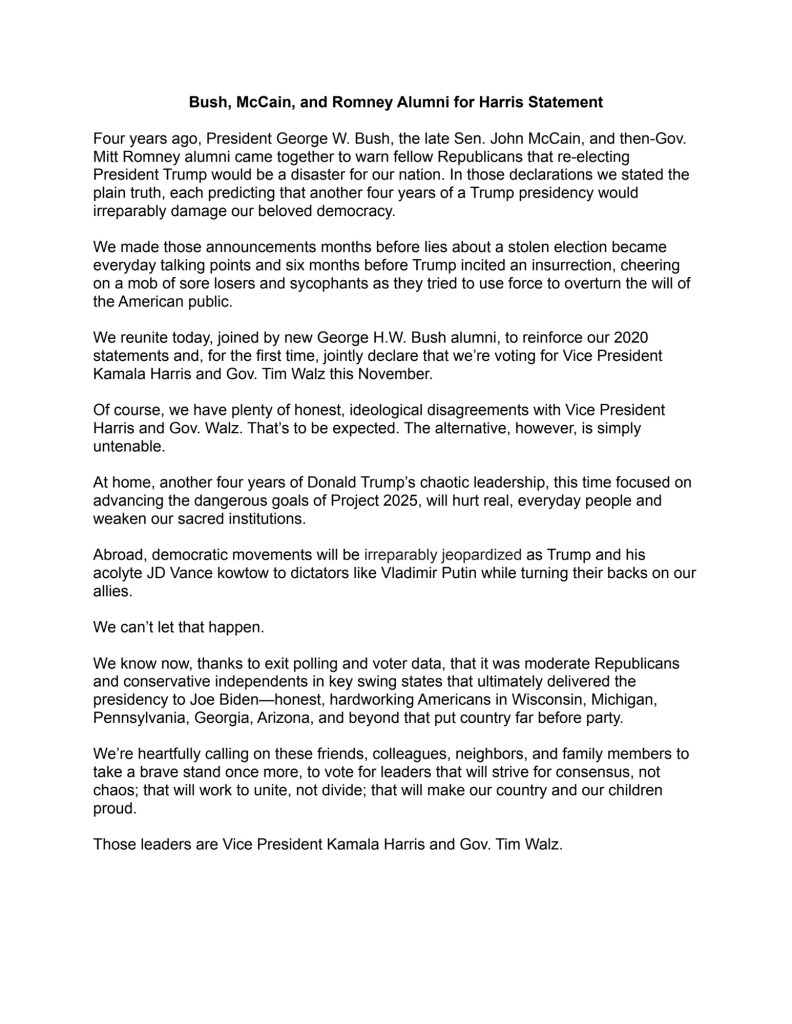
A long list of people who worked in the campaigns or government offices of George H. W. Bush, George W. Bush, Mitt Romney and John McCain issued a statement endorsing Kamala Harris yesterday. The full list appeared in USA Today. Many, but not all, of the group opposed Trump’s re-election in 2020. No comparable group of Obama-Biden alumni has endorsed Trump.

During its exhilarating convention, the Democratic Party rebranded itself. It was impossible to miss the sea of American flags, which everyone periodically waved in unison, or the loud chants of “USA! USA!”

It was impossible to miss the frequent paeans to FREEDOM and the signs in the audience emblazoned with the word FREEDOM.

As the brilliant writer Anand Girihadaras wrote on his blog “The Ink,” Democrats reclaimed five words that had been captured by the Republicans:

Freedom. Patriotism. Family. Masculinity. Normalcy.

Governor Tim Walz was a key figure in exemplifying these words. A guy animated by love of family. A coach. A hunter (who favors common-sense gun control). A member of the National Guard for 24 years. A guy.

Kamala Harris, Walz, and others focused on Freedom: the freedom to make your own healthcare decisions, the freedom that comes from knowing that your child will not be shot dead in school, the freedom to afford a home, the freedom to vote. Walz said, on more than one occasion, that the government should not insert itself into your doctors’ office or your bedroom. He repeatedly invoked what he described as a small-town virtue: “Mind Your Own Damn Business.”

Harris and Walz deliberately snatched those words away from the Republicans and claimed them as their own.

At the same time, they doubled down on criticizing Trump for his affinity for tyrants, like Putin. In their display of dignity and patriotism, they contrasted their party with Trump’s unhinged rants and childish personal insults. They emphasized the importance of telling the truth, as Trump tweeted that the next round of a Trump administration”would be great for women and reproductive rights.”

And they showcased JOY, as they laughed and danced in the aisles. The contrast was especially sharp during the states’ roll call vote: Republicans announced their votes to polite applause; Democrats announced their votes to music and dancing and flashing lights. Harris radiated joy, with her vivacious smile and her celebrated laugh. Trump evoked fear, frightening images of a nation in decline, divisesiveness. Which America do you want to live in?

The Republicans spoke wistfully about turning back the clock to a mythical time when America was “great.” An era of white male supremacy? An era of Christian dominance? The Democrats spoke hopefully about a better future, where everyone has the opportunity to live a decent life. The past or the future. Your choice.

The biggest contrast was the difference in the delegates themselves. The Republicans were, with minor variations, the party of white people. The Democrats overflowed with ethic and racial diversity.

Which party is the past? Which is the future?

Jennifer Rubin, columnist for the Washington Post, was at the convention in Chicago with her colleagues. She made a sage observation. The Democrats have a strong bench of new and young faces. The Republicans do not.

She wrote:

It has become evident during convention week that Democrats are blessed with three groups of leaders. The wise first group — Hillary Clinton, the Obamas, former speaker Nancy Pelosi (Calif.) and now Biden — has guided the party for the past generation, nationally making strides and keeping the Democratic coalition together. The domestic accomplishments they have collectively made would stand up to any other generation’s output. The second group’s time has come: Harris, Gov. Tim Walz (Minn.), Transportation Secretary Pete Buttigieg, Sen. Raphael G. Warnock (Ga.), House Minority Leader Hakeem Jeffries (N.Y.), Gov. Josh Shapiro (Pa.). They are more media savvy than many in the older generation and better able to reach voters who are younger and more diverse. This second group’s challenge will be putting a stake through the MAGA movement and charting a path forward for a sustainable, center-left governing majority. The third, and most interesting, group includes the future stars, two of whom (Reps. Alexandria Ocasio-Cortez (N.Y.) and Jasmine Crockett (Tex.)) lit up the convention on Monday night. Other less flashy but equally compelling figures have the governing chops to win legislative battles and keep the party from straying too far left. These include Rep. Abigail Spanberger (Va.), who is running for governor; Rep. Elissa Slotkin (Mich.), who is running for Senate; Rep. Mikie Sherrill (N.J.); and Rep. Dan Goldman (N.Y.), who distinguished himself by going toe-to-toe with Republicans who ineptly and corruptly tried to investigate the Bidens.

Republicans have nothing comparable. Trump has hollowed out and disgraced the party. Any rebuilding, if Trump loses, will likely have to fall to a new generation. Trump, Senate Minority Leader Mitch McConnell (Ky.) and a flock of House and Senate extremists have dominated the GOP, turned off a great many voters and done immense damage to comity, the rule of law and good governance. One of the most attractive features of a possible Harris victory: Many prominent Republicans will be swept aside. We can only hope a better crop replaces them.

Note that Trump and his acolytes have driven the next generation of Republicans out of the party. Trump himself campaigned to defeat any member of Congress who voted to impeach him. Trump-aligned governors have “primaried” moderate Republicans. To be successful in today’s Republican Party, a candidate must pledge to defend The Big Lie. That hollows out good people like Adam Kinzinger and Liz Cheney.