Archives for category: Corporate Reformers

Will big money buy the position of State Superintendent of Public Instruction in California? Will false ads carry Marshall Tuck to victory?

The ACLU OF Northern California condemned the Marshall Tuck campaign for mailers falsely asserting that it had “sued Tony Thurmond.” It had not, and the ACLU demanded that the campaign withdraw the ad and offer an apology to Thurmond. Tuck refused.

Tuck is running a campaign based on lies. His character has been revealed. Will the public catch on in time to stop him? Or will the public believe Tuck’s scurrilous attack ads? It is possible. Tuck has an astonishing amount of money to spend. But should California’s schools be overseen by a person of such low ethics and character.

A thought for Marshall Tuck (written by sportswriter Grantland Rice):

“For when the One Great Scorer comes to write against your name,
He writes—not that you won or lost,
But how you played the game.”

Is Marshall Tuck and his billionaire backers so desperate to win that they will say or do anything? Apparently so.


See letter from ACLU to EdVoice here:

Here is a report on the ads, with links to the ads.

The dispute over negative ads has escalated, with the Thurmond campaign seeking to have an independent committee take off the air an ad that falsely claims Thurmond was reprimanded by the Obama administration.

The campaign for schools chief has attracted at least $43 million worth of contributions, most of which have gone to independent expenditure committees supporting Tuck and Thurmond.

Tuck’s backers are far outpacing Thurmond’s in fundraising: Two committees supporting Tuck have taken in $24.1 million as of Monday, while a committee supporting Thurmond has received $11.5 million. Independent expenditure committees can take donations of unlimited size but are barred from coordinating with campaigns.

The Tuck campaign had raised $4.2 million in direct contributions, compared to $2.8 million for Thurmond, as of Sept. 22, the most recent filing deadline.

The contributions have come largely from advocates of charter school expansion who back Tuck and labor groups who support Thurmond.

With two weeks to go in the race, and as some Californians are submitting early ballots for the Nov. 6 election, Tuck and Thurmond backers are spending millions of dollars on television, radio and mail advertisements. Campaign finance records show the committees supporting Tuck spent $8.1 million on television advertising alone as of the most recent campaign finance filing deadline on Sept. 22, while a committee backing Thurmond spent $4.4 million. Those totals are likely to increase substantially before Election Day.

Some of that spending has gone toward negative ads, leading Tuck and Thurmond to spar over new television commercials that criticize their records.

One recent ad from an independent expenditure committee supporting Tuck blamed Thurmond for problems in West Contra Costa Unified, the East Bay school district where Thurmond was a school board member from 2008 to 2012.

Another ad, produced by the Thurmond campaign, sought to tie Tuck to the education agenda of President Donald Trump and Education Secretary Betsy DeVos.

Is it inaccurate to tie Tuck’s pro-charter history to Betsy DeVos. She supports charter schools. Tuck supports charter schools. No smear there. It’s a fact: Marshall Tuck supports school choice, like Betsy DeVos.

The anti-Thurmond ad was funded by an independent expenditure committee supporting Tuck established by EdVoice. EdVoice officials did not return multiple messages seeking comment on their ad.

“Before he was running for state superintendent, politician Tony Thurmond was responsible for a school district with widespread budget problems,” the ad states, referring to West Contra Costa Unified.

Text on the screen directly ties district problems to Thurmond. “Tony Thurmond: School Board Member”; “Tony Thurmond: Sued by the ACLU”; “Tony Thurmond: Reprimanded by the Obama Administration”; “Tony Thurmond: Failed Kids”; “Tony Thurmond: Wrong for State Superintendent.”

The voice over adds details about the district: “Ranked last in the state for failing to serve students of color. Sued for leaving at-risk students in rotting trailers with mushrooms growing in the floors. Reprimanded by the Obama Administration for failing to address widespread sexual harassment and assault in district schools. Tony Thurmond failed the students he was supposed to help. California deserves better.”

The ad does not mention that Thurmond was one of five West Contra Costa Unified board members.

The claim that Thurmond was reprimanded by the Obama administration is false. The letter from the Obama-era Education Department’s Office of Civil Rights criticizing West Contra Costa Unified’s handling of sexual harassment never mentions Thurmond or the district’s board. The letter was issued in 2013, after Thurmond left the board, though it does state the department’s investigation began during his term in 2010.

“I was never reprimanded by Obama, and I wasn’t even on the board when the letter was sent by the Department of Education,” Thurmond said. He added that the claim prompted his campaign to send a cease and desist order to the committee that produced the ad.

The ad’s statement that Thurmond was sued over school facilities is technically accurate, in that he was named as a defendant board member in an American Civil Liberties Union’s lawsuit against West Contra Costa Unified. However, the lawsuit named every member of the school board, along with the district, its superintendent and its associate superintendent. The district’s daily management falls to its administration, not the elected board members.

The ad mirrors criticism of Thurmond’s time in West Contra Costa in an opinion column published in the San Francisco Chronicle last month by Bill Evers, a hardcore Republican and a Tuck supporter. Evers is a research fellow at Stanford University’s conservative Hoover Institution. Evers was also a member of Trump’s education transition team. Evers is not a neutral observer. He is a rock-ribbed Republican who worked in George W. Bush’s Education Department as Assistant Secretary of Education. He was a senior advisor to the Coalition Provisional Authority in Iraq, after the Iraq War. His endorsement serves to reinforce the fact that Tuck has a conservative agenda that is aligned with the Republican Party.

Basic fact: Tony Thurmond was endorsed by the Democratic Party. Marshall Tuck was booed at the Democratic State Convention. Tony Thurmond has run an honorable campaign. Marshall Tuck has not.

The state chapter of the National Association for the Advancement of Colored People, as well as Christine Pelosi, the chairwoman of the California Democratic Party’s Women’s Caucus, have also denounced the ad. While the Tuck campaign is prohibited by law from coordinating with the independent expenditure committee that produced the ad, Thurmond’s campaign has called for Tuck to disavow it.

Tuck told EdSource he would not disavow the ad. It accurately described problems in West Contra Costa Unified during Thurmond’s term, Tuck said, and “the board should be held accountable for that.” But, he also stressed that the ad was outside of his control.

Andrew Blumenfeld, Tuck’s campaign manager, also defended the ad.

“Assembly member Thurmond uses his time on the school board as evidence of his ability to serve as state superintendent,” Blumenfeld said. “I think it’s well within bounds to question what was the quality of his leadership when he was on the school board.”

The California publication EdSource predicts that the race is on track to cost $50 million, with Tuck having a 2-1 advantage over Thurmond.

“The largest donors to EdVoice for the Kids PAC, which managed independent campaign committees for Tuck and other activities, are real estate developer Bill Bloomfield, $5.3 million; Doris Fisher, co-founder of the Gap clothing company, $3.1 million and venture capitalist Arthur Rock, $3 million.”

Tuck has been endorsed by Meg Whitman, chair of the board of Teach for America, by billionaire Michael Bloomberg of New York, by Christopher Cerf, who was appointed to be state commissioner in New Jersey by Republican Governor Chris Christie.

See info here:

http://cal-access.sos.ca.gov/Campaign/Committees/Detail.aspx?id=1243091&session=2017
Edvoice for the Kids PAC

Contributors here: http://cal-access.sos.ca.gov/Campaign/Committees/Detail.aspx?id=1243091&session=2017&view=received

Contributions made (mostly to Tuck campaign) http://cal-access.sos.ca.gov/Campaign/Committees/Detail.aspx?id=1243091&session=2017&view=contributions

See attached; expenditures of $4.9M since 09/17/2018 to two separate subcommittees
http://cal-access.sos.ca.gov/Campaign/Committees/Detail.aspx?id=1243091&session=2017&view=expenditures

Tom Ultican was everywhere at the Network for Public Education Conference in Indianapolis. He attended the keynotes and a full slate of workshops.

Here is his report.

Tom will bring you with him as he listens attentively at every session.

He concludes on this happy note.

A Personal Perspective

Almost four years ago, I attended my first NPE conference in Chicago. I was very motivated by what I saw and heard, however, I did have a concern. It seemed like the movement was dominated by older white teachers like me, who were approaching retirement age. I thought that did not bode well for the future of our movement to save quality public education.

This year the conference was even more motivational with a big positive difference. A large wave of diverse youthful professionals have taken leadership. The future looks very bright with so many brilliant young people who are growing their expertise in research and organizing. These youthful leaders are determined to save our public schools. They are standing up for a social good that is not related to Mammonism or self promotion. They are the resistance that is winning.

The idea of giving A-F grades to schools was a Jeb Bush invention. It is an almost perfect mirror of the poverty or affluence of the students in the school. Schools with high poverty levels will get low grades. This sets them up to be stigmatized as failures and to become juicy targets for tskeover and privatization. The privatizers keep the students they want and toss away those they don’t want. Meanwhile, the public money flows to private hands.

Laura Chapman here examines Ohio’s school report cards, which contain “multiple measures” to end up with the same result as a report card based only on test scores, which themselves measure family income and education.

She wrote this comment:

“The key components of the 2018 Ohio School Report Cards.

The six components are:

Achievement,
Gap Closing,
Improving At-Risk K-3 Readers,
Progress,
Graduation Rate,
Prepared for Success.

Districts and schools receive A-F grades on each of the six components and most of the individual measures for each component (e.g.a letter grade is assigned to Ohio’s EVASS metrics based on test scores. EVASS is a version of totally discredited VALUE-ADDED Metrics).

For the first time, districts and schools will be assigned overall letter grades. (e.g., Your school is D. Your school is an F.)

Here is the pitch for this ridicule-worthy scheme.

“Report cards are designed to give parents, communities, educators and policymakers information about the performance of districts and schools – to celebrate success and identify areas for improvement. This information identifies schools to receive intensive supports, drives local conversations on continuous improvement and provides transparent reporting on student performance. The goal is to ensure equitable outcomes and high expectations for all of Ohio’s students.”

One of these days I may count how many data points Ohio has shoved into the convoluted report card. Some are hardwired by the fools elected to the state house. Others are there in part from federal regulations. The rest are the product of a belief system that says, in effect measurement is an objective and infallible substitute for good judgment. Of course, the Report card grades track the relative affluence of the districts in Ohio and they are meaningless for Charter Schools. A recent conversation with a state school board member, running for re-election revealed total ignorance of problems with the value-added metric or the cost of the SAS contract for that misleading exercise.

reportcard.education.ohio.gov

Valerie Strauss summarizes the race between Marshall Tuck and Tony Thurmond.

Tuck has raised nearly $30 million from the billionaires who support charter schools; Thurmond has raised about $15 million, mostly from labor unions, teachers, and Democrats.

Tuck is supported by the Republican party. Although he claims to be a Democrat, he was booed at the state Democratic convention.

She writes:

One of the loudest and most expensive state races in the country is between two Democrats vying to win the nonpartisan position of superintendent of public instruction in California. More money is being spent on the race — for a position that has no independent policymaking power — than in most U.S. Senate campaigns.

The fight — the costliest in the state’s history for this post, with more than $43 million in campaign contributions, according to EdSource — is between state legislator Tony Thurmond and Marshall Tuck, a former charter school network president.

Thurmond, who was elected to the California State Assembly in 2014 from the East Bay, has been a teacher, social worker, city councilman and school board member. Tuck is a former banker who became the first president of the Green Dot network of charter schools in Los Angeles. After that, he founded a nonprofit that used privately donated money from the wealthy to help turn around troubled traditional public schools. Four years ago, he ran unsuccessfully for state superintendent in a race that cost some $30 million (with a lot of it coming from billionaires backing Tuck)…

The fight between Thurmond and Tuck is the latest chapter in a long-running debate about public education in a state with a scandal-ridden charter school sector and severely underfunded traditional school districts. California has more charter schools — which are publicly funded but privately operated — and more charter students than any state.

Should Tuck win, supporters of charter schools will take heart. If Thurmond triumphs, supporters of traditional public education will.

Tuck has raised far more than Thurmond, about $5 million in direct contributions, compared with $3.1 million for Thurmond, according to the Associated Press. Most of the money in the race has gone through political committees that can accept unlimited amounts of money but are not allowed to coordinate with the campaigns. In this arena, Tuck is far ahead, with two committees backing him taking in $24.1 million, according to Ed Source, with a committee supporting Thurmond’s bid taking in $11.5 million so far.

Much of Tuck’s contributions have come from billionaires who support charter schools and many who live out of state. Wealthy donors include Michael Bloomberg of New York; Eli Broad of Los Angeles; and Alice Walton of Texas, who has donated millions of dollars to his campaigns over a period of years. Netflix chief Reed Hastings and Gap founder Doris Fisher have also donated. And, not surprisingly, he is backed by the California Charter Schools Association (which celebrated the controversial 2017 confirmation of Betsy DeVos as U.S. education secretary).

We will find out in a few days whether out of state billionaires can buy the race.

Mercedes Schneider notes that Indianapolis is the target of a corporate reform takeover.

She describes the situation, then notes that this election offers voters a chance to vote out a school board member who supports privatization.

She writes:

When it comes to killing traditional public education in favor of market-based ed reform models that remove the community control from its own schools, market-based ed reformers means business– and the public would do best to believe that there is a market for the usurping of community influence over schools….

Granted, it is easier to discuss this issue from 2018 hindsight; however, the candidate who serves as the focus of the remainder of this post, Mary Ann Sullivan, is running for reelection on November 06, 2018, and there is still time for unsuspecting Indiana voters to educate themselves about what she was and is before heading to the polls in November 2018….

Let the lessons begin.

First of all, beware of those deflecting attention away from “school type” in the name of
improving educational opportunities for children,” especially if the candidate offering such advice is drawing quite the trove of funding to support her campaign.

Second, check for out-of-state contributions. According to Sullivan’s October 10, 2014, pre-election filing, she already had $51.4K in her campaign chest, including $2,000 in contributions from California billionaire Reed Hoffman, founder of Linkedin, and his wife, Michelle Yee, plus $1,100 from Manhattan, NY-based Democrats for Education Reform (DFER).

One might think that one or two out-of-state, ed reform contributors really doesn’t matter, but it does, and where there are a couple, there will likely be more:

According to Sullivan’s 2014, end-of-year filing, her campaign received a total of $73.7K for a local school board election– including $2,500 from former New York City mayor, billionaire Michael Bloomberg, and $2,500 from Connecticut billionaire and OxyContin heir, Jonathan Sackler.

Out-of-state billionaires spending money on school board elections is a hallmark of the ed reform preference of ushering in charter schools while snuffing out community schools.

Finally, where there is market-based ed reform, there is likely notable support from a business entity. In Sullivan’s case, it’s the political action committee (PAC) of the Indianapolis Chamber of Commerce, the Indy Chamber Business Advocacy Committee (BAC).

In 2014, Indy Chamber BAC supported Sullivan for a total of $18.8K ($10.5K cash; $8.3K in-kind).

Stop and think about that for a second: A candidate for school board has the $18.8K support of a business advocacy committee. it makes sense if one considers that ed reformers view education as a business and charterization of entire districts as an ultimate goal.

So, here we are, Indianapolis, in October 2018.

IPS is now marketized via the likes of the Mind Trust, which Sullivan endorses, and Sullivan is running for re-election.

Sullivan’s 2018 contributions (also here) to date are more modest than in 2014: $11K total, with $8.7K coming from the business PAC, Indy Chamber BAC.

Converting neighborhood schools to the portfolio model is part of the business of ed reform, and Sullivan is a conduit for ed reform in IPS.

Okay, Indy voters: Now that you know who is financially backing Sullivan, will you reelect her or send her packing?

Jan Resseger sums up the many reasons to be optimistic about resistance to corporate education Reform.

Among them are the teacher walkouts this spring.

And much more.

The Reformers are no longer making grandiose claims. The evidence is in. They have no secret sauce. Just money. Lots of it.

Summary: Democracy beats billionaires.

Tom Ultican, retired teacher of physics and advanced mathematics in California, here describes the billionaires and bad policies behind Marshall Tuck’s campaign for State Superintendent of Public Instruction.

He sees the Tuck campaign as a new front in the “Destroy Public Education Movement,” which he has written about extensively.

Here are some of the Big Money contributors to Tuck’s campaign:

The Waltons control Walmart and have been spending heavily to privatize public schools for more than three decades.

Bill Bloomfield is a rich guy from LA who has also poured $7,000,000 into independent expenditures for Tuck.

The Rogers family is the main local force behind the privatization of Oakland’s school system.

Doris Fisher founded The Gap with her husband Don. They have spent extensively promoting charter schools and were the first significant benefactors for the KIPP franchise.

Eli Broad is the only person to found two fortune 500 companies. He announced plans to charterize half of Los Angeles’s schools and published a guide for closing public schools.

John Scully was the former CEO of Apple and consistently supports school privatization.

David Horowitz is a Republican activist who gained notoriety for his anti-affirmative action campaign.

Arthur Rock is Silicon Valley royalty who spends lavishly to support school privatization.

Peter Chernin was COO of Rupert Murdoch’s News Corp. He is also a movie producer of some note.

Reed Hastings is possibly the most dedicated destroy public education billionaire. He sat on the board of the California Charter Schools Association for many years.

Richard Riordan is the billionaire former Mayor of Los Angeles who spends millions on public school privatization.

John Arnold is the ex-Enron executive who did not go to jail. He and Reed Hastings have each invested $100 million in a new national school privatizing organization called The City Fund.

Jonathan Sackler is the heir to the billionaire inventors of Oxycontin. Besides selling addictive drugs, Jonathan invests in the privatization of America’s schools.

Les Biller is a former CEO of Wells Fargo bank. He and his wife have a foundation in Seattle, Washington where they give heavily to charter schools.

Julian Robertson Jr. is a hedge fund manager in Chicago who thinks California really needs Marshal Tuck.

Stacy Schusterman is an energy industry heir from Tulsa, Oklahoma. She has been particularly active in California school board elections.

Michael Bloomberg is the billionaire former New York mayor who spawned Joel Klein, Eva Moskowitz and Michelle Rhee. He spends heavily on California school board elections.

The big money is not in direct contributions like those listed above. It is in the money for independent expenditure committees that do not have contribution limits. For example, the Ed Voice for the Kids Pac has already reported spending over $13,000,000 in support of Tuck (Id 1243091). There are many more of these PACs spending money to elect Tuck such as Education Reform Now Advocacy for Tuck and Charter Public Schools Political Action Committee.

Ultican contrasts the two candidates:

Tony Thurmond was born in Monterey, California. His father was stationed at the Fort Ord Army base. Tony’s father abandoned his family of four children. Thurmond’s Panamanian immigrant mother became a school teacher and moved the family to San Jose.

Tragedy struck six-years-old Tony when his mother died of cancer. Tony and a brother moved to Philadelphia where they were raised by a cousin.

After graduating from high school in Philadelphia, Tony matriculated to Temple University where he was elected student body president and received a BA in psychology. He attended graduate school at Bryn Mawr earning a dual masters in Law and Social Policy and Social work.

The most disgusting statement in the San Diego Union editorial read, “In his interview with us, Assemblyman Tony Thurmond, D-Richmond, who finished second to Tuck in the June primary, seemed just as affable but not nearly as ambitious as Tuck.” In case that was too subtle; Tony is a black man.

After rising above his traumatic childhood and becoming educated, Tony married and returned to California in 1998. For the 20 years preceding his election to the California State Assembly, Thurmond served in various positions at non-profit social service agencies. Tony says it was his public school education that helped him become at 20-year social worker and serve on a school board, a city council and now the California State Assembly.

Tony has two daughters in public school.

Marshall Tuck received an MBA from Harvard University in 2000 and a BA in Political Science from University of California Los Angeles in 1995. He grew up in the San Francisco Bay area and has a wife and son.

He spent some time as a consultant at Mitt Romney’s Bain & Co. He was an investment analyst at the Upper Manhattan Empowerment Zone. He moved to Los Angeles to work at Salomon Brothers as an investment banker focused on both mergers and acquisitions. After a brief stint in sales for a Software company, in 2002, Tuck was hired by Green Dot Charter Schools as Chief Operating Officer.

In 2007, Los Angeles Mayor Anthony Villaraigosa had been rebuffed in his efforts to take control of Los Angeles Unified School District. He did convince a few donors to underwrite the takeover of a small number of schools in areas which had suffered years of poor standardized test results. They created a non-profit called Partnership for LA and Villaraigosa tapped Marshall Tuck to lead the Partnership.

Tuck had by then become the CEO of Green Dot. The year he left for the Partnership, Green Dot schools posted nine of the fifty lowest SAT scores among Los Angeles schools.

Tuck was extremely unpopular at the Partnership. The Sacramento Bee reported, “Teachers passed a vote of no confidence at nine of the schools at the end of the first year, leading to independent mediation.” An online education news paper in Los Angeles, School Matters, reported, “Many of us hoped that when right-wing business banker Marshall Tuck was ignominiously forced to step down as the ‘CEO’ of the Partnership for Los Angeles Schools (PLAS), that we might have heard the last of Tuck altogether.”

Tuck’s authoritarianism and lack of education background has led to serial failures, however, those forces trying to privatize California’s public schools find his style to their liking.

In 2014, when Tuck lost the most expensive SPI race in California’s history, his allies were there to take care of him. Even though he has no training as an educator, he was made Educator-in-Residence at the New Teacher Center (NTC). Bill Gates has granted NTC $26,305,252 since 2009.

This Contest is Very Important If You Value American Democracy

Marshall Tuck is the representative of the Destroy Public Education billionaires who are spending massive amounts of money to get him elected. It is widely understood that elected school boards are the soil from which American democratic government rejuvenates itself. Dark “DPE” forces are undermining democracy in this country by destroying the people’s 200-years-old public education system. They must be stopped.

This is Jan Resseger’s third report on her experience at the Network for Public Education annual conference in Indianapolis last weekend. In this post, she reports on what she learned by attending a panel about the NPE-Schott Foundation study of state support for public schools vs. privatization of public schools.

One of the most fascinating workshops at the conference explored the complexity of researching the groundbreaking, June 2018 report, Grading the States: A Report Card on Our Nation’s Commitment to Public Schools, and the importance of the report, the first comprehensive effort to track and compare the growth of privatization and the characteristics of state vouchers and charters. The report, a collaboration of the Network for Public Education and the Schott Foundation for Public Education, defines its purpose: “States are rated on the extent to which they have instituted policies and practices that lead toward fewer democratic opportunities and more privatization, as well as the guardrails they have (or have not) put into place to protect the rights of students, communities and taxpayers. This is not an assessment of the overall quality of the public education system in the state—rather it is an analysis of the laws that support privatized alternatives to public schools.” (emphasis in the original)

The primary assumption of a report about the privatization of education but whose title incorporates these words, “a report card on our nation’s commitment to public schools,” is that the growth of several privatized education sectors at public expense—charter schools, vouchers, tuition tax credits and education savings accounts—reflects diminishing commitment to the inclusive mission of public education. Sure enough, the report confirms that assumption, most clearly in the diversion of tax funds away from public schools: “Vouchers and charters do not decrease education costs, but instead divert tax dollars ordinarily directed to public schools thus limiting the capacity of public schools to educate the remaining students.”

Last weekend’s workshop featured three speakers: the Executive Director of the Network for Public Education (NPE), Dr. Carol Burris, who was one of the report’s researchers; Tanya Clay House, the report’s primary author and researcher—also an attorney and consultant who has previously served as a Deputy Assistant Secretary in the U.S. Department of Education, the Director of Public Policy for the Lawyers’ Committee for Civil Rights Under Law, and the Public Policy Director at People for the American Way; and Derek Black, an attorney and professor of school finance law at the University of South Carolina…

As a participant in last weekend’s workshop, I was fascinated, as Burris and Clay House described the difficulties they faced as they tried to collect the most basic data about what is now nearly 20 years of expanding school privatization. The two women told of one data set they had assumed the report would cover only to be forced to omit that issue from the report because the the records had not been kept by enough states to make it possible to draw any comprehensive or meaningful conclusion. What became clear to me as I listened is that the promoters of school privatization trusted their own ideological belief that the marketplace would provide its own accountability. They assumed that as parents voted with their feet, parents themselves would identify high quality schools and seek them out; then schools of poor quality would not be marketable. Of course we know from research in Chicago and New Orleans and elsewhere that parents choose schools for all sorts of reasons that have nothing to do with school quality—a site near home or work, the presence of a childcare or after-school program, the reputation of the football team, the advertising on the side of the bus, the incentive of the gift of a computer upon enrollment. Several years ago, Margaret Raymond, a fellow at the pro-market Hoover Institution and director of the Stanford Center for Research on Education Outcomes (CREDO), shocked listeners at the Cleveland City Club by announcing that it has become pretty clear that markets don’t work in what she calls the education sector: “This is one of the big insights for me because I actually am a kind of pro-market kind of girl, but the marketplace doesn’t seem to work in a choice environment for education… I’ve studied competitive markets for much of my career… Education is the only industry/sector where the market mechanism just doesn’t work… I think it’s not helpful to expect parents to be the agents of quality assurance throughout the state.”

The third presenter in the NPE workshop was Derek Black, a civil rights attorney and school finance professor who explored what he believes is the overall significance of the Grading the States report. I was unable to capture verbatim Derek Black’s comments at the workshop, but in a blog post when the Grading the States report was published in June, Black made the same points in eloquent detail: “The report is, in many respects, the one I have been waiting for. It fills in key facts that have been missing from the public debate and will help move it in a more positive direction. In my forthcoming article, Preferencing Educational Choice: The Constitutional Limits, I also attempt to reframe the analysis of charter schools and vouchers, arguing that there are a handful of categorical ways in which states have actually created statutory preferences for charters and vouchers in relation to traditional public schools. I explain why a statutory preference for these choice programs contradicts states’ constitutional obligations in regard to education… My research, however, analyzes the issues from a relatively high level of abstraction, highlighting problematic examples in particular states and districts and synthesizing constitutional principles from various states. This new report drills down into the facts in a way I have never seen before. It systematically examines charter and voucher laws in each state with a standardized methodology aimed at identifying the extent to which each state’s laws represent a de-commitment to public education.”

Black continues: “Each year, the National Alliance for Public Charter Schools (NAPCS) releases a report detailing charter school laws, with the frame of reference being the extent to which states have laws that promote the expansion of charters. The report normatively assumes that charter schools are good and state laws that overly restrict them are bad… Because there hasn’t been any systemic response to NAPCS’s reports, it has been able to skew the conversation. This new report brings balance.”

When the Grading the States report was released in June, this blog summarized its conclusions. Needless to say, I came home from last weekend’s conference in Indianapolis and explored the report in more depth. Here is what jumps out at me as an Ohio citizen this fall, after I’ve been watching the fallout across Ohio all year since the state’s final closure of the giant online charter school, the Electronic Classroom of Tomorrow, after it ripped off Ohio taxpayers and students for 17 years. The report examines charter schools. Forty-four states and the District of Columbia have passed laws to permit charter schools. Of those 38, including my state, earned F grades. The report explains they are “states that embrace for-profit charter management, weak accountability and other factors that make their charter schools less accountable to the public.” “Twenty-eight of these states and the District of Columbia fail to require the same teacher certification as traditional public schools… Thirty-eight of the states and the District of Columbia have no required transparency provisions regulating the spending and funding by the charter school’s educational service providers… Of the 44 states and the District of Columbia with charter school laws, students with disabilities are particularly disadvantaged in 39 states and the District of Columbia, which do not clearly establish the provision of services. Twenty-two states do not require that the charter school return its taxpayer purchased assets and/or property back to the public if the charter school shuts down or fails.” The details on the various voucher programs are equally alarming.

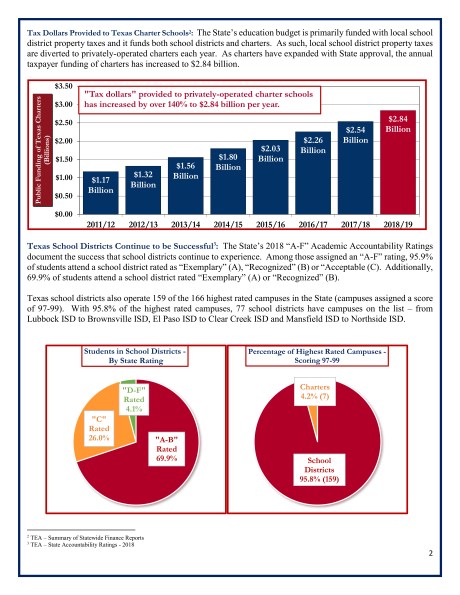
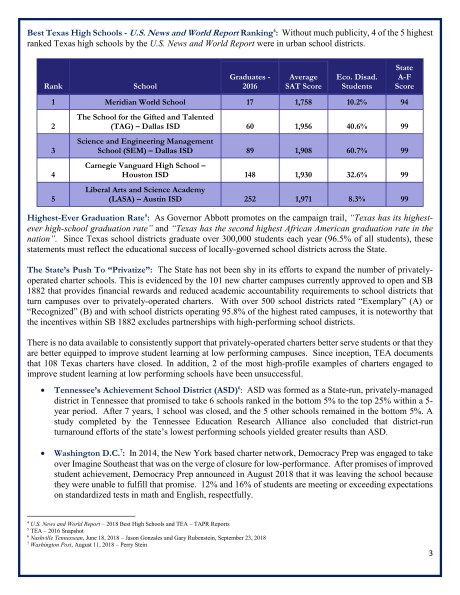
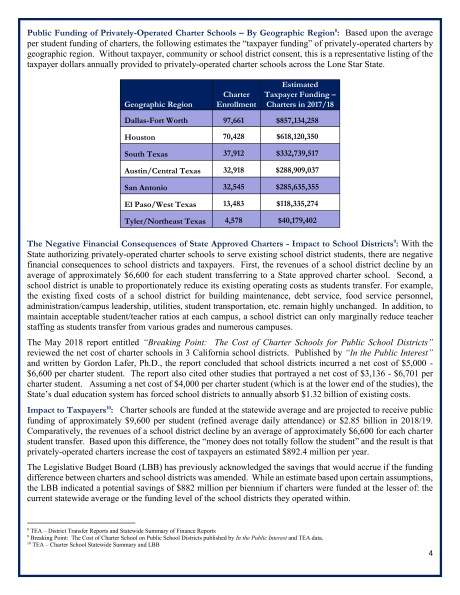
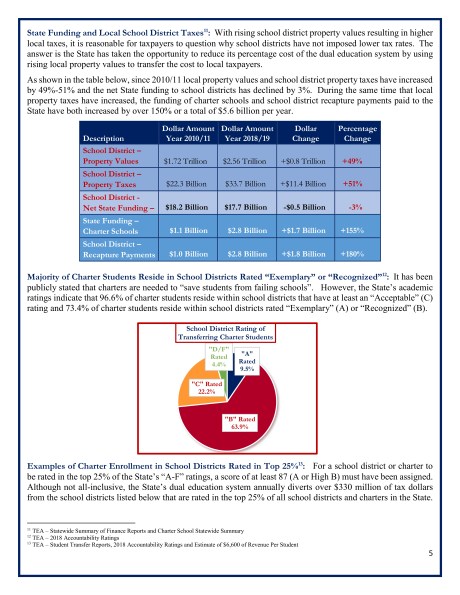
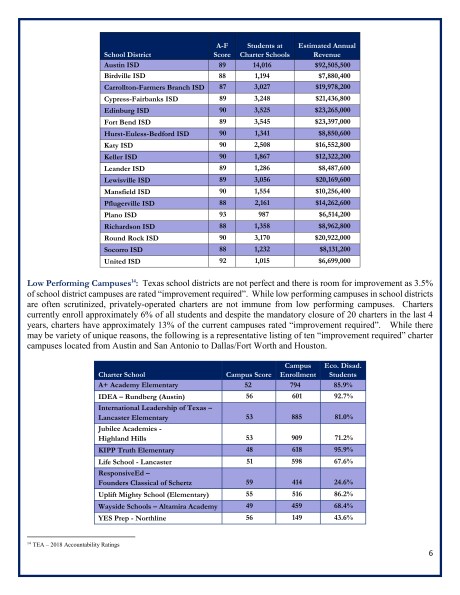
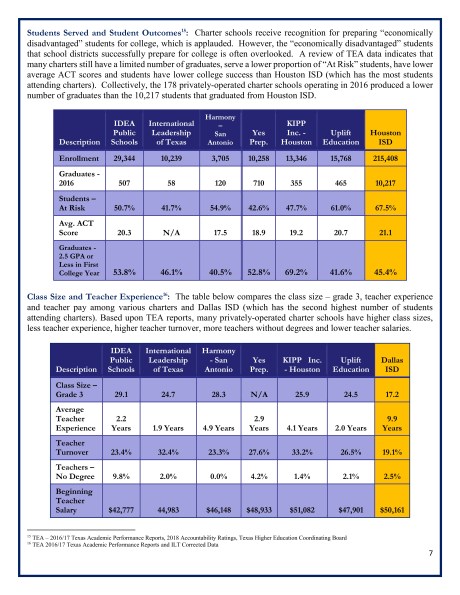
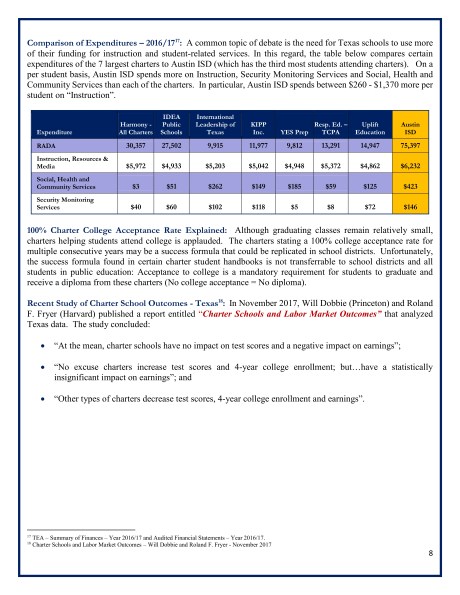
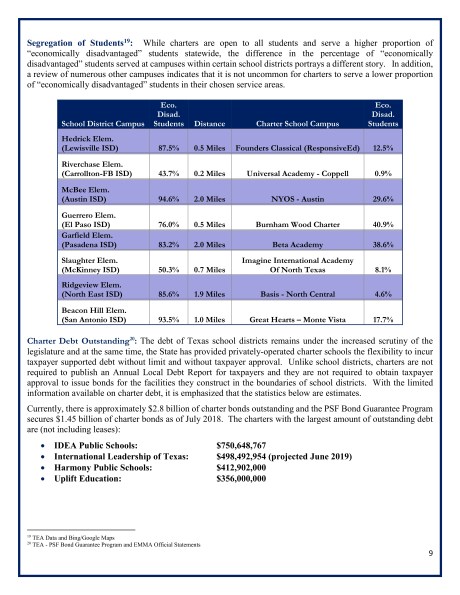
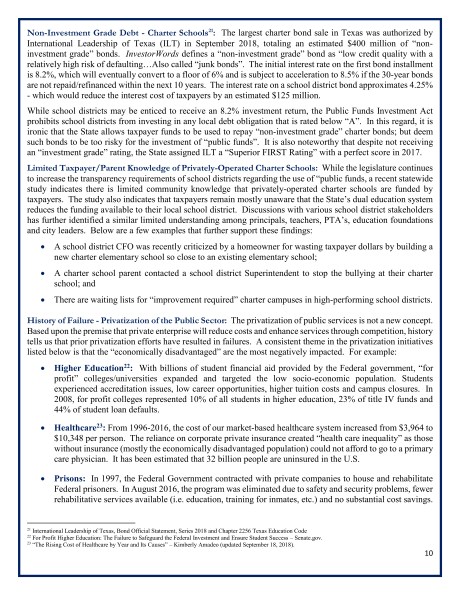
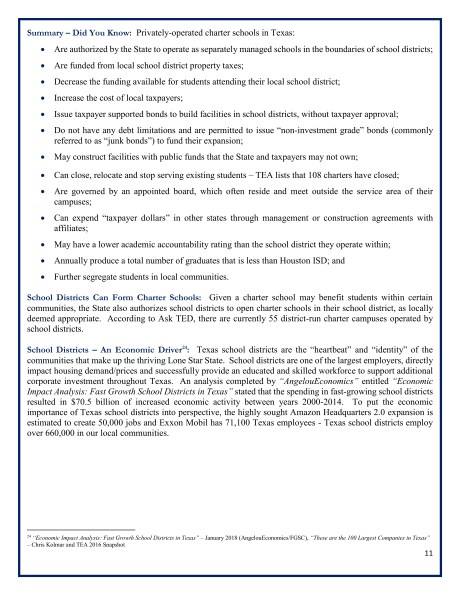
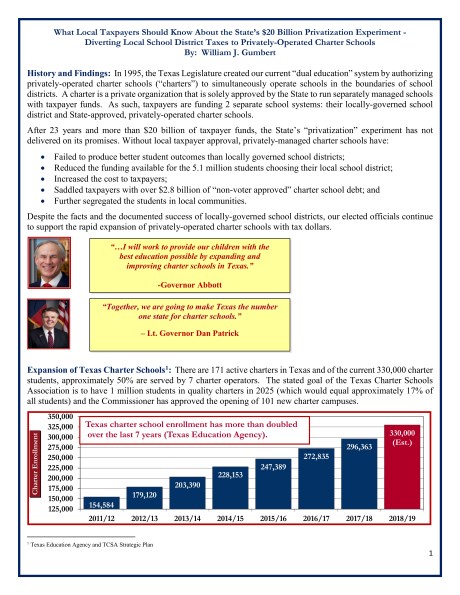
This is an important collection of data about the funding of public schools and charter schools in Texas. Do you think that taxpayers know that they are funding two separate school systems, one governed by elected, accountable school boards and the other governed by private, self-selected, unaccountable school boards? Do you think that the public knows that district public schools outperform charter schools?

What Local Taxpayers Should Know About the State's $20 Billion Privatization Experiment (October 2018)tax2tax3tax4tax5tax6tax7tax8tax9tax10tax11tax12

I was wracking my brain trying to remember an acronym that is a basic tactic of negative public relations.

I knew I had written about it but could not think of how ro find it. Finally I googled my name and “propaganda,” and this article popped up.

The acronym is FUD. It has been used in the public relations field to discredit a competitor. It is a central tactic in the game plan to undermine public education.

It is in the dictionary.

What you need to know about FUD:

https://www.huffingtonpost.com/diane-ravitch/public-education_b_4941678.html