Archives for category: Closing schools

On the very eve of the weekend celebrating the birthday of Dr. Martin Luther King, Jr., Newark’s state-appointed superintendent showed the citizens of Newark that they have no votes and they have no voice when it comes to the fate of their schools.

The Newark public schools have been under state control since 1995.

Cami Anderson, the current Newark Superintendent is a former Teach for America teacher and a graduate of the unaccredited Broad Academy, which is known for advocating the closing of public schools and the handover of public schools to private management.

At a public hearing called by Newark Councilman Ras Baraka to discuss school closings,  the principals of several schools spoke against their closing.

Anderson fired them for daring to dissent.

Here Jersey Jazzman describes the situation. 

He quotes Councilman Baraka, who said:

“Today Cami Anderson indefinitely suspended four Newark principals: Tony Motley of Bragraw Avenue School, Grady James of Hawthorne Avenue School, Dorothy Handfield of Belmont-Runyon, and Deneen Washington of Maple Avenue. She suspended the four principals because they spoke at a public forum on Wednesday in opposition to Ms. Anderson’s widely criticized “One Newark” reorganization plan which includes closing or “repurposing” nearly one third of Newark’s public schools.

Ms. Anderson’s action in suspending the four principals is the last straw in a chain of inept, and horribly out-of-touch decisions. The people of Newark need to hear the views of those within the school system who disagree with Ms. Anderson. The four principals have a constitutional right to speak out. The Newark school district is not a military dictatorship, and Ms. Anderson is neither an army general nor a police chief. Her behavior must be governed by the principles of our democracy.

Whatever one thinks of Ms. Anderson’s political and educational ideology, she has proven time and again that she holds in contempt the opinions of the people of Newark. From the beginning, she has not consulted with Newark’s parents, community and political leaders, or professional educators on any significant decision. Most recently, she announced and began implementing her ” One Newark” reorganization plan on the people of Newark with no consultation and no advance notice. In doing this, she ignited a firestorm of opposition from outraged citizens.

Anthony Cody watched videos of the hearing and has extensive clips from the testimony of each of the principals.

He writes as follows:

New Jersey is making headlines this month as the bullying tactics of Governor Christie have gone beyond shouting down individual school teachers, which many in the media seemed to find amusing, and into the realm of political scandal as the “Bridgegate” emails came to light.

Now Newark, New Jersey, is exploding, thanks to the attempts at intimidation by Governor Christie’s hand-picked superintendent of schools, Cami Anderson. Anderson came to Newark after working in New York City schools. Before that, she was employed with New Leaders for New Schools and Teach For America. She was trained by the Broad Academy, which literally wrote the book on how to close schools.  

Journalist Bob Braun today carries a report on the decision by  Anderson to “indefinitely suspend”  five of Newark’s principals. Braun explains:

The “incident” was a community meeting at the Hopewell Baptist Church last Wednesday where (H.G. James) spoke, praising the efforts of his students, teachers and parents.

James was one of five principals indefinitely suspended in one day by Cami Anderson, Christie’s agent in Newark. The others were Tony Motley, Bragaw Avenue School; Dorothy Handfield, Belmont-Runyon School; Deneen Washington, Maple Avenue School, and Lisa Brown, Ivy Hill School.

Four of the principals…tried to answer questions from local residents  worried about what would happen to their children as Anderson moves toward a wholesale transfer of public school assets to the KIPP Schools, a charter organization that operates TEAM Academy Charter Schools. Questions Anderson wasn’t answering.

The plot thickens when we understand what these community forums were all about. These forums were convened by mayoral candidate Ras Baraka, to give the community a voice in response to planned school closures. A video shows the principals speaking to their community.

It is not clear whether four or five principals were indefinitely suspended. It is clear that Christie, Cerf, and Anderson intend to hand the children of Newark over to charter operators, regardless of the wishes of their parents and the community. And it is clear that any school employee who disagrees will be indefinitely suspended.

This is not the way democracy is supposed to work. Public schools belong to the public, not to state officials to use as their plaything. Public officials are supposed to serve the public, not dictate to them.

The state-controlled districts in New Jersey–all predominantly African-American–are being treated like subjugated territories, in which the residents have no say about the control or disposition of their schools.

I agree with Anthony Cody: The destruction of public education in New Jersey’s state-controlled districts–deliberate and knowing–is far worse than Bridgegate. One involved an abuse of political power, an act of spite on the part of Governor Christie’s closest staff. The other involves the deliberate destruction of democracy and public education. It should be an impeachable offense.
Marc Epstein, a teacher for many years at Jamaica High School (targeted for closure) here describes the Bloomberg years in New York City public schools and how difficult it will be to unravel the changes he imposed:

Bloomberg’s School Disaster

When Mayor-elect de Blasio announced Carmen Farina as his choice for schools chancellor and pointedly added that she was an educator, a metaphorical puff of white smoke appeared on the horizon for most of the city’s 75,000 schoolteachers.

That’s because after a succession of four chancellors over the past 13 years who had no professional education experience, it was if the Babylonian Captivity of the papacy had finally come to an end with Farina’s succession.

The hope is that Farina, with 40 years of experience that includes two decades in the classroom and another two decades holding administrative positions as principal, district superintendent, and deputy chancellor, has a fair idea of what has gone on in the school system over the past 12 years of mayoral control.

But there is also a fair amount of anxiety. The fear is that political forces outside of the school system reaching as far as the White House have a vested interest in seeing to it that unraveling public education continues unabated.

There’s even word from Valerie Strauss at the Washington Post that Secretary of Education Arne Duncan helped put the kibosh on one of the candidates on de Blasio’s short list for chancellor.

Within hours of the Farina appointment the editorialists began espousing their anti anti-Bloomberg position. Anyone who might seek to undo Bloomberg’s accomplishments is a regressive Neanderthal according to the Wall Street Journal, Daily News, and New York Post.

Should Farina maintain the status quo, the fate of public education in New York City will be sealed. What’s more, she will enjoy the accolades of the media, a media that has become heavily invested, both figuratively and literally, in the narrative put forth by Michael Bloomberg about business solutions and data driven decision-making.

That’s because Bloomberg, with his vast wealth intact, despite having spent more than $600 million dollars on his mayoralty, will continue to shape the narrative with commissioned dynastic histories and the use of his own news empire.

In addition, Rupert Murdoch and his Newscorp, which includes the Wall Street Journal and New York Post, are heavily invested in the “education revolution.” Murdoch boasts former chancellor Joel Klein as his vice-president in charge of education operations too.

So if this to be the party line, and Mayor de Blasio and Chancellor Farina want to begin undoing the damage of the past 12 years, they would do well to expose the train wreck that has become the New York City school system under Michael Bloomberg sooner rather than later.

For the past 12 years New Yorkers have been treated to a steady drumbeat over the airwaves and in print that posits that Mike Bloomberg was able to housebreak an unresponsive, unmanageable, sclerotic public school system and head it in the right direction.

He accomplished this by taking on the teachers union, introducing business-tested management techniques, creating a new kind of school principal purposefully chosen with little classroom experience, but trained in these business techniques, reconfiguring the school districts, closing failed schools and creating hundreds of new schools that offer a wide variety of school choices to parents who could shop schools to their heart’s content.

The numbers would determine all decision-making on the macro and micro level, because numbers don’t lie. Principals were given control over their budgets so they could run a school unencumbered for the first time.

And, every editorial page, intellectual journal, and radio wordsmith, bought Bloomberg’s spiel hook, line, and sinker. They’ve bought it despite irrefutable reports of poor student test performance, record numbers of students entering college unprepared, and an on-time graduation rate of 3% at New York’s community colleges. What’s more, they celebrate a budgeting system that gives the principals an incentive to hire younger, cheaper, inexperienced teachers, over more senior teachers that Bloomberg wants pushed out of the system.

The simple truth of the matter is that all of Bloomberg’s claims are counterintuitive. Numbers were manipulated in the service of his prejudices and ideology. The multiple reconfigurations of the state’s largest department actually destroyed institutional memory, and hence accountability.

State education laws regarding services are flouted with impunity. English language learners and more advanced ESL students are denied mandated instruction. The “litigate and be damned” attitude has defined the operatives at the Tweed Courthouse.

The only ones held culpable in Bloomberg’s education universe were the average teachers, and that was good enough for the pundits and Wall Street. But culpability should never be confused with accountability!

A young schoolgirl drowns on an improperly chaperoned field trip and the assistant principal who was supposed to go on the trip is let off the hook because he was busy with the school budget. Oh, there were no parental consent slips either.

Before Bloomberg, heads would have rolled possibly as high up as the chancellor, but for Joel Klein it was just another day at the beach.

A student becomes ill but is left unattended because there is no nurse in the building and the Dean’s office was instructed not to call 911 for fear that an emergency call would damage the school’s safety record being monitored in the new data driven accountability system.

It turns out the student suffered a stroke and was left permanently impaired. Her name disappeared from the enrollment list, and it was only because a lawsuit was brought against the city, and the illegal memo was leaked to the Daily News by someone in the school that the story saw the light of day.

An investigation was conducted. The chancellor promised a full report. But in Bloomberg’s universe, time heals all wounds. Nobody was held to account or lost their job. No report assigning responsibility was issued, and the city quietly settled the lawsuit.

Two weeks ago science experiment went terribly awry. All the facts aren’t in, but it appears all sorts of safety regulations were ignored.

But that’s to be expected when you have supervisors who haven’t been seasoned by years of experience or are petrified by honest reporting because they fear that bad news could lead to the demise of their school.

This has become a school system that simply can’t handle the truth. I’ve been writing about the schools for a decade, and for the first time my name has been sent to a conflicts of interest board about the content of my writing.

It’s not because I’ve become rich doing it, mind you. It’s because a thuggish ethos has became part of the DNA of the New York City schools and you speak your mind at your peril. Learning, inquiry, and dissent are being systematically flensed from the classroom and the schoolhouse in much the same manner it was done in totalitarian societies.

The net result is that the school system that Mayor de Blasio inherited is not a “mixed bag” of good innovations and things that need tinkering with, but a $25 billion dollar a year city department that is in a death spiral.

Large bureaucracies fight their battles with the tools they are given. Time and again history demonstrates that a bureaucracy can be bent to the will of the political forces running them in ways that are inimical to its mission and its very existence.

During the Korean War it seems that the generals running the war had far less intelligence capabilities at their disposal than they had when they were fighting WW II.

So what did they do?

An expert in army intelligence during this period once told me, “they fought the war they had with the tools that they were given. That’s the nature of bureaucratic organizations.”

Which brings me back to the New York City school system. My belief is that the breakdown in accountability, the widespread dissemination of doctored statistics, and the predisposition to hold the classroom teacher responsible for everything that has gone wrong in the schools has deeply compromised institutional memory. And without institutional memory, a bureaucracy of this breadth is doomed.

As a consequence, nothing short of a South African post-apartheid style commission that examines the past decade of mayoral control will suffice.

This is imperative because a well-funded chorus of writers and journalists continue to churn out a hagiography of the Bloomberg era, and portray it as a Golden Age of public education when all the evidence indicates that there has been no progress at great expense to the children and taxpayers of New York.

It should be composed on one level of well known people whose impartiality is beyond reproach and include representatives of all segments of the teaching, clerical, and administrative pool.

If the past 12 years are simply papered over, and Bloomberg’s gutting of the school system is treated as a “work in progress” that wasn’t completed because three terms as mayor didn’t give him enough time, then Farina and de Blasio will ensure that a once great system now at its tipping point, plunges over the public policy cliff.

Seth Sandronsky and Michelle Renee Mattison try to understand the logic behind school closures? Is it low academic performance? Under-enrollment? Right sizing? Why are the closures concentrated in neighborhoods populated by Frican Americans and Hispanics? What is their record?

They write:

“Will there be a time when the term “school to prison pipeline” becomes “the home to prison pipeline” or the “home to military pipeline” because there are simply no more schools to speak of? If you interpret the public school closure epidemic sweeping U.S. cities as a deliberate attack on primarily poor black, Latino, and immigrant communities, then you already understand more than many politicians, judges, CEOs, and education policy apologists/analysts will concede.”

They ask the obvious question: Does it make sense?

“How can it be that we live in a political climate where school closure is accepted by many as a strategy for improving educational opportunities? (“Honey, they are going to teach the kids better by shutting lots of schools down.”) Can you imagine an argument whereby more hungry people will be fed if more grocery stores and restaurants are closed? How do we intervene in this nonsensical climate to keep our schools open?”

They note that the Eli Broad Foundation wrote the playbook on closing schools. It’s time, they say, to write our own to stop the relentless and destructive assault on public schools.

Marc Epstein taught at Jamaica High School in Queens, New York City, for many years. The school is under a death sentence, which means the end of many programs that served children with different needs. Here he makes a plea to Mayor de Blasio to save some of the doomed schools.

A De Blasio Clemency?


This is the time of year that governors and the president issue pardons and clemencies.  They are issued to prisoners who have either been exemplary citizens during their incarceration or set free because extenuating circumstances indicate that their punishment didn’t fit the crime.


Mayors aren’t granted this kind of executive power, but this year Bill De Blasio does have the executive power to call a halt to the systematic elimination of several of New York’s comprehensive high schools that have had their fate sealed by Michael Bloomberg’s school closing policy.


Ostensibly, these school closings were to result in improved student performance in small schools that were placed within buildings occupied by the traditional high schools. It was an idea hatched by Bill Gates, an idea that he abandoned long ago.


In the waning days of his mayoralty, Bloomberg has embarked on a citywide tour, touting his legacy.  The papers have dutifully transmitted City Hall’s talking points, with hardly a demurral finding its way onto the printed page.


The Wall Street Journal’s 3,000 word “Bloomberg Reshaped The City” article credited the record high 60% high school graduation to Bloomberg’s stewardship of the schools and politely left out the inconvenient statistic that shows a record high number of New York’s high school graduates are unprepared for college and require remedial courses in math and English.


In an interview with Joel Klein, Bloomberg’s schools chancellor for over 10 years, that appeared in the Scholastic Administrator, Klein expressed his hope that the next schools chancellor will continue Bloomberg’s education legacy.


If only Mayor De Blasio will pick “someone who is committed to building on the progress of the last 11- plus years,” Klein’s tenure won’t have been in vain, at least according to Klein.


If that should be the case, we should prepare for record numbers of meaningless diplomas, more school closings, an unstable teacher work force, and a school system where academic apartheid defines education opportunity.


Record numbers of students now use mass transportation to get to the “school of their choice.” Why have 250,000 students using mass transit when many of them could walk to school instead, is a question that has gone unasked and unanswered by reporters and politicians for over a decade.


The community has been de-coupled from the neighborhood high school, because hardly a neighborhood high school exists anymore. The result is that parental participation suffers, after-school activities suffer, and the community suffers.


A record number of students attend boutique schools that screen their applicants.  I estimate that close to 10% of the seats available to high school students are now reserved for these students.  Most of these students used to help make up the population of the traditional high schools.


When Jamaica High School was handed its death warrant, the Department of Education, fearing a backlash from parents who simply didn’t buy the line that Jamaica was a failed school, cleverly carved a Gateway School out of the Gateway program that had existed in Jamaica for about 20 years.

And then, miracle of miracles, the new Gateway High School received an “A” on its report card!


Is there a serious argument that can be made for a public policy that is perpetually closing and reopening school houses because they are “failed”?

We’ve all heard of the Amityville Horror, but does that mean we should treat the schoolhouse as we would a haunted house?  But if closing and opening hundreds of schools is the new normal, we’d do better to hire Shinto priests to exorcise the evil spirits in these buildings rather than renaming and re-staffing them.


Our lowest performing students usually carry baggage that includes unstable home life, poor to no healthcare, limited language skills, and physical impoverishment. 


If instead of further destabilizing their school environment, Mayor Bloomberg had thrown his energy and resources into creating schools along the “Comer Model,” he might actually have had something to show to the public. 


The Comer school model developed by Dr. James P. Comer at the Yale Child Study Center has been around for close to fifty years and has a proven track record in addressing the problems of low achieving students in the inner city. But the lure of the well-meaning philanthropist with no expertise proved irresistible.


Instead, we are left with the tired litany of the teachers and union as villains, and the mayor and his minions as heroic for taking them on. But beneath the surface Bloomberg has created a highly segregated school system that keeps the disadvantaged far away from the middle classes and the upwardly mobile.


If Mayor De Blasio wants to reverse this death spiral, he’d do well to grant clemency to schools like Jamaica High School and Beach Channel High School and give them the resources they need to make them work for the children and their communities.


In their heyday comprehensive high schools included students who were on multiple career paths. There were differentiated diplomas and a multiplicity of choices. The students might not have attended all the same classes together, but they played on the same teams, shared the same teachers, and developed mutual respect for one another.


Inexplicably that has been destroyed, and instead of these students existing side by side with each other in the same community, they live and learn as peoples apart.


When this consideration is no longer a part of our education system we all become impoverished.  Clemency is one way to begin turning this around.


Jersey Jazzman reports that Newark officials, who love to close public schools, will close a school that First Lady Michelle Obama highly praised. When she visited Maple Avenue Elementary School in 2010, she praised the staff and called the school “phenomenal.”

The Obama administration loves closing public schools and firing everyone who works in them. This is called a “turnaround.” It is one of the administration’s worst initiatives. Call it the Donald Trump approach to school reform: “You’re fired!”

You remember Tony Bennett? Not the famous singer but the guy who was State Commissioner of education in Florida. The guy who led the effort to privatize public education in Indiana and led the charge for charter schools, vouchers, for-profit charters, virtual charters, high-stakes testing, the A-F grading system, and the elimination of collective bargaining rights for teachers. Remember that he was honored by the Thomas B. Fordham Institute as the leading “reformer” (translated, privatizers) of all state chiefs. He was also chair of Jeb Bush’s “Chiefs for Change,” composed of state superintendents who share Jeb’s antipathy to public education.

Now, you may recall, that Bennett ran for re-election and was trounced by Democrat Glenda Ritz. Despite Bennett’s more than 5-1 funding advantage over Ritz, she won more votes than the new Republican governor, Mike Pence.

Here is a recap: After his stunning defeat, Bennett was promptly hired as state superintendent in Florida, where Jeb Bush created the template for the privatization movement. Meanwhile, back in Indiana, newly elected Governor Pence has done whatever he could to strip power and authority away from Glenda Ritz’s office and turn it over to a parallel agency that he created or to the Legislature, controlled by his allies.

As for Bennett, he didn’t last long in Florida. In August 2013, he resigned after a journalist for AP revealed that Bennett and his team had changed the A-F grading system to avoid giving a C grade to a charter school founded by a major contributor. Bennett contested the journalist’s interpretation, but his resignation suggested tat he wasn’t prepared to fight to refute the allegations.

The Bennett story was one of the biggest of the year.

There is only one other important detail that has not been explored, at least not on this blog: Who put up nearly $2 million to re-elect Tony Bennett in Indiana? Was it supplied by grateful parents in Indiana? No.

Mostly, it was big out-of-state donors who fund the privatization movement across the nation, in state and even local races.

His single biggest contributor was Alice Walton of the Walmart family of Arkansas. She gave $200,000, nearly 11% of Bennett’s total. Alice Walton has generously funded privatization campaigns in Georgia, Washington state, and elsewhere.

His second largest contribution of $175,000 came from Dean V. White, an Indiana corporate leader who is a major on or to Indiana Republicans.

Christel Dehaan gave Bennett $90,000. It was her charter school that was at the center of the grade–fixing scandal. Dehaan gave a total of $283,000 to the Indiana Republican Party this year.

Michelle Rhee’s StudentsFirst contributed $64,000.

There were also contributions to Tony Bennett by Eli Broad of Los Angeles, who pretends to be a liberal Democrat; the voucher-loving, far-right American Federation of Children, led by the DeVos family; Michael Bloomberg, Mayor of New York City, who prefers to project an image as a liberal independent; Roger Hertog, equity investor in New York and former chair of NYC’s conservative Manhattan Institute; Dan Loeb, hedge fund manager in New York City.

Florida blogger Bob Sikes reported: “Rhee’s contribution to Bennett’s Indiana campaign places her among his top contributors. Among his contributors from Florida were three members of Florida’s board of education, Jeb Bush, Patricia Levesque and charter school giants Charter Schools USA and Academica.” Patricia Levesque is Jeb Bush’s top policy advisor.

A newly elected school board in Pittsburgh voted to cancel a contract with Teach for America, reversing the vote of the previous school board, which planned to hire 30 TFA recruits.

The motion passed with six affirmative votes; two opposed and an abstention. The outgoing board previously approved the contract, 6-3.

This was remarkable because it is one of the few times–maybe the first time–that a school board rejected a TFA contract and recognized how controversial it is to hire young inexperienced teachers for the neediest students.

The school board also voted to keep open an elementary school that the previous board had decided to close.


An insider at the NYC Department of Education defends Mayor-Elect Bill de Blasio’s plan to support schools instead of closing them.

For nearly the past dozen years, Mayor Bloomberg has followed an agenda of closing schools and opening schools.

This insider, anonymous for obvious reasons, says de Blasio is right:

“The New York Post has already begun its propaganda campaign against Mayor-elect de Blasio’s plans to improve New York City’s schools. An honest assessment of the data demonstrates that under Mike Bloomberg’s 12 years of leadership student outcomes in New York City remained flat. Of course, the DOE has run an intense PR campaign designed to conceal this fact, but the data are clear. The NY Post wants those failed policies to continue. De Blasio has promised a new approach.

Today’s NY Post has an article claiming that PS 114, a “school de Blasio saved is back on the fail list.” The NY Post regrets that while under Bloomberg’s policies the school “would normally face the threat of closing” under de Blasio the school will now be supported on a path to improvement. Which approach makes sense?

Let’s begin with the evidence used to claim the school is failing. The solitary data point mentioned by the NY Post is the report card grade of “C” the school received this week. 85% of this grade is based on test scores. The report cards compare student performance across years in a manner the tests were not designed to do. The reports cards also do not account for the statistical noise in test results, meaning that schools whose test scores are statistically indistinguishable nonetheless receive very different grades. The very premise the report card grade is based on is false.

PS 114 has a “peer index” in the lowest 4% of all city schools. Peer indexes are supposed to compare only similar schools to each other, as everyone agrees it would be unfair to compare schools that work with disadvantaged and struggling students to schools that work with only selected students. But the data show that the report cards fail to make fair comparisons. Schools with lower peer indexes receive lower average grades. Schools that receive “F” grades have a peer index 24% lower on average than schools that receive “A” grades. Peer indexes lump together very dissimilar schools and peer indexes do not really control for incoming student characteristics. The grades are bogus and penalize schools that work with disadvantaged students.

Test scores are a very narrow part of what makes a great school. Other data show that this school has many strengths. The students who graduate PS 114 are more successful than the average in passing core courses in middle school. A review of the school by educational experts conducted less than a year ago noted that:

the school’s focus on citywide instructional expectations is evident in literacy, math, teacher effectiveness, and parental involvement action plans…This purposeful drive toward improvement leads to relevant modifications that elevate learning for all students such as embedding specific literacy skills in instructional tasks and prolonged units of study to build confidence and capacity for overcoming the challenge of solving complex math problems… The entire school community contributes to the direction of the school and supports the principal’s vision for improved student outcomes…Parents interviewed expressed knowledge of the school’s annual goals and espouse, “The school is empowering”. Hence, parents state that they work alongside teachers as dedicated volunteers and help set policy for school improvement… The school engages parents in a variety of activities and informational meetings therefore, parents have a good understanding of school-level data and are highly informed as to their role in supporting the academic as well as social-emotional well-being of their children. Ongoing dialogue and established partnerships among stakeholders center on student learning and individual success. Concerted efforts to engage parents in the educational process lead to parents viewing themselves as important partners in the progress of the school as such they perpetuate high academic and social-emotional learning expectations for their children.

Despite attempts by the New York Post and the DOE to obfuscate reality, it is evident that the letter grade is a poor measure of school success. Thankfully, Mr. de Balsio has said he will stop the practice of assigning meaningless letter grades to schools and would create a “war room” of experienced educators to work collaboratively with schools on improvements. Happily for the student and parents of PS 114, there is a bright future for the school community.

We now have the opportunity to discard failed policies and to implement better ones, ones that will help schools improve. How should we go about doing this?

We must do a better job of sharing information about school with parents and students. Stop giving schools meaningless letter grades and made-up report cards. Share a broad array of information about schools transparently and clearly. This should include, in addition to how students do on tests as compared to similarly situated students, such information as arts offerings, clubs, years of teacher experience, suspension rates, % of students leaving the school prior to natural transition point, and videos of classes for parents and students to view. Develop a website and apps that allow parents and students to weigh this information at the level of priority important to them. Websites like this already exist, such as this one that allows the user to rank graduate programs based on individual priorities. Publish test score data using ranges to account for levels of statistical significance and include multiple years of data to account for meaningless year-to-year fluctuations. Create a system so that parents and students can write reviews of schools and publish that information on the website after a peer vetting and review process.

We must do a better job of analyzing school data and working to improve New York City schools. Instead of using data for political and ideological ends let’s start using data, only the statistically significant and meaningful data that is, to support and improve schools.

Analyze the data to see if some schools have large gaps between course pass rates and Regents exam performance (including students who took a course but did not sit for the Regents exam).

Support such schools in clarifying grading practices. Analyze the data to see if some schools have large gaps between graduation rate and student persistence in college.

Support such schools in increasing the rigor of their academics and in building life-skills of students. Analyze the data to see if some schools lose, perhaps as a deliberate strategy to make their numbers look good, a large proportion of their students from each cohort.

Support such schools in working with the every student who enters their doors and in lowering their attrition rate. Provide every school community with a data narrative identifying the long-term, multi-year trends and support each school in working to shift practices if necessary.

Analyze the data on student characteristics to ensure that each school has a student body representative of the diversity of New York City. The Office of Student Enrollment should be held accountable for preventing the clustering of specific sorts of students in specific schools.

Provide schools with continuous feedback on how they are doing throughout the course of the year. Do not grade schools with a single letter, months after the school year ends. No teacher would ever use such a grading practice in the classroom. Use data in positive ways to identify specific teachers and departments that have outstanding results year after year. Use technology platforms to have those teachers and departments share their practices and lessons across the city. Advocate with the State Department of Education to allow students flexible options, in addition to standardized exams, to meet graduation requirements. This should include portfolios, demonstrations, and presentations. Let’s leave behind the zero-sum competitive game that has characterized the last dozen years in the DOE. We need to leverage the outstanding professionals and phenomenal practices that exist in every school in the city to collaboratively provide every student with a great education.

When I returned from the hospital, I had a large stack of mail.

Among my mail was a tiny illustrated book, the kind you usually buy for 8-year-olds, called “From Once There Was a School to A School Was Once There.” It was written by Michael Mugits and illustrated by Anna Liu-Gorman.

The book tells what happens to a beloved neighborhood school after cuts in the budget, increased enrollment in charter/private/parochial/home schools, a tax cap levy, mandated teacher evaluation by test scores, Race to the Top mandates, layoffs and school closures. This little book contains this sad and terrible story of what is deceptively called “school reform” in only 25 illustrated pages.

On the cover is Longshore Elementary School, surrounded by swings and a sliding board and trees. On the back cover is the same building, now called Senior Center of Longshore. The swings and slide are gone. So is the school.

It is a very touching, very moving book. It tells the story of the destructive policies that have destroyed schools in community after community. In the back is a helpful list of acronyms.

If you want anyone to quickly understand the war against public schools, send them this little book. It is $8.95.

Here is a quote, the one that ends the book:

“Years ago as a boy

I recall with great joy

Everything I had learned

And the future I had yearned.

All of the hopes and dreams,

teachers, classmates and teams.

I looked at the building and lawn.

The playground was long gone.

So were the echoes of laughter,

The big sign above the front door

read Senior Center of Longshore.

I muttered in despair…

A School Was Once There.”

You can get copies by contacting the author, Michael Mugits, at mmugits@hotmail.com.

He is a school district administrator in upstate New York. The illustrator is an art teacher and a Nationally Board Certified Teacher.

The Bloomberg years have been good for New York City in some ways; for example, smoking has been extinguished in all public and even many private places. The mayor’s dedication to public health is highly commendable.

But other things have been disastrous. The mayor has succeeded in making Manhattan a playground for international tourism and the uber-rich, but the explosion of new residential construction has added apartments that sell for millions of dollars. The New York Times, when it endorsed Bill de Blasio for mayor on October 27, noted in passing that 46% of the populace is New York City lives below the poverty line. In a city as expensive as New York City, nearly half the population is poor. That is a sad record, and it is reflected in the continuing struggles of the schools, which must educate the children of those who are homeless, hungry, and in need of intensive supports of all kinds.

At the outset of his administration, some dozen years ago, Mayor Bloomberg decided that the reform of the education system would be his greatest legacy. He said it again and again in his campaign. He was convinced that the only thing missing was management skills, of which he had plenty. He actually claimed that he could get better “results” with the same amount of money (then $12 billion). The spending has more than doubled, but the better results remain elusive. Unfortunately, the mayor decided that testing and accountability and choice would be the strategies that he would rely on to transform the system. In doing so, he mirrored George W. Bush’s No Child Left Behind. That was the zeitgeist of 2002, when Bush signed NCLB and Bloomberg took office and gained complete control of the school system.

Some observers, especially those who live thousands of miles away, are impressed with the Bloomberg record. Certainly the mayor has expanded the public relations staff devoted to selling the story of his “success.” In the years before Bloomberg, there were three people in the press office, whose job was to get information for reporters. Under Bloomberg, the PR staff ballooned, not only at the Department of Education itself, but grew to include the mayor’s own PR staff, so it is difficult to say exactly how many people were paid to “sell” the mayor’s story of success. Some thought it was a staff of at least 20, but it may have been even more.

Sadly, what was lost was any possibility of getting accurate information from the Department of Education. The PR staff existed to “sell the story” and spin results, not to candidly assess what was happening and how initiatives were working. That work was left to independent groups, which found it very difficult to raise money since the mayor used his considerable influence to affect decisions at the city’s major foundations. Anyone who questioned the administration’s claims had a difficult time finding any funding at all.

In pursuit of his elusive goal of 100% success, the mayor went through several iterations. He had three chancellors: Joel Klein, a lawyer, who lasted eight years and reorganized the schools at least three, perhaps four, times; Cathie Black, a publisher, who lasted 90 days and was a disaster, almost singlehandedly wrecking the mayor’s reputation as a reliable judge of management capability and displaying his disdain for anyone who had any experience in education; then Dennis Walcott, who had once headed the Urban League, but was better known for his long and acquiescent service to Bloomberg as an education advisor.

Over the course of this past dozen years, many schools have closed, many schools have opened. Many new schools also closed after they too posted low scores. The mayor never rethought his strategy of closing schools and opening schools, of using test scores and letter grades as measures of school quality. The graduation rate went up, but the remediation rate at local colleges remained staggeringly high.

What the city needs most today is an administration committed to telling the unvarnished truth about what is happening to the students, the teachers, and the school. If it is possible in our society today, the new administration must be prepared to be honest about successes and failures, and devote the resources necessary to have a high-quality internal department of evaluation and research. Much more is needed, but a good place to start is with a firm commitment to tell the truth without spin or hype.

Here is an analysis of the Bloomberg record, written by an insider at the Department of Education.

Click on the images to enlarge them.

Grading A Dozen Years of Education Policy in the Big Apple: A Report Card

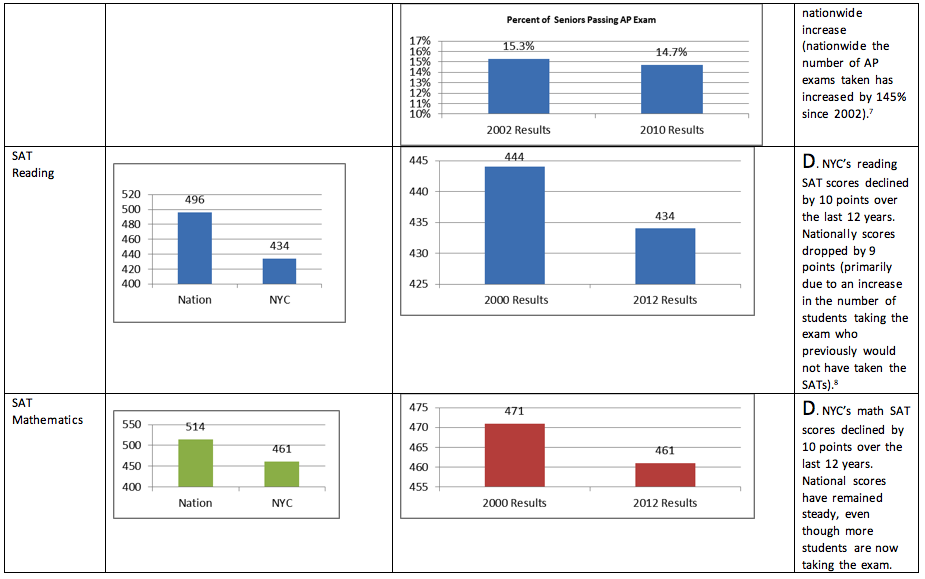
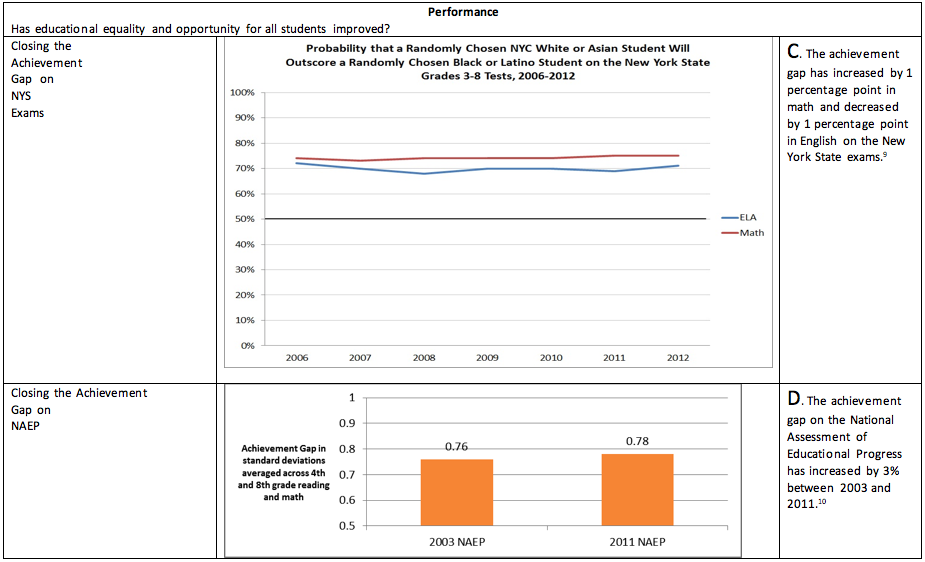
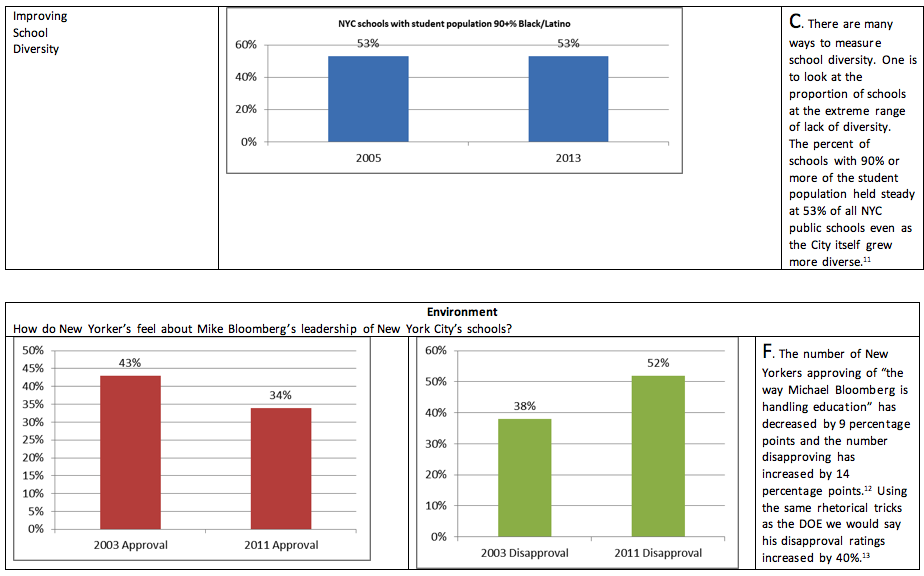
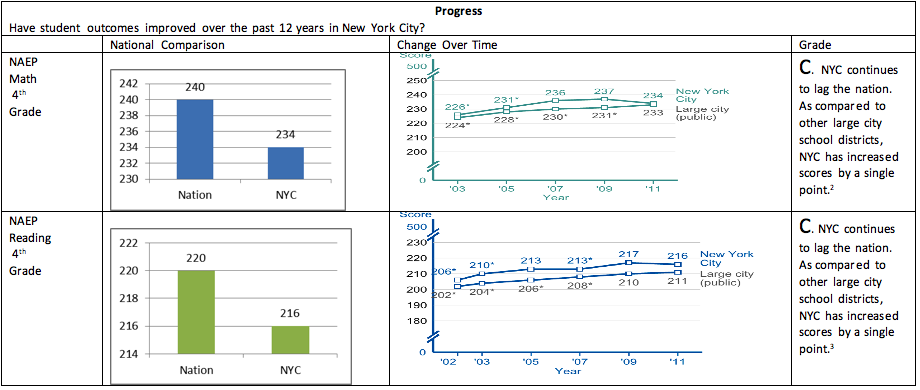
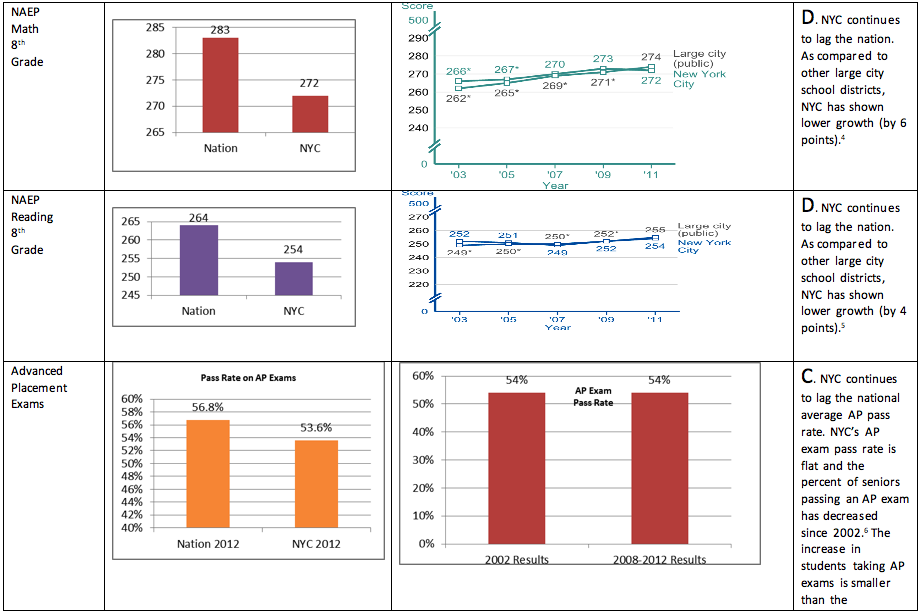
As we come to the end of a dozen years of Michael Bloomberg’s control of New York City’s schools, it is an appropriate time to take stock of the results. Using actual data from New York City schools, what do we learn about results of the specific policies implemented over the past 12 years? [1] Is the education of our students better after many changes and new policies? Has the focus on testing students, using test scores and formulas to grade (and punish) teachers and schools, closing schools, opening schools (and closing those schools too), co-locating and championing charter schools and new schools, and the multiple re-organizations of the bureaucracy helped students?

Screen shot 2013-10-23 at 10.43.38 PM Screen shot 2013-10-23 at 10.43.54 PM Screen shot 2013-10-23 at 10.44.11 PM Screen shot 2013-10-23 at 10.44.26 PM Screen shot 2013-10-23 at 10.44.40 PM
FINAL GRADE= D[14].Some readers may have questions or doubts about the data presented above. We do our best to answer them in the section below.

Have you cherry-picked data? These are the real numbers and we have sourced all the data. In fact, some data that were not included show even greater under-performance in New York City schools over the past 12 years. For example, the NAEP results in science show New York City lags behind the national average by 14 points in 4th grade and by 20 points in 8th grade. [15] However, since the most recent data are from 2009 and over 4 years old we did not include them.

Why do some of the metrics have different years of data cited? Because the New York City Department of Education refuses to publicly release complete data sets (and often denies data requests of researchers), we had to use the data we could identify by scouring the web and academic publications. The DOE’s secretive approach to sharing data with researchers, even with all identifying student information removed, is ironic given that they share private student information with corporations. [16]

Is it fair to compare New York City to the national average? The New York City Department of Education uses a similar measure by evaluating individual school in comparison to the performance of all city schools. This means that a school with primarily high needs students is evaluated against screened specialized schools. However, we are fairer than the NYC DOE and do not use the national comparison in the actual scoring. In this context it is worth noting that the formula New York State created and that New York City has implemented to evaluate teachers based on students test scores penalizes teachers who teach significant numbers of disadvantaged students. [17]

Why do you use test scores as your evaluative criteria? Because these are the very criteria that the education policies in New York were based on. As it turns out, even on their own terms, the policies have shown very poor outcomes. Even with the deck stacked in favor of Bloomberg’s policies the data still show that the policies have not been successful. If we were to add other criteria such as quality arts programs things are even worse. Data self-reported by schools shows that since 2006 elementary school students have at least 5% fewer opportunities to take visual arts, dance, theater and music classes taught by arts teachers. This is clearly an underestimate of the loss of arts options for students as an independent audit has demonstrated. [18]

How do you explain the increase in graduation rate in New York City? An independent study based on full access to DOE records and internal emails would help answer this question. A couple of points are in order.

A) The New York State Regents exams were made significantly easier over the past dozen years especially in terms of the grading scale applied to the exams. Math is an illustrative example. The Sequential Math 1 exam required the test taker to earn 65 percent of the available points to receive a passing score. The Math A exam, which replaced Sequential 1 in June 2002, required the test taker to earn 43 percent of the available points to receive a passing score. The Integrated Algebra exam, which replaced the Math A exam in 2009, requires the test taker to earn only 34.5 percent of the available points to receive a passing score. [19] Additionally the Biology exam was replaced by the Living Environment exam in 2001 and the Global Studies exam by the Global History exam in 2000. In each case the newer version was less content driven. [20]An academic study looking at changes in scoring and in difficulty of the Regents exams over the past 15 or so years would fill a gaping hole in our ability to make sense of test trends.

B) Schools were graded on the number of students earning credit. This led to some schools having jumps of 30-55+ percentage points in the number of students passing 10 or more classes. [21]In the space of 4 years the overall level of credit accumulation by students increased by 16 percentage points. [22]This can only be explained as being due to a citywide lowering of the bar on the expectations for earning credit, leading to a higher graduation rate, presumably at the cost of the actual quality of the diploma/college readiness of the student. [23]

C) The demographics of school age children in New York City changed dramatically since 2000, with white and Asian children becoming an increasingly larger proportion of the population. [24]As is well-known those demographic groups have significantly more educational success than Black and Latino children. Closing this achievement gap is one of the core missions of public education.

D) How can the increase in graduation rate reflect true increases in student learning when the grades 3-8 test scores have been mostly flat over the past dozen years? [25]Did students miraculously begin to learn more only when they hit 12th grade? The 8th grade Math/ELA scores on the NAEP increased by less 1.5% between 2003 and 2009, significantly less than the increase of other large urban school districts. How does that translate into an increase in graduation rates 4 years later unless the quality of a high school diploma and the bar for earning one was significantly lowered during that time?

E) The New York City Department of Education likes to compare its numbers to those of the “Big 5” cities (NYC, Buffalo, Rochester, Syracuse and Yonkers) in New York State. This is a deliberately misleading comparison as only 1 of these cities, Yonkers, is demographically similar to New York City. [26] NYC has significantly underperformed when compared to Yonkers. In fact, since 2008 the graduation rate in NYC has barely budged (the percent of students graduating by August after 4 years having gone from 62.7% to 64.7%). Yonkers, on the other hand, has seen its graduation rate increase by over 9 percentage points (from 62.9% to 72.1%). [27] Yonkers has outperformed New York City while serving a similar student population.

Bottom line: The data used here is comparable across years. It is more reliable than graduation rate which is a social construct having no set criteria or meaning. New York City underperforms on graduation rate when compared to comparable districts in New York State.

What does this all mean for the future of education in New York City? It means that we have our work cut out for us, as does the next mayor. With each mistake made over the last dozen years we have learned how we can do better. What have we learned?

  • We need to ensure that every single school has as diverse a student body as possible. Whether G&T programs, screened or specialized high schools, all schools must have a student body that reflects the diversity of New York City. The Office of Enrollment must improve their systems so that diversity is a crucial element of the process.
  • We need to provide schools with expert support and guidance in curriculum. We cannot take a sink or swim approach to teaching and learning, with every school left to their own devices. The Office of Teaching and Learning must be re-opened after having been shuttered under Bloomberg. Truly expert teachers must be identified at each grade level and subject area, their lessons videoed, their materials copied, and all of such resources must be shared with teachers throughout the city.
  • We need to develop rich early intervention and support services for students. This includes vastly increasing the number of speech teachers and math and reading intervention specialists in elementary schools. We cannot pretend that merely increasing the demands we make on students with the Common Core can take the place of our responsibility to support students in the critical early years to ensure they do not fall behind. This will also require developing a citywide early warning system and specialized curriculum to identify and provide quality remedial opportunities to students who are falling behind.
  • We need to provide support to schools that are struggling. It is wrong to continue to close schools just because they serve a high-needs student population. [28]Teams of experts must be formed to work directly with such schools in the areas of programming, data, and instructional cohesion. Each team must be assigned to one school to ensure quality support. This will also require changing Fair Student Funding so that all schools are funded equitably. [29]
  • We need to reform the DOE central office so that they take ownership of, are responsible for, and are held accountable for the success of every school (and student) in New York City. They must do the hard work of helping all schools and students improve. [30]They can no longer be allowed to take the easy way out. [31] The enormous support for a small percentage of charter schools, with no clear improvement in performance, makes no sense. The significant resources and PR devoted to the charter sector must end, while ensuring that the 6% of NYC’s children in charter schools receive a quality education. [32]Instead of destroying existing schools in order to create new schools we must add new and 21st century aligned academic and CTE programs to the schools we already have to ensure their success and that students have genuine choices and opportunities. [33]
  • We need to create an independent research office to evaluate educational initiatives so that the metrics are uniform across schools and can’t be gamed. [34]This office should report to the Panel for Educational Policy whose members should be selected to time- limited terms of office. The panel will then collaborate with the mayor in ensuring that community voice is heard.
  • We need to reorganize the bureaucracy so that schools are evaluated and coached on instructional techniques and youth development approaches by geographically based personnel with knowledge of the school and community. Other functions such as budgeting, HR and the like should be run out of regional offices. Web-based platforms will allow schools to form non-geographic affinity groups so that similar schools can share ideas no matter how far apart they are in the city.
  • We need to think creatively about ways to provide students with the additional quality learning time they need to succeed. The school year should be extended with a shorter summer break in the month of July and the new school year beginning again at the start of August. Summer learning loss is a huge factor in diminished student outcomes and we must address it system-wide.
  • Finally, we need to develop better ways to communicate with parents and communities to present an accurate picture of school performance. The current system penalizes schools and teachers who work with high-needs students. These are the precise parents and families who need the most help. Transparency about these factors must be improved.

[1] There have been some earlier attempts to answer this question https://dianeravitch.net/2012/10/02/after-a-decade-bloomberg-reforms-still-failing/. Our grading policy is as follows: significant improvement (by 10+%) over the past dozen or so years=A, improvement (2-9%) over the past dozen or so years=B, flatlining (-1,0,+1) over the past dozen or so years=C, decline (-2- -9%) over the past dozen or so years=D, significant decline (-10+%) over the past dozen years=F. This is, of course, a rather charitable grading policy as it assumes that no improvement even after a dozen years earns a gentleman’s C and not a F. We will weigh the 3 sections using the same weights as the School Report Cards implemented under Mike Bloomberg for New York City schools. Progress=60% of the final grade, Performance=25% of the final grade and Environment=15% of the final grade.

[2] http://nces.ed.gov/nationsreportcard/pdf/dst2011/2012453XN4.pdf

[3] http://nces.ed.gov/nationsreportcard/pdf/dst2011/2012456XN4.pdf

[4] http://nces.ed.gov/nationsreportcard/pdf/dst2011/2012453XN8.pdf

[5] http://nces.ed.gov/nationsreportcard/pdf/dst2011/2012456XN8.pdf

[6] http://cityroom.blogs.nytimes.com/2011/02/09/15-of-high-school-seniors-passed-an-a-p-test-last-year/ and http://nypost.com/2010/02/11/ny-schoolkids-do-a-ok-on-ap-tests/

[7] http://media.collegeboard.com/digitalServices/pdf/ap/rtn/9th-annual/9th-annual-ap-report-appendix-b.pdf nationwide AP results

[8] http://www.manhattan-institute.org/html/cr_26.htm NYC’s 2000 SAT results. http://nces.ed.gov/fastfacts/display.asp?id=171 nationwide SAT results through 2011. http://professionals.collegeboard.com/testing/sat-reasoning/scores/averages 2012 SAT results.

[9] http://eyeoned.org/content/closing-the-achievement-gap-have-we-flat-lined_379/

[10] http://eyeoned.org/content/the-emperors-new-close_313/

[11] http://schools.nyc.gov/NR/rdonlyres/B54A0720-E4EE-432D-A322-940346CCE61B/0/2013DemographicSnapshotPUBLIC.xlsx and http://www.nytimes.com/interactive/2012/05/11/nyregion/segregation-in-new-york-city-public-schools.html?_r=0 showing that “Black isolation in schools has persisted even as residential segregation has declined.” https://dianeravitch.net/2013/09/08/insider-at-bloomberg-doe-spills-the-beans-about-failed-policies/ has data on the extreme inequities in school outcomes where only a small handful of NYC produce outcomes at the national average. Finally, the Independent Budget Office has shown that from 2002-2011 school integration has remained flat http://www.ibo.nyc.ny.us/iboreports/printnycbtn11.pdf

[12] http://www.nytimes.com/interactive/2011/09/07/nyregion/20110907-nyc-schools-poll.html?ref=education

[13] The DOE, when reporting numbers, often uses percent increase rather than the actual number of percentage points. This makes small gains looks much larger than they otherwise would.

[14] Following the formula outlined in the first footnote the calculation is as follows: Progress x 60% + Performance x 25% + Environment x 15%= Final Grade. Replacing the letter grades with numbers A=1, B=2, C=3, D=4, F=5. The scores of each component were averaged and plugged into the formula as follows: (4.1667 x .6) + (3.3333 x .25) + (5 x .15) = 4.08=D.

[15] http://nces.ed.gov/nationsreportcard/pdf/dst2007/2008471XN8.pdf

[16] http://www.nytimes.com/2013/10/06/business/deciding-who-sees-students-data.html.

[17] http://www.lhcss.org/positionpapers/nysgrowthmodel.pdf

[18] http://schools.nyc.gov/offices/teachlearn/arts/ArtsCount/ArtsReport/2011-12/Final2012ArtsInSchools.pdf

[19] http://nycpublicschoolparents.blogspot.com/2008/01/ny-state-math-regents-exams-soft.html and http://atfss.wordpress.com/nys-regents/. Note that these numbers vary slightly with each exam.

[20] http://www.city-journal.org/2009/eon0731me.html

[21] http://blogs.edweek.org/edweek/eduwonkette/2008/11/the_nyc_high_school_progress_r_1.html

[22] http://www.edwize.org/credit-accumulation-soars-in-nyc-but-students-remain-behind

[23] Note that this may be very good public policy. Lowering the bar for a high school diploma so that more young adults have the opportunities for college education and job training where there is more flexibility around pursuing one’s interests is intuitively smart policy. However, when the bar is lowered policy-makers can’t claim that the graduation rate is comparable to earlier rates.

[24] “The fact is, the number of children in New York decreased by almost 9 percent between 2000 and 2010. According to the Department of City Planning, the black population under 18 decreased especially dramatically during those ten years, by 22.4 percent, while the population of white children decreased by only 3.8 percent. In the city’s richest borough, Manhattan, the number of white kids actually grew—by nearly 23 percent—and in rapidly gentrifying Brooklyn, the number of white kids increased by 7 percent. (The displacement of blacks and Latinos in some neighborhoods is painfully pronounced: In Brooklyn’s District 6, which encompasses Park Slope, the South Slope, Cobble Hill, Carroll Gardens, and Red Hook, the number of white kids grew by 28.5 percent while the number of black and Hispanic kids each dropped by 36 percent.) Asians are the one ethnic group whose number of children increased overall during the decade.” http://nymag.com/news/features/childhood/modern-childhood-2013-4/index3.html

[25] http://gothamschools.org/2010/07/28/test-scores-down-sharply-biggest-decline-for-needy-students/ data showing flat scores after New York State stopped lowering the bar for proficiency on the grades 3-8 exams.

[26] http://assembly.state.ny.us/member_files/044/20090319/report.pdf

[27] http://www.p12.nysed.gov/irs/pressRelease/20130617/GradRateSlides.ppt

[28] http://annenberginstitute.org/sites/default/files/SchoolTransformationReport_0.pdf https://dianeravitch.net/2012/08/25/nycs-schools-for-poorest-faring-poorly/ and https://dianeravitch.net/2012/08/09/after-ten-years-of-reform-in-new-york-city/

[29] https://dianeravitch.net/2012/09/05/how-new-york-city-stiffs-the-neediest-students/ https://dianeravitch.net/2012/08/12/in-nyc-fair-student-funding-is-unfair/ and https://dianeravitch.net/2012/08/30/who-is-putting-children-first/

[30] https://dianeravitch.net/2012/10/17/if-teachers-ran-their-classes-like-nyc-runs-schools-then/

[31] https://dianeravitch.net/2013/10/22/a-report-from-the-sinking-ship-at-nycs-doe-headquarters/

[32] https://dianeravitch.net/2013/10/15/the-charter-school-bubble-in-new-york-city/ on spending for charter schools. https://dianeravitch.net/2013/02/26/an-inside-the-doe-view-of-the-nyc-credo-study/ on the performance of charter schools. https://dianeravitch.net/2012/12/20/inflated-claims-of-charter-success-in-nyc/ and https://dianeravitch.net/2012/12/03/reader-calls-out-ny-daily-news-for-charter-spin-2/ on the exaggerated PR on behalf of charter schools.

[33] https://dianeravitch.net/2013/03/01/why-nyc-closes-high-schools/ on the coddling of new schools at the expense of existing ones.

[34] https://dianeravitch.net/2013/09/19/nyc-whistle-blower-how-the-doe-is-like-enron/