There’s lots of talk about whether or not school buildings should be open. European school buildings recently shut over concerns that children do indeed spread the virus. Yet former Mayor Mike Bloomberg now says, “It’s time for Joe Biden to stand up and to say, the kids are the most important things and important players here. And the teachers just are going to have to suck it up and stand up and provide an education.”
In fact we’ve never stopped doing that, but Bloomberg seems not to have received the memo. Bloomberg says kids are most important. Twelve years of working in New York City schools under Mike Bloomberg tell me to him, that really means adults are not important at all.
It’s particularly galling, after having devoted your life to help children, to be told you don’t care about them because you question the wisdom of risking your life, the lives of the children, and the lives of all our families.
In fact, here in New York City, elementary and middle-school buildings are open. A distinct minority of students can come in, masked and socially distanced, and get tested regularly in order to ensure safety. I can’t read Bloomberg’s mind, but if he actually wants buildings to be safe, I have no idea how he wants to change that.
Regardless, Bloomberg’s views, shared by many in media and elsewhere, reflect an utter lack of respect for those of us who work in schools. This is beneficial to neither teachers nor students. Who is going to fight for better conditions in schools? Is it people like Bloomberg, who cavalierly threaten teacher layoffs in a city with exploding class sizes, unreduced in 50 years? Do people really think young people would get the attention they need, or benefit in any viable fashion from the classes of up to 70 he proposed?
It doesn’t really matter. Mike Bloomberg, like Donald Trump, has more money than most and he knows things. When you have that much money, many accept your opinions. Publications of all stripes mirror them. And years of such treatment has had a distinct effect on those of us who work in schools. Many of us are afraid to speak out. It took an awful lot for the red-state strikes to happen. We’re more fortunate and better organized here, but we still face dire and deadly consequences of ill treatment. Many of us simply will not speak not speak out. It’s too risky.
Please open the link and read the rest of the article.
New York City has a form of education governance called mayoral control, initiated by billionaire Mayor Michael Bloomberg in 2002, in which the mayor appoints most of the school board members and selects the chancellor of the system. Bloomberg claimed at the time that he knew how to solve all the problems of education, and he appointed an attorney with no education experience (Joel Klein) as his chancellor. Klein brought in McKinsey and a host of business consultants to reorganize the school system repeatedly. On the one occasion in 2004 when the city’s school board voted to oppose a decision by the mayor (who wanted to end social promotion for third graders, an idea championed by Jeb Bush), he (and the borough president of Staten Island) fired three dissenting members of the panel on the spot.
‘‘This is what mayoral control is all about,” Mr. Bloomberg said last night. ”In the olden days, we had a board that was answerable to nobody. And the Legislature said it was just not working, and they gave the mayor control. Mayoral control means mayoral control, thank you very much. They are my representatives, and they are going to vote for things that I believe in.”
In light of the mayor’s control of education, it came as a shock when the city’s “Panel on Educational Policy” voted 8-7 to oppose the mayor’s plan to continue testing 4-year-olds for admission to the highly coveted “gifted and talented program.” Both the mayor and the chancellor admitted that the testing program was a terrible idea, but insisted that it should be given just one year more. A majority of the panel thought that it made no sense to do the wrong thing “just one more time.” Children in the gifted program get extra enrichment that should be available to all students.
Chalkbeat reports:
In an extraordinary rebuke to Mayor Bill de Blasio, a New York City education panel early Thursday morning rejected a testing contract — halting, for now, the controversial practice of testing incoming kindergartners for admission to gifted programs.
With testing originally scheduled for this spring, it’s unclear how admissions to the city’s gifted and talented programs will move ahead.
The rejection was an unusual flex for a panel that has little formal authority, is mostly appointed by the mayor, and has acted largely as a rubber stamp for his education policies. Approval seemed like a forgone conclusion when Mayor Bill de Blasio announced earlier this month that the entrance test would continue for one more year. But that required the Panel for Educational Policy to approve an extension of the city’s contract with the company that provides the entrance exams, at a cost of $1.7 million.
Instead, the vote failed 8-7, despite City Hall’s intense lobbying behind the scenes and the appointment of a new panel member just a day earlier. The rejection came even after Deputy Mayor Dean Fuleihan appeared at the virtual meeting, promising future significant reforms to the gifted program. In the meantime, the city proposed several admissions tweaks aimed at creating more diversity for the incoming kindergarten class.
New York City is one of the only school districts in the nation that uses a test given to preschoolers to determine admission to elementary school gifted programs. Mayor de Blasio and Schools Chancellor Richard Carranza have both criticized the exam, but intended to use it this year while pursuing long-term changes.
“This is a very challenging topic. As a pedagogue, as a principal, as a parent, I can say with certainty that there is a better way to serve our learners than a test given to 4-year-olds,” Carranza said at Wednesday’s meeting. “That’s why we want this to be the last year this test is administered.”
Ken Rice was an elected member of the Oakland Unified School District from 1997-2000. That was before the billionaire disrupters decided to take control of Oakland and turn it into their own petri dish for “reform” (i.e., privatization). Rice wrote the following description of the recent school board election, in which grassroots organizations stood together and beat the candidates of the out-of-district/out-of-state billionaires. He is a member of Educators for Democratic Schools (EDS), an Oakland-based organization composed primarily of retired public school teachers, administrators and school board members. When Ken Rice ran for school board, his race cost $12,000. Due to the intrusion of big money, grassroots groups are always outspent and usually overwhelmed. But Rice explains here how Oakland parents and educators fought back and won.
He writes:
Apparently Money Isn’t Always Everything–$300,000 Beats $900,000 In The Oakland School Board Elections!
“In nearly 20 years of privatization push into Oakland, this is the first time since 2003 that Oakland schools will be returned to local control by a school board that values and embraces authentic public education. Remaining hopeful for the future, and look forward to strengthening and improving Oakland’s schools.” ~ Diane Ravitch
The Oakland Unified School District (OUSD), the petri dish for school privatization for the past two decades, might have an answer. I ran and was elected to the Oakland school board and served one term (1997-2000). I raised $12,000. My opponent raised about the same amount. In those days the school board elections were neighborhood races funded by local supporters. There was no out of state money or PACs involved.
That began to change about ten years ago: huge donations from individuals and foundations began to pour into Oakland school board races. The money was funneled through the California Charter School Association and GO (Great Oakland Public Schools), a pro-charter organization. The money also came from Michael Bloomberg, the Walton Foundation, Eli Broad, Laurene Jobs (Steve Jobs’ widow), and several more. The goal was to elect a pro-charter, Board of Education. Unsurprisingly, the pro-charter organizations were successful.
The Oakland school board has approved about 65 charter school applications over the last twenty years–many of them in the last 12 years. Of those charters, about twenty have closed their doors—in some cases during the academic year, causing great dislocation to families who had to find another school for their children mid-year. OUSD now has 30% of its 50,000 students in charter schools—the highest percentage of students in charters of any school district in California.
What is surprising is what happened in the 2020 election. For the first time in memory no incumbents were running for any of the four of the seven school board seats up for election. Thus, there was a possibility of greatly changing the make-up of the school board, whose majority has opted for policies of charter school approval, school closures and lack of responsiveness to the greater Oakland educational community. This was an opportunity to flip the board . . . and flip it did!
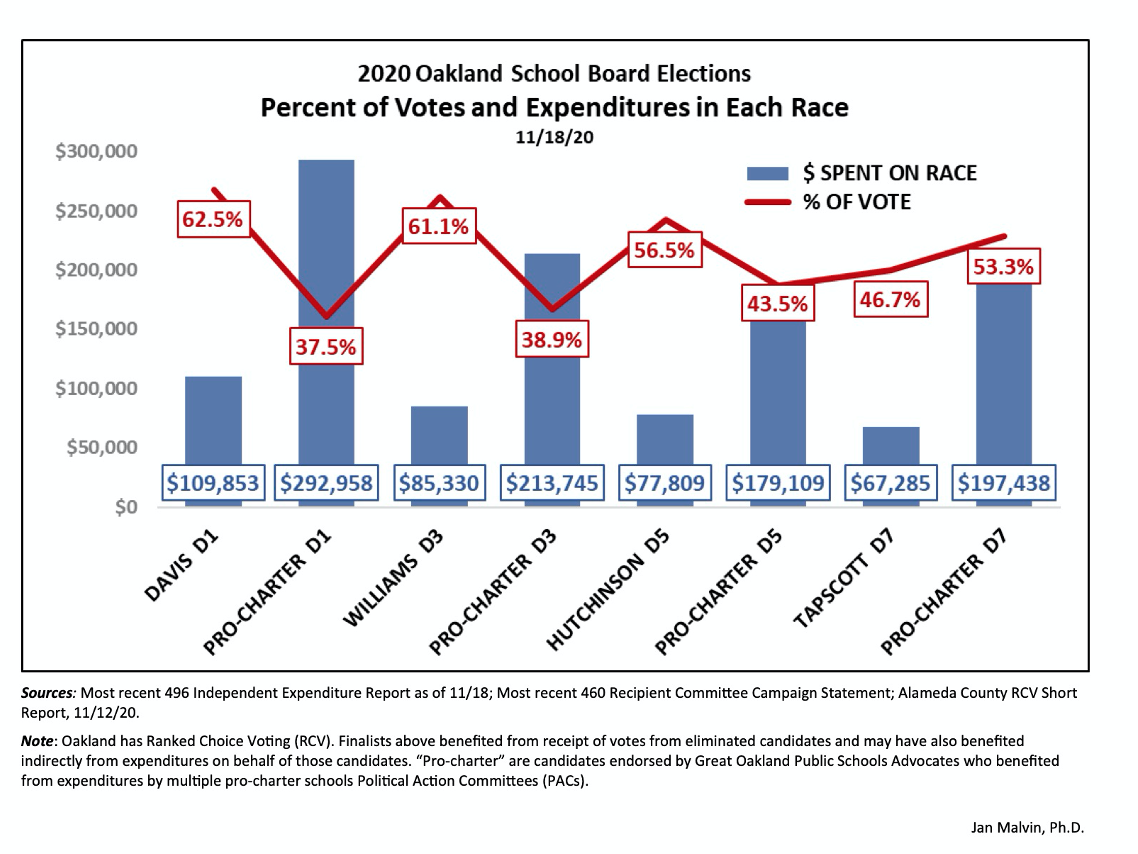
The charter community recognized this opportunity, and poured almost $900,000 into electing their candidates for the four open seats! Yet when the votes were counted, three of their four candidates lost.
Trying to understand how and why this happened can provide an insight into the educational landscape of not only Oakland, but urban cities nationally. While it might be early to know for certain why the charter candidates were defeated, we can make some educated guesses.
Strong Local Candidates
Two of the three candidates who won had deep Oakland roots. Two had been teachers (one in Oakland, one in San Francisco) and the other had worked in Oakland’s after school programs. Two had been community activists around school issues for years.
Oakland elections are calculated by ranked choice voting (RCV). When the RCV was tabulated, Sam Davis, the candidate in District 1 received 62% of the vote. Sam built a stellar campaign focused around school communities. He held zoom meetings with each school community in his district hosted by a combination of parents and teachers who worked in those schools. VanCedric Williams, in District 3, got 61%. VanCedric, a public school teacher for almost twenty years, had strong support from the teacher’s union as well as other unions. Mike Hutchinson in District 5 got 56%. Mike had run for the Board previously, networked with other education activists nationwide, and had built a reputation of challenging Board policies by going to Board meetings for years and reaching out on social media.
Backing of the Teacher’s Union
Last year, teachers in Oakland led a successful strike. The union’s ability to drum up enthusiasm with their members was one contributor to that success. Teachers recognized that if their future demands were to be met, they needed to have a responsive Board. Specifically, the current Board was considering a plan that would close up to 24 schools in Oakland, mostly in Brown and Black communities. At the same time, none of the 44 charter schools in Oakland were under threat of closure. Teachers made the connection between a charter friendly board and school closures of the public schools and were determined to change the direction of the district’s “blueprint”.
Teachers phone banked, texted, walked to drop off literature, and held zoom meetings in support of the three candidates who won. As Sam Davis noted, many voters tend to rely on their friends and neighbors who know something about the schools. The friends and neighbors were telling each other to vote for the candidates they trusted.
Backing of Other Groups: Building a Coalition
The three candidates were endorsed by the Democratic Party. This wasn’t an accident. Educational activists pushed the local democratic clubs to endorse candidates who would not be friendly to charters and wouldn’t owe their election to big money. These clubs, in turn, pushed the local Democratic party. In California the state Democratic party has taken a critical stance towards charter schools, and this was replicated locally. Organizers noticed that as people walked to the polls on election day, many of them carried the Democratic Party door hanger with them. Some of these candidates were also endorsed by :
The Alameda Central Labor Council
SEIU 1021
State Assemblyperson Rob Bonta
State Superintendent of Schools Tony Thurmond
Network for Public Education
Also, other community organizations like Educators for Democratic Schools, Democratic Socialists of America, and Wellstone Democratic Renewal Club helped to call, text, and walk precincts.
The Word is Out
You can fool some of the people all of the time but you can’t fool all of the people all of the time, or so Lincoln believed. Over time, the general public has begun to understand that there is an attempt to buy their votes. As I dropped off a flier at one home, a parent came to the door and asked, with hostility, “This isn’t the candidate who is getting all that money from Bloomberg, is it?” Several media sources reported on money from Bloomberg ($500,000 from Bloomberg alone!) and others pouring into Oakland.
After recovering from the astonishment that anyone would spend that kind of money for a school board election, voters became leery of candidates receiving those huge amounts of money. In District 1 where I live–and the charter candidate received nearly $300,000!–I found glossy fliers in my mailboxes more times than I could keep track of.
It is profoundly disturbing and a huge threat to our democracy that this big money trend has filtered down to local school board races. The Oakland community fought back against the billionaires’ spending advantage, and when the new board is seated in January, it will have a clear pro-public school majority. With appealing candidates and strong ground games, Oakland voters have shown that big money can be defeated. While Oakland will never go back to the days when a local neighborhood candidate spent only $12,000 to be elected, this recent victory over out of state billionaire bucks and their agenda sends a clear signal that our community will not be bought.
(Ken Rice is former OUSD board member, a member of Educators for Democratic Schools and currently has a daughter attending an OUSD school.)
Tom Ultican writes here about three major school board elections: Oakland, Los Angeles, and Indianapolis. These are districts that are in the crosshairs of the billionaire privatizers. No one can explain why billionaires want to privatize the public schools in these three districts (as well as dozens more). We now have nearly 30 years of evidence that neither charters nor vouchers produce educational miracles. New Orleans is not a national model: Last year, half the charter schools in this all-charter district were identified by the state as D or F-rated schools. Assignment to anyone: Why do the billionaires keep funding failure?
Ultican reports that the pro-privatization candidates vastly outspent the pro-public education candidates. In Oakland, the pro-public education slate won all but one seat (in that race, the pro-public education groups were divided, or they would have had a clean sweep).
In Los Angeles, the billionaires won one seat, enough to give them a single-seat majority of the school board.
In Indianapolis, the billionaires swamped the pro-public education candidates with their vast spending power.
It is an attack on democracy when billionaires from out-of-state (or from in-state) can drop a few million into a local school board race and make it impossible for ordinary citizens to compete. The individuals and the groups funding this assault on democracy–Michael Bloomberg, William Bloomfield, Stacey Schusterman, Arthur Rock, the Walton family, Reed Hastings, Doris Fisher, and other billionaires should hang their heads in shame. So should Stand for Children (which funnels billionaire money into races against public school advocates) and The Mind Trust.
For their ceaseless efforts to dismantle public schools and replace them with privately managed charters, I hereby place the following billionaires on this blog’s “Wall of Shame”: Michael Bloomberg, the Walton family, Reed Hastings, William Bloomfield, Doris Fisher, Arthur Rock, and Stacy Schusterman.
The same richly deserved dishonor goes to the infamous servant of the billionaires, Stand for Children.
Eric (Chaz) Chasanoff died of COVID-19 at the age of 69. He was a greatly admired high school teacher and blogger. He started his blog “Chaz’s School Daze” in 2006 in response to the oppressive policies of the Bloomberg-Klein regime. He was an inspiration to other teachers and bloggers, including me.
I urge you to browse his blog. His was a strong, fearless, independent voice. He will be missed.
Sadly, with condolences to his family, friends and former colleagues, I add Chaz Chasanoff to this blog’s honor roll. A teacher who loved teaching, a fearless and relentless advocate for students and teachers. A teacher who spoke truth to power. A man of principle.
The major funders are the usual members of the Billionaire Boys and Girls Club: Bloomberg, Waltons, Chan Zuckerberg, and Mrs. Jobs.
Please open and read his post.
If you thought the Disrupters might have softened their tone during the pandemic, like, as a show of decency, you will be disappointed. They are still attacking, vilifying, and mocking anyone daring to defend public education, which is a cornerstone of our democracy. It must really upset them that after all these years and billions spent on privatization, only 6% of American students enroll in charter schools.
For some reason, I am one of their prime targets. I suppose I should take it as a compliment.
I will never answer in kind.
They are swimming in cash, but what they cannot buy is civility, kindness, compassion, or dignity.
Tim O’Brien, who wrote a book about Donald Trump, worked on the Bloomberg campaign and is now an advisor to Bloomberg. A few days ago, he appeared on the Joy Reid show on MSNBC and warned the GOP that if they dragged Hunter Biden into the presidential campaign, they would be subject to a “scorched earth” attack on the Trump family that would expose them as grifters. He warned that Ivanka, Donald Jr., Eric, and Jared Kushner would experience scrutiny “unlike anything they’ve experienced thus far in the media.”
A top Senate Republican abruptly canceled plans to subpoena records and testimony from an official connected to a Ukrainian firm that once employed the son of former vice president Joe Biden.
The decision by Sen. Ron Johnson (R-Wis.), chairman of the Senate Homeland Security and Governmental Affairs Committee, comes as Democrats have attacked the probe as politically motivated, especially as Biden surges in his bid for the Democratic presidential nomination and the chance to face President Trump. Some have warned it could play into Russian efforts to spread disinformation ahead of the presidential election in November.
In a message Wednesday to members of the panel, sent roughly an hour before a planned vote, Johnson said he would indefinitely postpone the subpoena for documents and testimony from Andrii Telizhenko, a Ukrainian national who worked for a U.S. lobbying firm that acted on behalf of Burisma, the Ukrainian energy company that employed Hunter Biden as a board member.
Johnson said he was doing so “[o]ut of an abundance of caution and to allow time for [senators] to receive additional briefings.”
Deshotels writes that the suspension of recess so that students could have more time for test prep led to lower test scores!
He writes:
Why isn’t constant drilling on test taking skills at the expense of recess, PE, art, music, vocational education, and other “less important” instruction producing higher test scores? Maybe because the current trend to ignore fundamental child development principle’s is harmful in every way, including killing the joy of schooling for both children and teachers! Teachers in Finland, whose students perform at the top of the rankings on international achievement tests, routinely take young children outdoors where they can play, investigate nature and develop normally as they are programmed by their genes to do. Why do American reformers insist on counteracting nature and instead have transformed our education system to motivation killing test drudgery?
It was equally stupid to remove teachers from the decision-making process and leave it to legislators and the state education department. What a bad idea!
This outrageous trampling on the rights and critical input of the teaching profession in education decisions has actually resulted in the opposite of what our non-educator reformers said they wanted to do. Do you think our government can stop the Corona virus by ignoring the recommendations of the highly trained experts in disease prevention? The same is true of refusing to listen to real teachers about education reform. Do you believe, as the reformers would have you believe, that education reform in Louisiana is really working in preparing students for college and careers? Are you willing to ignore the most recent devastating revelation by our own Board of Regents that after all the reforms imposed on K-12 education in Louisiana, only 18 out of one hundred of our students will attain a college degree of any kind. Not even a two year associate’s degree! These are the worst results I have ever seen! Don’t blame the teachers. Teacher attended the legislative committee proposing these changes by the thousands to protest these untested ideas, only to be scolded for having the nerve to come to Baton Rouge on a school day (but that was the only time the Education committee was meeting!). Now the chickens are coming home to roost and thousands of our most dedicated teachers have left the profession.
Who has been making decisions? The Louisiana Association of Business and Industry, exactly the worst people to decide how to educate the state’s children.
The stranglehold over control of public education by the Louisiana Association of Business and Industry promises even more failure with the upcoming appointment of John White’s replacement.
Make no mistake about it, LABI has had almost total control over K-12 education for over 4 years since they used Michael Bloomburg’s and Walton family contributions to totally purchase all the BESE elected positions. They have made nothing but bad decisions with all this power. The school privatization they pushed has been almost a total failure with data showing that students who stay in their public schools do significantly better than they do when they move to a voucher or charter school.
Now LABI is preparing to pick the state’s next superintendent to succeed the failed John White, who mastered the art of spinning data to make it look good when it wasn’t. Of course, they are pushing White’s loyal assistant.
Let’s look at some of the real results of LABI supported reforms. On their web site, LABI claims that Louisiana is closing the achievement gap between privileged and underprivileged students. Data demonstrates instead that the exact opposite is true. They are also dead wrong claiming that ACT scores are improving. LABI is now down to apparently basing its education policies on wishful thinking rather than evidence.
The same is true of teacher evaluations based on student test scores using our defective state tests. LABI has insisted that Louisiana evaluate its teachers partially on student test scores. But all the data proves that the VAM system used is unstable and inaccurate. So a couple of years ago I got thrown off of a state committee studying changes to VAM because I had the nerve to state on my blog that LABI was like the dog that caught the truck with this whole VAM fiasco. They don’t have any idea what to do with VAM but they will never admit they were wrong. Meanwhile some very competent and dedicated teachers have had their careers ruined by VAM and thousands of great teachers have left the profession.
Louisiana has been fully in the grips of the Disruption Machine. It has fallen to the bottom of NAEP, which John White hailed as “proof” that the state had enacted higher standards. More failure like that and Louisiana will fall below Alabama and New Mexico, the lowest performing states.
Louisiana has bought into all the favorite remedies of “reform” (aka disruption), and there is nothing to show for it but failure, propaganda, and lies.
ProPublica published a stunning article about the relationship between Michael Bloomberg and the Sackler family, and how they reached out to him for advice about how to handle their poor public relations and the opprobrium they encountered because of their role in the opioid crisis.
The article also goes into detail about Bloomberg’s reluctance to let his reporters delve into the private lives of other very rich people, perhaps because he didn’t want anyone delving into his private life.
Mortimer Sackler and Michael Bloomberg met at the Bloomberg LP offices in New York, joined by Bloomberg Philanthropies CEO Patricia Harris. A spokesperson for Bloomberg said he took the meeting out of courtesy. Bloomberg told Sackler that the company should develop a list of 10 talking points, according to people familiar with the conversation. He also encouraged Sackler to have a conversation with Bloomberg Philanthropies, a spokesperson for Sackler said.
After the meeting, Sackler asked Purdue’s communications team to create a list of media messages and send it to him for review. One former Purdue executive said Sackler continued to repeat Bloomberg’s advice on conference calls and at meetings into 2019. “He’ll say, ‘When I met with Mike Bloomberg, he said we need to have messages, so what are they?’” the executive recalled.
Bloomberg also helped the Sacklers find a crisis communications manager. He recommended his longtime mayoral spokesman Stu Loeser, who was running a private firm that touted his “political instincts and deep connections.”
A Bloomberg Philanthropies spokesperson said it was a purely professional recommendation. ”If someone were to ask Mike for a recommendation for a doctor, he’d send you to his physician,” the spokesperson said.
Purdue then hired Loeser, who unsuccessfully recommended that Purdue announce a program to combat the opioid epidemic. “I went into this thinking this was a family that had such a massive need to change things that they were willing to take on a massive project to help people. Obviously, that didn’t happen,” Loeser said. A spokesperson for Sackler family members denied Loeser’s account, and said he didn’t propose such an initiative while working for the company.
Mortimer Sackler followed up with Harris about speaking with the head of public health initiatives at Bloomberg Philanthropies, Kelly Henning. Harris responded that Henning was “very eager to meet.” In February 2018, Sackler, Loeser and Purdue CEO Craig Landau discussed the opioid epidemic with Henning at the philanthropies’ offices.
There are conflicting accounts of the proposals Sackler made at that meeting. Henning said Sackler proposed that the two organizations collaborate on a media campaign. She said he implied that drug abusers were to blame for the opioid crisis. “He presented that it’s the people’s fault, not the industry’s fault,” she said.
OxyContin’s makers delayed the reckoning for their role in the opioid crisis by funding think tanks, placing friendly experts on leading outlets, and deterring or challenging negative coverage.
A spokesperson for Sackler said that he offered to team up with Bloomberg Philanthropies to help fight the opioid crisis, and that no media campaign was discussed. “The sole purpose of the meeting was to find ways to help find solutions to a serious health care problem,” the spokesperson said, adding that Sackler “does not now and never did believe or state that people suffering from addiction are to blame for their addiction.”
A Purdue Pharma spokesperson said Landau attended the meeting “to explore potential partnerships for the purpose of combating the abuse and diversion of prescription opioids.” It is “completely false” to suggest that there was any discussion of blaming the epidemic on drug abusers, the spokesperson said.
As public opinion turned against the family, Mortimer, the last remaining Sackler on the Purdue board, stepped down in January 2019. Two months later, the billionaires team finally measured the Sacklers’ wealth. It found that the family, despite its recent woes, was worth $13 billion. In April, the Serpentine Sackler Gallery said it has “no future plans to accept funding from the Sacklers.” Purdue filed for Chapter 11 bankruptcy in September.
Loeser no longer works for Purdue; he’s back with Bloomberg, serving as a spokesman for his presidential campaign. To focus on the campaign, Bloomberg has taken a temporary leave from chairing the Serpentine and Serpentine Sackler Galleries.

 Diane Ravitch's blog