Archives for category: Bloomberg, Michael

Marc Epstein, a career educator in the New York City school system, wrote an earlier post on Mayor de Blasio’s task of “cleaning the stables.” He refers to the Herculean task of cleaning the Augean stables. This was a dirty job, thought to be impossible, but Hercules succeeded. We hope that Mayor de Blasio will as well.

Marc Epstein writes:

Cleaning The Stables – Part II

Now you tell us?

After 12 years of subjecting the nation’s largest school system to a series of extreme makeovers, Merryl Tisch, Chancellor of the Board of Regents, the body charged with oversight of the public schools, informed us that the third major reorganization of the New York City public schools engineered by Mayor Bloomberg was an abject failure. “Me, if I were going to take over the school system, I would look heavily to change the networks,” she opined.

That her remarks received scant coverage from the vaunted New York press should come as no surprise to those of us who have lived through this nightmare. That’s because in the eyes of New York’s power elite, Michael Bloomberg was simply “too big to fail.”

Just what are those “Networks” Tisch referred to? For New Yorkers who exited the public school system long ago to educate their children in private and parochial schools, or to the new immigrants who find this discussion indecipherable, here is an explanation.

When the state legislature gave the mayor control over the schools over a decade ago, it was unconditional. There was no oversight from Albany, no strings attached to his powers. There was still a board of education, but he appointed the majority, who served at his pleasure and renamed “the Panel on Education Policy,” to signal its strictly advisory nature. If any of his appointees dared to disagree with his orders, he fired them immediately. When he doubled the operating budget and instituted a series of radical reorganizations, those on the sidelines either cheered or remained silent. As far as New York’s political class was concerned, when it came to the nation’s largest school system, it was a case of “I don’t want her, you can have her, she’s too fat for me,”

Bloomberg entered office as one of the wealthiest men in America. So, cloaked with an aura of invincibility unparalleled for a mayor, he crafted a “teachers and their union vs. our kids” narrative that was part of a nationwide campaign instigated by a handful of philanthropists with very, very, deep pockets and the desire to turn public education on its head.

He could proceed with his agenda with the knowledge that there’s nothing more soporific than stories recounting administrative failures and the destruction of a bureaucracy, especially when the bureaucracy had been twisted into a pretzel by five decades of political manipulation.

He began his assault on public education by cleverly disarming the teachers union with a seemingly exorbitant pay raise that increased entry-level salaries dramatically. It ensured a bumper crop of young teacher recruits, while granting a modest raise for senior teachers.

The dismantling of the school system rested on a few simple principles. First, declare as many schools, especially high schools, as failed institutions and posit that it was the fault of the faculty and administration.

An incessant drumbeat aided by his own news media company and the tabloids owned by his fellow billionaires Rupert Murdoch and Mortimer Zuckerman hammered away at the teachers as a parasitic class who needed to be held responsible for the failure of inner city minorities, and at their union for protecting them from deserved termination by manipulating convoluted contracts and obsolete civil service law.

Second, he refused to place those allegedly “failed” employees who numbered in the thousands, in his reconstituted “new” schools, or in other schools with vacancies. He supposedly “empowered ” principals to manage their operating budgets by changing the formula for hiring faculty, so the practice of charging a principal the average salary price for a teacher regardless of seniority was eliminated.

The result has been a cohort of headless horsemen teachers roaming the system as they rotate schools week to week collecting full salaries and acting as substitutes in order to make their lives as demeaning as possible.

My school has been without a librarian for 6 years because the principal can’t “afford” to hire a librarian. So a well-appointed library can’t circulate books or be open for students to do research or study, while well-qualified librarians from “failed” closed schools wander the system as substitutes!

Instead of covering classes with substitutes who cost the city $150 per day, he opted for regular teachers without permanent assignments who cost the city about $500 per day, while continuing to hire new teachers!

This “business” practice was extended to include guidance counselors and assistant principals as well. It may well be the first time the largest city bureaucracy in the 50 states was staffed like a satrap in the Medo-Persian style of the 5th century BCE.

Don’t go looking for editorials of outrage or news stories documenting this madness. After all, it’s impossible that Bloomberg accumulated close to $30 billion dollars by being an inept administrator or a particularly malevolent individual, is it?

The editorialists would rather condone this policy than scrutinize it. After all, if Bloomberg ran his business in this manner, why shouldn’t he be allowed to fire whomever he wants whenever he wants to?

The third leg of the strategy was to create a new managerial class of principals and assistant principals who had as little classroom experience as possible and no attachment to the school “culture.” Marketed as the “best and the brightest,” many of them were little more than hatchet men who were given orders to bring back as many teacher scalps as possible. Mayor De Blasio will find that they represent one of the many “poison pills” Mayor Bloomberg has bequeathed him.

Traditionally, the principal was the principal educator in the schoolhouse. Today, the new principal charged with weeding out as many teachers as possible simply had to be a bully. I spent over a month in a small school that experienced a staff turnover of 90% in just four years under this kind of management.

If you work in the system and have been around schools run with this sort of thuggishness, you’re not surprised when you encounter supervisors with little more than a 6th grade reading and writing level. I recall a heavily tattooed female assistant principal who was crude beyond measure and the last person you would want overseeing the education of your child. I doubt that she could compose a cogent essay of 500 words.

The new managerial class, purportedly trained in the best of Jack Welch’s managerial strategies, is suffused with uneducated barbarians who were elevated to positions of great responsibility. But incapable of educating, they simply pillage the teacher cohort.

Part four called for decoupling the neighborhood school from the community. He used the bait and switch tactic. Parental “choice” was the marketing technique to give parents the illusion that they had hundreds of choices instead of the stale neighborhood school for their child’s education.

With hundred of new small schools with the name “preparatory” or “academy” attached to it, how was a parent to know one from the other? To call these schools by the names we associate with fancy private prep schools was nothing but a cruel joke. To further add to the illusion that they were being heard, a new paid position of parent coordinator was added to the school system.

While there are parent coordinators who put in a full day’s work, their purpose was to make the PTA irrelevant and allow the coordinator to act as the flak-catcher for an unhappy parent. With 250,000 kids now traveling all over the city in the name of “school choice,” what are the odds that a PTA will have a real voice in the average school far from home?

The fifth and final tactic was to create parallel institutions that obfuscated and duplicated duties in order to hide responsibility for administrative actions.

State law requires superintendants run schools, but it’s the Networks that Chancellor Tisch alluded to that have been telling principals how to run their schools, which is really quite odd because the Networks were supposed to be providers of educational services to the schools, not direct them. In fact the schools were given the choice to pick the Network they wanted to work with.

Opaque, parallel institutions are not the hallmark of a democracy. But as any student of history knows, they define the worst sorts of totalitarian enterprises. So there you have it, the destruction of what was once one of the finest education systems in the country in five easy pieces, pulled off with the assent or abdication of duty by the movers and shakers of New York.
The Bloomberg years have been good for New York City in some ways; for example, smoking has been extinguished in all public and even many private places. The mayor’s dedication to public health is highly commendable.

But other things have been disastrous. The mayor has succeeded in making Manhattan a playground for international tourism and the uber-rich, but the explosion of new residential construction has added apartments that sell for millions of dollars. The New York Times, when it endorsed Bill de Blasio for mayor on October 27, noted in passing that 46% of the populace is New York City lives below the poverty line. In a city as expensive as New York City, nearly half the population is poor. That is a sad record, and it is reflected in the continuing struggles of the schools, which must educate the children of those who are homeless, hungry, and in need of intensive supports of all kinds.

At the outset of his administration, some dozen years ago, Mayor Bloomberg decided that the reform of the education system would be his greatest legacy. He said it again and again in his campaign. He was convinced that the only thing missing was management skills, of which he had plenty. He actually claimed that he could get better “results” with the same amount of money (then $12 billion). The spending has more than doubled, but the better results remain elusive. Unfortunately, the mayor decided that testing and accountability and choice would be the strategies that he would rely on to transform the system. In doing so, he mirrored George W. Bush’s No Child Left Behind. That was the zeitgeist of 2002, when Bush signed NCLB and Bloomberg took office and gained complete control of the school system.

Some observers, especially those who live thousands of miles away, are impressed with the Bloomberg record. Certainly the mayor has expanded the public relations staff devoted to selling the story of his “success.” In the years before Bloomberg, there were three people in the press office, whose job was to get information for reporters. Under Bloomberg, the PR staff ballooned, not only at the Department of Education itself, but grew to include the mayor’s own PR staff, so it is difficult to say exactly how many people were paid to “sell” the mayor’s story of success. Some thought it was a staff of at least 20, but it may have been even more.

Sadly, what was lost was any possibility of getting accurate information from the Department of Education. The PR staff existed to “sell the story” and spin results, not to candidly assess what was happening and how initiatives were working. That work was left to independent groups, which found it very difficult to raise money since the mayor used his considerable influence to affect decisions at the city’s major foundations. Anyone who questioned the administration’s claims had a difficult time finding any funding at all.

In pursuit of his elusive goal of 100% success, the mayor went through several iterations. He had three chancellors: Joel Klein, a lawyer, who lasted eight years and reorganized the schools at least three, perhaps four, times; Cathie Black, a publisher, who lasted 90 days and was a disaster, almost singlehandedly wrecking the mayor’s reputation as a reliable judge of management capability and displaying his disdain for anyone who had any experience in education; then Dennis Walcott, who had once headed the Urban League, but was better known for his long and acquiescent service to Bloomberg as an education advisor.

Over the course of this past dozen years, many schools have closed, many schools have opened. Many new schools also closed after they too posted low scores. The mayor never rethought his strategy of closing schools and opening schools, of using test scores and letter grades as measures of school quality. The graduation rate went up, but the remediation rate at local colleges remained staggeringly high.

What the city needs most today is an administration committed to telling the unvarnished truth about what is happening to the students, the teachers, and the school. If it is possible in our society today, the new administration must be prepared to be honest about successes and failures, and devote the resources necessary to have a high-quality internal department of evaluation and research. Much more is needed, but a good place to start is with a firm commitment to tell the truth without spin or hype.

Here is an analysis of the Bloomberg record, written by an insider at the Department of Education.

Click on the images to enlarge them.

Grading A Dozen Years of Education Policy in the Big Apple: A Report Card

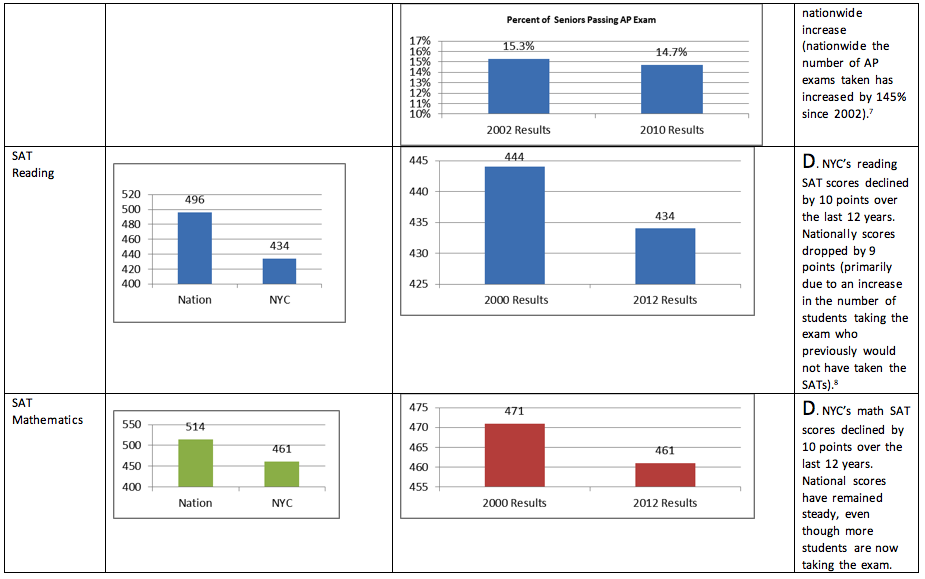
As we come to the end of a dozen years of Michael Bloomberg’s control of New York City’s schools, it is an appropriate time to take stock of the results. Using actual data from New York City schools, what do we learn about results of the specific policies implemented over the past 12 years? [1] Is the education of our students better after many changes and new policies? Has the focus on testing students, using test scores and formulas to grade (and punish) teachers and schools, closing schools, opening schools (and closing those schools too), co-locating and championing charter schools and new schools, and the multiple re-organizations of the bureaucracy helped students?

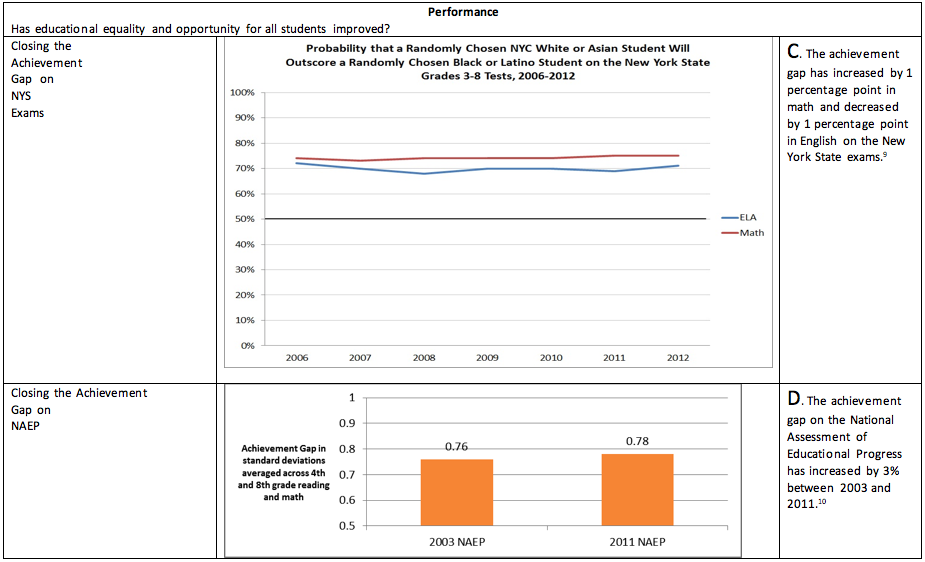
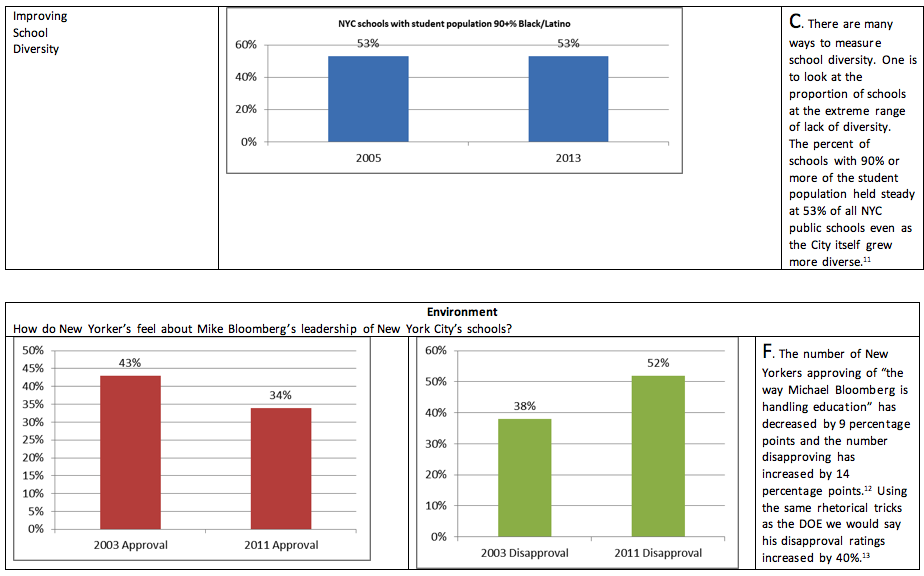
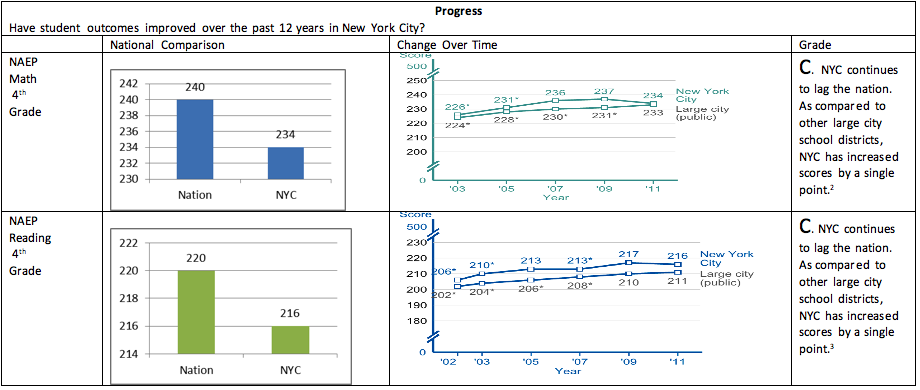
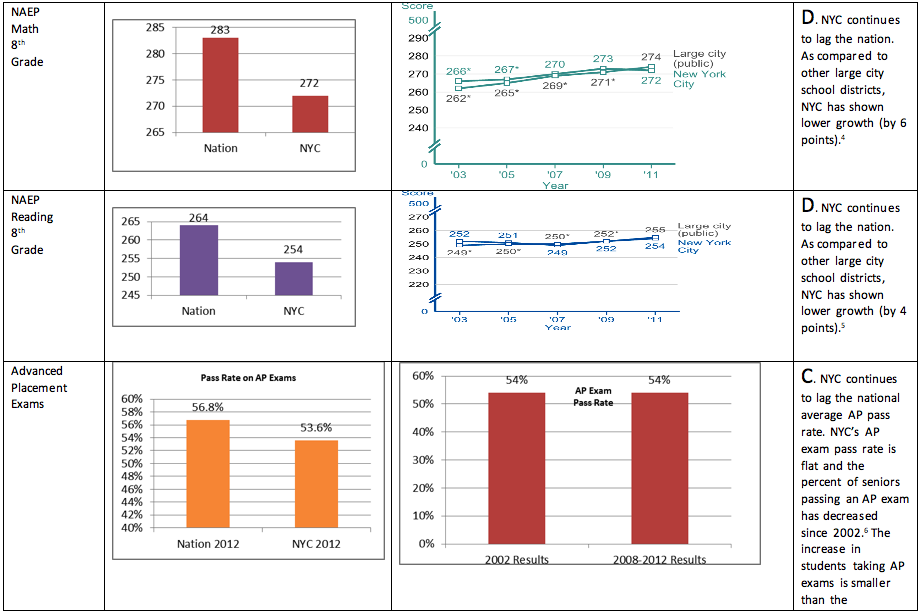
Screen shot 2013-10-23 at 10.43.38 PM Screen shot 2013-10-23 at 10.43.54 PM Screen shot 2013-10-23 at 10.44.11 PM Screen shot 2013-10-23 at 10.44.26 PM Screen shot 2013-10-23 at 10.44.40 PM
FINAL GRADE= D[14].Some readers may have questions or doubts about the data presented above. We do our best to answer them in the section below.

Have you cherry-picked data? These are the real numbers and we have sourced all the data. In fact, some data that were not included show even greater under-performance in New York City schools over the past 12 years. For example, the NAEP results in science show New York City lags behind the national average by 14 points in 4th grade and by 20 points in 8th grade. [15] However, since the most recent data are from 2009 and over 4 years old we did not include them.

Why do some of the metrics have different years of data cited? Because the New York City Department of Education refuses to publicly release complete data sets (and often denies data requests of researchers), we had to use the data we could identify by scouring the web and academic publications. The DOE’s secretive approach to sharing data with researchers, even with all identifying student information removed, is ironic given that they share private student information with corporations. [16]

Is it fair to compare New York City to the national average? The New York City Department of Education uses a similar measure by evaluating individual school in comparison to the performance of all city schools. This means that a school with primarily high needs students is evaluated against screened specialized schools. However, we are fairer than the NYC DOE and do not use the national comparison in the actual scoring. In this context it is worth noting that the formula New York State created and that New York City has implemented to evaluate teachers based on students test scores penalizes teachers who teach significant numbers of disadvantaged students. [17]

Why do you use test scores as your evaluative criteria? Because these are the very criteria that the education policies in New York were based on. As it turns out, even on their own terms, the policies have shown very poor outcomes. Even with the deck stacked in favor of Bloomberg’s policies the data still show that the policies have not been successful. If we were to add other criteria such as quality arts programs things are even worse. Data self-reported by schools shows that since 2006 elementary school students have at least 5% fewer opportunities to take visual arts, dance, theater and music classes taught by arts teachers. This is clearly an underestimate of the loss of arts options for students as an independent audit has demonstrated. [18]

How do you explain the increase in graduation rate in New York City? An independent study based on full access to DOE records and internal emails would help answer this question. A couple of points are in order.

A) The New York State Regents exams were made significantly easier over the past dozen years especially in terms of the grading scale applied to the exams. Math is an illustrative example. The Sequential Math 1 exam required the test taker to earn 65 percent of the available points to receive a passing score. The Math A exam, which replaced Sequential 1 in June 2002, required the test taker to earn 43 percent of the available points to receive a passing score. The Integrated Algebra exam, which replaced the Math A exam in 2009, requires the test taker to earn only 34.5 percent of the available points to receive a passing score. [19] Additionally the Biology exam was replaced by the Living Environment exam in 2001 and the Global Studies exam by the Global History exam in 2000. In each case the newer version was less content driven. [20]An academic study looking at changes in scoring and in difficulty of the Regents exams over the past 15 or so years would fill a gaping hole in our ability to make sense of test trends.

B) Schools were graded on the number of students earning credit. This led to some schools having jumps of 30-55+ percentage points in the number of students passing 10 or more classes. [21]In the space of 4 years the overall level of credit accumulation by students increased by 16 percentage points. [22]This can only be explained as being due to a citywide lowering of the bar on the expectations for earning credit, leading to a higher graduation rate, presumably at the cost of the actual quality of the diploma/college readiness of the student. [23]

C) The demographics of school age children in New York City changed dramatically since 2000, with white and Asian children becoming an increasingly larger proportion of the population. [24]As is well-known those demographic groups have significantly more educational success than Black and Latino children. Closing this achievement gap is one of the core missions of public education.

D) How can the increase in graduation rate reflect true increases in student learning when the grades 3-8 test scores have been mostly flat over the past dozen years? [25]Did students miraculously begin to learn more only when they hit 12th grade? The 8th grade Math/ELA scores on the NAEP increased by less 1.5% between 2003 and 2009, significantly less than the increase of other large urban school districts. How does that translate into an increase in graduation rates 4 years later unless the quality of a high school diploma and the bar for earning one was significantly lowered during that time?

E) The New York City Department of Education likes to compare its numbers to those of the “Big 5” cities (NYC, Buffalo, Rochester, Syracuse and Yonkers) in New York State. This is a deliberately misleading comparison as only 1 of these cities, Yonkers, is demographically similar to New York City. [26] NYC has significantly underperformed when compared to Yonkers. In fact, since 2008 the graduation rate in NYC has barely budged (the percent of students graduating by August after 4 years having gone from 62.7% to 64.7%). Yonkers, on the other hand, has seen its graduation rate increase by over 9 percentage points (from 62.9% to 72.1%). [27] Yonkers has outperformed New York City while serving a similar student population.

Bottom line: The data used here is comparable across years. It is more reliable than graduation rate which is a social construct having no set criteria or meaning. New York City underperforms on graduation rate when compared to comparable districts in New York State.

What does this all mean for the future of education in New York City? It means that we have our work cut out for us, as does the next mayor. With each mistake made over the last dozen years we have learned how we can do better. What have we learned?

  • We need to ensure that every single school has as diverse a student body as possible. Whether G&T programs, screened or specialized high schools, all schools must have a student body that reflects the diversity of New York City. The Office of Enrollment must improve their systems so that diversity is a crucial element of the process.
  • We need to provide schools with expert support and guidance in curriculum. We cannot take a sink or swim approach to teaching and learning, with every school left to their own devices. The Office of Teaching and Learning must be re-opened after having been shuttered under Bloomberg. Truly expert teachers must be identified at each grade level and subject area, their lessons videoed, their materials copied, and all of such resources must be shared with teachers throughout the city.
  • We need to develop rich early intervention and support services for students. This includes vastly increasing the number of speech teachers and math and reading intervention specialists in elementary schools. We cannot pretend that merely increasing the demands we make on students with the Common Core can take the place of our responsibility to support students in the critical early years to ensure they do not fall behind. This will also require developing a citywide early warning system and specialized curriculum to identify and provide quality remedial opportunities to students who are falling behind.
  • We need to provide support to schools that are struggling. It is wrong to continue to close schools just because they serve a high-needs student population. [28]Teams of experts must be formed to work directly with such schools in the areas of programming, data, and instructional cohesion. Each team must be assigned to one school to ensure quality support. This will also require changing Fair Student Funding so that all schools are funded equitably. [29]
  • We need to reform the DOE central office so that they take ownership of, are responsible for, and are held accountable for the success of every school (and student) in New York City. They must do the hard work of helping all schools and students improve. [30]They can no longer be allowed to take the easy way out. [31] The enormous support for a small percentage of charter schools, with no clear improvement in performance, makes no sense. The significant resources and PR devoted to the charter sector must end, while ensuring that the 6% of NYC’s children in charter schools receive a quality education. [32]Instead of destroying existing schools in order to create new schools we must add new and 21st century aligned academic and CTE programs to the schools we already have to ensure their success and that students have genuine choices and opportunities. [33]
  • We need to create an independent research office to evaluate educational initiatives so that the metrics are uniform across schools and can’t be gamed. [34]This office should report to the Panel for Educational Policy whose members should be selected to time- limited terms of office. The panel will then collaborate with the mayor in ensuring that community voice is heard.
  • We need to reorganize the bureaucracy so that schools are evaluated and coached on instructional techniques and youth development approaches by geographically based personnel with knowledge of the school and community. Other functions such as budgeting, HR and the like should be run out of regional offices. Web-based platforms will allow schools to form non-geographic affinity groups so that similar schools can share ideas no matter how far apart they are in the city.
  • We need to think creatively about ways to provide students with the additional quality learning time they need to succeed. The school year should be extended with a shorter summer break in the month of July and the new school year beginning again at the start of August. Summer learning loss is a huge factor in diminished student outcomes and we must address it system-wide.
  • Finally, we need to develop better ways to communicate with parents and communities to present an accurate picture of school performance. The current system penalizes schools and teachers who work with high-needs students. These are the precise parents and families who need the most help. Transparency about these factors must be improved.

[1] There have been some earlier attempts to answer this question https://dianeravitch.net/2012/10/02/after-a-decade-bloomberg-reforms-still-failing/. Our grading policy is as follows: significant improvement (by 10+%) over the past dozen or so years=A, improvement (2-9%) over the past dozen or so years=B, flatlining (-1,0,+1) over the past dozen or so years=C, decline (-2- -9%) over the past dozen or so years=D, significant decline (-10+%) over the past dozen years=F. This is, of course, a rather charitable grading policy as it assumes that no improvement even after a dozen years earns a gentleman’s C and not a F. We will weigh the 3 sections using the same weights as the School Report Cards implemented under Mike Bloomberg for New York City schools. Progress=60% of the final grade, Performance=25% of the final grade and Environment=15% of the final grade.

[2] http://nces.ed.gov/nationsreportcard/pdf/dst2011/2012453XN4.pdf

[3] http://nces.ed.gov/nationsreportcard/pdf/dst2011/2012456XN4.pdf

[4] http://nces.ed.gov/nationsreportcard/pdf/dst2011/2012453XN8.pdf

[5] http://nces.ed.gov/nationsreportcard/pdf/dst2011/2012456XN8.pdf

[6] http://cityroom.blogs.nytimes.com/2011/02/09/15-of-high-school-seniors-passed-an-a-p-test-last-year/ and http://nypost.com/2010/02/11/ny-schoolkids-do-a-ok-on-ap-tests/

[7] http://media.collegeboard.com/digitalServices/pdf/ap/rtn/9th-annual/9th-annual-ap-report-appendix-b.pdf nationwide AP results

[8] http://www.manhattan-institute.org/html/cr_26.htm NYC’s 2000 SAT results. http://nces.ed.gov/fastfacts/display.asp?id=171 nationwide SAT results through 2011. http://professionals.collegeboard.com/testing/sat-reasoning/scores/averages 2012 SAT results.

[9] http://eyeoned.org/content/closing-the-achievement-gap-have-we-flat-lined_379/

[10] http://eyeoned.org/content/the-emperors-new-close_313/

[11] http://schools.nyc.gov/NR/rdonlyres/B54A0720-E4EE-432D-A322-940346CCE61B/0/2013DemographicSnapshotPUBLIC.xlsx and http://www.nytimes.com/interactive/2012/05/11/nyregion/segregation-in-new-york-city-public-schools.html?_r=0 showing that “Black isolation in schools has persisted even as residential segregation has declined.” https://dianeravitch.net/2013/09/08/insider-at-bloomberg-doe-spills-the-beans-about-failed-policies/ has data on the extreme inequities in school outcomes where only a small handful of NYC produce outcomes at the national average. Finally, the Independent Budget Office has shown that from 2002-2011 school integration has remained flat http://www.ibo.nyc.ny.us/iboreports/printnycbtn11.pdf

[12] http://www.nytimes.com/interactive/2011/09/07/nyregion/20110907-nyc-schools-poll.html?ref=education

[13] The DOE, when reporting numbers, often uses percent increase rather than the actual number of percentage points. This makes small gains looks much larger than they otherwise would.

[14] Following the formula outlined in the first footnote the calculation is as follows: Progress x 60% + Performance x 25% + Environment x 15%= Final Grade. Replacing the letter grades with numbers A=1, B=2, C=3, D=4, F=5. The scores of each component were averaged and plugged into the formula as follows: (4.1667 x .6) + (3.3333 x .25) + (5 x .15) = 4.08=D.

[15] http://nces.ed.gov/nationsreportcard/pdf/dst2007/2008471XN8.pdf

[16] http://www.nytimes.com/2013/10/06/business/deciding-who-sees-students-data.html.

[17] http://www.lhcss.org/positionpapers/nysgrowthmodel.pdf

[18] http://schools.nyc.gov/offices/teachlearn/arts/ArtsCount/ArtsReport/2011-12/Final2012ArtsInSchools.pdf

[19] http://nycpublicschoolparents.blogspot.com/2008/01/ny-state-math-regents-exams-soft.html and http://atfss.wordpress.com/nys-regents/. Note that these numbers vary slightly with each exam.

[20] http://www.city-journal.org/2009/eon0731me.html

[21] http://blogs.edweek.org/edweek/eduwonkette/2008/11/the_nyc_high_school_progress_r_1.html

[22] http://www.edwize.org/credit-accumulation-soars-in-nyc-but-students-remain-behind

[23] Note that this may be very good public policy. Lowering the bar for a high school diploma so that more young adults have the opportunities for college education and job training where there is more flexibility around pursuing one’s interests is intuitively smart policy. However, when the bar is lowered policy-makers can’t claim that the graduation rate is comparable to earlier rates.

[24] “The fact is, the number of children in New York decreased by almost 9 percent between 2000 and 2010. According to the Department of City Planning, the black population under 18 decreased especially dramatically during those ten years, by 22.4 percent, while the population of white children decreased by only 3.8 percent. In the city’s richest borough, Manhattan, the number of white kids actually grew—by nearly 23 percent—and in rapidly gentrifying Brooklyn, the number of white kids increased by 7 percent. (The displacement of blacks and Latinos in some neighborhoods is painfully pronounced: In Brooklyn’s District 6, which encompasses Park Slope, the South Slope, Cobble Hill, Carroll Gardens, and Red Hook, the number of white kids grew by 28.5 percent while the number of black and Hispanic kids each dropped by 36 percent.) Asians are the one ethnic group whose number of children increased overall during the decade.” http://nymag.com/news/features/childhood/modern-childhood-2013-4/index3.html

[25] http://gothamschools.org/2010/07/28/test-scores-down-sharply-biggest-decline-for-needy-students/ data showing flat scores after New York State stopped lowering the bar for proficiency on the grades 3-8 exams.

[26] http://assembly.state.ny.us/member_files/044/20090319/report.pdf

[27] http://www.p12.nysed.gov/irs/pressRelease/20130617/GradRateSlides.ppt

[28] http://annenberginstitute.org/sites/default/files/SchoolTransformationReport_0.pdf https://dianeravitch.net/2012/08/25/nycs-schools-for-poorest-faring-poorly/ and https://dianeravitch.net/2012/08/09/after-ten-years-of-reform-in-new-york-city/

[29] https://dianeravitch.net/2012/09/05/how-new-york-city-stiffs-the-neediest-students/ https://dianeravitch.net/2012/08/12/in-nyc-fair-student-funding-is-unfair/ and https://dianeravitch.net/2012/08/30/who-is-putting-children-first/

[30] https://dianeravitch.net/2012/10/17/if-teachers-ran-their-classes-like-nyc-runs-schools-then/

[31] https://dianeravitch.net/2013/10/22/a-report-from-the-sinking-ship-at-nycs-doe-headquarters/

[32] https://dianeravitch.net/2013/10/15/the-charter-school-bubble-in-new-york-city/ on spending for charter schools. https://dianeravitch.net/2013/02/26/an-inside-the-doe-view-of-the-nyc-credo-study/ on the performance of charter schools. https://dianeravitch.net/2012/12/20/inflated-claims-of-charter-success-in-nyc/ and https://dianeravitch.net/2012/12/03/reader-calls-out-ny-daily-news-for-charter-spin-2/ on the exaggerated PR on behalf of charter schools.

[33] https://dianeravitch.net/2013/03/01/why-nyc-closes-high-schools/ on the coddling of new schools at the expense of existing ones.

[34] https://dianeravitch.net/2013/09/19/nyc-whistle-blower-how-the-doe-is-like-enron/


Merryl Tisch, chancellor of the New York State Board of Regents, harshly criticized one of Mayor Bloomberg’s signature initiatives, the school support networks.

“Me, if I were going to take over the school system, I would look heavily to change the networks,” Tisch said during a panel discussion hosted by the nonprofit group, PENCIL.

“I think the networks have basically failed children who are [English-language learners],” added Tisch, who is due to defend the state’s education policies at a state senate hearing Tuesday. “They have failed children who have special needs.”

Under the $90 million network system, principals choose from about 55 Department of Education or nonprofit-run support providers, which assist schools with teacher training, budgeting and more.

This is important, as the Boston Consulting Group (a management consulting firm) advised the Philadelphia School Reform Commission to replicate the Bloomberg networks,

Why BCG was impressed by the geographically dispersed networks is anyone’s guess.

A new study hails the success of Mayor Bloomberg’s small schools initiative. The mayor closed hundreds of schools and opened hundreds of schools.

This study follows soon after the release of a study by the Annenberg Institute of School Reform showing the Bloomberg small schools excluded large numbers of the “over the counter” students, the late arrivals who often have the highest needs, such as new immigrants. These students were diverted away from the mayor’s signature schools and sent to struggling schools that were slated for closure. They were tossed aside. Collateral damage.

That’s one way of creating a success story: keep out the kids with the highest needs. Fund researchers. Declare victory. Forget about the OTC kids.

With the Bloomberg era winding down after twelve long years, top executives are fleeing or rewriting their history. No one at Tweed knows how to help schools that are struggling. They know only how to close them and open new ones. Then they close the new ones when they fail.

Here is an inside report:

“Anyone who follows the debates on the best ways to improve education in America has to wonder: do the educators who tout corporate style reforms really believe what they preach? Do the corporate-style reformers really believe that testing, sanctions, charters, and metrics of all shapes and sizes are really best? How can they refuse to acknowledge the research demonstrating that that these things have perverse consequences and don’t work? Why won’t they consider rich curricula, quality early childhood programs, and expanded support services for schools and for children?

Current events in New York City have helped shine light on these questions. Until the recent upset in the Democratic primary, it was widely expected that the next mayor would be Ms. Christine Quinn. She was expected to continue Mayor Bloomberg’s corporate-agenda-driven education policies. Now it is clear that Bill de Blasio, a progressive who has run on a platform of prioritizing opportunity and equity for all students, will be the next mayor of New York City. He has said “it is clear that the lights are out and no one is listening in the Tweed building.” This has left the bureaucrats at Tweed, the education headquarters of New York City, scrambling.
When Dennis Walcott, the Chancellor, proclaimed to an audience of principals that he doesn’t “involve myself in politics” they laughed. Perhaps we can expect no better from a political appointee. But we can definitely expect more from professional educators. How have they held up?

Just a couple of weeks ago Marc Sternberg, the deputy chancellor responsible for closing over 100 schools, fled to a position with the Walton Foundation. Then the Annenberg Institute for School Reform, an academic institute at Brown University, released a report showing that thousands of struggling students had been deliberately sent to the schools that ended up being closed. Although many of these schools did an admirable job in educating the students they were sent, they were closed anyway. It goes without saying that thousands of struggling students were not sent to the new schools opened up under Bloomberg. Those schools were granted special privileges. Mr. Sternberg escaped just in the nick of time. After refusing to release these data for years he does not have to face the truth. The new schools are Bloomberg’s Potemkin villages.

Shael Suransky, the #2 official at Tweed, has suddenly started to write columns acknowledging the limits of the pseudo-science metrics used to evaluate schools. He seems to have forgotten that he was in charge of the unit that produced those bogus metrics. Or, that less than a year and half ago, he wrote a letter defending them to the New York Times. When education researchers pointed out the flaws of these metrics 5 years ago (see, for example, the eduwonkette blog) he was silent and continued to use those flawed metrics to punish schools and the communities they were a part of. Six months ago New Visions, an organization that supports high schools in New York City, published a comprehensive report noting many flaws with these metrics. Mr. Suransky was silent. He continued to use those flawed metrics to evaluate principals and to decide whether or not to grant teachers tenure. Now that the political landscape has changed he has miraculously found his voice and changed his tune.

As for the other top bureaucrats, although they insist that every educator in every school be evaluated and held accountable we now know, thanks to the intrepid reporting of Leonie Haimson, that not a single one of them receives a performance evaluation. For those not already inured to such things the hypocrisy is astounding

That the educators at Tweed do not care about the truth is not surprising. People want power and will overlook facts and the genuine interests of children to obtain and remain in power. If we truly care about children and want to develop policies that provide educational equity for all students we need to clean out Tweed and develop systems that won’t allow such things to happen again.
It seems clear that mayoral control is a better system than the balkanized structure that existed before. But in order to make it work the Panel on Education Policy needs to be an honest broker of education policy in New York City. The panel should be granted access to all the data and the authority to call on outside evaluators to assess the merit of proposed policies. They will need to serve a conduit for community and parent voice. Only then will the public know and be able to trust that education in New York City in moving in the right direction.”

Another parting shot from the lame-duck Bloomberg administration.

Students will no longer be guaranteed a seat in their zoned neighborhood high school.

Bloomberg has wanted an all-choice system for years, and this is his parting shot.

Students list their choices, but the high school or the computer makes the decision.

Most students now travel from 45 minutes to an hour to get to their assigned “choice” high school.

Parents are not happy.

They still like the idea of a neighborhood high school.

Meanwhile, my insider at the DOE tells me that the officials at the DOE are in a quandary.

Few of them are educators. All they have ever done is to close established schools and open new ones.

Then after five years, they close the “failed” new schools, and open another to replace it.

The one complicated thing they don’t know how to do: Help struggling schools get better.

Bill de Blasio has a monumental task confronting him assuming he is elected mayor.

He will be like the guy following Humpty Dumpty, trying to re-assemble a school system that has been broken into 1500 pieces, lacking any supervision, management, or vision.


Mayor Bloomberg responded to the latest reports about rising poverty in New York City with a plea for more billionaires to move to the city. Presumably that would create new jobs for chauffeurs, maids, gardeners, personal chefs, butlers, and others to serve the needs of the powerful and wealthy. They might even endow some more of the charter schools that are on the drawing boards in the waning days of the Bloomberg administration.

Remember the poem by Emma Lazarus that is mounted on a plaque inside the Statue of Liberty. It is called “The New Colossus,” and it says, in part,

“Give me your tired, your poor,
Your huddled masses yearning to breathe free,
The wretched refuse of your teeming shore.
Send these, the homeless, tempest-tost to me,
I lift my lamp beside the golden door!”

Bloomberg thinks that Lazarus got it wrong. Send us the billionaires!

Here is the article as it appears in the Wall Street Journal:

  •  
  • September 20, 2013, 9:26 p.m. ET

Mayor Says More Billionaires Would Ease City’s Economic Situation

Mayor Says Increase in Wealthy Residents Provides Tax Revenue to Benefit the Poor

Billionaire Mayor Michael Bloomberg said Friday it would be a “godsend” if every other billionaire around the globe moved to New York City, a clarion call for the rich just days after new U.S. Census figures showed an increase in the city’s poverty rate and a wide gap between the wealthy and poor.

On his weekly radio show, Mr. Bloomberg, who has been accused over the years of being out of touch, suggested New Yorkers would benefit if the income gap were even wider because the wealthy pay for a big portion of city services.

ReutersMichael Bloomberg said billionaires in the city are why there is such a sizable gap between the rich and poor.

Related


Mr. Bloomberg said his administration has spent most of the past 12 years trying to help decrease poverty in the city. But he suggested New York could benefit if the income gap grew even more, saying the problem isn’t at the low-end.

“The reason it’s so big is at the higher end we’ve been able to do something that none of these other cities can do, and that is attract a lot of the very wealthy from around the country and around the world,” Mr. Bloomberg said.

“They are the ones that pay a lot of the taxes. They’re the ones that spend a lot of money in the stores and restaurants and create a big chunk of our economy,” he said. “And we take tax revenues from those people to help people throughout the entire rest of the spectrum.”

Mr. Bloomberg said billionaires in the city are why there is such a sizable gap between the rich and poor. But “if we could get every billionaire around the world to move here it would be a godsend—that would create a much bigger income gap.”

Forbes recently estimated Mr. Bloomberg’s net worth at $31 billion. Mr. Bloomberg’s 12-year tenure at City Hall ends Dec. 31.

According to new Census figures, the city’s poverty rate rose to 21.2% last year, up from 20.9% in 2011 and 20.1% in 2010. The figures also showed the mean household income of the lowest fifth at $8,993, compared with $222,871 for the highest fifth.

Income inequality in the city has become a flashpoint in the race to succeed Mr. Bloomberg. Bill de Blasio, the presumptive Democratic nominee, has said addressing the gap will be a centerpiece of his administration. He’s repeatedly described New York as a “tale of two cities.” Mr. Bloomberg and GOP mayoral nominee Joe Lhota have accused Mr. de Blasio of engaging in class warfare.

Mr. de Blasio said the city welcomes “everyone” but that city government needs “to focus not on the few but on the many.”

“The mayor needs to understand that beyond his social circle are millions of New Yorkers who are struggling and are looking to contribute to this economy if they could only get a job to contribute to it with,” he said.

Mr. Lhota said the conversation needs to be about creating jobs. “Jobs are the only way known to mankind that will deal with income inequality,” he said.

City Comptroller John Liu—who ran for the Democratic nomination for mayor and lost to Mr. de Blasio—said it would “only be a godsend” if the city’s wealthiest residents paid an equitable income tax rate. He pointed out that families making $50,000 are paying the same rate as a family making nearly $50 million.

“The mayor’s comment shows once again just how out of touch he is with the average New Yorker,” Mr. Liu said.

—Andrew Grossman and Joe Jackson contributed to this article.Write to Michael Howard Saul at michael.saul@wsj.com

Time is running out on the Bloomberg administration, so his compliant board will vote at its next meeting in October on a record giveaway of public school space to privately managed charters.

The panel, which has a majority of members appointed by the mayor, will consider more than 40 proposals for co-locating schools at two meetings next month. More than 30 of these plans are for new schools.

Communities will debate the proposals, but the mayor’s “Panel on Education Policy” never listens to what communities want. If the past is any guide, there will be cries from parents and students not to force another school into their building, but they will be ignored. The board will follow the mayor’s orders.

Voters overwhelmingly disapprove of the mayor’s education policies–polls show only 22-26% approve of closing schools and opening schools, closing schools and opening schools, again and again-but it’s full speed ahead for the failed policies of Mayor Bloomberg.

Why so many “failing schools” after more than a decade of mayoral control?

I know a mole inside the New York City Department of Education. He/she knows how the DOE manipulates data to burnish the mayor’s image. This is a good reason to oppose mayoral control of the schools. He/she says the mayor’s small schools close with regularity; that the data cannot be trusted; that the Department has shown preference to charter schools but they got lower scores on the Common Core tests than the public schools.

Most shocking: the DOE intends to delete all the emails on its computers.

Quick, someone file a FOIL before it’s too late.

The mole writes:

“A Bad Business: The Bankruptcy of Education Policy”

Mike Bloomberg, in his recent interview with the magazine New York, admitted to following the companies run by his friends as economic barometers of New York City’s conditions. According to his website, “Mike has made education reform the focal point of his agenda,” an agenda dominated by applying business ideas to New York City’s schools.

Are the profit margins of huge corporations truly “indicators,” as Bloomberg claims, of how the citizens of New York City are doing? Does his application of business ideas actually improve schools for children? Let’s examine the evidence to see how the next mayor can do better.

Day trader versus business owner. Under Bloomberg, the bureaucrats at Tweed see themselves as “portfolio managers.” Just like day traders, they take no responsibility for the success or failure of the shares in their portfolio. They close and open schools, just like a day trader flips stocks. They refuse to take ownership of the schools under their charge and decline to commit to ensuring their success. Of course, in this case, the stock shares are schools with roots in a community and tens of thousands of children. What do the numbers say is the end result all this? The schools opened under Bloomberg are shuttered at the same rate as older schools, leading to an overall profit of zero. What should the next mayor do? Like a small-business owner who works as hard as possible to ensure her business succeeds, he must put children first and hold the education bureaucrats accountable for the success of each and every school in New York City.

Enron-like accounting practices versus independent auditor. Under Bloomberg, the Department of Education fudges and manipulates numbers to serve their political ends. They refuse to open up their complete data sets to independent researchers at universities who publish results in peer-reviewed journals. Sometimes they release limited data to friendly “think” tanks or to organizations that need to maintain their good will. These paid advertisers publish favorable “reports” in order to continue to have access to the seemingly top secret data.

Now they plan on deleting all emails from the Department of Education right before Bloomberg leaves office, just like Arthur Anderson and Enron.

What is the end result of all this? Bloomberg touts false numbers as “evidence” of “success” while the voices of independent researchers are silenced. For example, Aaron Pallas, a professor at Columbia University’s Teachers College, was refused access to data after finding that the achievement gap did not close under Bloomberg.

What should the next mayor do? Just like an honest business has its results audited by an independent accounting firm, he must put children first and create an independent panel of researchers who are guaranteed full access to all DOE data. The reports of the panel should be made public and should inform education policy decisions in the city.

Crony capitalism versus fair business practices. Under Bloomberg, select schools are favored and granted unfair financial advantages over other schools. New schools that opened under Bloomberg are given more money per student than other schools. Charter schools are given more money per student, including free-of-charge public school space, than other schools. Favored schools are granted extra money through mysterious appeals and special grants. This is similar to business practices in corrupt countries where relatives and friends of the ruling family are granted monopolies and other unfair advantages in business.

What should the next mayor do? He should put children first and institute a set of fair business practices under which all schools receive the full share of funding they are entitled to based on the students they serve.

Buyer beware versus fiduciary duty. For years credit card companies and other financial firms used small print and legalese to rip-off customers. Companies are now required to abide by consumer rights laws. Under Bloomberg, a complicated and frustrating high school application process has been deceptively advertised as choice for students. While some parents and students have the time and patience to navigate the process others do not.

What is the end result? Vast differences in student enrollment patterns between schools. The 10% of schools with the highest special education enrollment rates average 27.4% students with special needs. The 10% of schools with the lowest special education enrollment rates average 4.5% students with special needs. The 10% of schools with the highest English Language Learner enrollment rates average 40.8% (not including specialized schools for new immigrants). The 10% of schools with the lowest English Language Learner enrollment rates average 1%. Screened and specialized schools have a student body that is extremely unrepresentative of New York City’s children.

What should the next mayor do? He must put children first and ensure that every student has the opportunity to attend a quality school with a diverse student body that allows students to build the skills needed to function in our global economy and international city.

False advertising versus truth in advertising. Under Bloomberg, schools were supposedly being run along the lines of a business. It is now clear that this was false advertising and the “business” practices employed have bankrupted many a corporation. Ideology has determined policy rather than data and evidence.

Charter schools were touted as putting public schools to shame while the data showing that charters do not serve similar student populations and get rid of underperforming students was ignored. Then the test scores of the new common core exams were released and charter schools performed significantly worse than public schools. This data was ignored.

If Coca Cola had followed a similar “business” approach they would have continued to market “New Coke” and bankrupted the entire company. What should the next mayor do? He must put children first and ensure that all children have access to a quality early childhood education program. The economic data shows such programs have very high returns on investment and more than pay for themselves over time. We need a mayor who is willing to employ honest business practices such as ownership, honest accounting, fairness, and responsibility to the consumer in improving our schools.

Bill de Blasio won an amazing victory in the New York City Democratic mayoral primary. Not long ago, he was in fourth place but last night he ran decisively ahead of former Comptroller Bill Thompson (the UFT’s candidate) and Christine Quinn (who was tarnished by her close association with Mayor Bloomberg).

In exit polls, voters said their leading concerns were jobs and education. Of the three leading candidates, de Blasio was the sharpest critic of the mayor’s education policies.

The election was a clear repudiation of Bloomberg’s strategies of test-based accountability, closing schools (despite community opposition), and charter schools. .

The New York Times polls showed that only one in four New Yorkers approved of Bloomberg’s education policies. The Quinnipiac poll showed approval at only 22%.

One thing is clear:

The national reform movement just took a big hit. New Yorkers rejected it as stale and oppressive. They don’t like the status quo. They want change. They want leadership that cares more about children than about data. They want leadership that values education more than testing.

A public school parent and former local school board member, Bill de Blasio is poised to bring a fresh vision to the city’s schools.